
Germany Hydrogen Fuel Cell Vehicle Market Size and Share
Market Overview
| Study Period | 2020 - 2032 |
|---|---|
| Forecast Data Period | 2027 - 2032 |
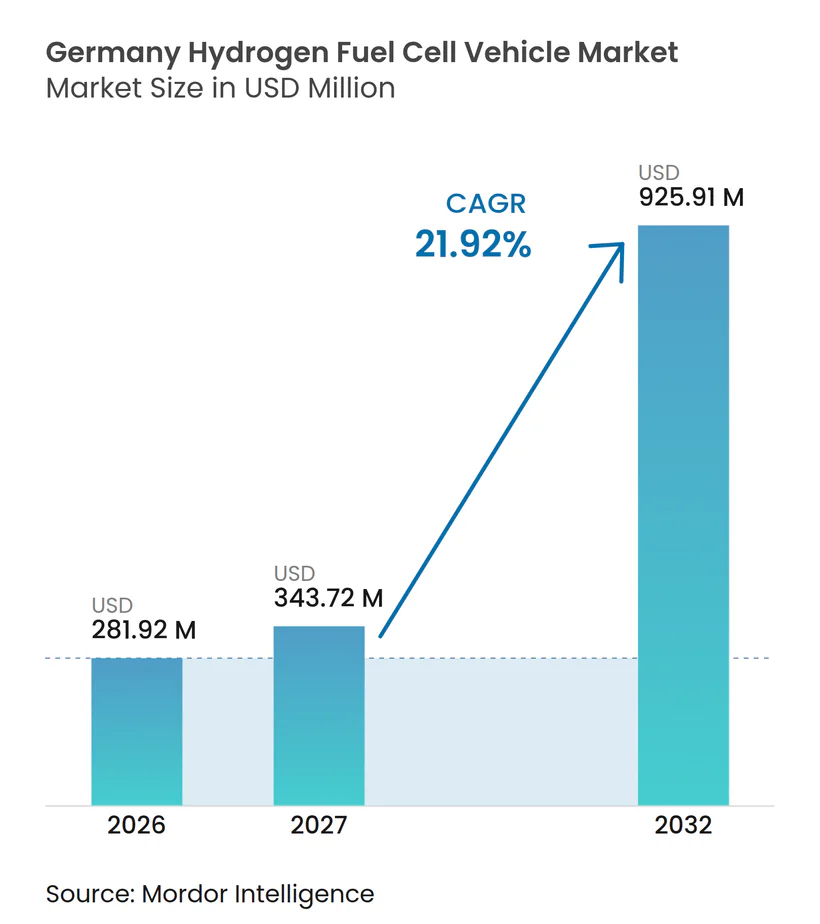
| Base Year Market Size (2026) | USD 281.92 Million |
| Market Size (2027) | USD 343.72 Million |
| Market Size (2032) | USD 925.91 Million |
| Growth Rate (2027 - 2032) | 21.92 % |
| Market Concentration | Medium |
Major Players *Disclaimer: Major Players sorted in no particular order Image © Mordor Intelligence. Reuse requires attribution under CC BY 4.0. | |
Germany Hydrogen Fuel Cell Vehicle Market Analysis by Mordor Intelligence
The Germany hydrogen fuel cell vehicle market size was valued at USD 281.92 million in 2026 and is expected to grow from USD 343.72 million in 2027 to USD 925.91 million by 2032, at a CAGR of 21.92% during 2027-2032. Growth centers on commercial transport, where freight operators are evaluating hydrogen powertrains for long-distance routes that place limits on battery range and charging time. Germany combines a large commercial-vehicle manufacturing base with dense freight corridors and early commitments from domestic vehicle makers. EU CO2 standards, federal support, and domestic fuel-cell development strengthen the conditions for deployment. The Germany hydrogen fuel cell vehicle market also depends on refueling coverage, since vehicle availability alone cannot support wider fleet operations. Partnerships among vehicle makers, fuel suppliers, and component providers are becoming more important as companies seek coordinated routes to commercial deployment.
Key Report Takeaways
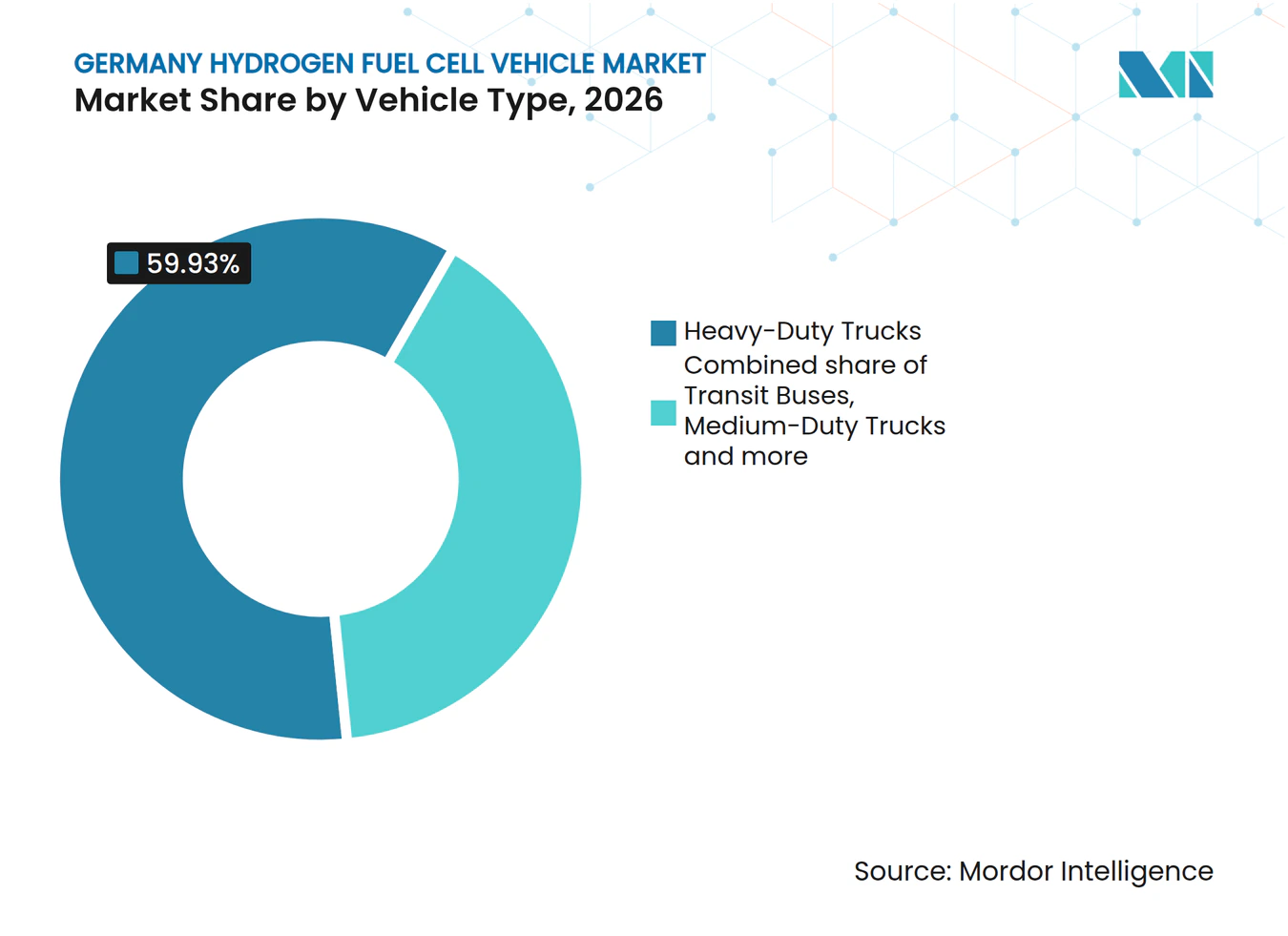
- By vehicle type, heavy-duty trucks held a 59.93% share of the Germany hydrogen fuel cell vehicle market in 2026, while medium-duty trucks are projected to grow at a 24.67% CAGR through 2032.
- By technology, proton-exchange-membrane fuel cells held a 97.15% share of the Germany hydrogen fuel cell vehicle market in 2026, while solid-oxide fuel cell range extenders are projected to grow at a 24.53% CAGR through 2032.
- By driving range, the medium-range category held a 54.12% share of the Germany hydrogen fuel cell vehicle market in 2026, while the long-range category is projected to grow at a 25.34% CAGR through 2032.
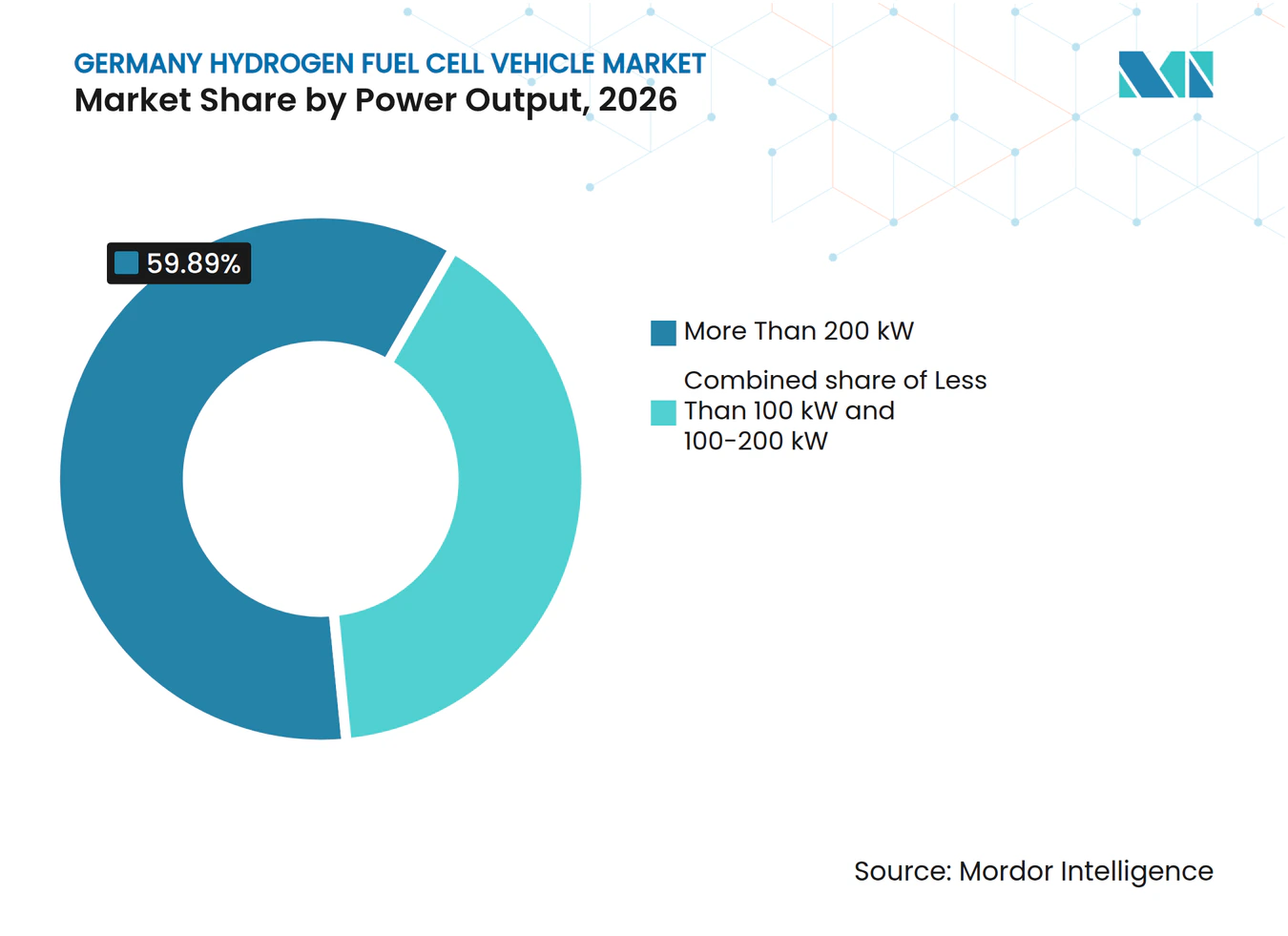
- By power output, systems above 200 kW held a 59.89% share of the Germany hydrogen fuel cell vehicle market in 2026 and are projected to grow at a 25.85% CAGR through 2032.
- By application, commercial freight and logistics held a 62.48% share of the Germany hydrogen fuel cell vehicle market in 2026 and is projected to grow at a 24.10% CAGR through 2032.
- By end-user ownership, fleet operators held a 72.34% share of the Germany hydrogen fuel cell vehicle market in 2026 and are projected to grow at a 23.50% CAGR through 2032.
- By geography, Western Germany held a 35.22% share of the Germany hydrogen fuel cell vehicle market in 2026, while Eastern Germany is projected to grow at a 25.12% CAGR through 2032.
Note: Market numbers in this report are based on Mordor Intelligence's proprietary estimation framework, which combines nine months of actuals with Q4 projections for base year 2026.
Market Trends and Insights
Drivers Impact Analysis of Germany Hydrogen Fuel Cell Vehicle Market*
| Driver | (~) % Impact on CAGR Forecast | Geographic Relevance | Impact Timeline |
|---|---|---|---|
| EU and German Zero-Emission Heavy-Duty Fleet Requirements | +4.2% | National; early compliance pressure in North Rhine-Westphalia and Baden-Württemberg | Short term (≤ 2 years) |
| Long-Range, High-Utilization Freight Routes with Limited Charging Downtime | +3.8% | National; highest relevance on A1, A2, A7, A61 motorway corridors | Medium term (2–4 years) |
| Public Funding for Hydrogen Refueling and N2/N3 Vehicle Market Activation | +3.5% | National; initial stations on TEN-T core network corridors | Short term (≤ 2 years) |
| German OEM and Tier-Supplier Capability in Fuel-Cell Powertrains | +3.2% | National; centered in Baden-Württemberg (Kirchheim/Teck, Esslingen, Stuttgart) | Medium term (2–4 years) |
| Depot-Based Hydrogen Demand Clustering Around Freight and Transit Hubs | +2.8% | Western Germany (Ruhr, Rhine-Main); Southern Germany (Munich metropolitan area) | Medium term (2–4 years) |
| Liquid-Hydrogen and High-Pressure Refueling Standardization for Long-Haul Fleets | +2.5% | Global standardization with first-mover sites in Germany (Wörth, Duisburg) | Long term (≥ 4 years) |
| Source: Mordor Intelligence | |||
EU and German Zero-Emission Heavy-Duty Fleet Requirements
Regulation (EU) 2024/1610 requires heavy-duty vehicle manufacturers to achieve a 45% CO2 reduction by 2030 and a 90% reduction by 2040, relative to 2019 baselines. The 15% interim target applied to the 2025 through 2029 reporting period, which brought fleet renewal plans into closer focus. German logistics operators are therefore considering hydrogen and battery-electric vehicles at the same time. The framework gives manufacturers a reason to deploy zero-emission trucks before the 2030 target becomes binding because earlier deployment can improve compliance planning. Germany’s political support for the framework also gives fleet buyers greater certainty when assessing longer vehicle replacement cycles. Reporting obligations make fleet emissions more visible to procurement committees that must compare vehicle choices. These requirements support the Germany hydrogen fuel cell vehicle market, where truck operators need options for demanding routes.
Long-Range, High-Utilization Freight Routes with Limited Charging Downtime
Germany’s major freight routes link manufacturing areas with North Sea ports, the Ruhr region, and Central European distribution centers. These routes require high vehicle use and dependable operating schedules. Hydrogen truck refueling can be completed in less time than a full battery recharge at high-power charging equipment. This matters most when a vehicle travels many annual kilometers and incurs productive time lost during scheduled charging stops. Daimler Truck’s second-phase GenH2 trials run on regular German logistics routes, including national long-distance transport and operations in the Duisburg and Wörth regions. The trials include logistics users in retail, pharmaceuticals, and transport, where unplanned downtime can disrupt service commitments. Depot-based demand clusters in the Ruhr, Rhine-Main, and Munich areas can further support the regular supply of fuel. This operating profile gives the Germany hydrogen fuel cell vehicle market a clearer use case among fleets with long annual mileage.
Public Funding for Hydrogen Refueling and N2/N3 Vehicle Market Activation
Germany’s Federal Ministry of Transport launched a EUR 220 million (~USD 258 million) funding program in January 2026 for hydrogen refueling stations and N2 and N3 commercial vehicles. The program supports station investment and vehicle purchases as linked packages [1]. Each funded, publicly accessible station must reach at least 10% utilization of its daily capacity through linked vehicles, which connects infrastructure spending to actual vehicle demand. Vehicle support can cover up to 80% of the additional cost compared with diesel. The program focuses on N2 and N3 vehicles, aligning public funding with the commercial classes most likely to use shared refueling assets. It can also create local partnerships between logistics companies and hydrogen suppliers. These conditions may help the Germany hydrogen fuel cell vehicle market move beyond isolated vehicle trials toward depot-based operating models.
German OEM and Tier-Supplier Capability in Fuel-Cell Powertrains
Germany has fuel-cell suppliers and vehicle manufacturers developing systems for heavy commercial applications. Cellcentric has unveiled the BZA fuel-cell system, which provides high net output. The company reports that the system reduces fuel consumption and component requirements while extending service life. Prototype production is underway in Esslingen, and the company plans to begin series production. EKPO and Akkodis have also begun on-road testing of the NM fuel-cell stack. Germany’s industrial capabilities support closer coordination among stack design, vehicle architecture, and service requirements. Standards for high-pressure and liquid hydrogen will also determine whether these systems can serve long-haul fleets at scale. These developments provide the Germany hydrogen fuel cell vehicle market with a domestic foundation for powertrain engineering and testing.
Restraints Impact Analysis of Germany Hydrogen Fuel Cell Vehicle Market*
| Restraint | (~) % Impact on CAGR Forecast | Geographic Relevance | Impact Timeline |
|---|---|---|---|
| High Delivered Cost of Hydrogen and Fuel-Cell Vehicles Versus Battery Alternatives | -2.8% | National; sharpest for cost-sensitive SME logistics fleets outside major subsidy corridors | Medium term (2–4 years) |
| Insufficient and Unevenly Distributed Hydrogen Refueling Coverage | -2.4% | National; most acute in Eastern Germany and rural Southern Germany | Medium term (2–4 years) |
| Limited Model Availability and Residual-Value Uncertainty | -1.6% | National; higher risk for smaller fleet operators unwilling to carry first-mover residual risk | Medium term (2–4 years) |
| Hydrogen Certification, Origin, and Cross-Border Accounting Complexity | -1.2% | National; primarily affects cross-border operators trading under EU taxonomy criteria | Long term (≥ 4 years) |
| Source: Mordor Intelligence | |||
High Delivered Cost of Hydrogen and Fuel-Cell Vehicles Versus Battery Alternatives
Fuel-cell trucks continue to carry a significant price premium over diesel vehicles. While public support can narrow this gap, the remaining upfront capital requirement may still restrict adoption among smaller freight companies. Green hydrogen costs can also keep operating expenses above those of diesel and battery-electric alternatives under certain operating conditions. Limited vehicle availability and uncertain future resale values create additional risks for operators that cannot absorb early-mover losses.
Large fleets with dedicated depot-refueling infrastructure and predictable vehicle utilization currently represent the strongest case for adoption. The dominance of fleet operators in end-user value highlights the role of large buyers in driving early demand. Without leasing options or service-based financing models, the Germany hydrogen fuel cell vehicle market may remain concentrated among companies that can manage vehicle and fuel costs at scale.
Insufficient and Unevenly Distributed Hydrogen Refueling Coverage
Germany’s public hydrogen station network declined as legacy car-focused sites closed and investment shifted toward commercial vehicle capacity. H2 Mobility reported a strategy focused on stations for commercial transport, rather than a broad passenger-car network. Limited truck-capable stations restrict fleets to specific routes and reduce operating flexibility. Liquid hydrogen availability is also limited, which constrains the wider use of platforms designed for this fuel format. Cross-border operators also need to manage hydrogen certification, origin, and accounting requirements alongside vehicle operations. The federal program aims to improve coverage along the TEN-T network, but station development and vehicle delivery must remain aligned. The Germany hydrogen fuel cell vehicle market, therefore, faces a practical adoption barrier where refueling locations are not available at the time fleets need them.
*Our forecasts treat driver/restraint impacts as directional, not additive. The impact forecasts reflect baseline growth, mix effects, and variable interactions.
Germany Hydrogen Fuel Cell Vehicle Market Segment Analysis
By Vehicle Type:
Heavy Freight Leads While Medium-Duty Demand ExpandsHeavy-duty trucks held a 59.93% share of the Germany hydrogen fuel cell vehicle market in 2026 and are projected to grow at a 23.80% CAGR through 2032. Their position reflects the focus of incentives and operating economics on N3 commercial vehicles. Daimler Truck is preparing a small series of 100 NextGenH2 tractor units at its Wörth plant. DACHSER is scheduled to receive the first unit in December 2026 for long-distance operations from Karlsruhe. Hyundai’s XCIENT Fuel Cell fleet reached 20 million cumulative kilometers in Europe by January 2026 [2]. The fleet operated 165 trucks across Germany, Switzerland, France, the Netherlands, and Austria.
Medium-duty trucks are projected to grow at the fastest vehicle-type CAGR of 24.67% through 2032. Their growth points to regional distribution and urban freight applications as refueling networks improve. Transit buses remain the second-largest commercial category after heavy-duty trucks. Fuel-cell buses are expanding in several German cities, including Cologne, Rostock, Wuppertal, and Duisburg. Light commercial vehicles, passenger cars, coaches, and special-purpose vehicles remain smaller categories. A lack of models and insufficient 700-bar refueling capacity limit their adoption. Municipal vehicles such as refuse trucks and airport equipment are still mostly at the pilot stage. The Germany hydrogen fuel cell vehicle market can expand beyond long-haul freight if these specialized use cases gain access to reliable local refueling.



By Technology:
PEM Fuel Cells Retain the Main PositionProton-exchange-membrane fuel cells held a 97.15% share of the Germany hydrogen fuel cell vehicle market in 2026 and are projected to grow at a 21.85% CAGR through 2032. PEM systems meet truck requirements by supporting cold starts, variable loads, and compact system design. The cellcentric BZA375 is a PEM system that provides up to 375 kW of net output. Its design brings output into a single unit and reduces the number of parts compared with the earlier BZA150 architecture. PEM modules also support hydrogen bus deployments. This gives the technology relevance in both heavy vehicles and urban public transport.
Solid-oxide fuel cell range extenders remain a small but differentiated category and are projected to grow at a 24.53% CAGR through 2032. They can offer high electrical efficiency under steady loads and can tolerate lower-purity hydrogen streams. These features may matter if hydrogen quality differs during the buildout of supply infrastructure. Alkaline and phosphoric acid fuel cells remain focused on stationary and specialist uses. Other fuel-cell formats are still at early commercial stages for on-road vehicles. Technology diversification is likely to be a longer-term question rather than a near-term shift in demand. The Germany hydrogen fuel cell vehicle market remains anchored in PEM systems because most deployed commercial use cases require their performance characteristics.
By Driving Range:
Long-Range Vehicles Gain RelevanceThe long-range category above 500 miles is projected to grow at a 25.34% CAGR through 2032 in the Germany hydrogen fuel cell vehicle market. Liquid-hydrogen truck platforms support this category by offering greater energy storage per unit tank mass. The Mercedes-Benz NextGenH2 Truck has an 85-kg liquid hydrogen tank capacity. Daimler Truck expects a range above 1,000 km per fill for the platform. This range supports longer domestic routes and cross-border operations to the Netherlands, Austria, and Poland. ISO 13984:2026 provides fueling protocols for liquid-hydrogen land vehicles. The standard gives vehicle makers, station operators, and fleet managers a shared technical reference.
The medium-range category, from 251 to 500 miles, held a 54.12% share in 2026. Current 350-bar gaseous hydrogen refueling stations meet the needs of many trucks in this category. Short-range vehicles serve urban buses, last-mile vehicles, and municipal applications. These vehicles can rely on depot refueling, where access to public stations is less important. Additional truck stations along freight corridors could change the range mix over time. Daimler Truck and Linde have submitted their subcooled liquid-hydrogen interface work for ISO standardization. The Germany hydrogen fuel cell vehicle market may therefore shift toward longer-range vehicles as liquid hydrogen infrastructure becomes more widely available.
By Power Output:
Systems Above 200 kW Lead DemandSystems above 200 kW held a 59.89% share in 2026 and are projected to grow at a 25.85% CAGR through 2032. This category includes the 375 kW cellcentric BZA375, Daimler’s 300 kW GenH2 configuration, and 240 kW Solaris bus systems. These power levels meet the needs of heavy vehicles that operate at high weight or sustained speed. They also support routes with gradients and intensive operating cycles. The concentration in high-power systems shows the commercial focus of the Germany hydrogen fuel cell vehicle market. It also explains why heavy-duty trucks account for most of the early market value.
The 100-200 kW category includes medium-duty trucks, 12-meter transit buses, and some coach applications. These vehicles serve regional routes where power requirements are lower than those of long-haul freight. The below-100 kW group mainly includes passenger cars, light commercial vehicles, and light special-purpose equipment. It is the smallest and slowest-growing group because model availability is limited. EKPO’s NM20 testing program targets trucks, buses, rail, and marine applications. This development shows that domestic suppliers are focusing on the commercial power bands where demand is currently strongest. The Germany hydrogen fuel cell vehicle market is therefore developing around mid- and high-power operating requirements.

By Application:
Commercial Freight and Logistics Set the PaceCommercial freight and logistics held a 62.48% share of the Germany hydrogen fuel cell vehicle market in 2026 and is projected to grow at a 24.10% CAGR through 2032. Daimler Truck’s customer trials involve Hornbach, Reber Logistik, Teva Germany, Rhenus, and DHL Supply Chain. The programs cover retail, pharmaceutical, logistics, and e-commerce use cases. In June 2025, Toyota Motor Europe added four VDL fuel-cell trucks to its logistics fleet, bringing it to five, on routes linking Diest, Lille, Cologne, Rotterdam, and Weesp. These routes also connect Belgium, France, and the Netherlands. Such operations place fuel-cell trucks within regular transport contracts rather than short demonstrations.
Public transportation is the next major application, supported by hydrogen bus deployments in several cities. Material handling is also growing in warehouses and ports where centralized refueling can improve operating economics. Rail, maritime, and airport ground support are smaller applications with potential for expansion. Military, defense, agriculture, and off-road uses remain low-volume categories. MAN handed three fuel-cell trucks to LoadFox in July 2026 for logistics operations between Munich, Dachau, and Nuremberg. The deployment indicates growing interest in routes outside the largest freight corridors. The Germany hydrogen fuel cell vehicle market is likely to develop through applications that combine high use with controlled refueling access.
By End-User Ownership:
Fleet Operators Hold the Strongest PositionFleet operators held a 72.34% share of the Germany hydrogen fuel cell vehicle market in 2026 and are projected to grow at a 23.50% CAGR through 2032. This combination makes fleet operators the main commercial customer group for manufacturers. Their purchases can involve several vehicles, longer fuel agreements, and planned depot operations. A private or semi-private hydrogen station at a logistics hub can reduce reliance on public infrastructure. Large operators can also negotiate supply terms that smaller companies may not be able to obtain. These structural conditions support the Germany hydrogen fuel cell vehicle market, in which early deployment depends on coordinated decisions regarding vehicles and fuel.
Public transit authorities are the second-largest end-user group. Transit agencies in Cologne, Rostock, and Wuppertal operate hydrogen buses as part of wider zero-emission fleets. Government and defense buyers are reviewing hydrogen for specialized logistics and patrol needs. Mining and industrial operators are early users where indoor air-quality requirements support fuel-cell equipment. Individual consumers remain a marginal customer group. The shift away from 700-bar public refueling stations makes passenger-car ownership more difficult. The Germany hydrogen fuel cell vehicle market will remain centered on professional users until a broader consumer refueling network returns.
Geography Analysis
Western Germany held a 35.22% share of the Germany hydrogen fuel cell vehicle market in 2026 and combines high road freight density with a relatively developed commercial hydrogen network. H2 Mobility operates a hydrogen refueling station in Düsseldorf with substantial daily hydrogen capacity. The station serves trucks, buses, and passenger cars through high-pressure refueling. Transit bus fleets in Kerpen and Duisburg add local depot demand, while federal HyPerformer support targets regional hydrogen production and truck refueling infrastructure.
Eastern Germany is projected to grow at a 25.12% CAGR through 2032 as the region builds a hydrogen supply base through pipeline and production projects. ONTRAS commissioned a pipeline section at the Bad Lauchstädt Energy Park, connecting a wind-powered electrolyzer to the TotalEnergies Central Germany refinery. The HYBOR project will connect Bobbau in Saxony-Anhalt with Saxony and Thuringia through a dedicated pipeline network. TH Two ECO MOBILITY received funding to support heavy-duty hydrogen mobility in Thuringia. These projects may alleviate supply constraints that have limited the Germany hydrogen fuel cell vehicle market in eastern Germany.
Southern and northern Germany account for the remaining demand. Southern Germany has a high concentration of vehicle manufacturers and component suppliers, including cellcentric facilities in Kirchheim/Teck, Esslingen, and Stuttgart, as well as a larger planned plant in Weilheim an der Teck. MAN’s Bayernflotte project is conducting real-world truck operations in the Munich, Dachau, and Nuremberg areas. Northern Germany has a less developed FCEV infrastructure base despite broader activity in battery-electric buses. However, planned projects near Stralsund-Rügen and the expansion of the hydrogen network toward Lubmin may strengthen the region’s position in the future. Regional development in the Germany hydrogen fuel cell vehicle market will continue to depend on freight demand, local hydrogen supply, and refueling infrastructure.
Competitive Landscape
Market Concentration
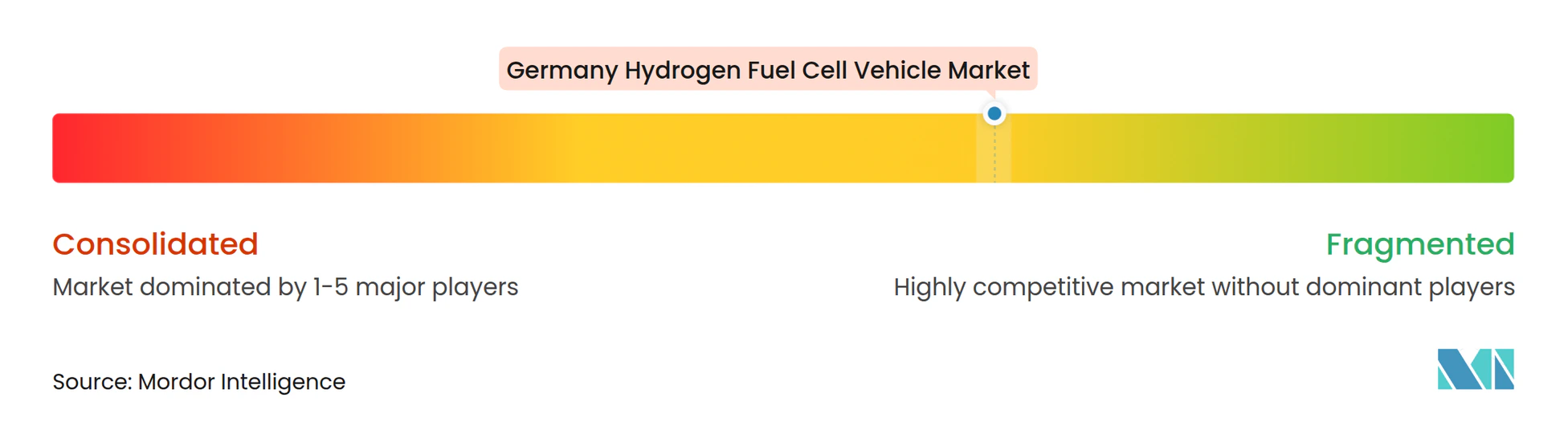
The Germany hydrogen fuel cell vehicle market is moderately concentrated at the vehicle-maker level. No single manufacturer has established a broad series-production capacity for hydrogen trucks in Germany, while Daimler Truck and Hyundai have the most advanced operating records among truck makers. Daimler Truck’s five GenH2 trucks covered more than 225,000 km in the first customer-trial phase, and a second phase with five additional partners began in November 2025. Hyundai’s XCIENT fleet had accumulated 20 million km in Europe in January 2026. These programs provide both companies with practical information on vehicle reliability, fuel consumption, and fleet operations.
In July 2026, Toyota signed a binding agreement to join Daimler Truck and Volvo Group as an equal shareholder in cellcentric, subject to regulatory approvals, which would combine Toyota’s fuel-cell technology with cellcentric’s European manufacturing base. cellcentric’s BZA375 program provides a shared route to a next-generation heavy-duty fuel-cell system. Daimler Truck is also preparing its first NextGenH2 delivery to DACHSER in December 2026 [3]. Hyundai is advancing its position through continued XCIENT fleet operation across European logistics routes. These moves indicate that companies are pursuing commercial experience alongside technology development.
Competition also depends on fuel supply, refueling control, and digital fleet management. Air Liquide, Linde, Shell Deutschland, and TotalEnergies are relevant because vehicle deployment requires fuel availability and station capacity. QUANTRON relaunched in April 2025 with a focus on zero-emission commercial vehicles, including fuel-cell trucks. EKPO’s on-road NM20 testing adds another domestic supply option for commercial fuel-cell systems. Solaris continues to support the bus portion of the value chain through hydrogen vehicle orders.
Germany Hydrogen Fuel Cell Vehicle Industry Leaders
-
Hyundai Motor Company
-
Daimler Truck Holding AG
-
Toyota Motor Corporation
-
BMW AG
-
MAN Truck & Bus SE
- *Disclaimer: Major Players sorted in no particular order
Germany Hydrogen Fuel Cell Vehicle Market Companies Covered in this Report
- Toyota Motor Corporation
- Hyundai Motor Company
- Daimler Truck Holding AG
- BMW Group
- MAN Truck & Bus SE
- Volvo Group
- Scania AB
- Iveco Group N.V.
- Daimler Buses GmbH
- Solaris Bus and Coach sp. z o.o.
- Ballard Power Systems Inc.
- PowerCell Sweden AB
- Plug Power Inc.
- Cummins Inc.
- SFC Energy AG
- ElringKlinger AG
- cellcentric GmbH & Co. KG
- H2 Mobility Deutschland GmbH
- QUANTRON AG
- Alstom SA
- Wrightbus Limited
- Air Liquide S.A.
- Linde plc
- Shell Deutschland GmbH
- TotalEnergies SE
Recent Industry Developments in Germany Hydrogen Fuel Cell Vehicle Market
- September 2026: Toyota agreed to supply fuel cell systems for 40 heavy-duty trucks in Scania’s Pilot Partner program to test hydrogen fuel cell trucks in real-world logistics operations.
- August 2026: EKPO Fuel Cell Technologies and Akkodis began on-road testing of EKPO’s NM20 fuel cell stack in a 40-ton hydrogen truck.
- July 2026: MAN Truck and Bus put three fuel-cell trucks with Bosch fuel cell systems into everyday logistics service with LoadFox under the Bavarian-funded Bayernflotte project.
- July 2026: Toyota signed a binding agreement to join Daimler Truck and Volvo Group as an equal shareholder in the fuel-cell joint venture cellcentric, subject to regulatory approvals.
Germany Hydrogen Fuel Cell Vehicle Market Report Scope
The Germany Hydrogen Fuel Cell Vehicle Market Report is Segmented by Vehicle Type (Passenger Cars, Light Commercial Vehicles, Medium-Duty Trucks, Heavy-Duty Trucks, Transit Buses, Coaches and Intercity Buses, and Special-Purpose and Municipal Vehicles), Technology (Proton-Exchange-Membrane Fuel Cell, Solid-Oxide Fuel Cell Range Extender, Alkaline Fuel Cell, Phosphoric Acid Fuel Cell, and Other Fuel-Cell Technologies), Driving Range (Short Range [0-250 Miles], Medium Range [251-500 Miles], and Long Range [Above 500 Miles]), Power Output (Less Than 100 kW, 100-200 kW, and More Than 200 kW), Application (Private Transportation, Public Transportation, Commercial Freight and Logistics, Material Handling, Rail, Maritime, and Airport Ground Support, Military and Defense, and Agriculture and Off-Road Operations), End-User Ownership (Individual Consumers, Fleet Operators, Public Transit Authorities, Government and Defense Organizations, and Mining and Industrial Operators), and Geography (Northern Germany, Eastern Germany, Western Germany, and Southern Germany). The Market Forecasts are Provided in Terms of Value (USD) and Volume (Units).
Segmentation Overview
| Passenger Cars |
| Light Commercial Vehicles |
| Medium-Duty Trucks |
| Heavy-Duty Trucks |
| Transit Buses |
| Coaches and Intercity Buses |
| Special-Purpose and Municipal Vehicles |
| Proton-Exchange-Membrane Fuel Cell |
| Solid-Oxide Fuel Cell Range Extender |
| Alkaline Fuel Cell |
| Phosphoric Acid Fuel Cell |
| Other Fuel-Cell Technologies |
| Short Range, 0-250 Miles |
| Medium Range, 251-500 Miles |
| Long Range, Above 500 Miles |
| Less Than 100 kW |
| 100-200 kW |
| More Than 200 kW |
| Private Transportation |
| Public Transportation |
| Commercial Freight and Logistics |
| Material Handling |
| Rail, Maritime, and Airport Ground Support |
| Military and Defense |
| Agriculture and Off-Road Operations |
| Individual Consumers |
| Fleet Operators |
| Public Transit Authorities |
| Government and Defense Organizations |
| Mining and Industrial Operators |
| Northern Germany |
| Eastern Germany |
| Western Germany |
| Southern Germany |
| By Vehicle Type | Passenger Cars |
| Light Commercial Vehicles | |
| Medium-Duty Trucks | |
| Heavy-Duty Trucks | |
| Transit Buses | |
| Coaches and Intercity Buses | |
| Special-Purpose and Municipal Vehicles | |
| By Technology | Proton-Exchange-Membrane Fuel Cell |
| Solid-Oxide Fuel Cell Range Extender | |
| Alkaline Fuel Cell | |
| Phosphoric Acid Fuel Cell | |
| Other Fuel-Cell Technologies | |
| By Driving Range | Short Range, 0-250 Miles |
| Medium Range, 251-500 Miles | |
| Long Range, Above 500 Miles | |
| By Power Output | Less Than 100 kW |
| 100-200 kW | |
| More Than 200 kW | |
| By Application | Private Transportation |
| Public Transportation | |
| Commercial Freight and Logistics | |
| Material Handling | |
| Rail, Maritime, and Airport Ground Support | |
| Military and Defense | |
| Agriculture and Off-Road Operations | |
| By End-User Ownership | Individual Consumers |
| Fleet Operators | |
| Public Transit Authorities | |
| Government and Defense Organizations | |
| Mining and Industrial Operators | |
| By Geography | Northern Germany |
| Eastern Germany | |
| Western Germany | |
| Southern Germany |
Key Questions Answered in the Report
What is the projected growth rate for hydrogen fuel cell vehicles in Germany?
The Germany hydrogen fuel cell vehicle market is forecast to grow at a 21.92% CAGR from 2027 to 2032, reaching USD 925.91 million by 2032.
Which hydrogen vehicle type has the largest share in Germany?
Heavy-duty trucks held a 59.93% share in 2026, supported by freight demand, policy focus, and long-route operating requirements.
Why are fleet operators important for hydrogen vehicle adoption?
Fleet operators held a 72.34% share of end-user value in 2026 and are projected to grow at a 23.50% CAGR through 2032 because they can align vehicle purchases with depot refueling.
What is the main barrier to wider hydrogen truck deployment in Germany?
Uneven truck-capable refueling coverage and high hydrogen and vehicle costs continue to limit broader deployment.
Which fuel-cell technology leads commercial vehicle demand in Germany?
Proton-exchange-membrane fuel cells held a 97.15% share in 2026, reflecting their relevance for heavy-duty and transit applications.