
Germany Green Finance Market Size and Share
Market Overview
| Study Period | 2021 - 2032 |
|---|---|
| Forecast Data Period | 2027 - 2032 |
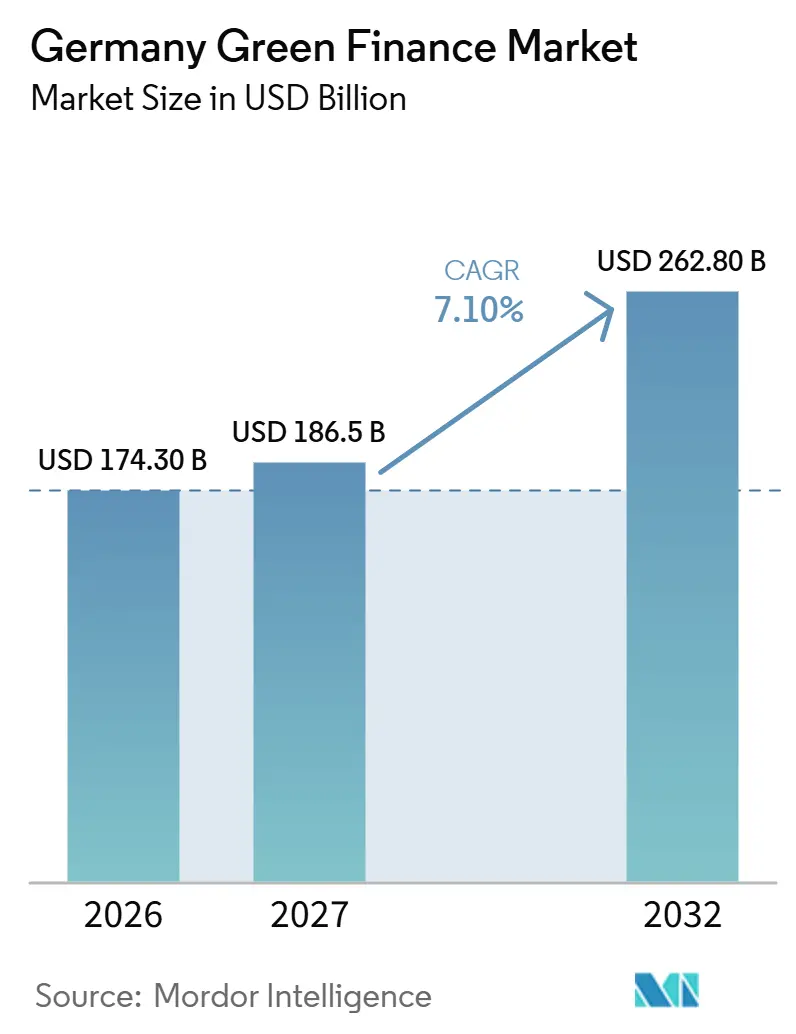
| Base Year Market Size (2026) | USD 174.30 Billion |
| Market Size (2027) | USD 186.5 Billion |
| Market Size (2032) | USD 262.80 Billion |
| Growth Rate (2027 - 2032) | 7.10 % |
| Market Concentration | Low |
Major Players *Disclaimer: Major Players sorted in no particular order Image © Mordor Intelligence. Reuse requires attribution under CC BY 4.0. | |
Germany Green Finance Market Analysis by Mordor Intelligence
The Germany Green Finance Market size was valued at USD 174.30 billion in 2026 and is estimated to grow from USD 186.5 billion in 2027 to reach USD 262.80 billion by 2032, at a CAGR of 7.10% during the forecast period (2027-2032).
The Germany green finance market is supported by legally binding climate targets, federal green securities, and KfW lending programs that provide a stable base for private capital. Sovereign issuance of EUR 14.5 billion (USD 17.06 billion) in 2025 brought outstanding Green German Federal Securities to EUR 79.25 billion (USD 93.22 billion), which supports a visible benchmark for euro-denominated issuance. The Germany green finance market also benefits from KfW’s role in setting product standards and supporting lending to energy, buildings, and industrial projects. Tighter scrutiny of sustainability claims is raising documentation requirements, particularly for smaller issuers, but it is also strengthening confidence in credible transactions. Investment opportunities are increasingly linked to renewable repowering, carbon management, and financing structures that share risk between public and private institutions.
Key Report Takeaways
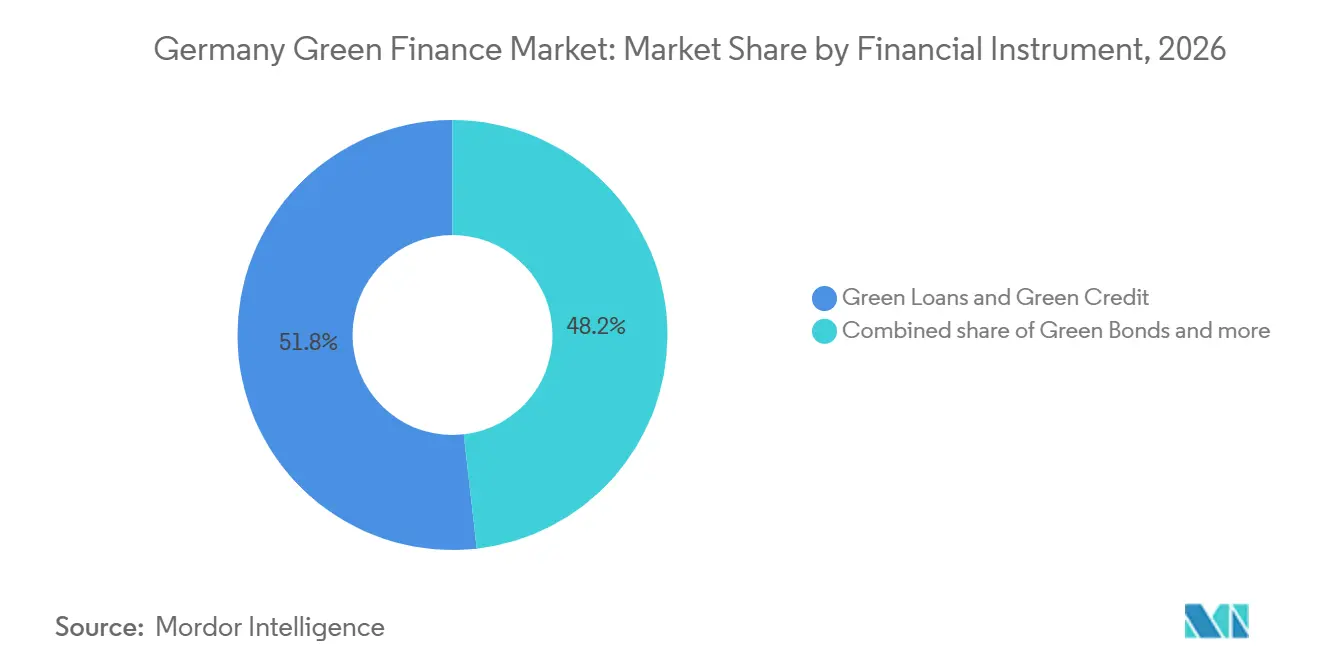
- By financial instrument, green loans and green credit held 51.8% of the Germany green finance market share in 2026, while other green debt and financing instruments recorded the highest projected CAGR at 9.2% through 2032.
- By environmental theme, renewable energy and low-carbon power accounted for 28.6% of the Germany green finance market size in 2026, while carbon capture, utilisation, removal and storage is advancing at a 14.8% CAGR through 2032.
- By issuer and borrower, large non-financial corporates held 27.3% of market activity in 2026, while SMEs recorded the highest projected CAGR at 9.5% through 2032.
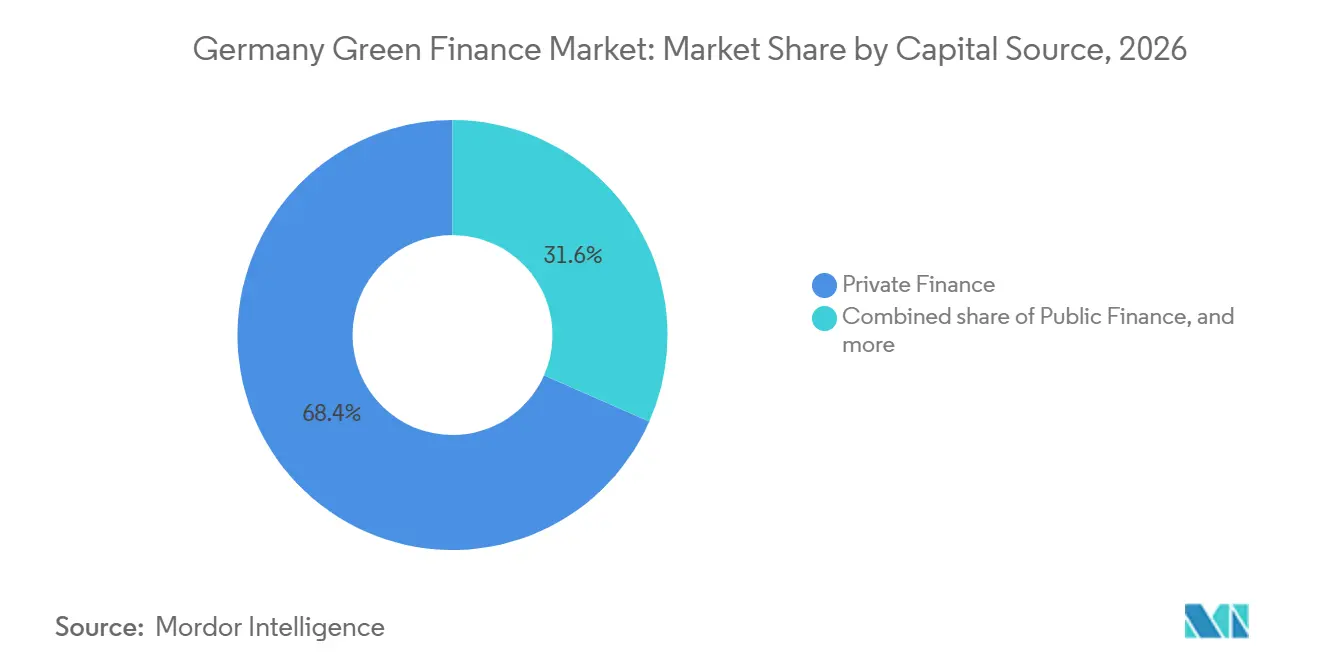
- By capital source, private finance held 68.4% of market activity in 2026, while public-private and blended finance recorded the highest projected CAGR at 10.2% through 2032.
- By financing purpose, new financing accounted for 76.2% of market activity in 2026, while refinancing is forecast to expand at a 7.8% CAGR through 2032.
Note: Market numbers in this report are based on Mordor Intelligence's proprietary estimation framework, which combines nine months of actuals with Q4 projections for base year 2026.
Market Trends and Insights
Drivers Impact Analysis of Germany Green Finance Market*
| Driver | (~) % Impact on CAGR Forecast | Geographic Relevance | Impact Timeline |
|---|---|---|---|
| Climate Neutrality and Decarbonization Investment Requirements | +2.5% | National, concentrated in North Rhine-Westphalia industrial corridors and Bavaria manufacturing clusters | Long term (≥ 4 years) |
| Green Bond Issuance and Sustainable Lending Expansion | +1.8% | National, with Frankfurt as the primary capital markets hub | Short term (≤ 2 years) |
| EU Taxonomy and Disclosure Requirements | +1.2% | National, with spillover to EU-27 cross-border flows | Medium term (2-4 years) |
| Renewable Energy and Industrial Decarbonization Financing Needs | +1.5% | National, concentrated in North Sea offshore wind and Rhineland solar corridors | Medium term (2-4 years) |
| Energy-Efficient Building Renovation and Clean Heating Investment | +0.8% | National, concentrated in eastern German housing stock and major metropolitan areas | Long term (≥ 4 years) |
| Green Federal Securities and Euro-Area Yield-Curve Benchmarking | +0.6% | National, with global spillover to euro-denominated sustainable debt markets | Short term (≤ 2 years) |
| Source: Mordor Intelligence | |||
Germany’s Climate Neutrality and Decarbonization Investment Requirements
Germany’s climate-neutrality obligations create a continuing need for financing across industry, power, and heat. The Federal Ministry for Economic Affairs and Energy opened preparatory bidding for the 2027 Carbon Contracts for Difference round in October 2026. It assigned sector budgets for hydrogen, CCU/S, and high-temperature process heat, including a minimum of EUR 1.5 billion (USD 1.76 billion) for hydrogen[1]. The 2025 BIK funding competition supported 38 projects with potential savings of 40 million tonnes of carbon dioxide equivalent. A further CCU and CCS call widened eligibility to cement, waste, and chemical activities in February 2026. This framework favors lenders that can assess industrial processes and the long-term revenue arrangements behind projects.
Expansion of Green Bond Issuance and Sustainable Lending
KfW issued a EUR 5 billion (USD 5.88 billion), 7-year green bond in February 2026 and received more than EUR 26 billion (USD 30.58 billion) in orders from 206 investors[2]. The transaction pushed cumulative KfW green bond issuance above EUR 100 billion (USD 117.63 billion) and reinforced benchmark liquidity in the Germany green finance market. Deutsche Bank issued Germany’s first European Green Bond in February 2026, raising EUR 500 million (USD 588.16 million) for EU Taxonomy-aligned residential mortgage refinancing. Its 2025 sustainable and transition finance volume reached EUR 98 billion (USD 115.28 billion), its highest level since 2021. Larger benchmark transactions are increasing expectations for documentation, allocation reporting, and liquidity. This leaves a separate mid-market opportunity for issuers that can demonstrate strong taxonomy alignment.
EU Sustainable Finance Taxonomy and Disclosure Requirements
EU disclosure rules are changing the information that lenders and investors use to classify sustainable activity. Commission Delegated Regulation (EU) 2026/73 reduces required reporting data points for financial undertakings and introduces a 10% materiality threshold. The revised approach applies to in-scope institutions from financial year 2026. It directs attention toward outcomes and the quality of underlying data rather than broad sustainability labels. BaFin’s 2026 risk outlook identifies greenwashing as a supervisory priority and stresses the need for transparent product information[3]. Banks with internal sustainability data capabilities are better placed to meet these requirements and support clients that need credible financing structures.
Renewable Energy and Industrial Decarbonization Financing Needs
Repowering projects are a central lending opportunity because they use existing sites and typically face lower permitting risk than new developments. KfW IPEX-Bank arranged EUR 1.6 billion (USD 1.88 billion) in consortium financing for CEE Group to repower 29 German wind and solar sites in December 2025. The projects are expected to expand capacity from 457 MW to 1.1 GW[4]. DZ Bank more than doubled new renewable energy credit to EUR 1.7 billion (USD 1.99 billion) in 2025, bringing its portfolio to EUR 9.7 billion (USD 11.41 billion). KfW’s Renewable Energies Plus program extends loans of up to EUR 150 million (USD 176.45 million) per project for renewable installations outside EEG subsidies. The Germany green finance market can therefore support more power purchase agreement-backed solar, wind, and storage projects.
Restraints Impact Analysis of Germany Green Finance Market*
| Restraint | (~) % Impact on CAGR Forecast | Geographic Relevance | Impact Timeline |
|---|---|---|---|
| Greenwashing Risk and Credibility Concerns | -0.7% | National, concentrated in Frankfurt asset management and capital markets | Short term (≤ 2 years) |
| Green Finance Verification and Reporting Costs | -0.4% | National, disproportionately affecting regional banks and smaller issuers | Medium term (2-4 years) |
| Limited Bankability of Early-Stage Green and Transition Projects | -0.5% | National, concentrated in hydrogen and CCUS pilot project segments | Long term (≥ 4 years) |
| SME and Mittelstand Sustainability Data and Taxonomy Readiness Gaps | -0.6% | National, concentrated in manufacturing and construction SMEs below 50 employees | Medium term (2-4 years) |
| Source: Mordor Intelligence | |||
Greenwashing Risk and Credibility Concerns
BaFin has increased its focus on product advertising and physical climate-risk modeling by insurers. This has lengthened review processes before green instruments are issued or existing loan books are relabeled. Smaller issuers can face higher legal, verification, and reporting costs because they lack dedicated sustainable finance teams. The effect on the Germany green finance market is a greater premium on clear eligibility criteria and auditable use-of-proceeds reporting. It also supports institutions that can explain their own assessment methods instead of relying only on third-party ratings.
SME and Mittelstand Sustainability Data and Taxonomy Readiness Gaps
Small businesses remain a major source of potential demand, but sustainability data is often incomplete. KfW Research found that sustainability featured in 12% of loan discussions for firms with fewer than 5 employees, compared with 37% for firms employing 50 or more people. This gap makes it difficult for lenders to match smaller projects to taxonomy requirements and credit processes. It also limits the ability of SMEs to show the evidence required for preferential green loan pricing. Financing programs that simplify documentation can help unlock this demand. The Germany green finance market will depend on practical templates and lending products that work for firms with limited reporting resources.
*Our forecasts treat driver/restraint impacts as directional, not additive. The impact forecasts reflect baseline growth, mix effects, and variable interactions.
Germany Green Finance Market Segment Analysis
By Financial Instrument:
Green Loans Anchor the Market, Structured Alternatives AccelerateGreen loans and green credit held 51.8% of Germany's green finance market share in 2026. The position reflects close corporate banking relationships and the use of KfW pass-through lending structures. Large syndicated transactions show a move toward tighter rules for eligible collateral and cash flows. This raises the standard for loan documentation across the segment. The European green bond issued by Deutsche Bank also indicates that stricter debt standards are becoming commercially usable.
Other green debt and financing instruments are forecast to grow at a 9.2% CAGR through 2032. Green guarantees, promissory notes, and sustainability-linked supply chain finance give companies options beyond standard bilateral loans. KfW and Deutsche Leasing introduced a EUR 200 million (USD 235.26 million) Sustainable ERP Global Loan Leasing facility in 2026. It supports sustainable leasing investments and can widen access to SME capital expenditure. Leasing can serve equipment and supplier investments that do not fit conventional project-finance processes.


By Environmental Theme:
Renewable Energy Leads, CCUS Creates a New Financing FrontierRenewable energy and low-carbon power commanded 28.6% of Germany's green finance market size in 2026. The category is supported by repowering, power purchase agreements, and the growing need for storage. DZ Bank’s EUR 9.7 billion (USD 11.41 billion) renewable portfolio illustrates the scale of lending committed to energy transition assets. KfW Program 570 broadens lending for installations that operate outside EEG subsidies. The Klimafreundlicher Neubau program created EUR 4.5 billion (USD 5.29 billion) in KfW-backed commitments in 2025 and triggered EUR 13 billion (USD 15.29 billion) in investment across 36,747 residential units.
Carbon capture, utilisation, removal and storage is projected to record a 14.8% CAGR through 2032. Germany’s decision to include CCU and CCS in Carbon Contracts for Difference supports longer-term revenue visibility for industrial projects. The 2025 BIK competition funded 14 CCUS projects with EUR 60 million (USD 70.58 million) in cement, lime, and waste activities. Grant support and long-term contracts can reduce early commercial uncertainty. This gives lenders a clearer route to assess projects in the Germany green finance market.
By Issuer / Borrower:
Corporates Drive Demand, SMEs Define the Growth OpportunityLarge non-financial corporates accounted for 27.3% of issuer and borrower activity in 2026. Energy-intensive exporters need long-dated loans and financing linked to Carbon Contracts for Difference. The federal government issued EUR 14.5 billion (USD 17.06 billion) in sovereign green bonds in 2025. Baden-Württemberg also raised EUR 800 million (USD 941.05 million) through its fifth green bond issuance, with more than 65% of its investor base from outside Germany. Commercial financial institutions continue to expand issuance and client financing as transition plans become more formal.
SMEs are projected to be the fastest-growing borrower category at a 9.5% CAGR through 2032. Their demand reflects investment in energy efficiency, electrification, and low-carbon production. NORD/LB found that 71% of Mittelstand companies are increasing innovation investment and 36% of budgets are directed to energy-transition projects. Berlin Kredit Transformation offers loans of up to EUR 10 million (USD 11.76 million) for SME investment and transformation projects. These programs help bring smaller firms into Germany's green finance market.
By Capital Source:
Private Finance Dominates, Blended Structures Are Fastest GrowingPrivate Finance accounted for 68.4% of activity in 2026, highlighting the depth of commercial banking and institutional participation. The Germany green finance market depends on public programs that reduce risk without replacing private funding. KfW shapes the pricing and availability of loans for buildings, heating, and renewable energy. The EIB and Commerzbank created a EUR 1.2 billion (USD 1.41 billion) Energy Investment facility that covers 50% of Commerzbank’s risk on eligible municipal energy loans below EUR 80 million (USD 94.10 million). This expands capacity in areas that may be too small for stand-alone project finance.
Public-Private and Blended Finance is forecast to grow at a 10.2% CAGR through 2032. Risk-sharing structures can support transactions without requiring full public funding of each project. The European Investment Fund and Deutsche Leasing announced a EUR 1.1 billion (USD 1.29 billion) InvestEU guarantee package. It is expected to support around 4,600 SME contracts with guarantee rates of up to 70%. Such mechanisms help lenders reach projects where data or maturity does not meet conventional lending standards.

By Financing Purpose:
New Financing Leads, Refinancing Matures as a Distinct MarketNew Financing accounted for 76.2% of activity in 2026. This reflects the investment required for new capacity and the repowering of existing renewable assets. Permitting and construction capacity can be more limiting than finance for mature projects. KfW IPEX-Bank’s CEE Group transaction shows the scale of capital needed for repowering. The high share of new financing creates a future pool of assets that can later be refinanced.
Refinancing is expected to grow at a 7.8% CAGR through 2032. Loans originated between 2019 and 2022 are beginning to mature, creating competition for assets with operating histories. Green labels may support refinancing if projects continue to meet eligibility and reporting requirements. KfW Program 570 allows global loans through regional development institutions, bringing structures to smaller renewable projects. More operating assets should improve lender data for risk assessment.
Geography Analysis
Western Germany: Frankfurt’s Capital Markets Infrastructure
Frankfurt and the Rhine-Main corridor provide the core capital-markets infrastructure for the Germany green finance market. Deutsche Bank’s European Green Bond and Transition Finance Framework took effect in 2026 and reflects product development in this center. Commerzbank’s Green Infrastructure Finance portfolio reached EUR 12 billion (USD 14.12 billion) in committed investments since 2020 and targets EUR 20 billion (USD 23.53 billion) by 2030. North Rhine-Westphalia adds demand from chemical, steel, glass, and ceramics producers, while Carbon Contracts for Difference influence financing for these facilities.
Southern Germany: Landesbanken Bridge Mittelstand Finance
Southern Germany connects public promotional lending with Mittelstand investment through LBBW and BayernLB. Baden-Württemberg’s EUR 800 million (USD 941.05 million) green bond drew more than 65% of its investor base from outside Germany in 2025, demonstrating demand for credible sub-sovereign frameworks. Regional lenders translate KfW funding into bilateral facilities for engineering firms, automotive suppliers, and renewable cooperatives. NORD/LB found that 50% of Mittelstand respondents were willing to use sustainability loans for future investment.
Northern and Eastern Germany: Renewable Energy and Emerging Municipal Finance
Northern Germany’s wind base makes repowering a defining source of Germany green finance market activity. The EUR 1.6 billion (USD 1.88 billion) CEE Group financing directed international syndicated capital toward 29 wind and solar sites. The NORD/LB and EIB partnership provides EUR 165 million (USD 194.09 million) for photovoltaic systems, onshore wind, and battery storage. Eastern states, including Saxony, Saxony-Anhalt, and Mecklenburg-Vorpommern, are expanding renewable project pipelines. Municipal climate resilience and grid modernization remain less developed areas, where regional facilities can help address the financing gap.
Competitive Landscape
Market Concentration
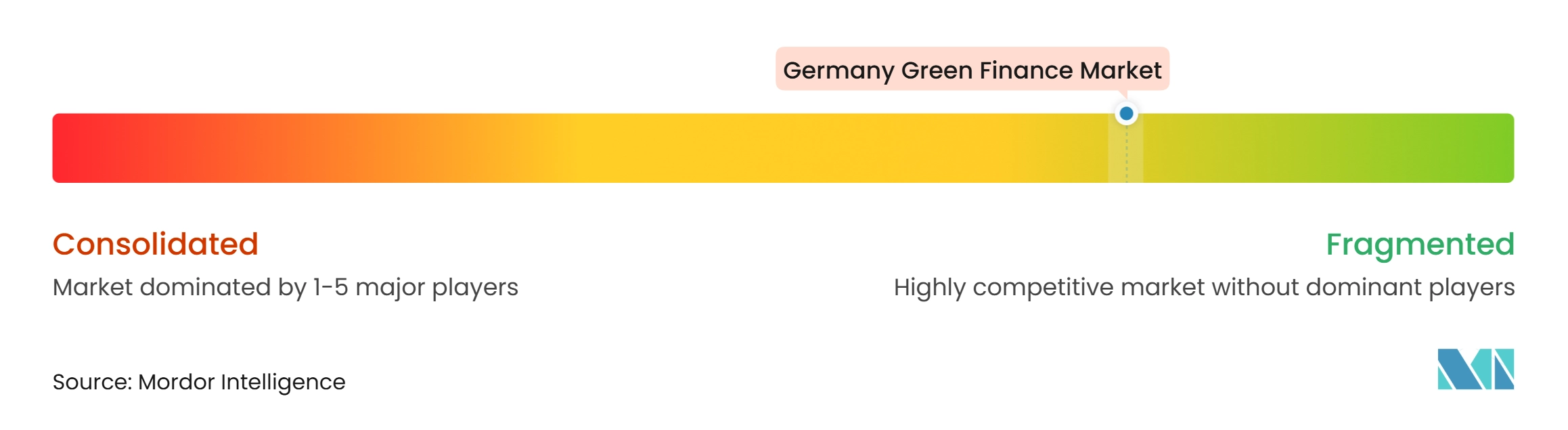
KfW, Deutsche Bank, Commerzbank, and DZ Bank form the institutional core of Germany's green finance market. KfW anchors public development finance and shapes the availability and price of credit. Deutsche Bank and Commerzbank compete for large corporate and project transactions through taxonomy-aligned debt and lending products. DZ Bank has expanded renewable lending and its portfolio, while LBBW, BayernLB, and NORD/LB support regional companies and infrastructure borrowers.
Competitive strategies are increasingly based on product design, sector underwriting, and evidence of environmental performance. In February 2026, Deutsche Bank issued a EUR 500 million (USD 588.16 million) European Green Bond for taxonomy-aligned mortgage refinancing. In June 2026, KfW launched Renewable Energies Plus with financing of up to EUR 150 million (USD 176.45 million) per project, addressing renewable assets outside EEG subsidies. In November 2025, NeXtWind closed a EUR 1.8 billion (USD 2.12 billion) syndicated debt facility for its German onshore wind platform. These actions strengthen lender capabilities in large transactions and establish standards that others may follow.
Specialist ethical banks hold smaller positions but can differentiate through focused lending and depositor-led allocation. Asset managers and infrastructure investors compete for institutional mandates and debt investment opportunities. The Germany green finance market has room for standard approaches to transition metrics in hard-to-abate sectors, biodiversity-linked instruments, and affordable green housing.
Germany Green Finance Industry Leaders
-
KfW
-
DWS Group
-
Allianz SE
-
Volkswagen Bank GmbH
-
Deutsche Bank AG
- *Disclaimer: Major Players sorted in no particular order
Germany Green Finance Market Companies Covered in this Report
- KfW
- DWS Group
- Allianz SE
- Volkswagen Bank GmbH
- Deutsche Bank AG
- Commerzbank AG
- DZ BANK AG
- Landesbank Baden-Württemberg (LBBW)
- Bayerische Landesbank (BayernLB)
- GLS Gemeinschaftsbank eG
- UmweltBank AG
- Amundi
- DekaBank Deutsche Girozentrale
- BlackRock, Inc.
- Munich Re
- NORD/LB
- Helaba
- Aareal Bank AG
- ING-DiBa AG
- Deutsche Pfandbriefbank AG (pbb)
Recent Industry Developments in Germany Green Finance Market
- October 2026: The Federal Ministry for Economic Affairs and Energy opened preparatory bidding for the 2027 Carbon Contracts for Difference round, allocating sector-specific budgets for hydrogen, CCU/S, and high-temperature process heat.
- June 2026: KfW launched Renewable Energies Plus, offering loans of up to EUR 150 million (USD 176.45 million) per project for renewable installations outside EEG subsidies.
- May 2026: The Federal Ministry of Finance confirmed EUR 14.5 billion (USD 17.06 billion) in green federal securities issued during 2025, bringing the outstanding total to EUR 79.25 billion (USD 93.22 billion).
- March 2026: The German Finance Agency issued a EUR 4 billion (USD 4.71 billion), 15-year Green Federal Bond under the updated Green Bond Framework.
Germany Green Finance Market Report Scope
Segmentation Overview
| Green Bonds |
| Green Loans and Green Credit |
| Other Green Debt and Financing Instruments |
| Renewable Energy and Low-Carbon Power |
| Energy Efficiency, Storage, Networks, and Green Buildings |
| Clean Transportation |
| Sustainable Water, Wastewater and Flood Management |
| Pollution Prevention and Control |
| Circular Economy, Resource Efficiency, and Eco-Efficient Products / Processes |
| Sustainable Agriculture, Forestry, Fisheries and Land Use |
| Terrestrial and Aquatic Biodiversity and Ecosystem Conservation |
| Climate-change Adaptation and Resilience |
| Carbon Capture, Utilisation, Removal and Storage |
| Sovereigns, Sub-Sovereigns and Public Agencies |
| Development Banks and Other Official Financial Institutions |
| Commercial Financial Institutions |
| Large Non-Financial Corporates |
| SMEs |
| Households and Individuals |
| Public Finance |
| Private Finance |
| Public-Private / Blended Finance |
| New Financing |
| Refinancing |
| By Financial Instrument | Green Bonds |
| Green Loans and Green Credit | |
| Other Green Debt and Financing Instruments | |
| By Environmental Theme | Renewable Energy and Low-Carbon Power |
| Energy Efficiency, Storage, Networks, and Green Buildings | |
| Clean Transportation | |
| Sustainable Water, Wastewater and Flood Management | |
| Pollution Prevention and Control | |
| Circular Economy, Resource Efficiency, and Eco-Efficient Products / Processes | |
| Sustainable Agriculture, Forestry, Fisheries and Land Use | |
| Terrestrial and Aquatic Biodiversity and Ecosystem Conservation | |
| Climate-change Adaptation and Resilience | |
| Carbon Capture, Utilisation, Removal and Storage | |
| By Issuer / Borrower | Sovereigns, Sub-Sovereigns and Public Agencies |
| Development Banks and Other Official Financial Institutions | |
| Commercial Financial Institutions | |
| Large Non-Financial Corporates | |
| SMEs | |
| Households and Individuals | |
| By Capital Source | Public Finance |
| Private Finance | |
| Public-Private / Blended Finance | |
| By Financing Purpose | New Financing |
| Refinancing |
Key Questions Answered in the Report
What is the projected value of green finance in Germany by 2032?
The Germany green finance market is forecast to reach USD 262.8 billion by 2032, growing at a 7.1% CAGR from 2027 to 2032.
Which financial instrument holds the largest share in Germany?
Green Loans and Green Credit hold the largest share at 51.8% in 2026.
Which green finance theme is growing fastest in Germany?
Carbon Capture, Utilisation, Removal and Storage is projected to grow at a 14.8% CAGR through 2032.
Why are blended finance structures gaining importance in Germany?
Blended structures share risk between public and private institutions and are forecast to grow at a 10.2% CAGR through 2032.
What is the main obstacle for German SMEs seeking sustainable finance?
SMEs often lack the sustainability data needed for taxonomy-aligned lending, and sustainability was discussed in only 12% of loan talks with firms employing fewer than 5 people.
How do Carbon Contracts for Difference affect financing decisions?
They can provide long-term revenue certainty for hydrogen, CCU/S, and high-temperature heat projects, helping lenders assess industrial decarbonization investments.