
Geocells Market Size and Share
Market Overview
| Study Period | 2021 - 2031 |
|---|---|
| Market Size (2026) | USD 655.32 Million |
| Market Size (2031) | USD 918.26 Million |
| Growth Rate (2026 - 2031) | 6.98 % |
| Fastest Growing Market | Asia-Pacific |
| Largest Market | Asia-Pacific |
| Market Concentration | Low |
Major Players *Disclaimer: Major Players sorted in no particular order Image © Mordor Intelligence. Reuse requires attribution under CC BY 4.0. | |
Geocells Market Analysis by Mordor Intelligence
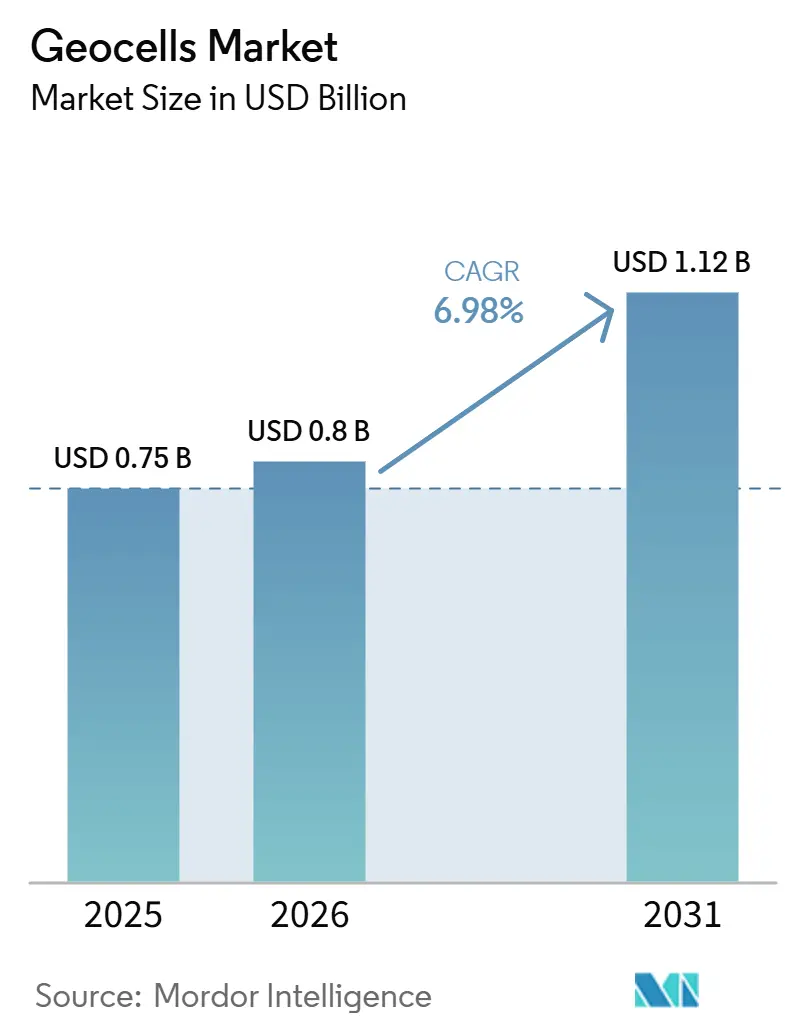
The Geocells Market size was valued at USD 618.23 million in 2025 and is estimated to grow from USD 655.32 million in 2026 to reach USD 918.26 million by 2031, at a CAGR of 6.98% during the forecast period (2026-2031). Transport infrastructure programs, soil stabilization needs, and erosion-control work support demand for cellular confinement systems. Geocells can reduce dependence on imported aggregate, where weak subgrades and difficult terrain raise project costs. Public buyers are also giving more weight to lifecycle performance and environmental documentation when selecting ground-improvement systems. ISO/TR 18228-5:2025 provides a common design reference for stabilization applications, which can make specifications easier for public agencies and engineering teams. The lack of consistent performance requirements in parts of South and Southeast Asia can still delay approvals and limit the wider use of higher-performance materials.
Key Report Takeaways
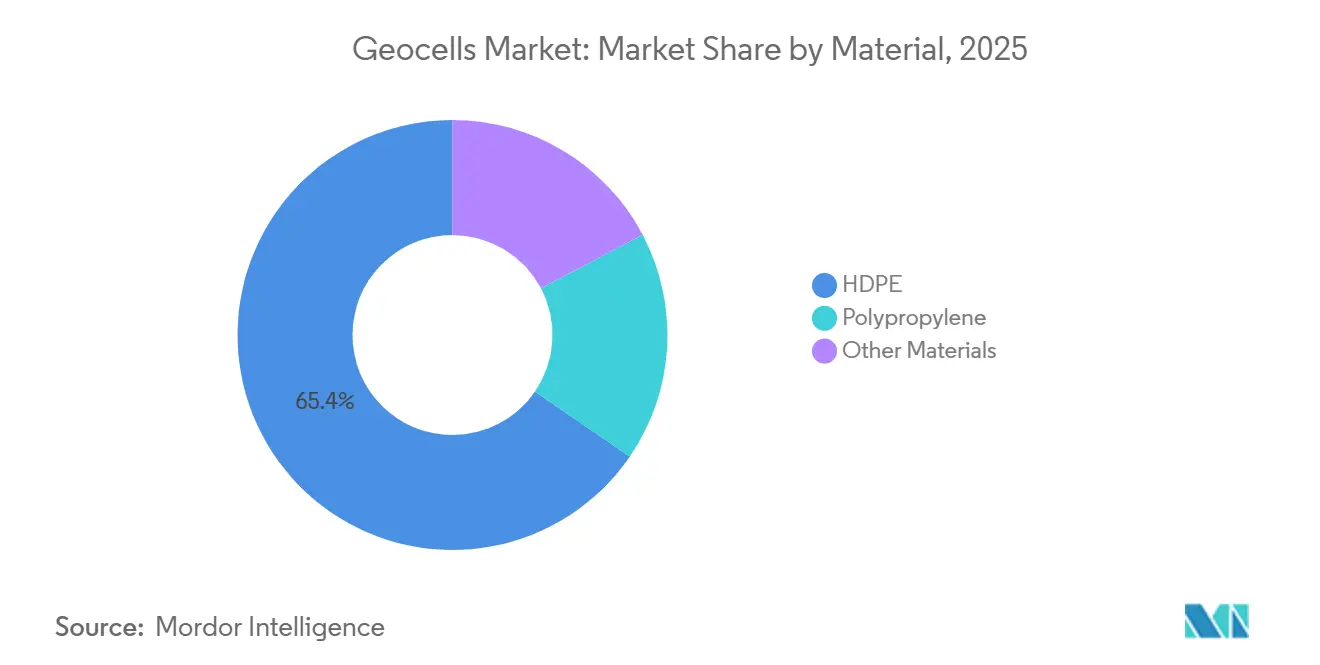
- By material, HDPE held 65.43% of the geocells market share in 2025, while polypropylene is forecast to grow at an 8.12% CAGR through 2031.
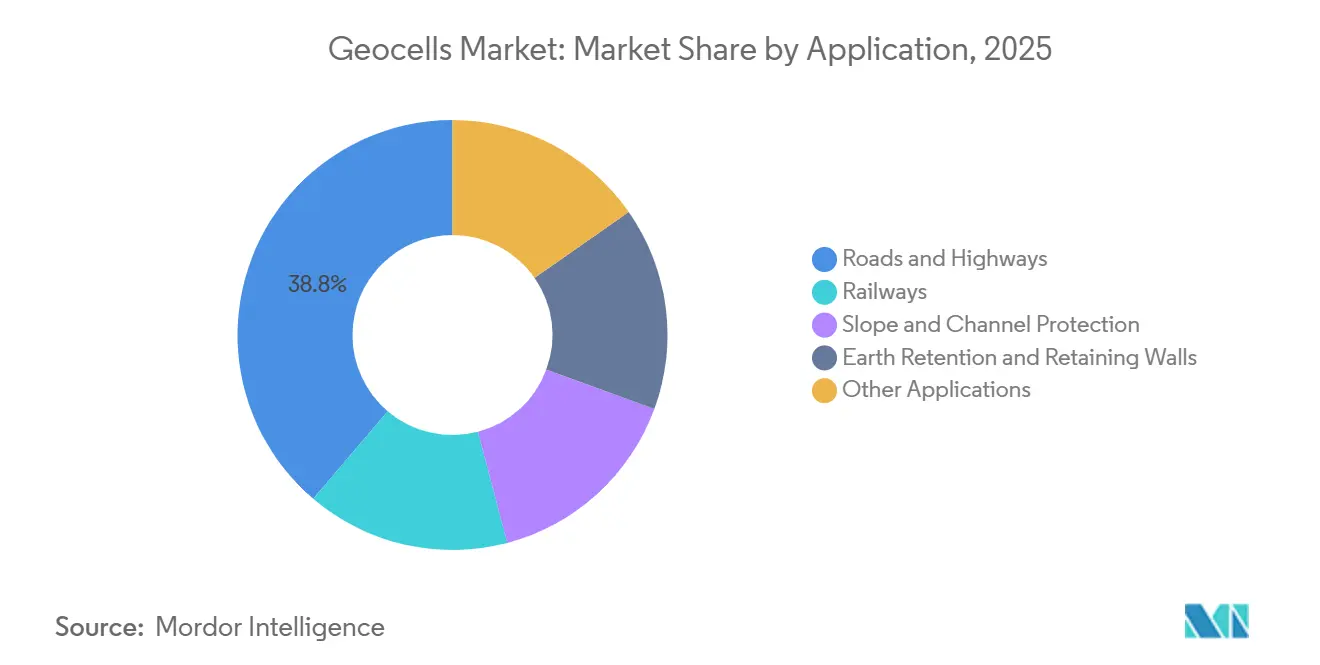
- By application, roads and highways held 38.78% of the geocells market share in 2025, while slope and channel protection is forecast to grow at an 8.25% CAGR through 2031.
- By geography, Asia-Pacific accounted for 40.13% of the geocells market share in 2025 and is projected to expand at a 7.84% CAGR through 2031.
Note: Market size and forecast figures in this report are generated using Mordor Intelligence’s proprietary estimation framework, updated with the latest available data and insights as of January 2026.
Market Trends and Insights
Drivers Impact Analysis of Geocells Market*
| Driver | (~) % Impact on CAGR Forecast | Geographic Relevance | Impact Timeline |
|---|---|---|---|
| Infrastructure Investment in Roads, Railways and Ports | +2.1% | Global; concentrated in Asia-Pacific, Middle-East, and South Asia | Short to medium term (≤ 4 years) |
| Sustainable Soil Stabilization and Aggregate Reduction | +1.5% | Global; strongest in markets with weak subgrade and high aggregate logistics costs | Medium term (2–4 years) |
| Rising Slope Failure and Erosion-Control Requirements | +1.2% | Asia-Pacific, Europe, South America | Medium to long term (2–5 years) |
| Lifecycle-Cost Optimization in Infrastructure Projects | +0.8% | Global; strongest in North America and Europe | Long term (≥ 4 years) |
| Geocell Adoption in Climate-Vulnerable Infrastructure | +0.7% | Asia-Pacific, South America, MEA | Medium term (2–4 years) |
| Performance-Based Specifications for Cellular Confinement | +0.5% | North America, Europe, Asia-Pacific | Long term (≥ 4 years) |
| Source: Mordor Intelligence | |||
Infrastructure Investment in Roads, Railways and Ports
Road, rail, and port investments remain the main source of demand for the geocells market. Large projects in Asia, the Middle-East, and South America often face soft soils, uneven terrain, and high aggregate transport costs. These conditions make cellular confinement systems relevant to both new construction and rehabilitation work. Geocells can allow the use of locally available or marginal infill, which is useful at remote and riverside sites. That advantage can improve project economics in hilly parts of South and Southeast Asia. Rail projects also create demand because ballast and subgrade confinement can limit lateral movement and extend maintenance intervals. The effect is strongest where engineers need a practical ground-improvement option without importing large volumes of specification-grade aggregate.
Sustainable Soil Stabilization and Aggregate Reduction
Aggregate reduction gives the geocells market a clear case in weak-subgrade road construction. A 2024 review of unpaved-road design methods reported that geocells can reduce base-course aggregate requirements by 27% in typical weak-subgrade conditions. A 2025 field-validated study found that geocell reinforcement increased the bearing-capacity factor from 3.14 to 5.14. The same study reported 56.5% aggregate savings for a 0.15 m novel polymeric alloy (NPA) geocell layer in a 0.20 m base course under the stated test conditions. Fewer aggregate deliveries can reduce fuel use, vehicle traffic, site congestion, and construction time. These benefits align with procurement practices that consider embodied carbon and material efficiency.
Rising Slope Failure and Erosion-Control Requirements
Rainfall-related slope failures are increasing the need for erosion-control systems in transport and environmental remediation projects. A 2025 study found that engineering activity near loess slopes can increase the effects of rainfall-triggered failure. The study supported the use of erosion-control geosynthetics within slope-design approaches. Transport Infrastructure Ireland's 2026-2030 climate adaptation plan identifies slope failure and erosion as hazards for national roads and includes geotechnical remediation for exposed sections. ISO/TR 18228-8:2026 also provides design guidance for geosynthetics in surface erosion control[1]ISO Technical Committee 221, “ISO/TR 18228-8:2026 Design Using Geosynthetics Part 8 Surface Erosion Control,” International Organization for Standardization, standards.iteh.ai. These developments support wider use of geocells in channel lining, embankment protection, and climate-exposed infrastructure.
Lifecycle-Cost Optimization in Infrastructure Projects
Lifecycle costs matter more when road rehabilitation needs compete with new construction for public funding. A 2024 study of flexible pavements in Thailand found that geosynthetic reinforcement reduced vehicle operating costs by 14% over the evaluation period compared with unstabilized sections. PRS Geo-Technologies reported that its Neoloy Tough-Cells system reduced structural pavement thickness by 44% and project costs by 30% on a Polish service-road project. Presto Geosystems published an Environmental Product Declaration for its GEOWEB geocell system in April 2025 under ISO 14025. The declaration covers carbon dioxide performance, energy consumption, and natural-resource use across the product lifecycle. Such documentation can help geocell suppliers participate in sustainability-led procurement, while performance-based standards can make technical comparisons more consistent.
Restraints Impact Analysis of Geocells Market*
| Restraint | (~) % Impact on CAGR Forecast | Geographic Relevance | Impact Timeline |
|---|---|---|---|
| Installation Complexity and Contractor Skill Requirements | -1.0% | Global; most pronounced in MEA and rural South/Southeast Asia | Medium term (2–4 years) |
| Competition from Geogrids, Geotextiles and Conventional Systems | -0.8% | Global | Short term (≤ 2 years) |
| Inconsistent Geocell Performance Specifications | -0.5% | Developing markets in Asia, MEA | Medium to long term (2–5 years) |
| Long-Term Creep and Deformation Concerns in Conventional HDPE Systems | -0.4% | Global | Long term (≥ 4 years) |
| Source: Mordor Intelligence | |||
Installation Complexity and Contractor Skill Requirements
Geocell installation requires crews to expand panels, place anchor pins, and compact infill correctly. Uneven anchor spacing or poor compaction can reduce confinement efficiency. In some rural markets, contractors have limited experience with cellular confinement systems. A weak installation can be attributed to the product rather than the work method, which can reduce confidence among public buyers. Formal certification and field training take time to build across a dispersed contractor base. Some manufacturers offer pre-expanded panels and simpler anchoring guidance, but those formats are better suited to lower-load applications. This constraint is most visible in price-sensitive public works outside major urban markets.
Competition from Geogrids, Geotextiles and Conventional Systems
Biaxial and triaxial geogrids are established alternatives in paved-road sub-base reinforcement. A 2025 study compared biaxial geogrids, triaxial geogrids, and geocells in recycled-aggregate flexible pavements. It found that performance differences can narrow under standardized soil and load conditions. Cement and lime stabilization also remain familiar options where local aggregate is plentiful, and sites are flat. Geocells retain a stronger case in soft subgrades, high-load areas, and erosion-sensitive locations. Suppliers need design support, application evidence, and clear specifications to defend that position against lower-cost alternatives.
*Our forecasts treat driver/restraint impacts as directional, not additive. The impact forecasts reflect baseline growth, mix effects, and variable interactions.
Geocells Market Segment Analysis
By Material:
HDPE Holds the Largest Base, While Polypropylene Gains GroundHDPE accounted for 65.43% of the geocells market share in 2025. Its position reflects established use in road, rail, and port projects, as well as supply availability across North America, Europe, and the Asia-Pacific. Engineers commonly select HDPE for its tensile strength, chemical resistance, and fit with familiar civil-engineering specifications. The material also benefits from cost-competitive pricing in standard ground-stabilization work. Conventional HDPE can experience creep deformation under sustained dynamic loading, which can restrict its use in permanent, high-load structures. A 2024 study examined elastic-viscoplastic behavior in polymer-blend geocell sheets, supporting the importance of material selection for demanding applications. These limits create an opening for higher-performance formulations in railbeds and container-yard platforms.
Polypropylene is projected to expand at an 8.12% CAGR from 2026 to 2031. Lower unit weight supports handling and rapid deployment at temporary access roads, landscaping sites, and moderate-load erosion-control projects. Polyester and textile-based products continue to serve specialized channel and shoreline applications where chemical and hydrolytic resistance justify a higher cost. Novel Polymeric Alloy products form a higher-performance tier within advanced materials. These systems are positioned for airport pavements, high-speed rail subgrades, and heavy port platforms that require long design lives. ISO/TR 18228-5:2025 and evolving cellular-confinement testing expectations can raise the baseline performance required for specification eligibility. The result is a clearer split between widely used HDPE systems and premium products for permanent heavy-duty applications.



By Application:
Roads and Highways Lead, While Slope and Channel Protection AdvancesRoads and highways held 38.78% of the geocells market share in 2025. Demand is linked to large highway programs and the need to stabilize weak road subgrades. Geocells can improve the use of available infill materials and reduce the thickness of granular layers. A 2025 study reported modulus ratios of 3.4 to 7.6 for geocell-stabilized unpaved road bases compared with unreinforced sections. That performance can support longer service life and deferred maintenance on rural access roads carrying heavy vehicles. Roads remain the broadest demand base because they combine new construction, maintenance, and rehabilitation needs. Railways, retaining structures, working platforms, parking areas, landfills, and shoreline protection provide additional application opportunities.
Slope and channel protection is projected to record an 8.25% CAGR from 2026 to 2031, the highest rate among application segments. The segment benefits from stronger attention to erosion, drainage, embankment stability, and climate resilience. Cellular systems can retain soil and vegetation while protecting channels and exposed slopes. Railways are also gaining relevance because ballast confinement can reduce lateral spreading in weak subgrades. PRS Geo-Technologies reported 90% construction-time savings and a 60% longer design life on a subarctic railway reconstruction using its Neoloy Tough-Cells system. The project involved soft peat with a California Bearing Ratio (CBR) below 1% and 100-ton haul loads. These use cases show why application demand is becoming more diverse, even though roads remain dominant.
Geography Analysis
APAC Geocells Market
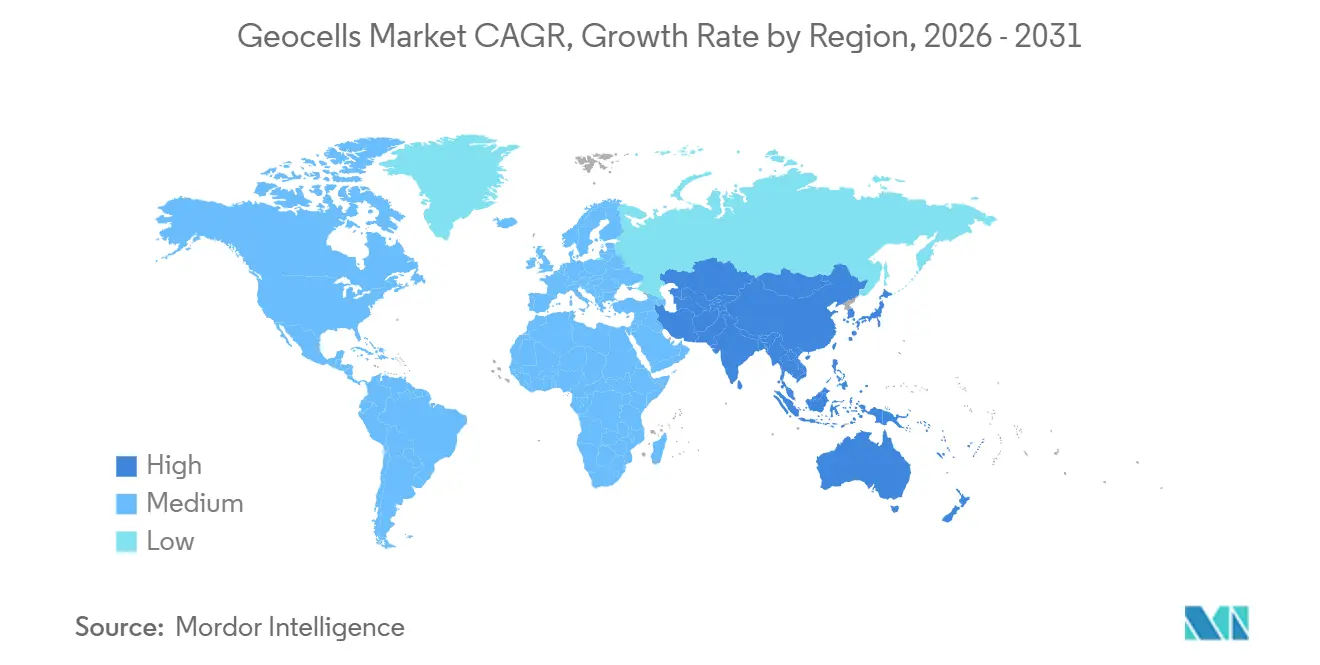
Asia-Pacific held 40.13% of the geocells market share in 2025. The region is also forecast to grow at a 7.84% CAGR from 2026 to 2031. Large transport projects in China, India, Indonesia, Vietnam, and the Philippines support demand for road reinforcement and slope stabilization. Mountainous terrain, tropical rainfall, and variable subgrade conditions increase the relevance of confinement systems. Local manufacturing, regional distribution, and compliance with country-specific standards can affect tender competitiveness. Japan, South Korea, and Australia are more mature markets where buyers focus on resilience, quality standards, and long-life infrastructure. Suppliers with local partners can respond more effectively to certification and local-content requirements.
North America and Europe Geocells Market
In North America, road rehabilitation and soft-subgrade projects create a need for practical stabilization solutions. Canada also offers a specialized opportunity in permafrost and northern road rehabilitation. In Europe, aging transport assets and environmental procurement criteria support interest in aggregate-efficient systems. Naue renewed its Deutsche Bahn High-Performance Qualification for the Secudrain WAS 7 drainage geosynthetic in January 2026, and the qualification remains valid through January 2029. The renewal shows the importance of long-term institutional qualification in rail-infrastructure supply chains. European buyers often place greater weight on documented performance and environmental credentials.
MEA and South America Geocells Market
South America, and Middle-East and Africa offer meaningful future opportunities. Road rehabilitation in tropical and alluvial terrain can favor systems that stabilize soft ground with less imported aggregate. In the Middle-East, desert projects create demand where loose sandy soils make conventional granular stabilization costly. Saudi certification requirements can influence which suppliers compete for local work. Sub-Saharan Africa has a large long-term infrastructure need, but uneven public spending and limited contractor training can constrain near-term adoption. Climate-exposed roads, embankments, and drainage systems remain relevant use cases across these regions. Supply reliability and contractor support will be important to convert project pipelines into recurring demand.

Competitive Landscape
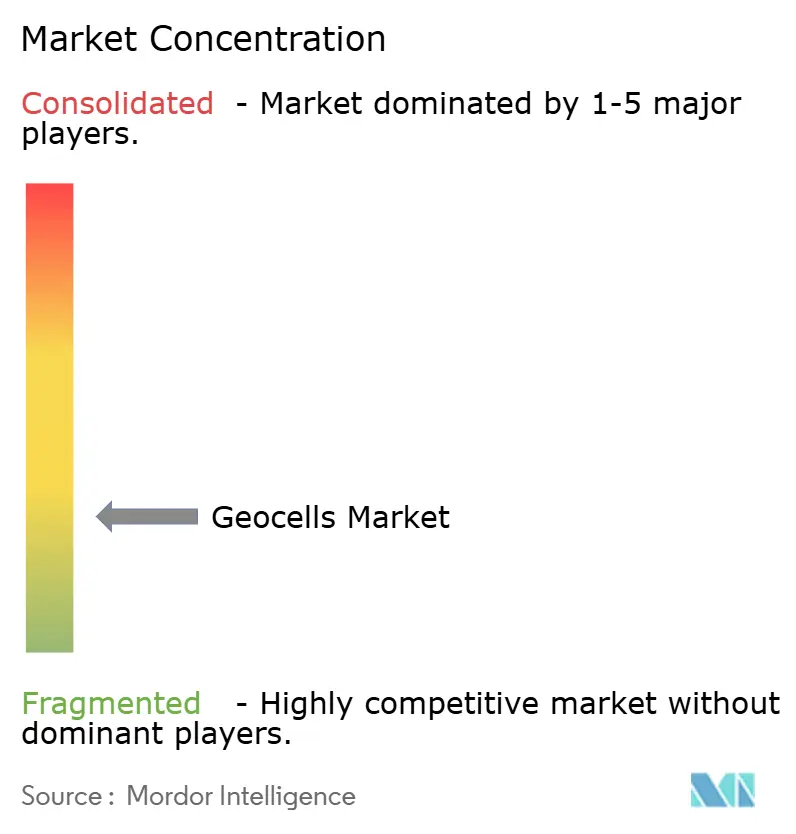
The geocells market is highly fragmented, with the top five players including Presto Products Company, PRS Geo-Technologies, Strata Geosystems, Officine Maccaferri Spa, and Tensar, A Division of CMC. Many regional suppliers focus on cost-competitive HDPE products for standard applications. Global specialists compete more heavily through material technology, design support, product evidence, and engineering services. The split between commodity HDPE and premium engineered polymer systems creates distinct pricing tiers. This structure limits broad pricing power even as product uses expand. Tensar filed a January 2025 U.S. patent application for multilayer integral geogrids with a cellular layer structure, showing that adjacent geogrid suppliers are pursuing hybrid reinforcement products. Such products could increase competition in pavement reinforcement.
Companies are also using acquisitions and distribution relationships to broaden geographic reach and system capabilities. HUESKER completed its acquisition of Sineco International in April 2025, adding drainage and erosion-control geocomposites to its product portfolio. The move expands the company's presence in application areas where geocells and geocomposites can overlap. Strata Geosystems completed the acquisition of Venus Interlinings in February 2026, strengthening its vertically integrated supply of geocell and geotextile systems in India. Tensar announced a January 2026 distribution alliance with Cirtex in New Zealand and expanded its Australian distribution network through Cirtex and Maccaferri Australasia[2]Tensar, “Tensar Announces Strategic Alliance with Cirtex in New Zealand,” Tensar, tensarcorp.com. These actions reflect the value of distribution coverage and complementary product portfolios in infrastructure markets.
Railway ballast confinement and climate-exposed embankment reinforcement remain less developed application spaces. Suppliers with credible performance data can use these areas to move beyond standard road work. The ISO/TR 18228 series is making design methods more consistent across stabilization and erosion-control applications. Wider use of common standards can reduce the advantage created by proprietary design approaches. Competition can then shift toward application engineering, design software, product availability, and field support. Presto Geosystems' 2025 Environmental Product Declaration gives the company documented lifecycle information that can support sustainability-related tenders.
Geocells Industry Leaders
Presto Products Company
PRS Geo-Technologies
Strata Geosystems
Officine Maccaferri Spa
Tensar, A Division of CMC
- *Disclaimer: Major Players sorted in no particular order
Geocells Market Companies Covered in this Report
- ABG Limited
- ACE Geosynthetics
- Geo Products
- Geofabrics Australasia Pty Ltd.
- HUESKER International
- Naue GmbH & Co. KG
- Officine Maccaferri Spa
- Polyfabrics Australasia Pty Ltd
- Presto Products Company
- PRS Geo-Technologies
- Solmax
- Strata Geosystems
- Tensar, A Division of CMC
- Terram Geosynthetics Pvt. Ltd.
- TMP Geosynthetics

Recent Industry Developments in Geocells Market
- June 2026: Geoquest signed an agreement to acquire the geosynthetics division of Grupo TDM, which operates geocell manufacturing plants in Peru and Brazil. The acquisition strengthens Geoquest's geocell manufacturing presence and expands its cellular confinement solutions business across six Latin American countries.
- December 2025: In India, NITK Surathkal developed a jute-based geocell as a sustainable, cost-effective alternative to plastic for road construction and slope stabilization, funded by the National Jute Board under the Union Ministry of Textiles and executed in collaboration with Birla Jute Mills. The eco-friendly, carbon-negative geocell is cheaper to produce and well-suited for large-scale rural infrastructure projects.


Global Geocells Market Report Scope
Geocells are three-dimensional cellular confinement systems manufactured from polymeric materials that are expanded on-site and filled with soil, aggregates, or concrete to improve load distribution and ground stability. They are widely used for soil stabilization, erosion control, slope protection, and load support in transportation, civil engineering, and infrastructure projects.
The Geocells Market is segmented by material, application, and geography. By material, the market is segmented into HDPE, polypropylene, and other materials (including polyester and textile). By application, the market is segmented into roads and highways, railways, slope and channel protection, earth retention and retaining walls, and other applications (including airports and runways, ports and container yards, working platforms, parking areas, landfills, and landscaping and shoreline protection). The report also covers the market size and forecasts for geocells in 17 countries across major regions. For each segment, the market sizing and forecasts have been done on the basis of value (USD).
| HDPE |
| Polypropylene |
| Other Materials (including Polyester, Textile) |
| Roads and Highways |
| Railways |
| Slope and Channel Protection |
| Earth Retention and Retaining Walls |
| Other Applications (Airports and runways, Ports and container yards, Working platforms, Parking areas, Landfills, and Landscaping and shoreline protection) |
| Asia-Pacific | China |
| India | |
| Japan | |
| South Korea | |
| ASEAN Countries | |
| Rest of Asia-Pacific | |
| North America | United States |
| Canada | |
| Mexico | |
| Europe | Germany |
| United Kingdom | |
| France | |
| Italy | |
| Spain | |
| NORDIC Countries | |
| Russia | |
| Rest of Europe | |
| South America | Brazil |
| Argentina | |
| Rest of South America | |
| Middle-East and Africa | Saudi Arabia |
| South Africa | |
| Rest of Middle-East and Africa |
| By Material | HDPE | |
| Polypropylene | ||
| Other Materials (including Polyester, Textile) | ||
| By Application | Roads and Highways | |
| Railways | ||
| Slope and Channel Protection | ||
| Earth Retention and Retaining Walls | ||
| Other Applications (Airports and runways, Ports and container yards, Working platforms, Parking areas, Landfills, and Landscaping and shoreline protection) | ||
| By Geography | Asia-Pacific | China |
| India | ||
| Japan | ||
| South Korea | ||
| ASEAN Countries | ||
| Rest of Asia-Pacific | ||
| North America | United States | |
| Canada | ||
| Mexico | ||
| Europe | Germany | |
| United Kingdom | ||
| France | ||
| Italy | ||
| Spain | ||
| NORDIC Countries | ||
| Russia | ||
| Rest of Europe | ||
| South America | Brazil | |
| Argentina | ||
| Rest of South America | ||
| Middle-East and Africa | Saudi Arabia | |
| South Africa | ||
| Rest of Middle-East and Africa | ||


Key Questions Answered in the Report
What is the size of the geocells market?
The Geocells Market size was valued at USD 618.23 million in 2025 and is estimated to grow from USD 655.32 million in 2026 to reach USD 918.26 million by 2031, at a CAGR of 6.98% during the forecast period (2026-2031).
Which geocell material is most widely used?
HDPE was the leading material in 2025, holding a 65.43% share. It is widely used because suppliers can provide it at cost-competitive prices and engineers recognize its suitability for standard civil applications.
Which application is expected to grow the fastest through 2031?
Slope and channel protection is projected to grow at an 8.25% CAGR through 2031. The segment benefits from concerns around rainfall, erosion, drainage, and embankment stability.
Which region leads demand for geocells?
Asia-Pacific led with a 40.13% share in 2025 and is forecast to grow at a 7.84% CAGR through 2031. Its scale reflects widespread transport construction and rehabilitation needs in China, India, Indonesia, Vietnam, and the Philippines.
Page last updated on:


 Your data is secure and never sold or shared.


