
Geosynthetic Erosion Control Products Market Size and Share
Market Overview
| Study Period | 2021 - 2031 |
|---|---|
| Market Size (2026) | USD 1.41 Billion |
| Market Size (2031) | USD 1.92 Billion |
| Growth Rate (2026 - 2031) | 6.35 % |
| Fastest Growing Market | Asia-Pacific |
| Largest Market | North America |
| Market Concentration | Medium |
Major Players *Disclaimer: Major Players sorted in no particular order Image © Mordor Intelligence. Reuse requires attribution under CC BY 4.0. | |
Geosynthetic Erosion Control Products Market Analysis by Mordor Intelligence
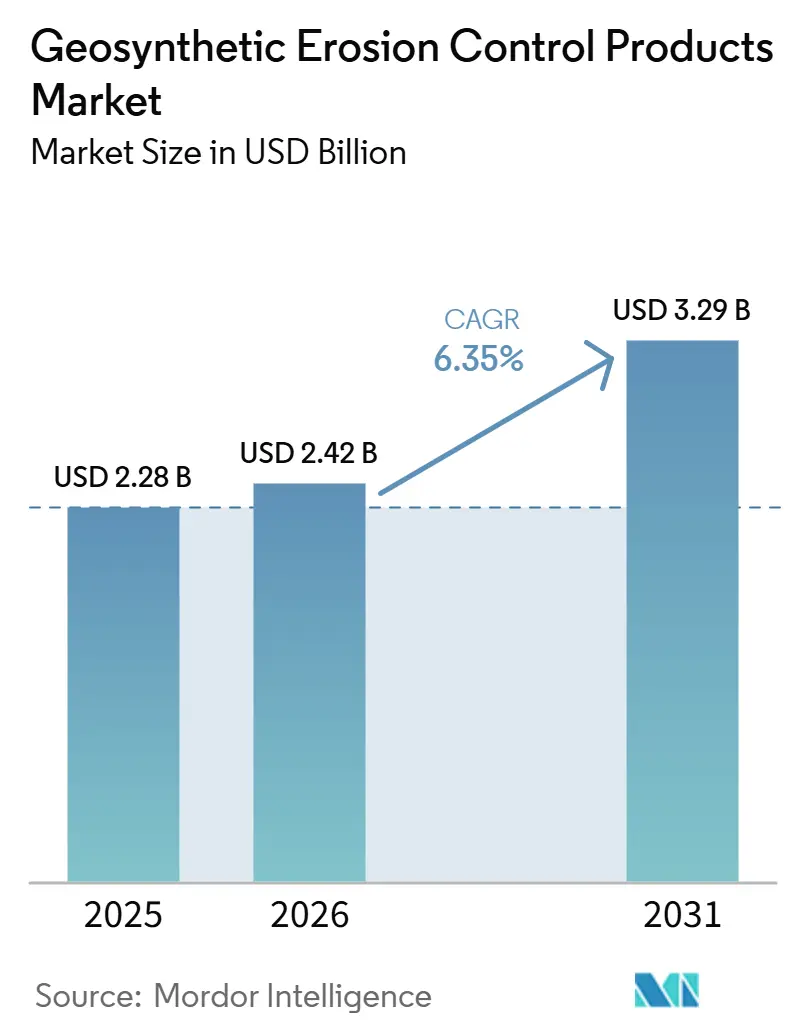
The Geosynthetic Erosion Control Products Market size is projected to be USD 1.33 billion in 2025, USD 1.41 billion in 2026, and reach USD 1.92 billion by 2031, at a CAGR of 6.35% from 2026 to 2031. The Geosynthetic erosion control products market is supported by permitting rules that require effective erosion and sediment controls on qualifying construction sites. The United States Environmental Protection Agency requires such controls for covered construction activity under its Construction General Permit, which creates consistent demand during project planning and site work. Road, embankment, drainage, and coastal projects extend the use of these materials across both new construction and rehabilitation work. Product development also directs the Geosynthetic erosion control products market toward biodegradable, recycled content, and monitored systems that can meet stricter environmental and performance requirements. Suppliers are responding by pairing materials with design support, installation guidance, and documentation that help owners demonstrate compliance.
Key Report Takeaways
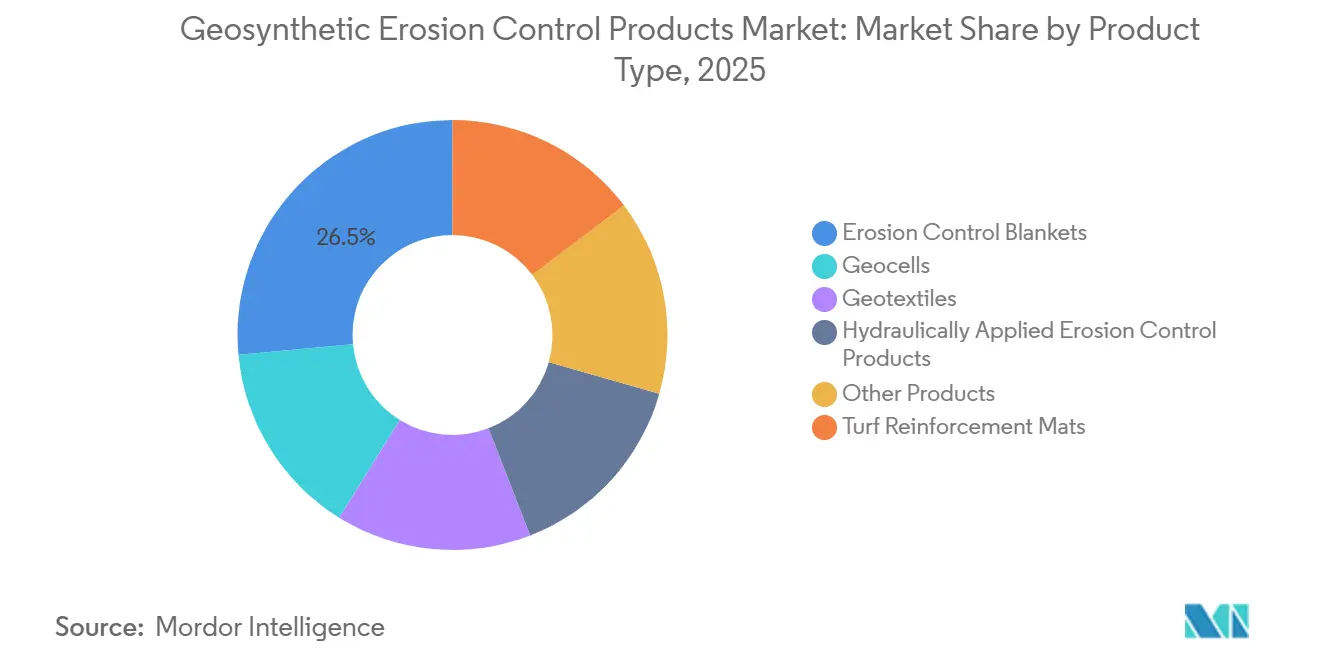
- By product type, erosion control blankets accounted for 26.46% of revenue in 2025, while turf reinforcement mats are forecast to grow at a CAGR of 7.25% through 2031.
- By material, polypropylene held 39.27% revenue share in 2025, while natural fibers are forecast to grow at a CAGR of 7.03% through 2031.
- By product form, rolled products accounted for 47.58% of revenue in 2025, while loose-fill and hydraulically applied products are forecast to grow at a CAGR of 6.58% through 2031.
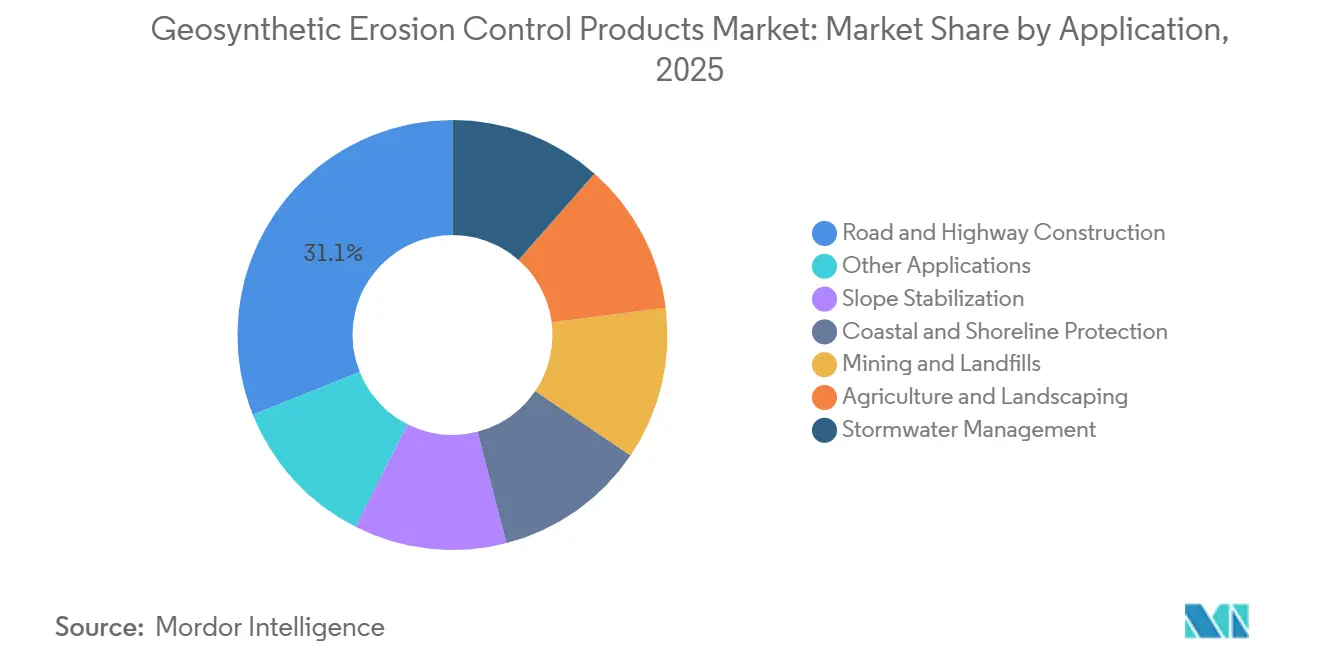
- By application, road and highway construction held 31.05% revenue share in 2025, while coastal and shoreline protection is forecast to grow at a CAGR of 6.91% through 2031.
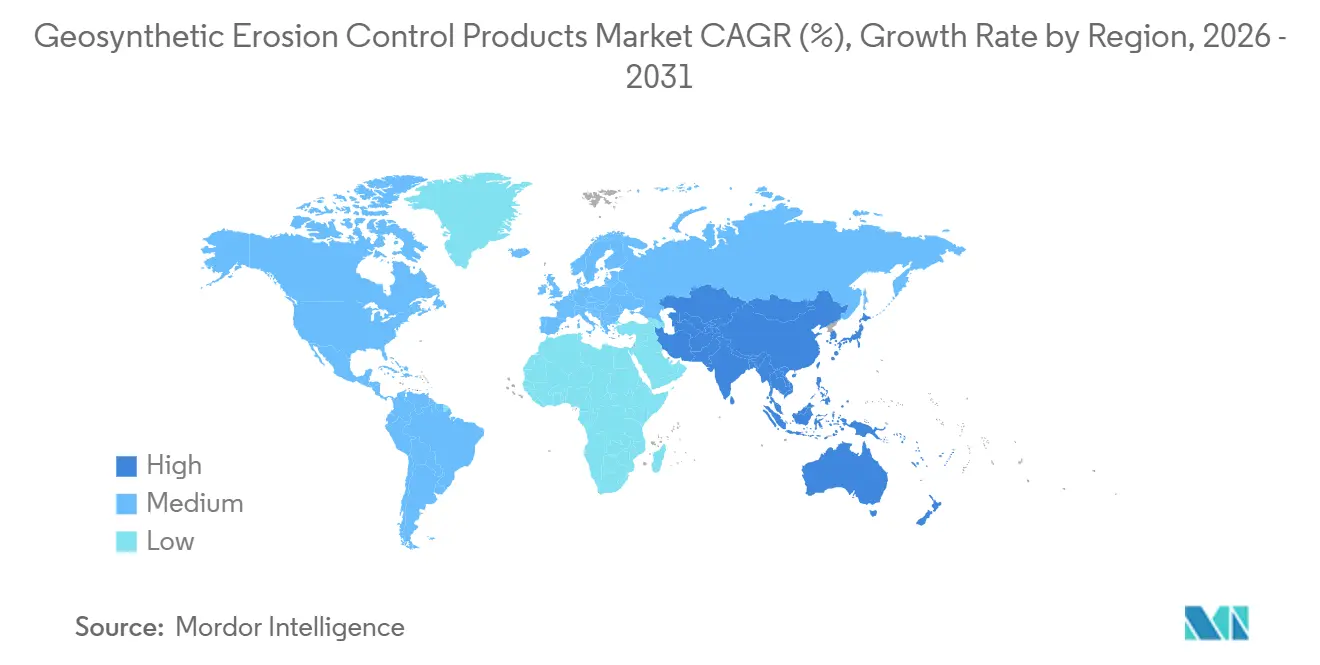
- By geography, North America held 35.21% revenue share in 2025, while Asia-Pacific is forecast to grow at a CAGR of 7.17% through 2031.
Note: Market size and forecast figures in this report are generated using Mordor Intelligence’s proprietary estimation framework, updated with the latest available data and insights as of January 2026.
Market Trends and Insights
Drivers Impact Analysis of Geosynthetic Erosion Control Products Market*
| Drivers | (~) % Impact on CAGR Forecast | Geographic Relevance | Impact Timeline |
|---|---|---|---|
| Mandatory erosion-control measures in construction permitting | +1.2% | Global, strongest in North America and the EU | Short term (≤ 2 years) |
| Highway, embankment, and hydraulic infrastructure expansion | +1.5% | Global, APAC core, and North America primary | Short term (≤ 2 years) |
| Climate-driven floods, slope, and coastal protection spending | +1.1% | Global, coastal, and river-basin regions | Medium term (2-4 years) |
| Preference for biodegradable and recycled erosion-control products | +0.8% | North America and the EU, with expansion to APAC | Medium term (2-4 years) |
| Labor-saving rolled product installation systems | +0.6% | North America and Europe | Short term (≤ 2 years) |
| Digital monitoring and performance-based project specifications | +0.4% | North America and the EU, with expansion to APAC | Long term (≥ 4 years) |
| Source: Mordor Intelligence | |||
Mandatory Erosion-Control Measures in Construction Permitting
The geosynthetic erosion control products market receives demand support from regulations that make erosion and sediment management a project requirement rather than an optional purchase. The EPA Construction General Permit requires operators to design, install, and maintain effective erosion and sediment controls on covered sites, including projects that disturb 1 acre or more. The permit was modified in April 2025 to extend coverage to Lands of Exclusive Federal Jurisdiction, and it is scheduled to expire on February 16, 2027. This framework supports demand for blankets, mats, and related systems used in grading, channel protection, and stabilization activities. State permit conditions require additional documentation and product performance records beyond federal requirements. The Federal Highway Administration and the Geosynthetic Materials Association have also made field-installation guidance available through a mobile application, increasing the focus on documented installation quality.
Highway, Embankment, and Hydraulic Infrastructure Expansion
The geosynthetic erosion control products market is closely tied to the scale and timing of civil infrastructure work. The Federal Highway Administration budget for fiscal year 2026 reached USD 72.6 billion, including a USD 64.1 billion request and USD 8.5 billion in advance appropriations[1]. The Infrastructure Investment and Jobs Act also supports a 5-year federal-aid highway program totaling USD 350 billion through fiscal year 2026. Highway grading exposes soil across slopes, medians, drainage channels, and embankments, so contractors use erosion-control materials throughout construction sequencing. Rehabilitation and widening work may require slope grading in constrained corridors, which favors products from the Central Road Research Institute in India. Also, the growing use of geosynthetics on road projects in landslide-prone areas allows contractors to install quickly in a limited workspace. Research from India’s Central Road Research Institute also noted the growing use of geosynthetics on road projects in landslide-prone, ecologically sensitive hilly terrain.
Climate-Driven Flood, Slope, and Coastal Protection Spending
The geosynthetic erosion control products market is supported by projects that manage flooding, slope damage, and shoreline erosion. High-performance turf reinforcement mat systems can reinforce vegetation in flood-defense applications and serve as an alternative to hard armor under relevant hydraulic conditions. The Environmental Protection Agency (EPA) has identified green infrastructure and natural coastal features as approaches that can reduce coastal risks while supporting ecological functions. These requirements increase the role of vegetated systems, as project owners seek both hydraulic protection and restoration benefits. Coastal authorities can use geosynthetic backing to stabilize planted areas without relying only on concrete or riprap. This application brings public resilience spending into the geosynthetic erosion control products market through longer-term protection programs.
Preference for Biodegradable, Recycled, and Efficient Installation Systems
The geosynthetic erosion control products market is changing as project owners reconsider plastic-based netting and favor materials with defined environmental credentials. A July 2026 American Society of Civil Engineers publication described a framework for transportation agencies moving away from plastic-based erosion-control materials. The related survey covered all 50 state departments of transportation and reported that agencies making this transition had not reported lower erosion-control performance. Coir, jute, and hemp products can support restoration work in coastal and riparian locations where material biodegradability is important. Rolled systems also offer practical installation advantages, as contractors can cover large slopes with inspection-ready blanket and mat formats. Digital documentation and monitoring can further support performance-based specifications by showing whether installation and field performance meet project requirements.
Restraints Impact Analysis of Geosynthetic Erosion Control Products Market*
| Restraints | (~) % Impact on CAGR Forecast | Geographic Relevance | Impact Timeline |
|---|---|---|---|
| Synthetic polymer and natural-fiber raw-material price volatility | -0.9% | Global, the strongest impact in Asia and North America | Short term (≤ 2 years) |
| Installation damage and performance variability | -0.5% | APAC and MEA, developing-market project sites | Medium term (2-4 years) |
| Limited contractor familiarity and specification inconsistency | -0.4% | APAC, MEA, and South America | Medium term (2-4 years) |
| Competition from riprap, concrete, hydroseeding, and conventional civil works | -0.6% | Global, price-sensitive emerging markets | Medium term (2-4 years) |
| Source: Mordor Intelligence | |||
Synthetic Polymer and Natural-Fiber Raw-Material Price Volatility
The geosynthetic erosion control products market remains exposed to price fluctuations in polypropylene, polyethylene, coir, jute, and hemp. Polypropylene and polyethylene are petrochemical materials, and their prices can move with crude oil, naphtha, and propylene market conditions. Polymer feedstock prices rose during the June 2025 Israeli-Iranian conflict before demand and supply conditions stabilized the polypropylene market in July 2025. Smaller fabricators may include escalation clauses in project bids, shifting more price risk to buyers and affecting public procurement processes. Natural-fiber materials also remain sensitive to monsoon patterns and smallholder harvest cycles in South and Southeast Asia. These cost movements can reduce pricing flexibility for mid-tier suppliers that lack integrated raw-material supply or hedging capacity.
Installation Damage, Uneven Familiarity, and Competing Methods
The geosynthetic erosion control products market depends on installation practices that align with product specifications and site conditions. A 2026 Federal Highway Administration (FHWA)-sponsored Virginia study found that seed mix compatibility, surface roughness, and stapling patterns affected vegetation establishment for rolled erosion-control products[2]. When contractors inadequately prepare the subgrade or use improper fastening methods, field performance can fall short of laboratory expectations. Contractors and engineers in some Asia-Pacific, Middle-East, Africa, and South American locations have limited familiarity with geosynthetic installation protocols. As a result, they may choose riprap, concrete revetments, hydroseeding, or conventional civil works, even when a geosynthetic approach is suitable. Supplier training, certification programs, and validated installation guides can help address this barrier, but they also increase operating requirements for smaller producers.
*Our forecasts treat driver/restraint impacts as directional, not additive. The impact forecasts reflect baseline growth, mix effects, and variable interactions.
Geosynthetic Erosion Control Products Market Segment Analysis
By Product Type:
Erosion Control Blankets Lead, Turf Reinforcement Mats Build Higher-Performance DemandErosion control blankets accounted for 26.46% of the geosynthetic erosion control products market share in 2025, making them the largest product category. Their position reflects their ability to serve slopes with varied gradients, climates, and vegetation-establishment periods. Contractors can deploy blankets quickly on moderate slopes without specialized labor, making them suitable for highway and commercial grading projects where compliance and vegetation establishment must progress together. Geotextiles address filtration and separation requirements, while hydraulically applied erosion-control products support sites where rolled installation is difficult. Geocells are used on steeper embankments and mining reclamation sites that require three-dimensional confinement of infill material.
These categories give suppliers a product range that addresses temporary surface protection and more permanent structural stabilization. Their combined use shows how project teams match products to rainfall, grade, soil condition, site access, expected vegetation, and required protection duration, rather than treating all exposed ground as a single engineering condition. On routine sites, erosion control blankets provide rapid coverage while plant cover develops. In more complex locations, the same specification process can direct projects toward geocells, geotextiles, or hydraulically applied products that better match exposure and structural requirements.
Turf reinforcement mats are projected to advance at a 7.25% CAGR through 2031, the highest rate within the product type classification. Their use is expanding in flood defense, channel lining, and coastal revetment work that requires vegetated reinforcement under higher hydraulic stress. These systems can replace or complement hard-armor approaches in suitable projects. American Excelsior introduced the Recyclex TRM family in February 2026 with 100% recycled fibers and fiber-specific gravity above 1 to prevent flotation during hydraulic events. This product example shows how manufacturers are combining recycled-content claims with hydraulic performance in new specifications.

By Material:
Polypropylene Remains the Core Substrate, While Natural Fibers Gain Specification SupportPolypropylene captured 39.27% of the geosynthetic erosion control products market share in 2025 and remained the leading material. UV resistance, chemical stability, mechanical strength, and cost-competitive manufacturing support its position. These features make polypropylene suitable for rolled products used across infrastructure corridors and highway programs. Polyester remains relevant in high-tensile, geogrid-backed turf reinforcement mats. Polyethylene is used in geocell wall structures and other applications that require its specific material properties. However, neither material has matched polypropylene’s breadth of use in erosion control.
The established polypropylene supply chain also supports product availability across diverse construction regions. This availability matters when contractors need repeatable specifications across multiple sites, as a familiar material can be procured, installed, inspected, and replaced through existing manufacturing and distribution channels without changing the basic project workflow. Its technical characteristics support use across a wide range of climatic conditions and construction settings. This established position does not eliminate the need for other polymers, but it explains why polypropylene remains the reference material for many standard erosion-control designs, particularly when projects require familiar performance characteristics, established fabrication methods, readily available distribution, and a record of use across common construction and stabilization applications.
Natural fibers are forecast to grow at a 7.03% CAGR through 2031, leading the material classification. Within the geosynthetic erosion control products market, demand for natural fibers is concentrated in transportation projects that are moving away from synthetic netting and in restoration sites that require biodegradable materials. Natural-fiber matrices can be combined with native seeds to support soil stabilization and vegetation establishment in a single installation sequence. Naue GmbH & Co. KG introduced Secumat Green 3D Mesh in September 2025 using bio-based and renewable materials, including bioplastic filaments, coconut, and jute. The product is designed to support vegetation for up to 10 years before biodegradation.
By Product Form:
Rolled Products Retain the Broadest Revenue Base, While Hydraulic Formats Address Access ConstraintsRolled products accounted for 47.58% of the geosynthetic erosion control products market size in 2025. Blankets and mats in roll form are suitable for large construction sites where coverage rate, inspection, and specification compliance are important. Installation crews apply these products consistently across extensive slope areas within limited construction windows. As a result, contractors use rolls in highways, pipelines, and commercial grading projects.
Modular products, such as geocell panels, are used in projects where slope geometry, loading, or proximity to structures require engineered confinement. Their role differs from surface-cover systems, making them not directly interchangeable. The geosynthetic erosion control products industry uses both forms to address broad surface protection and localized stabilization needs. Logistics and engineering shape the division between formats, as crew access, available equipment, slope configuration, inspection practices, and construction timing determine which format is more practical: rolled or modular.
Loose-fill and hydraulically applied products are expected to grow at a 6.58% CAGR through 2031. Bonded fiber matrix and flexible growth medium systems suit steep cut slopes, post-wildfire areas, mine reclamation sites, and other areas with limited equipment access. These formats can also function as seed-delivery platforms that support germination and root establishment in site-specific soils. Their growth expands the potential buyer base beyond conventional erosion-control specialists. Ecological restoration contractors and mine-closure engineers use these products where revegetation and erosion control occur together.
The 2026 Virginia research on seed compatibility and surface preparation points to tighter installation specifications, rather than a broad shift away from rolled products. This keeps hydraulic formats focused on terrain and access conditions where their application method supports project requirements. Their value is higher where crews cannot safely unroll or anchor a conventional product, where the surface is irregular, or where the owner needs erosion protection and seed placement in the same field operation.
By Application:
Road and Highway Construction Leads, While Coastal Protection Records the Fastest GrowthRoad and highway construction accounted for 31.05% of the geosynthetic erosion control products market in 2025, representing the largest application share. Transport corridors require slope, embankment, drainage, and stormwater controls during active project phases. Federal highway funding and related infrastructure work link this application to large public construction programs. Road alignments through hilly terrain also require longer-term stabilization where geology and rainfall create persistent erosion exposure. Slope stabilization plays a related but distinct role, often requiring permanent protection rather than temporary construction-phase coverage. Mining and landfill projects add technical demand through waste-closure systems that combine slope stabilization, geomembrane protection, and ecological restoration. A January 2026 Geofabrics paper described the use of geosynthetics in mine-closure rehabilitation.
Coastal and shoreline protection is expected to grow at a CAGR of 6.91% through 2031, making it the fastest-growing application. This growth reflects exposure to coastal damage and increased use of biologically integrated protection systems. Vegetated reinforcement can provide hydraulic protection while supporting restoration goals that differ from hard armor solutions. Agriculture, landscaping, and stormwater management generate stable demand, although their performance standards can be less consistent than those for highway and coastal projects. Municipal separate storm sewer system requirements can expand the use of erosion control in land-disturbing activities below the 1-acre federal threshold. As a result, compact and lower-cost products may remain relevant for smaller land-management projects. The geosynthetic erosion control products market can expand across these applications when suppliers align product design with site conditions, water conditions, and expected vegetation outcomes. This approach enables suppliers to serve large public works and smaller local projects without offering every customer the same technical package, price point, or expected service life. These varied requirements keep the application base broad, even as individual project categories record different growth rates.
Geography Analysis
North America Geosynthetic Erosion Control Products Market
North America accounted for 35.21% of global revenue in 2025, maintaining its position as the largest regional market. Federal and state stormwater enforcement supported adoption across active construction sites, while the Infrastructure Investment and Jobs Act (IIJA) deployed USD 62 billion in federal highway funding during fiscal year 2025, and the fiscal year 2026 Federal Highway Administration (FHWA) budget reached USD 72.6 billion. This level of road investment increased the market's exposure to geosynthetic erosion control products for slope and embankment applications across highway projects. The American Society of Civil Engineers (ASCE) framework for eliminating plastic-based erosion-control materials provided transportation agencies with a basis for updating procurement requirements. Canada contributed pipeline-related demand, while Mexico added demand from mining reclamation activities. These applications broadened the regional demand base beyond U.S. highway construction.
APAC Geosynthetic Erosion Control Products Market
Asia-Pacific is forecast to expand at a CAGR of 7.17% through 2031, making it the fastest-growing regional market. China implemented JTG/T 3332-2026 on July 1, 2026, replacing the 2012 highway geosynthetics specification. The revised standard covers subbase reinforcement, drainage, slope protection, and quality acceptance in highway construction, increasing the importance of product performance and documented quality for public road work. Japan received a government designation for geosynthetic cementitious composite mat technology as a New Technology Information System (NETIS) Recommended Technology in April 2026, while India’s roadwork in landslide-prone terrain created additional use cases for erosion-control and slope-stabilization materials. Therefore, road, hydraulic, and coastal construction needs support the geosynthetic erosion control products market across the region.
EMEA and South America Geosynthetic Erosion Control Products Market
Europe continues to record stable demand, as environmental compliance and green construction requirements influence infrastructure specifications. The region favors biodegradable and recycled-content products, guided by sustainability criteria in material selection. This trend supports the natural-fiber direction within the geosynthetic erosion control products market. In South America, demand is linked to road expansion, mining reclamation, and agricultural infrastructure in areas with variable terrain. The Middle-East and Africa offer new project opportunities through infrastructure and mining activity, although contractor familiarity remains uneven. Naue appointed TeMa South Africa as its representative for South Africa and sub-Saharan Africa in June 2025. This appointment improved local product access and technical support for a regional customer base with limited coverage, helping project teams use systems that require local design and installation guidance.
Competitive Landscape
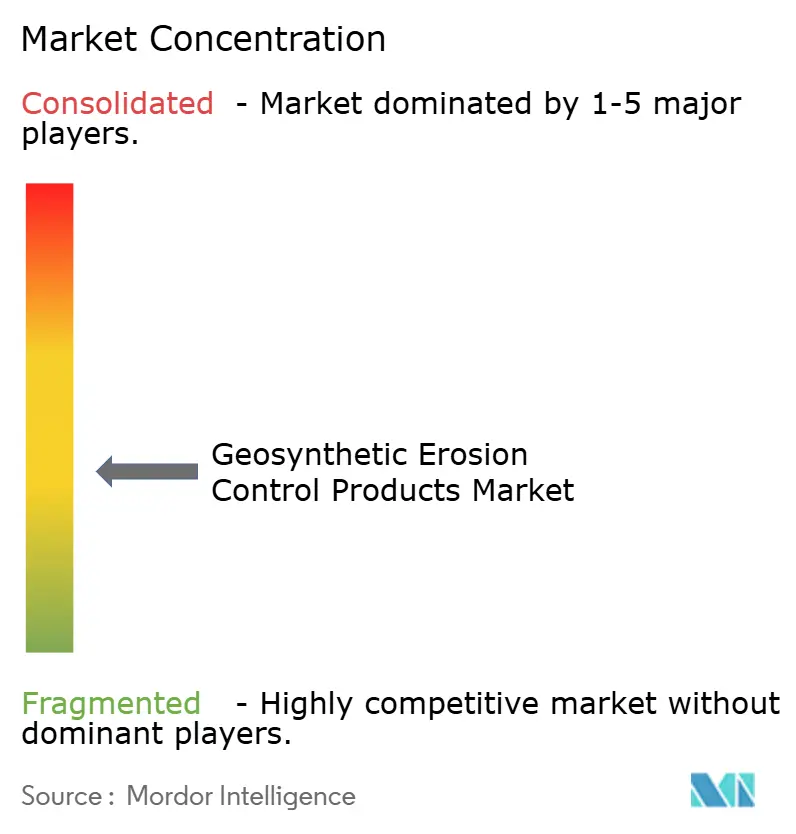
The geosynthetic erosion control products market is moderately fragmented, with several integrated global suppliers and many regional or application-specific producers. Naue, Officine Maccaferri, Solmax (including TenCate Geosynthetics), and HUESKER compete based on technical capabilities, broad product portfolios, and engineering support. Their offerings include temporary blankets, permanent reinforcement systems, geotextiles, geocells, and related products, enabling suppliers to serve multiple stages of civil projects. Competition extends beyond material cost, as project owners also assess installation guidance, design assurance, and project documentation. Smaller specialists remain competitive through natural-fiber expertise or application-specific knowledge. BonTerra, American Excelsior, and BontexGeo Group supply biodegradable, eco-friendly erosion control products.
Companies are expanding their roles in design workflows beyond product supply. Maccaferri introduced the EcoMac Design Suite in January 2025, while Naue uses its SolutionFinder Erosion Control tool to support engineering-led product specification. These tools help engineers select systems that fit hydraulic and slope conditions. Maccaferri completed its acquisition of Synteen Technical Fabrics in February 2025, adding a US manufacturing base for geogrids and high-strength polyester geosynthetics. The move gave the company greater access to North American transportation and public-land project requirements. Naue’s September 2025 launch of its bio-based Secumat Green 3D Mesh reflected the shift toward products that combine biodegradable inputs with extended vegetation support. American Excelsior’s February 2026 launch of Recyclex TRM also combined recycled content with performance features designed for hydraulic events.
Opportunities remain in biodegradable and recycled-content certification, monitored performance contracts, and markets with limited local technical support. Some suppliers are also developing smart geosynthetic systems with integrated sensing capabilities to support infrastructure monitoring. These capabilities may become more relevant as projects require post-installation records of sediment control and system performance. Companies with local training capabilities can also address installation errors that affect confidence in product performance.
Geosynthetic Erosion Control Products Industry Leaders
-
Solmax
-
HUESKER International
-
Contech Engineered Solutions LLC
-
American Excelsior Company
-
Naue GmbH and Co. KG
- *Disclaimer: Major Players sorted in no particular order
Geosynthetic Erosion Control Products Market Companies Covered in this Report
- ABG Limited
- ACF West, Inc.
- American Excelsior Company
- BonTerra Limited
- BontexGeo Group
- Carthage Mills
- Contech Engineered Solutions LLC
- Fibertex Nonwovens A/S
- HUESKER International
- Naue GmbH & Co. KG
- Nedia Enterprises, Inc.
- Officine Maccaferri Spa
- Solmax
- Strata Geosystems
- Tensar, A Division of CMC
- Thrace Group
- Western Green
Recent Industry Developments in Geosynthetic Erosion Control Products Market
- July 2026: China’s Ministry of Transport implemented the revised highway geosynthetics standard, JTG/T 3332-2026, replacing the 2012 version. The updated specification covers subbase reinforcement, drainage, slope protection, and quality acceptance across highway construction in China. It raises baseline performance requirements for all geosynthetic products used in state-funded road projects.
- February 2025: Officine Maccaferri completed the acquisition of US-based Synteen Technical Fabrics Inc., a manufacturer of geogrids and high-strength polyester geosynthetics serving the Federal Highway Administration and the US Forest Service. The deal established a new North American manufacturing base.
Global Geosynthetic Erosion Control Products Market Report Scope
Geosynthetic erosion control products are polymer-based materials, such as geotextiles, geocells, and mats, designed to prevent soil erosion caused by wind and water. These products stabilize soil and support vegetation growth.
The geosynthetic erosion control products market is segmented by product type, material, product form, application, and geography. By product type, the market is segmented into erosion control blankets, turf reinforcement mats, geocells, geotextiles, hydraulically applied erosion control products, and other products. By material, the market is segmented into polypropylene, polyethylene, polyester, natural fibers, and other materials. By product form, the market is segmented into rolled products, modular products, loose-fill and hydraulically applied products, and other product types. By application, the market is segmented into road and highway construction, slope stabilization, coastal and shoreline protection, mining and landfills, agriculture and landscaping, stormwater management, and other applications. The report also covers market size and forecasts for geosynthetic erosion control products across 16 countries in major regions. The market sizes and forecasts are provided in terms of value (USD).
Segmentation Overview
| Erosion Control Blankets |
| Turf Reinforcement Mats |
| Geocells |
| Geotextiles |
| Hydraulically Applied Erosion Control Products |
| Other Products |
| Polypropylene |
| Polyethylene |
| Polyester |
| Natural Fibers |
| Other Materials |
| Rolled Products |
| Modular Products |
| Loose-Fill and Hydraulically Applied Products |
| Other Product Types |
| Road and Highway Construction |
| Slope Stabilization |
| Coastal and Shoreline Protection |
| Mining and Landfills |
| Agriculture and Landscaping |
| Stormwater Management |
| Other Applications |
| Asia-Pacific | China |
| India | |
| Japan | |
| South Korea | |
| ASEAN Countries | |
| Rest of Asia-Pacific | |
| North America | United States |
| Canada | |
| Mexico | |
| Europe | Germany |
| United Kingdom | |
| France | |
| Italy | |
| NORDIC Countries | |
| Russia | |
| Rest of Europe | |
| South America | Brazil |
| Argentina | |
| Rest of South America | |
| Middle-East and Africa | Saudi Arabia |
| South Africa | |
| Rest of Middle-East and Africa |
| By Product Type | Erosion Control Blankets | |
| Turf Reinforcement Mats | ||
| Geocells | ||
| Geotextiles | ||
| Hydraulically Applied Erosion Control Products | ||
| Other Products | ||
| By Material | Polypropylene | |
| Polyethylene | ||
| Polyester | ||
| Natural Fibers | ||
| Other Materials | ||
| By Product Form | Rolled Products | |
| Modular Products | ||
| Loose-Fill and Hydraulically Applied Products | ||
| Other Product Types | ||
| By Application | Road and Highway Construction | |
| Slope Stabilization | ||
| Coastal and Shoreline Protection | ||
| Mining and Landfills | ||
| Agriculture and Landscaping | ||
| Stormwater Management | ||
| Other Applications | ||
| By Geography | Asia-Pacific | China |
| India | ||
| Japan | ||
| South Korea | ||
| ASEAN Countries | ||
| Rest of Asia-Pacific | ||
| North America | United States | |
| Canada | ||
| Mexico | ||
| Europe | Germany | |
| United Kingdom | ||
| France | ||
| Italy | ||
| NORDIC Countries | ||
| Russia | ||
| Rest of Europe | ||
| South America | Brazil | |
| Argentina | ||
| Rest of South America | ||
| Middle-East and Africa | Saudi Arabia | |
| South Africa | ||
| Rest of Middle-East and Africa | ||
Key Questions Answered in the Report
What is current market size of Geosynthetic Erosion Control Products Market?
The Geosynthetic Erosion Control Products Market size is projected to be USD 1.33 billion in 2025, USD 1.41 billion in 2026, and reach USD 1.92 billion by 2031, at a CAGR of 6.35% from 2026 to 2031.
Which material has the leading share?
Polypropylene held a 39.27% share in 2025 due to its durability, UV resistance, and deep supply chain.
Why are natural fibers becoming more important?
Natural fibers are projected to grow at a 7.03% CAGR as transportation and restoration projects favor biodegradable materials.
Which application has the largest share?
Road and highway construction accounted for 31.05% in 2025 because grading, slopes, and drainage areas require erosion control.