
Gaming Influencer Marketing Services Market Size and Share
Market Overview
| Study Period | 2020 - 2031 |
|---|---|
| Market Size (2026) | USD 2.36 Billion |
| Market Size (2031) | USD 4.34 Billion |
| Growth Rate (2026 - 2031) | 12.96 % |
| Fastest Growing Market | Asia-Pacific |
| Largest Market | North America |
| Market Concentration | Medium |
Major Players *Disclaimer: Major Players sorted in no particular order Image © Mordor Intelligence. Reuse requires attribution under CC BY 4.0. | |
Gaming Influencer Marketing Services Market Analysis by Mordor Intelligence
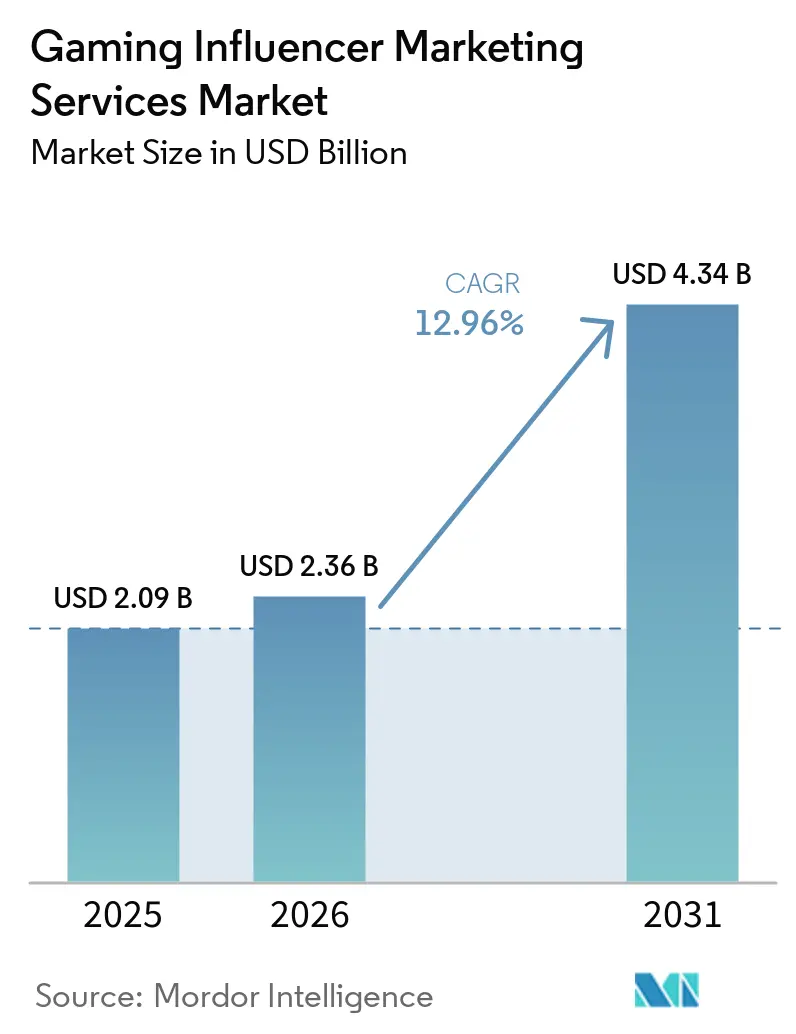
The Gaming Influencer Marketing Services Market size is projected to be USD 2.09 billion in 2025, USD 2.36 billion in 2026, and reach USD 4.34 billion by 2031, growing at a CAGR of 12.96% from 2026 to 2031. The gaming influencer marketing services market is gaining importance because audiences increasingly resist advertising that interrupts gameplay or live viewing. Brands are therefore placing more emphasis on creator content that reaches viewers within the gaming experience. Service providers are responding with campaign planning, creator selection, activation management, content support, community programs, and measurement services. Publishers, hardware companies, and non-gaming advertisers are increasingly using these services as creator activity becomes part of regular marketing planning. Competition is moving toward firms that can combine creative execution with reliable measurement, fraud controls, and disclosure processes.
Key Report Takeaways
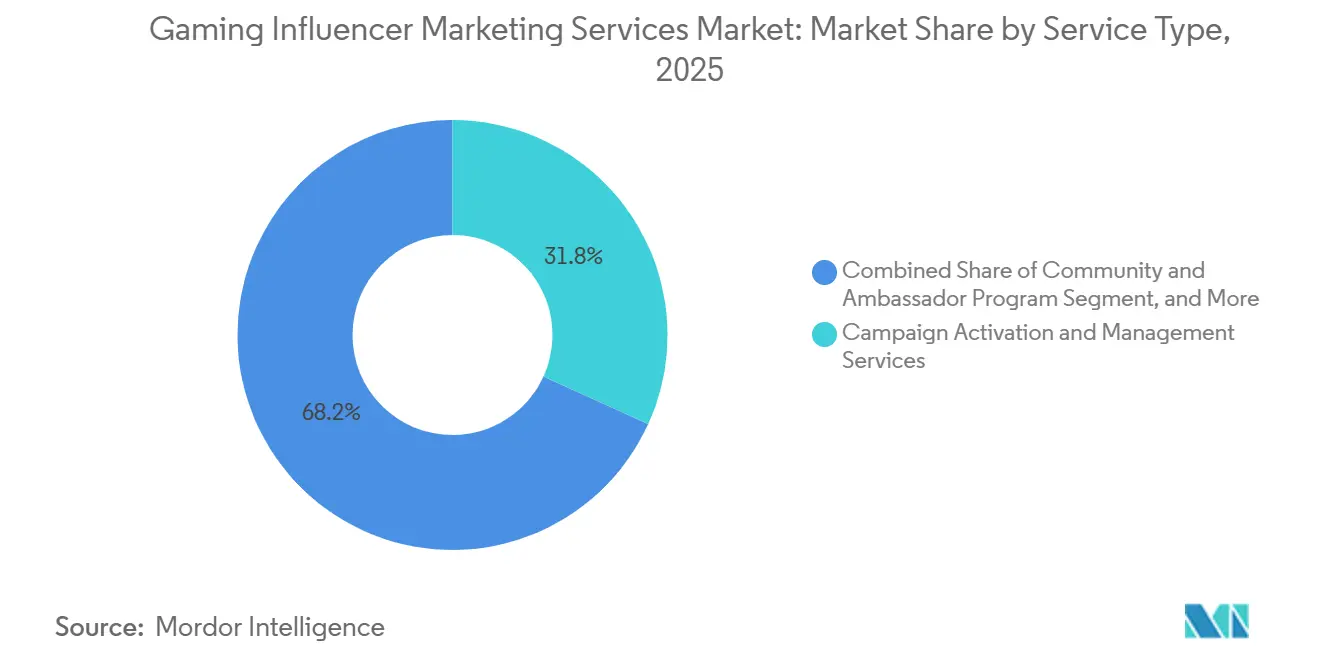
- By service type, Campaign Activation and Management Services held 31.80% of the Gaming Influencer Marketing Services Market share in 2025, while Analytics, Attribution, and Reporting Services are projected to expand at a 13.71% CAGR through 2031.
- By platform, YouTube held 38.60% of the Gaming Influencer Marketing Services Market share in 2025, while TikTok is projected to expand at a 13.98% CAGR through 2031.
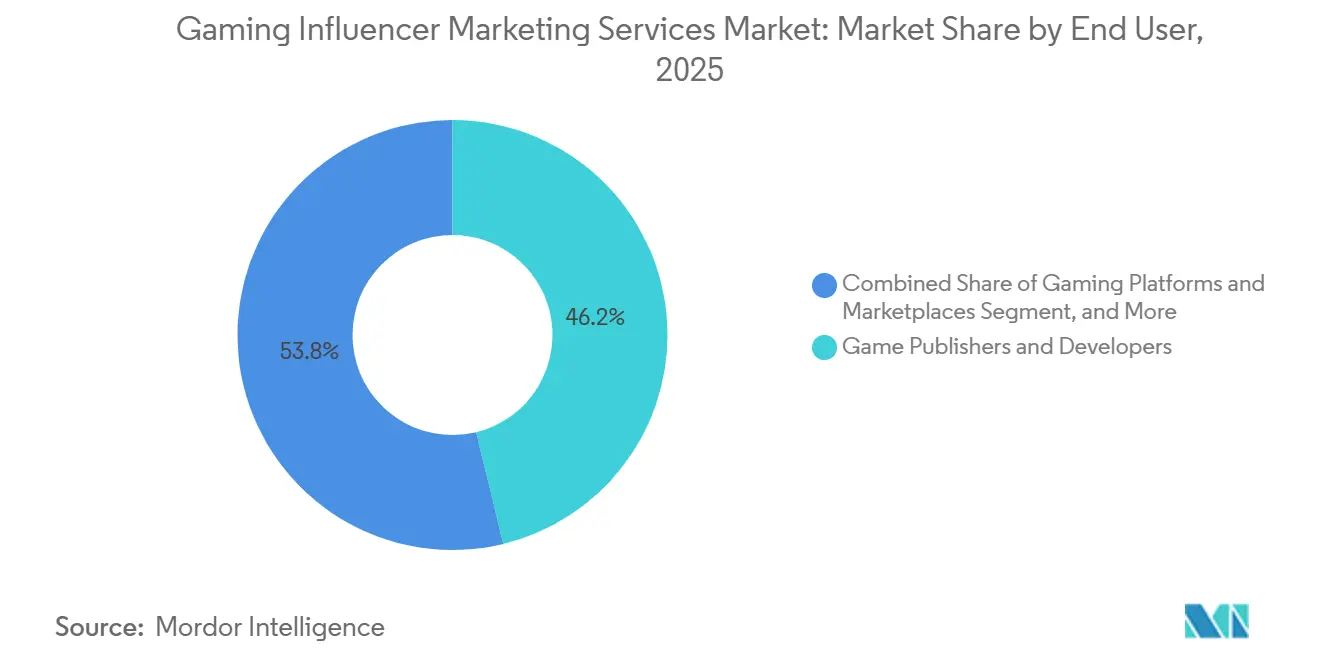
- By end user, Game Publishers and Developers held 46.20% of the Gaming Influencer Marketing Services Market share in 2025, while Non-Gaming Brands Targeting Gaming Audiences are projected to expand at a 13.84% CAGR through 2031.
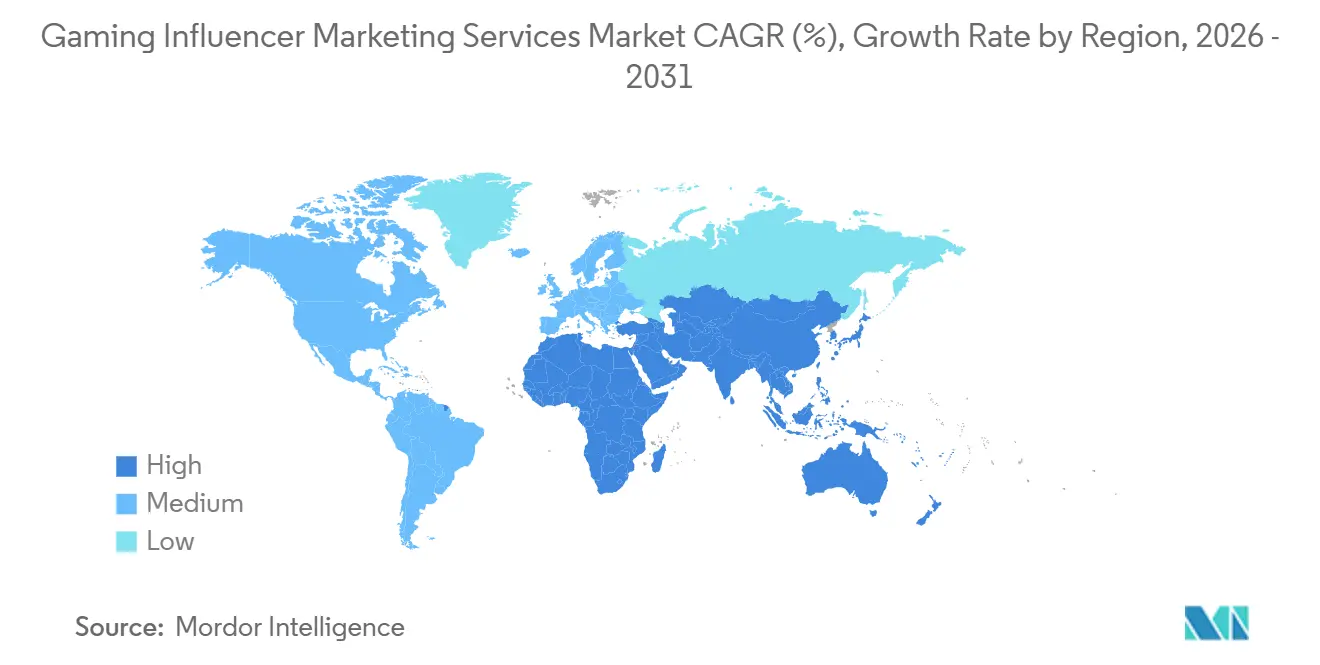
- By geography, North America held 39.40% of the Gaming Influencer Marketing Services Market share in 2025, while Asia-Pacific is projected to expand at a 13.93% CAGR through 2031.
Note: Market size and forecast figures in this report are generated using Mordor Intelligence’s proprietary estimation framework, updated with the latest available data and insights as of January 2026.
Market Trends and Insights
Drivers Impact Analysis of Gaming Influencer Marketing Services Market*
| Driver | (~) % Impact on CAGR Forecast | Geographic Relevance | Impact Timeline |
|---|---|---|---|
| Rising Ad Avoidance in Core Gaming Audiences | +2.8% | Global | Short term (≤ 2 years) |
| Growth of Live Streaming and Creator-Led Game Discovery | +2.5% | Global, particularly North America and Asia-Pacific | Medium term (2-4 years) |
| Expansion of Non-Endemic Brand Spend Into Gaming Communities | +2.0% | North America and Europe, spill-over to Asia-Pacific | Medium term (2-4 years) |
| Demand for Performance-Based User Acquisition Beyond Paid Social | +1.7% | Global, led by Asia-Pacific mobile gaming markets | Medium term (2-4 years) |
| Live-Service Content Calendars Expanding Creator Activation Windows | +1.3% | Global, particularly North America and Asia-Pacific | Long term (≥ 4 years) |
| Self-Serve Sponsorship Tools Reducing Campaign Setup Friction | +0.9% | Global, particularly SMB publishers in Asia-Pacific and South America | Long term (≥ 4 years) |
| Source: Mordor Intelligence | |||
Rising Ad Avoidance in Core Gaming Audiences
Gaming audiences often react negatively when advertising interrupts play or viewing. A 2025 journal study found that attitudes toward in-game advertising strongly shaped ad-avoidance behavior across gaming contexts. This behavior makes creator content more relevant because sponsored activity can be integrated with gameplay, reviews, and live conversations. The format allows a brand message to appear alongside content that viewers have already chosen to watch. The gaming influencer marketing services market benefits when publishers shift their attention from interruptive exposure to creator-led communication. Agencies can support this shift by matching creators with games and audiences that fit the campaign.
Growth of Live Streaming and Creator-Led Game Discovery
Live streaming remains an important way for viewers to discover games, follow updates, and form opinions about new releases. YouTube Gaming recorded 2.5 billion hours of gaming content watched during the third quarter of 2025. The same report stated that TikTok Live reached 9.1 billion hours watched during that quarter. Publishers can use Twitch and YouTube for longer launch activity, while TikTok Live and short video formats can support frequent updates. This creates recurring work in creator briefing, content scheduling, platform coordination, and campaign reporting. The gaming influencer marketing services market gains from this broader need for coordinated activity across several viewing formats.
Expansion of Non-Endemic Brand Spend into Gaming Communities
Financial services, automotive, insurance, luxury, and consumer goods brands are increasingly treating gaming communities as a communications channel. This change widens the client base beyond game publishers and gaming hardware companies. Non-gaming brands commonly need help identifying suitable creators and understanding the expectations of specific player communities. Their limited familiarity with gaming culture can increase demand for managed campaign services. Riot Games listed AWS, Cisco, Coinbase, Mastercard, and Mercedes-Benz among partners for the 2025 League of Legends World Championship. The gaming influencer marketing services market can benefit when these brands need support with creator selection, disclosure requirements, and brand suitability.
Demand for Performance-Based User Acquisition Beyond Paid Social
Mobile game publishers are placing more weight on the quality of acquired players, rather than on download volume alone. Creator content can show gameplay and set expectations before a viewer decides to install a game. This process can help publishers reach users who understand the game before downloading it. Attribution is still difficult when viewing and installation happen on different devices or at different times. The gaming influencer marketing services market, therefore, has room for providers that can connect creator activity with installs, in-game behavior, or other outcomes. These capabilities can be especially important for mobile publishers that evaluate campaigns through retention and player value.
Restraints Impact Analysis of Gaming Influencer Marketing Services Market*
| Restraint | (~) % Impact on CAGR Forecast | Geographic Relevance | Impact Timeline |
|---|---|---|---|
| Tightening Disclosure and Youth-Safety Rules for Sponsored Gaming Content | -1.3% | North America and Europe, increasingly Asia-Pacific | Short term (≤ 2 years) |
| Creator Fraud and Brand-Safety Risk in Gaming Niches | -1.0% | Global | Short term (≤ 2 years) |
| Cross-Platform Attribution Leakage from Second-Screen Viewing | -0.8% | Global | Medium term (2-4 years) |
| Rate Inflation Around Tentpole Launches and Event Spikes | -0.6% | North America and Europe | Short term (≤ 2 years) |
| Source: Mordor Intelligence | |||
Tightening Disclosure and Youth-Safety Rules for Sponsored Gaming Content
Disclosure obligations can raise the operating requirements for sponsored gaming content. The Federal Trade Commission states that influencers should clearly disclose material relationships with brands.[1] This includes relationships involving payment, free products, game keys, or early access. Agencies need processes that make disclosures clear in streams, videos, and social posts. Youth audiences require particular care because advertising and data practices are subject to additional restrictions. The gaming influencer marketing services market faces added campaign friction, but providers with reliable compliance workflows can reduce risk for clients.
Creator Fraud and Brand-Safety Risk in Gaming Niches
Gaming campaigns can be exposed to inflated engagement, impersonation, unsuitable content, and artificial audiences. These risks complicate creator selection because follower totals may not show whether an audience is authentic or relevant. Brand safety also depends on the content context, the game community, and the creator’s conduct over time. Providers must examine audience quality and validate activity before approving campaign partners. This work can increase campaign costs and delay launch decisions. The gaming influencer marketing services market is therefore under pressure to improve creator verification and brand-suitability controls.
*Our forecasts treat driver/restraint impacts as directional, not additive. The impact forecasts reflect baseline growth, mix effects, and variable interactions.
Gaming Influencer Marketing Services Market Segment Analysis
By Service Type:
Campaign Execution Leads Spending While Analytics ExpandsCampaign Activation and Management Services held 31.80% of the Gaming Influencer Marketing Services Market share in 2025. The segment covers the practical work required to run creator campaigns around launches, updates, and downloadable content. Publishers often have a limited period to create awareness when a major title is released. They need coordinated creator briefing, key distribution, platform support, content delivery, and post-campaign review. This service is also relevant when brands use Twitch Drops or similar initiatives that link viewing activity with in-game rewards. The segment remains important because campaign execution requires close coordination across creators, publishers, platforms, and player communities.
Influencer Sourcing and Contracting Services serve clients that do not maintain large internal creator networks. Content Production and Creative Services help convert a campaign plan into material that fits a creator’s audience and the game itself. Community and Ambassador Program Services support ongoing contact with creators throughout a live-service game’s lifecycle. Lurkit stated that Bohemia Interactive’s Frostline DLC program onboarded more than 1,100 creators through its platform.[2] Analytics, Attribution and Reporting Services is projected to grow at a 13.71% CAGR from 2026 to 2031. This part of the Gaming Influencer Marketing Services Market size is supported by clients that want clearer links between creator activity and commercial results. Campaign Strategy and Planning Services can also remain relevant where non-gaming brands need guidance on creator tiers, audience fit, and campaign timing.

By Platform:
YouTube Leads While TikTok Changes DiscoveryYouTube accounted for 38.60% of the Gaming Influencer Marketing Services Market share in 2025. Its role encompasses live streams, longer reviews, tutorials, and searchable videos that remain visible after launch. This makes the platform useful for both immediate campaign attention and ongoing game discovery. YouTube creators can explain gameplay systems in more detail than short-form formats usually allow. Publishers can also use the platform to support updates, downloadable content, and community milestones. The platform’s continuing importance supports demand for services that manage creator selection, campaign timing, and performance reporting.
TikTok is projected to grow at a 13.98% CAGR from 2026 to 2031. Short-form content can introduce gameplay, characters, or gaming accessories in a format that supports rapid discovery. TikTok Live also offers live interaction for creators and viewers. Twitch remained important for real-time community activation despite its lower share of live-streaming viewership in the third quarter of 2025. Twitch Drops can connect sponsored viewing with player participation through in-game rewards. Instagram has a separate role in lifestyle and peripheral campaigns, while newer platforms can offer additional reach but may require stronger safety review. The gaming influencer marketing services market must therefore support different content styles, measurement approaches, and audience expectations across platforms.
By End User:
Publishers Led Demand While Non-Gaming Brands GrowGame Publishers and Developers held 46.20% of the Gaming Influencer Marketing Services Market share in 2025. These buyers use creator campaigns for launches, live-service updates, downloadable content, and player acquisition. Mobile studios can work with many smaller creators in performance-focused programs. PC and console publishers can use larger creator programs during narrow launch periods. Hardware and peripheral manufacturers require creators whose audiences understand gaming setups and product features. Esports organizations and teams need creators who can communicate team stories and competitive gaming topics to involved audiences.
Non-Gaming Brands Targeting Gaming Audiences is projected to grow at a 13.84% CAGR from 2026 to 2031. These clients often lack established creator relationships and detailed knowledge of game genres. They may also need additional support with audience expectations, content suitability, and disclosure practices. This creates demand for agencies that can handle planning and execution without requiring the client to build a specialized internal team. The segment includes brands from financial services, automotive, insurance, and consumer goods categories. The gaming influencer marketing services industry can expand its client base by continuing to engage gaming communities in broader brand programs. Providers that combine cultural understanding with campaign controls are likely to be better positioned for this demand.
Geography Analysis
North America Gaming Influencer Marketing Services Market
North America held 39.40% of the Gaming Influencer Marketing Services Market share in 2025. The region has a large concentration of publishers, talent managers, performance marketing firms, and creator networks. Its regulatory environment also raises the value of agencies that can manage sponsored-content disclosures. The Federal Trade Commission’s guidance requires clear disclosure of a material connection between a brand and an influencer. This helps explain the need for formal campaign processes in youth-oriented gaming activity.
Europe and APAC Gaming Influencer Marketing Services Market
Europe is another important cluster for PC and console gaming, esports sponsorship, and peripheral marketing. Germany, the United Kingdom, France, and Spain contribute to campaign demand across these activities. The 2025 Esports World Cup partner-club program recorded 106 unique brands across European teams.[3] Europe also has a wider range of creator platforms that agencies must support. Asia-Pacific is projected to grow at a 13.93% CAGR from 2026 to 2031. Southeast Asia relies heavily on mobile gaming and short-form video, while Japan and South Korea have distinct creator ecosystems and platform preferences. These conditions require local relationships and platform-specific operating knowledge.
South America and MEA Gaming Influencer Marketing Services Market
South America has a smaller share but remains relevant, especially in Brazil. Localization is important because campaigns from foreign publishers can lose relevance when they do not use local creators or Portuguese-language communication. The Middle East gained visibility through Saudi Arabia’s support for the Esports World Cup, which recorded 168 million hours watched in 2025. Africa remains at an earlier stage in structured influencer marketing services. South Africa, Nigeria, and Kenya represent potential entry points, although measurement tools and creator monetization infrastructure remain limited. The gaming influencer marketing services market will need localized campaign design as gaming communities develop differently across these regions.
Competitive Landscape
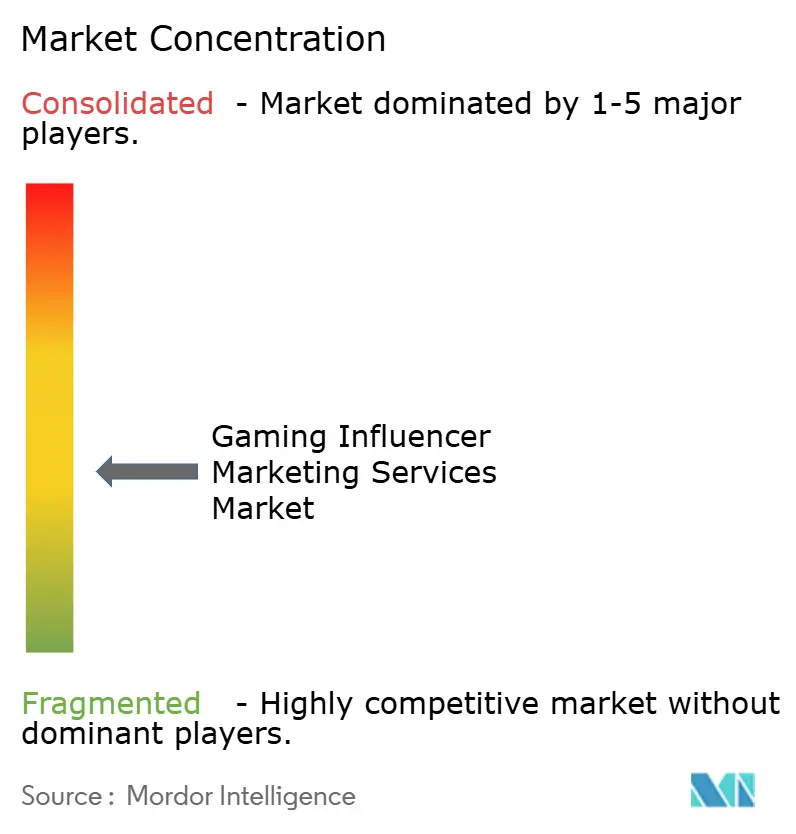
The gaming influencer marketing services market is fragmented across gaming specialist agencies, general influencer platforms, and gaming technology companies with managed-service offerings. GameSquare Holdings, Inc., Stream Hatchet, S.L.U., BEN Group, Inc., and GameInfluencer are examples of gaming-focused agencies. NeoReach and Viral Nation operate broader influencer platforms that include gaming activity. GameSquare Holdings combines managed services with gaming-related technology and media assets. No single provider has a leading position across creator discovery, fraud review, attribution, and live-service program management. Clients can therefore use more than 1 provider when their requirements cover several service areas.
GameSquare has pursued a more integrated model through FaZe Clan, Stream Hatchet, Click Management, and TubeBuddy. The company stated that its Click Management roster had approached 100 creator relationships. It also announced an agreement to acquire TubeBuddy in February 2026. This approach brings creator management, analytics, esports media, and channel support closer together. Razer acquired StreamElements' assets in July 2026, adding a creator-tooling and streaming-overlay platform to its portfolio.[4] These moves show how companies in the gaming value chain are seeking closer links to creator tools and audience data.
Attribution remains difficult when a viewer watches content on one device and completes an action on another device later. This leaves room for providers that can improve links between creator activity and storefront outcomes. Brand safety and audience verification are also becoming more relevant to clients that seek reliable creator programs. Agencies that invest in tracking, suitability review, and campaign operations may differentiate themselves in a fragmented field. The competitive position of each firm can vary by platform, geography, and client type.
Gaming Influencer Marketing Services Industry Leaders
-
GameSquare Holdings, Inc.
-
Stream Hatchet, S.L.U.
-
BEN Group, Inc.
-
Wehype Global AB
-
GameInfluencer GmbH
- *Disclaimer: Major Players sorted in no particular order
Gaming Influencer Marketing Services Market Companies Covered in this Report
- GameSquare Holdings, Inc.
- Stream Hatchet, S.L.U.
- BEN Group, Inc.
- Wehype Global AB
- GameInfluencer GmbH
- Viral Nation Inc.
- Derfit Enterprises Limited
- Kairos Media Ltd
- Socially Powerful Ltd
- Audiencly GmbH
- Mediabodies Limited
- Connect Management Ltd
- Valen Agency
- Disrupt Limited
- Madeviral Pte. Ltd.
- NeoReach Inc.
Recent Industry Developments in Gaming Influencer Marketing Services Market
- July 2026: Razer acquired the assets of StreamElements from Live Momentum Ltd, securing ownership of a cloud-based creator tooling and streaming overlay platform used by 2.6 million creators daily. Razer plans to operate StreamElements in its current form, integrating creator ecosystem data into its broader hardware and services portfolio.
- June 2026: GameSquare Holdings signed SypherPK, one of the world’s largest Fortnite gaming creators, to its Click Management talent roster, following the earlier addition of Steak, the second-largest Roblox creator. The additions expanded GameSquare’s creator network across two of gaming’s highest-engagement communities.
- February 2026: GameSquare Holdings entered into an asset purchase agreement with BENlabs to acquire TubeBuddy, an AI-enabled software and workflow platform for YouTube channel optimization, in exchange for 5 million shares of Series A-2 Preferred Stock. The acquisition added an estimated USD 3 million of EBITDA and expanded GameSquare’s creator enablement and audience analytics capabilities.
- March 2025: Stream Hatchet, a wholly owned subsidiary of GameSquare Holdings, signed its largest campaign contract to date with Capcom to support the launch of Monster Hunter Wilds. The game reached 1.3 million concurrent users on Steam at launch and became Capcom’s fastest-selling game.
Global Gaming Influencer Marketing Services Market Report Scope
The gaming influencer marketing services market comprises services that connect gaming brands, publishers, developers, esports organizations, and related stakeholders with gaming influencers and content creators to promote products, games, platforms, events, and campaigns across digital and social media channels.
The Gaming Influencer Marketing Services Market Report is Segmented by Service Type (Campaign Strategy and Planning Services, Influencer Sourcing and Contracting Services, Campaign Activation and Management Services, Content Production and Creative Services, Community and Ambassador Program, and Analytics, Attribution and Reporting Services), Platform (YouTube, Twitch, TikTok, Instagram, and Other Platforms), End User (Game Publishers and Developers, Esports Organizations and Teams, Gaming Platforms and Marketplaces, Gaming Hardware and Peripheral Manufacturers, and Non-Gaming Brands Targeting Gaming Audiences), and Geography (North America, South America, Europe, Asia-Pacific, Middle East, and Africa). The Market Forecasts are Provided in Terms of Value (USD).
Segmentation Overview
| Campaign Strategy and Planning Services |
| Influencer Sourcing and Contracting Services |
| Campaign Activation and Management Services |
| Content Production and Creative Services |
| Community and Ambassador Program |
| Analytics, Attribution and Reporting Services |
| YouTube |
| Twitch |
| TikTok |
| Other Platforms |
| Game Publishers and Developers |
| Esports Organizations and Teams |
| Gaming Platforms and Marketplaces |
| Gaming Hardware and Peripheral Manufacturers |
| Non-Gaming Brands Targeting Gaming Audiences |
| North America | United States |
| Canada | |
| Mexico | |
| South America | Brazil |
| Argentina | |
| Colombia | |
| Rest of South America | |
| Europe | Germany |
| United Kingdom | |
| France | |
| Italy | |
| Spain | |
| Russia | |
| Rest of Europe | |
| Asia-Pacific | China |
| Japan | |
| South Korea | |
| India | |
| Australia | |
| Indonesia | |
| Thailand | |
| Vietnam | |
| Rest of Asia-Pacific | |
| Middle East | Saudi Arabia |
| United Arab Emirates | |
| Turkey | |
| Rest of Middle East | |
| Africa | South Africa |
| Egypt | |
| Nigeria | |
| Kenya | |
| Rest of Africa |
| By Service Type | Campaign Strategy and Planning Services | |
| Influencer Sourcing and Contracting Services | ||
| Campaign Activation and Management Services | ||
| Content Production and Creative Services | ||
| Community and Ambassador Program | ||
| Analytics, Attribution and Reporting Services | ||
| By Platform | YouTube | |
| Twitch | ||
| TikTok | ||
| Other Platforms | ||
| By End User | Game Publishers and Developers | |
| Esports Organizations and Teams | ||
| Gaming Platforms and Marketplaces | ||
| Gaming Hardware and Peripheral Manufacturers | ||
| Non-Gaming Brands Targeting Gaming Audiences | ||
| By Geography | North America | United States |
| Canada | ||
| Mexico | ||
| South America | Brazil | |
| Argentina | ||
| Colombia | ||
| Rest of South America | ||
| Europe | Germany | |
| United Kingdom | ||
| France | ||
| Italy | ||
| Spain | ||
| Russia | ||
| Rest of Europe | ||
| Asia-Pacific | China | |
| Japan | ||
| South Korea | ||
| India | ||
| Australia | ||
| Indonesia | ||
| Thailand | ||
| Vietnam | ||
| Rest of Asia-Pacific | ||
| Middle East | Saudi Arabia | |
| United Arab Emirates | ||
| Turkey | ||
| Rest of Middle East | ||
| Africa | South Africa | |
| Egypt | ||
| Nigeria | ||
| Kenya | ||
| Rest of Africa | ||
Key Questions Answered in the Report
What is the size of the Gaming Influencer Marketing Services Market?
The Gaming Influencer Marketing Services Market size is projected to increase from USD 2.36 billion in 2026 to USD 4.34 billion by 2031, at a 12.96% CAGR.
Which service type leads spending?
Campaign Activation and Management Services led with 31.80% share in 2025, reflecting demand for coordinated creator campaign execution.
Which platform has the largest share?
YouTube held 38.60% share in 2025 because it supports live content, reviews, tutorials, and searchable gaming videos.
Which end user is expanding most quickly?
Non-Gaming Brands Targeting Gaming Audiences is projected to grow at a 13.84% CAGR through 2031.
Which region is growing fastest?
Asia-Pacific is projected to grow at a 13.93% CAGR from 2026 to 2031, supported by mobile gaming and varied local creator ecosystems.
What challenges do service providers face?
Key challenges include sponsored-content disclosures, audience authenticity, brand suitability, and cross-device attribution.