
Gait Biometrics Market Size and Share
Market Overview
| Study Period | 2021 - 2032 |
|---|---|
| Market Size (2027) | USD 1.62 Billion |
| Market Size (2032) | USD 2.81 Billion |
| Growth Rate (2027 - 2032) | 11.64 % |
| Fastest Growing Market | Asia-Pacific |
| Largest Market | North America |
| Market Concentration | Medium |
Major Players *Disclaimer: Major Players sorted in no particular order Image © Mordor Intelligence. Reuse requires attribution under CC BY 4.0. | |
Gait Biometrics Market Analysis by Mordor Intelligence
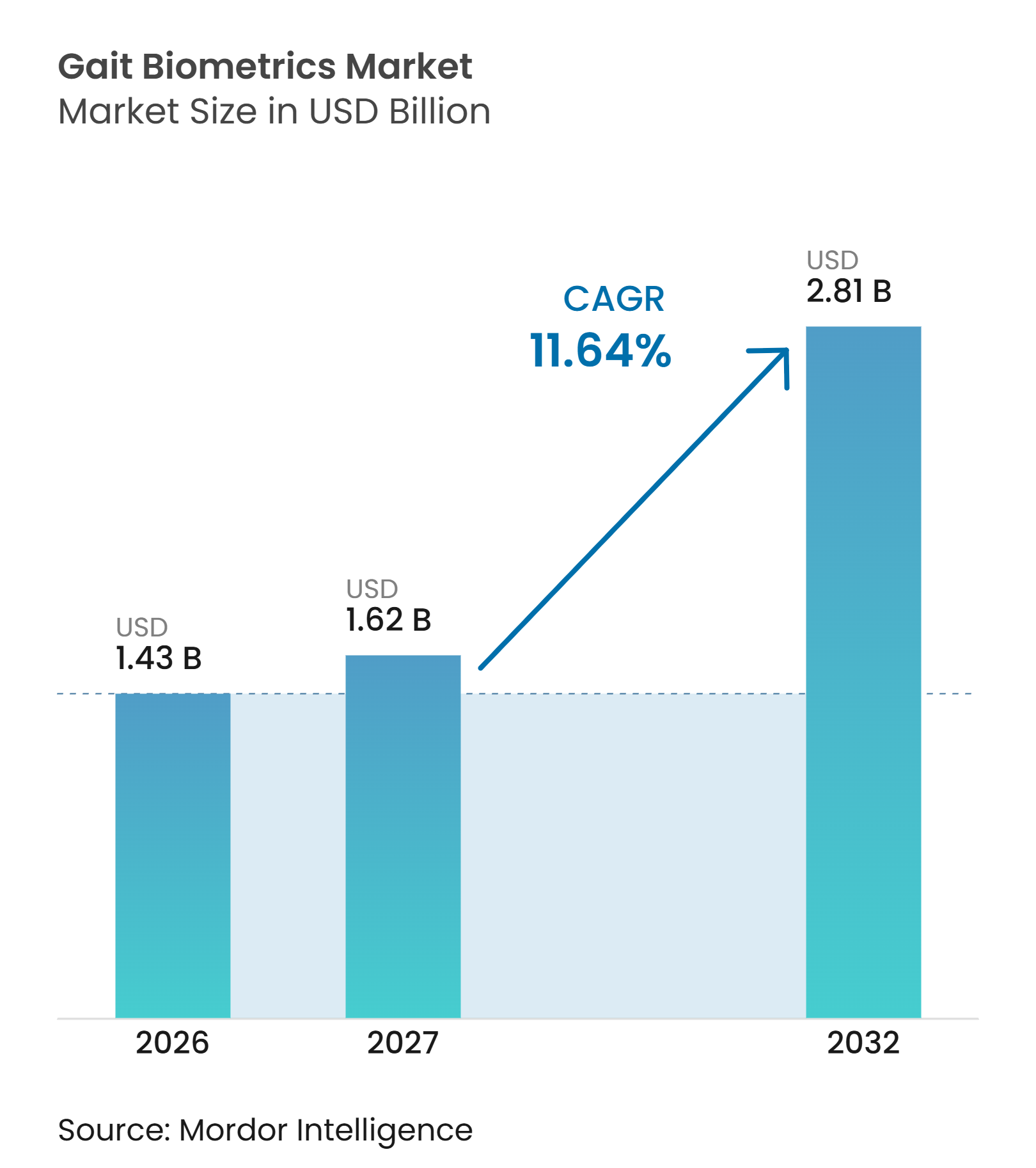
The Gait Biometrics Market size is expected to increase from USD 1.43 billion in 2026 to USD 1.59 billion in 2027 and reach USD 2.81 billion by 2032, growing at a CAGR of 11.64% over 2027-2032. Demand is shifting toward identity tools that work from a distance and do not depend on subject cooperation. Government security programs remain important, while healthcare monitoring is creating a separate source of demand. Software platforms are gaining value as buyers seek recurring analytics services rather than periodic hardware replacements. Edge processing is also becoming more useful where operators need lower latency and tighter control of biometric data. The Gait Biometrics Market faces different conditions by region because privacy rules can limit surveillance uses while healthcare adoption continues.
Key Report Takeaways
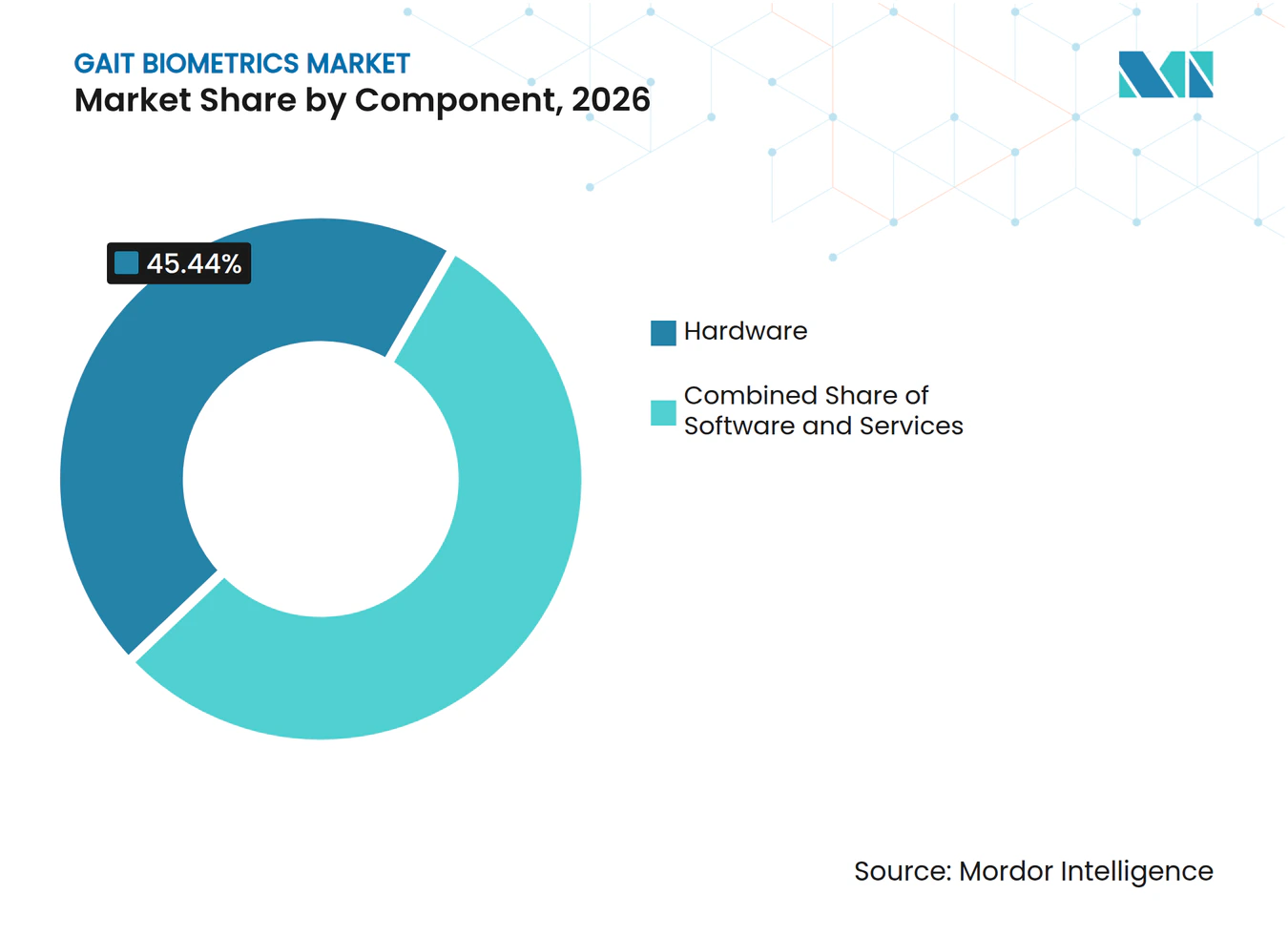
- By component, hardware held 45.44% of the Gait Biometrics Market share in 2026, while software is projected to expand at an 11.92% CAGR through 2032.
- By technology, computer vision techniques held 54.27% of the Gait Biometrics Market share in 2026, while sensor fusion and multimodal analytics is projected to expand at an 11.86% CAGR through 2032.
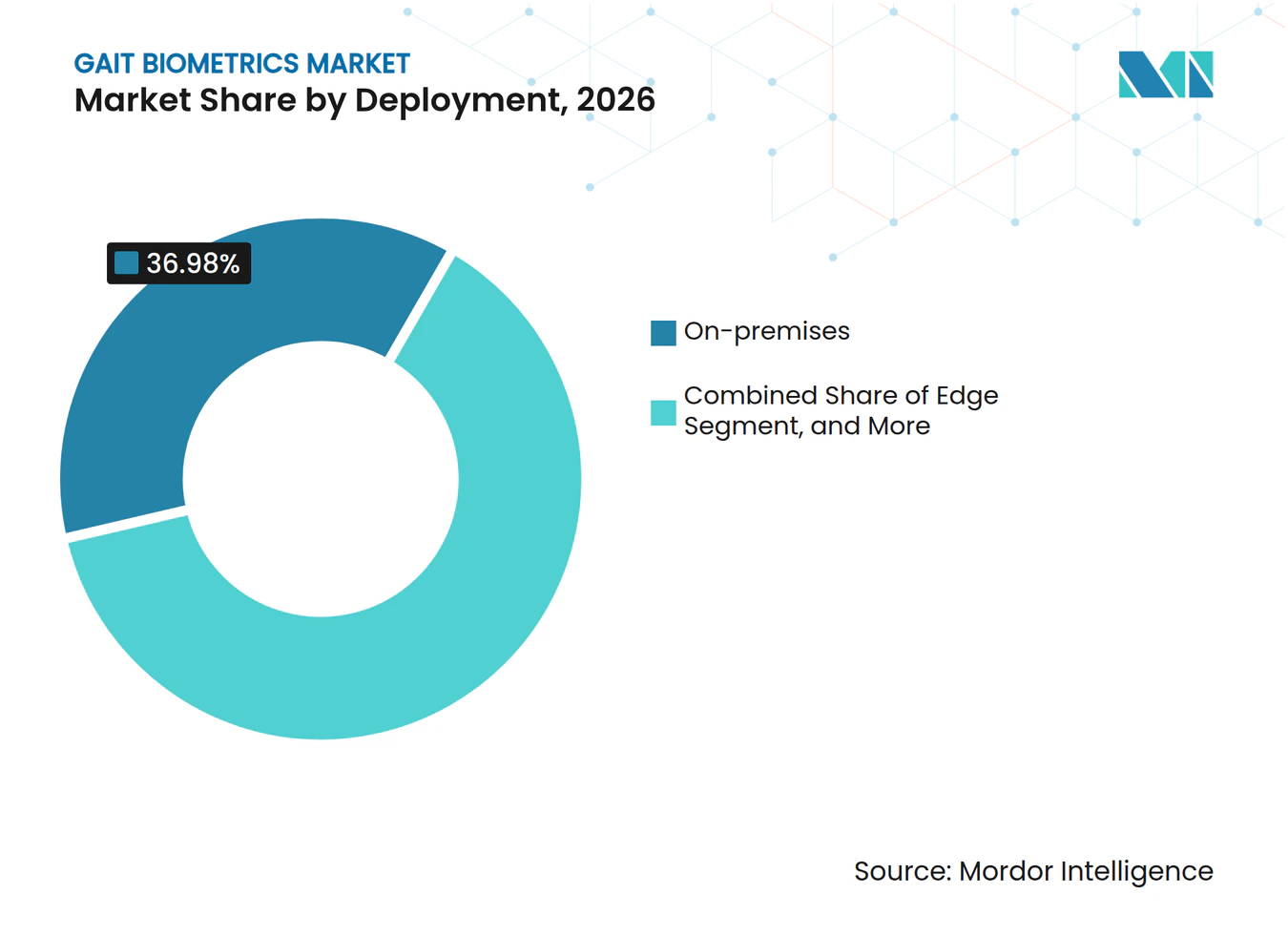
- By deployment, on-premises held 36.98% of the Gait Biometrics Market share in 2026, while edge deployment is projected to expand at a 12.32% CAGR through 2032.
- By authentication mode, identification and re-identification held 40.29% of the Gait Biometrics Market share in 2026, while passive and continuous authentication is projected to expand at a 12.11% CAGR through 2032.
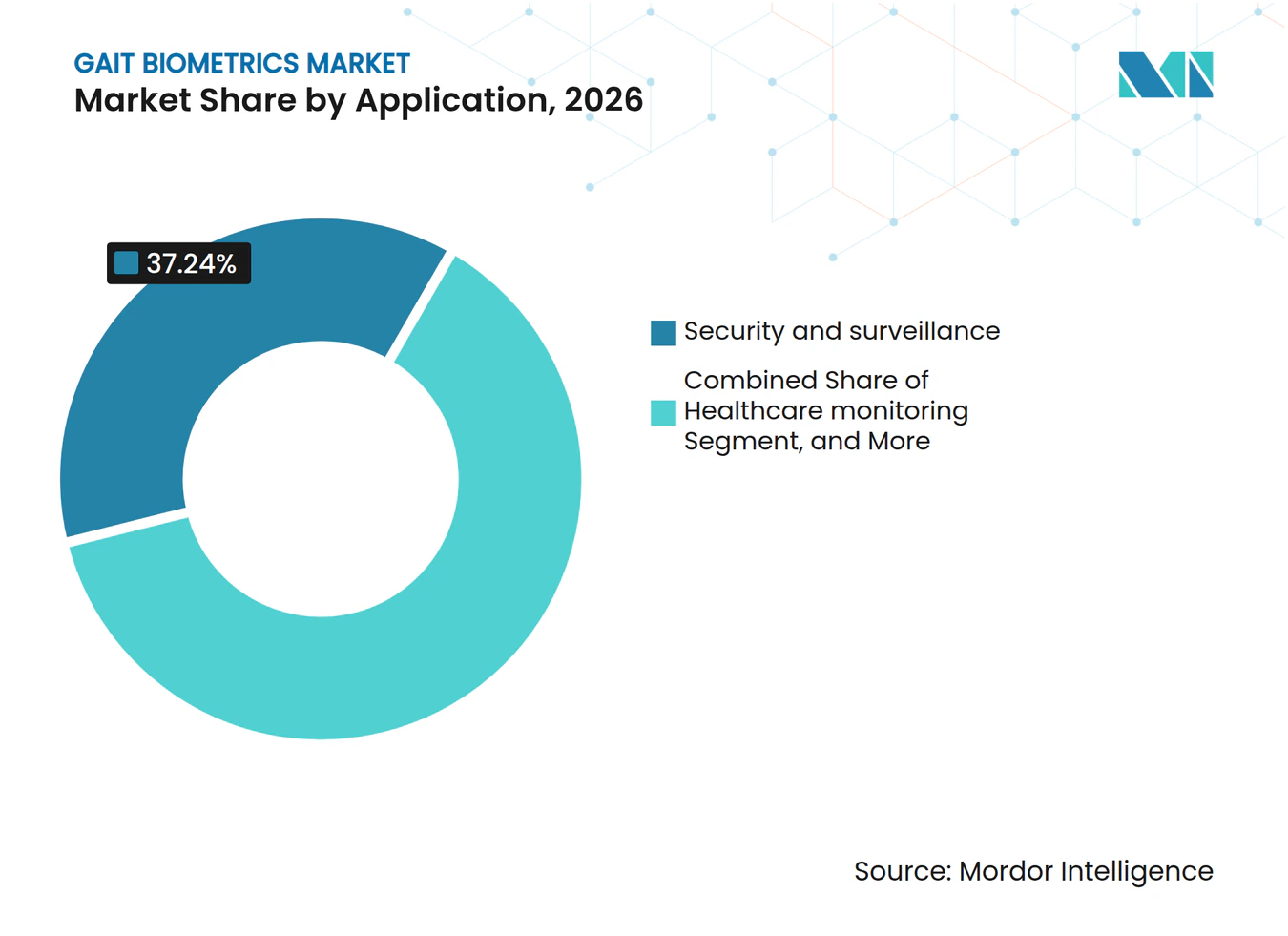
- By application, security and surveillance held 37.24% of the Gait Biometrics Market share in 2026, while healthcare monitoring and rehabilitation is projected to expand at a 12.42% CAGR through 2032.
- By end user, government and law enforcement held 32.14% of the Gait Biometrics Market share in 2026, while healthcare providers and hospitals is projected to expand at a 12.33% CAGR through 2032.
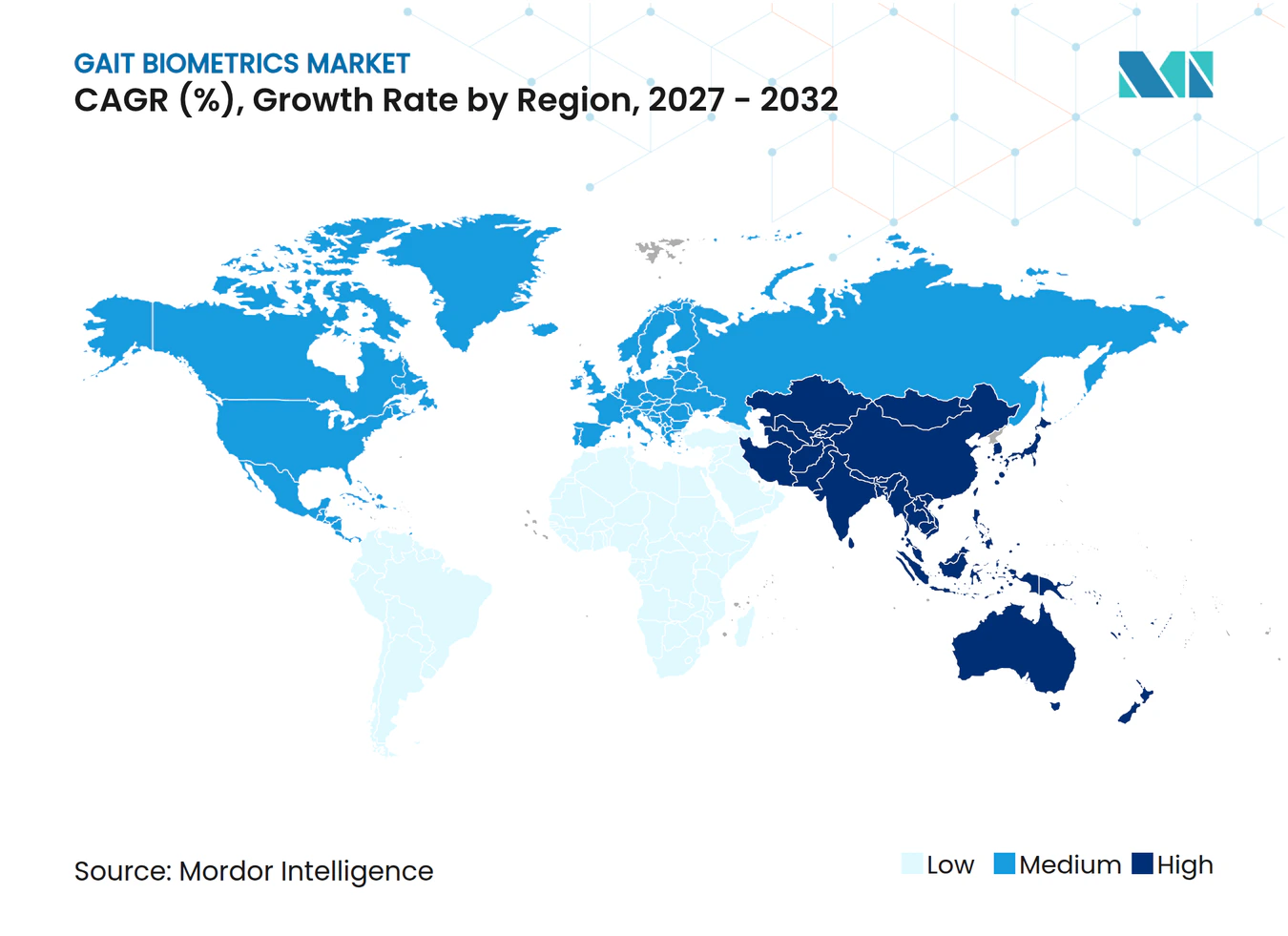
- By geography, North America held 33.26% of the Gait Biometrics Market share in 2026, while Asia-Pacific is projected to expand at a 12.16% CAGR through 2032.
Note: Market numbers in this report are based on Mordor Intelligence's proprietary estimation framework, which combines nine months of actuals with Q4 projections for base year 2026.
Market Trends and Insights
Drivers Impact Analysis of Gait Biometrics Market*
| Driver | (~) % Impact on CAGR Forecast | Geographic Relevance | Impact Timeline |
|---|---|---|---|
| Rising Demand for Contactless, Long-Distance Identity Verification | 3.20% | Global | Short term (≤ 2 years) |
| Expansion of AI-Enabled Video Surveillance and Smart-City Infrastructure | 2.80% | Global | Medium term (2-4 years) |
| Growth in Remote Gait Monitoring for Neurological and Aging-Related Care | 2.10% | North America and Europe | Medium term (2-4 years) |
| Smartphone and Wearable Sensor Ubiquity Enabling Low-Friction Capture | 1.60% | Global | Short term (≤ 2 years) |
| Edge Computing Reducing Latency and Raw-Video Transfer Requirements | 1.20% | Asia-Pacific core, spillover to Middle East and Africa | Medium term (2-4 years) |
| Privacy-Preserving Gait Representations Enabling New Deployments | 0.80% | Global, led by Europe | Long term (≥ 4 years) |
| Source: Mordor Intelligence | |||
Rising Demand for Contactless, Long-Distance Identity Verification
Gait analysis changes the usual requirement for a person to stand close to a sensor or cooperate with a check. This makes the Gait Biometrics Market relevant for facilities where movement cannot be paused for a standard biometric scan. Border crossings, airports, transit hubs, and large public venues need identity methods that fit existing movement patterns. Contactless systems can complement face, iris, and fingerprint tools when masks, distance, or limited cooperation complicate verification. NEC developed walk-through face and iris recognition technology for people moving at up to 6 km/h, indicating a broader shift toward recognition in motion.[1] Such deployments favor platforms that combine several identity signals within a single operating process.
Expansion of AI-Enabled Video Surveillance and Smart-City Infrastructure
Smart-city programs create a continuing demand base for video analytics and identity infrastructure. Their value to suppliers comes from multi-year installations rather than isolated equipment purchases. Camera networks also give providers a practical route to deploy computer vision tools without replacing every endpoint. The Gait Biometrics Market can benefit when cities seek functions that use their established surveillance networks more effectively. Large suppliers can create high switching costs when analytics, storage, access controls, and maintenance are delivered as one platform. This structure can divide regional opportunities because public procurement rules and approved vendor lists differ widely.
Growth in Remote Gait Monitoring for Neurological and Aging-Related Care
Healthcare demand is less dependent on security spending cycles and is based on clinical monitoring needs. Gait assessment can support observation of Parkinson's disease, multiple sclerosis, stroke recovery, and fall risk. A 2025 Neurology publication examined gait analysis across neurologic disorders, supporting its place in clinical assessment discussions.[2] Remote monitoring also helps care teams review functional change between in-person visits. Wearable sensors can record repeated measures in home settings, which may give clinicians a broader view of daily mobility. Aging populations and pressure to reduce unnecessary visits support demand for validated monitoring tools in the Gait Biometrics Market.
Smartphone and Wearable Sensor Ubiquity Enabling Low-Friction Capture
Phones, tablets, and wearables contain cameras, accelerometers, and gyroscopes that can collect movement information. These devices reduce the need for specialized capture equipment in some clinical and consumer settings. Lower capture costs can encourage software providers to offer assessment and analytics through subscription models. That shift may put pressure on suppliers whose revenue relies mainly on dedicated sensing hardware. The Gait Biometrics Market can therefore serve both high-specification clinical systems and lower-cost software-led products. Clinical buyers will still require repeatable measurement, validation, and appropriate data controls before adopting consumer-device workflows.
Restraints Impact Analysis of Gait Biometrics Market*
| Restraint | (~) % Impact on CAGR Forecast | Geographic Relevance | Impact Timeline |
|---|---|---|---|
| Privacy, Consent, and Biometric-Surveillance Compliance Burden | -1.4% | Global, primarily Europe and North America | Medium term (2-4 years) |
| Accuracy Degradation from Clothing, Footwear, Occlusion, and Viewpoint Changes | -1.1% | Global | Short term (≤ 2 years) |
| High Total Cost of Ownership for Multi-Camera and Edge Infrastructure | -0.9% | Asia-Pacific and Middle East and Africa | Long term (≥ 4 years) |
| Limited Interoperability and Standardization Across Sensors and Models | -0.7% | Global | Long term (≥ 4 years) |
| Source: Mordor Intelligence | |||
Privacy, Consent, and Biometric-Surveillance Compliance Burden
Privacy law can materially affect where and how gait recognition systems are used. The EU AI Act places strict limits on real-time remote biometric identification for law enforcement and establishes requirements for high-risk uses. The European Union Agency for Fundamental Rights has also called for legal authorization, independent oversight, and protection for people in lawful assemblies.[3] GDPR treats biometric data used for unique identification as special-category personal data, requiring a valid legal basis and safeguards. Organizations in the United States must also consider state and local biometric privacy obligations. These conditions add review time, governance work, and system-design requirements for Gait Biometrics Market participants.
Accuracy Degradation From Clothing, Footwear, Occlusion, and Viewpoint Changes
Gait patterns can change when a person wears different clothing or footwear or carries items. Camera angle, poor lighting, occlusion, and crowd density can also reduce system performance. These factors create a gap between controlled testing results and operating conditions in public spaces. A 2025 study on thermal-array gait recognition addressed privacy-aware re-identification under challenging sensing conditions. Thermal, depth, and RGB sensor combinations may improve reliability across changing conditions. However, added sensing hardware and computing requirements can increase total deployment costs for the Gait Biometrics Market.
*Our forecasts treat driver/restraint impacts as directional, not additive. The impact forecasts reflect baseline growth, mix effects, and variable interactions.
Gait Biometrics Market Segment Analysis
By Component:
Hardware Infrastructure Leads as Software Monetization AcceleratesHardware held 45.44% of the Gait Biometrics Market share in 2026. The segment includes camera arrays, depth sensors, floor pressure grids, and inertial measurement units. Large surveillance systems need many endpoints, which creates considerable initial equipment demand. Clinical and sports users also buy wearable tracking devices for repeated movement measurement. Hardware suppliers benefit when organizations update facilities or add sites. These installations can require calibration, integration, and support before operations begin. The installed base gives established equipment vendors an important role in procurement decisions. It also creates an entry point for analytics providers that can work with existing devices.
Software is projected to expand at an 11.92% CAGR through 2032 within the Gait Biometrics Market. Recognition algorithms can be licensed without requiring customers to replace every camera or sensor. This model supports recurring revenue through analytics subscriptions and software updates. Government and healthcare customers may prefer contracts that combine software, integration, maintenance, and data governance services. Services also benefit from complex installations that use more than 1 sensor type. Compliance documentation can become a meaningful part of delivery where sensitive biometric data is involved. Software-led offerings can shorten refresh cycles because model upgrades do not require a complete physical rebuild. The balance of value may therefore move toward algorithm quality, workflow design, and deployment support.



By Technology:
Computer Vision Techniques Lead as Sensor Fusion Redefines Accuracy BenchmarksComputer vision techniques accounted for 54.27% of the Gait Biometrics Market share in 2026. Their position reflects the wide installed base of IP cameras in security environments. Suppliers use silhouette, skeleton, pose estimation, and depth imaging methods to extract movement features. Standard cameras can support some pose-based workflows without additional sensing equipment. This compatibility helps buyers extend existing video infrastructure. Machine learning algorithms operate across both camera-led and sensor-led methods. They should be viewed as a capability that supports several technology approaches. The segment remains closely tied to public security and identity uses.
Sensor fusion and multimodal analytics are projected to expand at an 11.86% CAGR through 2032. These approaches combine data from modalities such as RGB video, depth, thermal sensing, and wearable motion sensors. Their main purpose is to reduce errors caused by lighting, viewpoint, and changing personal conditions. The Gait Biometrics Market size for sensor fusion benefits when buyers need more dependable operation outside controlled settings. Research on thermal-array recognition highlights an alternative that can reduce dependence on high-definition RGB imagery. Cross-sensor learning is relevant when an organization must work across different sites and device types. These systems need stronger integration and testing than single-modality products. Their appeal rests on accuracy, privacy considerations, and operational resilience.
By Deployment:
On-Premises Dominates While Edge Accelerates Past CloudOn-premises deployment held 36.98% of the Gait Biometrics Market share in 2026. Government and law enforcement users often need to keep biometric identities within controlled environments. Defense and critical infrastructure operators may also require systems that function during communications disruption. These requirements support local servers and air-gapped architectures. On-premises systems give operators direct control over storage, access, and data movement. They may also align more easily with data sovereignty requirements. Cloud systems offer scalability for distributed healthcare networks and other multisite users. However, localization rules and sensitive-data concerns can slow their adoption in some jurisdictions.
Edge deployment is projected to expand at a 12.32% CAGR through 2032. It processes biometric information near the point of capture rather than sending all video to a central service. This can lower latency for border lanes, access points, and crowd-monitoring operations. It can also reduce raw video transfers over networks. A 2025 Scientific Reports article evaluated real-time multi-person gait recognition at the edge. The Gait Biometrics Market size for edge systems is supported by dedicated AI processors and improving energy efficiency. Edge architectures can help organizations limit the movement of sensitive source data. They still require careful device management, security updates, and local capacity planning.

By Authentication Mode:
Identification and Re-Identification Anchors the Market as Passive Authentication Gains GroundIdentification and re-identification held 40.29% of the Gait Biometrics Market share in 2026. These uses support the tracking of people across separate camera views and locations. Airports, transit hubs, and public security operators value this capability for investigation and movement analysis. Active authentication is used in cases where a person knowingly verifies their identity for access. That method is better suited to controlled enterprise settings with clear user intent. It can supplement card, badge, or other identity checks. Subject awareness may simplify some compliance questions when compared with remote identification. Each mode requires policies that define its purpose, retention, access, and error response.
Passive and continuous authentication is projected to expand at a 12.11% CAGR through 2032. It gives security teams a way to review identity assurance over time rather than only at login. This can be useful when a credential remains active after initial verification. A 2025 ACM paper reported an adaptive gait-authentication system for mobile and wearable settings. The Gait Biometrics Market can gain from enterprise interest in reducing impersonation risk. Passive systems must still avoid creating unnecessary monitoring of users. Clear consent, proportionate use, and reliable error handling will influence adoption. The segment's progress depends on whether convenience and security can coexist with privacy expectations.
By Application:
Security and Surveillance Leads as Healthcare Monitoring Outpaces the MarketSecurity and surveillance accounted for 37.24% of the Gait Biometrics Market share in 2026. This application includes person identification, suspicious-activity review, and forensic investigation. Border control and law enforcement remain important buyers because they manage large flows of people. Access control and identity management are adjacent uses in commercial property and secure facilities. Research and development support the validation methods used across clinical and security settings. Existing camera networks make surveillance applications easier to scale than new hardware-only programs. Privacy restrictions can limit some public-space uses, especially in Europe. Suppliers must therefore distinguish between lawful, controlled deployments and prohibited surveillance practices.
Healthcare monitoring and rehabilitation are projected to expand at a 12.42% CAGR through 2032. Clinical teams use gait measures to observe functional change, mobility, and recovery. Neurologic care is a key area, as movement can indicate changes that warrant further assessment. A 2025 Neurology article examined gait analysis in neurologic disorders. The Gait Biometrics Market gains a more diversified demand base as hospital and home-care programs adopt objective mobility measures. Sports and fitness analytics use related motion-capture methods for injury prevention and performance review. Automotive and human-machine interaction remain earlier-stage opportunities. Medical validation, reimbursement conditions, and quality requirements will shape the pace of healthcare adoption.
By End User:
Government and Law Enforcement Leads as Healthcare Providers Drive Fastest GrowthGovernment and law enforcement held 32.14% of the Gait Biometrics Market share in 2026. These buyers procure systems for border management, public safety, and investigative work. Their projects often include integration, maintenance, training, and secure operations. Defense and military users have related needs for perimeter security and personnel tracking. Commercial and industrial enterprises form a separate demand group for controlled access and site protection. Sports organizations and research institutions use gait tools for performance and scientific study. Public contracts can be large and long-running, but they also face procurement rules and public scrutiny. Data protection requirements remain central to program design.
Healthcare providers and hospitals are projected to expand at a 12.33% CAGR through 2032. They use gait data for neurological monitoring, fall-risk review, and rehabilitation tracking. Wearable AI can support frequent observation outside hospital visits. A 2025 Nature Communications study reported on wearable AI for on-device frailty assessment. Healthcare buyers require evidence that a system is accurate, safe, and useful within clinical workflows. Medical-device quality processes and software guidance can influence how products are developed and validated. The Gait Biometrics Market size in this end-user group depends on clinical acceptance and procurement budgets. Providers also need secure methods to manage sensitive patient information.
Geography Analysis
North America Gait Biometrics Market
North America held 33.26% of the Gait Biometrics Market share in 2026. The region benefits from federal investment in border security, airport systems, and law enforcement identity infrastructure. It also has research hospitals, rehabilitation networks, and professional sports organizations that use movement analysis. These groups support demand beyond security applications. Privacy frameworks in the United States shape how commercial providers collect, store, and use biometric information.
APAC Gait Biometrics Market
Asia-Pacific is projected to expand at a 12.16% CAGR through 2032. Large government surveillance programs and smart-city investment support the region's demand profile. Japan's immigration agency completed the installation of NEC walkthrough gates at 3 airports in 2025. The Gait Biometrics Market benefits from a diverse regional base, including China, Japan, Singapore, South Korea, India, and Australia. Regional buyers use different operating models, from border modernization to urban security and digital public services. This diversity reduces dependence on a single public procurement cycle.
EMEA and South America Gait Biometrics Market
Europe holds a significant position in the Gait Biometrics Market, although its regulatory framework limits certain surveillance uses. The EU AI Act and GDPR require careful assessment of biometric applications. IDEMIA and Sopra Steria completed the shared Biometric Matching System go-live for eu-LISA in August 2025. Clinical gait analysis remains relevant in Germany, France, and the United Kingdom. South America, the Middle East, and Africa are smaller opportunities where camera-network investment can support later analytics deployment.
Competitive Landscape
Market Concentration
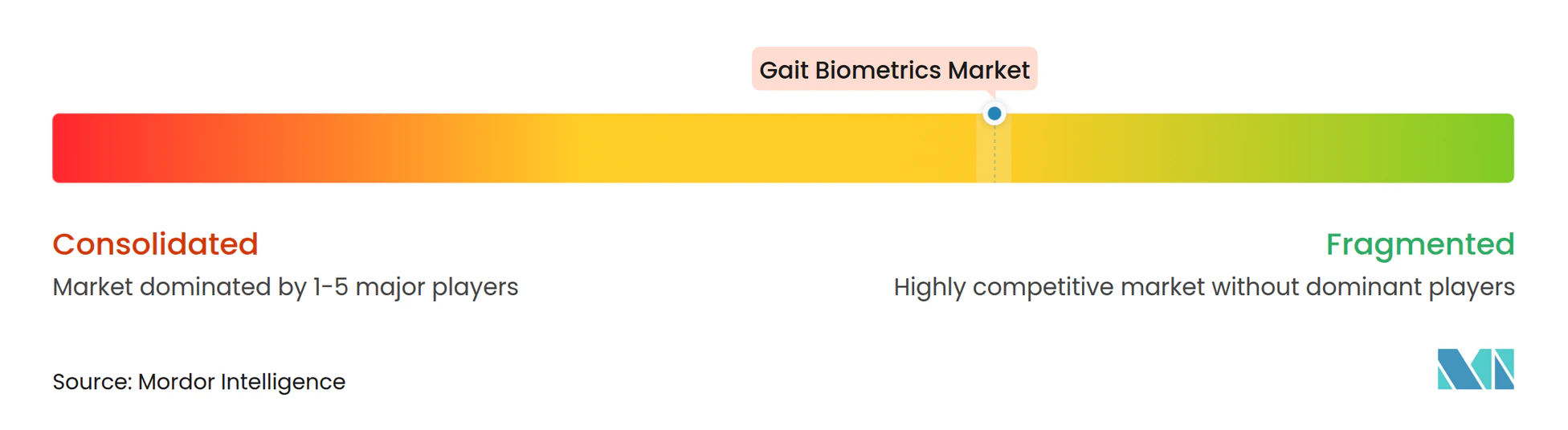
The Gait Biometrics Market has distinct competitive groups in government systems and clinical analytics, and is moderately fragmented. NEC Corporation and IDEMIA Group compete for large identity projects that require integration capacity and long-term support. Leading integrators typically include movement analytics within broader identity management platforms. This approach raises switching costs because buyers integrate recognition, storage, access, and support into a single system. It also makes isolated vendor replacement difficult after a platform has been deployed.
NEC announced walk-through face and iris biometric technology in December 2025 for subjects moving at up to 6 km/h. The move shows how large vendors combine multiple recognition methods to extend their product range. IDEMIA went live with the NAFIS NextGen biometric identification system in Australia in October 2025. IDEMIA and Sopra Steria also delivered the EU-LISA shared biometric matching system in 2025. These examples show that public-sector competition depends on trusted delivery, interoperability, and operating support. The Gait Biometrics Market, therefore, rewards firms that can manage complex system requirements.
Clinical and sports analytics are more fragmented than government identity projects. Vicon Motion Systems, Qualisys, Tekscan, Xsens Technologies, Noraxon, and Zebris Medical compete through measurement precision and validation. Software-first providers may offer analytics on existing camera infrastructure and reduce equipment needs. Privacy-preserving system design could become important in Europe, where legal conditions limit some remote biometric uses. On-device inference and protected gait templates can help reduce the amount of raw data transferred. New entrants must still demonstrate dependable operation and navigate intellectual-property and validation requirements.
Gait Biometrics Industry Leaders
-
NEC Corporation
-
IDEMIA Group
-
Intel Corporation
-
MindMaze SA
-
Noraxon U.S.A. Inc.
- *Disclaimer: Major Players sorted in no particular order
Gait Biometrics Market Companies Covered in this Report
- NEC Corporation
- IDEMIA Group
- Intel Corporation
- Hangzhou Hikvision Digital Technology Co., Ltd.
- Zhejiang Dahua Technology Co., Ltd.
- MindMaze SA
- BioSensics LLC
- CIR Systems Inc.
- Motek Medical BV
- Noraxon U.S.A. Inc.
- Qualisys AB
- Tekscan Inc.
- zebris Medical GmbH
- Vicon Motion Systems Ltd.
- Motion Analysis Corporation
- ProtoKinetics LLC
- Xsens Technologies B.V.
- DIH Group
- Aratek Innovation Private Limited
- Watrix Technology Ltd.
- GaitBetter
Recent Industry Developments in Gait Biometrics Market
- September 2026: The European Union Agency for Fundamental Rights published a report on remote biometric identification by law enforcement, calling for comprehensive legal authorization, independent oversight, and prohibitions on identifying participants in lawful assemblies.
- September 2026: Fujitsu and Indonesia’s PT Alita Praya Mitra signed an MoU to introduce Fujitsu Human Motion Analytics in Indonesia. Demonstrated applications included AI Gait Analysis for walking-pattern and mobility assessment, alongside senior functional training, rowing-performance, and golf-swing analysis.
- October 2025: Noraxon released the MR4 2026 Summer Release, adding the Powers Return to Sport Assessment and launching the portable Vector 1D Force Plate for vertical ground-reaction-force measurement in performance testing, training, research, and applied movement analysis.
- June 2026: Qualisys introduced Prisma Pose, a markerless skeletal-tracking engine integrated directly into Qualisys Track Manager (QTM). It removes the need for third-party biomechanics software and is planned as an add-on license for QTM users in Q4 2026; it also powers OnTraq.
Global Gait Biometrics Market Report Scope
The Gait Biometrics Market comprises technologies and solutions that identify or verify individuals based on their unique walking patterns, analyzing features such as stride length, speed, posture, and limb coordination to create a distinctive gait signature.
The Gait Biometrics Market Report is Segmented by Component (Hardware, Software, and Services), Technology (Computer Vision Techniques, Machine Learning Algorithms, and Sensor Fusion and Multimodal Analytics), Deployment (Cloud, On-Premises, and Edge), Authentication Mode (Active, Passive, and ID/Re-ID), Application (Security and Surveillance, Access Control and Identity Management, Healthcare Monitoring and Rehabilitation, Sports and Fitness Analytics, Research and Development, and Automotive and Human-Machine Interaction), End User (Government and Law Enforcement, Defense and Military, Healthcare Providers and Hospitals, Commercial and Industrial Enterprises, Sports and Fitness Institutions, and Research Institutes), and Geography (North America, South America, Europe, Asia-Pacific, Middle East, Africa). The Market Forecasts are Provided in Terms of Value (USD).
Segmentation Overview
| Hardware |
| Software |
| Services |
| Computer Vision Techniques |
| Machine Learning Algorithms |
| Sensor Fusion and Multimodal Analytics |
| Cloud |
| On-Premises |
| Edge |
| Active Authentication |
| Passive and Continuous Authentication |
| Identification and Re-Identification |
| Security and Surveillance |
| Access Control and Identity Management |
| Healthcare Monitoring and Rehabilitation |
| Sports and Fitness Analytics |
| Research and Development |
| Automotive and Human-Machine Interaction |
| Government and Law Enforcement |
| Defense and Military |
| Healthcare Providers and Hospitals |
| Commercial and Industrial Enterprises |
| Sports and Fitness Institutions |
| Research Institutes |
| North America | United States |
| Canada | |
| Mexico | |
| South America | Brazil |
| Argentina | |
| Rest of South America | |
| Europe | Germany |
| United Kingdom | |
| France | |
| Italy | |
| Rest of Europe | |
| Asia-Pacific | China |
| Japan | |
| South Korea | |
| India | |
| Rest of Asia-Pacific | |
| Middle East and Africa | Saudi Arabia |
| United Arab Emirates | |
| South Africa | |
| Egypt | |
| Rest of Middle East and Africa |
| By Component | Hardware | |
| Software | ||
| Services | ||
| By Technology | Computer Vision Techniques | |
| Machine Learning Algorithms | ||
| Sensor Fusion and Multimodal Analytics | ||
| By Deployment | Cloud | |
| On-Premises | ||
| Edge | ||
| By Authentication Mode | Active Authentication | |
| Passive and Continuous Authentication | ||
| Identification and Re-Identification | ||
| By Application | Security and Surveillance | |
| Access Control and Identity Management | ||
| Healthcare Monitoring and Rehabilitation | ||
| Sports and Fitness Analytics | ||
| Research and Development | ||
| Automotive and Human-Machine Interaction | ||
| By End User | Government and Law Enforcement | |
| Defense and Military | ||
| Healthcare Providers and Hospitals | ||
| Commercial and Industrial Enterprises | ||
| Sports and Fitness Institutions | ||
| Research Institutes | ||
| By Geography | North America | United States |
| Canada | ||
| Mexico | ||
| South America | Brazil | |
| Argentina | ||
| Rest of South America | ||
| Europe | Germany | |
| United Kingdom | ||
| France | ||
| Italy | ||
| Rest of Europe | ||
| Asia-Pacific | China | |
| Japan | ||
| South Korea | ||
| India | ||
| Rest of Asia-Pacific | ||
| Middle East and Africa | Saudi Arabia | |
| United Arab Emirates | ||
| South Africa | ||
| Egypt | ||
| Rest of Middle East and Africa | ||
Key Questions Answered in the Report
What is the Gait Biometrics Market size?
The Gait Biometrics Market is expected to increase from USD 1.43 billion in 2026 to USD 2.81 billion by 2032, at an 11.64% CAGR.
What is driving adoption of gait biometrics?
Contactless identity verification, smart-city video infrastructure, remote clinical monitoring, and edge computing are supporting adoption.
Which component leads gait biometrics spending?
Hardware held 45.44% share in 2026 because deployments require cameras, sensors, wearable devices, and supporting infrastructure.
Which application is expanding fastest?
Healthcare monitoring and rehabilitation is projected to expand at a 12.42% CAGR through 2032, supported by clinical mobility assessment needs.
Which region has the highest current share?
North America held 33.26% share in 2026, supported by border security, airport modernization, and healthcare research activity.
What limits wider use of gait recognition?
Privacy compliance, consent requirements, and lower accuracy under changing clothing, viewpoints, and occlusion can slow deployments.