
South America Government and Security Biometrics Market Size and Share
Market Overview
| Study Period | 2020 - 2031 |
|---|---|
| Forecast Data Period | 2026 - 2031 |
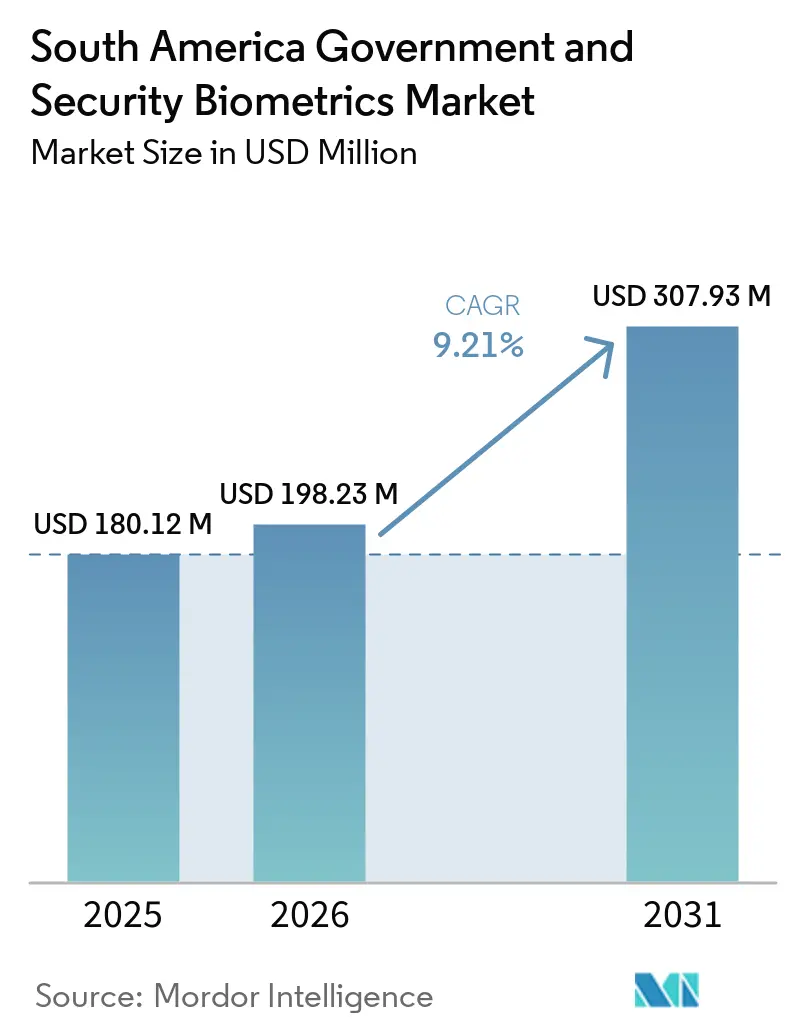
| Base Year Market Size (2025) | USD 180.12 Million |
| Market Size (2026) | USD 198.23 Million |
| Market Size (2031) | USD 307.93 Million |
| Growth Rate (2026 - 2031) | 9.21 % |
| Market Concentration | Low |
Major Players *Disclaimer: Major Players sorted in no particular order Image © Mordor Intelligence. Reuse requires attribution under CC BY 4.0. | |
South America Government and Security Biometrics Market Analysis by Mordor Intelligence
The South America Government and Security Biometrics Market size was USD 180.12 million in 2025 and is projected to reach USD 307.93 million by 2031, at a CAGR of 9.21% during the forecast period from 2026 to 2031. Civil identity programs, border management, and investigative systems are bringing biometric procurement into the same public investment cycle. Governments are moving from paper credentials to electronic documents that link identity records to biometric checks. This favors suppliers that can combine enrollment, matching, document verification, and audit controls in a single system. Brazil remains central to demand because its identity, electoral, and transport programs operate at a national scale. Privacy requirements and constrained public budgets still shape the timing and design of deployments across the South America Government and Security Biometrics Market.
Key Report Takeaways
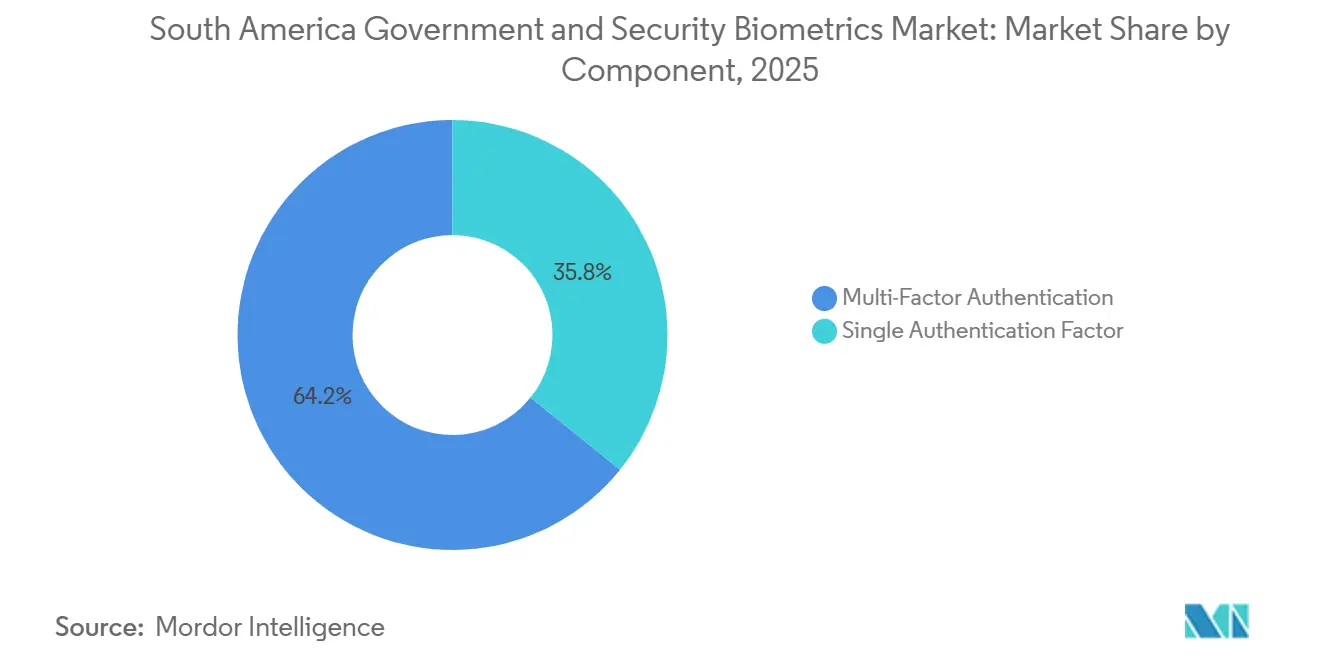
- By authentication type, Multi-Factor Authentication held 64.23% of the South America Government and Security Biometrics Market share in 2025 and is forecast to grow at a 10.84% CAGR through 2031.
- By contact type, Contact-Based solutions held 71.38% share in 2025, while Non-Contact-Based solutions are forecast to grow at a 10.67% CAGR through 2031.
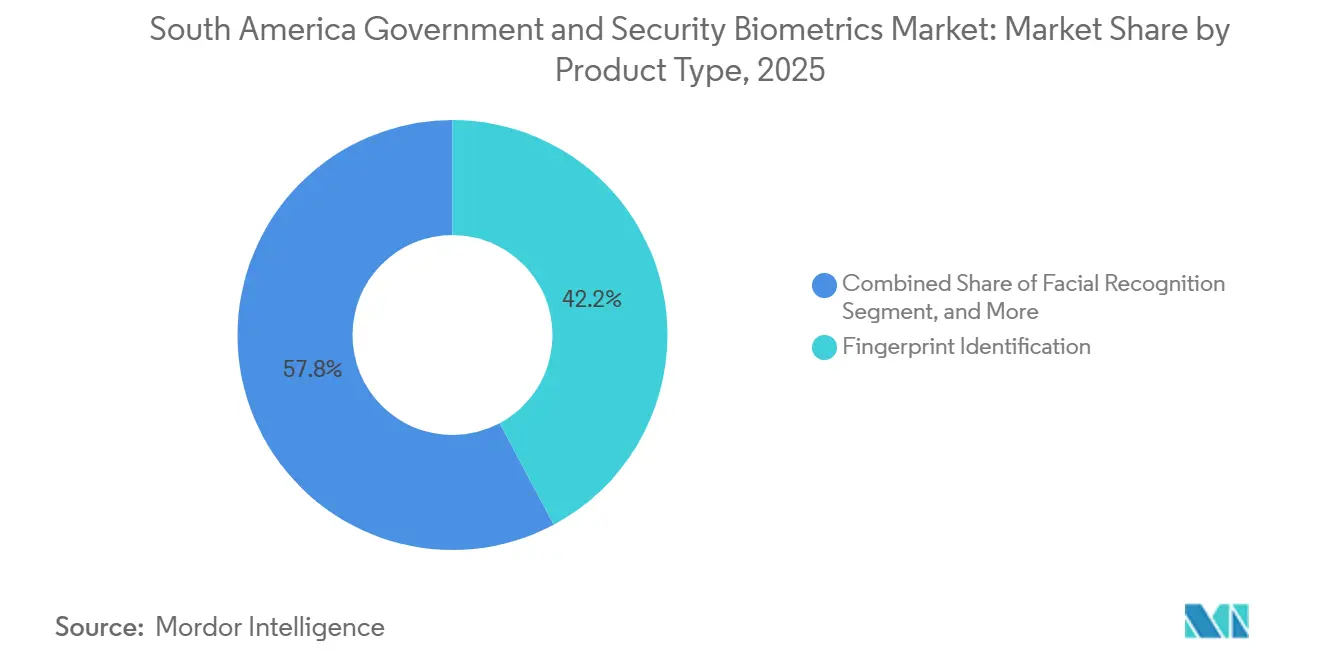
- By product type, Fingerprint Identification held 42.19% of the South America Government and Security Biometrics Market share in 2025, while Facial Recognition is forecast to grow at a 10.92% CAGR through 2031.
- By component, Hardware held 58.74% share in 2025, while Software is forecast to grow at an 11.14% CAGR through 2031.
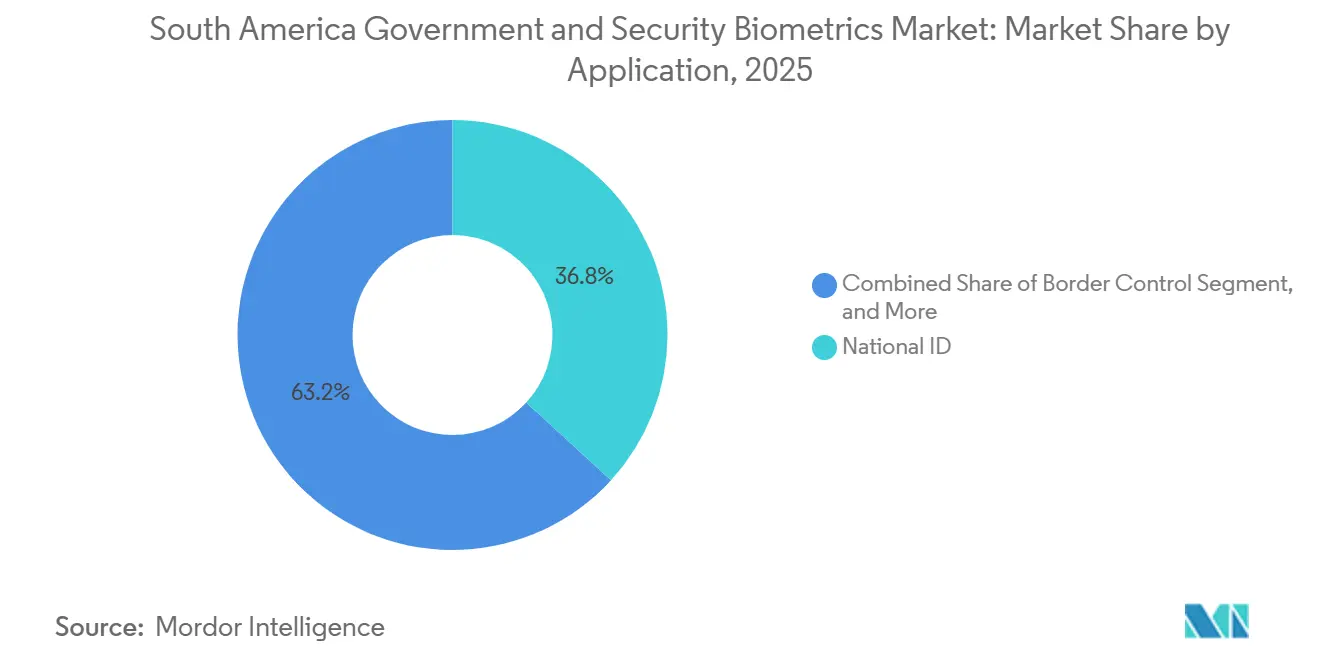
- By application, National ID held 36.81% of the South America Government and Security Biometrics Market share in 2025, while Border Control is forecast to grow at a 10.73% CAGR through 2031.
- By end user, Civil Government held 44.56% share in 2025, while Law Enforcement is forecast to grow at a 10.89% CAGR through 2031.
- By geography, Brazil held 52.47% of the South America Government and Security Biometrics Market share in 2025, while Colombia is forecast to grow at an 11.08% CAGR through 2031.
Note: Market size and forecast figures in this report are generated using Mordor Intelligence’s proprietary estimation framework, updated with the latest available data and insights as of January 2026.
Market Trends and Insights
Drivers Impact Analysis of South America Government and Security Biometrics Market*
| Driver | (~) % Impact on CAGR Forecast | Geographic Relevance | Impact Timeline |
|---|---|---|---|
| Government Digital Identity and National ID Expansion | +3.5% | South America, with Brazil and Argentina as primary demand centers | Medium term (2-4 years) |
| Border Control Modernization and Biometric E-Gates | +2.2% | Brazil, Chile, Colombia, Peru, and Mercosur border crossings | Short term (≤ 2 years) |
| Public-Sector Demand for Fraud-Resistant Service Delivery | +1.5% | Brazil, Colombia, Argentina, Chile, and Peru | Medium term (2-4 years) |
| AI-Enabled Multimodal Identification for Law Enforcement | +1.2% | Brazil, Colombia, Chile, Peru, and Uruguay | Long term (≥ 4 years) |
| Mercosur Cross-Border Digital Identity Interoperability | +0.8% | Argentina, Brazil, Paraguay, and Uruguay | Long term (≥ 4 years) |
| Brazilian Biometric Boarding and Port Modernization | +0.6% | Brazil, with implications for Argentina and Chile maritime corridors | Short term (≤ 2 years) |
| Source: Mordor Intelligence | |||
Government Digital Identity and National ID Expansion
Brazil’s plan to make the Carteira de Identidade Nacional, or CIN, the single biometric national identity credential by 2032 is a major driver of demand for the South America Government and Security Biometrics Market. The country had issued CIN credentials to 49 million people by early 2026. In March 2026, the Ministry of Management and Innovation in Public Services launched PROCIN and committed BRL 44.25 million (USD 7.78 million) to support issuance in Bahia, Amapá, Amazonas, and Maranhão.[1] The program requires enrollment capacity, biometric capture, data management, and identity verification systems across participating states. Brazil’s Federal Biometric Service, created in February 2025, supports centralized many-to-many matching and makes biometric identity data more useful for fraud detection. Argentina also began issuing its electronic Documento Nacional de Identidad in February 2026, featuring a contactless chip and ICAO 9303-aligned features, thereby expanding the need for compatible enrollment and verification tools.[2]
Border Control Modernization and Biometric E-Gates
Border programs are extending demand in the South America Government and Security Biometrics Market beyond civil registration. Airports, land crossings, and migration agencies need identity checks that can validate travel documents and compare biometric data with authorized watchlists. Chile signed the Biometric Identification Transnational Migration Alert Program letter of intent with the United States in July 2025. The arrangement provides for the exchange of fingerprint and iris data to identify people connected with transnational crime and high-risk migration flows. This type of cooperation increases the importance of data capture quality, interoperable biometric templates, and secure matching processes. It also favors providers with demonstrated experience integrating software, travel documents, and checkpoint equipment. Border agencies are likely to give greater weight to operational reliability because failures can disrupt passenger processing and security workflows.[3]
Public-Sector Demand for Fraud-Resistant Service Delivery
Social programs are widening the addressable use cases for the South America Government and Security Biometrics Market. Brazil introduced biometric verification requirements for Bolsa Família recipients, linking access to social benefits with CIN enrollment by December 31, 2026. The requirement places greater emphasis on identity checks at enrollment, where duplicate or false claims can be added to a registry. Agencies, therefore, need liveness detection and many-to-many matching, rather than only a one-to-one check at a service counter. These requirements also increase demand for systems that can manage large civil databases in compliance with public data rules. Suppliers that can combine enrollment quality controls with de-duplication and detailed audit records are better placed for welfare and civil registry programs.
AI-Enabled Multimodal Identification for Law Enforcement
Law enforcement is increasing the use of facial, fingerprint, and other biometric evidence in the South America Government and Security Biometrics Market. Brazil’s Ministry of Justice issued Portaria 1.122/2026 in February 2026, setting procedures for AI-assisted facial recognition in criminal investigations. The procedures require documentation of the algorithm, settings, and data used in photographic suspect matching. This raises the importance of audit trails and repeatable examination methods for suppliers serving public agencies. Agencies also need systems that can compare data from several biometric sources without weakening evidentiary controls. As biometric results are used more often in investigations, procurement is likely to favor platforms that support review, documentation, and human verification.
Restraints Impact Analysis of South America Government and Security Biometrics Market*
| Restraint | (~) % Impact on CAGR Forecast | Geographic Relevance | Impact Timeline |
|---|---|---|---|
| High Upfront Infrastructure and Integration Costs | -2.3% | South America, with stronger effects in Ecuador, Bolivia, Paraguay, and Venezuela | Long term (≥ 4 years) |
| Data Privacy, Bias, and Public Acceptance Risks | -1.1% | Brazil, Colombia, and South America | Medium term (2-4 years) |
| Fragmented Procurement and Interoperability Across National Systems | -0.9% | South America, particularly multi-country programs | Long term (≥ 4 years) |
| Connectivity and Power Reliability Constraints Outside Major Urban Centers | -0.5% | Rural Brazil, interior Colombia, Venezuela, Bolivia, and Ecuador border areas | Long term (≥ 4 years) |
| Source: Mordor Intelligence | |||
High Upfront Infrastructure and Integration Costs
The South America Government and Security Biometrics Market requires substantial investment before a national system becomes operational. Projects can include enrollment kits, capture stations, servers, software licenses, staff training, and migration of legacy records. Civil registries and police systems often store fingerprint templates in formats that are difficult to transfer between platforms. Moving these records to ISO/IEC-compliant formats can add time and cost to modernization programs. Annual technology budgets can also be misaligned with the longer delivery schedules of national identity or automated biometric identification systems. Modular procurement can help agencies add software functions before completing all hardware installations, but it does not remove the need for local integration and support.
Data Privacy, Bias, and Public Acceptance Risks
Data protection requirements can delay the South America Government and Security Biometrics Market when agencies cannot show a lawful and proportionate use of biometric information. Colombia’s Resolution 16582, issued in March 2025, found that biometric authentication cannot be the sole option when a lawful alternative is required. The decision has implications for welfare, financial inclusion, and other public-facing services that rely on fingerprint or facial verification. Brazil’s LGPD also raises compliance requirements for systems handling sensitive biometric data. Suppliers need clear retention rules, access controls, purpose limits, and alternative verification paths where appropriate. These safeguards add cost and review time, but they are increasingly important for contract continuity and public trust.
*Our forecasts treat driver/restraint impacts as directional, not additive. The impact forecasts reflect baseline growth, mix effects, and variable interactions.
South America Government and Security Biometrics Market Segment Analysis
By Authentication Type:
Multi-Factor Authentication Supports Higher-Assurance ChecksMulti-Factor Authentication held 64.23% of the South America Government and Security Biometrics Market share in 2025 and is forecast to grow at a 10.84% CAGR through 2031. It is used where agencies need to link a live person with a trusted credential and a biometric record. A common design combines a smart card or electronic document with fingerprint or facial capture. This reduces reliance on a single biometric sample when presentation attacks or document fraud are a concern. Civil registration, border control, and law enforcement agencies use this approach for higher-assurance workflows.
Brazil’s Federal Biometric Service requires agencies accessing the CIN database to support multi-factor matching. That requirement encourages broader adoption of systems that can verify both credentials and individuals. Single Authentication Factor systems remain relevant for lower-risk and high-throughput uses, including transit access. However, they are less suitable where an agency must confirm identity before issuing benefits, documents, or investigative results. The South America Government and Security Biometrics Market is therefore moving toward layered verification for core government functions.
By Contact Type:
Non-Contact-Based Systems Gain Use in High-Volume SettingsContact-Based solutions held 71.38% share in 2025, while Non-Contact-Based solutions are forecast to grow at a 10.67% CAGR through 2031. Facial recognition supports faster processing at airports, border posts, and public transport locations because users do not need to touch a sensor. Contact-Based systems still have a large installed base in civil registries, electoral databases, and automated fingerprint identification systems. Many agencies maintain extensive fingerprint archives that cannot be quickly replaced. Re-enrollment campaigns also require funding, equipment, and local administrative capacity.
The installed base keeps contact-based technology relevant in the South America Government and Security Biometrics Market. Griaule ranked sixth globally in NIST’s MINEX III fingerprint recognition evaluation in July 2026 and first among South American providers, demonstrating continuing performance improvements in fingerprint matching.[4] Contactless fingerprint capture is also narrowing the distinction between the two approaches. Agencies can select non-contact systems for speed while retaining fingerprint systems for de-duplication and forensic work. ISO/IEC standards for fingerprint image data remain important for interoperability in both approaches.
By Product Type:
Fingerprint Identification Retains a Large Installed BaseFingerprint Identification held 42.19% of the South America Government and Security Biometrics Market share in 2025. The modality remains important for criminal records, civil de-duplication, and historical identity files. Governments have invested in fingerprint-based AFIS platforms for many years, creating data assets that support ongoing use. Fingerprint matching is also suited to verifying uniqueness across large registries. These factors sustain demand even as agencies add new biometric modalities.
Facial Recognition is forecast to grow at a 10.92% CAGR through 2031 and was the fastest-growing product category in the South America Government and Security Biometrics Market. Its touch-free operation supports e-gates and other settings where agencies need to process large numbers of people quickly. Voice and iris recognition serve more specialized border and investigative requirements. Vein recognition is a smaller category that may be relevant where agencies seek a contactless option for higher-risk identity checks. Procurement increasingly combines several modalities so that agencies can match the tool to a specific operating environment.

By Component:
Software Expands as Agencies Need Data ManagementHardware held 58.74% share in 2025 because agencies continue to invest in enrollment stations, capture devices, e-gates, and server infrastructure. These items are necessary to build or expand national identity and border systems. Hardware demand remains tied to the reach of enrollment programs and the replacement cycle for field equipment. It also depends on local installation and maintenance capacity. The South America Government and Security Biometrics Market remains in a build-out phase in several countries.
Software is forecast to grow at an 11.14% CAGR through 2031. Agencies need matching engines, deduplication tools, latent fingerprint examination, data-sharing controls, and audit trails. These functions create demand that continues after initial device purchases. Services are also gaining relevance as public bodies seek help with database maintenance, algorithm updates, and user support. FacePhi reported 24.4% revenue growth in 2025 and provided 2026 revenue guidance of EUR 46.2 million (USD 52.5 million), reflecting the opportunity for software-led identity providers.
By Application:
National ID Provides a Long-Term Demand BaseNational ID accounted for 36.81% of the South America Government and Security Biometrics Market share in 2025. Civil identity programs require enrollment, credential issuance, biometric matching, and renewal processes over multiple years. The identity record can then support access to health, welfare, financial, and judicial services. This gives national ID programs a broader role than a single document issuance project. It also links suppliers to future upgrades, replacement credentials, and expanded verification uses.
Border Control is forecast to grow at a 10.73% CAGR through 2031 and was the fastest-growing application within the South America Government and Security Biometrics Market. Airports and land crossings need to validate electronic documents and compare eligible travelers with secure records. E-Passport and E-Visa applications are growing alongside national identity projects. Argentina’s electronic Documento Nacional de Identidad provides an example of a contactless document designed for electronic authentication. Healthcare, welfare, and public safety uses can follow once a government has a trusted civil identity record. These applications increase the value of platforms that can safely serve multiple agencies.
By End User:
Civil Government Creates Stable Procurement DemandCivil Government held 44.56% share in 2025. National identity agencies, civil registries, and migration authorities purchase systems to support legislated identity programs and multi-year enrollment targets. These programs often have clearer mandates than commercial deployments. They also require data governance, document security, and long-term operational support. This creates steady demand across the South America Government and Security Biometrics Market.
Law Enforcement is forecast to grow at a 10.89% CAGR through 2031. Agencies in Brazil, Colombia, and Chile are moving from small trials to operational systems linked to judicial and criminal databases. Innovatrics reported that its ABIS deployment for Brazil’s Polícia Civil do Distrito Federal supports fingerprint, facial, and latent-print comparisons in investigations. Military and defense bodies, E-Passport and E-Visa authorities, welfare agencies, and regulated organizations have separate budgets and compliance requirements. ICAO and ISO/IEC standards provide a common technical basis across these end-user groups.
Geography Analysis
Brazil Government and Security Biometrics Market
Brazil held 52.47% of the South America Government and Security Biometrics Market share in 2025. Its scale comes from activity in civil identity, electoral biometrics, airport processes, and government service delivery. Brazil had issued CIN credentials to 49 million people by early 2026 and set a target of 130 million holders by the end of 2026. The Federal Biometric Service supports centralized matching, while LGPD requirements raise the compliance threshold for suppliers handling biometric information.
Colombia and Chile Government and Security Biometrics Market
Colombia is forecast to grow at an 11.08% CAGR through 2031 and was the fastest-growing geography. Its demand is supported by law enforcement modernization, electoral security activity, and data governance requirements. The Registraduría Nacional del Estado Civil and the National Police formed an electoral security partnership in April 2025 to link facial validation to judicial records ahead of the 2026 congressional elections. Law 2502 of 2025 designated the use of AI in identity theft as an aggravating criminal factor, underscoring the importance of accountable identity verification. Chile also adds demand through its July 2025 biometric data-sharing agreement with the United States.
Broader South America Government and Security Biometrics Market
Argentina’s 2026 electronic DNI rollout requires compatible enrollment terminals, chip readers, and matching systems. Peru, Uruguay, Paraguay, Bolivia, Ecuador, Guyana, and Venezuela present different conditions for the South America Government and Security Biometrics Market. Peru has expanded digital identity and migration-related biometric activities, while Uruguay has considered a multimodal system for civil identification and scientific police functions, connected to Mercosur discussions on cross-border authentication. Venezuela faces economic and infrastructure limits that restrict formal technology procurement. Rural connectivity and power reliability can affect deployment in Bolivia, Ecuador, and remote border areas.
Competitive Landscape
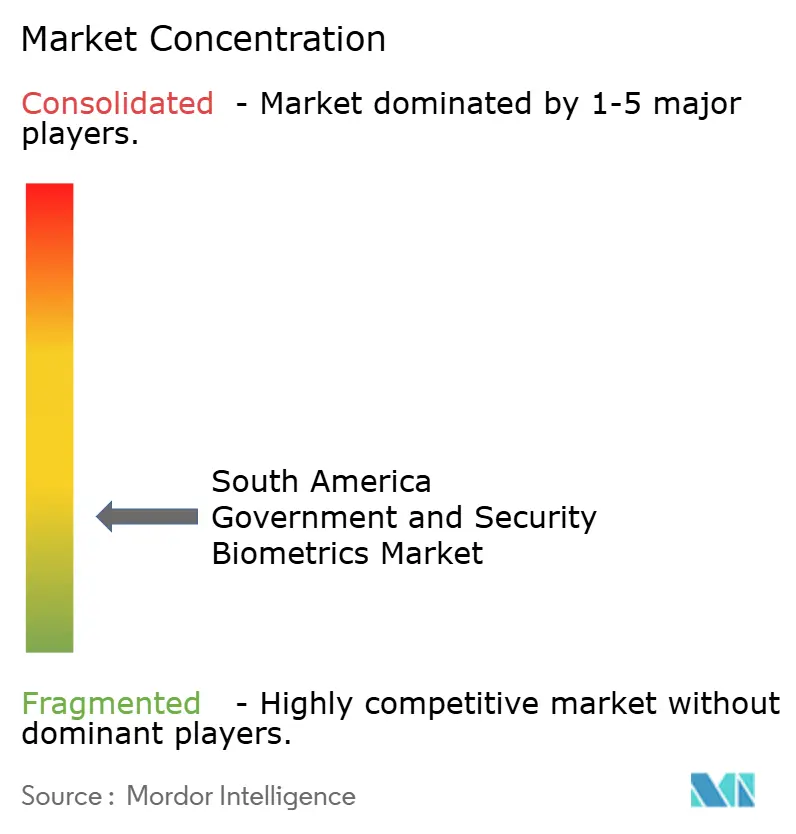
The South America Government and Security Biometrics Market is moderately fragmented. No provider holds a dominant position across every country, application, and biometric modality. Global credential and document security providers compete for civil identity and electronic document programs. Algorithm and platform providers compete for automated biometric identification systems, matching libraries, and developer tools. Regional integrators add local deployment, hardware, and service support.
This structure gives government buyers several ways to assemble a solution while making interoperability an important selection factor. IDEMIA, Griaule, Innovatrics, TECH5, Neurotechnology, FacePhi, HID Global, Aratek, Thales, Veridos, Valid, NEC, and Herta Security represent relevant supplier groups. Griaule’s sixth-place global MINEX III ranking in July 2026 strengthens its standing for tenders requiring independently evaluated fingerprint algorithms. Griaule has an established role in Brazil’s biometric environment, where historic fingerprint data creates an advantage for providers with local implementation experience. Innovatrics has supported public-sector biometric projects and demonstrated facial recognition in Santiago’s public transport environment.
The competitive position of each supplier depends on its ability to integrate legacy AFIS records with newer multimodal systems, and providers are focusing on recurring platform revenue rather than only device supply. FacePhi’s alliance with Huenei in March 2026 combined behavioral biometrics, liveness detection, and document validation for regulated uses. Suppliers need controls for data retention, access, purpose limitation, and human review. ISO/IEC compatibility and independently assessed algorithm performance help vendors meet public procurement criteria.
South America Government and Security Biometrics Industry Leaders
-
IDEMIA Identity and Security France S.A.S.
-
HID Global Corporation
-
Griaule Biometrics, LLC
-
Aware, Inc.
-
Suprema Inc.
- *Disclaimer: Major Players sorted in no particular order
South America Government and Security Biometrics Market Companies Covered in this Report
- IDEMIA Identity and Security France S.A.S.
- HID Global Corporation
- Aware, Inc.
- Griaule Biometrics, LLC
- Suprema Inc.
- Precise Biometrics AB
- BIO-key International, Inc.
- Innovatrics, s.r.o.
- Integrated Biometrics, LLC
- Iris ID Systems, Inc.
- TECH5 Group B.V.
- M2SYS LLC
- Aratek Biometrics Co., Ltd.
- Dermalog Identification Systems GmbH
- Jenetric GmbH
- Xperix Inc.
- Neurotechnology UAB
- Mantra Softech (India) Private Limited
- FacePhi Biometria, S.A.
- Veridos GmbH
- IrisGuard, Inc.
Recent Industry Developments in South America Government and Security Biometrics Market
- February 2026: Argentina's RENAPER began full-scale issuance of the new electronic Documento Nacional de Identidad under Disposition 55/2026, incorporating an NFC-enabled chip, policarbonate construction, laser-engraved data, and biographic and biometric data stored in ICAO 9303-compliant format.
- June 2026: The government of Brazil’s Federal District issued Decree No. 48,728, mandating all public administration bodies to integrate their surveillance cameras, sensors, and radar systems into the unified DF 360 Segurança Integral platform, the first mandatory cross-agency video integration requirement at the state government level in South America.
- February 2026: Brazil's Ministry of Justice published Portaria 1.122/2026, establishing mandatory procedural parameters for AI-assisted facial recognition in criminal investigations, including documentation of algorithm identity, parameters used, and ACE-V methodology for forensic compliance.
- July 2025: The United States and Chile signed the Biometric Identification Transnational Migration Alert Program (BITMAP) letter of intent, enabling bilateral exchange of fingerprint and iris biometric data to identify transnational criminals and high-risk migration flows, operationally activating Chile's multi-modal biometric capture infrastructure at prisons and border posts.
South America Government and Security Biometrics Market Report Scope
The South America government and security biometrics market refers to the deployment of biometric hardware, software, and services for identity verification and access management by public sector agencies. It encompasses technologies such as facial recognition, fingerprint identification, and iris scanning, utilized for border control, national IDs, e-passports, and law enforcement. Supporting both single and multi-factor authentication across contact and non-contact modalities, these solutions help regional governments enhance national security, streamline citizen services, and prevent identity fraud.
The South America Government and Security Biometrics Market Report is Segmented by Authentication Type (Single Authentication Factor, and Multi-Factor Authentication), Contact Type (Contact-Based, and Non-Contact-Based), Product Type (Voice Recognition, Facial Recognition, Fingerprint Identification, Vein Recognition, and Iris Recognition), Component (Hardware, Software, and Services), Application (Border Control, E-Passport, E-Visa, National ID, Healthcare and Welfare, and Other Applications), End User (Civil Government, Military and Defense, Law Enforcement, E-Passport and E-Visa Authorities, Healthcare and Welfare Agencies, and Commercial and Regulated Organizations), and Geography (Brazil, Argentina, Colombia, Chile, Venezuela, and Rest of South America). The Market Forecasts are Provided in Terms of Value (USD).
Segmentation Overview
| Single Authentication Factor |
| Multi-Factor Authentication |
| Contact-Based |
| Non-Contact-Based |
| Voice Recognition |
| Facial Recognition |
| Fingerprint Identification |
| Vein Recognition |
| Iris Recognition |
| Hardware |
| Software |
| Services |
| Border Control |
| E-Passport |
| E-Visa |
| National ID |
| Healthcare and Welfare |
| Other Applications |
| Civil Government |
| Military and Defense |
| Law Enforcement |
| E-Passport and E-Visa Authorities |
| Healthcare and Welfare Agencies |
| Commercial and Regulated Organizations |
| Brazil |
| Argentina |
| Colombia |
| Chile |
| Venezuela |
| Rest of South America |
| By Authentication Type | Single Authentication Factor |
| Multi-Factor Authentication | |
| By Contact Type | Contact-Based |
| Non-Contact-Based | |
| By Product Type | Voice Recognition |
| Facial Recognition | |
| Fingerprint Identification | |
| Vein Recognition | |
| Iris Recognition | |
| By Component | Hardware |
| Software | |
| Services | |
| By Application | Border Control |
| E-Passport | |
| E-Visa | |
| National ID | |
| Healthcare and Welfare | |
| Other Applications | |
| By End User | Civil Government |
| Military and Defense | |
| Law Enforcement | |
| E-Passport and E-Visa Authorities | |
| Healthcare and Welfare Agencies | |
| Commercial and Regulated Organizations | |
| By Geography | Brazil |
| Argentina | |
| Colombia | |
| Chile | |
| Venezuela | |
| Rest of South America |
Key Questions Answered in the Report
What is the South America Government and Security Biometrics Market size?
The South America Government and Security Biometrics Market was valued at USD 180.12 million in 2025, is estimated at USD 198.23 million in 2026, and is projected to reach USD 307.93 million by 2031 at a CAGR of 9.21%.
What is driving demand for government biometrics in South America?
National identity programs, border modernization, fraud-resistant public services, and law enforcement systems are expanding demand for secure enrollment and matching tools.
Which authentication method led government biometric deployments?
Multi-Factor Authentication held 64.23% share in 2025 because agencies use it to connect trusted credentials with live biometric checks.
Which biometric technology is growing fastest in South America?
Facial Recognition was the fastest-growing product type, while Non-Contact-Based solutions are projected to grow at a 10.67% CAGR through 2031.
Which country is the largest government and security biometrics opportunity?
Brazil held 52.47% share in 2025, supported by CIN issuance, electoral systems, and broader government identity programs.
What are the main constraints on biometric deployments?
High integration costs, legacy system migration, privacy requirements, and unequal connectivity can delay public-sector implementation.