
Market Overview
| Study Period | 2021 - 2031 |
|---|---|
| Forecast Data Period | 2026 - 2031 |
| Base Year Market Size (2025) | USD 1.72 Billion |
| Market Size (2026) | USD 1.78 Billion |
| Market Size (2031) | USD 2.12 Billion |
| Growth Rate (2026 - 2031) | 3.62 % |
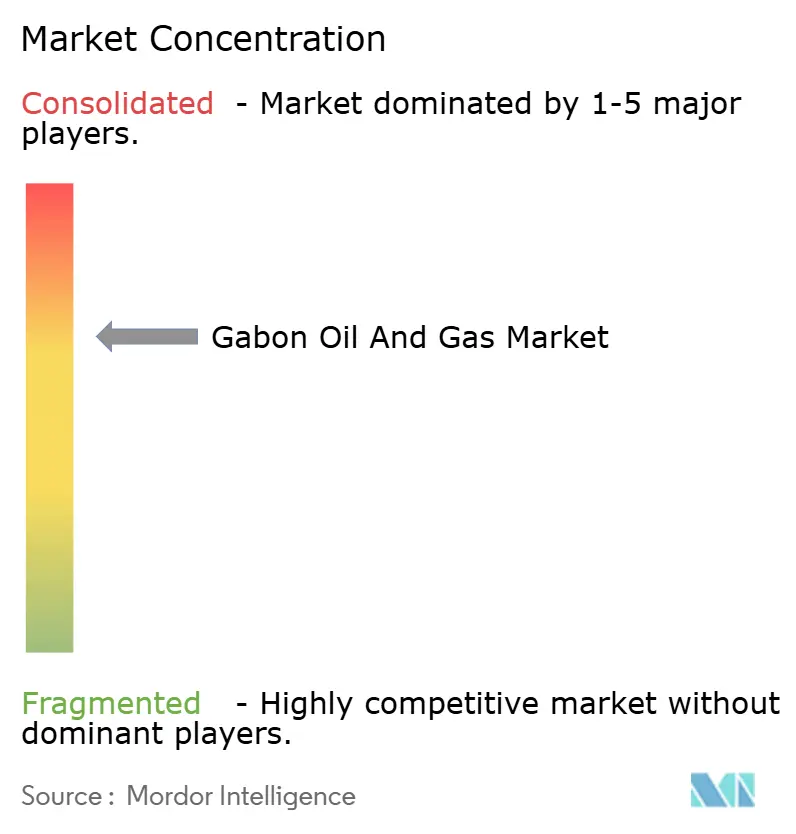
| Market Concentration | Medium |
Major Players *Disclaimer: Major Players sorted in no particular order Image © Mordor Intelligence. Reuse requires attribution under CC BY 4.0. | |
Gabon Oil And Gas Market Analysis by Mordor Intelligence
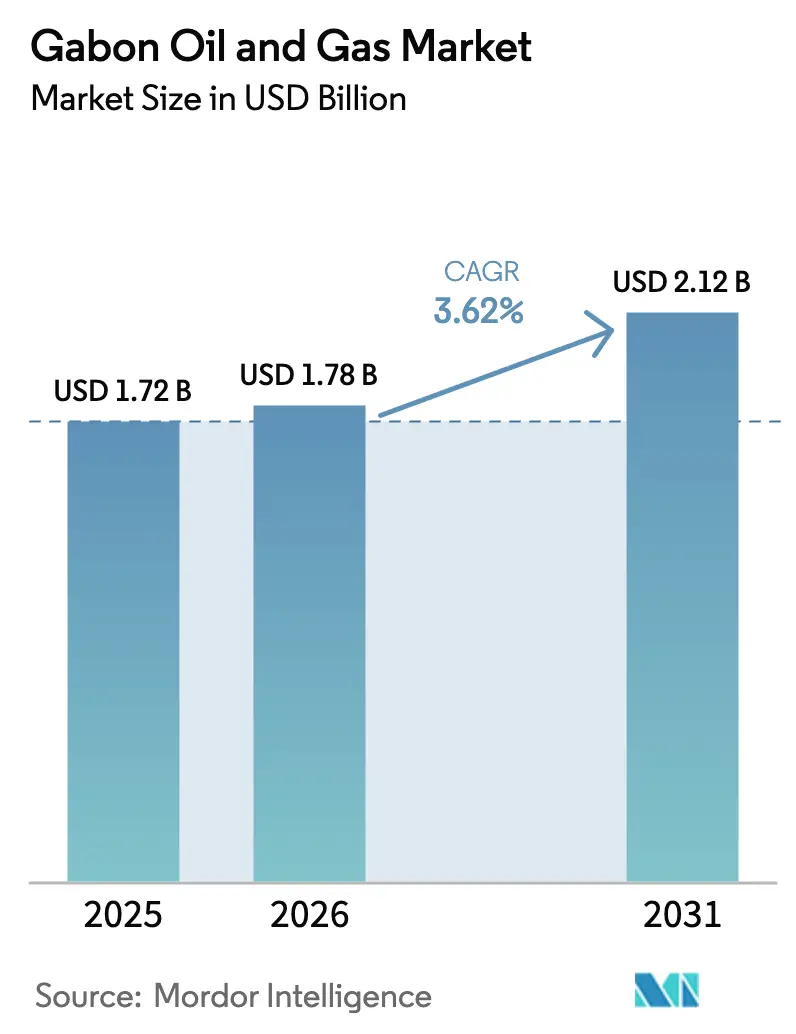
The Gabon Oil And Gas Market size was valued at USD 1.72 billion in 2025 and is estimated to grow from USD 1.78 billion in 2026 to reach USD 2.12 billion by 2031, at a CAGR of 3.62% during the forecast period (2026-2031).
Deep-water exploration successes, a streamlined dual-code fiscal regime, and steady Asian demand for low-sulfur crude underpin the outlook. At the same time, declining legacy onshore fields, skills gaps in subsea operations, and tighter safety oversight keep growth moderate. Upstream activity will remain the engine of the Gabon oil & gas market as international oil companies (IOCs) accelerate drilling around Dussafu and Hibiscus, while Perenco’s Cap Lopez floating LNG facility anchors midstream investment. Decommissioning spend is also rising, creating a parallel opportunity set for specialized contractors.
Key Report Takeaways
- By sector, the upstream segment held 76.1% of Gabon's oil & gas market share in 2025, and the same is forecast to post the fastest 3.8% CAGR through 2031.
- By location, onshore operations accounted for 70.5% of the Gabon oil & gas market in 2025, whereas offshore projects are expanding at a 6.5% CAGR through 2031.
- By service, construction captured 51.9% revenue share in 2025, yet decommissioning is advancing at a 7.2% CAGR between 2026-2031.
Note: Market size and forecast figures in this report are generated using Mordor Intelligence’s proprietary estimation framework, updated with the latest available data and insights as of January 2026.
Gabon Oil And Gas Market Trends and Insights
Drivers Impact Analysis*
| Driver | (~) % Impact on CAGR Forecast | Geographic Relevance | Impact Timeline |
|---|---|---|---|
| Revised Hydrocarbons Code attracting IOCs | 0.8% | National, with offshore deepwater blocks | Medium term (2-4 years) |
| New deep-water discoveries (Dussafu, Hibiscus) | 1.2% | Offshore Gabon, primarily Dussafu basin | Long term (≥ 4 years) |
| Cap Lopez FLNG & gas monetisation build-out | 0.9% | National, export to regional LNG markets | Short term (≤ 2 years) |
| Global demand for low-sulphur crudes | 0.4% | Global, with primary demand from Asia-Pacific | Medium term (2-4 years) |
| Batanga LPG project cutting imports | 0.3% | National, Libreville and Port-Gentil markets | Short term (≤ 2 years) |
| AI-enabled EOR for mature fields | 0.5% | Onshore legacy fields, Gamba and Rabi-Kounga | Medium term (2-4 years) |
| Source: Mordor Intelligence | |||
Revised Hydrocarbons Code Attracting IOCs
Gabon’s 2025 dual-code framework separates oil and gas terms, trims state participation to 10%, and grants import-duty exemptions for LNG equipment, making fiscal terms regionally competitive.[1] ExxonMobil and BP executed ultra-deepwater memoranda of understanding (MoUs) in 2025, ending a decade-long hiatus by supermajors. Perenco fast-tracked Cap Lopez FLNG once accelerated depreciation for gas projects became law. The code mandates 90-day approvals for production-sharing contracts, compressing bureaucratic timelines. Independents such as BW Energy and Panoro expanded Dussafu drilling on the back of the same incentives.
New Deep-Water Discoveries (Dussafu, Hibiscus)
BW Energy’s Bourdon find in March 2025 raised Dussafu recoverable reserves to over 150 million barrels and supports a third production hub. Reservoirs in Gamba sandstones show permeability above 500 mD, yielding 5,000-10,000 barrels per day (bpd) initial rates that justify USD 40-60 million well costs. PETRONAS confirmed frontier potential when Boudji-1 logged 90 m hydrocarbon sands in 2024. These successes offset a 60% onshore decline since the 1990s. Panoro’s 17.5% stake in Dussafu generated 4,760-6,502 bpd in 2025 and funded MaBoMo Phase 2 drilling.
Cap Lopez FLNG & Gas Monetization Build-Out
Perenco’s USD 2 billion Cap Lopez FLNG, slated for 2026 start-up, will liquefy 700,000 tpa LNG and 25,000 tpa LPG from associated gas currently flared. The modular barge converts environmental liabilities into export cash flow, targeting Asian buyers seeking smaller cargoes.[2] Gabon holds 27 billion scm of proven gas yet lacks domestic pipelines, so floating LNG is the only bankable route. Replicable modules may unlock Tchibala and Torpille gas, broadening the monetization base. Compliance with ISO 14001 and IMO MARPOL Annex VI is baked into the export license.
Global Demand for Low-Sulfur Crudes
Rabi Light and Mandji contain <0.5% sulfur, meeting IMO 2020 rules and commanding USD 8-per-barrel premiums to sour grades in 2025. Exports averaged 204,000 bpd in 2024, with China taking 72,000 bpd and other Asian refiners 57,000 bpd. Low-sulfur demand helps sustain drilling even when Brent prices soften. However, fresh sweet supply from Guyana and Brazil is narrowing differentials, pressuring Gabonese netbacks. Producers must therefore pare costs or integrate carbon-intensity certification to stay competitive.
Restraints Impact Analysis*
| Restraint | (~) % Impact on CAGR Forecast | Geographic Relevance | Impact Timeline |
|---|---|---|---|
| Decline of legacy on-shore fields | -0.6% | Onshore Gamba, Rabi-Kounga, Tchatamba basins | Long term (≥ 4 years) |
| Post-coup political / fiscal uncertainty | -0.4% | National, affecting upstream investment decisions | Medium term (2-4 years) |
| Skilled-labour shortage for deep-water ops | -0.3% | Offshore deepwater blocks, subsea operations | Medium term (2-4 years) |
| Environmental & safety lapses (platform fires) | -0.2% | Offshore platforms, primarily Perenco operations | Short term (≤ 2 years) |
| Source: Mordor Intelligence | |||
Decline of Legacy Onshore Fields
Onshore output fell from 370,000 bpd in 1997 to 224,000 bpd in 2024 and could slip to 100,000-200,000 bpd by 2030 without major EOR investment. Water cuts exceed 80%, and reservoir pressure is dropping, reducing waterflood efficiency. Polymer or CO₂ projects cost USD 15,000-25,000 per incremental barrel of reserves with 10-year paybacks, deterring capital. TotalEnergies quit its mature assets in 2021, transferring liabilities to Perenco. A 30% decline would cut fiscal receipts by USD 1.8 billion, squeezing infrastructure budgets.
Skilled-Labor Shortage for Deep-Water Ops
Subsea engineers, dynamic-positioning officers, and ROV pilots are scarce, forcing operators to import specialists at USD 800-1,200 per day.[3] Gabonese vocational programs focus on onshore trades; few graduates have hands-on BOP or subsea tree exposure. Expat reliance triggers local-content penalties when national staffing falls under 70%. Industry/academic partnerships and CEMAC-wide certification could ease costs and improve mobility. TechnipFMC and Schlumberger have begun sponsoring simulation labs, but scale remains modest.
*Our forecasts treat driver/restraint impacts as directional, not additive. The impact forecasts reflect baseline growth, mix effects, and variable interactions.
Segment Analysis
By Sector: Upstream Dominance Sustained by Deep-Water Momentum
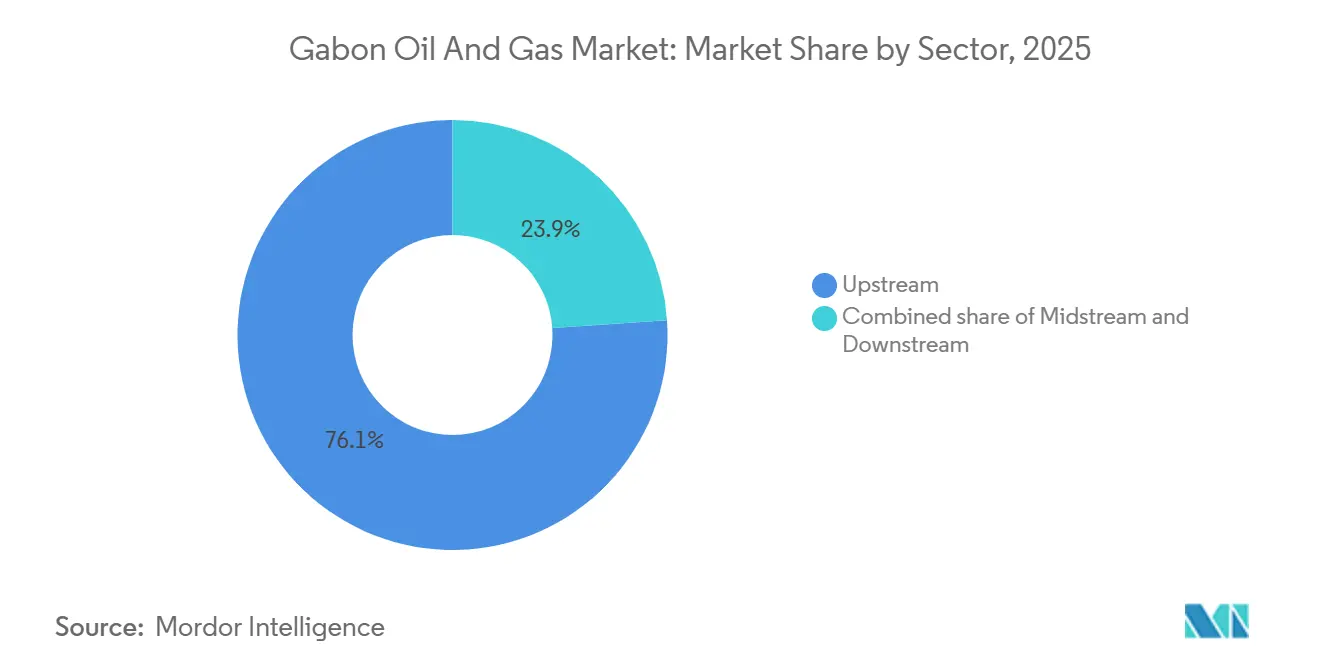
The upstream portion of the Gabon oil & gas market size accounted for 76.1% revenue in 2025 and is advancing at a 3.8% CAGR through 2031. Annual spend is driven by USD 40-60 million wells and USD 500 million-plus floating production systems. Midstream outlays are smaller because new wells tie back to existing hubs, while downstream refining covers only 7% of domestic crude throughput.
Investment prioritizes projects with quick cash cycles, such as VAALCO’s USD 80 million infill program at Etame that pays back in under two years, contrasting with PETRONAS’s ultra-deepwater Boudji-1, where capital and risk rise sharply. Efficiency gains from integrated engineering contracts further cement upstream primacy. The Gabon oil & gas market will maintain this upstream tilt unless incentives emerge for local petrochemicals or gas-to-liquids complexes.

By Location: Offshore Acceleration Reshaping Production Geography
Onshore fields still dominate Gabon's oil & gas market share at 70.5% in 2025, yet offshore volumes are growing 6.5% per year and could overtake by 2028. Deep-water wells deliver 5,000-10,000 bpd rates at operating costs of USD 12-18 per barrel, outranking older onshore units that now average USD 20-28.
The trend accelerated after ExxonMobil's 2025 MoU to explore ultra-deepwater blocks analogous to Guyana's Stabroek play. Onshore players are piloting horizontal drilling and AI-enabled polymer floods, but each well adds just 200-500 bpd. Offshore growth, therefore, sets the pace for the Gabon oil & gas market, contingent on timely FPSO deployment and streamlined environmental reviews.
By Service: Decommissioning Surge Reflects Aging Infrastructure
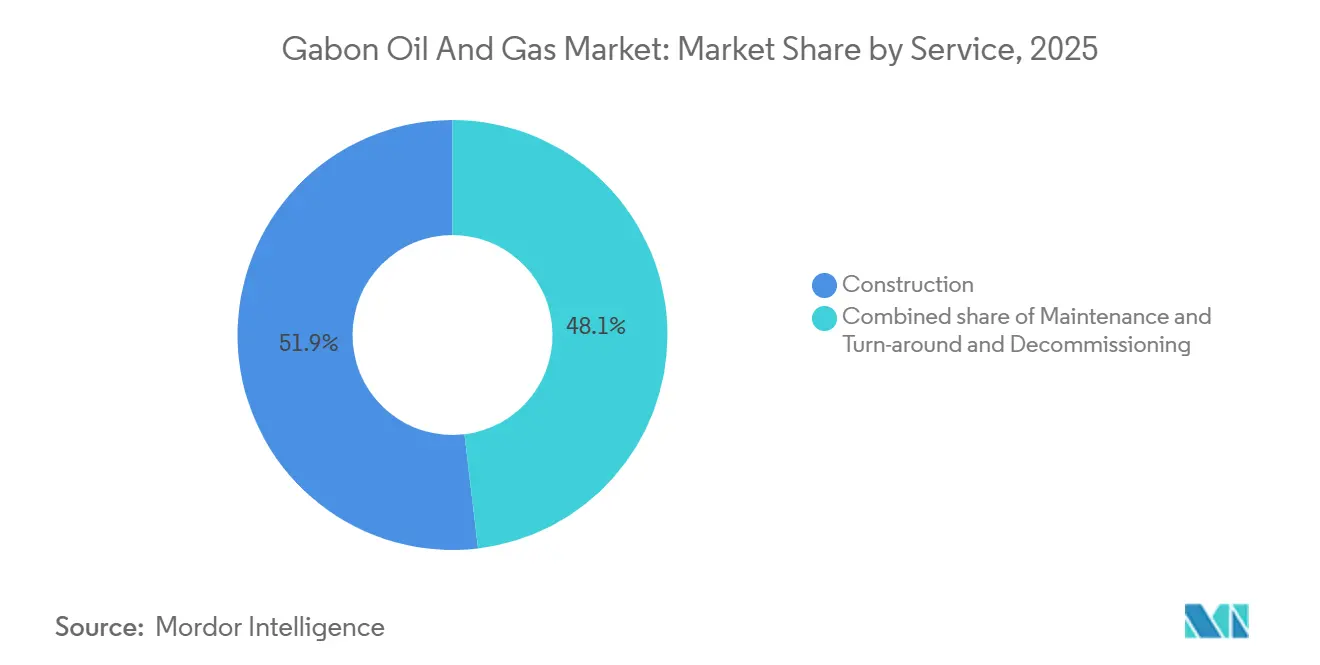
Construction claimed 51.9% of service revenue in 2025, yet decommissioning is the fastest-growing slice at 7.2% CAGR, mirroring platform age profiles.[4] More than 40 structures installed pre-2000 show corrosion and fatigue that demand removal under ISO 14001.
Tullow’s asset sale carried USD 31 million in decommissioning provisions, highlighting latent liabilities. Specialized contractors handle plug-and-abandonment, heavy-lift topside removal, and seabed remediation, all new revenue pools inside the Gabon oil & gas market. Operators must decide between life-extension capex or earlier retirement to redeploy capital offshore.
Geography Analysis
Offshore Dussafu, Cap Lopez, and Likuale blocks and onshore Gamba and Rabi-Kounga basins form the geographic spine of the Gabon oil & gas market. Onshore still represented 70.5% market weight in 2025, yet depletion has set total national production on course for 100,000-200,000 bpd by 2030 unless offshore replacement barrels arrive. Perenco leads onshore with marginal-field projects such as Wamba, but output gains are modest. BW Energy’s Bourdon find, and Panoro’s MaBoMo Phase 2 inject growth offshore, nudging the balance seaward.
Higher-quality reservoirs offshore achieve breakeven at USD 35-45 per barrel Brent, well under the USD 50-60 required for advanced EOR onshore. PETRONAS’s Likuale discovery and ExxonMobil’s ultra-deepwater initiative may unlock Guyana-scale Cretaceous plays, broadening the reserve base. Meanwhile, fiscal incentives in the 2025 code and the country’s compact geography - with many discoveries within 50 km of shore - lower tie-back costs and de-risk economics.
Cap Lopez FLNG monetizes associated gas, converting what was flared into export revenue while cutting carbon penalties. The onshore Batanga LPG plant reduces import dependence but cannot absorb all surplus gas, leaving reinjection prevalent. Future basin entries will likely cluster around existing hubs, reinforcing geographic path dependence inside the Gabon oil & gas market.
Regulatory Landscape
Gabon’s hydrocarbons activities are primarily governed by Law No. 002/2019 (Hydrocarbons Code), with project authorizations issued by the Ministry in charge of Hydrocarbons after technical assessment by the Direction Generale des Hydrocarbures (DGH). The State retains ownership of underground hydrocarbon resources and operational data acquired, which supports a centralized approval model for exploration, development, and production.
Environmental compliance is a key regulatory lever under the 2019 framework, including restrictions on routine gas flaring and venting (exceptions require approvals involving both hydrocarbons and environmental authorities). Participation provisions allow the State to take up to 10% interest in developments at market conditions, and the national operator may acquire up to 15% direct participation in production sharing contracts, shaping deal structuring alongside Gabon’s updated fiscal direction for oil and gas terms referenced in the report’s dual-code approach.
Competitive Landscape
Gabon's upstream remains moderately concentrated: Perenco, BW Energy, VAALCO, and Gabon Oil Company jointly hold roughly 70% of production, with no single entity above 30%. The state's USD 1.04 billion purchases of Assala and Tullow assets in 2025 lifted Gabon Oil Company to 50,700 bpd and 133 million barrels of 2P reserves. Independents exploit nimble models, BW Energy's fast-track FPSOs bring wells online within 18-24 months, beating deepwater norms.
Service majors TechnipFMC and Schlumberger deploy integrated EPC and digital reservoir solutions, securing sticky long-term contracts. White spaces include ultra-deepwater frontier acreage, modular FLNG for stranded gas, and AI-enhanced EOR onshore, each demanding USD 500 million-plus capex portfolios. ExxonMobil's 2025 re-entry suggests supermajor appetite is returning as fiscal risk abates.
Local-content rules mandating a 70% Gabonese workforce could skew competition if training pipelines lag. Digital analytics and decarbonization credentials are emerging as tender differentiators, potentially reshaping supplier hierarchies inside the Gabon oil & gas market.
Gabon Oil And Gas Industry Leaders
-
Perenco SA
-
BW Energy
-
TotalEnergies SE
-
VAALCO Energy Inc.
-
Maurel et Prom SA
- *Disclaimer: Major Players sorted in no particular order
Market Opportunities and Future Outlook
Gas monetization and midstream services tied to flare reduction create a clear whitespace, supported by the regulatory constraint on routine flaring under Law No. 002/2019. This opportunity is anchored by Perenco’s Cap Lopez FLNG (700,000 tpa LNG and 25,000 tpa LPG), scheduled for start-up in 2026. That profile points to demand for associated-gas capture, compression, treatment, marine logistics, and export-quality compliance systems, including ISO 14001 and IMO MARPOL Annex VI requirements referenced in the report, while also supporting modular approaches that can be replicated across other gas pockets.
On the upstream side, new capital is concentrating in offshore redevelopment and step-out hubs, while mature onshore assets are being repositioned for specialist operators and service providers. BW Energy’s April 2026 25-year extension of the Dussafu Marin license to 2048 provides a long-duration framework for infill drilling and incremental tie-backs. Gabon’s June 2026 policy shift to give domestic companies priority access to mature marginal fields points to a two-track opportunity set, with local operators focusing on brownfield optimization, workovers, and integrity-led maintenance, and international players and the supply chain emphasizing higher-risk offshore drilling, subsea, and FPSO-linked scopes. Decommissioning and integrity programs also take on more commercial weight as operators respond to aging infrastructure and stricter safety oversight highlighted in the report context.
Recent Industry Developments
- June 2026: Perenco faced raids by the French National Financial Prosecutor’s Office on June 11 and 12, 2026, tied to an investigation into alleged corruption and money laundering linked to its Central African operations. The action increased compliance and counterparty scrutiny around one of Gabon’s most material operators, overlapping with its central role in gas monetization projects such as Cap Lopez.
- May 2026: TotalEnergies EP Gabon disclosed Q1 2026 production of 16.1 kb/d and cited an unplanned shutdown for integrity works on the Anguille/Ile Mandji to Cap Lopez export pipeline. The update highlighted how legacy pipeline integrity can affect realized volumes and reinforced demand for inspection, repair, and maintenance services across mature assets.
- April 2026: BW Energy signed a 25-year extension of the Dussafu Marin production licence offshore Gabon, extending the term from 2028 to 2048, with an option for a further five years. The longer license runway supports multi-phase development planning at Dussafu and improves commercial certainty for drilling campaigns, subsea work, and FPSO-linked contracting.
Research Methodology Framework and Report Scope
Market Definition and Coverage
For this report, the Gabon oil and gas market is defined as the value generated from upstream, midstream, and downstream activities inside Gabon, with activity split by onshore and offshore operations and supported services tied to these assets.
Scope exclusions: The sizing does not treat crude and gas trading outside Gabon, or unrelated power generation revenues, as part of this market.
Segmentation Overview
- By Sector
- Upstream
- Midstream
- Downstream
- By Location
- Onshore
- Offshore
- By Service
- Construction
- Maintenance and Turn-around
- Decommissioning
Data Sources, Market Sizing, and Validation
Desk Research
Desk research was used to set the fact base for Gabon hydrocarbons activity, and then to build the first view of the demand pool by segment. We referred to public sources such as energy ministry releases and regulator notices, central bank and national statistics publications, OPEC and other intergovernmental energy datasets, and customs and port statistics where available.
To make the model usable year over year, company filings, investor presentations, and reputable press were used to map project timelines, planned maintenance, and operating changes across offshore and onshore assets. A paid subscription covering company financials and another covering shipment level import and export signals were used selectively to cross-check revenue exposure and activity shifts. These examples are not exhaustive, and many other public sources were also used to collect data, validate assumptions, and clarify gaps.
Primary Interviews and Surveys
Interviews and surveys with oilfield service professionals, operators, distributors, regulators, and energy managers in Gabon help clarify production plans, local procurement, service fees, refinery activity, fuel demand, and project timing. These discussions are used to explain gaps in public data, test secondary assumptions, and adjust the final model where field evidence supports a change.
Distribution of primary research fieldwork respondents
| Company type | Respondent position |
|---|---|
| Top tier: 28% | CXOs: 18% |
| Mid tier: 50% | Functional/Unit leaders: 30% |
| Smaller Players: 22% | Managers: 52% |
Market-Sizing & Forecasting
Sizing starts from a top-down rebuild of Gabon activity, where national production and field development signals are translated into spend and revenue pools across upstream, midstream, and downstream, and then split by onshore and offshore footprints. Once that structure is set, the totals are corroborated with selective bottom-up checks, such as sampled project and service tickets, typical contract values by work type, and a few supplier roll-ups to see whether any segment appears overstated.
Key inputs that influence the model include liquids and gas output direction, the count and timing of offshore and onshore projects moving into construction or sustaining mode, planned maintenance and turn-around cycles, pipeline and terminal utilization cues, and the cadence of decommissioning activity. Where a data point was missing for a segment, we used bounded ranges from interview feedback and then anchored them back to observable activity indicators.
Forecasting was carried out using scenario analysis, because investment timing and offshore project schedules can shift with approvals, oil price expectations, and execution speed. Each scenario was reviewed against expert views, and then one central case was selected for the published forecast path.
Data Validation & Update Cycle
Outputs are checked through triangulation across independent signals, and then reviewed for variances that do not match known activity changes. If a segment shows a sharp move that cannot be explained by project timing, utilization, or price assumptions, we revisit the drivers and re-contact relevant respondents.
Before sign-off, the model is reviewed in steps, starting with input reasonableness, followed by segment roll-ups, and then a final full-market consistency pass. Reports are refreshed annually, with interim updates triggered by material events such as major project sanctions, delays, regulatory shifts, or large price swings, and a last-minute review is completed before delivery so clients receive the most current view.
Mordor Intelligence's Gabon Oil and Gas Market Estimate Compared With Other Published Estimates
Published values for the Gabon oil and gas market can look far apart, even when everyone is discussing the same country and the same broad industry. Differences usually come from what parts of the value chain are counted, whether service revenue is included alongside core upstream and downstream value, and the year and currency assumptions used for conversion.
Production and project-timing checks, plus a reality check against activity-linked services such as maintenance and turn-around, are the evidence points that keep Mordor Intelligence's estimate tied to what is actually happening in Gabon across upstream, midstream, and downstream. When other publishers mix in broader product baskets, apply higher implied prices, or use wider interpretation of downstream add-ons, their totals can drift upward even if the growth story is similar.
Benchmark comparison
| Source | Market Size | Gaps in Research Methodology |
|---|---|---|
| Mordor Intelligence | USD 1.72 B (2025) | |
| Global Consultancy A | USD 5.80 B (2024) | Uses a broader product-led basket that can fold in downstream product categories such as petrochemicals and retail fuels more explicitly, which expands value beyond activity-linked oil and gas operations. |
| Industry Publisher B | USD 2.00 B (2025) | Appears to rely on a higher-level national value view with fewer stated checks on service intensity and offshore project cycle timing, which can shift the level even when the direction of growth is close. |
Looking at the spread, the biggest drivers are boundary choices and how directly each model is tied back to observable activity signals. By keeping the scope anchored to Gabon operations and by cross-checking the main value drivers through multiple steps, the final figure stays explainable and repeatable when inputs change year to year.
Key Questions Answered in the Report
What is the forecast value of the Gabon oil & gas market by 2031?
It is projected to reach USD 2.12 billion, growing at a 3.62% CAGR.
Which segment currently dominates spending in Gabon’s hydrocarbons sector?
Upstream operations hold 76.1% revenue share and continue to absorb most capital.
How will Cap Lopez FLNG influence Gabon’s gas strategy?
The 700,000 tpa facility monetizes previously flared gas, turning an environmental liability into LNG export revenue from 2026.
Why are offshore projects gaining momentum in Gabon?
Deep-water wells deliver higher initial rates at lower operating costs, leading offshore volumes to grow 6.5% annually.
What safety challenges have recently affected operations?
Incidents such as the 2024 Becuna platform fire prompted stricter audits and raised offshore insurance premiums by 20-30%.