
Frozen Fruit Bar Market Size and Share
Market Overview
| Study Period | 2021 - 2031 |
|---|---|
| Market Size (2026) | USD 13.39 Million |
| Market Size (2031) | USD 16.81 Million |
| Growth Rate (2026 - 2031) | 4.65 % |
| Fastest Growing Market | Asia-Pacific |
| Largest Market | North America |
| Market Concentration | Medium |
Major Players
*Disclaimer: Major Players sorted in no particular order Image © Mordor Intelligence. Reuse requires attribution under CC BY 4.0. |
|
Frozen Fruit Bar Market Analysis by Mordor Intelligence
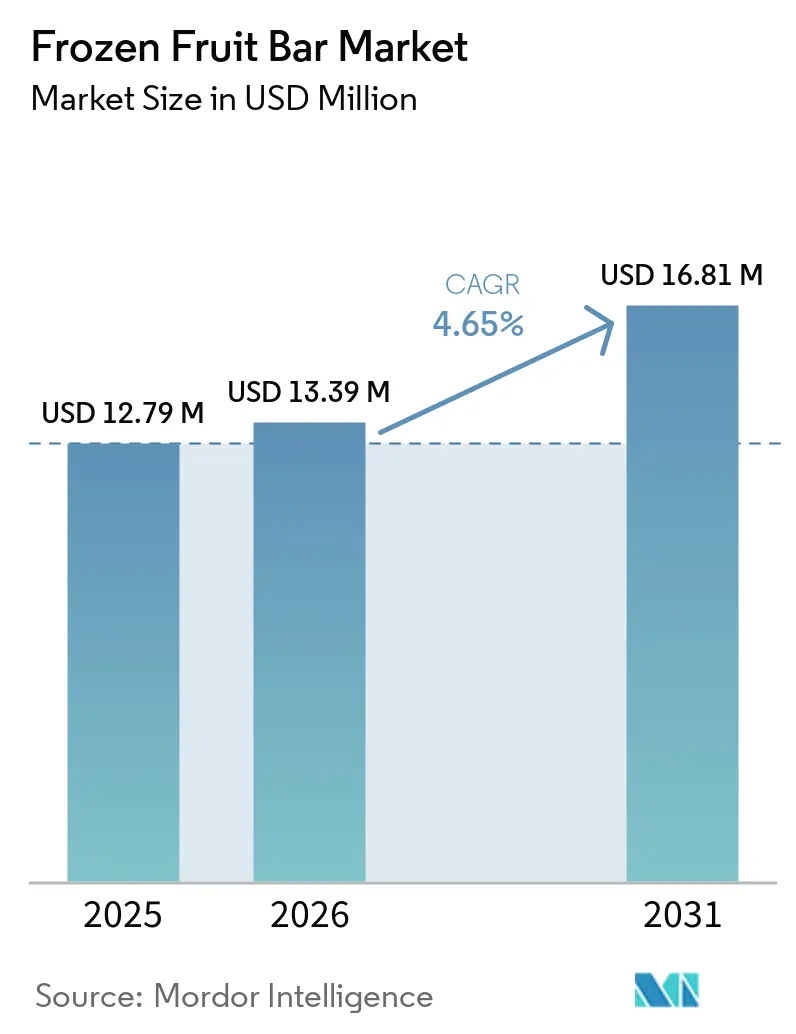
The frozen fruit bar market size is expected to increase from USD 12.79 million in 2025 to USD 13.39 million in 2026 and reach USD 16.81 million by 2031, growing at a CAGR of 4.65% over 2026-2031. The frozen fruit bar market benefits from growing demand for fruit-forward snacks with simple ingredient lists. Products containing fruit purée, water, and limited sweeteners align with clean-label preferences and dairy-free dietary patterns. As fruit-rich diets are associated with a lower risk of chronic diseases, frozen fruit bars support health-focused positioning compared with cream-based frozen novelties[1]Source: World Health Organisation, "Healthy diet", who.int. Brands are also incorporating functional ingredients, distinctive textures, and tropical flavors to drive purchases beyond the traditional summer dessert occasion. However, the market faces supply and distribution challenges, as tropical fruit inputs are seasonal and frozen products require reliable refrigeration. These conditions favor brands that can maintain ingredient quality, manage costs, and secure appropriate placement across grocery and specialty retail channels.
Key Report Takeaways
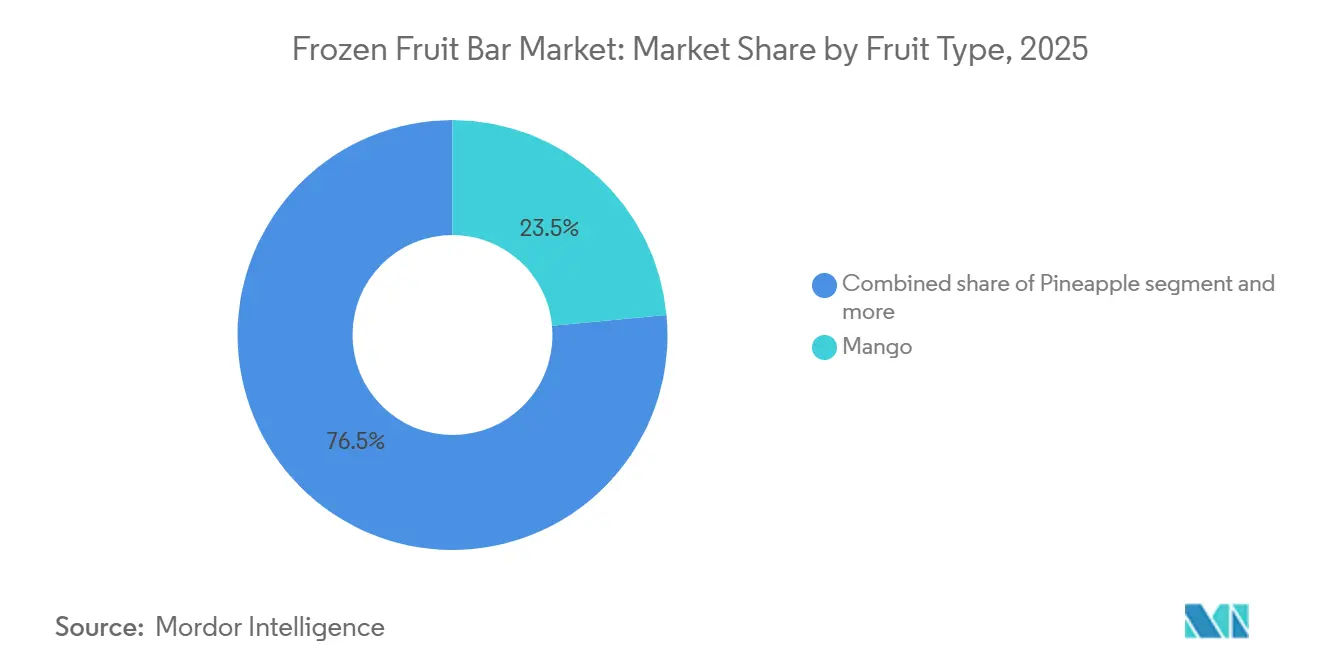
- By fruit type, mango held the largest share of the frozen fruit bar market at 23.52% in 2025, while pineapple is projected to grow at the fastest CAGR of 5.49% during 2026-2031.
- By category, single fruit bars held the largest share of the frozen fruit bar market at 56.73% in 2025, while mixed fruit bars are projected to grow at the fastest CAGR of 5.98% during 2026-2031.
- By ingredient, conventional formulations held the largest share of the frozen fruit bar market at 59.12% in 2025, while natural and organic formulations are projected to grow at the fastest CAGR of 5.45% during 2026-2031.
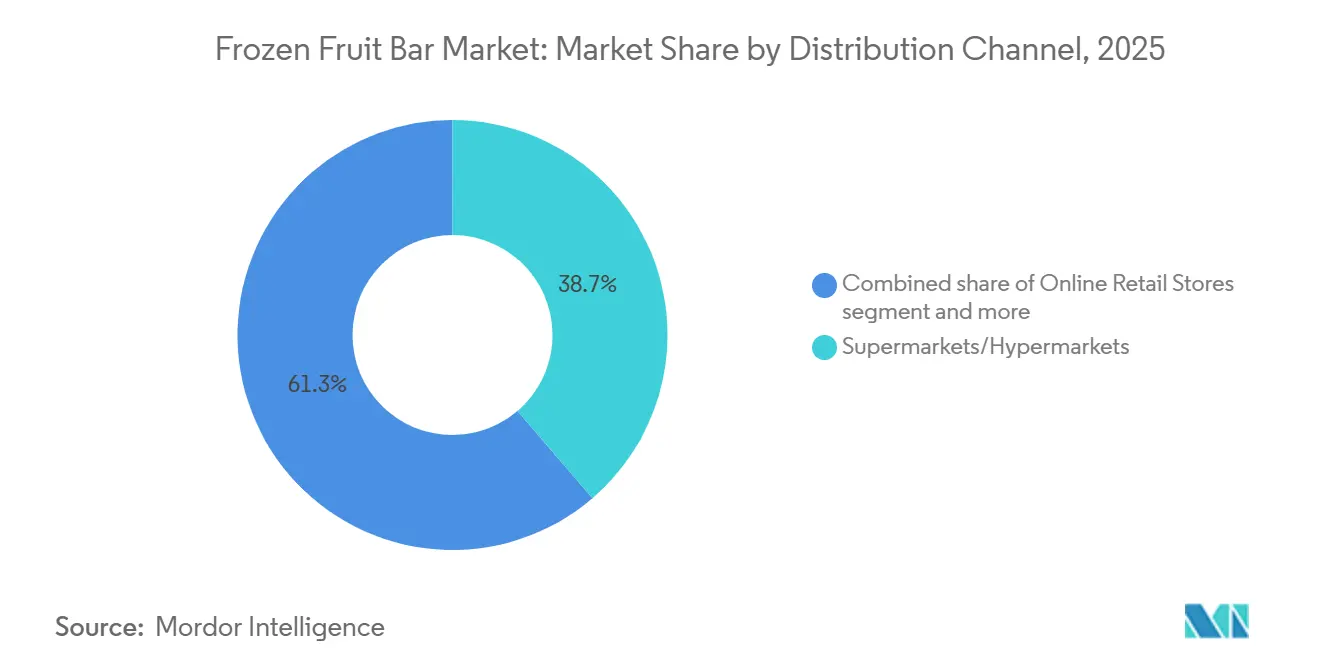
- By distribution channel, supermarkets and hypermarkets held the largest share of the frozen fruit bar market at 38.72% in 2025, while online retail stores are projected to grow at the fastest CAGR of 6.89% during 2026-2031.
- By geography, North America accounted for the largest share of the frozen fruit bar market, at 37.45% in 2025, while Asia-Pacific is projected to grow at the fastest CAGR of 7.15% during 2026-2031.
Note: Market size and forecast figures in this report are generated using Mordor Intelligence’s proprietary estimation framework, updated with the latest available data and insights as of January 2026.
Global Frozen Fruit Bar Market Trends and Insights
Drivers Impact Analysis*
| Driver | (~) % Impact on CAGR Forecast | Geographic Relevance | Impact Timeline |
|---|---|---|---|
| Clean-label and real-fruit snacks | +1.1% | Global, earliest gains in North America and Europe | Short term (≤ 2 years) |
| Plant-based and dairy-free indulgence | +0.8% | North America and Europe, with spillover to Asia-Pacific | Medium term (2-4 years) |
| Portion-controlled and lower-sugar treats | +0.6% | North America, United Kingdom, and Australia | Short term (≤ 2 years) |
| Tropical and exotic fruit innovation | +0.8% | Global, with core gains in Asia-Pacific, Middle East and Africa, and South America | Medium term (2-4 years) |
| Functional hydration formulations | +0.4% | North America, with spillover to Europe | Short term (≤ 2 years) |
| Cold-chain access in emerging markets | +0.5% | Asia-Pacific, with spillover to South America and Middle East and Africa | Long term (≥ 4 years) |
| Source: Mordor Intelligence | |||
Demand for Clean-Label and Real-Fruit Frozen Snacks
The frozen fruit bar market benefits from formulations that use fruit purée, water, and limited sweeteners. These formulations meet consumer demand for short ingredient lists without requiring extensive product reformulation. The revised U.S. Nutrition Facts label provides shoppers with clearer visibility of calories and added sugars at the point of purchase, making fruit bars easier to compare with cream-based frozen novelties[2]Source: US Food and Drug Administration, "Changes to the Nutrition Facts Label", fda.gov. Claims such as “made with real fruit,” “no added sugar,” and “non-GMO” have become increasingly important in natural retail channels. In addition, the single-serve format supports portion-controlled consumption, which appeals to health-conscious consumers seeking convenient frozen snack options. Consequently, the frozen fruit bar market provides brands with opportunities to secure shelf space and support premium pricing, particularly where clean-label credentials influence purchasing decisions.
Growth of Plant-Based and Dairy-Free Indulgence
The frozen fruit bar market is well positioned to benefit from growing plant-based demand, as many fruit bars are naturally dairy-free. This characteristic reduces the formulation work typically required to convert dairy-based products into plant-based alternatives. Draft FDA guidance was launched in January 2025 to clarify how plant-based alternatives can use standard food descriptors containing dairy-related language, reducing labeling uncertainty for brands selling through conventional and natural retail channels[3]Source: US Food and Drug Administration, "Labeling of Plant-Based Alternatives to Animal-Derived Foods", fda.gov. GoodPop launched Peaches n' Cream and Berries n' Cream in July 2026. The products feature organic, vegan, gluten-free, and kosher certifications and will use organic fruit juice, purée, and a coconut cream center. These credentials enable brands to serve households seeking dairy-free and allergen-conscious frozen products.
Flavor Innovation Using Tropical and Exotic Fruits
Tropical and exotic fruits support premium flavor offerings in established retail markets while connecting products with frozen dessert traditions in South America, Southeast Asia, and the Middle East. In February 2025, Dole Packaged Foods introduced Dole Whip Mango and Pineapple Fruit First Treats, which use real fruit purée as the primary ingredient in dairy-free and gluten-free products. These products achieved nationwide retail availability in the United States in June 2025. Pineapple’s 5.49% CAGR also reflects its association with bromelain and its use in two-fruit product formats. Tropical fruits also enable manufacturers to differentiate their product portfolios through distinctive flavor combinations and naturally vibrant colors. Regional producers use varietals such as yuzu, lychee, tamarind, guanábana, and passion fruit to cater to local preferences and offer novelty through export channels.
Freezer-Based Hydration and Functional Formulations
The frozen fruit bar market is expanding beyond its traditional dessert positioning through functional hydration offerings. The product is anticipated to sell out within minutes of its online launch, reflecting strong consumer interest in products that combine indulgence, convenience, and wellness benefits. It is certified organic and contains no artificial dyes, aligning with growing demand for clean-label frozen snacks. JonnyPops developed the product in response to consumer feedback on sports recovery and rehydration during illness. By incorporating electrolytes into a no-sugar-added frozen format, the company addresses demand for convenient hydration options that can be consumed after physical activity or during recovery. This approach could create opportunities in freezer sections beyond seasonal impulse-purchase occasions and support year-round demand by positioning frozen fruit bars as convenient hydration and wellness-focused products.
Restraints Impact Analysis*
| Restraint | (~) % Impact on CAGR Forecast | Geographic Relevance | Impact Timeline |
|---|---|---|---|
| Fruit Seasonality and Purée Cost Volatility | -0.3% | Global, most acute in Asia-Pacific and South America | Medium term (2-4 years) |
| Frozen Distribution Energy and Logistics Costs | -0.5% | Global, pronounced in Middle East and Africa and South America | Long term (≥ 4 years) |
| Sugar-reduction trade-offs | -0.2% | North America and Europe | Short term (≤ 2 years) |
| Last-Mile Melting and Freezer-Execution Risk | -0.4% | Asia-Pacific, Middle East and Africa, and South America | Long term (≥ 4 years) |
| Source: Mordor Intelligence | |||
Fruit Supply Seasonality and Purée Cost Volatility
The frozen fruit bar market depends on tropical fruit purée supply chains concentrated in Mexico and Southeast Asia. Dry spells and irregular monsoon patterns can constrain mango and pineapple availability by affecting harvests. Smaller manufacturers often rely on annual or spot purchasing agreements instead of multiyear contracts, limiting their ability to absorb input price fluctuations. Cost pressures are particularly acute during high-demand summer periods, when production and marketing requirements increase simultaneously. Brands with diversified sourcing origins and stronger supplier agreements are better positioned to maintain distribution plans amid changing harvest conditions. Maintaining higher inventory levels or using alternative fruit inputs can further help manufacturers manage short-term supply disruptions.
Frozen Distribution Energy and Logistics Costs
Frozen distribution costs constrain the frozen fruit bar market because these products require continuous temperature control. Refrigerated warehouse operating expenses increased by 6.09% year over year in the third quarter of 2024, driven by higher energy costs and challenging labor conditions across logistics hubs. Low unit prices limit the ability of manufacturers, distributors, and retailers to pass these cost increases on to consumers. The challenge is more pronounced in emerging markets, where informal retail channels and diesel-powered refrigerated transport are more prevalent. These conditions increase logistics costs and can affect product consistency along warm-climate delivery routes. In addition, limited cold-storage infrastructure and frequent power disruptions can increase spoilage risks and inventory losses, particularly in developing economies. Multi-packs and shared cold-chain distribution can help brands manage these cost pressures more effectively.
*Our forecasts treat driver/restraint impacts as directional, not additive. The impact forecasts reflect baseline growth, mix effects, and variable interactions.
Segment Analysis
By Fruit Type: Mango Leads Volume, While Pineapple Grows Fastest
Mango accounted for 23.52% of the frozen fruit bar market share in 2025, making it the leading fruit type. Broad consumer familiarity across mature and emerging markets supports its position, while established trade flows ensure year-round access to mango inputs. Its naturally sweet flavor and vibrant color also support its use in both single-fruit and blended frozen fruit bar formulations. In 2025, Dole Packaged Foods launched Dole Whip Mango Fruit First Treat, a dairy-free and gluten-free product made primarily with fruit purée. The product entered freezer aisles across the United States in June 2025.
Pineapple is projected to be the fastest-growing fruit type, registering a CAGR of 5.49% during 2026-2031. Its flavor profile supports premium mixed-bar formats and two-fruit swirl products, while its association with bromelain provides brands with a functional point of differentiation. Its balance of sweetness and acidity further supports its appeal in tropical and refreshing product formulations. Citrus maintains a mid-tier position, supported by vitamin C associations and demand for warm-weather refreshment. Grape remains primarily associated with volume-driven private-label offerings. Lychee, passion fruit, guanábana, and yuzu enable regional brands to differentiate their offerings within the frozen fruit bar market.



By Category: Single Fruit Bars Lead, While Mixed Fruit Bars Grow Fastest
Single-fruit bars accounted for 56.73% of the frozen fruit bar market share in 2025. Their leading position reflects strong consumer familiarity, operational simplicity, and alignment with standardized mass-retail freezer assortments that favor clear SKU structures. These formats suit retailers that prioritize high sales volumes and reliable replenishment. Their limited ingredient profiles can also simplify product labeling and inventory management. Their scale is expected to support a durable position in the frozen fruit bar market. However, their value proposition faces pressure as consumers increasingly seek more complex flavor combinations.
Mixed fruit bars are forecast to grow at a CAGR of 5.98% during 2026-2031. Brands use multi-flavor layers to justify premium retail pricing and encourage product trial. In September 2025, Outshine launched Fruit Blends in cherry limeade, piña colada, and tropical punch varieties. These products feature two-fruit swirl designs made with real fruit or juice. Mixed-fruit formulations can also diversify sourcing across two fruit purées, reducing exposure to supply disruptions affecting a single fruit origin in the frozen fruit bar market. Their broader flavor profiles also enable brands to differentiate their offerings within freezer assortments.
By Ingredient: Conventional Formulations Lead, While Natural and Organic Variants Grow Fastest
Conventional formulations accounted for 59.12% of the frozen fruit bar market share in 2025. Their established supply relationships and lower input costs support their market position. These products also meet the pricing requirements of convenience stores, club retailers, and mass grocery chains, which depend on efficient production and accessible price points. Their broad distribution availability further supports repeat purchases among price-sensitive consumers. Conventional products will remain important in channels where purchase decisions primarily depend on volume and price.
Natural and organic formulations are projected to grow at a CAGR of 5.45% during the 2026–2031 forecast period. Growth is particularly evident in specialty and natural grocery stores, where organic certification may serve as a baseline purchase requirement. Rising consumer preference for clean-label products also supports demand in these channels. JonnyPops' electrolyte-fortified product line holds organic certification and contains no artificial dyes. Suppliers source organic tropical fruit purée through narrower, higher-cost networks. However, long-term supplier relationships can provide frozen fruit bar market participants with greater price and volume visibility across harvest cycles.
By Distribution Channel: Supermarkets and Hypermarkets Lead, While Online Retail Grows Fastest
Supermarkets and hypermarkets accounted for 38.72% of the frozen fruit bar market share in 2025. Their freezer capacity provides the shelf space required to support broad product assortments. Large brands can secure placement in these outlets through established cold-chain networks and category management capabilities. This channel remains critical for high-volume, repeat household purchases and enables brands to position clean-label and conventional products within the same frozen aisle. In-store promotions and prominent freezer displays can further improve product visibility and encourage trial purchases.
Online retail stores are projected to grow at a CAGR of 6.89% during 2026-2031. This channel can lower entry barriers, including upfront slotting fees and promotional allowances. In May 2026, GoodPop launched Fruit Sours through Whole Foods, Wegmans, HEB, and select Costco locations, combining specialty retail visibility with targeted wholesale distribution. Convenience and grocery stores remain important channels for single-serve impulse purchases in warm-weather locations. Vending machines, foodservice outlets, and fitness centers provide additional distribution channels for functional hydration products in the frozen fruit bar market. Online platforms also enable brands to reach consumers beyond traditional retail catchment areas through direct delivery options.
Geography Analysis
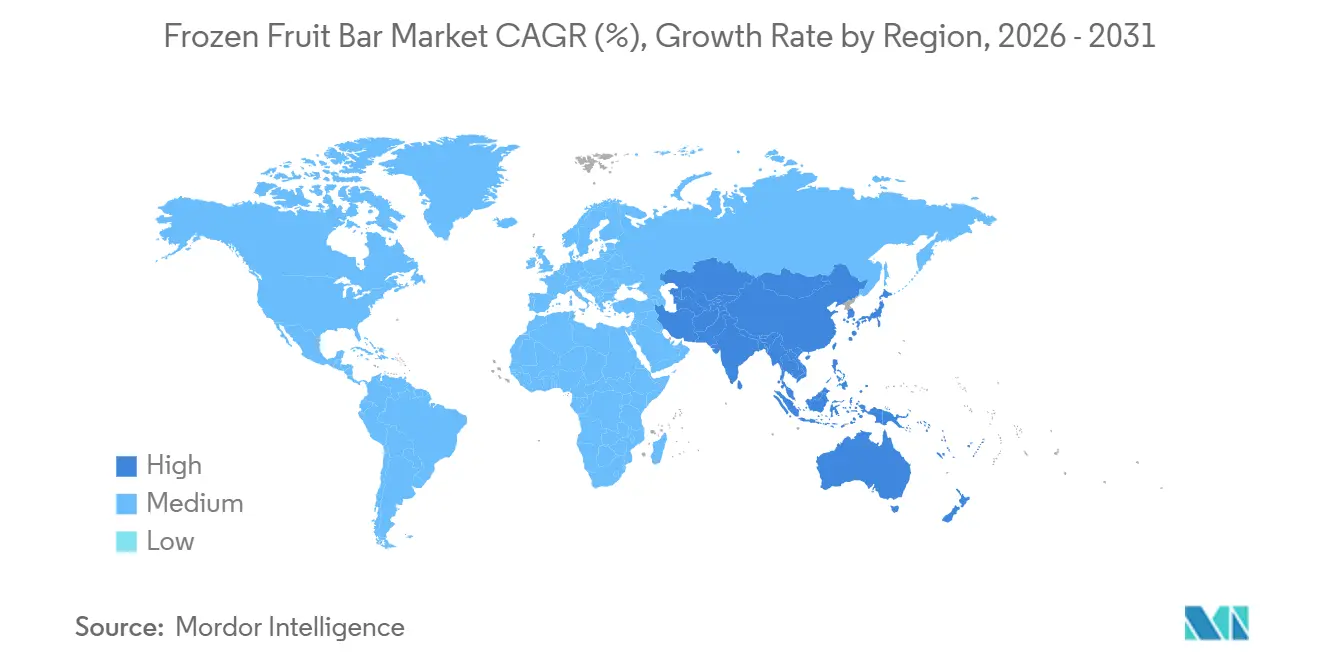
North America is projected to account for 37.45% of the frozen fruit bar market share in 2025, making it the largest regional segment. High household freezer ownership supports at-home consumption across the region, enabling consumers to store frozen fruit bars conveniently and purchase them in larger quantities. Established manufacturers leverage extensive retail distribution networks across major grocery chains, mass merchandisers, and specialty stores while continuing to drive product innovation through new flavors, clean-label offerings, and health-focused product formulations. The region's mature cold-chain infrastructure further ensures consistent product availability and quality across supermarkets, convenience stores, and online retail channels.
Asia-Pacific is forecast to record the fastest CAGR of 7.15% during 2026-2031. Warm climates and a large youth population support demand beyond the peak summer season. The expansion of modern grocery retail and e-commerce platforms also improves consumer access to frozen fruit bars across the region. In 2025, India sanctioned 394 cold-chain projects under the Pradhan Mantri Kisan Sampada Yojana, with 286 projects completed. These completed projects are aimed to create more than 10 lakh metric tonnes of cold storage capacity, enabling frozen food producers to expand into tier-2 and tier-3 cities. In China, on-demand delivery platforms also support same-day delivery of frozen products in major urban areas.
Europe shows strong demand for organic-certified frozen fruit products, particularly in Scandinavia and the United Kingdom. Consumers in Southern Europe place greater emphasis on premium artisanal products associated with local food culture. Stricter additive regulations and sugar-reduction targets support products formulated with real fruit ingredients. South America has established paleta and fruit bar traditions, particularly in Colombia and Brazil, while Mexico also has a well-established paleta tradition. This familiarity provides international brands with an entry point for premium products. The Middle East and Africa remain at an earlier stage of formal market adoption. Organized retail expansion and rising disposable incomes support demand for imported premium novelties in Gulf Cooperation Council and North African cities. However, uneven cold-chain coverage and price sensitivity continue to limit broader expansion.

Competitive Landscape
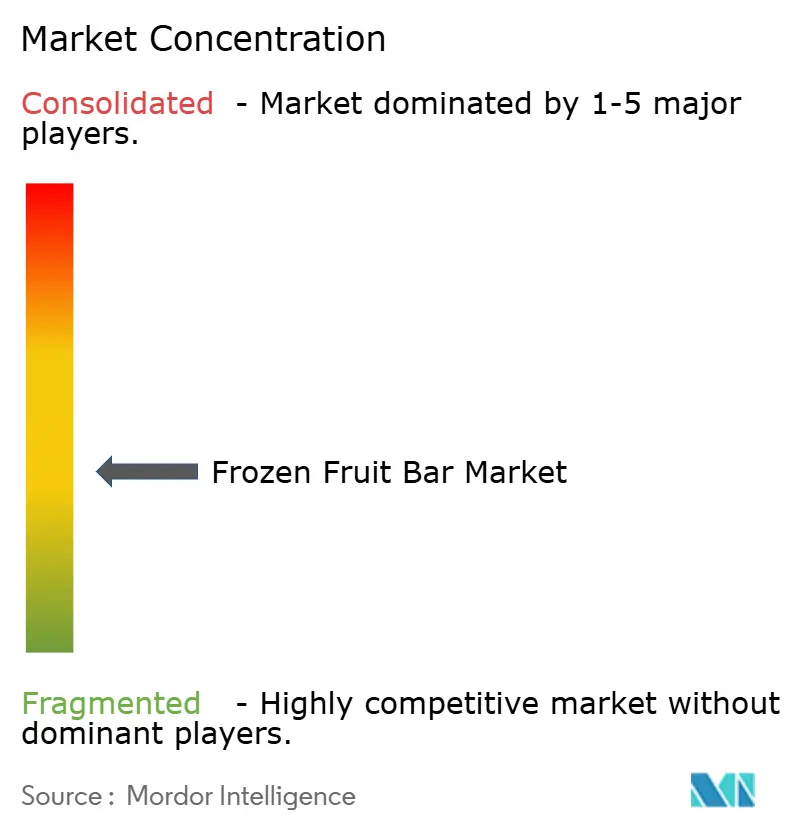
The frozen fruit bar market features a moderately fragmented competitive structure. Large manufacturers leverage established cold-chain systems and retail relationships to maintain broad grocery distribution. Clean-label brands and regional specialists compete through stringent ingredient standards, distinctive formats, and operational agility. Nestlé S.A. and Unilever maintain established freezer placement and category management relationships, while Outshine remains a high-volume branded frozen novelty line in North America. This market structure makes product development and retail promotions critical to competitive performance.
Companies increasingly use proprietary formats to strengthen differentiation in the frozen fruit bar market. GoodPop launched in May 2026 with a patent-pending sour candy coating on a real-fruit frozen pop, combining a familiar confectionery-inspired flavor profile with fruit-based ingredients. Its shelf-stable, melt-free format supports consumption occasions beyond refrigerated retail settings, including on-the-go snacking, outdoor activities, and retail channels with limited freezer infrastructure. Functional formulations, such as products containing added vitamins or other wellness-oriented ingredients, and origin-specific fruit sourcing also remain important areas where smaller brands can compete by offering distinct product attributes and stronger brand positioning.
Regional specialists, including Paleteria La Michoacana, Andrade's Desserts, and Tropicale Foods, maintain consumer loyalty through heritage positioning and artisanal production narratives. These brands appeal to consumers seeking familiar regional fruit flavors. Larger companies, however, have a greater ability to meet retailer requirements for consistent supply and food safety controls. U.S. Food Safety Modernization Act (FSMA) requirements and evolving European food safety standards continue to raise operational expectations for new entrants. These requirements favor brands with robust quality management and traceability systems. Therefore, the frozen fruit bar industry combines scale-based advantages with opportunities for differentiated regional and clean-label offerings. Competitive intensity remains high, as no single company holds dominant control of the category.
Frozen Fruit Bar Industry Leaders
-
Nestlé S.A.
-
Unilever plc
-
J&J Snack Foods Corp.
-
GoodPop Foods
-
JonnyPops
- *Disclaimer: Major Players sorted in no particular order

Recent Industry Developments
- July 2026: GoodPop added Fudge n' Vanilla French Fry Pop, Peaches n' Cream, and Berries n' Cream to its frozen novelty portfolio, targeting the swalty and nowstalgia consumer trends. Peaches n' Cream and Berries n' Cream are certified organic, vegan, gluten-free, and kosher. They are made with organic fruit juice, purée, and a coconut cream center, while the French Fry Pop uses real dairy ice cream.
- April 2026: JonnyPops launched its first functional hydration product, No Sugar Added with Electrolytes mini frozen pops, at retail. The line is certified organic, free from artificial dyes, and produced in a peanut-free facility. JonnyPops developed the product in response to consumer feedback around sports recovery and illness rehydration.
- September 2025: Outshine, a Dreyer's Grand Ice Cream brand, introduced Fruit Blends with cherry limeade, piña colada, and tropical punch frozen bars. The line featured two-fruit swirl designs made with real fruit or juice. The launch expanded the mixed-fruit category in North American mass retail.
- June 2025: Dole Whip Pineapple and Mango Fruit First Treats reached U.S. retail freezer aisles nationally. The products were available in 4-packs at grocery stores and 8-packs at Costco for USD 6.99. Both formats were dairy-free and gluten-free.


Global Frozen Fruit Bar Market Report Scope
| Mango |
| Citrus |
| Pineapple |
| Grape |
| Others |
| Single Fruit Bar |
| Mixed Fruit Bar |
| Natural and Organic |
| Conventional |
| Supermarkets/Hypermarkets |
| Convenience/Grocery Stores |
| Online Retail Stores |
| Other Channels |
| North America |
| Europe |
| Asia-Pacific |
| South America |
| Middle East and Africa |
| By Fruit Type | Mango |
| Citrus | |
| Pineapple | |
| Grape | |
| Others | |
| By Category | Single Fruit Bar |
| Mixed Fruit Bar | |
| By Ingredient | Natural and Organic |
| Conventional | |
| By Distribution Channel | Supermarkets/Hypermarkets |
| Convenience/Grocery Stores | |
| Online Retail Stores | |
| Other Channels | |
| By Geography | North America |
| Europe | |
| Asia-Pacific | |
| South America | |
| Middle East and Africa |


Key Questions Answered in the Report
What is the forecast growth rate for frozen fruit bars?
The category is forecast to grow at a CAGR of 4.65% from 2026 to 2031, reaching USD 16.81 million by 2031.
Which fruit type leads frozen fruit bar sales?
Mango led fruit types with a 23.52% share in 2025, supported by consumer familiarity and established global trade flows.
Which product format is growing fastest?
Mixed fruit bars are projected to record the fastest category growth, with a 5.98% CAGR during 2026-2031.
Which sales channel is expected to grow most quickly?
Online retail stores are forecast to grow at a 6.89% CAGR during 2026-2031, the fastest rate among distribution channels.
What region offers the strongest growth opportunity?
Asia-Pacific is forecast to expand at a 7.15% CAGR during 2026-2031, supported by warm climates and growing cold-chain capacity.
Page last updated on:





