
France Turf Protection Market Size and Share
Market Overview
| Study Period | 2021 - 2031 |
|---|---|
| Forecast Data Period | 2026 - 2031 |
| Base Year Market Size (2025) | USD 182.40 Million |
| Market Size (2026) | USD 191.34 Million |
| Market Size (2031) | USD 246.54 Million |
| Growth Rate (2026 - 2031) | 5.20 % |
| Market Concentration | Medium |
Major Players *Disclaimer: Major Players sorted in no particular order Image © Mordor Intelligence. Reuse requires attribution under CC BY 4.0. | |
France Turf Protection Market Analysis by Mordor Intelligence
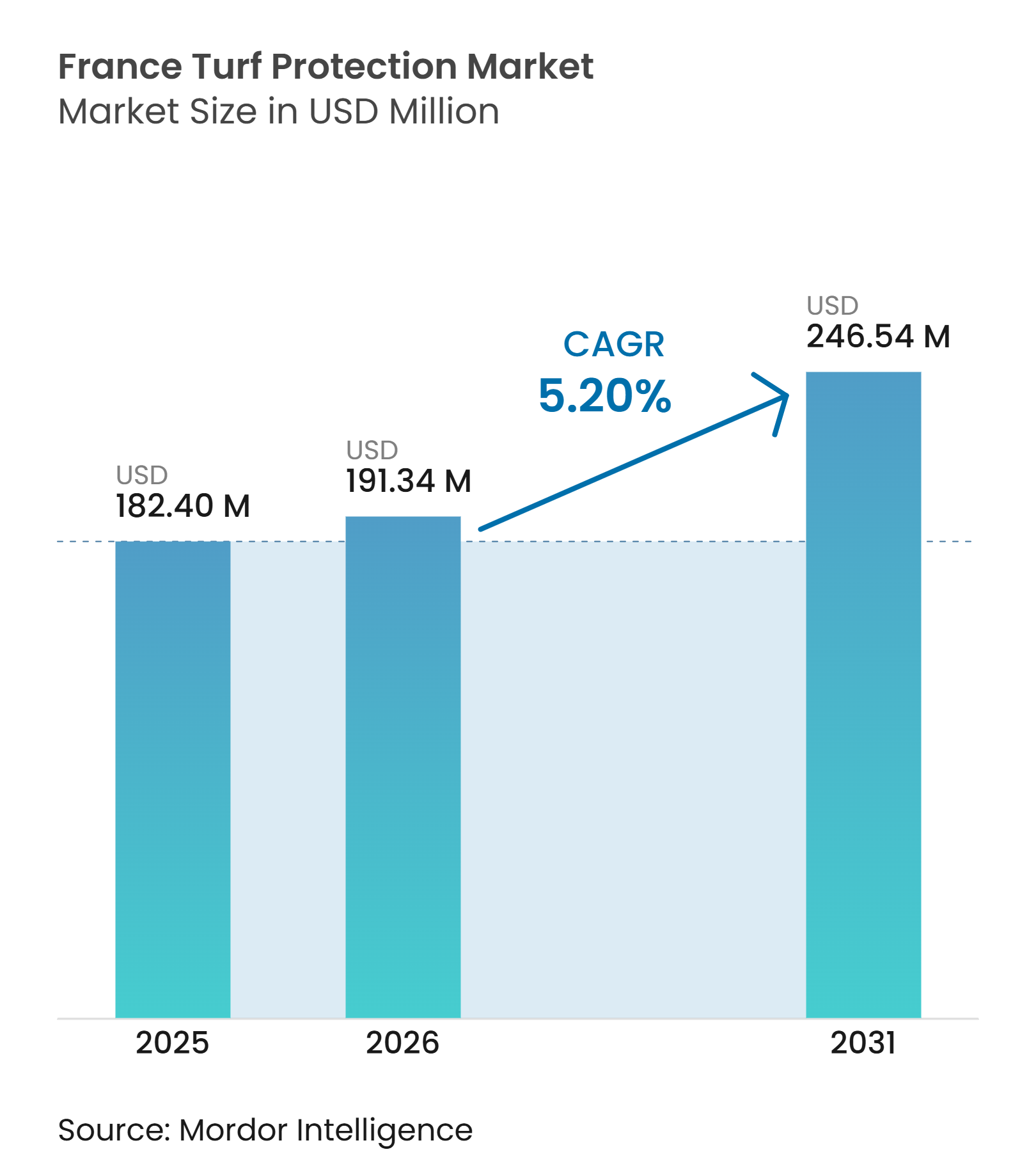
The France turf protection market size was valued at USD 182.40 million in 2025 and is estimated to grow from USD 191.34 million in 2026 to reach USD 246.54 million by 2031, at a CAGR of 5.20% during the forecast period (2026-2031). France occupies a distinct position in Europe, as conventional turf chemicals face strict controls while biological alternatives are being adopted more widely. The Loi Labbé framework and Écophyto 2030 have increased compliance requirements for plant-protection products and sports grounds since January 2025[1]. This regulatory environment supports higher spending per hectare on biological products and precision application tools. Heat, drought, disease pressure, and the renewal of major sports venues are also driving demand for recovery and stress-management programs. Suppliers are responding by expanding biological portfolios, improving liquid formulations, and developing programs suited to regulated turf-management practices.
Key Report Takeaways
- By product type, fungicides accounted for 36.8% of the France turf protection market share in 2025, while insecticides are forecast to grow at a CAGR of 8.90% from 2026 to 2031.
- By mode of action, chemical accounted for 68.5% of the France turf protection market size in 2025, while biological is forecast to grow at a CAGR of 10.9% from 2026 to 2031.
- By formulation, liquid concentrate accounted for 55.6% of the market in 2025 and is forecast to grow at a CAGR of 10.3% from 2026 to 2031.
- By application, landscaping accounted for 40.1% of the market in 2025, while sports fields are forecast to grow at a CAGR of 9.3% from 2026 to 2031.
- By end user, residential customers accounted for 41.2% of the market in 2025, while sports facility owners are forecast to grow at a CAGR of 8.9% from 2026 to 2031.
Note: Market size and forecast figures in this report are generated using Mordor Intelligence’s proprietary estimation framework, updated with the latest available data and insights as of January 2026.
Market Trends and Insights
Drivers Impact Analysis of France Turf Protection Market*
| Driver | (~) % Impact on CAGR Forecast | Geographic Relevance | Impact Timeline |
|---|---|---|---|
| Expansion of Golf, Football, Rugby, and Multi-Sport Facilities | +1.2% | France and broader EU | Short term (≤ 2 years) |
| Rising Turf Disease and Resistance Pressure | +0.8% | France and EU core | Short term (≤ 2 years) |
| Biological Turf-Protection Adoption Under Pesticide-Reduction Policy | +1.4% | France and EU, with the highest regulatory weight in France | Medium term (2-4 years) |
| Sensor-Guided Application and Data-Enabled Turf Management | +0.6% | France and Northern and Western Europe | Medium term (2-4 years) |
| Rising Insect Pest Pressure Across Managed Turf | +0.7% | France, and Southern Europe | Short term (≤ 2 years) |
| Professionalization of Municipal and Commercial Landscape Maintenance | +0.5% | France and EU, with early gains in Île-de-France, Provence, and Occitanie | Long term (≥ 4 years) |
| Source: Mordor Intelligence | |||
Expansion of Golf, Football, Rugby, and Multi-Sport Facilities
Golf and sports-turf infrastructure is undergoing a period of reinvestment that supports demand for establishment, protection, and recovery programs. Golf National's Albatros course reopened in 2026 after a two-year reconstruction program. The project reseeded 20 hectares with disease-resistant and low-irrigation varieties[2]. Newly established fine turf on modified sand profiles requires intensive care during its first two growing seasons. Dollar spot, Pythium, and Fusarium are key risks during this establishment period. Ligue 1 venues must also maintain demanding surface standards under tighter pesticide restrictions for professional sports grounds.
Long-term golf-course investment programs can include upgrades, sustainable turf practices, and biodiversity commitments. These projects extend the operational needs of established and newly seeded turf management programs and create recurring requirements for fungicides, irrigation support, and plant nutrition. Sports venues also have less flexibility to defer treatment because playing conditions affect competition schedules and venue quality. The France turf protection market benefits when renovations move from construction into the multi-season maintenance phase. Suppliers with products suitable for newly seeded turf can address this concentrated period of demand. Work at major golf and stadium sites also encourages similar practices among municipal and commercial operators.
Rising Turf Disease and Resistance Pressure
Disease pressure is becoming harder to manage as weather conditions change and the range of approved active ingredients narrows. Warmer and wetter springs can increase infection pressure, while hotter summers can weaken turf and raise recovery needs. Dollar spot, Fusarium patch, Pythium, and pyriculariose remain material concerns on golf and professional sports surfaces. The France turf protection market therefore depends on programs that protect turf through both disease and weather stress. Disease risk can be particularly disruptive at sites that cannot postpone fixtures or temporarily close playing areas, which encourages managers to plan preventive treatments, recovery inputs, and monitoring as a connected program.
The withdrawal of propiconazole from European Union markets has reduced flexibility in fungicide rotations. Turf managers are now more reliant on Succinate Dehydrogenase Inhibitor and Quinone outside Inhibitor chemistries. Repeated use of a narrower group of treatments can increase resistance-management pressure. Biological tools and rotation programs can help extend the usefulness of the remaining options, though they may require more treatment events than the conventional programs they replace. This pattern maintains a higher annual spend per hectare in complex disease-management settings and raises the importance of clear label guidance and locally proven treatment sequences. Suppliers must demonstrate where their products fit within a rotation rather than promoting a single input as a complete solution.
Biological Turf-Protection Adoption Under Pesticide-Reduction Policy
France's policy environment is supporting the adoption of biocontrol products as turf managers seek alternatives to certain conventional plant-protection products. Écophyto 2030 targets a 50% reduction in the use and overall risks of plant-protection products by 2030 compared with the 2011-2013 average. Sports ground managers are included among the stakeholders covered by the strategy. Products on the official biocontrol list benefit from regulatory provisions that differ from those applied to conventional products in public spaces. This regulatory framework can support the adoption of registered biocontrol products in public sports grounds and encourage their integration into turf-management programs.
PARSADA (Plan d’action stratégique pour l’anticipation du potentiel retrait européen des substances actives et le développement de techniques alternatives pour la protection des cultures) began operating in 2024 with EUR 146 million in funding to support alternatives to substances at risk of European Union level non-renewal. The program supports the development of replacement approaches and can encourage investment in alternatives to conventional plant-protection products. French national requirements continue to shape local purchasing decisions, while the Loi Labbé remains a key regulatory consideration for turf management. These policies can support demand for turf-protection solutions that comply with French registration and application requirements. Suppliers with established field evidence and regulatory experience can be better positioned to meet the requirements of professional turf managers.
Sensor-Guided Application and Data-Enabled Turf Management
Precision application is becoming more important at high-value French turf sites. Turf managers use weather-linked disease models, soil-moisture sensors, and sap-flow monitoring to select application windows. These tools help managers apply fungicides when turf conditions warrant treatment, reducing unnecessary applications while protecting product performance. This approach favors products whose results improve when timing is closely managed. The France turf protection market is therefore moving beyond simple product supply at elite venues.
The Aquaflow sub-surface irrigation system at the French Rugby Federation's national center in Marcoussis illustrates this operating model. The system supplies water by capillarity from an artificial phreatic layer with a capacity of 1,500 cubic meters. It is expected to save 60% to 100% of water while supporting turf health without conventional phytosanitary inputs. Suppliers that provide digital advisory support can gain a stronger role in site-management decisions. Integrated pest-management approvals can also strengthen product positioning. Transactional distributors may find it harder to match this service-based model.
Restraints Impact Analysis of France Turf Protection Market*
| Restraint | (~) % Impact on CAGR Forecast | Geographic Relevance | Impact Timeline |
|---|---|---|---|
| Withdrawal and Restriction of Conventional Active Ingredients | -1.0% | France and EU, with the highest regulatory weight in France | Short term (≤ 2 years) |
| High Registration, Stewardship, and Field-Trial Costs | -0.6% | France and EU | Medium term (2-4 years) |
| Resistance Management and Reduced Efficacy of Repeated Chemistry | -0.7% | France and EU core | Medium term (2-4 years) |
| Substitution by Artificial Turf in Selected Sports and Amenity Applications | -0.4% | France and EU, concentrated in municipal and amateur sports applications | Long term (≥ 4 years) |
| Source: Mordor Intelligence | |||
Withdrawal and Restriction of Conventional Active Ingredients
The withdrawal of approved active ingredients is narrowing the fungicide and herbicide toolkit available to French turf managers. Commission Implementing Regulation (EU) 2024/2777 formalized the European Union non-renewal of tritosulfuron on October 31, 2024. Member states were required to withdraw product authorizations by May 2025, with use-up periods ending by November 2025. This process can leave portfolio gaps across weed and disease-control programs. When an active ingredient is removed from the portfolio, managers may be forced to adopt less suitable rotations, which can affect product performance and planning at high-intensity turf sites.
The commercial challenge is greater for products with narrow turf-only uses. ANSES (French Agency for Food, Environmental and Occupational Health & Safety) applies the same safety standards as those for broader agricultural uses, but the potential revenue base for a turf registration is smaller. This can discourage manufacturers from submitting proactive renewal applications. The prospect of further non-renewals also creates uncertainty for distributors holding stock. European Union Regulation (EC) No 1107/2009 continues to govern these authorization and review cycles. The France turf protection market faces a continuing need for registered alternatives to address these practical gaps.
High Registration, Stewardship, and Field-Trial Costs
Registration, stewardship, and field-trial requirements can slow the introduction of turf products in France. Manufacturers must demonstrate safety, compliance, and performance before a product can be made available to regulated users. These costs are difficult to spread across a relatively focused turf customer base. Companies must also maintain local evidence that reflects French disease, climate, and application conditions. This burden is particularly significant for biological products seeking a place in established disease-control programs, and smaller suppliers may find it more difficult to finance the required registration and trial work.
These costs can affect competitive access even as demand for alternative turf-protection solutions grows. Suppliers without established trial networks or regulatory capabilities may face longer development timelines and higher costs to generate the evidence required for product approval. The relatively specialized nature of the turf market can further limit the commercial incentive to invest in separate registration and field-trial programs. This creates a barrier for new suppliers entering the France turf protection market and can slow the replacement of products affected by regulatory restrictions or withdrawals. While these requirements support product safety and performance standards, they can limit the speed at which new products are introduced.
*Our forecasts treat driver/restraint impacts as directional, not additive. The impact forecasts reflect baseline growth, mix effects, and variable interactions.
France Turf Protection Market Segment Analysis
By Product Type:
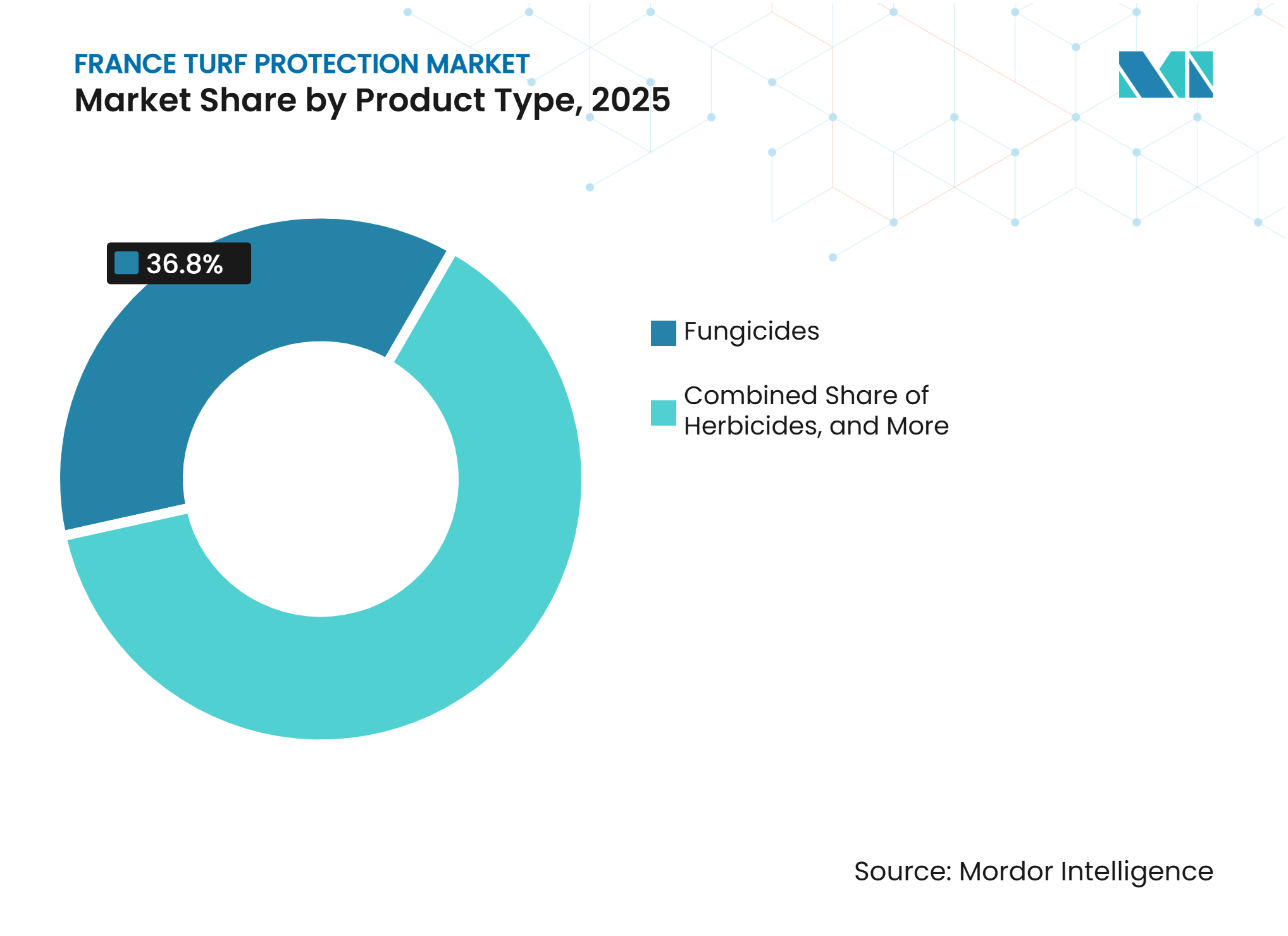
Fungicides Anchor Demand as Insecticides ScaleFungicides accounted for 36.8% of the France turf protection market share by product type in 2025. Their dominant position reflects persistent pressure from dollar spot, Fusarium, Pythium, and pyriculariose on professional and golf surfaces. Mild and humid conditions across much of northern and western France sustain fungal infection pressure from autumn through spring. Herbicides address weed-management requirements, including annual bluegrass and broadleaf weeds, while insecticides are used to manage pests such as crane flies and chafer grubs across turf areas.
Insecticides are forecast to grow at a CAGR of 8.90% from 2026 to 2031, driven by increasing demand for effective control of turf-damaging insect pests, particularly on golf courses, sports fields, and other intensively managed surfaces. Crane flies, chafer grubs, and other soil-dwelling pests can degrade turf quality and increase maintenance requirements, supporting the use of insecticides in integrated turf management programs. The expansion of professionally managed turf areas and a greater emphasis on maintaining consistent playing surfaces and quality are expected to further support insecticide demand in France during the forecast period.



By Treatment Type:
Chemical Still Dominant, Biological Advancing FastestChemical accounted for 68.5% of the market share by mode of action in 2025. Its current position reflects the need for reliable disease control during critical growth periods, particularly at high-value sites. Their long-term role is narrowing in public-space applications where conventional chemistry is restricted. Integrated solutions are gaining use among professional managers who incorporate biological and conventional inputs in structured rotations. These programs can preserve the reliability of chemical treatment while meeting biocontrol requirements. The France turf protection market remains dependent on successful integration rather than a straightforward chemical-to-biological transition.
Biological solutions are forecast to grow at a 10.9% CAGR from 2026 to 2031. Koppert France and Amoéba signed a Memorandum of Understanding in December 2024 for AXPERA, an amoeba-lysate biofungicide. The product was under European regulatory assessment in early 2025 and targets a broad range of fungal pathogens. Integrated programs benefit from this pipeline as they can combine biological products with retained conventional tools. Compatible registration and label guidance can reduce transition risk for turf managers, particularly on golf greens, where disease failure can have significant operational consequences.
By Formulation:
Liquid Concentrate, Entrenched, Wettable Powder, and Granular EvolvingLiquid concentrates accounted for 55.6% of the market in 2025 and are forecast to grow at a 10.3% CAGR from 2026 to 2031. This format is compatible with precision spraying equipment and provides uniform coverage on fine turf. It also allows multiple active ingredients to be mixed in a single tank, where permitted by labels, which is useful for integrated programs at golf facilities and professional sports grounds. Granular products continue to play a role in slow-release nutrition and soil-applied insecticides, and their application equipment can be simpler on lawns and bowling greens than on fine-turf surfaces.
Wettable powders remain a specialist format for some biocontrol and biofungicide products. Dry formats can help preserve active organisms for shelf stability. European Union microplastic regulations are also prompting a review of granular encapsulation materials. Envu introduced Signature XTRA Stressgard Liquid, a fosetyl-aluminum liquid formulation for golf and fine turf. The liquid formulation offers an alternative way to incorporate fosetyl-aluminum into existing spray-based turf-management programs.
By Application:
Landscaping Leads Market Share, While Sports Fields Record the Fastest GrowthLandscaping accounted for 40.1% of France turf protection market share by application in 2025. Public gardens, road verges, and institutional grounds provide a steady base of demand for weed management, turf nutrition, and disease control. These applications are shaped by restrictions on conventional products in public spaces. Contractors need compliant programs that maintain appearance and turf condition. The large installed base limits dependence on a small number of high-profile venues and supports recurring sales through professional maintenance channels.
Sports fields are forecast to grow at a 9.3% CAGR from 2026 to 2031. Post-Olympic and post-Rugby World Cup investment has increased maintenance requirements at federation-grade surfaces. Golf courses and professional football and rugby stadiums have quality standards that affect treatment frequency and product selection. The Loi Labbé restrictions on professional sports grounds took effect in January 2025. Biocontrol programs can involve more product applications per season than conventional spray programs. Sod farms also support renovation cycles by supplying natural grass treated with mycorrhizal products to aid establishment.
By End User:
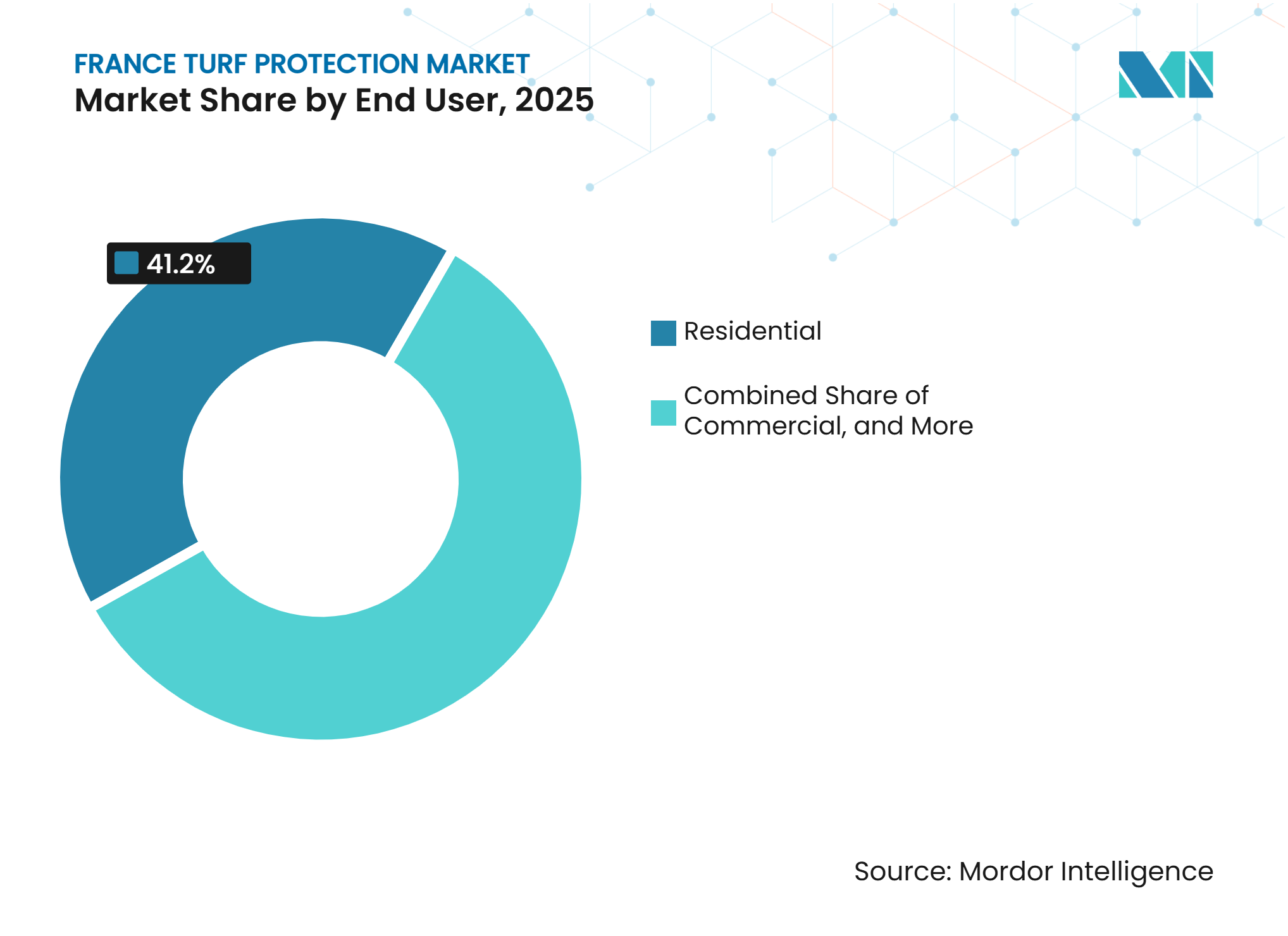
Residential Customers Lead Demand While Sports Facility Owners Drive GrowthResidential customers accounted for 41.2% of the market share by end user in 2025. Maintained lawns continue to support retail and cooperative-channel demand for lawn-care and weed-control products. This customer group has access to a narrower range of approved products under the Loi Labbé and Société Horticulture et Gazon restrictions. Professional-use products are being removed from amateur retail shelves. Consumers may therefore shift toward higher-priced alternatives rather than reduce spending altogether. Commercial landscape contractors also generate demand for products on the official French biocontrol list.
Sports facility owners are forecast to grow at an 8.9% CAGR from 2026 to 2031. Their demand is supported by surface-quality requirements, post-event investment, and sports-infrastructure planning. France's First National Climate Change Adaptation Plan for Sport identifies risks of heat, drought, and disease to natural turf across more than 16,000 amateur and professional stadiums. Municipalities and schools face the strictest pesticide limits and budget constraints, which can encourage outsourcing to contractors capable of managing technical and compliance requirements. This shift supports specialist service providers over in-house municipal operations.

Geography Analysis
France represents a significant European turf protection market, with extensive golf courses, football facilities, landscaping areas, and other managed turf spaces. The market is supported by increasing adoption of biological turf protection programs among professional turf managers. France's climate ranges from the mild and humid Atlantic zone to the drier Mediterranean south and continental interior, creating different disease, drought, and product-use requirements within a single national market.
Île-de-France has a concentrated group of high-profile turf assets, including Golf National, Roland Garros, and Ligue 1 and Top 14 rugby venues. Golf National completed its renovation in summer 2026, introducing low-irrigation and disease-resistant varieties across key playing surfaces. Newly established fine turf requires high fungicide intensity during the first two years of maturation. The Atlantic coast, including Gironde, Landes, and Loire-Atlantique, also has a high density of resort and municipal golf courses. Operators in these areas are moving toward biocontrol and precision irrigation to meet sustainability commitments and biodiversity requirements.
Southern France is emerging as a stronger demand area as heat stress, drought, and sports infrastructure needs converge. Occitanie and Provence-Alpes-Côte d'Azur experienced increased disease and heat-stress pressure in 2024 and 2025, supporting demand for fungicides and other turf protection products suited to higher temperatures. Research indicates that summer river flows could decline across French catchments, with the sharpest reductions in Pyrenean foothills and Mediterranean basins. The National Climate Change Adaptation Plan for Sport provides policy support for climate-resilient natural-turf maintenance.
Competitive Landscape
Market Concentration
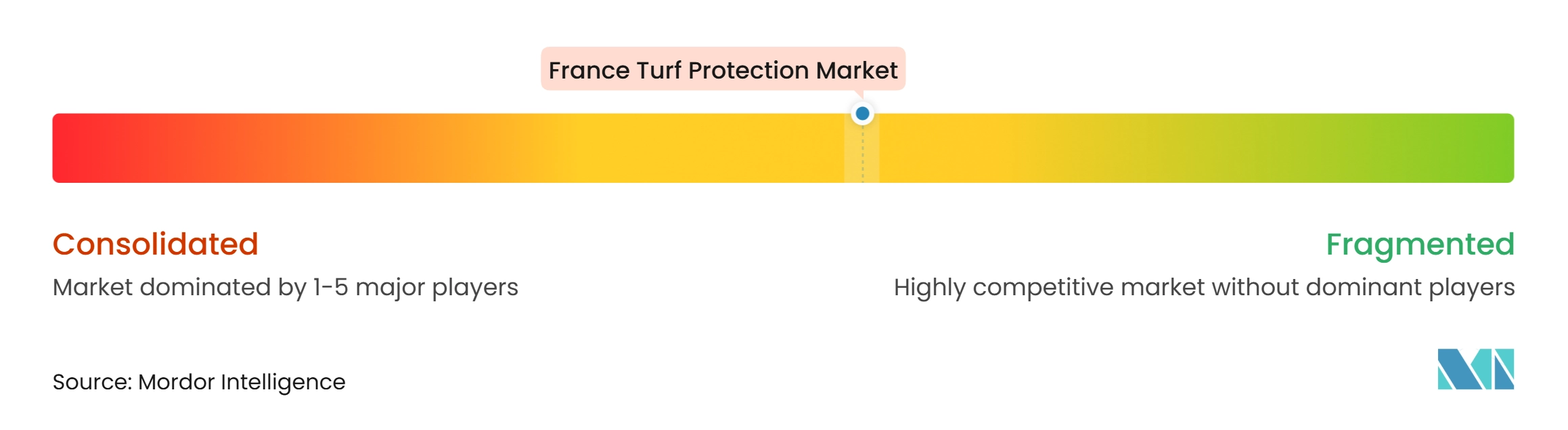
The France turf protection market is moderately fragmented, with several multinational and specialist suppliers serving professional turf users. Syngenta AG and Environmental Science FR SAS maintain established positions through broad fungicide and herbicide portfolios. BASF SE has France-specific authorized products, including Maxtima fungicide and Attraxor growth regulator. Corteva Inc and Nufarm Limited also hold established positions. Nufarm Limited is the authorization holder for the French-approved Green Turf 5 herbicide. The market also includes specialist biological suppliers, distributors, and regional nutrition companies.
Koppert France, Lallemand Plant Care, and other specialist suppliers compete through differentiated biological and turf protection products. The Vivagro and Envu relationship for a biorational solution targeting dollar spot and snow mold is supported by more than 30 European field trials. These collaborations demonstrate how larger turf protection platforms can expand their biological product offerings through partnerships with specialist companies.
Opportunities remain in integrated programs for resistant pathogens and in digital tools for compliance record keeping. Groupe NAU is a specialist French channel for turf-authorized fungicides and herbicides. Amoéba's AXPERA technology has a distinct mode of action and no known cross-resistance with existing fungicide classes. Competition is increasingly shaped by the breadth of authorized fungicide, herbicide, and insecticide portfolios, as well as the development of biological turf protection products.
France Turf Protection Industry Leaders
-
Syngenta AG
-
Environmental Science FR SAS (Envu)
-
BASF SE
-
Nufarm Limited
-
Corteva Inc
- *Disclaimer: Major Players sorted in no particular order
France Turf Protection Market Companies Covered in this Report
- Syngenta AG
- Environmental Science FR SAS (Envu)
- BASF SE
- Corteva Inc
- Nufarm Limited
- Koppert France
- UPL Limited
- Lallemand Plant Care
- Sumitomo Chemical Co., Ltd.
- Certis Belchim B.V.
- De Sangosse
- FMC Corporation
- Prograss Bio Ltd
- Groupe NAU
Recent Industry Developments in France Turf Protection Market
- July 2026: Amoéba and Koppert extended their exclusive distribution agreement for AXPERA technology, a biological fungicide technology based on amoeba lysate, through June 2031 across 18 European countries and the United States. The agreement follows the commercial launch of AXPERA-based products at GreenTech Europe in Amsterdam.
- December 2025: Envu unveiled Signature XTRA Stressgard Liquid, a liquid fosetyl-aluminum formulation for golf and fine turf. The fungicide is designed to control foliar and root Pythium diseases, algae, and Microdochium patch.
- September 2025: Envu expanded the application options for Durentis insecticide by making it available to fertilizer formulators for use in insecticide-fertilizer combination products targeting golf-course and lawn-care applications. The formulation is intended to provide insect pest control while supporting convenient application through fertilizer programs.
France Turf Protection Market Report Scope
The turf protection market is defined as products and solutions used to prevent, control, and reduce pest, disease, and stress damage in natural turfgrass across residential, commercial, and sports surfaces, with market value measured at the point of sale in USD.
The France Turf Protection Market is Segmented by Product Type (Fungicides, Herbicides, and Insecticides), by Treatment Type (Chemical and Biological), by Formulation (Granular, Liquid Concentrate, and Wettable Powder), by Application (Landscaping, Golf Courses, Sports Fields, and Sod Farms), and by End User (Residential Customers, Commercial Landscape Contractors, Sports Facility Owners, and Municipalities and Schools). The Market Forecasts are Provided in Terms of Value (USD).
Segmentation Overview
| Fungicides |
| Herbicides |
| Insecticides |
| Chemical |
| Biological |
| Granular |
| Liquid Concentrate |
| Wettable Powder |
| Landscaping |
| Golf Courses |
| Sports Fields |
| Sod Farms |
| Residential Customers |
| Commercial Landscape Contractors |
| Sports Facility Owners |
| Municipalities and Schools |
| By Product Type | Fungicides |
| Herbicides | |
| Insecticides | |
| By Treatment Type | Chemical |
| Biological | |
| By Formulation | Granular |
| Liquid Concentrate | |
| Wettable Powder | |
| By Application | Landscaping |
| Golf Courses | |
| Sports Fields | |
| Sod Farms | |
| By End User | Residential Customers |
| Commercial Landscape Contractors | |
| Sports Facility Owners | |
| Municipalities and Schools |
Key Questions Answered in the Report
What is the forecasted growth of the France turf protection market through 2031?
The France turf protection market is forecast to reach USD 246.54 million by 2031, growing at a CAGR of 5.20% from 2026 to 2031.
Which product type accounted for the largest share of the France turf protection market?
Fungicides accounted for the largest share, at 36.8% in 2025, supported by disease pressure on golf and professional sports surfaces.
Why are biological solutions growing in France?
Biological solutions are forecast to grow at a CAGR of 10.9% from 2026 to 2031, supported by pesticide-reduction policies and increasing demand for alternatives to conventional products.
How does climate affect turf management in France?
Heat, drought, and disease risks are increasing the use of stress-protection biostimulants, efficient irrigation, and structured disease-control programs.