
Market Overview
| Study Period | 2021 - 2031 |
|---|---|
| Forecast Data Period | 2026 - 2031 |
| Historical Data Period | 2021 - 2024 |
| Growth Rate | 2.06 % |
| Market Concentration | High |
Major Players *Disclaimer: Major Players sorted in no particular order Image © Mordor Intelligence. Reuse requires attribution under CC BY 4.0. | |
France Rotor Blade Market Analysis by Mordor Intelligence
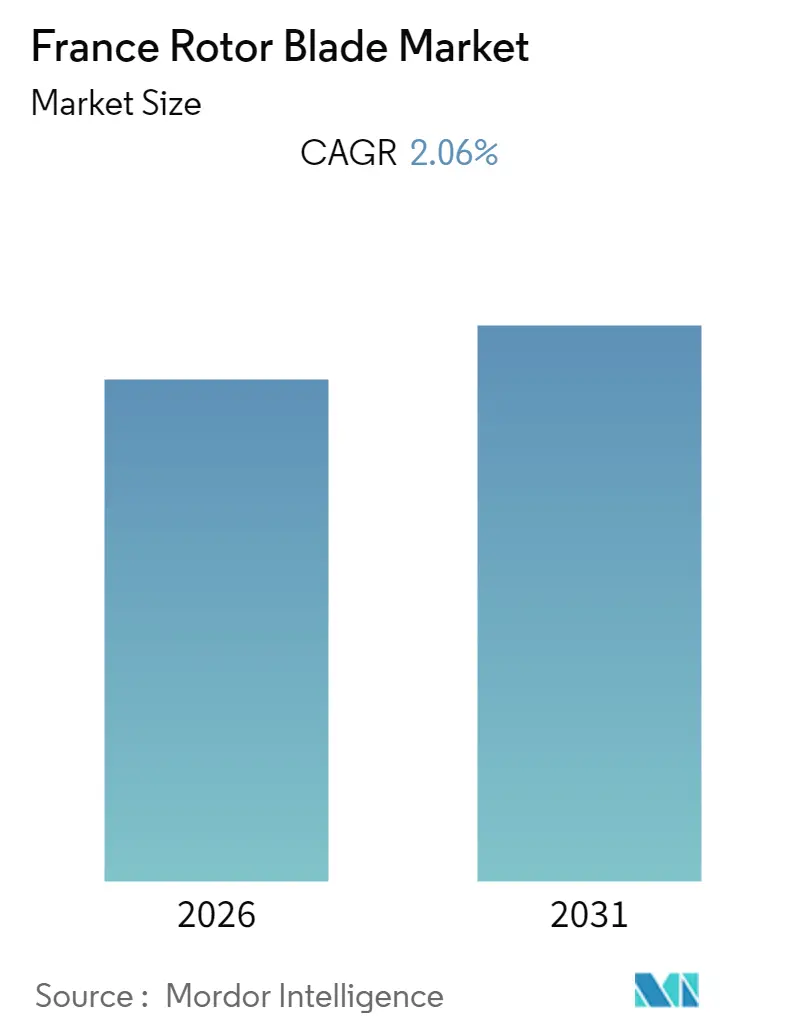
The France Rotor Blade Market size is expected to register a CAGR of 2.06% during the forecast period.
The market was moderately impacted by COVID-19 in 2020. Presently, the market has reached pre-pandemic levels.
- Over the long term, supportive government policies and private investments drive the country's rotor blade demand.
- On the flip side, the associated high cost of transportation and cost competitiveness of alternate clean power sources, like solar power, hydropower, etc., have the potential to hinder the market's growth.
- Nevertheless, product innovation and adaptation of the latest rotor blade technologies are expected to create soon lucrative growth opportunities for the France rotor blade market.
Note: Market size and forecast figures in this report are generated using Mordor Intelligence’s proprietary estimation framework, updated with the latest available data and insights as of 2026.
France Rotor Blade Market Trends and Insights
Onshore Segment to Dominate the Market
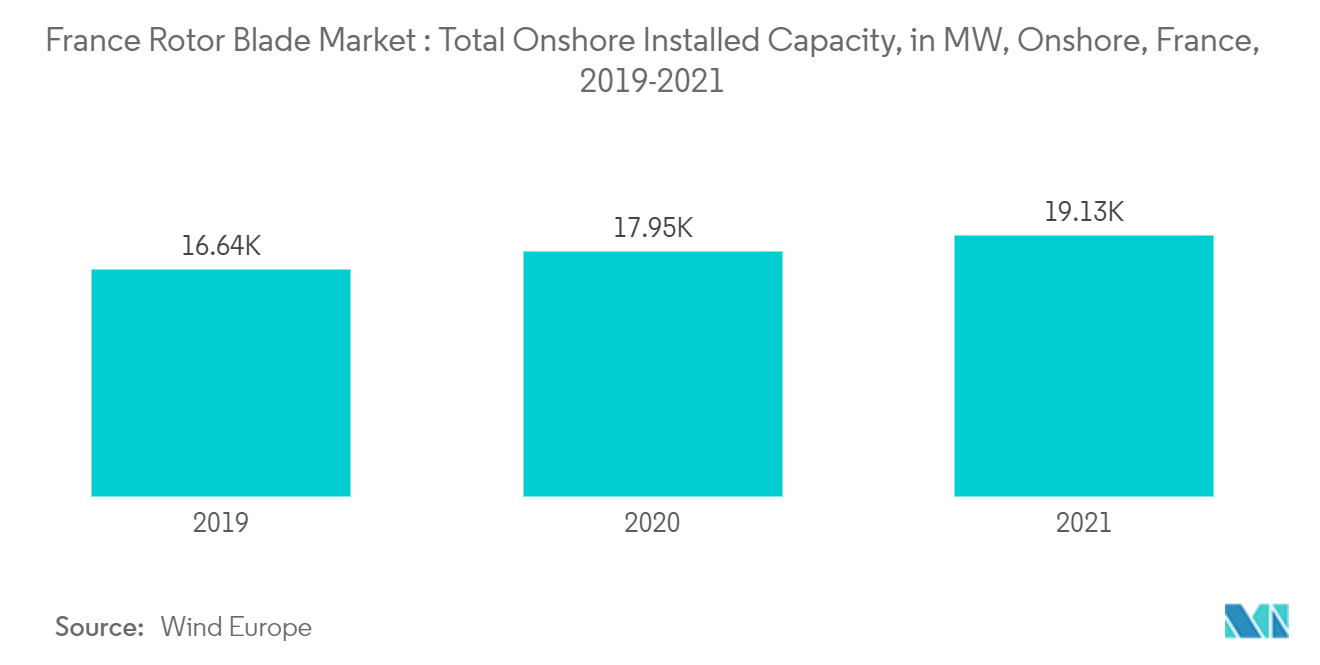
- Onshore wind energy power generation technology has evolved over the last five years to maximize electricity produced per megawatt capacity installed and to cover more sites with lower wind speeds. Besides this, in recent years, wind turbines have become larger with taller hub heights, broader diameters, and larger wind turbine blades. As of 2021, the total onshore installations in the country totaled 19,131 MW.
- France is among the leading countries in the European wind power market. In 2021, it added 1,192 MW, reaching 19.13 GW. The country had an average power rating of 2 MW per turbine. The wind power market in the country has been driven by government policies (such as subsidies and feed-in-tariff) to fill the gap created by the closure of nuclear power plants.
- The onshore sector has dominated the French wind power market. Moreover, under the new government's plans, the onshore wind power capacity is planned to be tripled by 2030. In 2021, the country was third only after Germany and Sweden.
- In July 2022, with a community benefit scheme agreed upon for local development projects, Falck Renewables officially opened its tenth wind farm in France. Falck Renewables officially opened its new wind farm in Illinois, Seine-Maritime department, France. The six-turbine wind farm, which came into commercial operation, has an installed capacity of 12 MW and an estimated annual production of around 28 GWh, sufficient to power approximately 6,600 households.
- In September 2022, Valorem and ENERCON France signed a contract to install six E-82 E4 wind energy converters at Ceilhes-et-Rocozels (Hérault, France) with a total capacity of 14.1 MW.
- Therefore, based on the above-mentioned factors, the onshore wind turbine rotor blade is expected to grow significantly due to supportive government policies and initiatives coupled with an increasing number of onshore wind energy projects.


Supportive Government Policies and Private Investments Driving the Market Demand
- The French government planned to increase the share of renewable energy in the power mix to 40% by 2030. The government announced an increase in the expenditure on renewables, from EUR 5 billion to EUR 8 billion annually.
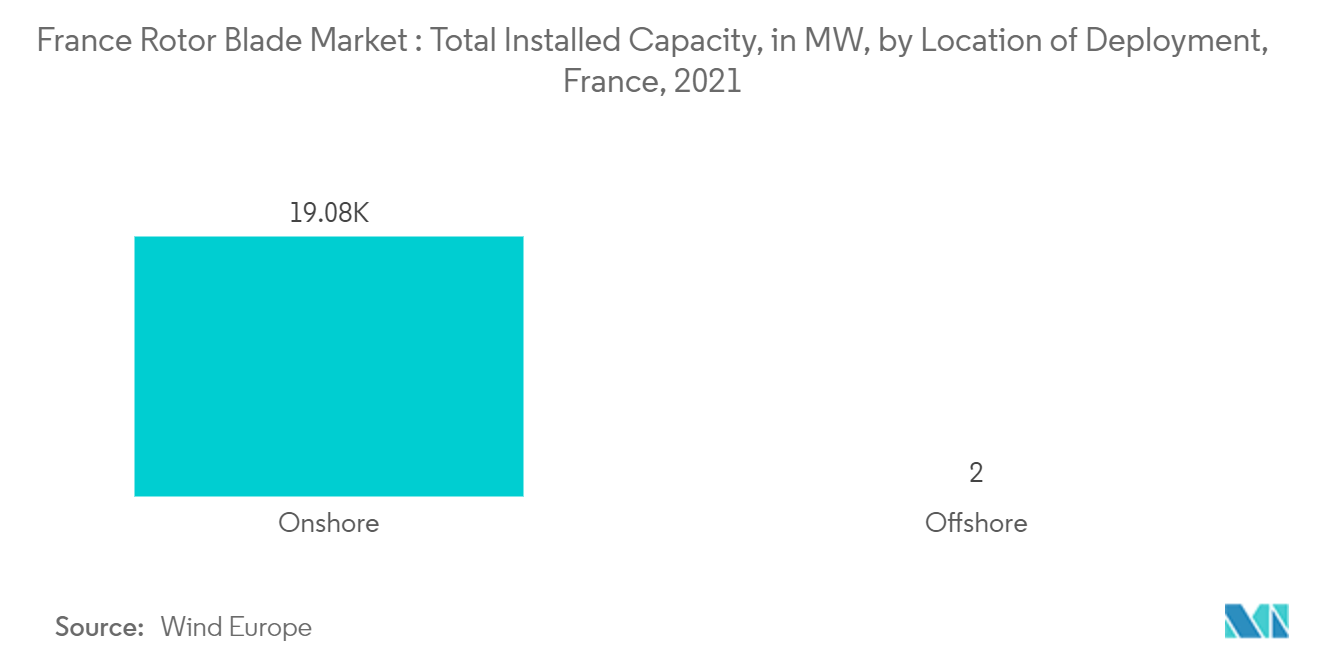
- Moreover, as of 2021, the country's onshore wind energy installation was about 19 GW, and 2 MW of offshore wind energy installation. Further, according to Programmation Pluriannuelle de l'Énergie (PPE), the country aims to have 34 GW of onshore wind by 2028, which in 2021 is about 19.08 GW. The expansion is vital for a successful energy transition and to help decarbonize the rest of France's energy mix.
- Though the country had no new offshore capacity added in 2021, like Germany and the United Kingdom, France is also seeking to develop its offshore wind power market. By February 2022, the country aims to have 40 GW of offshore wind power generation capacity by 2050.
- In March 2022, the French government signed an offshore sector deal with France's wind industry. The agreement recognizes that offshore wind is significant energy and industrial opportunity. It commits France to build 40 GW of offshore wind by 2050 spread over 50 wind farms which is expected to see considerable development in offshore wind power.
- To reach the country's wind power target, the country plans to organize auctions for a minimum of 2 GW of new offshore wind capacity each year starting in 2025. As of March 2022, the government is auctioning 1 GW a year. This means 20 GW of capacity is likely to be allocated by 2030, translating into 18 GW of operational offshore wind farms in 2035.
- So far, France has placed 3.5 GW of offshore wind up for auction, 500 MW floating wind. The country is well-suited for floating wind power, due to strong and stable winds in the deep sea, off its coasts.
- Hence, government policies and private investments that are helping in the development of the wind power market are expected to be positive during the forecast period, leading to growth in the wind turbine rotor blades market.
Regulatory Landscape
Wind power installations in France fall under the ICPE (Installations Classees pour la Protection de l'Environnement) framework, including rubrique 2980, with permitting and operating requirements that can affect project timelines and component end-of-life planning. Changes effective from July 2020 updated ICPE requirements for wind assets, reinforcing compliance expectations for siting, operations, and decommissioning obligations that flow through to rotor blade replacement and removal activities.
End-of-life rules are becoming a more direct demand driver for blade recycling and reuse services, with requirements cited for at least 55% of rotor blade mass to be recycled or reused from January 1, 2025. The framework also includes decommissioning mandates and financial warranties aimed at ensuring proper dismantling and recycling of wind turbine components, which pushes OEMs, owners, and service providers to qualify compliant recycling pathways.
Value Chain Analysis
The France rotor blade value chain covers composite raw materials and resins (with carbon fiber and glass fiber as the dominant inputs), blade design and tooling, manufacturing, inland and port logistics for oversized cargo, installation and commissioning, and O&M with repair plus end-of-life processing. France also has offshore-oriented industrial capability, including LM Wind Power's blade manufacturing footprint in Cherbourg (noted for 107-meter blade capability) and Siemens Gamesa's Le Havre industrial base producing turbine nacelles and integral blades, supporting localized supply for large turbines.
Downstream, the chain depends heavily on heavy-lift handling and port-side staging to move long blades from factories to installation vessels, particularly for offshore projects. Workforce and process qualification is embedded through local training partners that Siemens Gamesa has cited (UIMM Le Havre, AFPI, AFPA), which supports ramp-ups in blade manufacturing, quality assurance, and repair competencies alongside the physical production assets.
Competitive Landscape
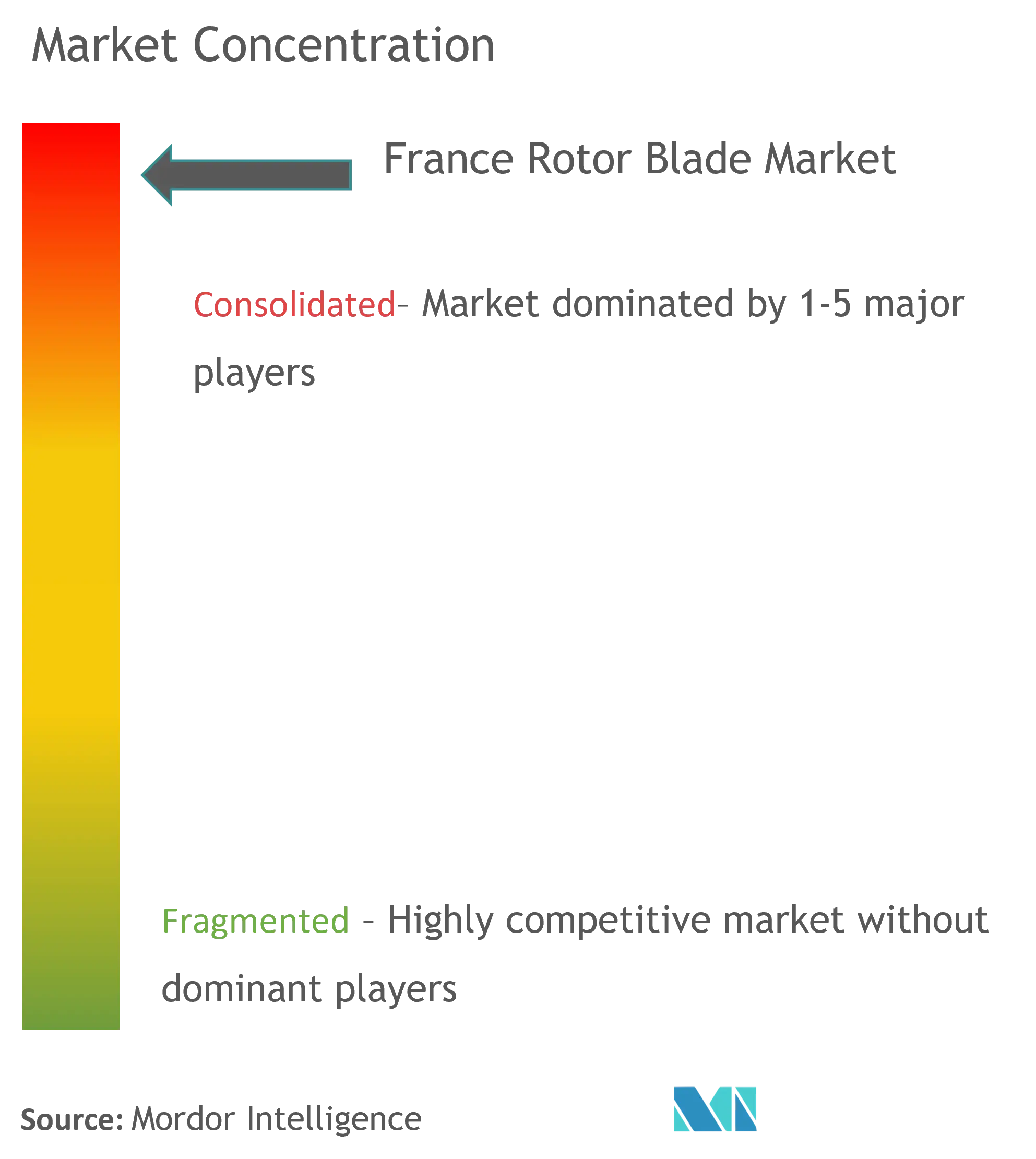
The France rotor blade market is consolidated in nature. Some of the major players in the market (in no particular order) include Nordex SE, Siemens Gamesa Renewable Energy, SA, Vestas Wind Systems A/S, Suzlon Energy Limited, and LM Wind Power (a GE Renewable Energy business).
France Rotor Blade Industry Leaders
Nordex SE
Siemens Gamesa Renewable Energy, S.A.
Vestas Wind Systems A/S
Suzlon Energy Limited
LM Wind Power (a GE Renewable Energy business)
- *Disclaimer: Major Players sorted in no particular order

Market Opportunities and Future Outlook
Offshore wind build-out and industrial localization remain the main whitespace areas for rotor blades in France, especially for very large blades used on next-generation turbines. The European Commission approved a French offshore wind support scheme worth EUR 63 billion for electricity production from 11 offshore wind farms (up to 11.1 GW), which adds revenue clarity for projects that then translate into blade demand across initial supply and long-term service.
A second opportunity theme is anchoring domestic and European supply chains for blades and related services, supported by investments and tender design. Siemens Gamesa has progressed with a EUR 200 million expansion at Le Havre to enable production of blades up to 115 meters (linked to production by 2026), while project pipelines continue to move through authorization and tendering, including TotalEnergies filing for authorization for the 1.5 GW Centre Manche Energies offshore wind farm in May 2026. Together with recycling requirements tightening from 2025, these moves create room for localized blade manufacturing utilization, refurbishment, and compliant end-of-life processing capacity in France.
Recent Industry Developments
- June 2026: Siemens Gamesa Renewable Energy announced the inauguration of an expanded blade manufacturing facility at Le Havre, including a 13,000 m2 extension to produce blades up to 115 m for 15 MW turbines, with a 200 million euro investment. The expansion increases domestic blade production capacity, strengthening France’s offshore wind supply chain for large blades.
- June 2026: French Government published the AO10 offshore wind tender call for 10 GW, including resilience criteria requiring that a majority of turbine components, including blades, be manufactured in Europe. The tender supports local suppliers and increases domestic manufacturing demand in the French offshore wind market.
- June 2026: Siemens Gamesa - Inaugurated the expanded blade manufacturing facility at Le Havre, featuring a 13,000 square meter extension to produce blades up to 115 meters long for 15 MW turbines, representing a 200 million euro investment. The development expands domestic capacity for large offshore blades and strengthens the local manufacturing footprint.


Research Methodology Framework and Report Scope
Market Definition and Coverage
This market covers revenue generated from rotor blades supplied for wind turbines deployed in France, including blades used in new installations and replacements across onshore and offshore projects.
Scope exclusions: It excludes nacelles, towers, foundations, full turbine pricing, and electricity generation revenues.
Segmentation Overview
- Location of Deployment
- Onshore
- Offshore
- Blade Material (Qualitative Analysis)
- Carbon Fiber
- Glass Fiber
- Other Blade Materials
Data Sources, Market Sizing, and Validation
Desk Research
Desk work started with France wind additions and the installed base, since rotor blades move with new builds and replacement needs. Public sources, such as IEA wind statistics, IRENA renewable capacity datasets, Eurostat energy and industrial indicators, and customs trade tables, were used to anchor activity levels and the timing of project cycles.
We also reviewed official tender and permitting disclosures, grid-connection updates, and national energy planning notes, then compared them with company annual reports, investor presentations, and reputable press to understand manufacturing footprints and order flow. For additional cross-checks, we relied on paid subscriptions for company financial context, patent lookups to track blade material shifts, and shipment-level import and export signals where they were visible. This desk source list is illustrative only, and many other references were used for data collection, validation, and clarification.
Primary Interviews and Surveys
Primary work focused on validating how France demand converts into blade revenue. In practice, this meant confirming blade counts per turbine, replacement triggers, and how pricing varies by blade length and material. We spoke with a mix of turbine and component supply chain roles, project engineering voices, and service and maintenance participants. Their inputs were then used to tighten model assumptions where public sources were ambiguous.
Distribution of primary research fieldwork respondents
| Company type | Respondent position |
|---|---|
| Top tier: 30% | CXOs: 14% |
| Mid tier: 54% | Functional/Unit leaders: 38% |
| Smaller Players: 16% | Managers: 48% |
Market-Sizing & Forecasting
The core sizing logic uses a top-down build from France wind activity. Annual onshore and offshore additions and the replacement pool are converted into blade units, then translated into revenue using realistic average selling prices. We then corroborate the totals through selective bottom-up checks, such as sampling blade suppliers serving France, channel conversations on typical contract values, and sanity checks using imported component values when trade data is informative.
Key inputs that shape the model include annual installed capacity additions in France, the split of onshore versus offshore projects, typical rotor diameters and blade counts per turbine, replacement rates tied to aging fleets and damage events, and blade price progression linked to material choice (glass versus carbon fiber) and logistics. For forecasting, scenario analysis is used, because pipeline timing, auction outcomes, and commissioning slippage can shift yearly demand even when long-term targets look steady. Where bottom-up visibility is thin, for example in privately negotiated replacement deals, we fill gaps with interview-led ranges and then align the result back to the demand pool implied by capacity and fleet age.
Data Validation & Update Cycle
Outputs are checked in more than one way before sign-off, including variance checks across onshore and offshore splits, pricing reasonability against material and transport trends, and trend continuity versus prior years. If an outlier shows up, we revisit assumptions, re-check the source trail, and re-contact relevant experts when the change is large enough to affect the final number.
The model is also compared against independent signals, such as France wind build momentum, project award calendars, and observed shifts toward larger rotors, before the final review stage. Reports are refreshed annually, and interim updates are made when a material event occurs, such as major policy changes or large project delays. Right before delivery, an analyst runs a fresh pass so clients receive the latest updated view.
Mordor Intelligence's France Rotor Blade Market Size Measured Against Other Published Estimates
Published market sizes for France rotor blades can look far apart because authors do not always count the same revenue streams, and they do not always align base years, pricing logic, and onshore versus offshore weighting. We keep the discussion practical by focusing on what can be traced to project volumes, replacement behavior, and realistic pricing.
The main gap comes from whether replacement blades and France-only deliveries are separated from broader wind component spending, and from how prices are moved forward for longer blades and carbon content. This is where Mordor Intelligence ties the estimate to turbine additions and a replacement pool rather than folding in full turbine packages or unrelated composite materials.
Benchmark comparison
| Source | Market Size | Gaps in Research Methodology |
|---|---|---|
| Mordor Intelligence | USD 0.00 M (2024) | |
| Industry Publisher A | USD 0.03 B (2025) | Often bundles rotor blades into wider wind component manufacturing revenue, and may apply Europe-level pricing and growth rates to France without rechecking the local onshore-offshore mix. |
| Sector Blog B | USD 0.01 B (2024) | Typically sizes only new installations and skips the replacement cycle, and it can use a single average blade price that does not reflect blade-length and material shifts in France. |
The spread mainly comes down to what gets counted and how blade prices are updated over time, especially for offshore-weighted years. Our approach stays repeatable because each step links back to visible project volumes, a defined replacement pool, and price assumptions that can be explained and stress-tested.


Key Questions Answered in the Report
What is the current France Rotor Blade Market size?
The France Rotor Blade Market is projected to register a CAGR of 2.06% during the forecast period (2026-2031)
Who are the key players in France Rotor Blade Market?
Nordex SE, Siemens Gamesa Renewable Energy, S.A., Vestas Wind Systems A/S, Suzlon Energy Limited and LM Wind Power (a GE Renewable Energy business) are the major companies operating in the France Rotor Blade Market.
What years does this France Rotor Blade Market cover?
The report covers the France Rotor Blade Market historical market size for years: 2020, 2021, 2022, 2023 and 2024. The report also forecasts the France Rotor Blade Market size for years: 2026, 2027, 2028, 2029, 2030 and 2031.
Page last updated on:





