
Forensic Genomics Market Size and Share
Market Overview
| Study Period | 2020 - 2031 |
|---|---|
| Market Size (2026) | USD 0.74 Billion |
| Market Size (2031) | USD 1.5 Billion |
| Growth Rate (2026 - 2031) | 15.17 % |
| Fastest Growing Market | Asia-Pacific |
| Largest Market | North America |
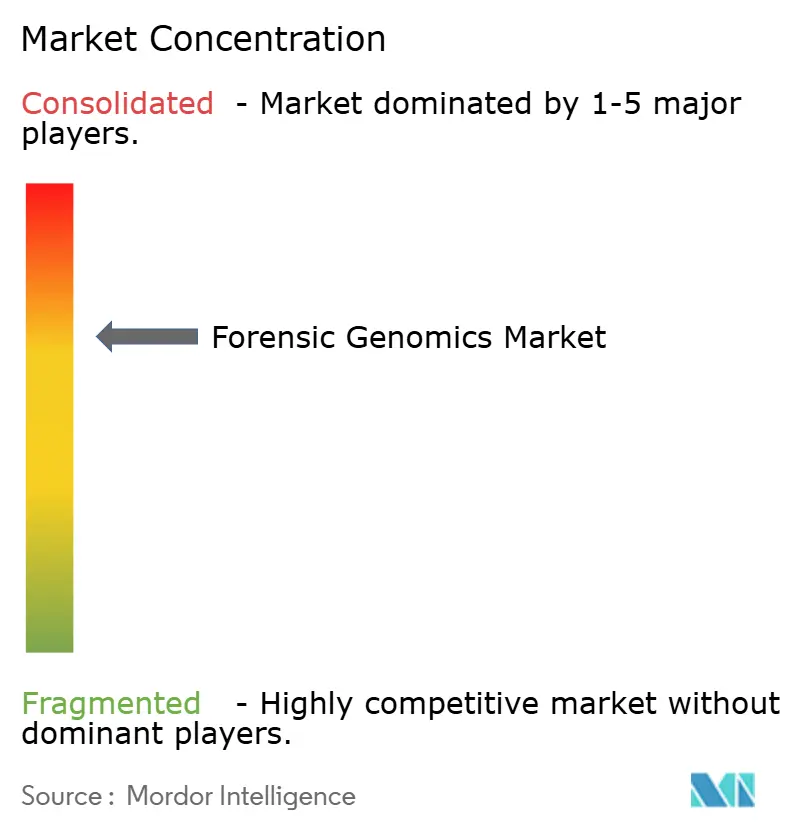
| Market Concentration | Medium |
Major Players *Disclaimer: Major Players sorted in no particular order Image © Mordor Intelligence. Reuse requires attribution under CC BY 4.0. | |
Forensic Genomics Market Analysis by Mordor Intelligence
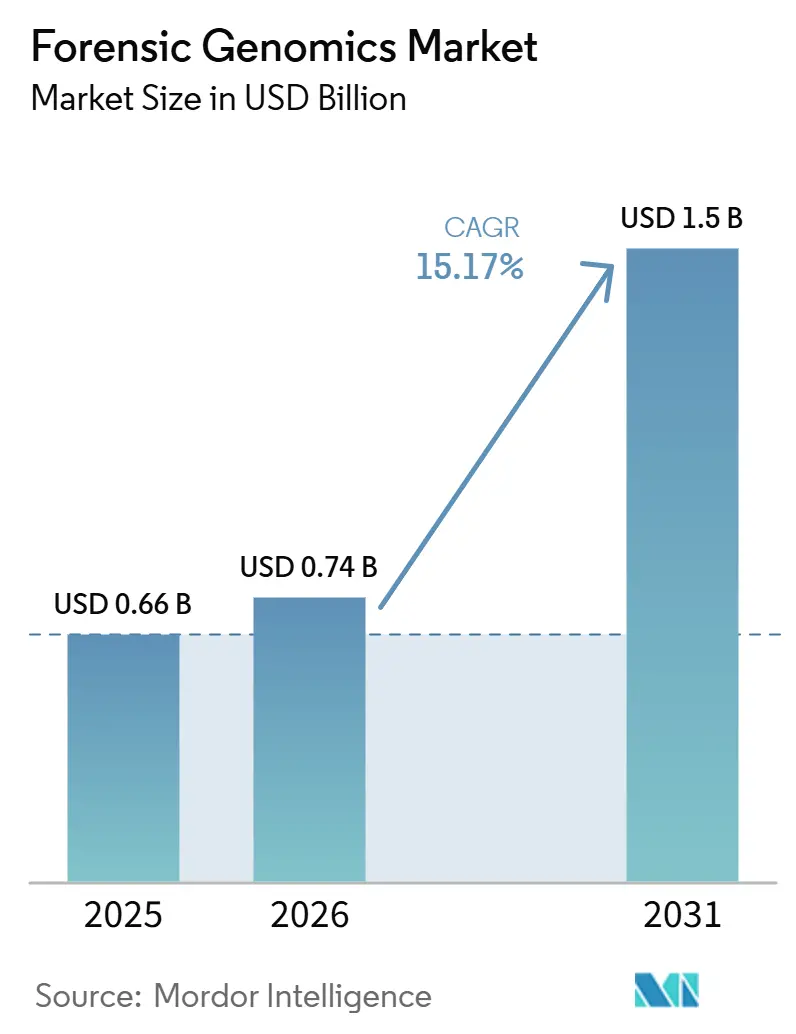
The forensic genomics market is expected to increase from USD 0.66 billion in 2025 to USD 0.74 billion in 2026 and reach USD 1.50 billion by 2031, growing at a CAGR of 15.17% over 2026-2031. The forensic genomics market is expanding because public agencies are investing in DNA databases, accredited laboratories, and casework capacity at the same time that civil identification uses continue to broaden. The forensic genomics market also benefits from a strict operating environment, because laboratories must meet scientific validation standards and legal admissibility requirements before they can shift to new workflows, which protects established vendors and slows unproven entrants. National standards for sequencing-based DNA examination in China, revised DNA profiling guidance in Japan, and federal funding support in the United States all reinforce procurement demand for validated systems, kits, and analysis tools. The forensic genomics market is also being shaped by a shift from hardware-only competition toward workflows that combine instruments, consumables, and software, especially as next-generation sequencing, rapid DNA systems, and kinship analysis tools move into routine use. Market opportunities remain strongest where governments are formalizing national workflows and where providers can reduce analytical complexity for laboratories that lack specialist bioinformatics capacity, even as privacy rules and validation costs continue to limit the pace of adoption in some jurisdictions.
Key Report Takeaways
- By product type, instruments held 47.92% share in 2025, while software and services are projected to expand at a 17.14% CAGR through 2031.
- By method, next-generation sequencing accounted for 51.34% share of the forensic genomics market in 2025, while polymerase chain reaction is forecasted to record the highest CAGR at 16.96% through 2031.
- By therapeutic area, paternity and familial testing held 39.68% of the forensic genomics market share in 2025, while criminal investigation & cold case resolution are expected to advance at a 17.58% CAGR through 2031.
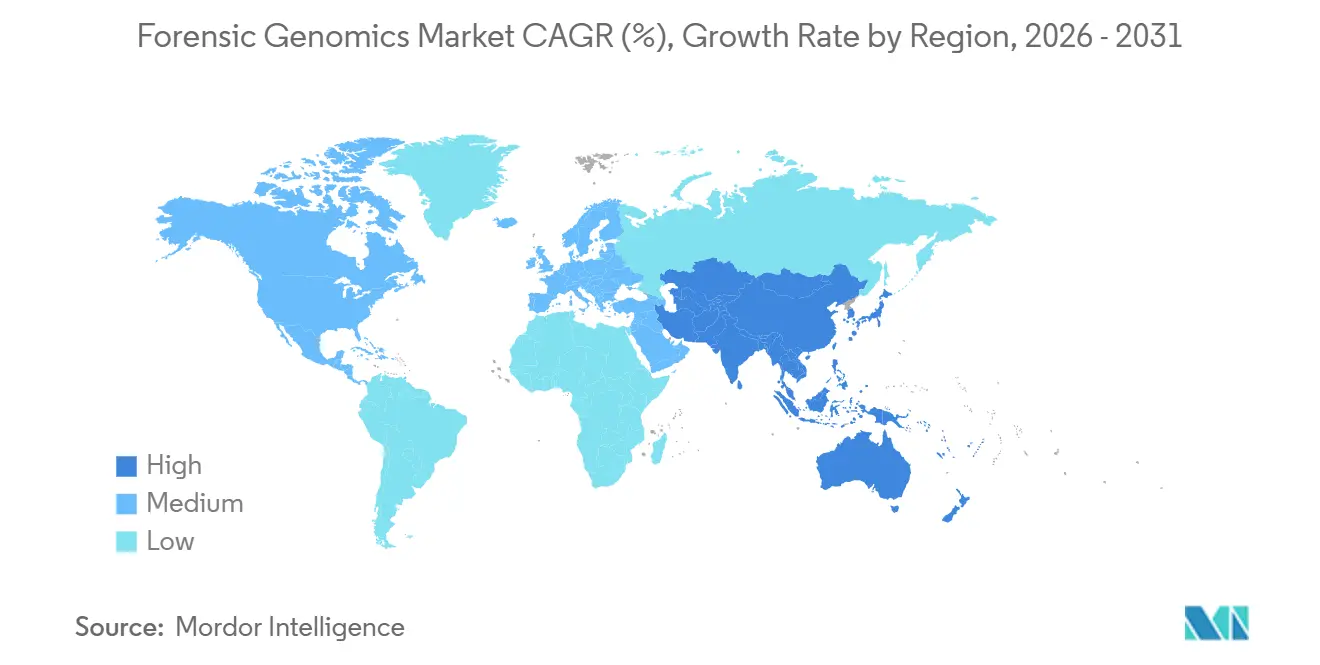
- By region, North America held 42.57% share in 2025, while Asia-Pacific is projected to expand at a 18.21% CAGR through 2031.
Note: Market size and forecast figures in this report are generated using Mordor Intelligence’s proprietary estimation framework, updated with the latest available data and insights as of January 2026.
Market Trends and Insights
Drivers Impact Analysis of Forensic Genomics Market*
| Driver | (~) % Impact on CAGR Forecast | Geographic Relevance | Impact Timeline |
|---|---|---|---|
| Advancements in Next-Generation Sequencing for Complex Forensic DNA Analysis | +3.8% | Global, concentrated in North America and Europe | Long term (≥ 4 years) |
| Expansion of National DNA Databases and Kinship Matching Programs | +3.2% | Global, with accelerating gains in APAC and MEA | Medium term (2-4 years) |
| Faster Interpretation from AI-Enabled Forensic Bioinformatics | +2.4% | North America and Western Europe | Medium term (2-4 years) |
| Growth in Rapid DNA and Portable Sequencing Adoption in Field Workflows | +2.2% | North America, emerging in APAC and South America | Short term (≤ 2 years) |
| Privacy-by-Design Forensic Workflows Increasing Demand for Privacy-Preserving Analytics | +0.9% | EU, North America | Long term (≥ 4 years) |
| Increasing Adoption of Forensic DNA Phenotyping and Investigative Genetic Genealogy | +1.6% | Global | Medium term (2-4 years) |
| Source: Mordor Intelligence | |||
Advancements in Next-Generation Sequencing (NGS) for Complex Forensic DNA Analysis
Next-generation sequencing moved into a lead position in 2025, with more than half of the forensic genomics market tied to this method by revenue. This marks a clear change from the older pattern where capillary electrophoresis defined most routine DNA forensics work. A 2025 peer-reviewed study showed that sequencing 26 autosomal STR loci reduced random match probability by more than 700 times compared with conventional CE-STR analysis, and flanking region variation improved discrimination further.[1]L. Devesse et al., “Implementation of NGS and SNP Microarrays in Routine Forensic Practice, Opportunities and Barriers,” BMC Genomics, springer.comThat performance matters in the forensic genomics market because mixed samples, low template samples, and degraded remains remain common in actual investigations and identification work. QIAGEN’s ForenSeq Kintelligence HT Kit reflects the same shift, because it is built around 10,230 SNP markers for kinship work and degraded skeletal remains, which shows that vendors are designing products for the hardest cases rather than only for routine workflows.[2]QIAGEN, “ForenSeq Kintelligence HT Kit,” QIAGEN, qiagen.com The forensic genomics market is therefore moving toward platforms that combine stronger discrimination, broader sample compatibility, and richer evidentiary output, even though laboratories still need more dedicated bioinformatics support before this transition can scale fully.
Expansion of National DNA Databases and Kinship Matching Programs
The forensic genomics market is closely linked to the continuing expansion of national DNA databases, because each additional profile makes the value of database participation more visible to law enforcement agencies and public funders. FBI statistics for late 2025 showed that NDIS stored more than 24.8 million offender DNA profiles and had aided more than 758,449 investigations, which keeps the case for continued spending on kits, instruments, and lab processing capacity firmly in place.[3]Federal Bureau of Investigation, “CODIS-NDIS Statistics,” FBI Law Enforcement, fbi.gov In the United States, the CODIS Access Modernization Act would allow eligible private forensic laboratories to upload qualifying DNA profiles directly to NDIS, which would broaden the commercial base beyond public sector labs if adopted. As more countries tighten operating rules around chain of custody, validation, and upload quality, the forensic genomics market gains volume, while established suppliers gain an advantage because their systems are better positioned to meet formal standards.
Growth in Rapid DNA and Portable Sequencing Adoption in Field Workflows
Rapid DNA is expanding the forensic genomics market by changing where analysis can happen, not only how quickly it can be completed. The Consortium of Forensic Science Organizations stated that a Rapid DNA instrument costs USD 250,000 per unit and cited a return of USD 1,070.62 for every USD 1.00 invested, which gives procurement teams a concrete operating case for use at booking stations and mass casualty sites. The forensic genomics market is therefore opening new demand pockets in remote law enforcement units, field response teams, and temporary processing sites that traditional bench-based workflows could not serve. China’s fully integrated forensic DNA detection system, recognized among the country’s Top 10 Biomedical Technology Advances for 2025, adds to that shift by showing that one-hour, lab free operation is now a realistic design target in the region.
Increasing Adoption of Forensic DNA Phenotyping and Investigative Genetic Genealogy
The forensic genomics market is also widening through applications that sit next to routine criminal casework, especially paternity, kinship, and investigative genealogy uses. Paternity and familial testing already represented the largest therapeutic area in 2025, which matters because this demand is tied not only to police budgets but also to courts, immigration cases, inheritance disputes, and direct relationship testing. The result is a broader and more stable addressable base for the forensic genomics market, even though adoption still depends on privacy rules, judicial oversight, and the availability of capable service providers.
Restraints Impact Analysis of Forensic Genomics Market*
| Restraint | (~) % Impact on CAGR Forecast | Geographic Relevance | Impact Timeline |
|---|---|---|---|
| High Capital and Validation Cost of Sequencers and Reference Workflows | -3.2% | Global, most acute in APAC and MEA | Long term (≥ 4 years) |
| Limited Availability of Certified Forensic Geneticists and Bioinformaticians | -1.8% | Global | Medium term (2-4 years) |
| Sample Degradation, Contamination Risk, and Chain-of-Custody Sensitivity | -1.5% | Global, more pronounced in MEA and South America | Short term (≤ 2 years) |
| Cross-Border Data Governance and Privacy Constraints on DNA Data Sharing | -2.2% | EU, North America, cross-border APAC | Long term (≥ 4 years) |
| Source: Mordor Intelligence | |||
High Capital and Validation Cost of Sequencers and Reference Workflows
The forensic genomics market still faces a meaningful access barrier because capital requirements remain high for both equipment and compliance. Rapid DNA systems alone carry an instrument price near USD 250,000, and laboratories that shift into next-generation sequencing must also fund supporting software, data storage, and validation work before they can use new workflows in casework. The cost burden therefore reaches beyond instrument purchase and extends into training, documentation, data handling, and the time laboratories lose while new workflows are being qualified. The forensic genomics market can continue to grow under those conditions, but adoption will remain uneven where laboratories have limited budgets or where new capacity is still being built from the ground up.
Cross-Border Data Governance and Privacy Constraints on DNA Data Sharing
The forensic genomics market also faces a structural limit in the way DNA data is governed across borders. Databases are typically built at the national level, while crime, migration, and identification needs often cross jurisdictions, which creates an operational gap between technical capability and legal permission. Even where automated comparison frameworks exist, vendors still face differences in STR loci panels, data formats, and privacy rules that complicate standardization and raise localization costs. In the forensic genomics market, that fragmentation means products often need country specific validation and workflow adaptation before they can be deployed at scale. Until privacy rules and interoperability frameworks become more aligned, the forensic genomics market will continue to operate below its full technical potential in cross border casework and collaborative investigations.
*Our forecasts treat driver/restraint impacts as directional, not additive. The impact forecasts reflect baseline growth, mix effects, and variable interactions.
Forensic Genomics Market Segment Analysis
By Product Type:
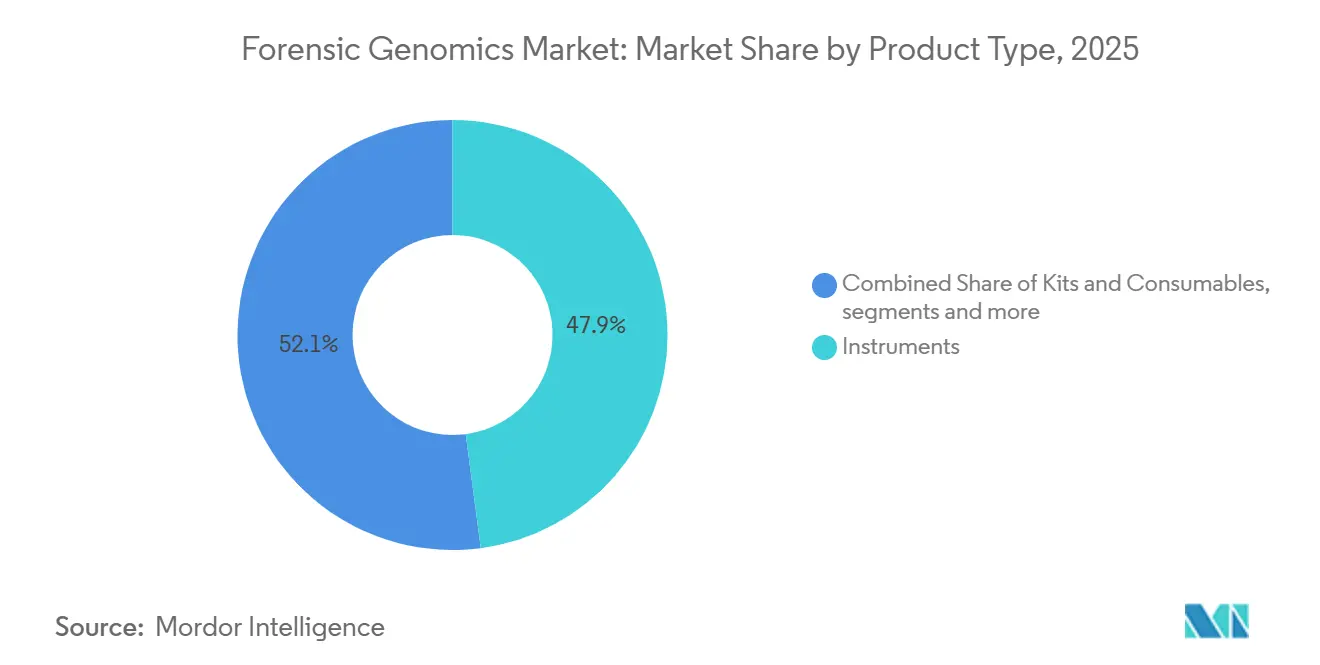
Software and Services Poised to Outpace HardwareInstruments accounted for 47.92% of the forensic genomics market size in 2025, which reflects the central role of capillary electrophoresis platforms and the growing installed base of sequencing systems in routine laboratory operations. This segment remains foundational because every accredited workflow depends on validated hardware before evidence can move into interpretation or reporting. The installed base also creates long replacement cycles, which gives the forensic genomics market a durable equipment layer with steady recurring demand for consumables, service contracts, and workflow upgrades. In the forensic genomics industry, that pattern supports established vendors whose products are already embedded in laboratory standard operating procedures.
Software and services are projected to record the fastest growth at a 17.14% CAGR through 2031, which shows that value creation in the forensic genomics market is moving toward analysis and interpretation as workflows become more data-intensive. This shift is tied to probabilistic genotyping, cloud-capable laboratory information systems, and specialist genealogy or kinship tools that address analytical bottlenecks rather than sample extraction alone. The forensic genomics market is therefore seeing competitive strength shift from hardware exclusivity toward the ability to explain mixtures, document interpretation logic, and support secure, auditable workflows.



By Method:
NGS Establishes Dominance, PCR Gains at the Field LevelNext-generation sequencing held 51.34% of the forensic genomics market share in 2025, making it the leading method segment and confirming that sequencing has moved from a specialist option into a mainstream forensic workflow. Its rise reflects better performance on degraded and low-quantity samples, which are common in difficult criminal investigations and unidentified human remains cases. The forensic genomics market has responded because laboratories increasingly need methods that can provide more information per sample without forcing multiple separate tests.
Polymerase chain reaction is expected to grow at a 16.96% CAGR through 2031, which means the forensic genomics market still has strong momentum in a method that is older but highly adaptable to field deployment. This growth is linked to rapid DNA systems, which rely on PCR-based workflows and answer a different need than high-throughput sequencing. Capillary electrophoresis continues to hold an entrenched role in routine profiling, especially where laboratories prefer to improve discrimination within existing infrastructure rather than replace the full workflow.
By Therapeutic Area:
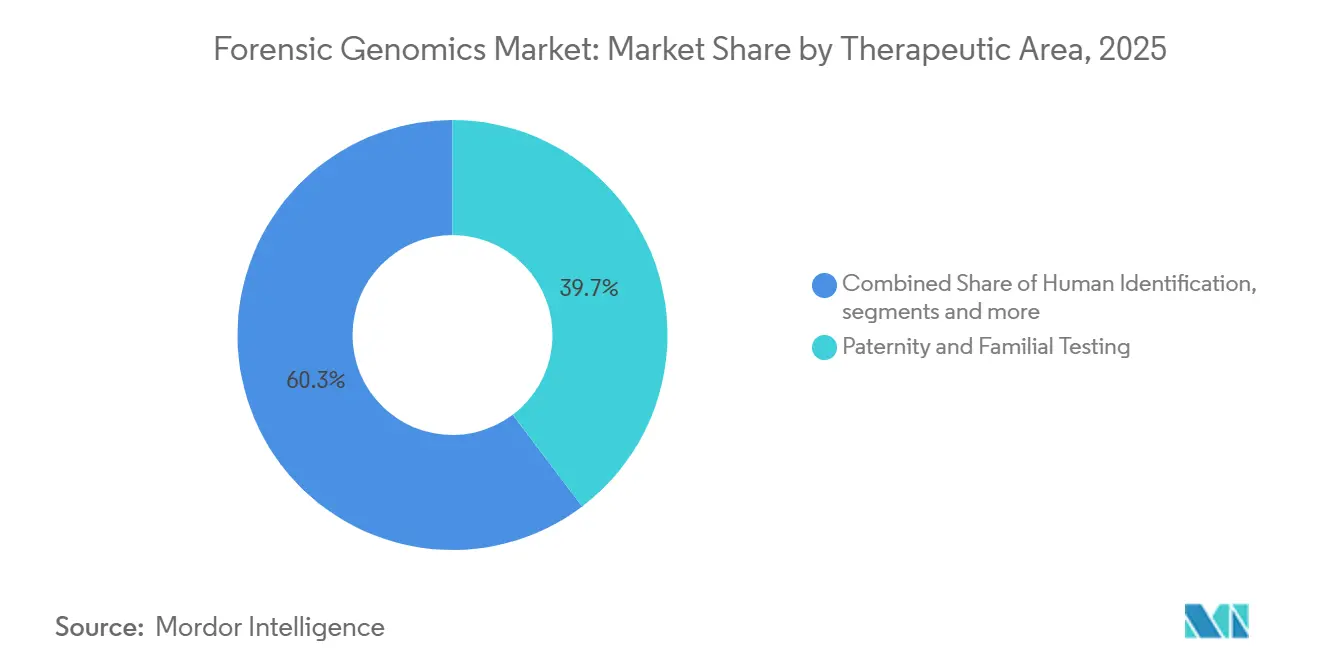
Paternity Testing Anchors Revenue, DVI Captures InvestmentPaternity and familial testing held 39.68% of the forensic genomics market in 2025, which gave this area the largest revenue contribution among applications. Its strength comes from a broader demand base than criminal casework alone, because courts, family disputes, inheritance matters, immigration reviews, and direct relationship testing all create recurring use. That helps the forensic genomics market maintain demand even when government casework cycles fluctuate or public budgets tighten. In the forensic genomics industry, this balance between civil and criminal uses gives the revenue base greater resilience than a law enforcement-only model would provide.
Criminal investigation & cold case resolution are projected to expand at a 17.58% CAGR through 2031, which makes it the fastest-growing application in the forensic genomics market. Growth in this area reflects rising expectations for speed, batch handling, kinship matching, and operation in difficult field conditions rather than in controlled laboratory settings alone. The forensic genomics market is likely to see this application pull forward capital spending, where agencies want faster identification capacity for mass casualty response and missing persons work.
Geography Analysis
North America Forensic Genomics Market
North America held 42.57% of the forensic genomics market share in 2025, which kept it in the leading regional position. The region’s advantage comes from the deepest laboratory network, the largest national DNA database, and stable public funding channels that continue to support casework expansion and technology refresh cycles. The proposed CODIS Access Modernization Act could widen the commercial base further by allowing eligible private laboratories to upload qualifying profiles directly to NDIS, which would expand demand beyond traditional public laboratories if enacted.
Europe Forensic Genomics Market
Europe remains the second-largest regional block in the forensic genomics market, supported by strong accreditation discipline and a mature operational culture in countries such as Germany, the United Kingdom, and France. The region’s laboratories operate within a framework that places heavy weight on validation quality, proficiency testing, and interoperability across established DNA comparison systems. This keeps demand focused on standards-compliant kits and auditable software rather than on low-cost, lightly validated alternatives. Privacy rules also influence product design in the forensic genomics market, because vendors need workflows that support controlled access, secure handling, and defensible use of sensitive genetic data. As a result, Europe remains a high-quality revenue region where procurement is often driven by regulatory fit as much as by raw instrument performance.
APAC Forensic Genomics Market
Asia-Pacific is the fastest-growing region, with the forensic genomics market for the region projected to grow at an 18.21% CAGR through 2031. China is a major force behind that pace because a series of national forensic DNA standards that became effective from 2024 onward created a formal procurement path for laboratory construction, examination specifications, and NGS-based DNA examination. Japan’s revised DNA profiling guidance adds another layer of demand discipline by updating requirements for national database submissions. South Korea and Australia continue to provide established regional demand, while emerging Southeast Asian markets represent earlier-stage opportunities for future rollout. The recognition of China’s integrated one-hour forensic DNA detection system in 2026 also suggests that domestic innovation is becoming a more active force in the regional forensic genomics market, especially in field-deployable formats.

Competitive Landscape
The forensic genomics market shows moderate consolidation in instruments and kits, where Thermo Fisher Scientific, QIAGEN, including Verogen, Promega Corporation, and Illumina hold strong positions in validated workflows used for criminal casework and database-aligned testing. These companies benefit from switching costs that are unusually high, because a laboratory that changes platforms must repeat validation, documentation, and internal acceptance work before the new workflow can be used in evidence processing. That operating reality gives the forensic genomics market a more durable competitive structure than many adjacent life science segments. It also explains why vendors compete not only on technology performance but also on approvals, data compatibility, workflow continuity, and courtroom defensibility.
Promega’s January 2025 launch of PowerPlex 35GY shows this strategy clearly, because it improved discrimination through an 8-color STR system while staying aligned with the needs of laboratories that still rely on established capillary electrophoresis infrastructure. Thermo Fisher’s GeneMapper PG Software represents a parallel move in the analytical layer, because it packages transparent mixture analysis into a compliance-oriented software environment rather than leaving value capture only at the instrument level. Together, these moves show that the forensic genomics market is being contested through workflow depth and regulatory fit as much as through hardware placement alone. The competitive center is therefore broadening from instruments into consumables, automation, and interpretation tools that help laboratories defend results under strict evidentiary standards.
A second layer of competition is emerging in forensic genetic genealogy, SNP-based kinship work, and advanced interpretation services, where specialist providers can win business even without leading instrument portfolios. This is one reason the forensic genomics market looks more fragmented in software and services than in core hardware. QIAGEN’s compatibility work around ForenSeq Kintelligence HT applications and kinship-focused workflows shows that major suppliers recognize the commercial relevance of this adjacent space. The forensic genomics market is therefore likely to remain moderately consolidated overall, with the largest vendors strongest in validated platforms and smaller specialists gaining room in advanced analysis, field deployment, and high complexity casework support.
Forensic Genomics Industry Leaders
Thermo Fisher Scientific Inc.
QIAGEN N.V.
Illumina, Inc.
Promega Corporation
Agilent Technologies, Inc.
- *Disclaimer: Major Players sorted in no particular order
Forensic Genomics Market Companies Covered in this Report
- Agilent Technologies
- Bio-Rad Laboratories
- Bode Technology Group, Inc.
- Eurofins
- Gene by Gene, Ltd.
- Hamilton Company
- Illumina
- InnoGenomics Technologies, LLC
- LGC Group
- MGI Tech Co., Ltd.
- Neogen
- NicheVision Forensics, LLC
- Othram, Inc.
- Parabon NanoLabs, Inc.
- Promega
- QIAGEN
- Sorenson Forensics, LLC
- Thermo Fisher Scientific
- Tri Tech Forensics, Inc.
- Verogen, Inc.

Recent Industry Developments in Forensic Genomics Market
- May 2026: The China Pharmaceutical Biotechnology Association selected the fully integrated forensic DNA detection system developed by Tsinghua University's Liu Peng group, Beijing Bio-InfoChip Enterprise, and the Ministry of Public Security's Forensic Science Center as one of China's Top 10 Biomedical Technology Advances for 2025. The system delivers sample-in, answer-out results in 1 hour without a laboratory environment, enabling identification and kinship analysis in field settings.
- October 2025: QIAGEN unveiled the EZ2 DNA Investigator Sep&Prep Kit at the 36th International Symposium on Human Identification (ISHI 2025), delivering fully automated sperm-fraction DNA separation for sexual assault samples in under 2.5 hours on the EZ2 Connect Fx system. The kit's sperm-specific lysis buffer and proprietary bead technology eliminate manual differential extraction, directly addressing a major throughput bottleneck in sexual assault kit backlogs across North American and European forensic labs.
- June 2025: Othram Expanded Business Model and Launched SNPSuite: Othram announced a major expansion into deployable workflow solutions, releasing SNPSuite, a secure offline desktop application for SNP-based kinship testing that is compatible with data from sequencing and microarray platforms. By making its core forensic analysis engine available to partner laboratories, Othram moved beyond service provision into a software licensing model that significantly broadens its addressable market.


Global Forensic Genomics Market Report Scope
As per the scope of the report, the forensic genomics market comprises technologies, products, and services that apply genomic analysis and DNA sequencing to support human identification, criminal investigations, kinship analysis, missing person identification, and forensic casework. It includes instruments, reagents, software, and laboratory services used by forensic laboratories and law enforcement agencies.
The forensic genomics market is segmented by product type, method, therapeutic area, and geography. By product type, the market is segmented into instruments, kits and consumables, and software and services. By method, the market is segmented into next-generation sequencing, capillary electrophoresis, polymerase chain reaction, and other methods. By therapeutic area, the market is segmented into paternity and familial testing, human identification, criminal investigation & cold case resolution, and other applications. By geography, the market is segmented into North America, Europe, Asia-Pacific, the Middle East and Africa, and South America. The report also covers the estimated market sizes and trends for 17 countries across major regions globally. The report offers values (USD) for all the above segments.
| Instruments |
| Kits and Consumables |
| Software and Services |
| Next-Generation Sequencing |
| Capillary Electrophoresis |
| Polymerase Chain Reaction |
| Other Methods |
| Paternity and Familial Testing |
| Human Identification |
| Criminal Investigation & Cold Case Resolution |
| Other Applications |
| North America | United States |
| Canada | |
| Mexico | |
| Europe | Germany |
| United Kingdom | |
| France | |
| Italy | |
| Spain | |
| Rest of Europe | |
| Asia-Pacific | China |
| Japan | |
| India | |
| Australia | |
| South Korea | |
| Rest of Asia-Pacific | |
| Middle East and Africa | GCC |
| South Africa | |
| Rest of Middle East and Africa | |
| South America | Brazil |
| Argentina | |
| Rest of South America |
| By Product Type | Instruments | |
| Kits and Consumables | ||
| Software and Services | ||
| By Method | Next-Generation Sequencing | |
| Capillary Electrophoresis | ||
| Polymerase Chain Reaction | ||
| Other Methods | ||
| By Therapeutic Area | Paternity and Familial Testing | |
| Human Identification | ||
| Criminal Investigation & Cold Case Resolution | ||
| Other Applications | ||
| By Geography | North America | United States |
| Canada | ||
| Mexico | ||
| Europe | Germany | |
| United Kingdom | ||
| France | ||
| Italy | ||
| Spain | ||
| Rest of Europe | ||
| Asia-Pacific | China | |
| Japan | ||
| India | ||
| Australia | ||
| South Korea | ||
| Rest of Asia-Pacific | ||
| Middle East and Africa | GCC | |
| South Africa | ||
| Rest of Middle East and Africa | ||
| South America | Brazil | |
| Argentina | ||
| Rest of South America | ||


Key Questions Answered in the Report
What is the 2031 outlook for the forensic genomics market?
The forensic genomics market is forecasted to reach USD 1.50 billion by 2031 from USD 0.66 billion in 2025 to USD 0.74 billion in 2026, advancing at a 15.17% CAGR over 2026-2031.
Which product group currently leads revenue generation?
Instruments led in 2025 with a 47.92% share, reflecting the installed base of capillary electrophoresis systems and the rising role of sequencing platforms.
Which method is shaping the strongest competitive shift?
Next-generation sequencing held 51.34% share in 2025, showing that laboratories are favoring methods that perform better on degraded and complex samples.
Which region offers the strongest near-term growth opportunity?
Asia-Pacific is projected to be the fastest-growing region at an 18.21% CAGR through 2031, supported by new national standards, government-backed lab buildout, and local technology development.
Page last updated on:





