
Footwear Adhesives Market Size and Share
Market Overview
| Study Period | 2022 - 2032 |
|---|---|
| Market Size (2027) | USD 3.16 Billion |
| Market Size (2032) | USD 4.13 Billion |
| Growth Rate (2027 - 2032) | 5.47 % |
| Fastest Growing Market | Asia-Pacific |
| Largest Market | Asia-Pacific |
| Market Concentration | Medium |
Major Players *Disclaimer: Major Players sorted in no particular order Image © Mordor Intelligence. Reuse requires attribution under CC BY 4.0. | |
Footwear Adhesives Market Analysis by Mordor Intelligence
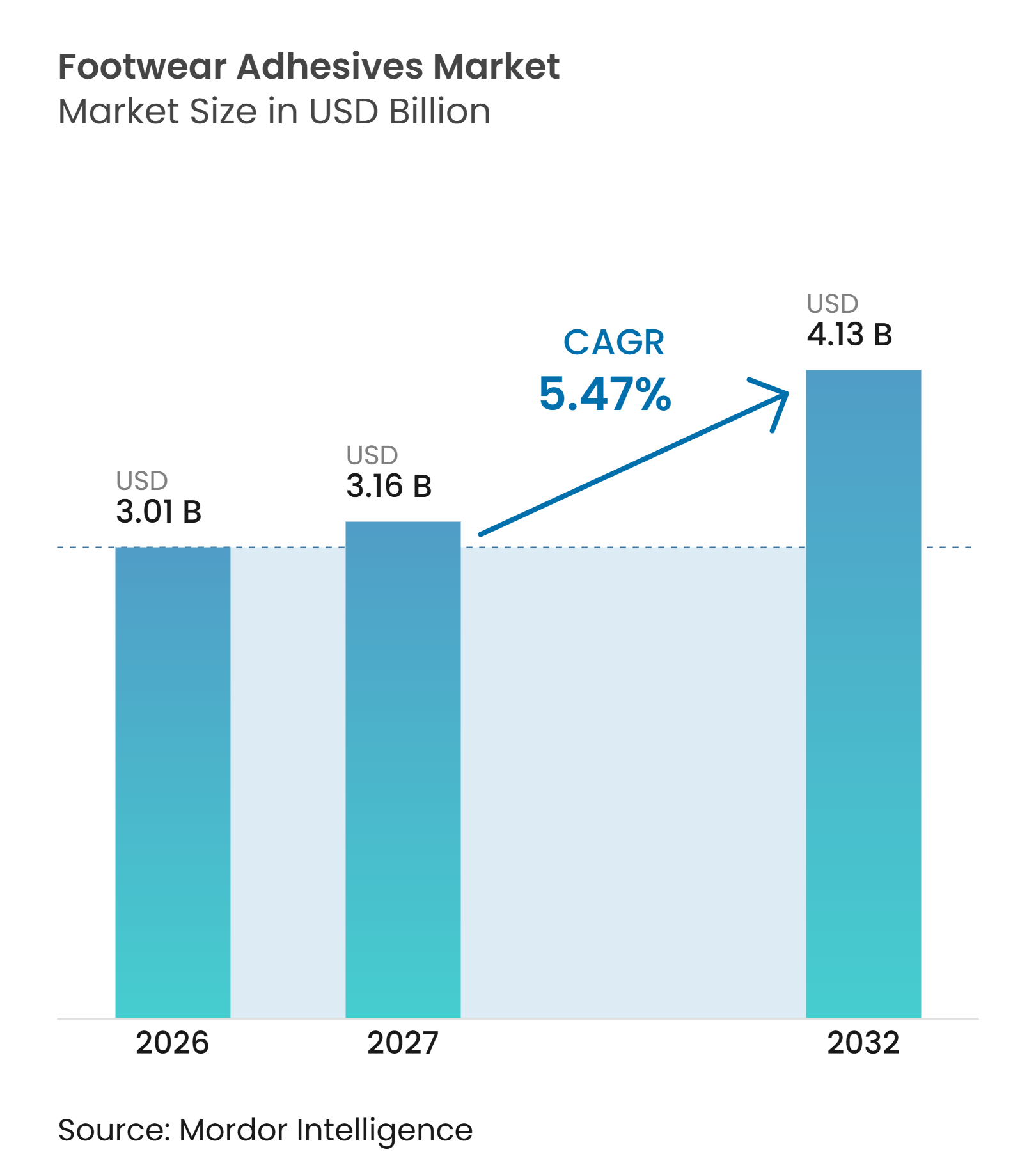
The global footwear adhesives market size was valued at USD 3.01 billion in 2026 and is estimated to grow from USD 3.16 billion in 2027 to USD 4.13 billion by 2032, at a CAGR of 5.47% during the forecast period (2027-2032). Athletic and casual footwear production in Asia remains the primary source of demand for footwear adhesives, which are used in sole attachment, upper lamination, and insole bonding. The market is shifting from solvent-based products to waterborne and reactive polyurethane systems as manufacturers respond to volatile organic compound (VOC) limits and brand requirements. Adhesive selection now affects chemical compliance, product traceability, and bond performance, favoring suppliers that can provide low-VOC products at quantities suited to large footwear plants. However, qualification periods, raw-material costs, and production-line changes continue to delay this transition at smaller manufacturers.
Key Report Takeaways
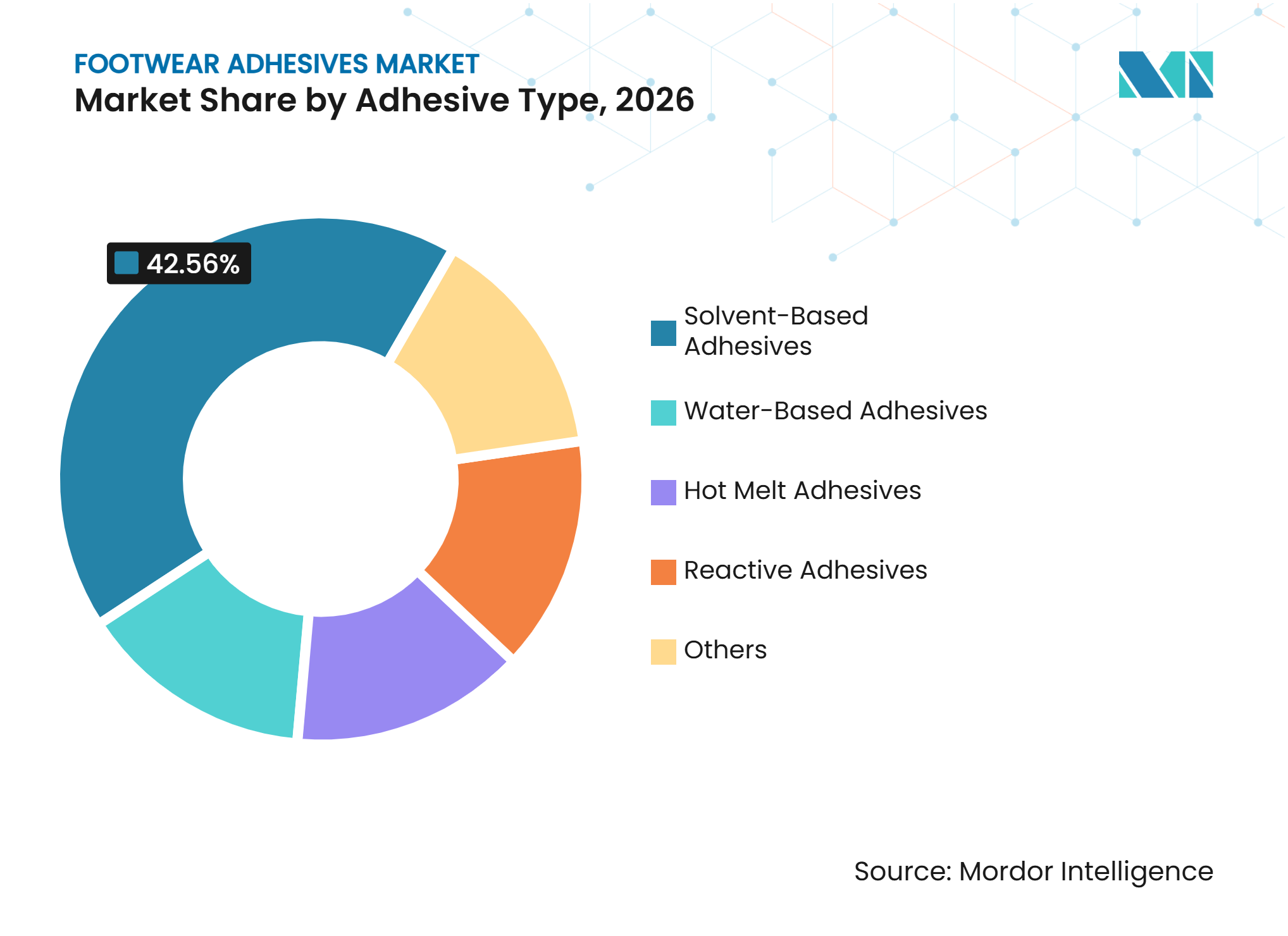
- By adhesive type, solvent-based adhesives held 42.56% of the Footwear Adhesives Market share in 2026, while water-based adhesives are forecast to grow at a 6.34% CAGR through 2032.
- By material and substrate, leather held 34.23% of the Footwear Adhesives Market share in 2026, while synthetic materials are forecast to grow at a 6.67% CAGR through 2032.
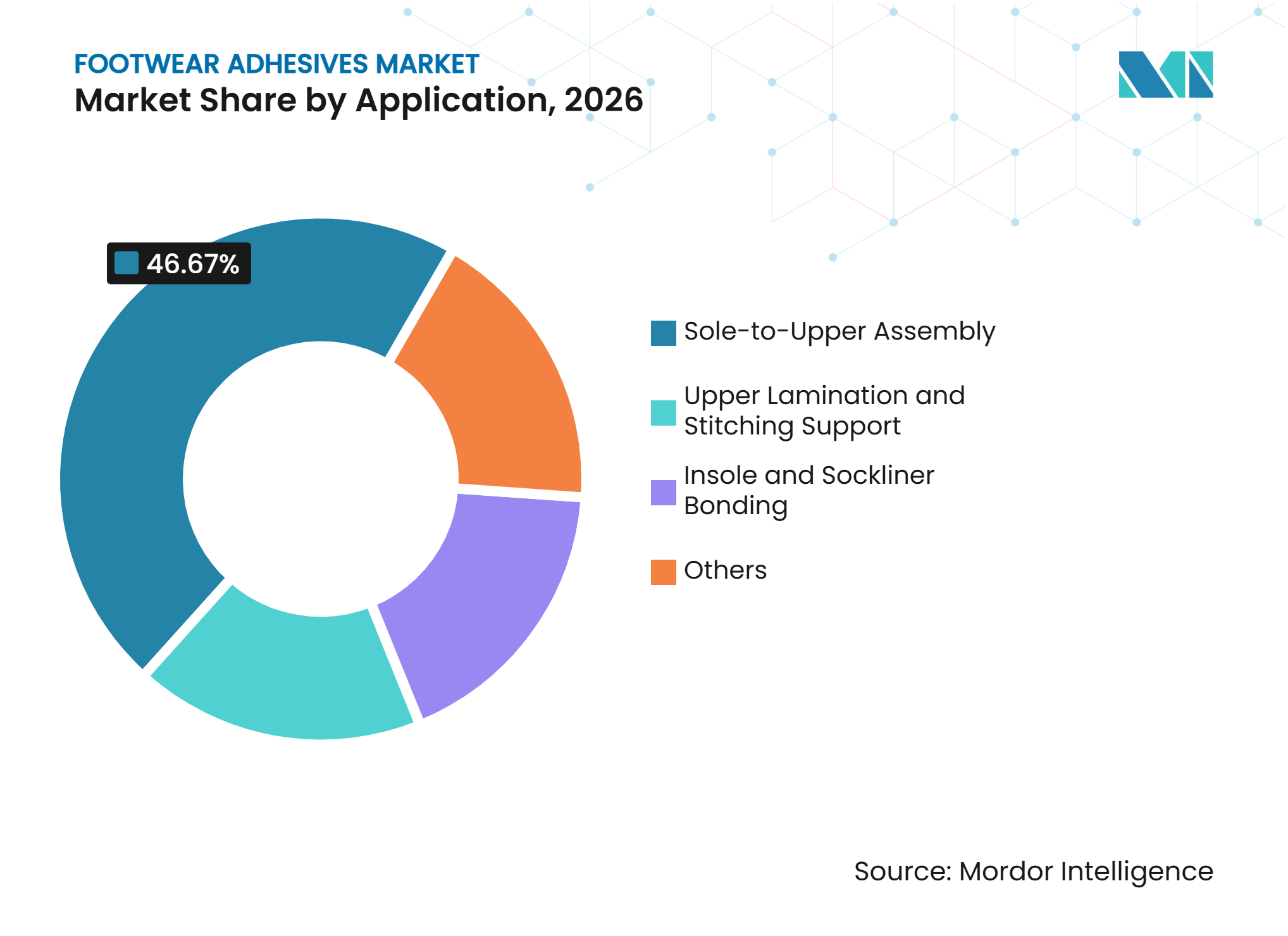
- By application, sole-to-upper assembly held 46.67% of the Footwear Adhesives Market share in 2026 and is forecast to grow at a 6.91% CAGR through 2032.
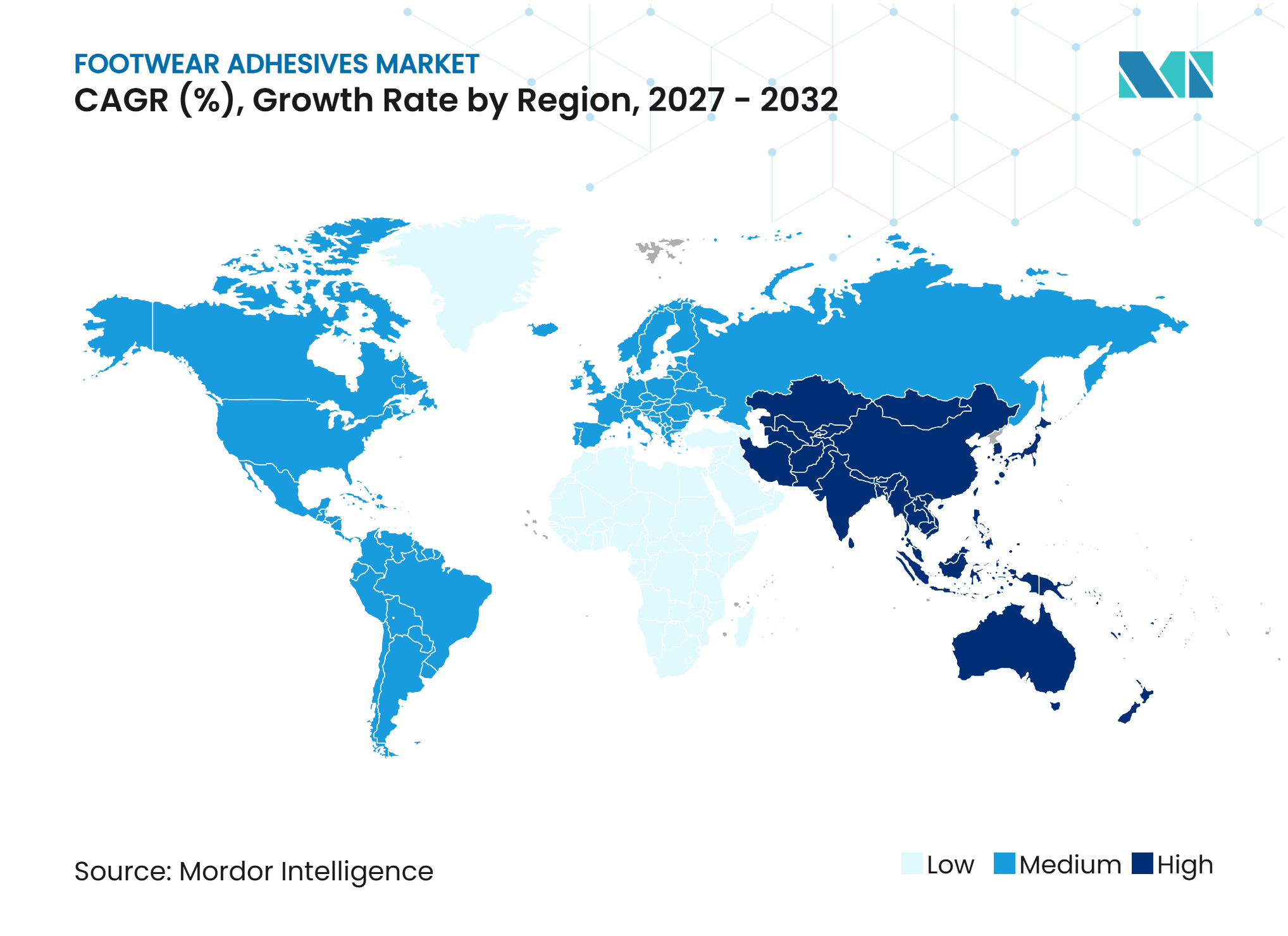
- By geography, Asia-Pacific held 43.11% of the Footwear Adhesives Market share in 2026 and is forecast to grow at a 6.88% CAGR through 2032.
Note: Market numbers in this report are based on Mordor Intelligence's proprietary estimation framework, which combines nine months of actuals with Q4 projections for base year 2026.
Market Trends and Insights
Drivers Impact Analysis of Footwear Adhesives Market*
| Drivers | (~) % Impact on CAGR Forecast | Geographic Relevance | Impact Timeline |
|---|---|---|---|
| Expansion of Athletic and Casual Footwear Production | +1.6% | Global, led by Asia-Pacific and North America | Short term (≤ 2 years) |
| Shift Toward Low-Volatile Organic Compound (VOC) and Water-Based Bonding | +1.2% | Global, strongest in Europe and Asia-Pacific core | Medium term (2-4 years) |
| Automation and One-Component Adhesive Processes | +0.8% | Asia-Pacific core, with spillover to South and Southeast Asia | Medium term (2-4 years) |
| Premium Performance Requirements for Lightweight Footwear | +0.6% | Global, led by North America and Western Europe | Medium term (2-4 years) |
| Brand-Led Solvent Elimination and Chemical Traceability | +0.5% | Global | Short term (≤ 2 years) |
| Source: Mordor Intelligence | |||
Expansion of Athletic and Casual Footwear Production
Demand for athletic and casual footwear supports adhesive consumption, as each pair requires several bonding stages. Major brands are expanding orders with Asian manufacturing partners, and leading Taiwanese footwear factories are adding capacity in Vietnam, Indonesia, and India. The footwear adhesives market benefits as this capacity extends demand beyond established production sites in China. Sole attachment typically consumes the greatest amount of adhesive per shoe. Multi-material designs combine Thermoplastic Polyurethane (TPU) midsoles, rubber outsoles, and textile uppers, increasing the number of bonding interfaces even when individual bond lines are thinner. This design trend increases demand for products that can consistently bond different materials at high output.
Shift Toward Low-VOC and Water-Based Bonding
Limits on VOC emissions and brand chemical policies are encouraging footwear manufacturers to replace solvent-heavy bonding systems. China continues to enforce GB 33372-2020 through adhesive product quality inspections, making VOC compliance a direct operational issue for suppliers and footwear plants. The footwear adhesives market is therefore placing more weight on water-based polyurethane dispersions and reactive systems. NanPao states that 75% to 80% of its shoe adhesive range qualifies as low-VOC or zero-VOC and identifies waterborne polyurethane dispersions and eco water-based resins as key priorities. ISO 20686:2025 covers gas chromatography-mass spectrometry testing of solvent residues in footwear materials, adding a compliance consideration across the supply chain. Brand-led solvent elimination and chemical traceability make low-VOC formulation capability increasingly important for supplier qualification.
Automation and One-Component Adhesive Processes
Manual application can limit throughput in high-output footwear factories, encouraging the use of automated dispensing. Robotic systems require products with controlled open times, stable viscosity, and consistent rheology. One-component water-based and hot-melt products can reduce the variability associated with manual mixing of two-component solvent-based formulas. Huntsman introduced SMARTLITE SCF 280 Thermoplastic Polyurethane (TPU) in September 2025 for midsole applications, positioning it for reliable compatibility with manufacturing systems. The footwear adhesives market benefits from automation when suppliers pair suitable formulations with application engineering support. Producers unable to meet process-consistency requirements face a higher barrier to supplying robotic production lines.
Premium Performance Requirements for Lightweight Footwear
Lightweight and technically complex shoes require bonding systems that perform across a wider range of materials. Foam midsoles, bio-based upper textiles, and other new components create bonding conditions that standard polyurethane products may not address consistently. Dow has expanded its footwear materials portfolio with bio-circular materials, reversible cross-linking resins, and polyolefin elastomers for artificial leather. These materials require adhesive suppliers to engage earlier in the product-development process. A 2025 peer-reviewed study found that waterborne adhesives based on aza-Michael and amine-epoxide chemistries achieved peel strengths of 0.54-0.64 N/mm and lap shear strengths of 172-284 kPa in leather applications. These results support the use of lower-solvent systems where footwear manufacturers require both material performance and chemical compliance.
Restraints Impact Analysis of Footwear Adhesives Market*
| Restraint | (~) % Impact on CAGR Forecast | Geographic Relevance | Impact Timeline |
|---|---|---|---|
| Raw-Material Price Volatility and Supply Disruptions | -0.7% | Global | Short term (≤ 2 years) |
| Qualification Costs and Long Original Equipment Manufacturer (OEM) Approval Cycles | -0.4% | Global | Medium term (2-4 years) |
| Process Reconfiguration for Water-Based Systems | -0.5% | Asia-Pacific core, with spillover to Middle East and Africa | Medium term (2-4 years) |
| Source: Mordor Intelligence | |||
Raw-Material Price Volatility and Supply Disruptions
Methylene Diphenyl Diisocyanate (MDI), Toluene Diisocyanate (TDI), polyols, and vinyl acetate monomer are core inputs for many footwear adhesive formulations. Their costs fluctuate with crude oil and chemical feedstock conditions, leaving smaller regional producers exposed. Larger companies can manage some of this volatility through scale or forward contracts. Covestro reported that a 2025 fire at its Dormagen Chempark site affected its full-year results, illustrating how a disruption at a chemical facility can impact supply across product lines[1]. The footwear adhesives market faces margin pressure when input costs rise faster than suppliers can adjust selling prices. These conditions are challenging for producers serving price-sensitive footwear manufacturers in Southeast Asia.
Qualification Costs and Long OEM Approval Cycles
Major footwear brands test new adhesive formulas for bond durability, hydrolysis resistance, flex-crack performance, and chemical compliance. These multi-stage qualification processes can take 12 to 24 months before adoption. A water-based product may therefore take considerable time to replace an established solvent-based formula, even when its technical performance is acceptable. H.B. Fuller identifies production flexibility for water-based products in factories that frequently change shoe models and sizes as an ongoing development priority. Process reconfiguration also requires equipment changes and worker training, particularly at smaller factories. Existing approved supplier lists can protect incumbents, as entry depends on both process integration and adhesive chemistry.
*Our forecasts treat driver/restraint impacts as directional, not additive. The impact forecasts reflect baseline growth, mix effects, and variable interactions.
Footwear Adhesives Market Segment Analysis
By Adhesive Type:
Solvent-Based Products Retain a Large Installed BaseSolvent-based adhesives accounted for 42.56% of the footwear adhesives market share in 2026, reflecting their established role in sole-to-upper attachment, where initial tack and reliable bond strength are important under fast production-line conditions. Existing curing equipment, production-line settings, and factory expertise are aligned with formulations that brands have qualified over many years. This installed base slows replacement because manufacturers must verify that alternatives perform reliably at commercial speeds and across their approved materials. Hot-melt products serve a different need by enabling rapid curing and compatibility with automated dispensing, particularly for insole and sockliner bonding. Their use indicates that adhesive selection is tied to both the construction step and the production process.
Water-based adhesives are projected to grow at a 6.34% CAGR through 2032, the fastest rate among adhesive types, as suppliers respond to VOC regulations, brand chemical policies, and traceability requirements. The market is also supported by NanPao's focus on waterborne polyurethane dispersions and eco water-based resins within its footwear portfolio. Reactive polyurethane systems retain a premium role in leather dress shoes and outdoor boots that require hydrolysis resistance and durability under repeated mechanical stress. The Association of European Adhesive & Sealant Industry (FEICA) reported in 2025 that bio-based adhesives with more than 83% bio-based content are commercially available for use in footwear laminates with bio-based TPU and PLA substrates. These technologies allow manufacturers to balance line speed, bond performance, material compatibility, and chemical requirements.



By Material and Substrate:
Synthetic Materials Increase Technical Bonding NeedsLeather accounted for 34.23% of the footwear adhesives market share in 2026 and remains relevant in formal, work-safety, and premium-casual footwear. It varies in porosity and surface chemistry, requiring suppliers to offer products that provide consistent penetration after skiving and roughing treatments. This requirement supports formulations that are broadly compatible with natural materials and enable repeatable processing at the factory level. Rubber also remains significant in athletic and outdoor footwear, as each outsole requires pretreatment and priming before bonding. This multi-step process creates demand for primers, surface-treatment products, and core adhesive products.
Synthetic materials are projected to grow at a 6.67% CAGR through 2032, supported by the rising use of TPU, EVA foam, recycled PET textiles, and bio-based polymers. These materials exhibit different surface energy and elasticity, which can prevent standard formulations from bonding consistently. Huntsman and Steitz Secura demonstrated a safety-footwear design in 2025 incorporating 30% recycled polyurethane in the midsoles, illustrating the practical integration of recycled materials. Arkema introduced Pebax EVA+ compounds for athletic midsoles at ISPO Munich in 2025, adding further material combinations for footwear designers. The footwear adhesives industry must therefore develop formulations for mixed-material assemblies, recycled content, and solvent-residue management in accordance with ISO 20686:2025.
By Application:
Sole-to-Upper Assembly Combines Scale and Performance NeedsSole-to-upper assembly accounted for 46.67% of the footwear adhesives market in 2026 and is projected to grow at a 6.91% CAGR through 2032. It is the most adhesive-intensive step in footwear construction, as it joins components exposed to repeated flexing and mechanical stress. Performance footwear requires strong, durable bonds, while factories also need compatibility with waterborne processing protocols. This combination directs product development toward mechanical performance, line reliability, and low-VOC compliance. It also makes sole attachment a central application for suppliers seeking to demonstrate technical value to large footwear manufacturers.
Insole and sockliner bonding benefits from the wider use of specialty foams and functional insoles in athletic and medical footwear. Upper lamination and stitching-support applications are becoming more relevant as no-sew construction expands from premium athletic products into broader product lines. Henkel has developed two-in-one products that eliminate the need for a separate priming step, while its CoolX range reduces drying temperatures from 50 to 35 degrees Celsius. These developments can simplify process steps and reduce energy use during upper assembly. The market is moving toward bonding systems that support both manufacturing efficiency and shoe performance.

Geography Analysis
Asia-Pacific
Asia-Pacific accounted for 43.11% of the footwear adhesives market share in 2026 and is projected to grow at a 6.88% CAGR through 2032. China remains the primary production location, while Vietnam, Indonesia, and India are receiving additional capacity from Taiwanese manufacturers in response to higher brand orders. China's enforcement of GB 33372-2020 creates a direct compliance requirement for adhesive suppliers operating near footwear clusters. The State Administration for Market Regulation brought 9 national standards for footwear into effect in June 2025 under GB 25038-2024, strengthening product safety and chemical requirements for footwear sold in China. NanPao has also identified South Korean non-Taiwan-affiliated factories as a growing customer group, indicating a broader shift in regional sourcing.
North America
North America's footwear adhesives market is shaped by demand for premium athletic and lifestyle footwear and by tighter controls on adhesive chemistry. The U.S. Environmental Protection Agency's risk management rule under the Toxic Substances Control Act restricted most commercial and consumer uses of trichloroethylene by September 2025. This regulatory development supports reformulation away from chlorinated solvent chemistries. Dow's low-carbon footwear materials and Huntsman's SMARTLITE TPU products are directed at the region's athletic brand base. Canada and Mexico provide nearshoring locations for brands seeking more resilient supply chains, extending adhesive demand beyond established Asian production corridors.
Europe, South America, Middle East and Africa
Europe maintains a premium footwear base in Italy, Germany, Portugal, and Nordic countries, where chemical compliance requirements support the use of water-based and reactive adhesives. ISO 20686:2025 provides a testing framework for solvent residues in footwear materials, adding to the regulatory focus on lower-residue systems. South America, led by Brazil and Argentina, has a stable demand base from domestic casual footwear production and established local brands. The Middle East and Africa present an emerging market profile, driven by urbanization, growing footwear consumption, and the development of local manufacturing capacity. NanPao's distribution presence in Egypt and Ethiopia indicates that Asian suppliers are establishing positions early in markets where multinational competitors have placed less emphasis.
Competitive Landscape
Market Concentration
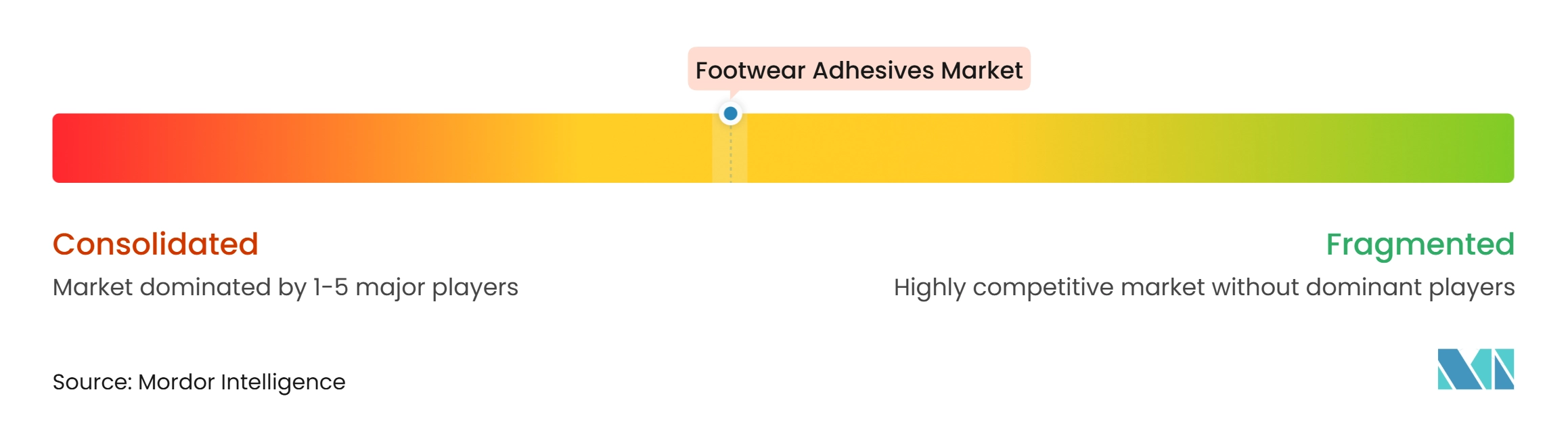
The Footwear Adhesives Market is moderately consolidated. Taiwanese producers, including NanPao Resins Chemical Group, Great Eastern Resins, and HWA PAO Resins, are key suppliers to high-output athletic footwear plants. European and North American companies compete through technology-focused portfolios and technical service offerings. NanPao reported 40% penetration among international athletic shoe brands and has set a target of 50%-60%. This positions the company in direct competition with larger adhesive groups in the sport-shoe supply chain.
Henkel competes through its water-based Aquence range and process-integration products, while H.B. Fuller focuses on its Ultraflex line and water-based solutions for factories with high product variation[2]. High-output athletic applications remain price-competitive and favor Asia-Pacific specialists that work closely with footwear factories. Premium, safety, and industrial footwear applications require more differentiated performance and attract specialty chemistry companies. Suppliers are seeking a greater role in material selection and production-process design, making application engineering a significant competitive factor in the Footwear Adhesives Market.
Circular product design is creating demand for adhesives that support separation of multi-material shoe components at end of life. Huntsman's 2025 recycled polyurethane safety-footwear project is an example of material innovation directed at circular footwear. In August 2025, Covestro acquired Pontacol AG to add multilayer adhesive film capabilities for textile, medical, and mobility applications. This move signals interest in adhesive formats beyond traditional liquid dispensing systems, and the Footwear Adhesives Market may therefore see broader use of film-format products in technical footwear applications.
Footwear Adhesives Industry Leaders
-
Henkel AG & Co. KGaA
-
H.B. Fuller Company
-
Arkema
-
Jowat SE
-
NANPAO RESINS CHEMICAL GROUP
- *Disclaimer: Major Players sorted in no particular order
Footwear Adhesives Market Companies Covered in this Report
- 3M
- Arkema
- Covestro AG
- Dow
- Great Eastern Resins Industrial Co. Ltd.
- H.B. Fuller Company
- Henkel AG & Co. KGaA
- Huntsman International LLC
- HWA PAO RESINS CHEMICAL CO., LTD.
- Jowat SE
- NANPAO RESINS CHEMICAL GROUP
- Pidilite Industries Limited
- Sika AG
- Tavorn Chemical Co., Ltd.
- Wacker Chemie AG
Recent Industry Developments in Footwear Adhesives Market
- September 2026: Pidilite Industries Limited announced a partnership with South Korea's Hwaseung Chemical to develop footwear adhesives for the Indian market, targeting sports and performance shoe manufacturers. The collaboration combined Hwaseung's technical footwear adhesive expertise with Pidilite's domestic distribution network to serve India's athletic footwear production market.
- October 2025: Henkel Adhesive Technologies and Dow Inc. expanded their strategic partnership to accelerate decarbonization across Henkel's adhesive portfolio. The collaboration introduced low-carbon feedstocks and renewable electricity into the production of hot-melt footwear adhesive, targeting a 20% to 40% reduction in the product carbon footprint across individual product lines.
Global Footwear Adhesives Market Report Scope
Footwear adhesives are specialized bonding compounds used in shoe manufacturing and repair to attach, seal, and laminate shoe components, such as joining the sole to the upper, securing linings, and tacking welts, without relying solely on traditional stitching or nailing. These adhesives are formulated to meet the specific mechanical and chemical demands of footwear production, including flexibility, durability, resistance to heat and moisture, and compatibility with a wide range of materials such as leather, rubber, synthetic fabrics, and foam.
The footwear adhesives market is segmented by adhesive type, material and substrate, application, and geography. By adhesive type, the market is segmented into solvent-based adhesives, water-based adhesives, hot melt adhesives, reactive adhesives, and others. By material and substrate, the market is segmented into leather, rubber, synthetic materials, and others. By application, the market is segmented into sole-to-upper assembly, insole and sockliner bonding, upper lamination and stitching support, and others. The report also covers market sizes and forecasts for footwear adhesives across 15 countries in major regions. The market sizes and forecasts are provided in terms of value (USD).
Segmentation Overview
| Solvent-Based Adhesives |
| Water-Based Adhesives |
| Hot Melt Adhesives |
| Reactive Adhesives |
| Others |
| Leather |
| Rubber |
| Synthetic Materials |
| Others |
| Sole-to-Upper Assembly |
| Insole and Sockliner Bonding |
| Upper Lamination and Stitching Support |
| Others |
| Asia-Pacific | China |
| India | |
| Japan | |
| South Korea | |
| ASEAN Countries | |
| Rest of Asia-Pacific | |
| North America | United States |
| Canada | |
| Mexico | |
| Europe | Germany |
| United Kingdom | |
| France | |
| Italy | |
| NORDIC Countries | |
| Rest of Europe | |
| South America | Brazil |
| Argentina | |
| Rest of South America | |
| Middle East and Africa | Saudi Arabia |
| South Africa | |
| Rest of Middle East and Africa |
| By Adhesive Type | Solvent-Based Adhesives | |
| Water-Based Adhesives | ||
| Hot Melt Adhesives | ||
| Reactive Adhesives | ||
| Others | ||
| By Material and Substrate | Leather | |
| Rubber | ||
| Synthetic Materials | ||
| Others | ||
| By Application | Sole-to-Upper Assembly | |
| Insole and Sockliner Bonding | ||
| Upper Lamination and Stitching Support | ||
| Others | ||
| By Geography | Asia-Pacific | China |
| India | ||
| Japan | ||
| South Korea | ||
| ASEAN Countries | ||
| Rest of Asia-Pacific | ||
| North America | United States | |
| Canada | ||
| Mexico | ||
| Europe | Germany | |
| United Kingdom | ||
| France | ||
| Italy | ||
| NORDIC Countries | ||
| Rest of Europe | ||
| South America | Brazil | |
| Argentina | ||
| Rest of South America | ||
| Middle East and Africa | Saudi Arabia | |
| South Africa | ||
| Rest of Middle East and Africa | ||
Key Questions Answered in the Report
What is current market size of Footwear Adhesives Market?
The Footwear Adhesives Market size was valued at USD 3.01 billion in 2026 and is estimated to grow from USD 3.16 billion in 2027 to USD 4.13 billion by 2032, at a CAGR of 5.47% during the forecast period (2027-2032).
Which footwear adhesive type is growing the fastest?
Water-based adhesives are projected to grow at a 6.34% CAGR through 2032. Volatile Organic Compound (VOC) controls, brand chemical policies, and increased requirements for supplier traceability support adoption across footwear manufacturing supply chains.
Why is Asia-Pacific important for footwear adhesive suppliers?
The Footwear Adhesives Market in Asia-Pacific accounted for 43.11% of the global market in 2026 and is projected to grow at a 6.88% CAGR through 2032. The region combines China’s established production base with capacity expansion in Vietnam, Indonesia, and India.
What application uses the most adhesive in shoe manufacturing?
Sole-to-upper assembly accounted for 46.67% of the market in 2026 and is projected to grow at a 6.91% CAGR through 2032. The process requires durable bonds for components exposed to repeated flexing and mechanical stress.