
Foam Glass Granulate and Gravel Market Size and Share
Market Overview
| Study Period | 2022 - 2032 |
|---|---|
| Market Size (2027) | USD 1.53 Billion |
| Market Size (2032) | USD 2.11 Billion |
| Growth Rate (2027 - 2032) | 6.56 % |
| Fastest Growing Market | Asia-Pacific |
| Largest Market | Asia-Pacific |
| Market Concentration | Medium |
Major Players *Disclaimer: Major Players sorted in no particular order Image © Mordor Intelligence. Reuse requires attribution under CC BY 4.0. | |
Foam Glass Granulate and Gravel Market Analysis by Mordor Intelligence
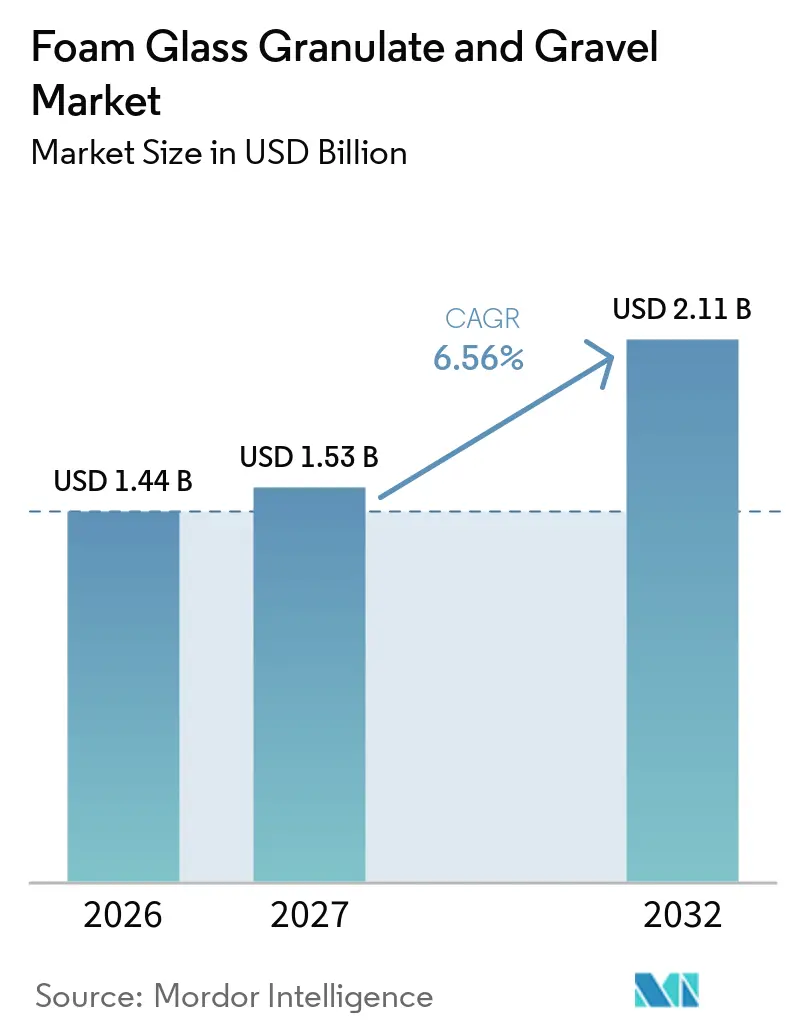
The foam glass granulate and gravel market size was valued at USD 1.44 billion in 2026 and is estimated to grow from USD 1.53 billion in 2027 to USD 2.11 billion by 2032, at a CAGR of 6.56% during the forecast period (2027-2032). The foam glass granulate and gravel market is supported by tighter energy and carbon requirements for buildings, which make durable below-grade insulation more relevant in new construction and renovation. European regulations require member states to improve the energy performance of the least-efficient buildings and to apply zero-emission requirements to new buildings, thereby increasing demand for materials that can withstand moisture and structural loads. The market also benefits from applications where foundation systems require lightweight fill on weak or saturated soils. Water management is an additional benefit, as the material can provide both drainage and insulation in a single layer. Producers are responding by sourcing recycled glass, adopting lower-carbon production processes, pursuing product certification, and providing contractor support. However, high purchase costs and limited feedstock availability remain key constraints.
Key Report Takeaways
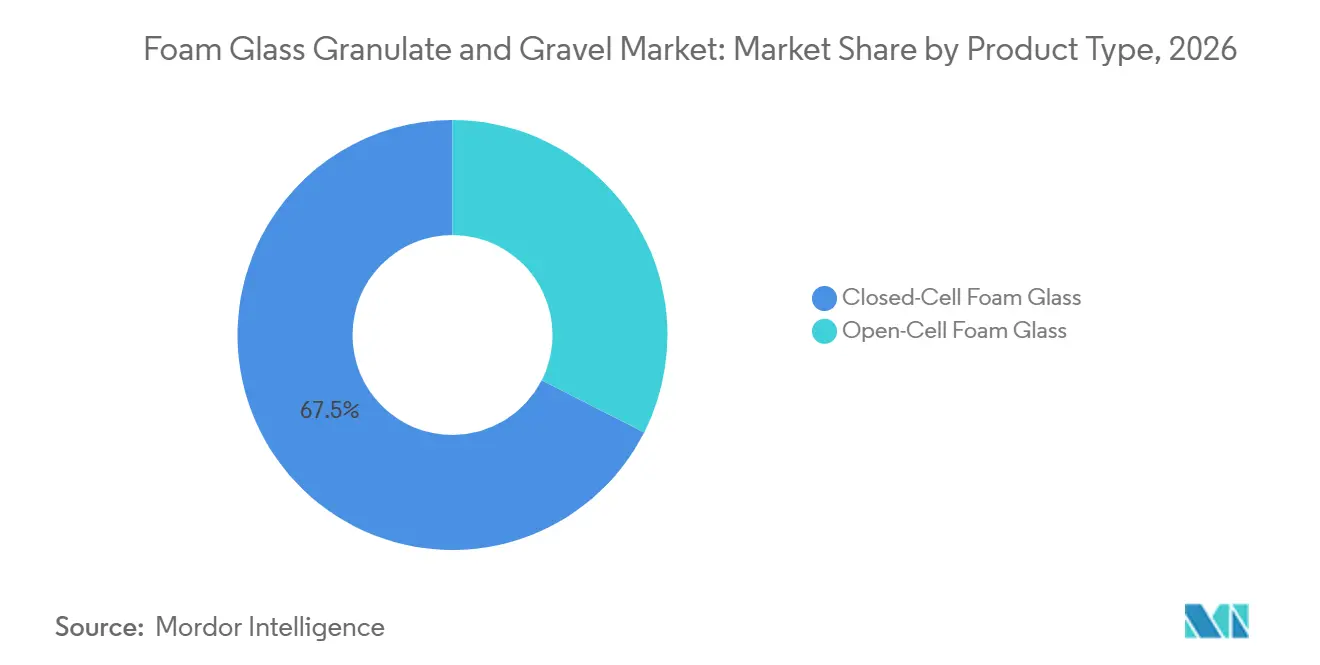
- By product type, closed-cell foam glass held 67.51% of the foam glass granulate and gravel market share in 2026, while open-cell foam glass is projected to expand at a 7.13% CAGR through 2032.
- By product form, granular foam glass accounted for 55.14% of the foam glass granulate and gravel market share in 2026, while pellets are forecast to grow at a 7.34% CAGR through 2032.
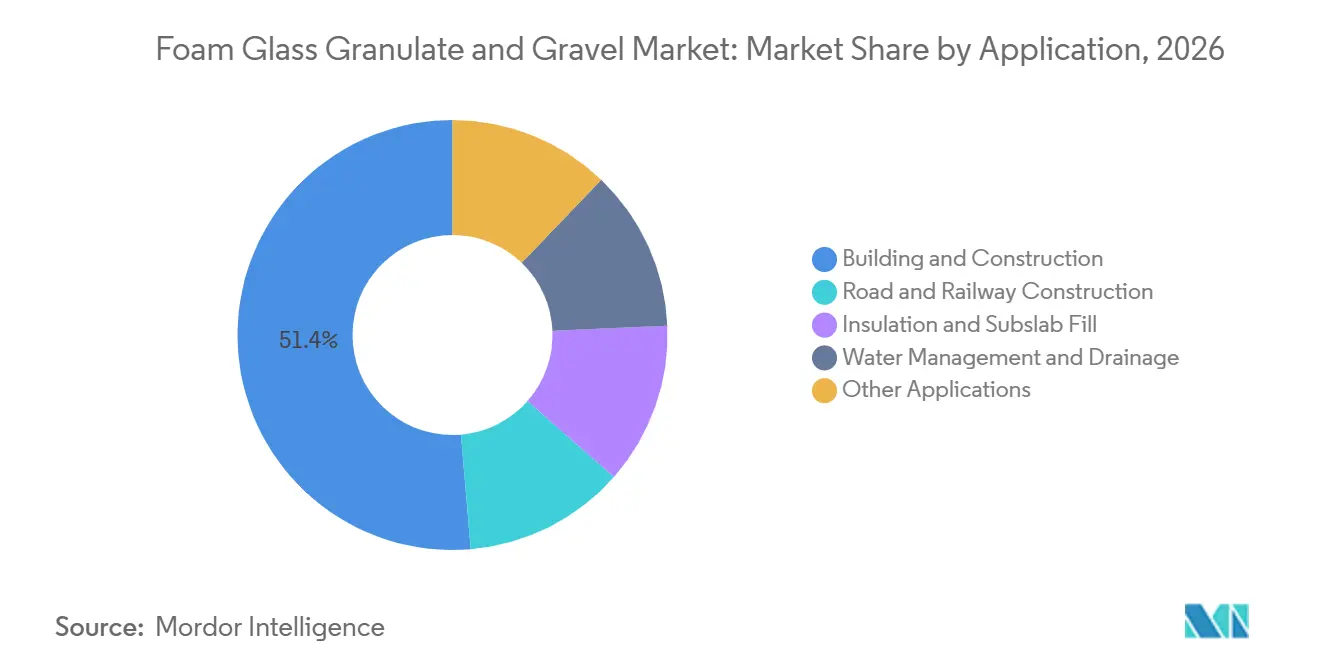
- By application, building and construction represented 51.36% market share in 2026, while water management and drainage are projected to advance at a 7.87% CAGR through 2032.
- By geography, Asia-Pacific held 36.27% market share in 2026 and is forecast to grow at a 7.61% CAGR through 2032.
Note: Market numbers in this report are based on Mordor Intelligence's proprietary estimation framework, which combines nine months of actuals with Q4 projections for base year 2026.
Global Foam Glass Granulate and Gravel Market Trends and Insights
Drivers Impact Analysis*
| Drivers | (~) % Impact on CAGR Forecast | Geographic Relevance | Impact Timeline |
|---|---|---|---|
| Energy-Efficient and Low-Carbon Building-Code Adoption | +2.1% | Global, primary gains in the EU and North America | Medium term (2-4 years) |
| Lightweight Fill Demand for Settlement-Prone Infrastructure | +1.4% | Global, strongest in North America and Northern Europe | Short term (≤ 2 years) |
| Circular Use of Post-Consumer Glass in Construction | +1.2% | Global, primarily EU, spillover to APAC core | Medium term (2-4 years) |
| Green-Roof, Drainage, and Water-Management Specification Growth | +0.9% | North America and the EU, early gains in East Asian metros | Short term (≤ 2 years) |
| Electrified Kiln and Renewable-Energy Production Differentiation | +0.7% | Global, Northern Europe first, then North America | Long term (≥ 4 years) |
| Source: Mordor Intelligence | |||
Energy-Efficient and Low-Carbon Building-Code Adoption
Stricter building energy codes are shifting insulation selection toward products that meet compliance requirements over long service periods. The recast Energy Performance of Buildings Directive requires EU member states to establish minimum energy performance standards for the worst-performing buildings and promotes zero-emission new buildings. The foam glass granulate and gravel market can benefit from this, as the load-bearing and moisture-resistant properties of these materials suit subslab and perimeter applications. The European Commission has also established a comparative framework for calculating cost-optimal energy performance, which focuses on lifetime building performance rather than initial material costs alone. In the United States, state energy code updates continue to strengthen foundation insulation requirements, including California standards that took effect in 2026. Non-combustible foam glass can therefore gain attention where project teams require insulation that also supports fire-safety and moisture-control objectives.
Lightweight Fill Demand for Settlement-Prone Infrastructure
The foam glass granulate and gravel market is expanding beyond conventional insulation applications into roads and foundations built on compressible or waterlogged ground. Lightweight aggregate reduces the load transferred to weak subgrades and can reduce the need for deeper excavation or other ground-improvement measures. AeroAggregates supplied ultra-lightweight foamed glass aggregate for the Wyoming Department of Transportation's Teton Pass repair, completed in July 2025. The company reported that the material weighed 85% less than quarried stone and reduced truck trips for the project by a factor of 6. Research from Université Laval also examined foam glass aggregate as a thermal stabilization material for road infrastructure in permafrost regions. These applications address demand in northern road networks and other locations where ground movement and frost damage result in high maintenance costs.
Circular Use of Post-Consumer Glass in Construction
The foam glass granulate and gravel market provides an outlet for low-grade post-consumer glass that cannot readily be returned to container-grade recycling. Germany's Federal Government adopted measures under its circular economy strategy in June 2026, with construction identified as a priority area for secondary raw materials. This direction favors materials that incorporate recycled content into durable construction applications. GLAPOR has positioned its foam glass products around sustainability criteria and circular material use, which helps project teams meet green-building documentation requirements. Foamit Group has also extended its long-term agreement with Svensk Glasåtervinning, helping secure a consistent recycled-glass supply. The foam glass granulate and gravel market still faces competition from other glass users for cullet, so local collection and sorting capacity will remain important to production economics.
Green-Roof, Drainage, and Water-Management Specification Growth
Stormwater regulations and green-roof requirements are creating a separate growth path for the foam glass granulate and gravel market. The material can serve as a drainage layer while contributing insulation, which can reduce the number of layers needed in a roof or site design. A 2025 peer-reviewed study measured drainage rates of 0.62-3.26 cm/s for foamed glass aggregate and found field capacity comparable with sand in stormwater applications. The study also examined sediment capture and contaminant removal potential, supporting consideration of these materials in bioretention and constructed wetland designs. Philadelphia's stormwater guidance identifies granular drainage layers in green-roof systems, illustrating how local technical standards can support the specification of suitable materials[1]. These uses can help the foam glass granulate and gravel market move from individual trials toward repeated municipal applications.
Restraints Impact Analysis*
| Restraints | (~) % Impact on CAGR Forecast | Geographic Relevance | Impact Timeline |
|---|---|---|---|
| Higher Upfront Cost Versus Conventional Aggregate in Some Projects | -1.4% | Global, most acute in APAC and South America | Short term (≤ 2 years) |
| Limited Contractor Familiarity and Installation-Specification Gaps | -1.0% | North America, APAC, the Middle East, and Africa | Medium term (2-4 years) |
| Regional Shortage of Qualified Recycled-Glass Feedstock | -0.7% | EU and North America, including the Pacific Northwest | Medium term (2-4 years) |
| Source: Mordor Intelligence | |||
Higher Upfront Cost Versus Conventional Aggregate in Some Projects
Foam glass can cost more at the point of purchase than quarried aggregate or common organic insulation products. This cost reflects recycled-glass processing, kiln operation, product testing, and the logistics required to supply a lightweight bulk material. The issue is most pronounced in small residential and commercial projects where procurement decisions are based on initial material cost. Large civil projects can recover part of the price premium when lightweight fill reduces the need for excavation, piling, preloading, or transportation. The foam glass granulate and gravel market is more concentrated in Asia-Pacific and South America, where local production capacity is limited, and import logistics add to delivered costs. Broader regional production and clearer lifecycle cost assessments are needed before the foam glass granulate and gravel market can consistently compete in price-sensitive projects.
Limited Contractor Familiarity and Installation-Specification Gaps
Limited familiarity among contractors and designers slows the market for foam glass granulate and gravel, even where the material meets project requirements. A 2025 ASCE study noted that knowledge gaps around hydraulic and environmental properties can constrain its use in stormwater applications. Incorrect compaction can affect the thermal and structural assumptions used in engineered designs, particularly when installers are accustomed to conventional fill products. This gap is most evident in North America, where adoption remains lower than in Scandinavia and Central Europe. Suppliers such as AeroAggregates and Glavel have increased product documentation and training support, with Glavel also providing technical guidance for infrastructure use[2]. Continued training and more standardized installation practices can make the foam glass granulate and gravel market easier to specify across construction markets.
*Our forecasts treat driver/restraint impacts as directional, not additive. The impact forecasts reflect baseline growth, mix effects, and variable interactions.
Segment Analysis
By Product Type: Closed-Cell Leads in Structural Uses, While Open-Cell Serves Specialized Needs
Closed-cell foam glass held 67.51% of the global market value in 2026. Its closed-cell structure limits capillary water movement and supports use in permanent subslab, perimeter, and drainage applications. This product type is preferred in applications where moisture can reduce the effectiveness of organic insulation over time. The Teton Pass repair used ultra-lightweight foamed glass aggregate in a mountain setting exposed to seasonal water infiltration. These requirements give closed-cell products a durable position in civil and below-grade construction within the foam glass granulate and gravel market.
Open-cell foam glass is projected to grow at a 7.13% CAGR through 2032. Its structure offers a different value proposition, where acoustic absorption is more important than moisture resistance and high compressive strength. Commercial retrofit projects can use open-cell materials to meet acoustic comfort requirements in walls and other enclosed spaces. China's revised JC/T 647-2026 standard introduces indicators for low-temperature and energy-saving building scenarios, potentially broadening the scope for specialized cellular-glass applications. The foam glass granulate and gravel market can therefore address both structural uses and smaller applications with distinct thermal or acoustic needs.

By Product Form: Granular Form Leads by Quantity, While Pellets Offer Greater Accessibility
Granular foam glass accounted for 55.14% of the global market value in 2026. It remains suitable for road embankments, green roofs, slab foundations, and other large projects that require bulk placement. Its angular particles provide friction and geotechnical resistance without the need for binding agents. The form also aligns with the handling practices used in major earthworks and foundation projects. Granular material, therefore, remains the primary format in the foam glass granulate and gravel market.
Pellets are forecast to grow at a 7.34% CAGR through 2032. Their uniform shape supports machine-dispensed and blown-in placement in confined renovation spaces. Glasopor AS launched a blown-in pellet solution in January 2025 for locations where mechanical excavation is difficult. This approach can make residential retrofit work more practical where building geometry and occupied spaces limit conventional placement. Powder remains relevant for lightweight concrete and precast applications, while blocks and other forms provide the foam glass granulate and gravel markets with access to customized industrial and cryogenic insulation needs.
By Application: Building and Construction Holds Value, While Water Management Expands
Building and construction accounted for 51.36% of the global market value in 2026. Subslab insulation and perimeter fill remain the central applications because they combine insulation, drainage, and structural support. Building-code reform and embodied-carbon requirements are reinforcing the appeal of products with long service life below grade. The foam glass granulate and gravel market also benefits from the need to avoid moisture exposure, pest damage, and compressive creep that can affect other insulation products. These characteristics keep construction as the primary commercial outlet.
Water management and drainage are forecast to grow at a 7.87% CAGR through 2032. Road and railway projects also use foam glass, where thermal insulation can limit frost heave and help protect permafrost-sensitive corridors. A 2025 Canadian Geotechnical Society conference paper evaluated foamed glass gravel for reducing permafrost degradation beneath road embankments. The 2025 American Society of Civil Engineers (ASCE) research adds evidence on drainage, storage, and sediment-capture performance for municipal water projects. Together, these applications expand the market into infrastructure and site-management work distinct from traditional building insulation.
Geography Analysis
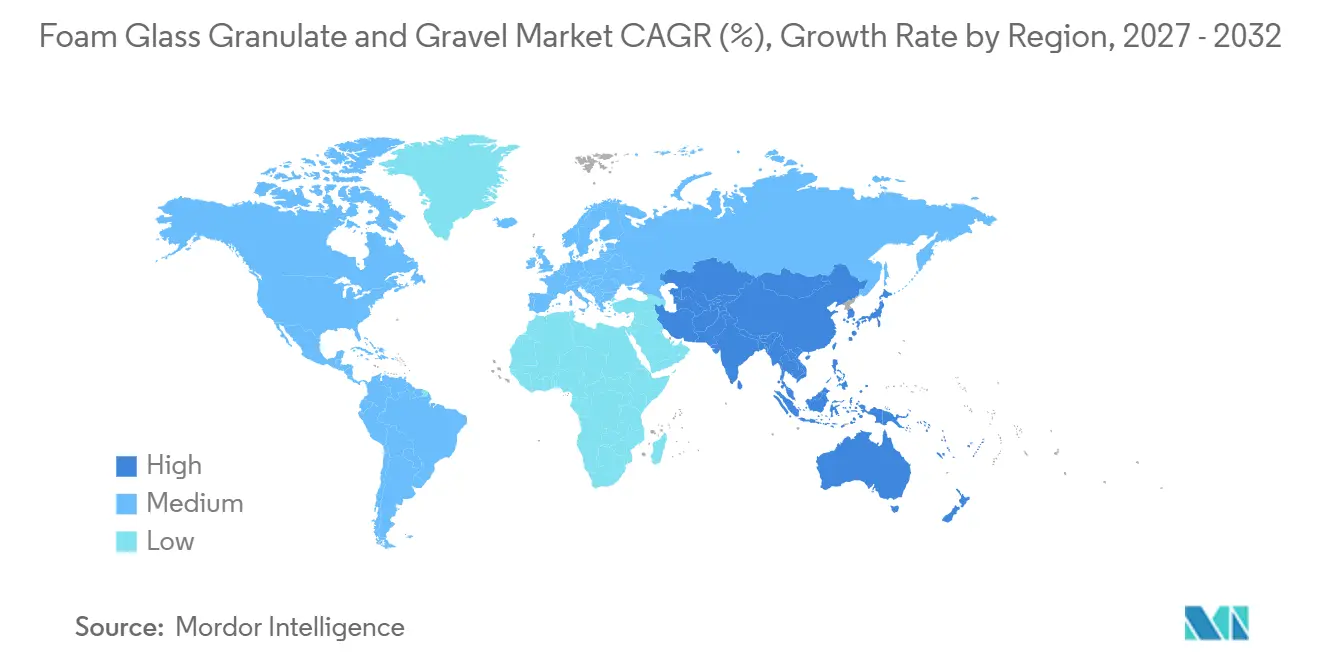
Asia-Pacific held 36.27% of global value in 2026 and is projected to grow at a 7.61% CAGR through 2032. China accounts for much of the region's scale, driven by green building requirements and a large construction base. The Green Building Evaluation Standard encourages materials with long service life and lower environmental impact, while China's revised JC/T 647-2026 standard introduces new product indicators for building energy-saving applications. The foam glass granulate and gravel market in Asia-Pacific is further supported by construction activity in coastal and reclaimed areas, where lightweight fill materials help reduce pressure on soft ground.
India contributes to demand through cold-storage expansion and infrastructure fill applications where lower foundation loads are important. Green building certifications, including the Green Rating for Integrated Habitat Assessment (GRIHA), the Indian Green Building Council (IGBC), and Leadership in Energy and Environmental Design (LEED), are raising awareness among developers. Japan's building upgrade programs support interest in non-combustible and dimensionally stable insulation. ASEAN countries add potential through investment in urban transport and commercial construction. Overall, Asia-Pacific offers the foam glass granulate and gravel market high construction activity and a growing base of codes and standards that support specialized insulation and fill materials.
North America is the second-largest region, supported by state-level energy codes and a growing local manufacturing base. AeroAggregates operates plants in Pennsylvania and Florida and reports approvals for road applications from 25 state departments of transportation. Europe remains the most mature regional market, led by Germany, Scandinavia, and the UK, where foam glass has been used in infrastructure for more than 25 years. Foamit Group opened electrified production lines in Norway in September 2025, and its Onsøy facility has an annual capacity of 280,000 m³. South America has infrastructure with full potential but limited local production. At the same time, opportunities in the Middle East and Africa are tied to specific construction projects and require greater contractor knowledge and established supply chains.
Competitive Landscape
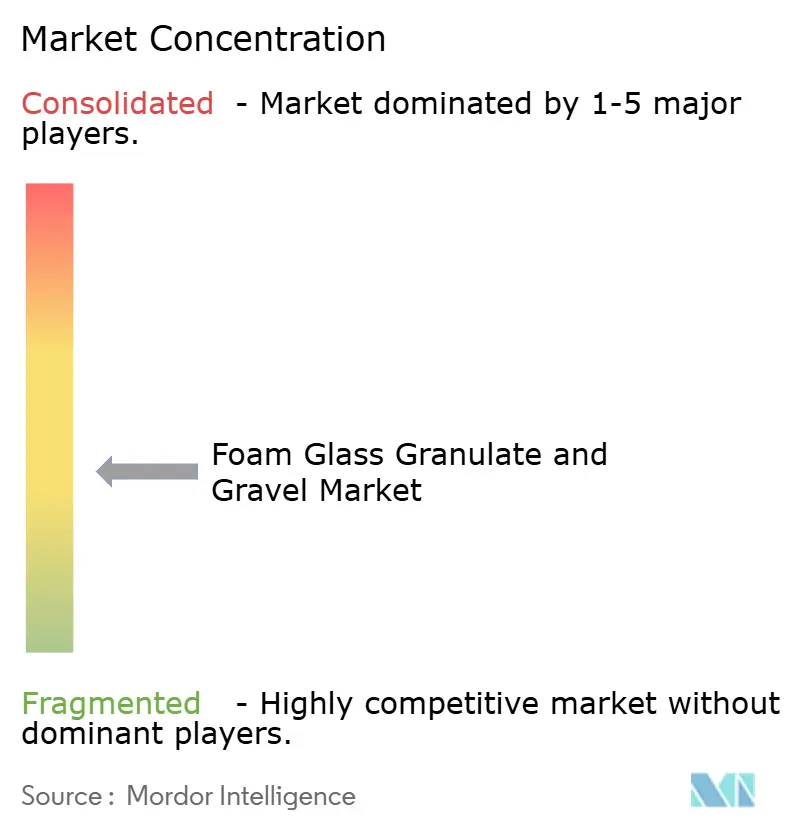
The foam glass granulate and gravel market is moderately fragmented, with established European specialists holding strong positions in their home regions. GLAPOR, MISAPOR, Liaver, Foamit Group, and Stikloporas compete through product certification, material performance, and established local supply chains. North American suppliers, AeroAggregates and Glavel, focus on technical approvals, domestic supply, and environmental documentation. Asian suppliers, including Nanjing EFG and Zhejiang Zhenshan, compete more strongly in quantity-oriented infrastructure applications. Capital requirements for kilns and access to recycled glass supply create barriers to entry, although no single company holds a global majority.
European suppliers generally focus on premium products that support LEED, BREEAM, Passivhaus, and similar project requirements. North American companies are building their market position through transportation approvals and transparent environmental data. In February 2026, Glavel announced a third-party-verified Environmental Product Declaration for foamed glass aggregate and a Declare Label. In 2026, AeroAggregates filed a US patent application for low-density, high-strength concrete using foamed glass aggregates. These developments indicate that suppliers are competing on demonstrated environmental performance and new downstream applications, rather than solely on aggregate quantity.
Foam Glass Granulate and Gravel Industry Leaders
-
MISAPOR
-
Foamit Corporation
-
GLAPOR Werk Mitterteich GmbH
-
AeroAggregates of North America, LLC
-
Thomas Armstrong
- *Disclaimer: Major Players sorted in no particular order
Recent Industry Developments
- August 2026: Foamit Group, Glava, and Stena Recycling announced a collaboration to integrate glass wool manufacturing offcuts as raw material feedstock for the Glasopor foam glass production plant in Norway, with processing commencing in spring 2026. Initial quantities exceed 1,000 tons per year, with potential to reach 3,500 tons, diversifying feedstock beyond container glass.
- February 2026: Glavel announced North America's first third-party-verified Environmental Product Declaration for foamed glass aggregate, produced with Pathways. The company also received a Declare Label certifying its product as Red List Free under International Living Future Institute standards, marking the first dual certification of this kind for foamed glass aggregate in the region.
Global Foam Glass Granulate and Gravel Market Report Scope
Foam Glass Granulate and Foam Glass Gravel are lightweight construction and insulation materials made from 100% recycled glass. These materials are produced by processing recycled glass into a cellular structure, which gives them low density, high compressive strength, and thermal insulation properties.
The foam glass granulate and gravel market is segmented by product type, product form, application, and geography. By product type, the market is segmented into open-cell foam glass and closed-cell foam glass. By product form, the market is segmented into granular, powdered, pellets, blocks, and others. By application, the market is segmented into building and construction, road and railway construction, insulation and subslab fill, water management and drainage, and other applications. The report also covers the market size and forecasts for foam glass granulate and gravel in 15 countries across major regions. The market sizes and forecasts are provided in terms of value (USD).
| Open-Cell Foam Glass |
| Closed-Cell Foam Glass |
| Granular |
| Powdered |
| Pellets |
| Blocks |
| Others |
| Building and Construction |
| Road and Railway Construction |
| Insulation and Subslab Fill |
| Water Management and Drainage |
| Other Applications |
| Asia-Pacific | China |
| India | |
| Japan | |
| South Korea | |
| ASEAN Countries | |
| Rest of Asia-Pacific | |
| North America | United States |
| Canada | |
| Mexico | |
| Europe | Germany |
| United Kingdom | |
| France | |
| Italy | |
| NORDIC Countries | |
| Rest of Europe | |
| South America | Brazil |
| Argentina | |
| Rest of South America | |
| Middle East and Africa | Saudi Arabia |
| South Africa | |
| Rest of Middle East and Africa |
| By Product Type | Open-Cell Foam Glass | |
| Closed-Cell Foam Glass | ||
| By Product Form | Granular | |
| Powdered | ||
| Pellets | ||
| Blocks | ||
| Others | ||
| By Application | Building and Construction | |
| Road and Railway Construction | ||
| Insulation and Subslab Fill | ||
| Water Management and Drainage | ||
| Other Applications | ||
| By Geography | Asia-Pacific | China |
| India | ||
| Japan | ||
| South Korea | ||
| ASEAN Countries | ||
| Rest of Asia-Pacific | ||
| North America | United States | |
| Canada | ||
| Mexico | ||
| Europe | Germany | |
| United Kingdom | ||
| France | ||
| Italy | ||
| NORDIC Countries | ||
| Rest of Europe | ||
| South America | Brazil | |
| Argentina | ||
| Rest of South America | ||
| Middle East and Africa | Saudi Arabia | |
| South Africa | ||
| Rest of Middle East and Africa | ||
Key Questions Answered in the Report
What is current market size of Foam Glass Granulate and Gravel Market?
The foam glass granulate and gravel market size was valued at USD 1.44 billion in 2026 and is estimated to grow from USD 1.53 billion in 2027 to USD 2.11 billion by 2032, at a CAGR of 6.56% during the forecast period (2027-2032).
Which foam glass product type has the largest share?
Closed-cell foam glass leads with a 67.51% share in 2026 because it is suited to load-bearing and moisture-resistant applications.
Which application is growing fastest for foam glass aggregate?
Water management and drainage are projected to grow at a 7.87% CAGR through 2032, supported by stormwater and green-roof uses.
Which region leads demand for foam glass granulate and gravel?
Asia-Pacific leads with a 36.27% share in 2026 and is also the fastest-growing region, with a 7.61% CAGR through 2032.