
Flour Market Size and Share
Market Overview
| Study Period | 2022 - 2032 |
|---|---|
| Market Size (2027) | USD 225.98 Billion |
| Market Size (2032) | USD 280.27 Billion |
| Growth Rate (2027 - 2032) | 4.40 % |
| Fastest Growing Market | Middle East and Africa |
| Largest Market | Asia-Pacific |
| Market Concentration | Low |
Major Players *Disclaimer: Major Players sorted in no particular order Image © Mordor Intelligence. Reuse requires attribution under CC BY 4.0. | |
Flour Market Analysis by Mordor Intelligence
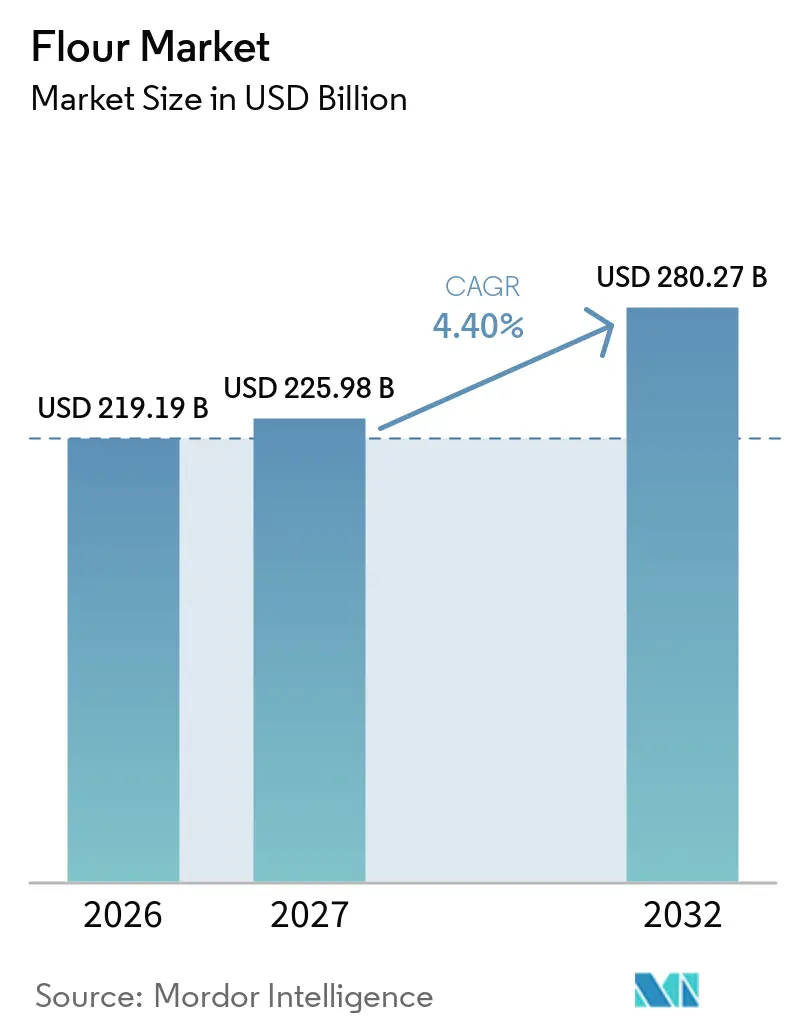
The flour market size is expected to grow from USD 219.19 billion in 2026 to USD 225.98 billion in 2027 and is forecast to reach USD 280.27 billion by 2032 at a 4.40% CAGR over 2027-2032. The flour market is supported by sustained demand from food manufacturing, baking, foodservice, and household consumption. Population growth, urbanization, evolving dietary preferences, and expanding demand for convenient food products continue to support flour consumption across established and emerging markets. Product innovation and changing consumer preferences are encouraging manufacturers to develop flour offerings suited to diverse food applications and evolving nutritional expectations. Improvements in milling technology, production efficiency, and supply-chain capabilities are also helping producers strengthen operational performance and meet customer requirements. Competitive activity remains diverse, with companies focusing on product quality, reliable supply, and customer relationships to reinforce their market positions.
Key Report Takeaways
- By flour type, wheat flour held 77.41% of the Flour market share in 2026, while oat flour is forecast to grow at a 6.37% CAGR during 2027-2032.
- By nature, conventional flour held 86.71% of the Flour market share in 2026, while organic flour is forecast to grow at a 6.53% CAGR during 2027-2032.
- By application, bread and bakery products held 40.27% of the flour market size in 2026, while confectionery and snacks are forecast to grow at a 6.23% CAGR during 2027-2032.
- By distribution channel, B2B sales held 82.39% of 2026 revenue, while B2C sales are forecast to grow at a 5.83% CAGR during 2027-2032.
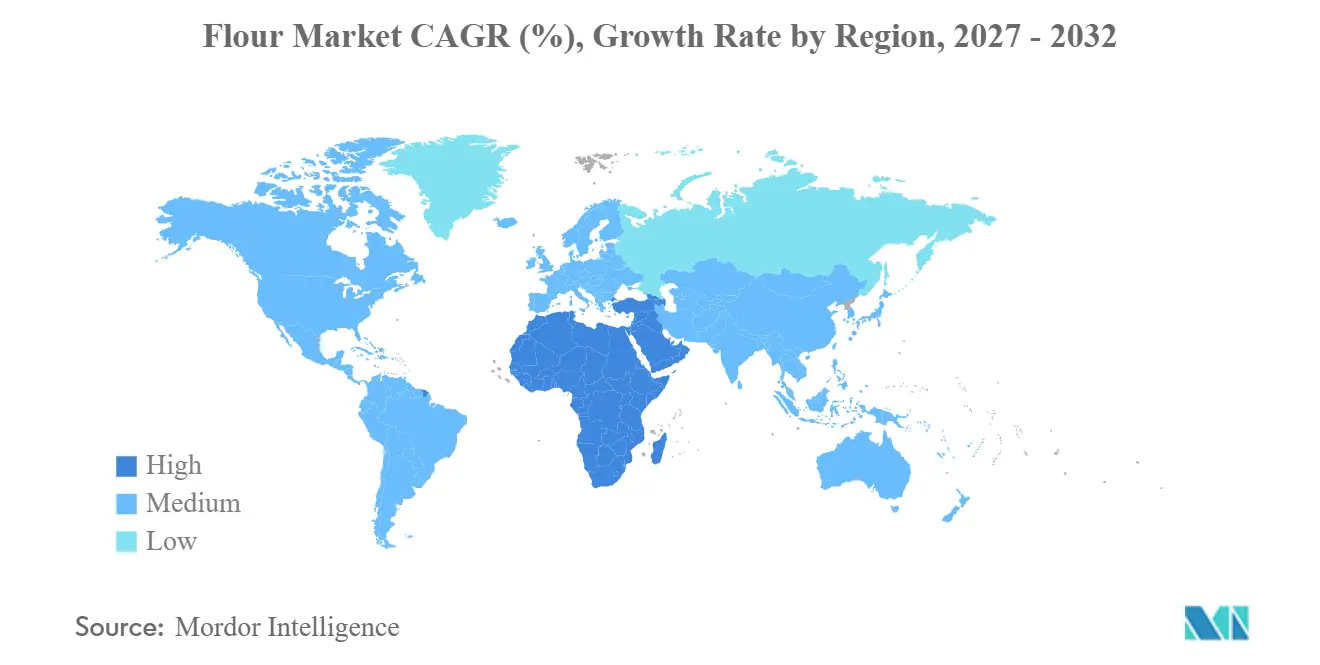
- By geography, Asia-Pacific held 36.29% of 2026 revenue, while the Middle East and Africa is forecast to grow at a 6.48% CAGR during 2027-2032.
Note: Market numbers in this report are based on Mordor Intelligence's proprietary estimation framework, which combines nine months of actuals with Q4 projections for base year 2026.
Market Trends and Insights
Drivers Impact Analysis of Flour Market*
| Driver | (~) % Impact on CAGR Forecast | Geographic Relevance | Impact Timeline |
|---|---|---|---|
| Growing demand from bakery and processed-food manufacturing | +1.0% | Global, led by Asia-Pacific, Middle East and Africa, and South America | Medium term (2-4 years) |
| Expansion of foodservice and quick-service restaurant networks | +0.9% | Middle East and Africa, Asia-Pacific, with spill-over to South America | Short term (≤ 2 years) |
| Sustained demand for wheat flour as a staple food ingredient | +0.8% | Asia-Pacific, Middle East and Africa, South America | Long term (≥ 4 years) |
| Rising demand for specialty and nutritionally differentiated flours | +0.6% | North America, Europe, with growing traction in Asia-Pacific | Medium term (2-4 years) |
| Government-led wheat flour fortification initiatives | +0.5% | Middle East and Africa, South and Southeast Asia | Medium term (2-4 years) |
| Growing demand for convenience and frozen bakery products | +0.5% | North America, Europe, urban Asia-Pacific | Short to medium term (1-3 years) |
| Source: Mordor Intelligence | |||
Growing Demand From Bakery and Processed-Food Manufacturing
Flour demand is supported by its essential role in commercial baking and processed-food manufacturing, where it is used in products such as bread, rolls, cakes, cookies, and other baked goods. According to the Federal Reserve Bank of St. Louis, the output value of the United States bakery and tortilla manufacturing industry increased from USD 86.33 billion in 2024 to USD 86.56 billion in 2025[1]. This growth reflects continued activity across a major flour-consuming industry. Commercial bakeries and food manufacturers rely on consistent flour supplies to maintain production volumes, product quality, and manufacturing efficiency. Flour also provides key functional properties, including structure, texture, and binding, making it an important ingredient across a wide range of baked and processed foods. As manufacturers continue supplying retail and foodservice customers, their ongoing production requirements help sustain demand for flour and support activity across the milling industry.
Expansion of Foodservice and Quick-Service Restaurant Networks
The expansion of foodservice outlets and quick-service restaurant networks supports flour demand through recurring requirements for buns, bread, pizza bases, wraps, pastries, and other flour-based menu items. According to the National Restaurant Association, United States restaurant and foodservice sales are projected to reach USD 1.55 trillion in 2026[2]. The continued scale of restaurant activity sustains ingredient procurement across restaurant chains and other foodservice operators. As chains extend their reach and serve customers through dine-in, takeaway, and delivery formats, they require dependable supplies of flour-based ingredients to maintain consistent menu offerings. Standardized recipes and centralized purchasing across multi-outlet networks can further support recurring procurement from commercial bakeries and food manufacturers. These requirements help sustain demand for flour across the foodservice supply chain.
Sustained Demand for Wheat Flour as a Staple Food Ingredient
Wheat flour remains a staple ingredient in many countries, supporting consistent demand through its role in everyday household diets and traditional food preparation. According to the United States Department of Agriculture’s Foreign Agricultural Service, wheat consumption for food, seed, and industrial use in India is estimated at 101.2 million metric tons for the 2025/26 marketing year[3]. Wheat flour products such as atta and maida are widely consumed across Indian households, particularly in the country's traditional wheat-consuming regions. Population growth and the continued importance of wheat-based foods in daily meals help sustain underlying consumption requirements. This established dietary role supports recurring demand for flour from household consumers and local milling businesses. The continued use of wheat flour in everyday food preparation provides a stable foundation for market demand across major consuming regions.
Rising Demand for Specialty and Nutritionally Differentiated Flours
Demand for specialty and nutritionally differentiated flours is increasing as food manufacturers and consumers seek ingredients that offer specific functional properties and nutritional benefits. Flour varieties with higher protein, fibre, or whole-grain content are gaining relevance in product development, particularly as manufacturers adapt recipes to meet changing dietary preferences. Alternative grain and pulse-based flours also provide opportunities to diversify ingredient formulations and develop products with distinctive textures, flavours, and nutritional profiles. These ingredients are being incorporated into applications such as bakery products, pasta, snacks, and other processed foods. Manufacturers are increasingly evaluating flour characteristics such as water absorption, binding capacity, and baking performance to achieve desired product outcomes. This growing emphasis on ingredient functionality and nutritional differentiation supports product innovation and broadens demand across the flour market.
Restraints Impact Analysis of Flour Market*
| Restraint | (~) % Impact on CAGR Forecast | Geographic Relevance | Impact Timeline |
|---|---|---|---|
| Volatility in wheat prices and grain availability | -0.7% | Global, most acute in Middle East and Africa and import-dependent South Asia | Short to medium term (1-3 years) |
| Food safety, fortification and labeling compliance requirements | -0.4% | Europe, North America, increasingly Asia-Pacific | Medium term (2-4 years) |
| High energy and milling operating costs | -0.6% | Global, most acute in Europe and energy-import dependent markets | Medium to long term (2-5 years) |
| Climate-related disruptions to wheat production and supply | -0.6% | Global, particularly impacting Black Sea, Australia, and South Asia wheat belts | Long term (≥ 4 years) |
| Source: Mordor Intelligence | |||
Volatility in Wheat Prices and Grain Availability
Fluctuations in wheat prices and grain availability pose a challenge for the flour market, as wheat is the primary raw material used in flour production. Changes in weather conditions, including droughts, excessive rainfall, and temperature variations, can affect crop yields and the availability of milling-grade wheat. Geopolitical tensions, trade restrictions, and disruptions to transportation can further influence grain supply chains and procurement costs. These uncertainties make it difficult for flour millers to plan purchases, manage inventories, and maintain consistent production costs. Sudden increases in wheat prices may also require producers to adjust flour prices while maintaining competitive customer offerings. Consequently, fluctuations in raw material costs and supply availability can complicate procurement planning, pricing decisions, and operational efficiency across the flour market.
Food Safety, Fortification and Labeling Compliance Requirements
Compliance with food safety, fortification, and labeling regulations presents an operational challenge for flour manufacturers, as producers must meet applicable standards throughout processing, packaging, and distribution. Requirements concerning product composition, contaminant levels, hygiene, and packaging information necessitate consistent quality-control procedures and appropriate testing systems. The Food Safety and Standards Authority of India (FSSAI) establishes requirements covering food product standards, contaminants, packaging and labeling, and food fortification, including provisions applicable to wheat flour. Manufacturers producing fortified flour must also ensure that micronutrient levels meet prescribed standards and that relevant labeling requirements are fulfilled. Maintaining compliance requires staff training, documentation, monitoring, and investment in quality-assurance processes.
*Our forecasts treat driver/restraint impacts as directional, not additive. The impact forecasts reflect baseline growth, mix effects, and variable interactions.
Flour Market Segment Analysis
By Flour Type:
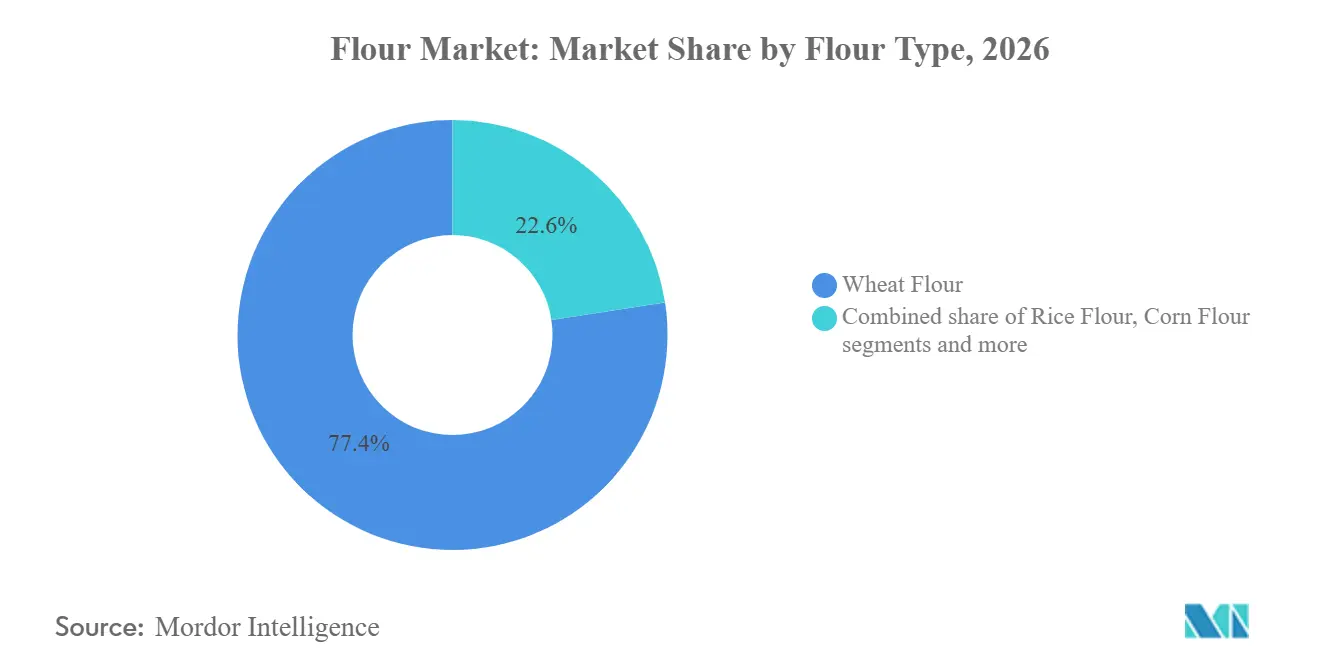
Wheat Dominance Intact, Oat Gains on Nutritional CredentialsWheat flour accounted for 77.41% of the flour market revenue in 2026, supported by its widespread use in food preparation and established milling and distribution networks. Its versatility makes it suitable for a broad range of food products and manufacturing applications. Other flour types also serve diverse culinary and processing requirements, contributing to the overall variety of products available in the market. Established production capabilities and familiarity with wheat-based foods continue to support wheat flour's leading position across global markets.
Oat flour is projected to be the fastest-growing flour type, with a 6.37% CAGR from 2027 to 2032. Growth is supported by increasing interest in nutritional variety and the use of alternative flour ingredients in food product development. Oat flour can be incorporated into bakery products, snacks, and other food formulations, allowing manufacturers to diversify their ingredient offerings. Its functional properties and compatibility with different recipes also support its use in product innovation. Continued interest in ingredient diversification and evolving food preferences is expected to support demand for oat flour over the forecast period.



By Nature:
Premium Uplift from Organic Outpaces the Conventional BaseConventional flour accounted for 86.71% of the flour market revenue in 2026, supported by its widespread use across food production and established manufacturing and distribution networks. Its versatility makes it suitable for a broad range of food applications, while established production capabilities support consistent supply. Familiarity with conventional flour and its suitability for large-scale processing continue to underpin its leading position. These factors help maintain its role as the dominant segment across global markets.
Organic flour is projected to be the fastest-growing nature segment, with a 6.53% CAGR from 2027 to 2032. Growth is supported by increasing interest in ingredient quality, nutritional attributes, and production practices associated with organic food products. Organic flour provides manufacturers with an alternative ingredient for developing products that align with evolving consumer preferences. Its use across bakery products and other food applications also creates opportunities for product diversification. Continued interest in differentiated ingredients and changing purchasing preferences is expected to support demand for organic flour over the forecast period.
By Application:
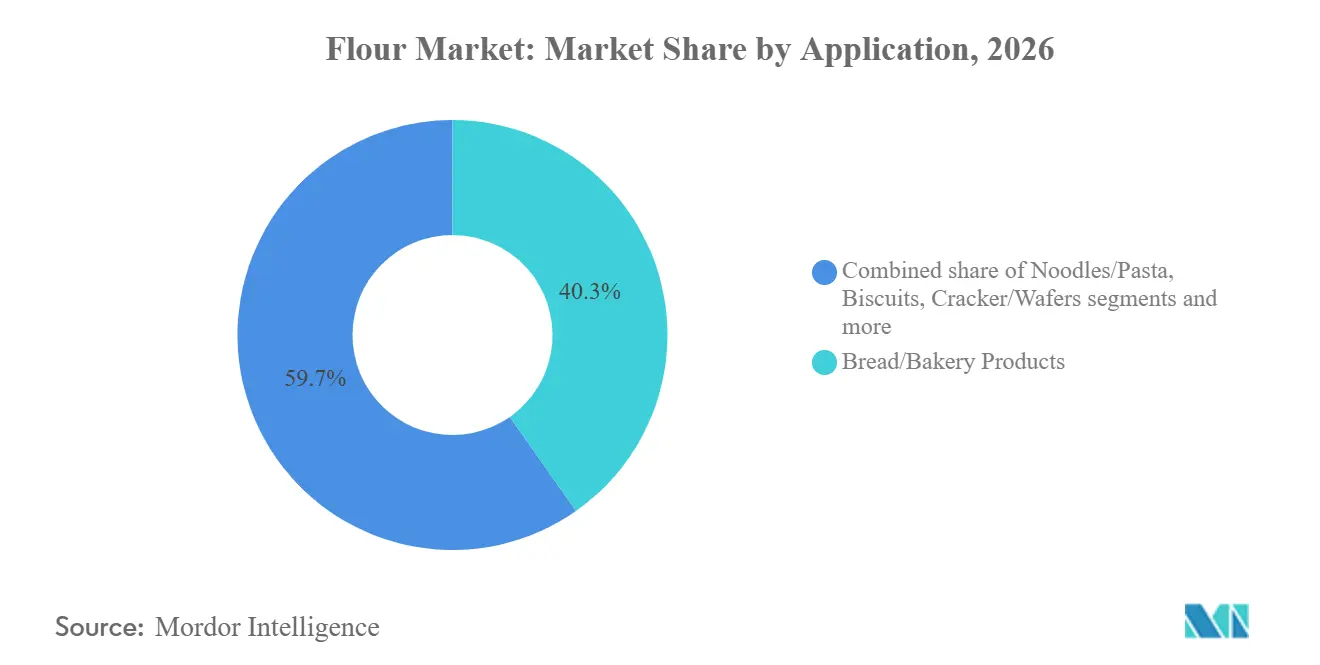
Bread Anchors Value While Confectionery/Snacks Drive Margin GrowthBread/bakery products accounted for 40.27% of the flour market revenue in 2026, supported by their widespread consumption and established role in food preparation across diverse markets. Flour is a key ingredient in products such as bread, cakes, pastries, and other baked goods, contributing to their structure and texture. Consistent demand from commercial bakeries and food manufacturers reinforces the segment's leading position. The versatility of flour across different baking applications further supports its extensive use across the food industry.
Confectionery/snacks is projected to be the fastest-growing application segment, with a 6.23% CAGR from 2027 to 2032. Growth is supported by evolving preferences for convenient snack products and continued product development across packaged food categories. Flour serves as an ingredient in a variety of confectionery and snack applications, providing functional properties that support product texture and consistency. Manufacturers can also use different flour types to develop products with varied formulations and characteristics. Continued innovation in snack and confectionery products, alongside changing consumption preferences, is expected to support demand for flour in this application over the forecast period.

By Distribution Channel:
B2B Scale Prevails but B2C Growth Signals Market MaturationBusiness-to-business (B2B) sales accounted for 82.39% of the flour market revenue in 2026, supported by bulk procurement requirements across food manufacturing and foodservice operations. Industrial buyers typically require consistent product specifications and reliable supply to support ongoing production. Flour manufacturers therefore serve a broad range of commercial customers through established procurement relationships and distribution networks. Recurring orders from these customers support production planning and maintain the segment's leading position in the market.
Business-to-consumer (B2C) sales are projected to be the fastest-growing distribution channel, with a 5.83% CAGR from 2027 to 2032. Growth is supported by increasing interest in home baking and greater access to diverse flour products through online and physical retail channels. Consumers can purchase specialized flour varieties for different dietary preferences and food preparation needs, encouraging product diversification within the channel. E-commerce and online grocery platforms also make a wider range of products accessible to consumers. Continued development of retail offerings and changing purchasing habits are expected to support B2C flour sales over the forecast period.
Geography Analysis
APAC Flour Market
Asia-Pacific accounted for 36.29% of the flour market revenue in 2026, supported by its substantial flour production and consumption base. Demand across the region is driven by the continued use of flour in staple foods, bakery products, and processed food manufacturing. Differences in consumption patterns and levels of market development across countries create varied growth opportunities. Established demand in major markets, alongside increasing consumption in developing economies, supports the region's leading position. Expanding food processing activity and changing dietary preferences are expected to sustain demand across Asia-Pacific.
MEA Flour Market
The Middle East and Africa is projected to be the fastest-growing regional market, with a 6.48% CAGR from 2027 to 2032. Growth is supported by rising demand for wheat-based staple foods, expanding urban populations, and increasing flour consumption across several countries. Investments in milling capacity and improvements in flour processing and distribution infrastructure are helping strengthen regional supply capabilities. The expansion of modern retail and foodservice networks is also creating additional demand for commercially produced flour. Continued development of domestic food manufacturing and evolving consumption patterns are expected to support market growth across the region.
The Americas and Europe Flour Market
North America, Europe, and South America contribute to the flour market through established food manufacturing industries, diverse consumption patterns, and ongoing product development. In mature markets, demand is supported by established bakery and food processing applications, while manufacturers increasingly focus on product differentiation, operational efficiency, and changing consumer preferences. South America benefits from the continued importance of wheat flour in everyday food preparation and the presence of industrial milling operations. Across these regions, established supply chains and demand from commercial food producers continue to support flour consumption, while varying levels of market maturity shape future growth opportunities.
Competitive Landscape
Market Concentration
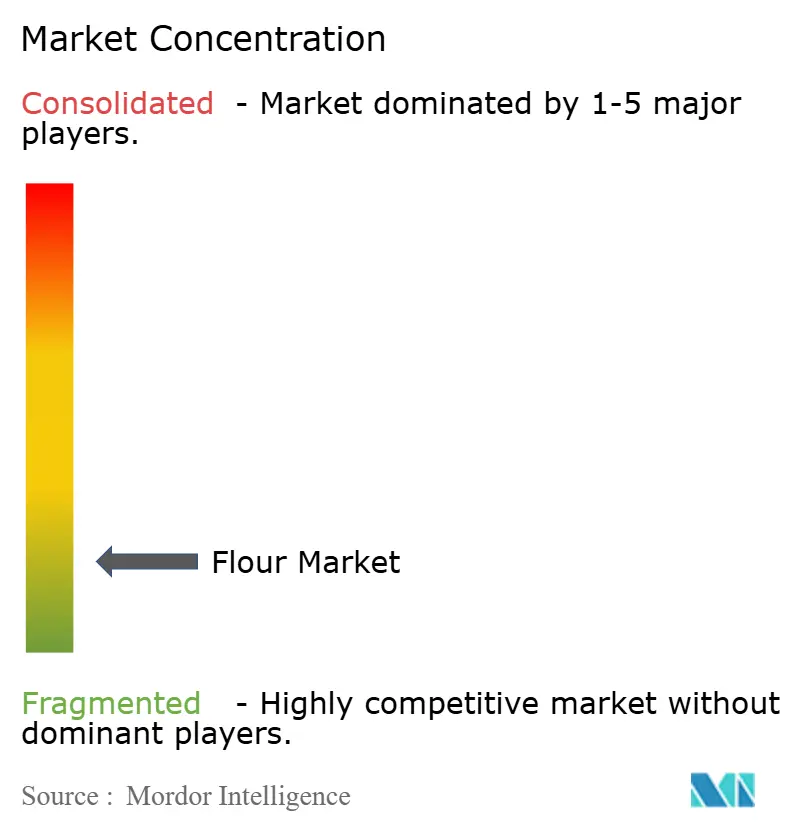
The flour market is fragmented, with competition distributed among multinational agribusiness companies and regional milling specialists. Archer-Daniels-Midland Company, Cargill, Incorporated, Nisshin Seifun Group Inc., GoodMills Group GmbH, and Grain Craft are among the major players in the market. Competition is shaped by milling capacity, product quality, distribution networks, customer relationships, and the ability to meet the specifications of commercial food manufacturers. Regional and local millers also contribute to the fragmented structure by serving customers in specific markets and providing flour suited to local processing requirements.
Leading players are investing in technical capabilities and expanding their operations to strengthen their market positions. In October 2025, Archer-Daniels-Midland Company opened a Central Lab for Milling at its Decatur, Illinois, facility to assess wheat quality and flour performance, supporting 31 facilities across North America. In July 2025, Grain Craft completed its acquisition of Bunge Global SA's North American dry corn and corn masa milling businesses, adding six milling facilities and approximately 600 employees to its operations. These developments demonstrate investment in technical quality assessment and expansion into adjacent grain-processing categories.
Other milling companies are also expanding their operational capacity and customer reach. In October 2025, Mennel Milling Company announced the completed acquisition of the Toledo Flour Mill from Mondelez International, strengthening its flour production capacity and enabling the facility to continue supplying Mondelez while serving additional markets. Regional and smaller millers also compete through specialized flour offerings, customized product specifications, established local distribution networks, and customer-specific services.
Flour Industry Leaders
-
Archer-Daniels-Midland Company
-
Cargill, Incorporated
-
Nisshin Seifun Group Inc.
-
GoodMills Group GmbH
-
Grain Craft
- *Disclaimer: Major Players sorted in no particular order
Flour Market Companies Covered in this Report
- Archer-Daniels-Midland Company
- Cargill, Incorporated
- Conagra Brands, Inc.
- General Mills, Inc.
- Bunge Global SA
- P&H Milling Group
- Grain Craft
- GoodMills Group GmbH
- Ingredion Incorporated
- King Arthur Baking Company, Inc.
- Bob’s Red Mill Natural Foods
- Bay State Milling Company
- Nisshin Seifun Group Inc.
- Wilmar International Limited
- Gruma, S.A.B. de C.V.
- Ebro Foods, S.A.
- Manildra Group
- Associated British Foods plc
- ITC Limited
- Olam Agri
Recent Industry Developments in Flour Market
- September 2026: Archer-Daniels-Midland Company announced a segregated supply-chain option for its Nature’s Gold regeneratively sourced flour programme in the United Kingdom. The initiative physically separates regenerative wheat through the supply chain, strengthening traceability from participating farms to flour production and providing customers with greater visibility into ingredient sourcing.
- October 2025: The Mennel Milling Company acquired the Toledo Flour Mill from Mondelēz International, expanding its flour-production capacity and strengthening its position in the United States. The facility can produce up to 40,000 hundredweight of soft wheat flour daily and continues to supply flour to Mondelēz under the new ownership
- September 2025: Greenfield Milling announced the opening of its flagship flour-milling facility in Richmond, Utah. Designed to produce up to 7,500 hundredweight of flour daily, the mill supplies Campbell’s Pepperidge Farm operations under a 20-year supply agreement. The company also announced plans to lease selected former Panhandle Milling assets to expand its capabilities in organic, conventional, and gluten-free flour and baking mixes.
- June 2025: GoodMills Group GmbH inaugurated its expanded mill in Kutno, Poland, following a EUR 25 million investment. The project doubled annual milling capacity from 140,000 tonnes to 280,000 tonnes and increased flour-silo capacity from 960 tonnes to 4,060 tonnes. The expansion strengthens the company's production and distribution capabilities in the Polish flour market, while supporting its broader capacity-growth plans in the country.
Global Flour Market Report Scope
The flour market encompasses the production and supply of flour derived from wheat, rice, corn, and other raw materials for use in food manufacturing and preparation. The market is segmented by flour type, including wheat flour, rice flour, corn flour, and other flour types; nature, including conventional flour and organic flour; application, including bread and bakery, noodles and pasta, biscuits, crackers and wafers, and other applications; distribution channel, including business-to-business and business-to-consumer; and geography, including North America, Europe, Asia-Pacific, South America, and the Middle East and Africa. The market forecasts are provided in terms of value in USD and volume in tons.
Segmentation Overview
| Wheat Flour |
| Rice Flour |
| Corn Flour |
| Oat Flour |
| Rye Flour |
| Other Flour Types |
| Conventional Flour |
| Organic Flour |
| Bread/Bakery Products |
| Noodles/Pasta |
| Biscuits, Crackers/Wafers |
| Confectionery/Snacks |
| Animal Feed |
| Other Applications |
| Business-to-Business (B2B) Sales | |
| Business-to-Consumer (B2C) Sales | Supermarkets and Hypermarkets |
| Convenience Stores | |
| Specialty Stores | |
| Online Retail |
| North America | United States |
| Canada | |
| Mexico | |
| Rest of North America | |
| Europe | Germany |
| United Kingdom | |
| Italy | |
| France | |
| Spain | |
| Netherlands | |
| Poland | |
| Belgium | |
| Sweden | |
| Rest of Europe | |
| Asia-Pacific | China |
| India | |
| Japan | |
| Australia | |
| Indonesia | |
| South Korea | |
| Thailand | |
| Singapore | |
| Rest of Asia-Pacific | |
| South America | Brazil |
| Argentina | |
| Colombia | |
| Chile | |
| Peru | |
| Rest of South America | |
| Middle East and Africa | South Africa |
| Saudi Arabia | |
| United Arab Emirates | |
| Nigeria | |
| Egypt | |
| Morocco | |
| Turkey | |
| Rest of Middle East and Africa |
| By Flour Type | Wheat Flour | |
| Rice Flour | ||
| Corn Flour | ||
| Oat Flour | ||
| Rye Flour | ||
| Other Flour Types | ||
| By Nature | Conventional Flour | |
| Organic Flour | ||
| By Application | Bread/Bakery Products | |
| Noodles/Pasta | ||
| Biscuits, Crackers/Wafers | ||
| Confectionery/Snacks | ||
| Animal Feed | ||
| Other Applications | ||
| By Distribution Channel | Business-to-Business (B2B) Sales | |
| Business-to-Consumer (B2C) Sales | Supermarkets and Hypermarkets | |
| Convenience Stores | ||
| Specialty Stores | ||
| Online Retail | ||
| By Geography | North America | United States |
| Canada | ||
| Mexico | ||
| Rest of North America | ||
| Europe | Germany | |
| United Kingdom | ||
| Italy | ||
| France | ||
| Spain | ||
| Netherlands | ||
| Poland | ||
| Belgium | ||
| Sweden | ||
| Rest of Europe | ||
| Asia-Pacific | China | |
| India | ||
| Japan | ||
| Australia | ||
| Indonesia | ||
| South Korea | ||
| Thailand | ||
| Singapore | ||
| Rest of Asia-Pacific | ||
| South America | Brazil | |
| Argentina | ||
| Colombia | ||
| Chile | ||
| Peru | ||
| Rest of South America | ||
| Middle East and Africa | South Africa | |
| Saudi Arabia | ||
| United Arab Emirates | ||
| Nigeria | ||
| Egypt | ||
| Morocco | ||
| Turkey | ||
| Rest of Middle East and Africa | ||
Key Questions Answered in the Report
What is the forecast growth rate for the flour market?
It is forecast to grow at a 4.40% CAGR from 2027 to 2032, reaching USD 280.27 billion by 2032.
Which product category is growing fastest?
Organic flour is forecast to grow at 6.53% CAGR from 2027 to 2032.
Which application generates the most flour demand?
Bread/bakery products account for 40.27% of 2026 revenue, making them the largest application.
Which region is growing fastest?
The Middle East and Africa is forecast to grow at 6.48% CAGR from 2027 to 2032.