
Flexible Office Market Size and Share
Market Overview
| Study Period | 2021 - 2032 |
|---|---|
| Market Size (2027) | USD 62.70 Billion |
| Market Size (2032) | USD 97.45 Billion |
| Growth Rate (2027 - 2032) | 9.22 % |
| Fastest Growing Market | South America |
| Largest Market | Asia-Pacific |
| Market Concentration | Low |
Major Players *Disclaimer: Major Players sorted in no particular order Image © Mordor Intelligence. Reuse requires attribution under CC BY 4.0. | |
Flexible Office Market Analysis by Mordor Intelligence
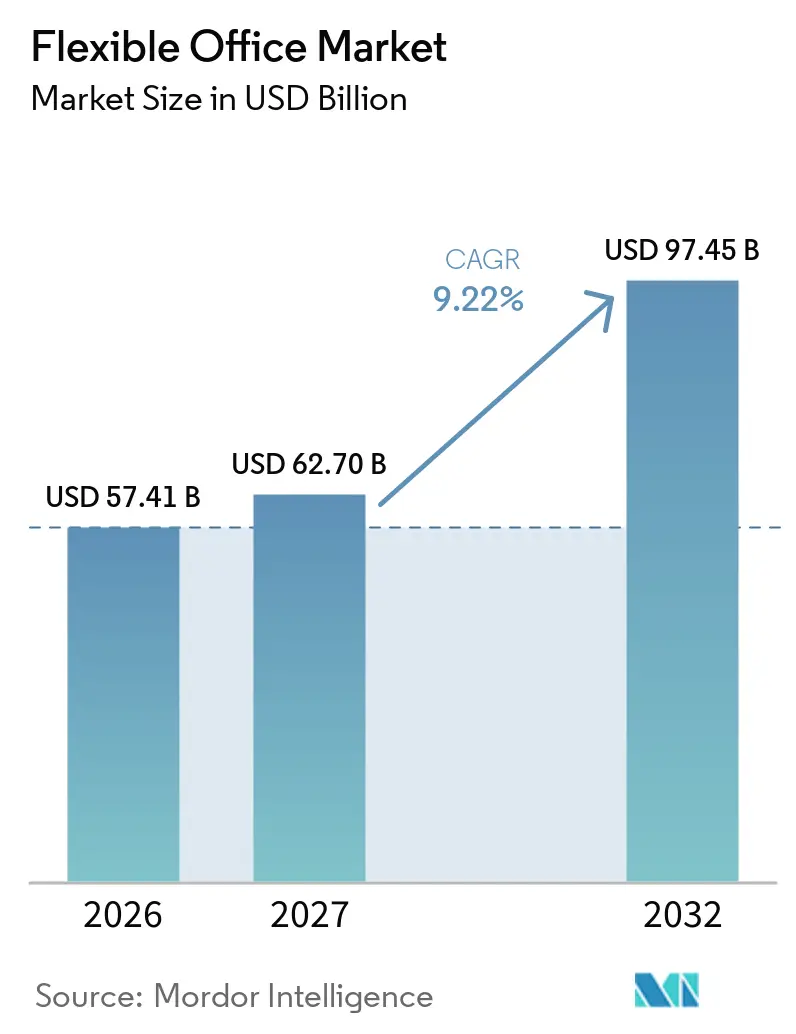
The Flexible Office Market size is projected to be USD 57.41 billion in 2026, USD 62.70 billion in 2027, and reach USD 97.45 billion by 2032, growing at a CAGR of 9.22% from 2027 to 2032.
The flexible office market is being shaped by corporate demand for workspaces that can adapt to changes in team size, location requirements, attendance patterns, and the operational needs of teams that do not use every desk daily. Organizations are reducing long-term lease commitments and using managed and on-demand spaces to support office attendance without investing in extensive fit-outs or maintaining unused capacity. Providers with broad networks, private office capacity, secure managed-office offerings, and consistent service standards are better positioned to serve enterprise clients that require reliable workspace across multiple locations. However, the flexible office market faces an operational challenge because many providers maintain long-term property commitments while client revenue can fluctuate rapidly during periods of slower hiring or lower office attendance. Partnerships and management agreements can mitigate this exposure, strengthen alignment between providers and landlords, and enable operators to expand with lower capital requirements.
Key Report Takeaways
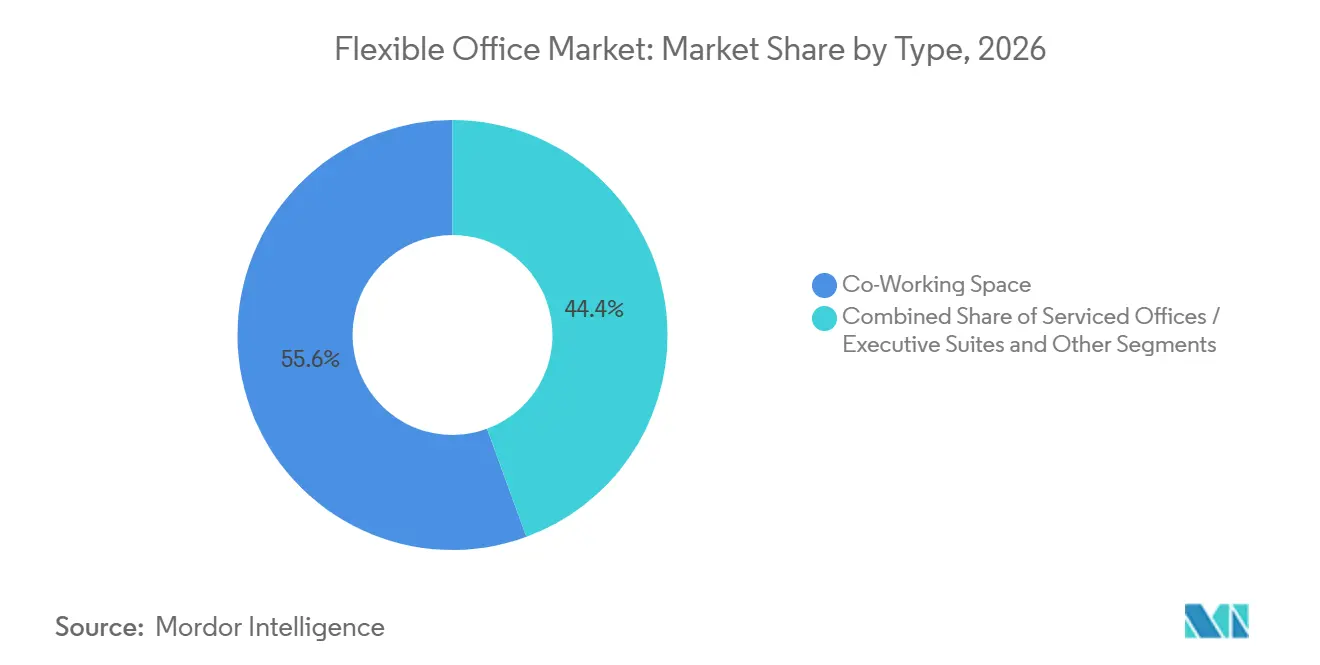
- By type, co-working space held 55.6% of the flexible office market share in 2026, while Serviced Offices and Executive Suites recorded the highest projected CAGR at 10.11% through 2032.
- By sector, IT and ITES accounted for 35.3% of the flexible office market share in 2026, while BFSI is projected to grow at a 10.25% CAGR through 2032.
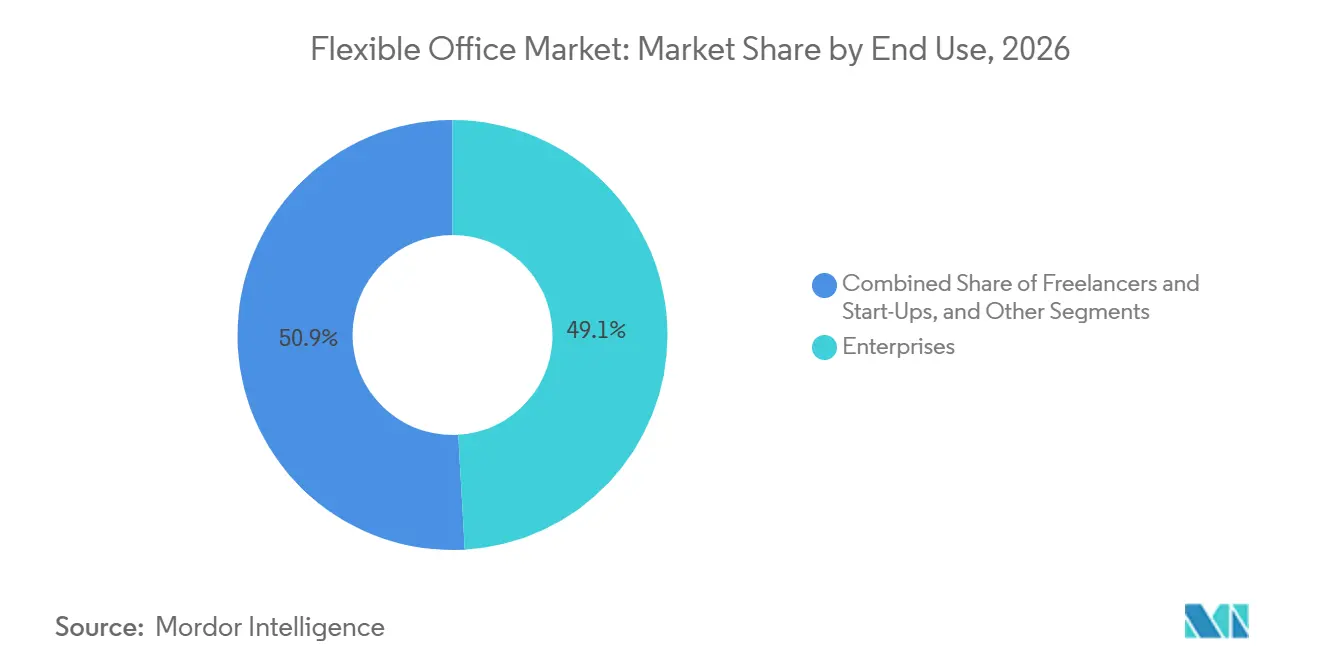
- By end use, enterprises held a 49.1% share of global flexible-office demand in 2026, while freelancers are forecast to expand at a 9.89% CAGR through 2032.
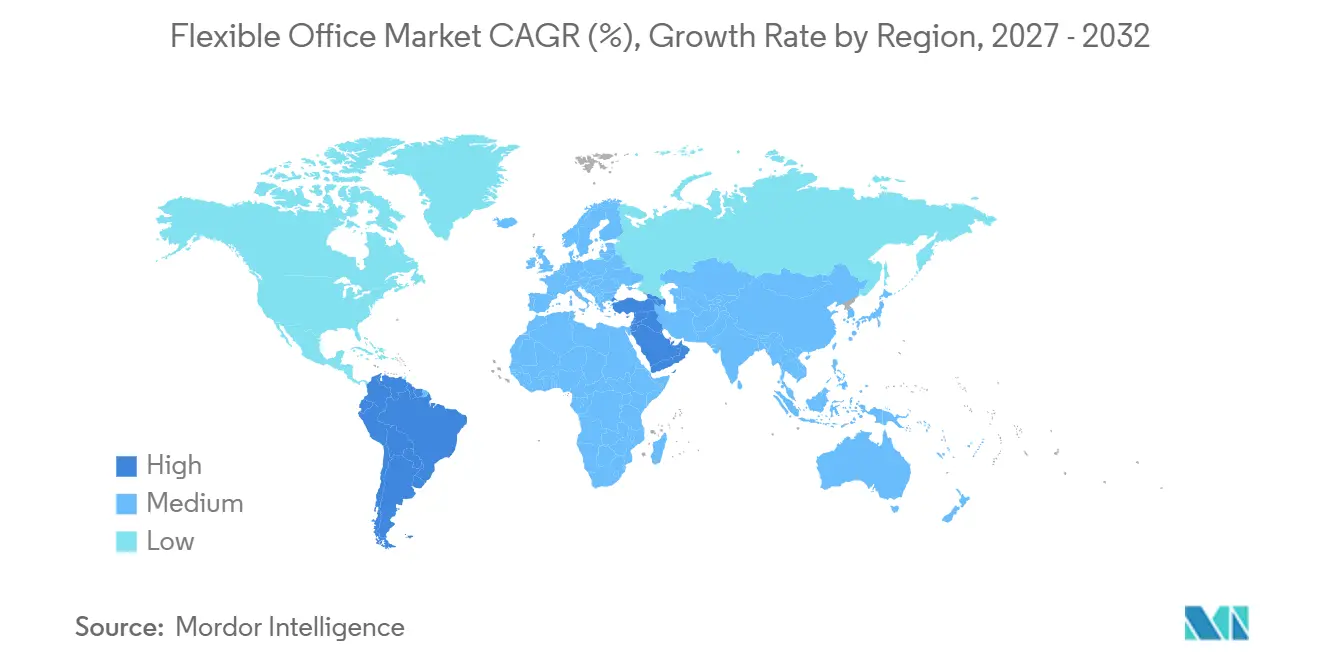
- By geography, Asia-Pacific accounted for a 34.8% share of global flexible-office demand in 2026, while South America is forecast to grow at a 10.51% CAGR through 2032.
Note: Market numbers in this report are based on Mordor Intelligence's proprietary estimation framework, which combines nine months of actuals with Q4 projections for base year 2026.
Market Trends and Insights
Drivers Impact Analysis of Flexible Office Market*
| Drivers | (~) % Impact on CAGR Forecast | Geographic Relevance | Impact Timeline |
|---|---|---|---|
| Hybrid Working Models Increasing Demand for Adaptable Office Capacity | +2.5% | Global, with highest intensity in North America, Europe, and Asia-Pacific | Short term (≤ 2 years) |
| Corporate Real Estate Cost Optimization Encouraging Flexible Leasing | +2.0% | Global, concentrated in North America, Asia-Pacific, and Western Europe | Medium term (2-4 years) |
| Startup and SME Expansion Supporting Ready-to-Use Office Demand | +1.4% | Asia-Pacific core, with spillover to South America and the Middle East | Medium term (2-4 years) |
| Multinational Market Entry Driving Serviced Office Demand | +1.1% | Asia-Pacific, the Middle East, and South America | Medium term (2-4 years) |
| Decentralization of Corporate Workplaces Expanding Flexible Office Demand | +0.8% | North America, Europe, and Australia | Medium term (2-4 years) |
| Enterprise Adoption of Customized Managed Offices | +0.7% | Global, with early depth in India, the United Kingdom, and the United States | Long term (≥ 4 years) |
| Source: Mordor Intelligence | |||
Hybrid Working Models Increasing Demand for Adaptable Office Capacity
Hybrid work has become a sustained component of corporate workplace planning, supporting recurring demand for flexible office capacity and reshaping how employers assess the costs of their office portfolios. The flexible office market supports this model by enabling employers to add desks in locations where teams convene without expanding their permanent footprint or committing to dedicated office build-outs in every location. Corporate portfolios are also shifting toward access to workspace across multiple locations rather than relying solely on a central office, particularly as employees live farther from headquarters. According to IWG, flexible workspace is expected to account for 30% of corporate portfolios by 2030, favoring operators that can support multi-site agreements through a consistent service model. This approach can reduce underutilized desk capacity while providing companies with practical spaces for local collaboration, client meetings, and short-term project work. Decentralized workplace strategies also extend demand for professional workspace beyond central business districts, creating opportunities in suburban and secondary business locations.
Corporate Real Estate Cost Optimization Encouraging Flexible Leasing
Corporate real estate cost optimization is prompting companies to adopt flexible leasing alongside conventional office space. Ready-to-use workplaces can bundle desks, furniture, connectivity, meeting rooms, and workplace services under a single agreement. This model reduces the upfront expenditure and administrative effort required to establish a new office. It is particularly beneficial for companies testing a new city, expanding project teams, or managing uncertain hiring plans. The flexible office market benefits as buyers increasingly evaluate the total cost of occupancy rather than assessing workspace solely by stated rent. Operators that deliver reliable infrastructure and workplace support can preserve the value of their managed office offerings in competitive urban locations.
Startup and SME Expansion Supporting Ready-to-Use Office Demand
Startups and small and medium-sized enterprises (SMEs) represent a broad customer base for ready-to-use workspaces. These businesses often require short-term commitments, shared facilities, and the flexibility to expand without relocating. IWG estimates that the global addressable population includes 1.2 billion white-collar workers, indicating a substantial potential customer base for workspace providers. The flexible office market can expand in secondary cities, where local business formation and professional employment are increasing. A distributed network can also enable providers to serve suburban business districts that may not support large conventional office developments. This demand stream is diverse but can be more sensitive to business funding availability and local economic conditions.
Multinational Market Entry Driving Serviced Office Demand
Multinational companies often require workspace quickly when entering a new country or establishing regional teams. Serviced offices provide private work areas, managed technology, access controls, and a business address without requiring a lengthy construction process. This format benefits financial services, technology, manufacturing, and business services teams seeking to establish operations rapidly. India provides a clear example: according to IBEF, flexible workspace operators are expected to lease 8.5 million square feet across the country’s top eight cities in the first half of 2026[1]. The flexible office market can capture a larger share of multinational demand by offering dedicated IT rooms and environments that align with clients’ branding and security policies. Enterprise-focused offerings may also encourage companies to continue using flexible space beyond their initial market-entry period.
Restraints Impact Analysis of Flexible Office Market*
| Restraints | (~) % Impact on CAGR Forecast | Geographic Relevance | Impact Timeline |
|---|---|---|---|
| High Fixed Property Lease Commitments and Facility Costs | -1.8% | Global, most acute in London, New York, Singapore, and Tokyo | Medium term (2-4 years) |
| Intense Competition Limiting Pricing Power | -1.3% | North America, Europe, and mature Asia-Pacific hubs | Medium term (2-4 years) |
| Short Client Contracts and Unpredictable Occupancy | -0.9% | Global, particularly markets with a high freelancer and startup mix | Short-term (≤ 2 years) |
| Data Security and Confidentiality Concerns | -0.7% | Global, concentrated in BFSI and life sciences hubs in the United Kingdom, the United States, India, and the United Arab Emirates | Medium term (2-4 years) |
| Source: Mordor Intelligence | |||
High Fixed Property Lease Commitments and Facility Costs
The primary financial constraint in the flexible office market is the mismatch between long-term property commitments and shorter client contracts. Operators may hold 10- to 15-year master leases, while clients typically commit for only 3 to 5 years. This gap creates a period during which operators must cover fixed rent, staffing, and facility costs through variable occupancy revenue. According to LoopNet, rent can account for 30% to 40% of coworking revenue, and operators commonly require 24 months to reach profitability[2]. Management agreements can reduce this exposure by allowing landlords to share the underlying property risk. IWG reports that partnership-built locations account for 33% of its network, and its signed contracts support a path toward 50%.
Intense Competition Limiting Pricing Power
Competition is most intense in established urban markets, where coworking brands, landlords, hospitality groups, and workplace platforms offer similar services. Providers without strong local brand recognition, differentiated offerings, or extensive networks may struggle to sustain desk pricing. Short client contract terms further increase this challenge, as occupancy levels and revenue can change rapidly. Security and confidentiality concerns may also constrain adoption in regulated industries unless providers demonstrate robust physical and digital security controls. These requirements are particularly relevant for clients in banking, financial services, insurance, and life sciences. Therefore, the flexible office market favors operators that offer private suites, reliable systems, and clear governance while maintaining competitive pricing.
*Our forecasts treat driver/restraint impacts as directional, not additive. The impact forecasts reflect baseline growth, mix effects, and variable interactions.
Flexible Office Market Segment Analysis
By Type:
Private Office Demand Is Reshaping Co-Working SpaceCo-working space held 55.6% of total flexible-workspace demand in 2026, making it the largest format in the flexible office market. Its scale comes from accessible memberships, shared amenities, and a network model that appeals to freelancers, small teams, early-stage companies, and organizations that need occasional team space. The format continues to give members a professional workplace without the commitment of a conventional lease and allows them to use meeting rooms and common areas only when needed. It also creates opportunities for operators to sell meeting rooms, event space, virtual-office services, and workplace support to a broad member base.
Serviced Offices and Executive Suites are forecast to expand at a 10.11% CAGR through 2032. This growth reflects demand for private, turnkey workplaces that can support confidential work, leadership teams, and larger client groups without a long setup period. The move toward private space reflects enterprise requirements for controlled access, secure technology, and environments that can carry a client’s own identity. Hybrid and virtual office services also serve companies that need a business address or periodic access rather than a full-time desk. These options broaden the flexible office market beyond daily physical attendance and make workspace available to firms with distributed workforces.



By Sector:
IT and ITES Leads While BFSI Expands Its Use of Managed SpaceInformation Technology and Information Technology-Enabled Services, or IT and ITES, accounted for a 35.3% share of total flexible-workspace demand in 2026. Technology companies often value fast access to connected and scalable offices, particularly when project teams change size. The sector also has experience with distributed work models and uses flexible space to place teams near talent pools. FICCI reported that information technology, technology, and software development firms represented 27% to 32% of flexible-space deal volume in India in 2025.
BFSI is the fastest-growing sector, with a projected CAGR of 10.25% through 2032. Banks, insurers, and other regulated firms increasingly require private suites, controlled access, and reliable technology when using flexible workplaces. That demand shifts the product mix toward managed offices rather than open-plan desks. Providers that meet client requirements for confidentiality and operational control can compete for this business. The flexible office industry is therefore serving a wider range of regulated and professional users than it did when startups were the main customer group.
By End Use:
Enterprise Demand Provides Scale While Freelancers Broaden UsageEnterprises held a 49.1% share of total flexible-workspace demand in 2026. Large companies use flexible locations to support project teams, distributed employees, temporary expansions, and market entry. They commonly need consistent service standards across several cities, along with digital booking and dedicated suites. IWG’s network of 4,609 open locations across more than 120 countries provides an example of the scale that can support those requirements.
Freelancers are forecast to record the fastest end-use growth at a 9.89% CAGR through 2032. This customer group values flexible access, short commitments, and workplace technology that supports independent work. Fiverr found that 50% of surveyed freelancers prioritize flexible work locations and 76% use artificial intelligence tools[3]. The group remains important to co-working demand, although its usage can vary with economic conditions and project activity. Startups and other small users also add demand, but enterprise contracts can provide a more stable base for operators.

Geography Analysis
Asia-Pacific
Asia-Pacific accounted for a 34.8% share of global flexible-office demand in 2026, making it the largest regional contributor to the flexible office market. India had more than 88.7 million square feet of flexible office stock in the first half of 2026 and was projected to exceed 100 million square feet by year-end. India’s share of global flexible workspace bookings increased from 2.2% in the first half of 2025 to 10.2% in the first half of 2026, indicating a stronger role in cross-border workspace demand. Asia-Pacific demand grew 19% during the first half of 2026, while supply increased 1%. That difference supports occupancy and reinforces the region’s importance to providers with enterprise and managed-office products.
South America
South America is forecast to grow at a 10.51% CAGR through 2032, the highest regional rate in the flexible office market. Brazil remains important because demand includes finance and commercial firms as well as technology users, which gives operators exposure to more than 1 customer group. That mix can support demand for both shared workspaces and private managed suites when companies expand teams or seek project-based locations. The regional office recovery provides a broader setting for flexible workspace growth in Brazil, Argentina, and Chile. WeWork consolidated ownership of its Latin American operations in 2025, which gave the company direct control of its regional business.
Europe, the Middle East, and North America
Europe, the Middle East, and North America have different conditions but share demand for flexible and professionally managed workplace options. IWG operates across more than 120 countries, showing the importance of network coverage for customers that work across regions and expect a consistent access experience. North America provides high-volume demand through large enterprise clients, freelancers, and suburban office users that value local access. The flexible office market in these regions rewards providers that can combine local service with a consistent client experience across cities and workplace formats. This demand also supports management agreements as a way to enter locations without taking on the full cost of a traditional lease.
Competitive Landscape
Market Concentration
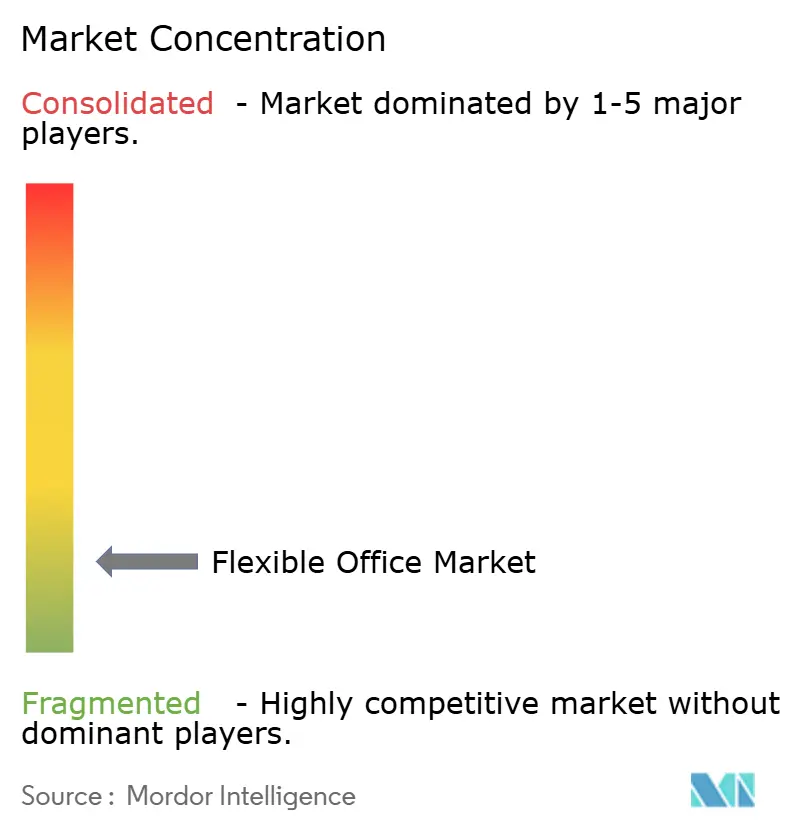
The flexible office market is fragmented, although large operators are expanding their reach through partnerships, acquisitions, and third-party access arrangements. IWG is a leading global operator and is projected to report USD 4.5 billion in system revenue in 2025, with 4,609 open locations and a pipeline of 1,370 signed but unopened centers. WeWork also maintains a global presence through owned locations and partner access arrangements. However, regional specialists remain important because local property markets, customer requirements, and landlord relationships vary across cities. Competition depends on network reach, the quality of private and shared workspaces, pricing, technology, and the ability to meet enterprise security requirements.
Management agreements and partnership models are reshaping how competitors expand while addressing the costs associated with conventional leasing. Under these structures, operators manage workspaces while landlords retain greater property exposure and may share in a location’s financial performance. IWG reports that partnerships account for 33% of its network, and its signed contracts support a target of 50%. In February 2026, WeWork is expected to expand its Coworking Partner Network to 2,000 bookable locations across 21 countries. This approach can extend client access without requiring providers to own or lease every location directly.
Strategic initiatives also highlight a focus on service breadth, local expansion, and broader access for enterprise customers. In September 2025, WeWork is expected to add more than 1,000 third-party partner locations across over 500 cities in the United States and Canada. In June 2025, the company is also expected to partner with ClassPass, allowing eligible members to book selected WeWork locations using ClassPass credits. IWG’s planned 2025 activity includes 782 openings and 1,132 signed locations. The flexible office market remains accessible to local operators; however, larger brands hold an advantage when enterprise customers require multi-city coverage and standardized workplace services.
Flexible Office Industry Leaders
-
IWG plc
-
WeWork Companies LLC
-
The Office Group
-
Mindspace Business Parks REIT Limited
-
Wojo
- *Disclaimer: Major Players sorted in no particular order
Flexible Office Market Companies Covered in this Report
- IWG plc
- WeWork Companies LLC
- The Office Group
- Mindspace Business Parks REIT Limited
- Wojo
- Awfis Space Solutions
- Talent Garden S.p.A.
- Huckletree
- JustCo
- Industrious
- Impact Hub GmbH
- Techspace
- Labs
- Deskopolitan
- Utopicus
- Station F
- Ordnungs ApS
- Matrikel 1
- Fora
- Orega
Recent Industry Developments in Flexible Office Market
- June 2026: Fora signed a deal to operate a 46,332 square foot flexible office at 76 Southbank in central London, expanding its portfolio to 62 buildings across the city. The building is owned by Dubai-based Easa Saleh Al Gurg Group and is co-tenanted with The LEGO Group and PayPal.
- February 2026: IWG announced a planned acquisition of Design Offices, Germany's largest premium flexible workspace operator with approximately 50 locations across 15 cities and EUR 142 million in 2024 revenues. The transaction was submitted for regulatory review to Germany's Bundeskartellamt (Federal Cartel Office), consistent with IWG's strategy of acquiring established national operators with prime location portfolios.
- February 2026: WeWork expanded its Coworking Partner Network to approximately 2,000 globally bookable locations across 21 countries, adding more than 900 third-party coworking operators internationally. Key markets added include the United Kingdom, France, Portugal, Spain, Mexico, Australia, and Thailand, enabling enterprise members to access distributed workspaces without WeWork owning physical space.
Global Flexible Office Market Report Scope
Segmentation Overview
| Co-Working Space |
| Serviced Offices / Executive Suites |
| Others (Hybrid, Virtual Office) |
| Information Technology (IT and ITES) |
| BFSI (Banking, Financial Services and Insurance) |
| Business Consulting and Professional Services |
| Other Services (Retail, Life-Sciences, Energy, Legal) |
| Freelancers |
| Enterprises |
| Start-Ups and Others |
| North America | United States |
| Canada | |
| Mexico | |
| South America | Brazil |
| Argentina | |
| Chile | |
| Rest of South America | |
| Europe | United Kingdom |
| Germany | |
| France | |
| Italy | |
| Spain | |
| Netherlands | |
| Russia | |
| Rest of Europe | |
| Middle East | Saudi Arabia |
| United Arab Emirates | |
| Turkey | |
| Rest of Middle East | |
| Africa | South Africa |
| Nigeria | |
| Rest of Africa | |
| Asia-Pacific | China |
| India | |
| Japan | |
| South Korea | |
| Australia | |
| Indonesia | |
| Rest of Asia-Pacific |
| By Type | Co-Working Space | |
| Serviced Offices / Executive Suites | ||
| Others (Hybrid, Virtual Office) | ||
| By Sector | Information Technology (IT and ITES) | |
| BFSI (Banking, Financial Services and Insurance) | ||
| Business Consulting and Professional Services | ||
| Other Services (Retail, Life-Sciences, Energy, Legal) | ||
| By End Use | Freelancers | |
| Enterprises | ||
| Start-Ups and Others | ||
| By Geography | North America | United States |
| Canada | ||
| Mexico | ||
| South America | Brazil | |
| Argentina | ||
| Chile | ||
| Rest of South America | ||
| Europe | United Kingdom | |
| Germany | ||
| France | ||
| Italy | ||
| Spain | ||
| Netherlands | ||
| Russia | ||
| Rest of Europe | ||
| Middle East | Saudi Arabia | |
| United Arab Emirates | ||
| Turkey | ||
| Rest of Middle East | ||
| Africa | South Africa | |
| Nigeria | ||
| Rest of Africa | ||
| Asia-Pacific | China | |
| India | ||
| Japan | ||
| South Korea | ||
| Australia | ||
| Indonesia | ||
| Rest of Asia-Pacific | ||
Key Questions Answered in the Report
What is the projected growth rate for flexible offices through 2032?
The flexible office market is forecast to grow at a 9.22% CAGR from 2027 to 2032, reaching USD 97.5 billion by 2032.
Which flexible office format has the largest share?
Co-working space is the largest type, with a 55.6% share in 2026.
Which flexible office format is growing fastest?
Serviced Offices and Executive Suites are forecast to grow at a 10.11% CAGR through 2032 as demand for private, turnkey space increases.
Which customer group accounts for the largest share of flexible workspace demand?
Enterprises held a 49.1% share in 2026 and use flexible space for project teams, market entry, and multi-location workplace access.
Which region leads global flexible office demand?
Asia-Pacific led with a 34.8% share in 2026, supported by growth in India and other regional business centers.
Why do companies use flexible office space?
Companies use flexible offices to reduce upfront fit-out costs, adjust capacity, enter new locations quickly, and provide space for hybrid teams.