
Flexible Foam Packaging Market Size and Share
Market Overview
| Study Period | 2021 - 2031 |
|---|---|
| Market Size (2026) | USD 3.34 Billion |
| Market Size (2031) | USD 4.60 Billion |
| Growth Rate (2026 - 2031) | 6.56 % |
| Fastest Growing Market | Asia-Pacific |
| Largest Market | Asia-Pacific |
| Market Concentration | Medium |
Major Players *Disclaimer: Major Players sorted in no particular order Image © Mordor Intelligence. Reuse requires attribution under CC BY 4.0. | |
Flexible Foam Packaging Market Analysis by Mordor Intelligence
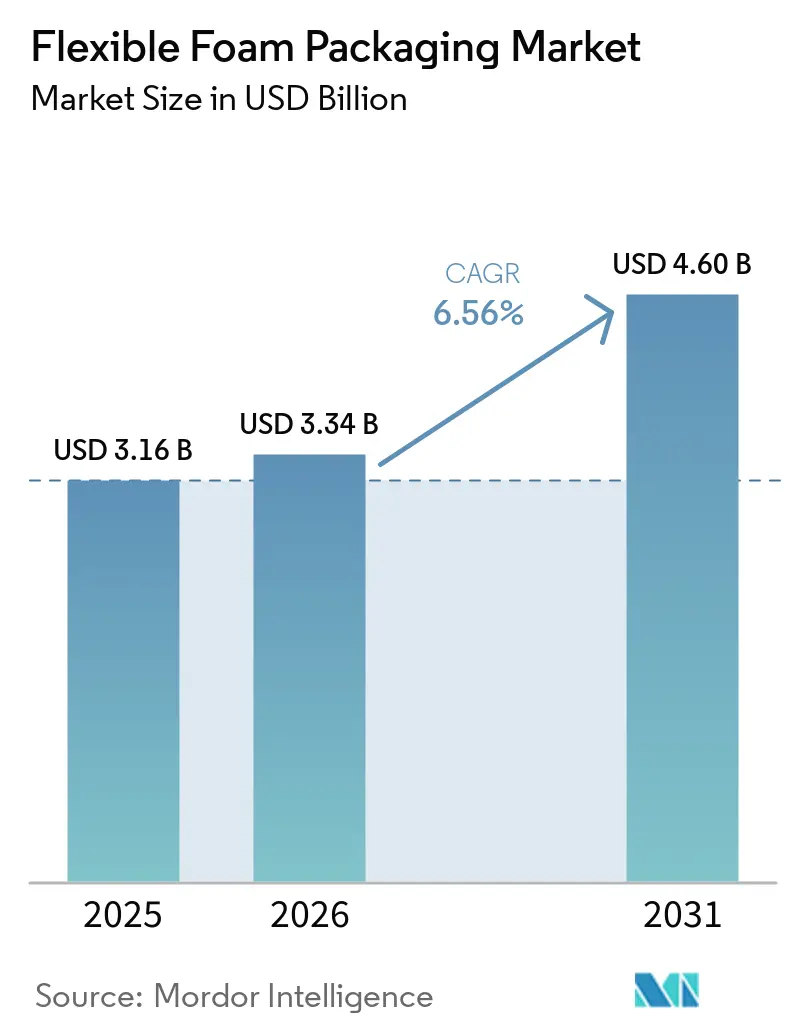
The flexible foam packaging market size was valued at USD 3.16 billion in 2025 and is estimated to grow from USD 3.34 billion in 2026 to reach USD 4.60 billion by 2031, at a CAGR of 6.56% during the forecast period (2026-2031). The flexible foam packaging market is shifting from generic void fill toward engineered inserts for products that require more consistent protection in parcel delivery. Pharmaceutical cold-chain shipping requires validated insulated packaging, which supports demand for qualified formats. Digital Computer Numerical Control (CNC) fabrication allows converters to cut foam directly from Computer-Aided Design (CAD) files, reducing the need for physical die tooling. Competitive strategies are shifting from base material costs to recycling credentials and precision fabrication. Regulation and raw material availability remain constraints for the flexible foam packaging market, particularly for products that depend on polyurethane inputs or must meet EU recyclability requirements.
Key Report Takeaways
- By type, polyurethane held 41.67% of the flexible foam packaging market share in 2025, while polyethylene is projected to grow at a 6.98% CAGR through 2031.
- By application, transportation held 27.42% of the flexible foam packaging market share in 2025, while electrical and electronics is projected to grow at a 7.75% CAGR through 2031.
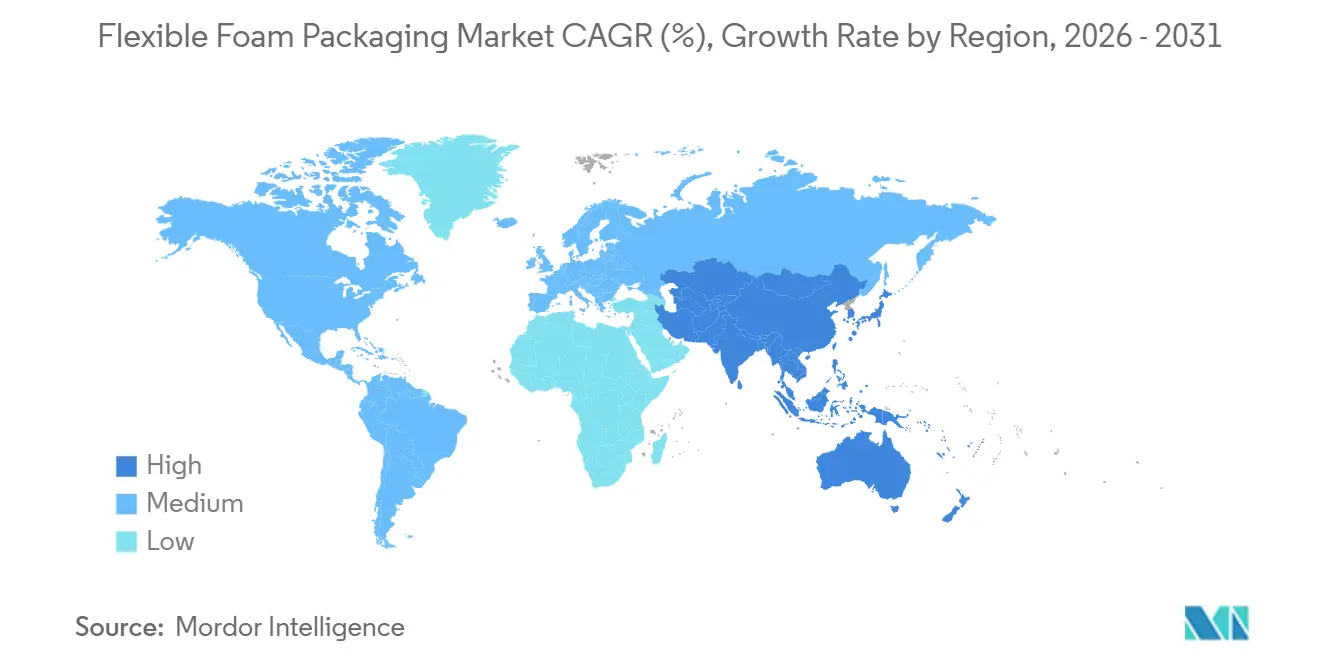
- By geography, Asia-Pacific held 38.11% of the flexible foam packaging market share in 2025 and is projected to grow at a 7.42% CAGR through 2031.
Note: Market size and forecast figures in this report are generated using Mordor Intelligence’s proprietary estimation framework, updated with the latest available data and insights as of January 2026.
Global Flexible Foam Packaging Market Trends and Insights
Drivers Impact Analysis*
| Drivers | (~) % Impact on CAGR Forecast | Geographic Relevance | Impact Timeline |
|---|---|---|---|
| E-Commerce Protective Packaging Demand | +2.0% | Global, with Asia-Pacific and North America leading | Short term (≤ 2 years) |
| Electronics and Automotive Damage Reduction Requirements | +1.5% | Asia-Pacific core, with spillover to the Middle East, Africa, and Latin America | Medium term (2-4 years) |
| Cold-Chain and Pharmaceutical Shipment Qualification | +1.0% | Global, with significant pull from low- and middle-income economies | Medium term (2-4 years) |
| Automated Right-Sized Packaging and Dimensional-Weight Optimization | +0.8% | North America and the European Union, expanding to the Asia-Pacific | Short term (≤ 2 years) |
| Digital Design and Computer Numerical Control (CNC) Conversion for High-Mix Low-Volume Orders | +0.5% | Global | Long term (≥ 4 years) |
| Source: Mordor Intelligence | |||
E-Commerce Protective Packaging Demand
E-commerce accounted for 16.9% of total U.S. retail sales in the first quarter of 2026, supporting demand for parcel-level protective packaging across a large, established retail channel. The flexible foam packaging market benefits because individual parcels require more protection than palletized shipments, which distribute handling forces across a larger load. Fulfillment operators increasingly use product-specific foam inserts where damage rates affect the cost of returns, replacements, customer service, and product reputation. This approach is particularly relevant for electronics and personal care products that standard paper-based alternatives may not adequately protect during repeated handling. Polyurethane inserts and polyolefin foam rolls are used in cross-border shipments from China, South Korea, and India to North America and Europe. The flexible foam packaging market, therefore, gains value from higher performance requirements, even when fulfillment operators tightly manage the quantity of material used in each package.
Electronics and Automotive Damage Reduction Requirements
Electronics and automotive producers are tightening packaging specifications as components become more fragile, carry higher unit values, and move through longer supply chains. Flexible polyurethane foam can be formulated across density and cell-structure variables to deliver cushioning for demanding applications with varying component shapes. This capability supports use in automotive components, electronic inserts, electric vehicle (EV) battery-related protection, and other applications where surface damage results in avoidable costs. Huntsman has positioned its SHOKLESS polyurethane systems for thermal, electrical, and structural protection of high-voltage battery cells[1]. The flexible foam packaging market can benefit as EV supply chains require specialized protection for sensitive components during production, transport, and assembly. These applications also favor converters that can meet detailed specifications rather than suppliers offering standard foam sheet or roll products.
Cold-Chain and Pharmaceutical Shipment Qualification
Cold-chain shipment requirements support the flexible foam packaging market, as temperature-sensitive products require documented thermal performance along defined distribution routes. World Health Organization (WHO) guidance covers the international packaging and shipping of vaccines and supports the use of validated transport systems for sensitive medical products. Qualification requirements can include route mapping, temperature-excursion records, and testing before a packaging format is approved for use by a pharmaceutical customer. Once a foam-insulated shipper is validated for a route, changing suppliers can require additional documentation, testing, and internal approval. Foam formats continue to serve applications where insulation, predictable performance, and cost remain central selection criteria for logistics teams. This environment favors converters that can supply technically documented solutions for pharmaceutical and vaccine distribution across demanding transport lanes.
Automated Right-Sized Packaging and Dimensional-Weight Optimization
Automated right-sizing changes the mix of products purchased by fulfillment operators seeking to reduce package size and dimensional-weight charges. Smaller package sizes can reduce the need for bulk void fill while increasing the need for accurately cut protective components that fit each product. The flexible foam packaging market is affected by this tradeoff, as a smaller shipment may use less foam but require a more specific insert. Computer-Aided Design (CAD)- to-Computer Numerical Control (CNC) workflows allow converters to produce inserts without relying on physical die tooling for every product design or order change. This capability is useful for high-mix, low-volume orders from electronics and medical device customers with varied product dimensions. Suppliers that combine digital design with reliable conversion can compete for higher-value packaging work within the flexible foam packaging market.
Restraints Impact Analysis*
| Restraints | (~) % Impact on CAGR Forecast | Geographic Relevance | Impact Timeline |
|---|---|---|---|
| Tightening Restrictions on Difficult-to-Recycle Foam Formats | -1.2% | European Union core, expanding to the United Kingdom, Canada, and Southeast Asia | Medium term (2-4 years) |
| Petrochemical Feedstock Price Volatility | -1.0% | Global, with Europe, the Middle East, India, Africa, and Asia-Pacific most exposed | Short term (≤ 2 years) |
| Contamination and Yield Loss in Post-Consumer Foam Collection | -0.7% | North America and the European Union | Long term (≥ 4 years) |
| Source: Mordor Intelligence | |||
Tightening Restrictions on Difficult-to-Recycle Foam Formats
Regulation (EU) 2025/40 entered into force on February 11, 2025, and became applicable on August 12, 2026. The regulation requires packaging placed on the EU market to meet recyclability requirements, influencing material selection decisions within the flexible foam packaging market. Its 2030 framework creates pressure on formats with less established collection, sorting, or recycling pathways. Extended producer responsibility fees may also vary based on a format's recyclability performance and the supporting evidence available. Expanded polypropylene and cross-linked polyethylene have clearer positioning in this environment than some conventional foam products. Manufacturers are responding through design-for-recycling initiatives, circular feedstocks, and portfolios that can meet changing customer qualification requirements.
Petrochemical Feedstock Price Volatility
Flexible foam production is exposed to the costs of Methylene Diphenyl Diisocyanate (MDI), Toluene Diisocyanate (TDI), and polyether polyols, which are key raw materials in polyurethane formulations. These inputs account for more than 60% of the raw material costs of polyurethane foam. In 2025, BASF introduced biomass-balance flexible polyurethane foam systems, broadening the available feedstock options for foam products[2]. Changes in input costs can compress converter margins when customers in price-sensitive packaging applications cannot absorb immediate price increases through contract adjustments. Large integrated producers may manage these fluctuations differently from independent converters purchasing materials on the spot market. This cost exposure remains a constraint for the flexible foam packaging market when procurement conditions change quickly.
*Our forecasts treat driver/restraint impacts as directional, not additive. The impact forecasts reflect baseline growth, mix effects, and variable interactions.
Segment Analysis
By Type: Polyurethane Retains the Largest Position, While Polyethylene Gains from Recycling Compatibility
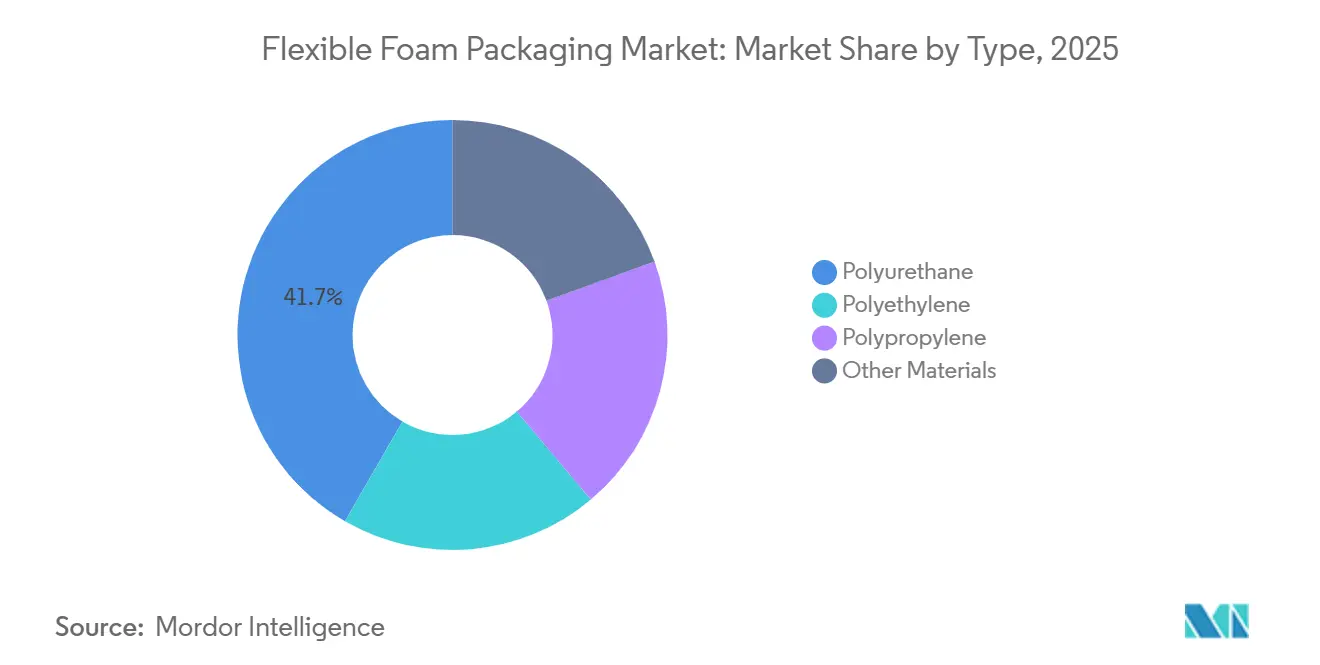
Polyurethane held 41.67% of the flexible foam packaging market share in 2025. This position reflects its formulation flexibility across open-cell and closed-cell grades, which serve different protection requirements. Open-cell variants support applications where air permeability is needed around humidity-sensitive products. Closed-cell grades provide moisture and thermal barriers for shipping electronics and pharmaceuticals. Flexible polyurethane foam can be adjusted by density and cell structure to meet specific cushioning needs.
The flexible foam packaging market size for polyethylene is projected to grow at a 6.98% CAGR through 2031. Polyethylene benefits from closed-cell moisture resistance and compatibility with polyolefin recycling streams. Cross-linked polyethylene offers tear resistance and dimensional stability, supporting applications that involve repeated handling. Expanded polypropylene is also gaining attention in markets where recyclability is an important purchasing consideration, while bio-based and starch-based alternatives remain in the early commercial stage.

By Application: Transportation Leads While Electrical and Electronics Grow Faster
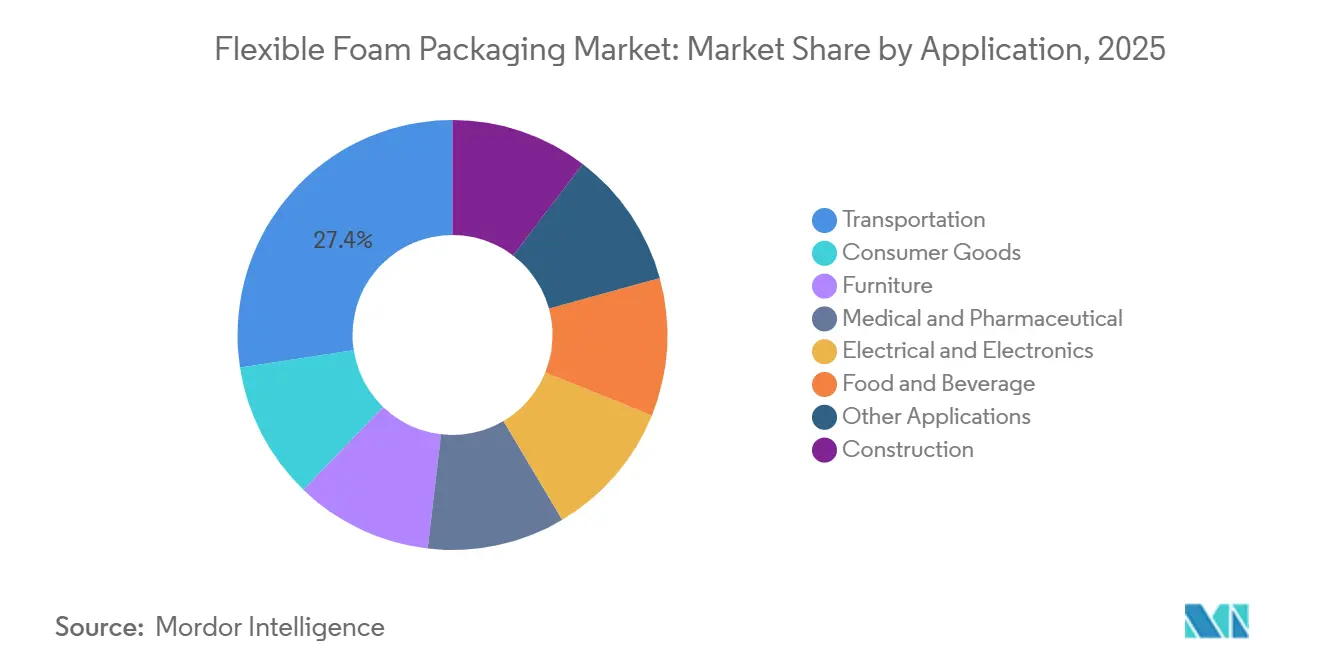
Transportation accounted for 27.42% of the flexible foam packaging market share in 2025. Automotive component protection and EV battery module inserts support this position. Foam offers a favorable balance between weight and protection in applications that move through multiple production and logistics stages. Automotive supply chains require packaging that protects components with varied shapes and surface finishes, maintaining demand for engineered packaging within the flexible foam packaging market.
The electrical and electronics segment is projected to grow at a 7.75% CAGR through 2031. Smaller and more fragile components increase the importance of cushioning and energy dissipation during parcel delivery. EUROPUR reports that flexible polyurethane foam is used for electronics and medical device protection, where these properties are critical. Medical and pharmaceutical applications use foam inserts in temperature-controlled shippers, while consumer goods, furniture, and construction remain established end uses for protective foam materials.
Geography Analysis
Asia-Pacific held 38.11% of the flexible foam packaging market share in 2025 and is expected to grow at a 7.42% CAGR through 2031. China's electronics manufacturing base links regional demand to production activity and export packaging needs. India's Production Linked Incentive (PLI) programs for mobile phones, IT hardware, and automotive electronics target a cumulative output increase of USD 150 billion to USD 200 billion by 2030. This policy framework supports demand for export-grade protective packaging. JSP's medium-term plan also targets a 21% increase in flat-panel display surface protection material sales.
North America and Europe are established demand centers for precision-engineered foam inserts. The United States benefits from parcel logistics and pharmaceutical distribution networks that use validated insulated shippers. E-commerce represented 16.9% of U.S. retail sales in the first quarter of 2026. In Europe, Regulation (EU) 2025/40 is directing attention toward formats with stronger design-for-recycling credentials. This environment is encouraging portfolio changes across the flexible foam packaging market.
South America, the Middle East, and Africa represent a smaller but expanding share of global revenue. Brazil and Argentina are tied to e-commerce development and agricultural export packaging requirements. Saudi Arabia's pharmaceutical manufacturing and distribution activity supports interest in validated cold-chain shippers. WHO vaccine logistics guidance also supports demand for reliable international transport packaging in lower-income health systems. These regions present opportunities for converters with appropriate distribution capability and technical documentation.
Competitive Landscape
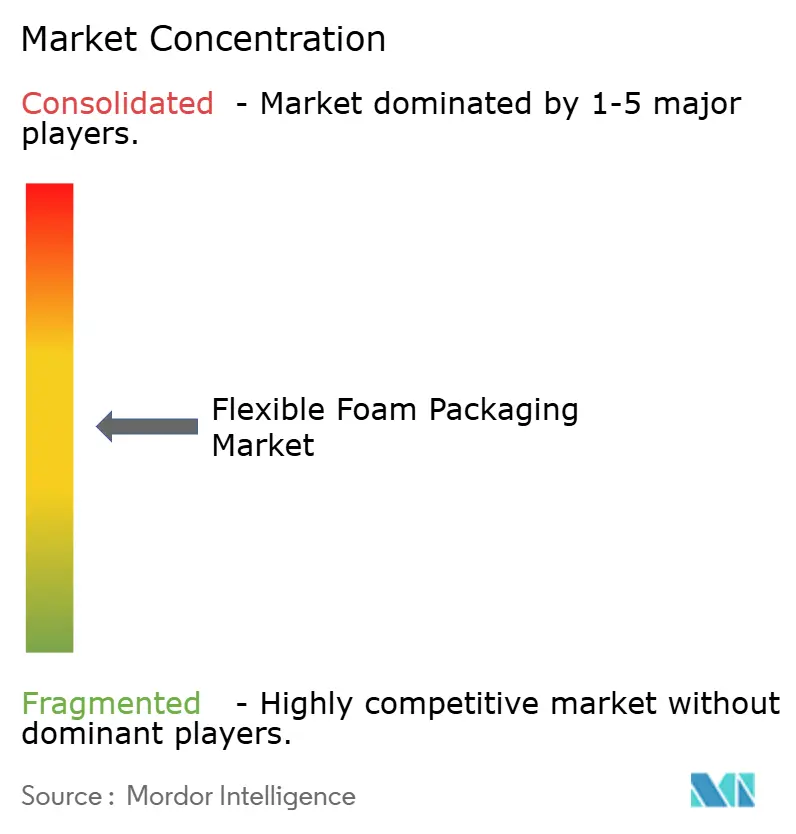
The flexible foam packaging market is moderately fragmented. BASF, Dow, and Huntsman supply raw materials and integrated systems. Armacell, Zotefoams, UFP Technologies, Pregis, and JSP focus on material conversion or application engineering. Competition increasingly centers on material performance, circularity credentials, and fabrication capability. BASF introduced biomass-balance flexible polyurethane foam systems in March 2025.
Sealed Air completed its acquisition by funds affiliated with Clayton, Dubilier & Rice in April 2026 at an enterprise value of USD 10.3 billion. The transaction moved the company to private ownership while retaining its Charlotte, North Carolina headquarters. Pregis acquired MP Global Packaging's cold-chain and thermal packaging division in August 2026. The acquired business operates 2 manufacturing facilities in Indiana and Nebraska. This acquisition broadens Pregis's cold-chain offering with a curbside-recyclable alternative to EPS-insulated shippers.
Zotefoams acquired Overseas Konstellation Company S.A. in November 2025 and appointed UFP Technologies as a Global Approved Partner. Smaller specialized converters can compete on high-mix orders by combining CNC fabrication with digitally integrated order management, reducing reliance on tooling to accommodate design changes. The flexible foam packaging market therefore rewards both material innovation and conversion capability.
Flexible Foam Packaging Industry Leaders
-
Sealed Air Corporation
-
BASF
-
Pregis LLC
-
ARMACELL
-
Sonoco Products Company
- *Disclaimer: Major Players sorted in no particular order
Recent Industry Developments
- August 2026: Pregis acquired MP Global Packaging's cold-chain and thermal packaging division, which operates 2 manufacturing facilities in Indiana and Nebraska producing paper-based thermal packaging for temperature-sensitive shipments. The acquisition expands Pregis's cold-chain portfolio with a curbside-recyclable alternative to EPS foam insulated shippers, serving pharmaceutical manufacturers and specialty pharmacy distributors.
- April 2026: Sealed Air Corporation completed its acquisition by funds affiliated with Clayton, Dubilier & Rice (CD&R) at an enterprise value of USD 10.3 billion, with stockholders receiving USD 42.15 per share in cash. The company transitioned to private ownership while retaining its Charlotte, North Carolina headquarters, with CD&R committing to support growth across Sealed Air's protective packaging businesses.
Global Flexible Foam Packaging Market Report Scope
Flexible foam packaging is a soft, elastic cushioning material that absorbs shocks and protects fragile items during shipping and storage. It is widely used across industries such as electronics, automotive, healthcare, and consumer goods, where product safety during transit is a priority.
The flexible foam packaging market is segmented by type, application, and geography. By type, the market is segmented into polyurethane, polyethylene, polypropylene, and other materials. By application, the market is segmented into construction, consumer goods, furniture, transportation, medical and pharmaceutical, electrical and electronics, food and beverage, and other applications. The report also covers the market size and forecasts for flexible foam packaging in 15 countries across major regions. The market sizes and forecasts are provided in terms of value (USD).
| Polyurethane |
| Polyethylene |
| Polypropylene |
| Other Materials |
| Construction |
| Consumer Goods |
| Furniture |
| Transportation |
| Medical and Pharmaceutical |
| Electrical and Electronics |
| Food and Beverage |
| Other Applications |
| Asia-Pacific | China |
| India | |
| Japan | |
| South Korea | |
| ASEAN Countries | |
| Rest of Asia-Pacific | |
| North America | United States |
| Canada | |
| Mexico | |
| Europe | Germany |
| United Kingdom | |
| France | |
| Italy | |
| NORDIC Countries | |
| Rest of Europe | |
| South America | Brazil |
| Argentina | |
| Rest of South America | |
| Middle East and Africa | Saudi Arabia |
| South Africa | |
| Rest of Middle East and Africa |
| By Type | Polyurethane | |
| Polyethylene | ||
| Polypropylene | ||
| Other Materials | ||
| By Application | Construction | |
| Consumer Goods | ||
| Furniture | ||
| Transportation | ||
| Medical and Pharmaceutical | ||
| Electrical and Electronics | ||
| Food and Beverage | ||
| Other Applications | ||
| By Geography | Asia-Pacific | China |
| India | ||
| Japan | ||
| South Korea | ||
| ASEAN Countries | ||
| Rest of Asia-Pacific | ||
| North America | United States | |
| Canada | ||
| Mexico | ||
| Europe | Germany | |
| United Kingdom | ||
| France | ||
| Italy | ||
| NORDIC Countries | ||
| Rest of Europe | ||
| South America | Brazil | |
| Argentina | ||
| Rest of South America | ||
| Middle East and Africa | Saudi Arabia | |
| South Africa | ||
| Rest of Middle East and Africa | ||
Key Questions Answered in the Report
What is current market size of Flexible Foam Packaging Market?
The flexible foam packaging market size was valued at USD 3.16 billion in 2025 and is estimated to grow from USD 3.34 billion in 2026 to reach USD 4.60 billion by 2031, at a CAGR of 6.56% during the forecast period (2026-2031).
Which material has the largest position in flexible foam packaging?
Polyurethane held a 41.67% share in 2025, supported by its adaptable cushioning, moisture barrier, and thermal protection properties.
Which application is growing fastest for flexible foam packaging?
Electrical and electronics is projected to record the highest application CAGR of 7.75% through 2031.
Which region leads flexible foam packaging demand?
Asia-Pacific held a 38.11% share in 2025 and is forecast to grow at a 7.42% CAGR through 2031.