
Fixed Crane Market Size and Share
Market Overview
| Study Period | 2020 - 2032 |
|---|---|
| Market Size (2027) | USD 14.87 Billion |
| Market Size (2032) | USD 19.72 Billion |
| Growth Rate (2027 - 2032) | 5.81 % |
| Fastest Growing Market | Middle East and Africa |
| Largest Market | Asia-Pacific |
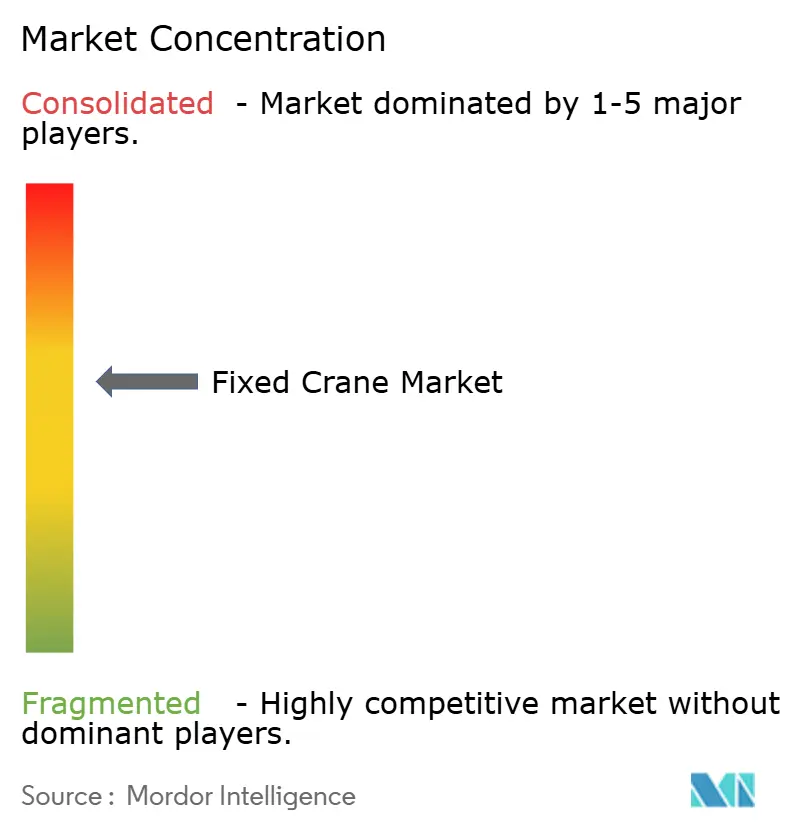
| Market Concentration | Medium |
Major Players *Disclaimer: Major Players sorted in no particular order Image © Mordor Intelligence. Reuse requires attribution under CC BY 4.0. | |
Fixed Crane Market Analysis by Mordor Intelligence
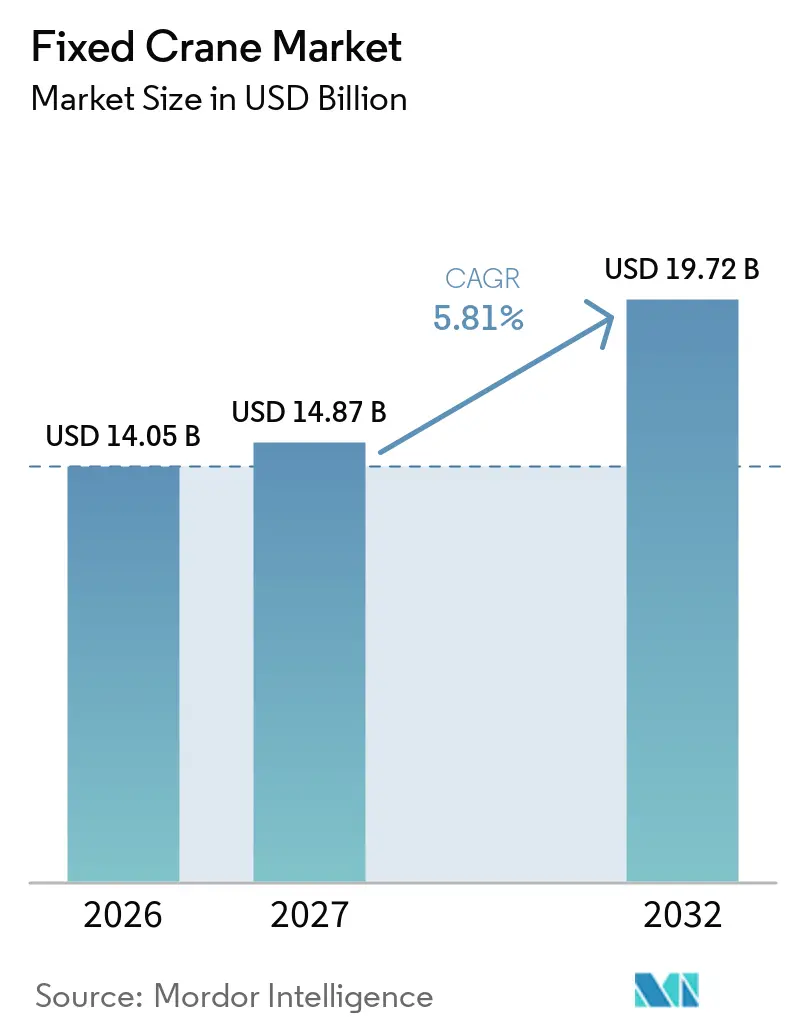
The fixed crane market size is expected to increase from USD 14.05 billion in 2026 to USD 14.87 billion in 2027 and reach USD 19.72 billion by 2032, growing at a CAGR of 5.81% over 2027-2032. The fixed crane market is supported by long-duration spending on terminals, energy facilities, and advanced manufacturing plants. These programs broaden demand beyond the construction projects that shaped earlier equipment cycles, because terminal expansions, energy assets, and manufacturing lines have distinct investment calendars, technical requirements, and asset lives, making demand less dependent on a single developer group or property cycle. Port operators, utilities, and manufacturers are allocating equipment to multi-year capital programs, which creates a more diverse order base and places greater weight on integration, uptime, and maintenance support throughout the equipment life.
Key Report Takeaways
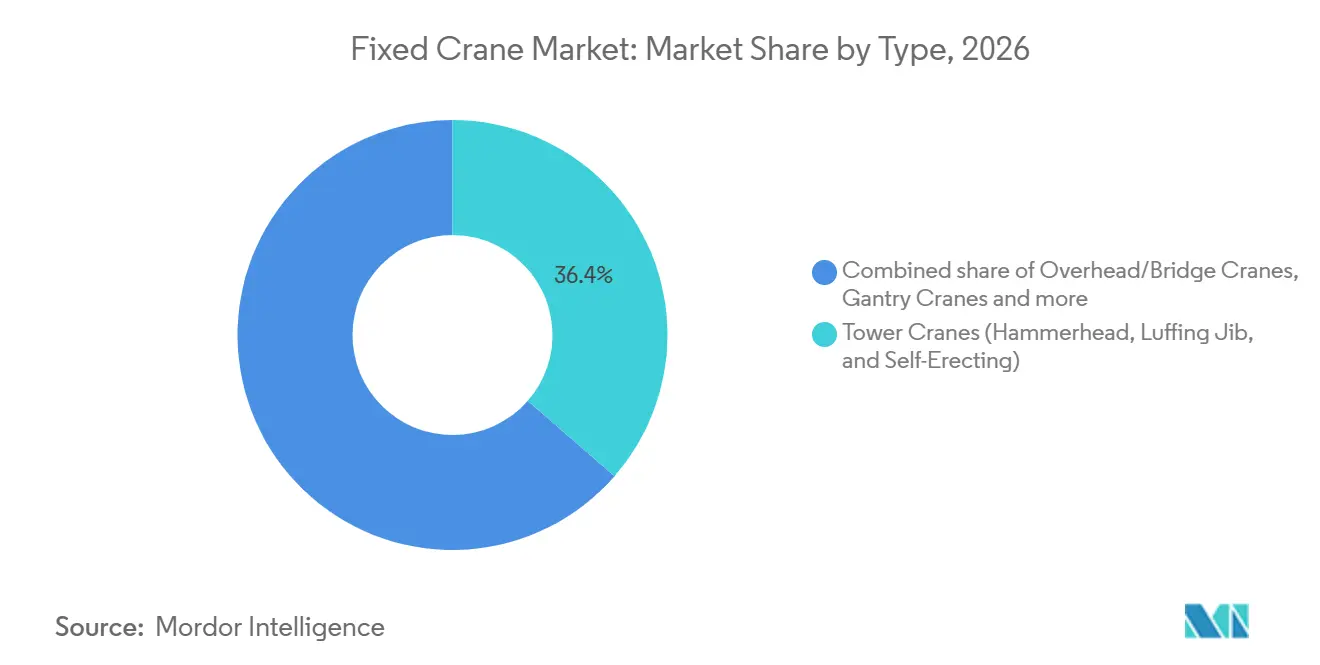
- By type, tower cranes held 36.42% of the fixed crane market share in 2026, while gantry cranes are projected to grow at a 6.93% CAGR through 2032.
- By lifting capacity, 10 to 50 tons held 41.18% of the fixed crane market share in 2026, while above 100 tons is projected to grow at a 6.74% CAGR through 2032.
- By power source, electric held 78.36% of the fixed crane market share in 2026, while hybrid is projected to grow at a 9.42% CAGR through 2032.
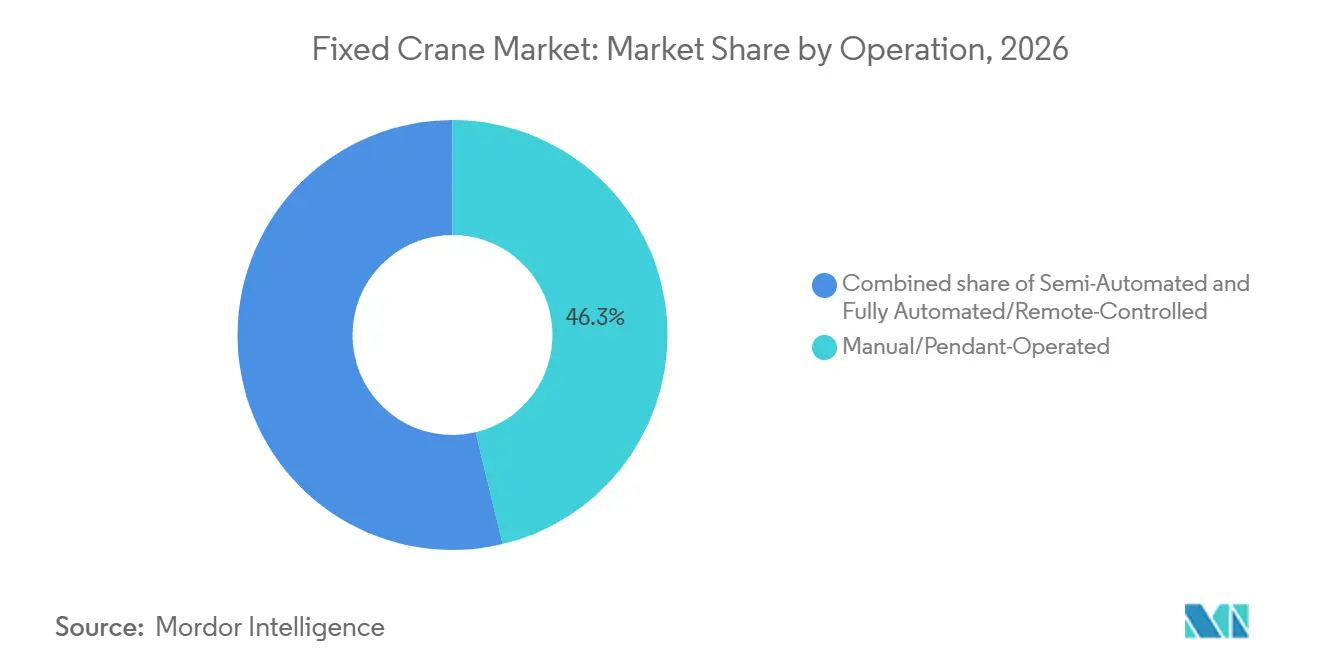
- By operation, manual/pendant-operated held 46.27% of the fixed crane market share in 2026, while fully automated/remote-controlled is projected to grow at a 9.18% CAGR through 2032.
- By application, building and construction held 39.63% of the fixed crane market share in 2026, while ports are projected to grow at a 7.12% CAGR through 2032.
- By geography, Asia-Pacific held 47.36% of the fixed crane market share in 2026, while Middle East and Africa is projected to grow at a 6.87% CAGR through 2032.
Note: Market numbers in this report are based on Mordor Intelligence's proprietary estimation framework, which combines nine months of actuals with Q4 projections for base year 2026.
Market Trends and Insights
Drivers Impact Analysis of Fixed Crane Market*
| Driver | (~) % Impact on CAGR Forecast | Geographic Relevance | Impact Timeline |
|---|---|---|---|
| Urban Infrastructure and High-Rise Construction | +1.5% | Global, concentrated in South and Southeast Asia, the Middle East, and North Africa | Medium term (2–4 years) |
| Port Modernization and Automated Cargo Handling | +1.2% | Global, led by Asia-Pacific, Middle East and Africa, and South America | Long term (≥ 4 years) |
| Industrial Automation and Industry 4.0 Integration | +0.9% | North America, Europe, and East Asia | Medium term (2–4 years) |
| Renewable Energy and Grid Upgrade Investment | +0.7% | Europe, North America, and Asia-Pacific | Long term (≥ 4 years) |
| Modular Construction and Prefabrication | +0.5% | North America and Europe, with early gains in Australia and Southeast Asia | Short term (≤ 2 years) |
| Brownfield Plant Modernization and Runway Reuse | +0.4% | Europe and North America | Short term (≤ 2 years) |
| Source: Mordor Intelligence | |||
Urban Infrastructure and High-Rise Construction
Urban infrastructure spending continues to support the fixed crane market where dense sites require permanent lifting systems. High-rise housing, mixed-use towers, elevated roads, metro corridors, and airport expansions favor tower cranes when working space is limited. India’s National Infrastructure Pipeline earmarked INR 111 lakh crore for FY2020-FY2025 across roads, urban infrastructure, and energy, creating a broad project pipeline that continues to need lifting equipment[1]. These programs keep demand tied to site conditions and project duration rather than to a single building category. In China, real estate development investment fell 15.9% year on year in January-November 2025, reducing local construction demand. Chinese manufacturers have consequently directed more equipment toward Southeast Asia, the Middle East, and Africa, which increases price competition in the fixed crane market.
Port Modernization and Automated Cargo Handling
Port modernization gives the fixed crane market a demand source that follows terminal operating plans instead of short construction schedules. Larger vessels and rising throughput require terminals to replace equipment with longer-reach and more automated systems. Rail-mounted gantry cranes are central to this replacement cycle because they connect container storage, yard planning, and digital operating systems. Procurement decisions increasingly include controls, scanners, safety systems, and integration work alongside the crane itself. That broader scope raises the importance of suppliers that can coordinate mechanical equipment and software functions. It also extends contract timelines and makes terminal projects a durable source of demand for the fixed crane market.
Industrial Automation and Industry 4.0 Integration
Industrial users increasingly assess cranes as part of a plant’s wider material-flow system. They seek synchronized lifting, shared-rail arrangements, controlled motion, and monitoring functions that can improve production reliability. Konecranes received an order for 39 industrial cranes for Hitachi Energy’s new transformer factory in Finland in 2025, demonstrating demand for purpose-built lifting systems in advanced production sites[2]. The same approach supports investment in digital controls, diagnostics, and operator assistance. For the fixed crane market, this shifts competition toward equipment that can meet operational and integration requirements. Manufacturers with established service capabilities can also remain involved after initial delivery through modernization and maintenance work.
Renewable Energy and Grid Upgrade Investment
Energy projects bring the fixed crane market into sites that differ from conventional building work. Offshore wind facilities, grid substations, nuclear construction halls, hydropower stations, and turbine assembly areas require specialized lifting arrangements. These applications often need higher specifications, site-specific engineering, and strict operating procedures. Their investment decisions are influenced by energy infrastructure programs, which can differ from property and commodity cycles. The resulting order base gives suppliers opportunities in projects where unit complexity is high. It also strengthens demand for long-term inspection, maintenance, and replacement services.
Restraints Impact Analysis of Fixed Crane Market*
| Restraint | (~) % Impact on CAGR Forecast | Geographic Relevance | Impact Timeline |
|---|---|---|---|
| High Capital Expenditure and Financing Constraints | -1.3% | Global, acutely felt in South America and Africa | Medium term (2–4 years) |
| Skilled Operator and Maintenance Workforce Shortages | -0.9% | Global, most acute in North America and Europe | Long term (≥ 4 years) |
| Foundation and Runway Constraints at Brownfield Sites | -0.6% | North America and Europe, including industrial brownfield corridors | Short term (≤ 2 years) |
| Long Engineering Cycles and Import-Control Exposure | -0.4% | Middle East and Africa, with spillover to South America and Southeast Asia | Medium term (2–4 years) |
| Source: Mordor Intelligence | |||
High Capital Expenditure and Financing Constraints
Large crane packages require significant upfront capital and can depend on structured financing. This creates a barrier for smaller terminal operators and mid-sized manufacturers that need to replace aging equipment. Deferred replacement can increase maintenance exposure, yet the cost of financing may still make a new installation difficult to approve. Interest rates and credit availability can therefore affect the timing of replacement decisions. Leasing and service-based offerings can reduce the initial burden, but these models are not equally available across regions. Brownfield upgrades add further expense when foundations, runways, or electrical systems require changes before equipment installation.
Skilled Operator and Maintenance Workforce Shortages
Automation changes the skills required to run and maintain cranes rather than removing the workforce requirement. Control-room supervision, systems integration, electrical maintenance, and diagnostics become more important as automation rises. The U.S. Bureau of Labor Statistics projects employment of industrial machinery mechanics, machinery maintenance workers, and millwrights to grow 14% from 2025 to 2035[3]. However, specialized expertise in automated crane controls remains limited relative to operational demand. This constraint can reduce equipment availability and slow the use of advanced functions at end-user sites. Suppliers are responding with remote diagnostics and service contracts, although site-level technical capability remains important.
*Our forecasts treat driver/restraint impacts as directional, not additive. The impact forecasts reflect baseline growth, mix effects, and variable interactions.
Fixed Crane Market Segment Analysis
By Type:
Tower Cranes Lead Established Construction Demand While Gantry Cranes Support Terminal InvestmentTower cranes held 36.42% of the fixed crane market share in 2026, reflecting their extensive use across urban building and infrastructure projects. Hammerhead designs suit open construction sites where several trades work in parallel. Luffing jib designs address dense urban locations where available slewing space is restricted. Self-erecting configurations meet the needs of smaller sites and projects that require quick installation. These subtypes allow contractors to select equipment according to height, reach, access, and site layout. Their broad deployment keeps tower cranes central to the fixed crane market, even as regional construction conditions vary. Manufacturers must nevertheless adapt designs to local safety rules, project access, transport constraints, and the operating practices of construction contractors.
Gantry cranes are projected to grow at a CAGR of 6.93% through 2032 within the fixed crane market. Rail-mounted configurations are favored in automated terminal projects because they support planned container movements across defined yard areas. Semi-gantry units also serve industrial sites where equipment must operate along a restricted path. Overhead and bridge cranes remain important for steel, automotive, and heavy manufacturing environments. Jib cranes serve localized lifting tasks in assembly work, while monorail and stiffleg systems cover more specialized uses. The type mix therefore combines construction equipment, continuous industrial lifting, port handling, and specialized installations.

By Lifting Capacity:
Mid-Range Equipment Anchors Broad Demand While Heavy Lifting Gains MomentumThe 10 to 50 tons class held 41.18% of the fixed crane market share in 2026. This range fits common requirements in factories, logistics facilities, warehouses, and lighter port operations. It is regularly selected when operators need useful lifting capability without introducing the more extensive structural work, specialized controls, and operational procedures associated with very high-capacity equipment. It supports routine material movement without the structural and engineering demands associated with larger systems. Manufacturers use this class across production lines, processing centers, and assembly areas. The range also aligns with many modernization projects that replace older bridge crane installations. Its broad applicability gives this segment a stable role across the fixed crane market.
Above 100 tons is projected to grow at a CAGR of 6.74% through 2032. Demand comes from applications that require heavy lifts, including energy infrastructure, transformer production, and major industrial facilities. These systems require detailed engineering and rigorous operating procedures. The crane, building structure, rail system, power arrangement, and maintenance plan must be considered together, since heavy lifting equipment becomes a permanent and closely managed part of site operations. Their purchase decisions often depend on plant construction schedules and specialized project specifications. Below 10 tons equipment remains relevant for workshops and lighter tasks, while the 51 to 100 tons range serves medium-scale industrial requirements.
By Power Source:
Electric Systems Hold the Installed Base While Hybrid Options Address Difficult SitesElectric configurations held 78.36% of the fixed crane market share in 2026. They are established across factories, warehouses, and terminals where reliable grid access is available. Their installed base supports ongoing activity in motor work, drive upgrades, and control-system replacement. Operators can often improve performance by modernizing these components, thereby extending the useful life of equipment that remains mechanically sound and suitable for the facility. Electric systems also fit projects that seek to reduce local emissions from lifting operations. Variable-frequency drives can support controlled movement and smoother braking in upgraded installations. This foundation makes electric equipment the established power choice across much of the fixed crane market.
Hybrid configurations are projected to grow at a CAGR of 9.42% through 2032. They address sites where grid access is intermittent, constrained, or unavailable. Construction sites and remote industrial facilities can use hybrid systems to maintain operations while reducing fuel consumption. This can be useful during the early stages of a project, when a permanent grid connection is not yet available or does not provide sufficient capacity for the intended duty cycle. These arrangements are particularly relevant when operators must meet site environmental requirements without sacrificing lifting availability. Diesel and diesel-electric equipment continues to serve remote, heavy-duty, and continuous-duty applications.
By Operation:
Manual Fleets Remain Large While Remote and Automated Systems Gain GroundManual/pendant-operated configurations held 46.27% of the fixed crane market share in 2026. Their position reflects the large installed base of workshop and factory cranes worldwide. These systems are familiar to operators and can meet routine lifting needs with limited control infrastructure. Their continued use reflects the practical needs of many workshops, where simple and dependable lifting remains more important than introducing a complex automated system. Many users can improve existing manual equipment through radio controls, anti-sway functions, and load monitoring. Safety and productivity requirements are nevertheless placing more pressure on aging manual fleets. This installed base creates both replacement and retrofit opportunities for the fixed crane market.
Fully automated/remote-controlled systems are projected to grow at a CAGR of 9.18% through 2032. Ports are a visible adoption area because automated yard equipment can support planned container movements. The operating model can help terminals coordinate repetitive movements across a defined yard, particularly where equipment must work alongside transport scheduling and digital terminal systems. Similar approaches are being used in stamping operations, coil handling, and specialized storage environments. Remote operation can move staff away from difficult operating locations while retaining direct oversight. Automated systems also require effective commissioning, maintenance, and control-room procedures.
By Application:
Construction Provides Scale While Port Automation Drives Faster GrowthBuilding and construction held 39.63% of the fixed crane market share in 2026. The segment includes urban towers, transport infrastructure, airports, and large mixed-use developments. Each project category has distinct lifting needs, but all may require equipment that remains on site for an extended period and operates within tightly managed construction sequences. Tower cranes are widely used where site constraints and project duration justify fixed lifting equipment. Demand is strongest where national and municipal infrastructure programs are moving into active construction. Regional performance can still differ significantly when property development slows in individual markets. Construction nonetheless remains the largest application base for the fixed crane market.
Ports are projected to grow at a CAGR of 7.12% through 2032. Terminals are replacing diesel equipment with electric and automated yard systems as they expand or modernize operations. The application includes quay cranes, rail-mounted gantry cranes, and other equipment required to move containers across the terminal. Equipment choices are tied to berth layout, yard design, storage density, and the operating model selected by the terminal owner. Port projects tend to involve long planning horizons because lifting assets must work with digital operating systems and site infrastructure. Industrial manufacturing and logistics and warehousing retain stable demand for continuous lifting systems, while shipbuilding, energy, and mining create specialized requirements. This application mix reduces dependence on a single construction cycle.
Geography Analysis
Asia-Pacific held 47.36% of the fixed crane market share in 2026 and remains the largest regional base. Infrastructure investment across India, Southeast Asia, and Australia supports demand across ports, freight systems, and industrial sites. The diversity of those projects allows demand to arise from transport connections, manufacturing capacity, and logistics facilities instead of depending only on residential development. India’s infrastructure pipeline continues to cover roads, urban systems, and energy, providing a broad basis for equipment requirements. China presents a different pattern because domestic real estate investment weakened during 2025. This has encouraged Chinese manufacturers to pursue export demand more actively. Their strategies place greater emphasis on overseas dealer networks, delivery capability, and product configurations that can meet the requirements of different regional customers.
North America and Europe show medium growth conditions as mature installed bases move through modernization cycles. In North America, advanced manufacturing, transformer capacity, and energy projects drive demand for specialized cranes. These customers often need dependable lifting equipment that can work within regulated production environments and remain available during demanding industrial schedules. Konecranes announced a four-crane order for TerraPower’s Natrium plant in Wyoming in January 2026, demonstrating requirements tied to nuclear construction. Europe combines industrial electrification needs with demand from data centers, battery plants, and wind-component facilities. The region’s established industrial base also produces a steady need to replace equipment and update control systems within existing plants. Existing factories also need equipment replacement and modernization as asset owners seek more reliable operations.
Middle East and Africa is projected to grow at a CAGR of 6.87% through 2032. Large infrastructure programs, port investment, and industrial diversification support demand across the region. The opportunity includes new facilities as well as upgrades to existing logistics and industrial assets that need more reliable or more capable lifting systems. Projects often involve import processes and site-specific engineering, which can extend delivery schedules. South America shows medium growth, with Brazil providing a base for port and industrial investment. Across these regions, buyers may prioritize local support, financing availability, and reliable delivery schedules alongside equipment specifications. This makes execution capability important, especially for projects where imported equipment must be installed, commissioned, and maintained under site-specific conditions.
Competitive Landscape
The fixed crane market is moderately concentrated. Liebherr-International AG, Konecranes Plc, ZPMC, Zoomlion Heavy Industry Science and Technology Co., Ltd., and The Manitowoc Company, Inc. form the strategic tier. Their position reflects broad product portfolios, international reach, and experience with complex customer requirements. Beyond these manufacturers, many regional suppliers compete on delivery time, price, and local service. Regional firms may have an advantage when customers need fast support, established local relationships, or equipment tailored to familiar construction and industrial practices. Liebherr and Konecranes are positioned strongly in specialized applications that require advanced engineering and certification.
Product strategy increasingly depends on the ability to support specialized applications and automation requirements. Konecranes received an order in 2025 to supply 39 cranes for a new Hitachi Energy transformer factory in Finland, with deliveries scheduled by the end of 2026. Liebherr has continued to update its tower crane portfolio and invest in production capacity for construction equipment. ZPMC, Zoomlion, XCMG, and SANY are broadening their reach through exports to regions with infrastructure and terminal investment. Manitowoc is strengthening its tower crane offering through product development in self-erecting equipment. These actions show that suppliers are competing through equipment range, service capability, and access to project markets.
Aftermarket support is becoming more important because users want greater uptime from equipment that remains in service for many years. A dependable parts supply and an effective inspection program can be as important to an owner as the original equipment specification. Remote diagnostics, parts availability, inspection work, and modernization can create longer customer relationships than a one-time equipment sale. Columbus McKinnon completed its acquisition of Kito Crosby in February 2026, adding scale in lifting components and hoist systems. Smaller providers such as Comansa, Raimondi, Wolffkran, Künz GmbH, and Kranbau Köthen GmbH can compete where application engineering and local specialization matter. Buyers can therefore choose between global suppliers with broad portfolios and specialists focused on particular crane types or operating conditions.
Fixed Crane Industry Leaders
-
Liebherr-International AG
-
Konecranes Plc
-
Shanghai Zhenhua Heavy Industries Co. Ltd. (ZPMC)
-
The Manitowoc Company, Inc.
-
Zoomlion Heavy Industry Science and Technology Co., Ltd.
- *Disclaimer: Major Players sorted in no particular order
Fixed Crane Market Companies Covered in this Report
- Liebherr-International AG
- Konecranes Plc
- Shanghai Zhenhua Heavy Industries Co. Ltd. (ZPMC)
- The Manitowoc Company, Inc.
- Zoomlion Heavy Industry Science and Technology Co., Ltd.
- SANY Heavy Industry Co. Ltd.
- XCMG Construction Machinery Co. Ltd.
- Weihua Group Co. Ltd.
- Columbus McKinnon Corporation
- Hiab Corporation
- ABUS Kransysteme GmbH
- Comansa S.A.
- Favelle Favco Berhad
- Wolffkran Holding AG
- Raimondi Cranes S.p.A.
- Gorbel Inc.
- Henan Nucleon Crane Group Co. Ltd.
- GH Cranes and Components
- Street Crane Company Limited
- EMH Inc.
Recent Industry Developments in Fixed Crane Market
- October 2026: Mayo Civil Engineering added two WOLFF luffing jib cranes to an earlier order, raising its planned delivery to eight units.
- May 2026: Konecranes agreed to supply nine overhead cranes to PT Tata Metal Lestari's facility in Sadang, West Java, Indonesia, with delivery and installation scheduled for the third quarter of 2026.
- February 2026: Columbus McKinnon completed its acquisition of Kito Crosby, expanding its portfolio of hoists and lifting components.
- January 2026: Konecranes announced a four-crane order for TerraPower's Natrium plant in Wyoming, including two nuclear-rated cranes with 150-ton main hoists.
Global Fixed Crane Market Report Scope
The Fixed Crane Market is segmented by Type, Lifting Capacity, Power Source, Operation, Application, and Geography. By Type, the market is segmented into Tower Cranes (Hammerhead, Luffing Jib, and Self-Erecting), Overhead/Bridge Cranes, Gantry Cranes (Rail-Mounted and Semi-Gantry), Jib Cranes, Stiffleg Cranes, Monorail Cranes, and Others. By Lifting Capacity, the market is segmented into Below 10 Tons, 10 to 50 Tons, 51 to 100 Tons, and Above 100 Tons. By Power Source, the market is segmented into Electric, Diesel/Diesel-Electric, and Hybrid. By Operation, the market is segmented into Manual/Pendant-Operated, Semi-Automated, and Fully Automated/Remote-Controlled. By Application, the market is segmented into Building and Construction, Ports, Shipbuilding, Industrial Manufacturing, Logistics and Warehousing, Energy and Mining, and Others. By Geography, the market is segmented into North America (United States, Canada, and Mexico), Europe (Germany, United Kingdom, France, Italy, Spain, Netherlands, Belgium, Sweden, Russia, Poland, and Rest of Europe), Asia-Pacific (China, India, Japan, South Korea, Australia, Singapore, Vietnam, Indonesia, Thailand, and Rest of Asia-Pacific), South America (Brazil, Argentina, Chile, Colombia, Peru, and Rest of South America), and Middle East and Africa (Saudi Arabia, United Arab Emirates, Israel, Turkey, South Africa, Egypt, Nigeria, and Rest of Middle East and Africa). Market forecasts are provided in terms of Value (USD) and Volume (Units).
Segmentation Overview
| Tower Cranes (Hammerhead, Luffing Jib, and Self-Erecting) |
| Overhead/Bridge Cranes |
| Gantry Cranes (Rail-Mounted and Semi-Gantry) |
| Jib Cranes |
| Stiffleg Cranes |
| Monorail Cranes |
| Others |
| Below 10 Tons |
| 10 to 50 Tons |
| 51 to 100 Tons |
| Above 100 Tons |
| Electric |
| Diesel/Diesel-Electric |
| Hybrid |
| Manual/Pendant-Operated |
| Semi-Automated |
| Fully Automated/Remote-Controlled |
| Building and Construction |
| Ports |
| Shipbuilding |
| Industrial Manufacturing |
| Logistics and Warehousing |
| Energy and Mining |
| Others |
| North America | United States |
| Canada | |
| Mexico | |
| Europe | Germany |
| United Kingdom | |
| France | |
| Italy | |
| Spain | |
| Netherlands | |
| Belgium | |
| Sweden | |
| Russia | |
| Poland | |
| Rest of Europe | |
| Asia-Pacific | China |
| India | |
| Japan | |
| South Korea | |
| Australia | |
| Singapore | |
| Vietnam | |
| Indonesia | |
| Thailand | |
| Rest of Asia-Pacific | |
| South America | Brazil |
| Argentina | |
| Chile | |
| Colombia | |
| Peru | |
| Rest of South America | |
| Middle East and Africa | Saudi Arabia |
| United Arab Emirates | |
| Israel | |
| Turkey | |
| South Africa | |
| Egypt | |
| Nigeria | |
| Rest of Middle East and Africa |
| By Type | Tower Cranes (Hammerhead, Luffing Jib, and Self-Erecting) | |
| Overhead/Bridge Cranes | ||
| Gantry Cranes (Rail-Mounted and Semi-Gantry) | ||
| Jib Cranes | ||
| Stiffleg Cranes | ||
| Monorail Cranes | ||
| Others | ||
| By Lifting Capacity | Below 10 Tons | |
| 10 to 50 Tons | ||
| 51 to 100 Tons | ||
| Above 100 Tons | ||
| By Power Source | Electric | |
| Diesel/Diesel-Electric | ||
| Hybrid | ||
| By Operation | Manual/Pendant-Operated | |
| Semi-Automated | ||
| Fully Automated/Remote-Controlled | ||
| By Application | Building and Construction | |
| Ports | ||
| Shipbuilding | ||
| Industrial Manufacturing | ||
| Logistics and Warehousing | ||
| Energy and Mining | ||
| Others | ||
| By Geography | North America | United States |
| Canada | ||
| Mexico | ||
| Europe | Germany | |
| United Kingdom | ||
| France | ||
| Italy | ||
| Spain | ||
| Netherlands | ||
| Belgium | ||
| Sweden | ||
| Russia | ||
| Poland | ||
| Rest of Europe | ||
| Asia-Pacific | China | |
| India | ||
| Japan | ||
| South Korea | ||
| Australia | ||
| Singapore | ||
| Vietnam | ||
| Indonesia | ||
| Thailand | ||
| Rest of Asia-Pacific | ||
| South America | Brazil | |
| Argentina | ||
| Chile | ||
| Colombia | ||
| Peru | ||
| Rest of South America | ||
| Middle East and Africa | Saudi Arabia | |
| United Arab Emirates | ||
| Israel | ||
| Turkey | ||
| South Africa | ||
| Egypt | ||
| Nigeria | ||
| Rest of Middle East and Africa | ||
Key Questions Answered in the Report
What is the forecast value of the fixed crane market by 2032?
The fixed crane market is projected to reach USD 19.72 billion by 2032, following growth from USD 14.87 billion in 2027. The forecast reflects demand from construction, port operations, energy infrastructure, and manufacturing sites that need permanent lifting equipment.
What is driving demand for fixed cranes?
Port automation, energy infrastructure, factory modernization, and urban infrastructure programs are supporting equipment demand. These projects often run over several years, which can provide a longer and more varied base of orders than a single building cycle.
Which fixed crane type leads global revenue?
Tower cranes held 36.42% of revenue in 2026, supported by their use in urban construction and infrastructure work. Hammerhead, luffing jib, and self-erecting variants allow operators to select equipment suited to different site conditions and access limits.
Which crane type is expected to grow fastest?
Gantry cranes are projected to grow at a CAGR of 6.93% through 2032, supported by terminal modernization and automation. Rail-mounted equipment is particularly important as terminals upgrade yard operations and connect cranes with digital operating systems.