
Fiberglass Flooring Market Size and Share
Market Overview
| Study Period | 2021 - 2031 |
|---|---|
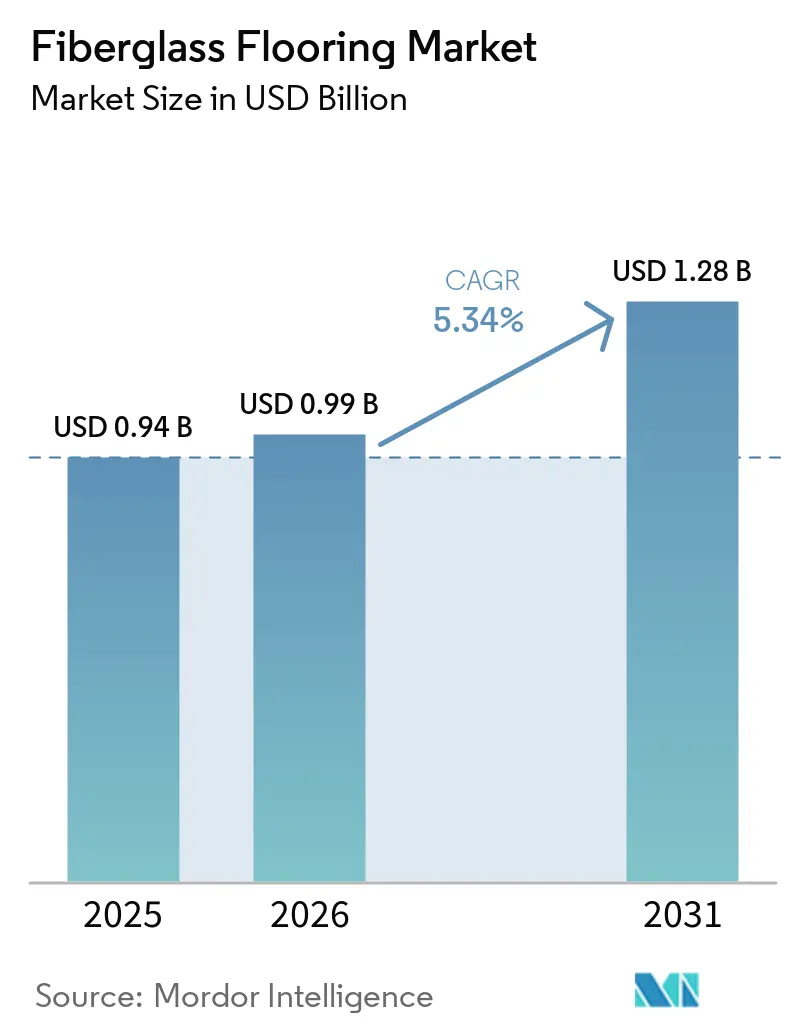
| Market Size (2026) | USD 0.99 Billion |
| Market Size (2031) | USD 1.28 Billion |
| Growth Rate (2026 - 2031) | 5.34 % |
| Fastest Growing Market | Asia-Pacific |
| Largest Market | Asia-Pacific |
| Market Concentration | Medium |
Major Players *Disclaimer: Major Players sorted in no particular order Image © Mordor Intelligence. Reuse requires attribution under CC BY 4.0. | |
Fiberglass Flooring Market Analysis by Mordor Intelligence
The Fiberglass Flooring Market size is projected to be USD 0.94 billion in 2025, USD 0.99 billion in 2026, and reach USD 1.28 billion by 2031, growing at a CAGR of 5.34% from 2026 to 2031. The fiberglass flooring market is driven primarily by commercial renovations, institutional upgrades, and healthcare modernization rather than new residential construction. Fiberglass reinforcement provides dimensional stability for luxury vinyl tile (LVT), vinyl composite tile (VCT), and vinyl sheet products used in high-traffic buildings. It helps reduce curling, edge separation, and thermal expansion that can affect conventional vinyl flooring specifications. These attributes support the use of fiberglass flooring in commercial procurement compared with standard vinyl alternatives. In North American public buildings, the replacement of aging VCT is shifting demand toward fiberglass-backed LVT, while VCT continues to support demand for budget-constrained projects.
Key Report Takeaways
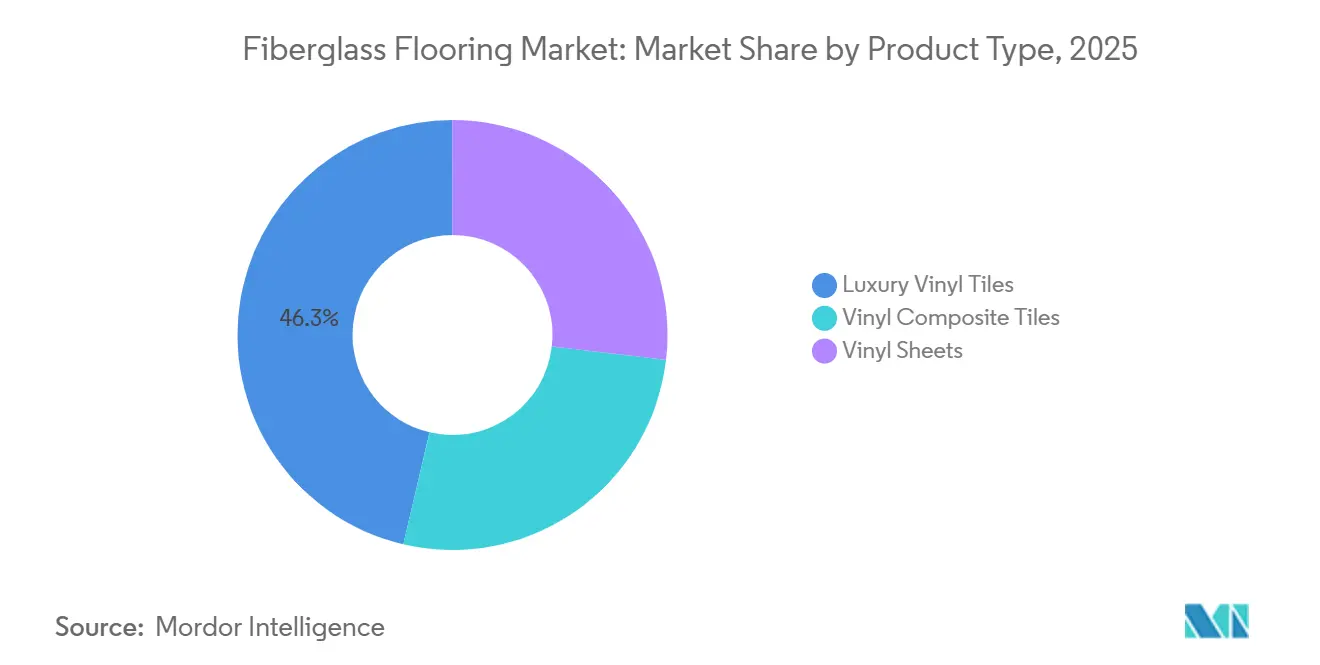
- By product type, luxury vinyl tiles accounted for 46.32% of revenue in 2025, while vinyl composite tiles are forecast to grow at a 6.07% CAGR through 2031.
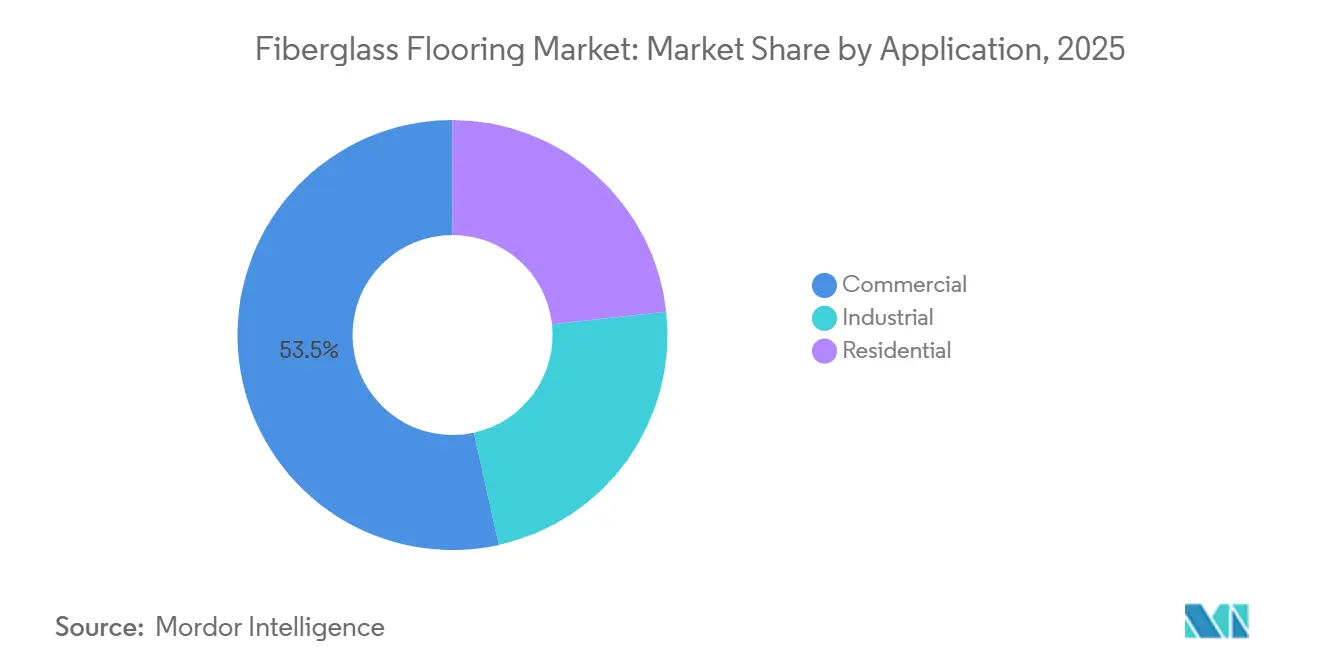
- By application, commercial applications accounted for 53.45% revenue share in 2025 and are forecast to expand at a 6.31% CAGR through 2031.
- By geography, Asia-Pacific accounted for 44.83% of revenue in 2025 and is forecast to grow at a 6.19% CAGR through 2031.
Note: Market size and forecast figures in this report are generated using Mordor Intelligence’s proprietary estimation framework, updated with the latest available data and insights as of January 2026.
Global Fiberglass Flooring Market Trends and Insights
Drivers Impact Analysis*
| Drivers | (~) % Impact on CAGR Forecast | Geographic Relevance | Impact Timeline |
|---|---|---|---|
| Demand for Waterproof and Dimensionally Stable Flooring | +1.2% | Global | Short term (≤ 2 years) |
| Expansion of Commercial Renovation and Institutional Construction | +1.1% | Global, concentrated in Asia-Pacific and North America | Medium term (2-4 years) |
| Low-Maintenance and Anti-Allergen Flooring Preference | +0.8% | Global, with intensity in healthcare-concentrated markets (North America, EU) | Medium term (2-4 years) |
| Growth of Fiberglass-Backed Luxury Vinyl Flooring | +1.0% | Global, APAC core with spill-over to the Middle East and Africa (MEA) | Medium term (2-4 years) |
| Retrofitting of Healthcare, Hospitality, and Retail Facilities | +0.7% | North America & EU (leading), APAC (emerging) | Short term (≤ 2 years) |
| Source: Mordor Intelligence | |||
Demand for Waterproof and Dimensionally Stable Flooring
The fiberglass flooring market is driven by commercial demand for flooring that remains stable under normal temperature fluctuations. Fiberglass reinforcement minimizes curling, edge lift, and visible subfloor irregularities, which can lead to early replacement in occupied facilities. Healthcare, foodservice, and education buyers increasingly require warranties that ensure dimensional stability under commercial heating, ventilation, and air conditioning (HVAC) conditions. Advancements in digital printing have reduced visual differences between resilient flooring and ceramic tile in commercial interiors. Consequently, procurement decisions increasingly prioritize dimensional performance and maintenance requirements over appearance alone. Interface introduced its polyvinyl chloride (PVC)-free Noravant resilient platform in February 2026, with a stated service life of up to 35 years. This development reflects demand for low-volatile organic compound (VOC), dimensionally stable, resilient flooring in commercial settings.
Expansion of Commercial Renovation and Institutional Construction
The fiberglass flooring market faces a first-cost barrier in price-sensitive procurement environments. Fiberglass-backed luxury vinyl tile (LVT) and vinyl sheet products may carry a 20-40% premium over conventional ceramic tile and ungauged vinyl. Buyers in emerging Asia-Pacific, the Middle East, Africa, and South America may prioritize annual capital budgets over multiyear maintenance savings. This dynamic creates distinct purchasing patterns between developed commercial projects and lower-cost projects in emerging markets. Renovation programs that resumed following delayed capital expenditure between 2020 and 2022 support the fiberglass flooring market. Healthcare systems, public schools, and government facilities continue to address accumulated flooring replacement requirements. India recorded 5.0% growth in its Index of Industrial Production in January 2025, indicating manufacturing activity that supports downstream demand for commercial and industrial flooring[1]Ministry of Statistics & Programme Implementation, “Index of Industrial Production, January 2025,” Government of India, mospi.gov.in..
Low-Maintenance and Anti-Allergen Flooring Preference
The fiberglass flooring market benefits from facility managers evaluating long-term ownership costs rather than initial purchase prices alone. Fiberglass-backed LVT can reduce the strip-and-wax maintenance cycle associated with vinyl composition tile (VCT) in high-traffic institutional buildings. Seamless, nonporous vinyl surfaces can also meet anti-allergen requirements in pediatric healthcare units, allergy-treatment clinics, and schools by replacing carpet. Certifications such as FloorScore and GREENGUARD Gold provide documented thresholds that public procurement teams can use during tender evaluations. Japan’s Building Standard Law regulates indoor air quality conditions in new and renovated buildings, increasing attention to low-emission product specifications. These requirements extend demand beyond healthcare procurement to facilities management applications.
Growth of Fiberglass-Backed Luxury Vinyl Flooring
The fiberglass flooring market continues to expand as fiberglass-backed LVT replaces flexible LVT in commercial specification tiers. The fiberglass layer stabilizes planks and tiles without materially increasing product thickness. This format can be installed over imperfect subfloors with less preparation than rigid stone-plastic composite (SPC) or wood-plastic composite (WPC) core products. In retrofit projects, avoiding extensive subfloor leveling can reduce installation costs by USD 2-5 per square foot. Large-format tile designs used in corporate and hospitality interiors also require tolerances that ungauged vinyl does not consistently provide. Mohawk Group acquired Hero Flooring in April 2026, adding a resilient flooring brand to its portfolio, including rubber products made from Nike Grind recycled content.
Restraints Impact Analysis*
| Restraints | (~) % Impact on CAGR Forecast | Geographic Relevance | Impact Timeline |
|---|---|---|---|
| Volatility in Glass Fiber, PVC, Resin, and Plasticizer Costs | -0.6% | Global | Short term (≤ 2 years) |
| Higher Initial Cost Compared with Conventional Vinyl and Ceramic Flooring | -0.5% | Emerging markets in Asia-Pacific, the Middle East and Africa, and South America | Medium term (2-4 years) |
| Limited End-of-Life Recycling Infrastructure for Multilayer Flooring | -0.3% | Europe primarily, and North America | Long term (≥ 4 years) |
| Source: Mordor Intelligence | |||
Volatility in Glass Fiber, PVC, Resin, and Plasticizer Costs
The fiberglass flooring market remains exposed to fluctuations in the prices of glass fiber, PVC resin, plasticizers, and energy. PVC resin represents 45-50% of the total input cost for fiberglass-backed vinyl flooring, directly linking petrochemical price movements to finished-product margins. In 2025, European producers faced higher energy costs, lower demand, competitive imports, and limited operating rates, affecting regional supply conditions. In September 2025, Chinese glass fiber manufacturers increased direct yarn prices by 5-10% in response to tariff-related pressures. In addition, Registration, Evaluation, Authorisation and Restriction of Chemicals (REACH) regulations prompted European producers to shift toward phthalate-free plasticizers, which cost 15-30% more than conventional alternatives. Integrated supply chains and long-term material procurement agreements can reduce exposure to input-cost fluctuations compared with spot purchasing.
Higher Initial Cost Compared with Conventional Vinyl and Ceramic Flooring
The fiberglass flooring market faces an upfront cost barrier, particularly in price-sensitive procurement environments. Fiberglass-backed LVT and vinyl sheet products can carry a 20-40% premium over conventional ceramic tile and ungauged vinyl flooring. Buyers in emerging Asia-Pacific, the Middle East, Africa, and South America may prioritize annual capital budgets over long-term maintenance savings. As a result, purchasing patterns differ between developed commercial projects and projects in emerging markets. For example, mid-market developers in South Asia may choose conventional tile or ungauged vinyl when fiberglass-backed products exceed per-square-foot construction budget thresholds. As incomes increase and hygiene and performance requirements become more stringent in countries such as India and Vietnam, the addressable base for specification-grade flooring may expand.
*Our forecasts treat driver/restraint impacts as directional, not additive. The impact forecasts reflect baseline growth, mix effects, and variable interactions.
Segment Analysis
By Product Type: LVT Anchors Value While VCT Sustains Institutional Demand
Luxury vinyl tile (LVT) accounted for 46.32% of revenue in 2025. Its position reflects its use across healthcare, retail, and corporate interiors, where dimensional stability, design options, and lower maintenance requirements support a premium in value. Vinyl composite tile (VCT) is forecast to grow at a CAGR of 6.07% from 2026 to 2031, the fastest rate among product types. VCT remains used in public schools, government offices, and municipal healthcare facilities, where initial capital budgets drive material selection. Its faster growth does not reverse the shift toward LVT specifications in higher-value projects. Instead, it reflects VCT’s role in budget-conscious institutions and its adoption in emerging markets where LVT exceeds purchasing thresholds.
Vinyl sheets remain relevant for seamless installations in hospital corridors, airport concourses, food-processing facilities, and clean rooms. These environments require joint-free surfaces for hygiene and safety reasons that tile formats cannot fully replicate. Material development continues to address end-of-life constraints associated with multilayer fiberglass flooring. A 2025 patent application described a multilayer PVC covering with woven fiberglass reinforcement designed to enable full recyclability of PVC. The fiberglass flooring market could gain a tender advantage if recyclable fiberglass-backed vinyl becomes commercially available in European public procurement before 2028. This development would address a concern that limits certain environmental procurement decisions in the fiberglass flooring market, particularly where circularity documentation is required alongside performance specifications. Rigid-core stone-plastic composite (SPC) products create some substitution pressure within the LVT category, but their added thickness can complicate renovations on existing floors. This limitation preserves a role for flexible glass-mat-backed LVT in commercial retrofit projects.



By Application: Commercial Applications Lead Market Share and Growth
Commercial applications accounted for 53.45% of the fiberglass flooring market share in 2025 and are forecast to grow at a CAGR of 6.31% through 2031. Healthcare renovation activity supports this position, as infection-control requirements favor seamless, chemical-resistant surfaces. Healthcare providers select fiberglass-backed LVT for patient-facing areas as a hygiene-compatible alternative to carpet. Hotels use this format in guestroom renovations because it provides moisture resistance in bathrooms and corridors. Retail chains also select glue-down LVT for standardized store programs because it combines a thin profile with durability in high-traffic environments. These applications make commercial demand less dependent on residential construction cycles.
Tarkett’s ReStart program accepts flooring from any manufacturer for reuse or recycling, demonstrating the relevance of circularity credentials in commercial tenders. Residential demand remains a smaller revenue contributor but is relevant in humid Asia-Pacific locations, where moisture resistance addresses a functional requirement. Industrial applications represent the smallest revenue base but serve food-processing, pharmaceutical manufacturing, and logistics facilities. These end users require flatness, chemical resistance, and durability under wheeled-equipment loads. The fiberglass flooring market serves these applications where standard vinyl cannot consistently meet operational requirements arising from equipment movement, sanitation routines, and exposure to demanding site conditions. Stricter volatile organic compound (VOC) requirements under GREENGUARD Gold and WELL Building Standard parameters increase the importance of certified products in commercial specifications. The resulting shift from standard-grade products to certified fiberglass flooring can increase revenue per square meter without a corresponding increase in installed area.
Geography Analysis
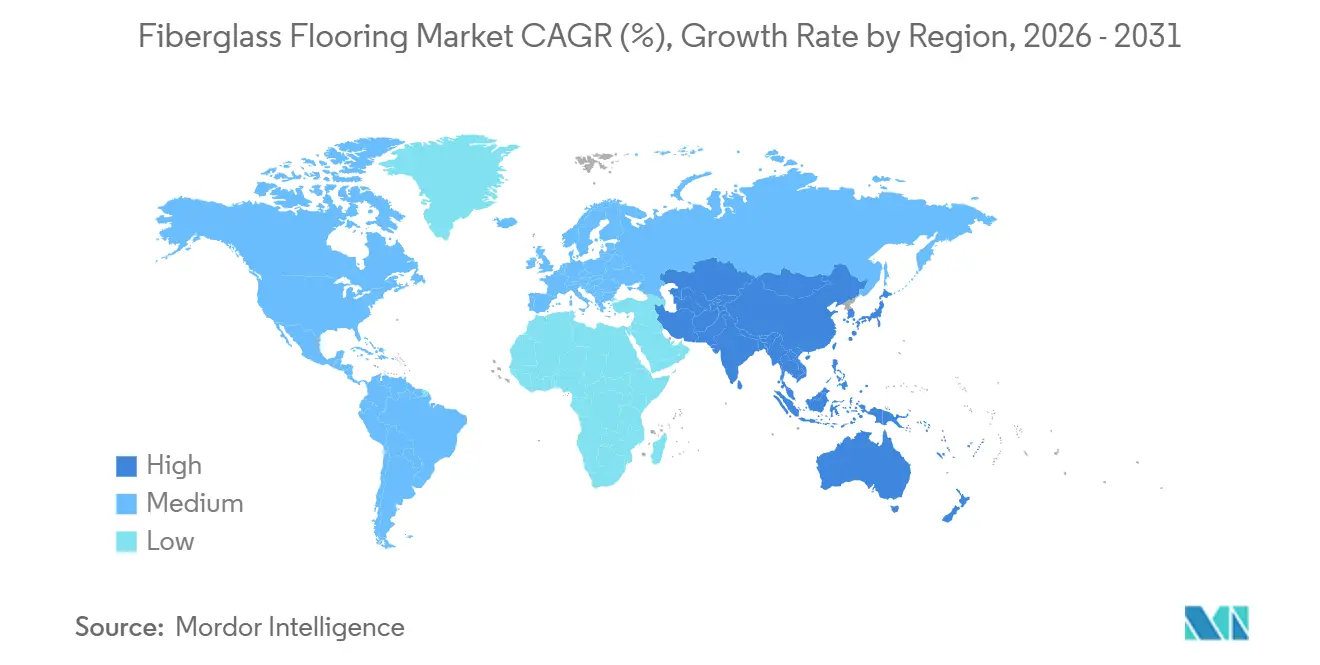
Asia-Pacific accounted for 44.83% of the fiberglass flooring market in 2025 and is projected to grow at a CAGR of 6.19% through 2031. China remains the region’s largest contributor, as commercial fit-out activity and infrastructure investment continue to support flooring specifications. India’s Pradhan Mantri Awas Yojana Urban 2.0 received an allocation of INR 2.2 lakh crore (USD 26.3 billion) for 2024-25, supporting a pipeline of affordable housing, schools, and community healthcare facilities[2]Ministry of Housing and Urban Affairs, “Pradhan Mantri Awas Yojana Urban 2.0 Budget Allocation,” Government of India, mohua.gov.in.. India also recorded 5.0% growth in industrial production in January 2025, supporting demand for commercial and industrial flooring. Japan’s indoor air quality requirements support demand for certified low-emission flooring, while manufacturers such as LX Hausys and NOX Corporation supply domestic and ASEAN commercial projects.
North America and Europe represent the largest revenue-generating regions outside Asia-Pacific, although their demand drivers differ. In North America, demand is primarily driven by the replacement of Vinyl Composition Tile (VCT) installed in schools, government buildings, and community health centers during the 1990s and early 2000s. Replacement projects increasingly use fiberglass-backed Luxury Vinyl Tile (LVT), supporting higher average selling prices across the installed commercial base. Europe experienced slower construction and renovation demand in 2025. Forbo Flooring Systems generated CHF 738.2 million (USD 824 million) in sales in 2025. Nordic countries and Germany continue to demonstrate demand for documented low-emission flooring and Environmental Product Declarations, while REACH requirements increase compliance costs for conventional plasticizer formulations.
South America, the Middle East, and Africa remain early-stage regions for specification-grade fiberglass flooring. Brazil accounts for the largest share of South American commercial construction and hospitality renovations, while economic volatility in Argentina slows the pace of upgrades. However, retail and healthcare facilities in Argentina continue to use resilient flooring specifications. Saudi Arabia’s Vision 2030-related construction programs support demand for hospitality, healthcare, and airport terminal fit-outs. South Africa also contributes demand through hospitality and private healthcare renovation projects. The fiberglass flooring market can serve these regions through expanded distribution agreements, as demand levels may not justify investments in new local manufacturing facilities. This approach enables established suppliers to meet regional project demand through existing channels without committing to a manufacturing footprint before demand reaches sufficient scale.

Competitive Landscape
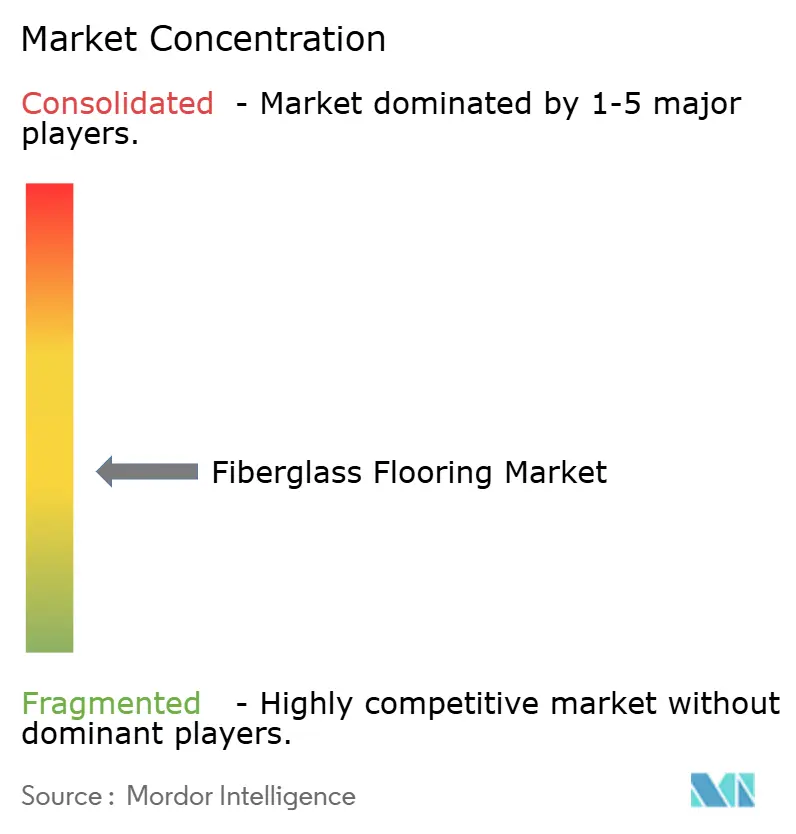
The fiberglass flooring market is moderately fragmented, with global players competing alongside regional specialists. Larger participants prioritize sustainable product credentials, surface-treatment chemistry, and specification support rather than commodity-based price competition. In April 2026, Mohawk Group acquired Hero Flooring, expanding its resilient flooring portfolio to include products featuring Nike Grind recycled content. The transaction combined sustainability and performance across resilient flooring categories. Opportunities exist in recycled or bio-based reinforcement materials and certified product offerings for healthcare and education projects in Southeast Asia. Product development focused on recyclability also addresses a constraint that may limit the adoption of multilayer fiberglass formats in green building procurement.
Digital print quality, precision installation systems, and anti-fouling treatments shape competition in the fiberglass flooring market. Digital printing enables stone and wood aesthetics without the material sourcing requirements associated with natural surfaces. Where floating installation is appropriate, click-lock engineering reduces certified installer labor time. Proprietary surface treatments extend maintenance intervals for commercial operators. Design libraries and faster color development also help suppliers compete for hospitality and corporate interior specifications. In North America and Northern Europe, institutional buyers often require third-party performance certifications. Consequently, the fiberglass flooring market favors suppliers that support design selection, product testing, and documented compliance throughout the specification process. Suppliers without certified credentials may lose access to commercial specification pipelines before price comparisons begin.
In February 2026, Interface launched Noravant as its first PVC-free resilient flooring platform, combining rubber performance with a Cradle to Cradle Silver-certified multilayer construction. The company states that the platform provides a service life of up to 35 years. Tarkett positions ReStart as a take-back program that accepts flooring from any manufacturer for repurposing or recycling. In 2025, Forbo’s Flooring Systems division generated sales of CHF 738.2 million (USD 824 million) through a commercial distribution network spanning 39 countries. The fiberglass flooring market supports suppliers that combine certified performance, channel coverage, and product stewardship. Regional specialists can maintain their positions through established relationships in defined applications or territories.
Fiberglass Flooring Industry Leaders
MOHAWK INDUSTRIES, INC.
Shaw Industries Group, Inc.
Tarkett
Gerflor
Mannington Commercial
- *Disclaimer: Major Players sorted in no particular order

Recent Industry Developments
- April 2026: Mohawk Group acquired Hero Flooring, a global resilient flooring brand with a portfolio centered on rubber products manufactured using Nike Grind recycled content from end-of-life footwear and manufacturing scrap. The acquisition expanded Mohawk Group's commercial flooring portfolio and presence in the fitness, healthcare, and commercial segments, supporting the broader fiberglass flooring market landscape.
- February 2026: Interface, Inc. launched Noravant, its first PVC-free resilient flooring platform, combining rubber performance with a Cradle to Cradle Silver-certified multilayer construction and a service life of up to 35 years. The debut product, Noravant Timber, features a woodgrain design in the rubber flooring category and is available across the Americas and select EMEA markets.


Global Fiberglass Flooring Market Report Scope
Fiberglass flooring is a durable, water-resistant surface made from glass fibers bonded with resin. Manufacturers use it as standalone resilient sheets or tiles, or as a reinforcing core layer in vinyl and industrial flooring.
The fiberglass flooring market is segmented by product type, application, and geography. By product type, the market is segmented into luxury vinyl tiles, vinyl composite tiles, and vinyl sheets. By application, the market is segmented into residential, commercial, and industrial. The report also covers market size and forecasts for fiberglass flooring across 15 countries in major regions. The market sizes and forecasts are provided in terms of value (USD).
| Luxury Vinyl Tiles |
| Vinyl Composite Tiles |
| Vinyl Sheets |
| Residential |
| Commercial |
| Industrial |
| Asia-Pacific | China |
| India | |
| Japan | |
| South Korea | |
| ASEAN Countries | |
| Rest of Asia-Pacific | |
| North America | United States |
| Canada | |
| Mexico | |
| Europe | Germany |
| United Kingdom | |
| France | |
| Italy | |
| NORDIC Countries | |
| Rest of Europe | |
| South America | Brazil |
| Argentina | |
| Rest of South America | |
| Middle East and Africa | Saudi Arabia |
| South Africa | |
| Rest of Middle East and Africa |
| By Product Type | Luxury Vinyl Tiles | |
| Vinyl Composite Tiles | ||
| Vinyl Sheets | ||
| By Application | Residential | |
| Commercial | ||
| Industrial | ||
| By Geography | Asia-Pacific | China |
| India | ||
| Japan | ||
| South Korea | ||
| ASEAN Countries | ||
| Rest of Asia-Pacific | ||
| North America | United States | |
| Canada | ||
| Mexico | ||
| Europe | Germany | |
| United Kingdom | ||
| France | ||
| Italy | ||
| NORDIC Countries | ||
| Rest of Europe | ||
| South America | Brazil | |
| Argentina | ||
| Rest of South America | ||
| Middle East and Africa | Saudi Arabia | |
| South Africa | ||
| Rest of Middle East and Africa | ||


Key Questions Answered in the Report
What is current market size of Fiberglass Flooring Market?
The Fiberglass Flooring Market size is projected to be USD 0.94 billion in 2025, USD 0.99 billion in 2026, and reach USD 1.28 billion by 2031, growing at a CAGR of 5.34% from 2026 to 2031.
Which product type leads fiberglass flooring sales?
Luxury vinyl tiles led with 46.32% revenue share in 2025, while vinyl composite tiles are projected to record the fastest product growth at a 6.07% CAGR.
Which application has the strongest demand for fiberglass flooring?
Commercial applications led with 53.45% revenue share in 2025 and are forecast to grow at a 6.31% CAGR through 2031.
Which region leads fiberglass flooring demand?
Asia-Pacific held 44.83% revenue share in 2025 and is forecast to expand at a 6.19% CAGR through 2031.
Page last updated on:





