
Ferric Chloride Market Size and Share
Market Overview
| Study Period | 2020 - 2031 |
|---|---|
| Market Size (2026) | USD 8.05 Billion |
| Market Size (2031) | USD 10.36 Billion |
| Growth Rate (2026 - 2031) | 5.18 % |
| Fastest Growing Market | South America |
| Largest Market | Asia Pacific |
| Market Concentration | Medium |
Major Players *Disclaimer: Major Players sorted in no particular order Image © Mordor Intelligence. Reuse requires attribution under CC BY 4.0. | |
Ferric Chloride Market Analysis by Mordor Intelligence
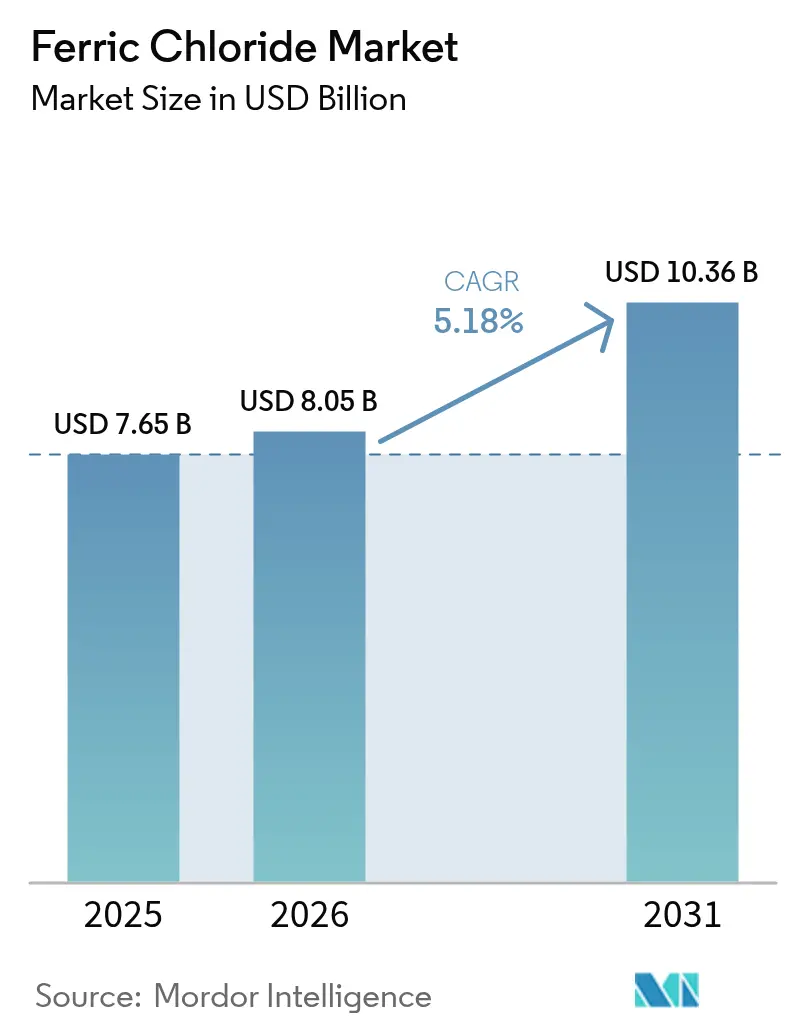
The Ferric Chloride Market size was valued at USD 7.65 billion in 2025 and estimated to grow from USD 8.05 billion in 2026 to reach USD 10.36 billion by 2031, at a CAGR of 5.18% during the forecast period (2026-2031). Rapid urbanization and rigorous wastewater treatment mandates, together with the electronics sector’s demand for high-purity etchants, underpin steady volume gains and value expansion. Increasing capital spending on municipal plants, the scaling of printed circuit board (PCB) fabrication, and early commercial deployment of iron-based energy-storage chemistry are broadening use cases beyond legacy coagulation. Pricing differentiation is widening as specialized grades command premiums that offset modest volume growth in commodity categories, while regulatory compliance ensures resilient baseline demand even during macro-economic slowdowns.
Key Report Takeaways
- By grade, Industrial/Technical offerings captured 73.10% ferric chloride market share in 2025. Electronic Grade is advancing at a 5.72% CAGR through 2031, the fastest pace among all grades.
- By application, Water and Wastewater Treatment held 62.85% of the ferric chloride market size in 2025. PCB manufacturing is forecast to expand at a 5.61% CAGR between 2026 and 2031.
- By geography, Asia-Pacific accounted for 45.05% of global revenues in 2025; South America is growing at a 5.38% CAGR through 2031.
Note: Market size and forecast figures in this report are generated using Mordor Intelligence’s proprietary estimation framework, updated with the latest available data and insights as of 2026.
Global Ferric Chloride Market Trends and Insights
Drivers Impact Analysis*
| Driver | (~) % Impact on CAGR Forecast | Geographic Relevance | Impact Timeline |
|---|---|---|---|
| High demand from municipal and industrial wastewater plants | +1.80% | Global, focus on Asia-Pacific and North America | Long term (≥ 4 years) |
| Stricter discharge norms for heavy-metal and nutrient removal | +1.20% | North America and EU, expanding to Asia-Pacific | Medium term (2-4 years) |
| Infrastructure push boosting asphalt-blowing demand | +0.70% | Middle East and South America | Medium term (2-4 years) |
| Adoption in e-scrap hydrometallurgy and copper recovery | +0.60% | Asia-Pacific core, spill-over to North America | Long term (≥ 4 years) |
| Emerging use in iron-based redox-flow batteries | +0.90% | North America & EU, with APAC manufacturing | Long term (≥ 4 years) |
| Source: Mordor Intelligence | |||
High Demand from Municipal and Industrial Wastewater Plants
Global investment in municipal wastewater systems is projected to top USD 1 trillion by 2033 as cities upgrade aging infrastructure and expand capacity to meet rising urban populations. These projects directly elevate coagulant consumption because ferric chloride achieves reliable turbidity reduction while precipitating phosphorus and heavy metals in a single dosing step. Industrial demand is also ratcheting higher as reshoring of chemical and electronics manufacturing compels facilities to meet tougher pretreatment thresholds before discharging to municipal sewers. The chemical’s dual utility—process reagent and effluent coagulant—streamlines plant inventories and boosts procurement efficiencies, strengthening its preference when lifecycle costs are considered.
Stricter Discharge Norms for Heavy-Metal and Nutrient Removal
The United States Environmental Protection Agency’s 2024 rulemaking tightens nationwide phosphorus discharge limits to 0.5 mg/L for large plants, while EU Directive 2024/3019 imposes a 0.5–0.7 mg/L range on urban facilities[1]EUR-Lex, “Directive 2024/3019 on Urban Wastewater Treatment,” eur-lex.europa.eu . These thresholds reduce allowable nutrient loads by roughly one-third versus the previous regime, triggering higher ferric chloride dosing because iron(III) chemistry forms stable ferric phosphate flocs at low residual concentrations. Local regulators are cascading the standards to smaller plants, locking in chemical demand independent of broader economic cycles. Plants switching from aluminum to iron coagulants cite 15% lower total phosphorus levels and fewer post-precipitation polishing steps, solidifying the driver’s multi-year impact.
Infrastructure Push Boosting Asphalt-Blowing Demand
Ferric chloride catalyzes controlled oxidation in asphalt blowing, increasing binder viscosity and high-temperature stability for heavy-load pavements[2]G. I. Egorova et al., “Innovations in Asphalt Concrete,” iopscience.iop.org . Middle Eastern highway expansions and Brazil’s national logistics upgrade plan both specify polymer-modified or chemically blown asphalts for lanes expected to see greater than 50,000 trucks daily. Formulators report 8% lower rut depth after five years in desert climates when ferric chloride is used versus traditional catalysts. Although this niche consumes less tonnage than water treatment, average realized prices are three times higher, contributing disproportionately to aggregate revenue growth and raising the ferric chloride market’s value density.
Adoption in E-Scrap Hydrometallurgy and Copper Recovery
Asia-Pacific recyclers processing 13 million tons of electronic waste yearly increasingly favor ferric chloride leaching because the reagent selectively dissolves copper while preserving precious metals for secondary recovery. Pilot plants in Malaysia recorded copper extraction yields above 95% and 20% lower greenhouse-gas intensity than pyrometallurgical routes. North American operators are adapting the flowsheets to handle complex multilayer PCBs, which augments reagent demand and creates an outlet for by-product hydrochloric acid captured from integrated chlor-alkali units. Over the long term, e-waste growth of 3–5% annually sustains this driver.
Restraints Impact Analysis*
| Restraint | (~) % Impact on CAGR Forecast | Geographic Relevance | Impact Timeline |
|---|---|---|---|
| Availability of substitute coagulants (poly-aluminium chloride, alum) | -0.80% | Price-sensitive markets worldwide | Medium term (2-4 years) |
| Corrosive handling and storage requirements | -0.50% | Regions lacking advanced infrastructure | Short term (≤ 2 years) |
| Volatility in iron-scrap supply chain | -0.60% | Global, with concentration in regions dependent on scrap imports | Short term (≤ 2 years) |
| Source: Mordor Intelligence | |||
Availability of Substitute Coagulants
Poly-aluminium chloride (PAC) achieves equal turbidity removal at 10–15% lower dose rates and generates less sludge, giving utilities a clear operating-cost advantage in cold-climate regions. Alum remains attractive where sludge disposal fees are minimal and pH control is straightforward. Competitive pressure therefore compresses margins in commodity segments, especially for utilities tendering strictly on delivered cost. However, ferric chloride retains technical leadership in simultaneous phosphorus and arsenic removal, which balances the restraint in markets governed by tighter effluent standards.
Corrosive Handling and Storage Requirements
Ferric chloride’s aggressive acidity mandates fiberglass-reinforced tanks, corrosion-resistant pumps, and full-face personal protective equipment, inflating capital outlays for small utilities. Operators report maintenance costs two to three times higher than neutral pH coagulants, and accidental releases can rapidly degrade concrete containment. Innovations such as peristaltic metering pumps reduce leakage risk, yet the base chemistry remains inherently corrosive, deterring adoption in plants with limited maintenance budgets.
*Our forecasts treat driver/restraint impacts as directional, not additive. The impact forecasts reflect baseline growth, mix effects, and variable interactions.
Segment Analysis
By Grade: Industrial Dominance Amid Electronic Specialization
Industrial/Technical products accounted for 73.10% ferric chloride market share in 2025, supplying utilities and general industry where cost efficiency is paramount. Electronic Grade is expanding at 5.72% CAGR through 2031, reinforcing the ferric chloride market size in high-value niches. Rigorous impurity thresholds below 10 ppm metals prevent PCB under-etching and ensure circuit fidelity, justifying three-to-four-fold premiums over commodity grades. Food and Pharma material remains a small but stable contributor, anchored by feed premix use for iron supplementation in poultry and swine operations.
Manufacturing complexity is rising. Electronic Grade producers integrate crystallization, micro-filtration, and nitrogen-blanketed storage to maintain batch consistency. These barriers restrict new entrants, helping incumbents protect margins even as raw-material costs fluctuate. Meanwhile, Industrial Grade suppliers invest in energy-efficient chlorination reactors and closed-loop hydrochloric acid recovery to stay competitive on delivered cost.




By Application: Water Treatment Leadership Challenged by Electronics Growth
Water and Wastewater Treatment represented 62.85% of the ferric chloride market size in 2025, benefiting from mandatory municipal procurement schedules and multi-year infrastructure commitments. PCB production posts the fastest CAGR at 5.61%, reflecting surging server, smartphone, and electric-vehicle electronics output. In this segment, chemical cost is dwarfed by the end-product’s value; therefore, buyers prioritize purity and process support. Asphalt blowing uptake is accelerating in equatorial climates where high pavement temperatures shorten service life. Pigment manufacturing and animal nutrient supplementation supply steady baseline demand, smoothing revenue against cyclical downturns in single sectors.
Process expertise is now a selling point. Suppliers offering digital feed-and-bleed control algorithms for ferric regenerators in PCB shops report 12-month paybacks for customers, fostering stickier contracts. In water utilities, bundled services such as jar-test optimization continue to shift procurement decisions from lowest price to total cost of compliance.

Geography Analysis
Asia-Pacific commanded 45.05% of global revenue in 2025 on the back of vertically integrated electronics and strong municipal infrastructure spending. China’s PCB capacity additions, India’s AMRUT-2 water reforms, and Southeast Asia’s battery supply-chain investments sustain top-line growth. Governments subsidize local chlor-alkali capacity, reducing import dependence and supporting favorable delivered pricing. The ferric chloride market share in the region is therefore unlikely to erode over the forecast horizon.
South America is the fastest mover with a 5.38% CAGR, catalyzed by Brazil’s USD 145 billion wastewater and sanitation program through 2033. Projects mandate advanced coagulation solutions to meet impending discharge norms, pivoting utilities toward iron chemistry. Argentina’s chemical sector expansion, including GR Química’s USD 24 million water-treatment build-out, further energizes regional offtake.
North America and Europe form mature arenas yet still log incremental volume gains as utilities retrofit plants to meet new phosphorus caps. Local supply resilience is strengthening; Chlorum Solutions’ USD 70 million Arizona chlor-alkali plant will cut freight distances by 500 miles for Southwest buyers, reducing carbon footprints and delivery risks. The Middle East and Africa remain nascent but promising: desalination reliance and megacity construction demand robust coagulant solutions, though budget and technical capacity constraints temper immediate scale.


Value Chain Analysis
Ferric chloride supply begins with upstream inputs including iron-bearing feedstocks (scrap iron, mill scale, iron ore, and steel-industry by-products such as spent pickling liquor) and chlor-alkali derivatives (chlorine and hydrochloric acid). Production routes convert these inputs into solution or solid forms, with purification and controlled handling steps becoming more stringent for electronic-grade material. Because the value chain is closely coupled to steel and chlor-alkali operating rates, shifts in pickling activity or chlorine/HCl availability can tighten regional supply and raise delivered costs.
Midstream logistics and downstream distribution are highly localized because transporting ferric chloride solutions is cost intensive and constrained by corrosive-handling requirements. This typically pushes producers to locate near steel sites, chlor-alkali assets, and major municipal or industrial customers. Sales commonly flow through direct supply contracts to water and wastewater utilities and industrial users, supported by storage, transloading, and dosing-system compatibility services. End-use demand is led by municipal and industrial water treatment, with additional pull from PCB etching and other specialty applications that reward consistent quality and technical support rather than lowest-price spot purchasing.
Competitive Landscape
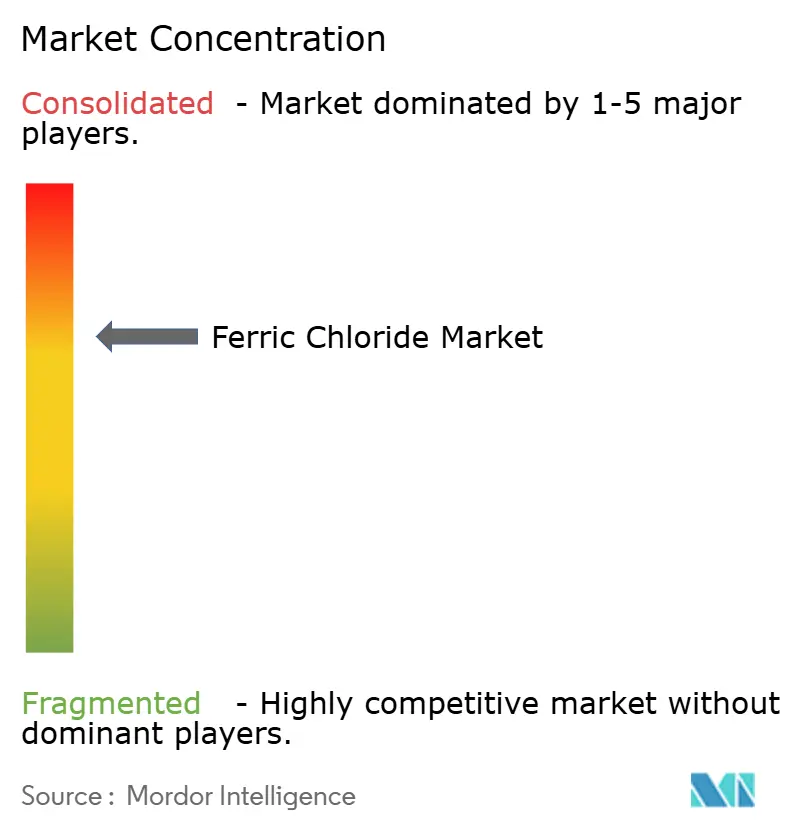
The ferric chloride market exhibits consolidated concentration. Global leadership rests with BASF, Kemira, among others, whose integrated chlor-alkali and downstream assets yield cost and logistics advantages. Collectively, the top five vendors hold roughly 58% of 2024 sales, indicating moderate concentration. Regional specialists such as Gujarat Alkalies, DCW Ltd., and Chlorum Solutions leverage proximity to end-users and lower freight to defend share. Technology partnerships are reshaping the field: Kemira’s 2024 decision to expand Tarragona output specifically for biogas digestion aid aligns product customization with growth verticals. Equipment innovators also influence purchase decisions; Saur’s deployment of Qdos pumps for corrosive chemical dosing improved uptime by 30%, favoring suppliers that certify compatibility.
Consolidation momentum is likely to continue as smaller producers grapple with the capital intensity of brine purification, neutral brine towers, and waste-acid recovery upgrades required under tightening emission rules. Strategic acquisitions that secure geographic gaps or add Electronic Grade capacity appear probable through 2030.
Ferric Chloride Industry Leaders
BASF
BCI
Kemira
PVS Chemicals, Inc.
Tessenderlo Group
- *Disclaimer: Major Players sorted in no particular order

Market Opportunities and Future Outlook
Compliance-driven phosphorus removal remains a primary whitespace for ferric chloride value capture, particularly where utilities tighten nutrient limits and shift procurement toward performance-backed dosing programs instead of commodity tenders. Supplier differentiation is also increasing through application support, such as jar testing and dosing optimization, along with equipment compatibility for corrosive chemicals that helps customers manage sludge, maintenance, and total cost of compliance. Another opportunity centers on combining ferric chloride with coagulant aids and complementary chemistries to reduce variability in treatment outcomes and improve dewatering performance, aligning with plants that are optimizing chemical use rather than just increasing volumes.
Specialty water-treatment use cases are also creating incremental demand pockets tied to active investments and acquisitions. Kemira has tied ferric chloride capacity expansion in Tarragona, Spain, to biogas applications (BDP) and wastewater phosphorus removal, with the expanded capacity planned to be operational during 2026, which points to targeted supply for higher-value treatment programs. Separately, circular-economy and sustainability research, including work on producing ferric chloride from alternative sources such as acid mine drainage, points to a route to diversify feedstocks and reduce reliance on conventional iron and chlor-alkali availability in regions exposed to supply chain volatility.
Recent Industry Developments
- February 2026: Kemira announced the acquisition of SIDRA Wasserchemie, adding two coagulant production facilities in Germany and expanding its water treatment footprint in Western and Central Europe. The acquisition improves local supply access for iron-based coagulants and broadens Kemira's ability to serve municipal and industrial customers with tighter delivery and service requirements.
- January 2026: Pencco Inc. was authorized by the City of Austin to supply liquid ferric chloride and liquid ferrous chloride for Austin Water. The authorization highlights the localized nature of municipal coagulant procurement and supports baseline consumption tied to wastewater treatment operations.
- July 2024: Kemira announced plans to expand ferric chloride capacity at Tarragona, Spain, to support production of specialized biogas digestion products (BDP) and increase supply for wastewater phosphorus removal. The project links capacity additions to higher-spec water and biogas applications where reliability of supply and consistent product performance factor into customer contracts.


Research Methodology Framework and Report Scope
Market Definition and Coverage
For this methodology, the ferric chloride market is defined as the global revenues generated from ferric chloride sold in liquid and solid forms across end uses such as water treatment, electronics etching, and process industries, reported in current US dollars.
Scope exclusions: We exclude on-site captive transfers with no external sale value and downstream services like water treatment plant operations where ferric chloride is only an input.
Segmentation Overview
- By Grade
- Industrial/Technical Grade
- Electronic Grade
- Food and Pharma Grade
- By Application
- Water and Wastewater Treatment
- Printed Circuit Board (PCB)
- Pigment Manufacturing
- Animal Nutrient Supplements
- Asphalt Blowing
- Other Applications
- By Geography
- Asia-Pacific
- China
- Japan
- India
- South Korea
- Rest of Asia-Pacific
- North America
- United States
- Canada
- Mexico
- Europe
- Germany
- United Kingdom
- France
- Italy
- Rest of Europe
- South America
- Brazil
- Argentina
- Rest of South America
- Middle East and Africa
- Saudi Arabia
- South Africa
- Rest of Middle East and Africa
- Asia-Pacific
Data Sources, Market Sizing, and Validation
Desk Research
Desk work starts by mapping the demand pool and price signals that can be checked without paywalls. We mainly refer to public sources such as USGS mineral and chemical statistics, UN Comtrade trade flows, World Bank and IMF macro indicators, and environmental agency publications that track wastewater treatment compliance and investment.
To make the market model usable, we also rely on widely available company annual reports, investor presentations, and plant announcements for capacity additions and operating rate commentary. Patent databases are referenced to understand newer purity needs for electronics and etchants and how that can change average pricing over time. A limited set of paid subscriptions is used only for company financials and shipment-level trade checks, and then the numbers are reconciled with the public trail. The sources listed above are illustrative, and we also reviewed many other public datasets and documents for data collection, validation, and clarification.
Primary Interviews and Surveys
Primary discussions are used to validate how ferric chloride is bought and priced across water utilities, industrial users, and distributors, and then to confirm what grades are truly comparable across regions. We interview manufacturers, channel partners, and large end users so that assumptions on utilization, import reliance, and price pass-through can be corrected when desk signals are weak. Since this is a global market, input was balanced across APAC, EMEA, and the Americas to avoid over-reading any single region's supply-demand situation.
Distribution of primary research fieldwork respondents
| Company type | Respondent position | Region |
|---|---|---|
| Top tier: 32% | CXOs: 14% | APAC: 41% |
| Mid tier: 53% | Functional/Unit leaders: 41% | EMEA: 34% |
| Smaller Players: 15% | Managers: 45% | Americas: 25% |
Market-Sizing & Forecasting
Sizing is built using a top-down demand reconstruction, where water and wastewater treatment chemical consumption, PCB and electronics etching activity, and industrial processing needs are translated into ferric chloride volumes and then priced into revenues. The model is checked through selective bottom-up approximations, including sampled supplier capacity by region, channel markups, and typical contract pricing ranges, which helps adjust totals when public data has gaps.
A few inputs that matter most in this market are municipal wastewater capex cycles, nutrient and phosphorus discharge rules that push coagulant dosing, PCB output trends, import and export balance for ferric salts, and the spread between industrial grade and higher purity material used for electronics. For forecasting, we use scenario analysis supported by simple multivariate relationships between demand drivers, such as wastewater investment and electronics output, and observed market volumes, then progress pricing using expected raw material and energy cost direction that we validated through interviews. Where bottom-up checks are incomplete, we avoid forcing precision and instead apply conservative fill rates that are reviewed region by region before finalizing the number.
Data Validation & Update Cycle
Model outputs are triangulated against independent signals like trade flows, capacity announcements, and application-level demand indicators. When a large variance shows up, we re-check it back to the source logic, particularly around grade mix and contract timing. Outliers are investigated through additional desk review and, when needed, follow-up calls so that differences in grade mix, contract timing, and currency conversion are not accidentally treated as real market growth.
Before sign-off, the work goes through multiple analyst reviews that test assumptions, math, and consistency across regions and applications. The report is refreshed on an annual cycle, and interim updates are triggered when major capacity changes, regulatory shifts, or sudden price movements are observed. Right before delivery, a final quick pass is done so clients receive the most current view possible.
Mordor Intelligence's Ferric Chloride Market Size Versus Other Published Estimates
Published ferric chloride market values often differ because the scope boundary is not the same across studies, and because price assumptions can move materially when grades and contract terms are mixed together. Differences also show up when one estimate is more volume-led and another is more price-led, even if the same end uses are discussed.
The benchmark table shows a spread that is mainly explained by which grades and applications are counted together, and how the base year is set when prices were volatile in some regions. In Mordor Intelligence's model, revenues are counted only for ferric chloride sold into defined applications, including water and wastewater treatment and electronics-related etching, and pricing is normalized through grade-mix checks rather than using a single blended global average.
Benchmark comparison
| Source | Market Size | Gaps in Research Methodology |
|---|---|---|
| Mordor Intelligence | USD 8.05 B (2026) | |
| Global Consultancy A | USD 7.97 B (2024) | Uses an earlier base year and a narrower product and application structure, which can understate the impact of later pricing changes and may not fully separate higher purity material used in electronics from general industrial volumes. |
| Industry Publisher B | USD 8.14 B (2025) | Combines multiple ferric chloride physical forms and end uses with broad grade buckets, and its base year sits between different price cycles, which can shift the value result when average selling price progression is applied uniformly. |
Across the three values, the main takeaway is that year selection and grade-mix treatment can move the total even when the same demand drivers are cited. Our approach stays traceable because each major end-use demand pool is built from a few measurable indicators, and then pricing is cross-checked with primary inputs before the final number is locked.


Key Questions Answered in the Report
How large is the ferric chloride market in 2026?
The ferric chloride market size stands at USD 8.05 billion in 2026.
What is the forecast CAGR for ferric chloride from 2026 to 2031?
The market is projected to grow at a 5.18% CAGR through 2031.
Which grade shows the fastest growth through 2031?
Electronic Grade is expanding at a 5.72% CAGR due to rising PCB demand.
Why is South America the fastest-growing region?
Brazil’s USD 145 billion wastewater outlay and Argentina’s chemical expansion push regional CAGR to 5.38%.
What drives substitution risk in water treatment?
Poly-aluminium chloride offers lower dosing and sludge volumes, pressuring ferric chloride adoption in cost-sensitive utilities.
Page last updated on:


 Your data is secure and never sold or shared.


