
Extended-SWIR Imaging Systems Market Size and Share
Market Overview
| Study Period | 2020 - 2031 |
|---|---|
| Market Size (2026) | USD 118.04 Million |
| Market Size (2031) | USD 225.23 Million |
| Growth Rate (2026 - 2031) | 13.79 % |
| Fastest Growing Market | Asia-Pacific |
| Largest Market | North America |
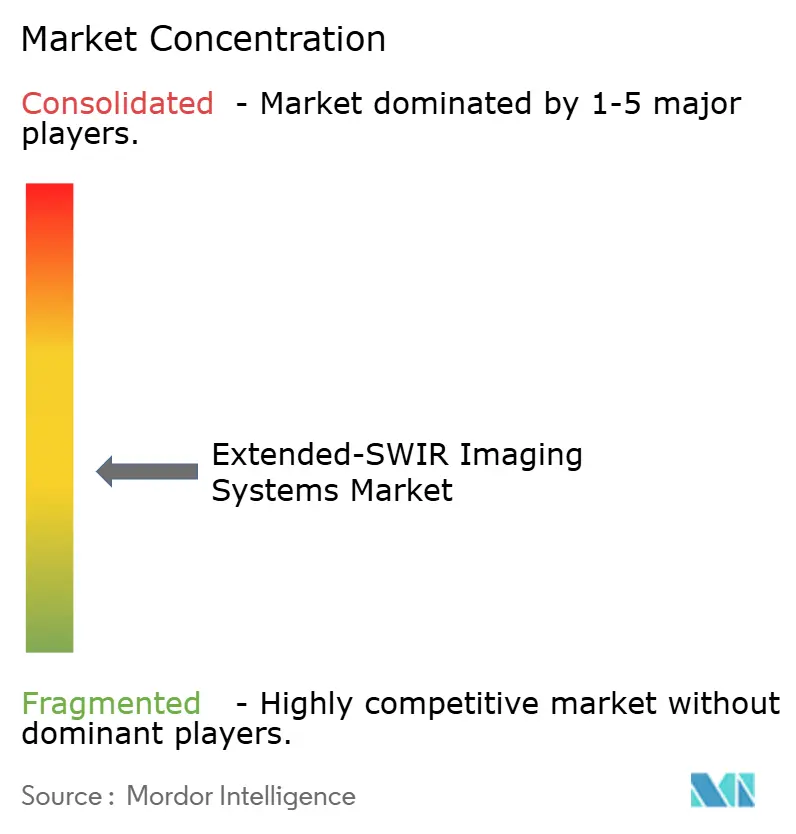
| Market Concentration | Medium |
Major Players
*Disclaimer: Major Players sorted in no particular order Image © Mordor Intelligence. Reuse requires attribution under CC BY 4.0. |
|
Extended-SWIR Imaging Systems Market Analysis by Mordor Intelligence
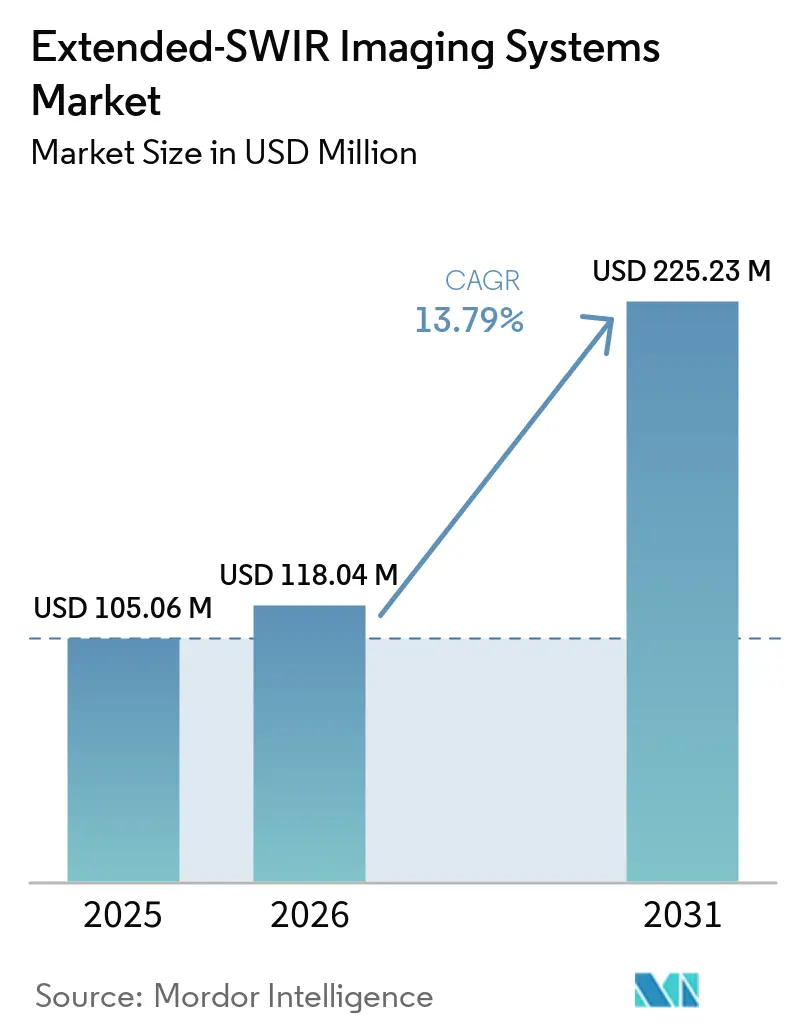
The Extended-SWIR Imaging Systems Market size is projected to expand from USD 105.06 million in 2025 to USD 118.04 million in 2026, and to USD 225.23 million by 2031, registering a CAGR of 13.79% between 2026 and 2031. Extended-SWIR imaging covers wavelengths beyond the conventional 1.7 µm InGaAs cutoff, reaching atmospheric transmission windows up to 2.7 µm. This range can reveal chemical absorption, material composition, and spectral contrast that standard SWIR systems cannot detect in the Extended-SWIR Imaging Systems Market. Compact thermoelectric and room-temperature designs are replacing laboratory-grade, cryogenic-cooled assemblies in more field applications. Defense procurement and AI-supported industrial inspection are expanding demand across established and newer uses. The Extended-SWIR Imaging Systems Market is also benefiting from systems that can be installed on gimbals and conveyor lines rather than only in fixed laboratory settings.
Key Report Takeaways
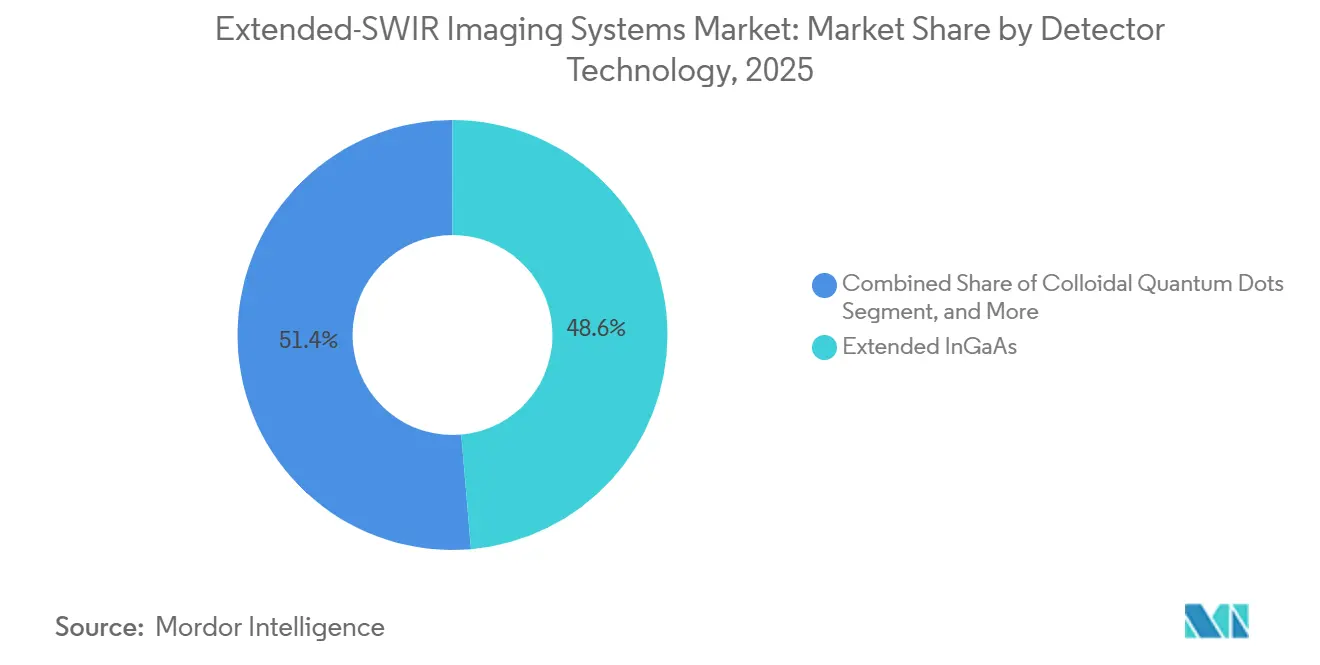
- By detector technology, extended InGaAs held 48.62% of the Extended-SWIR Imaging Systems Market share in 2025, while colloidal quantum dots are forecast to grow at a 15.64% CAGR through 2031.
- By wavelength range, 1.7 to less than 1.9 µm accounted for 28.47% of total revenue in 2025, while 2.5 to 2.7 µm is forecast to grow at a 15.27% CAGR through 2031.
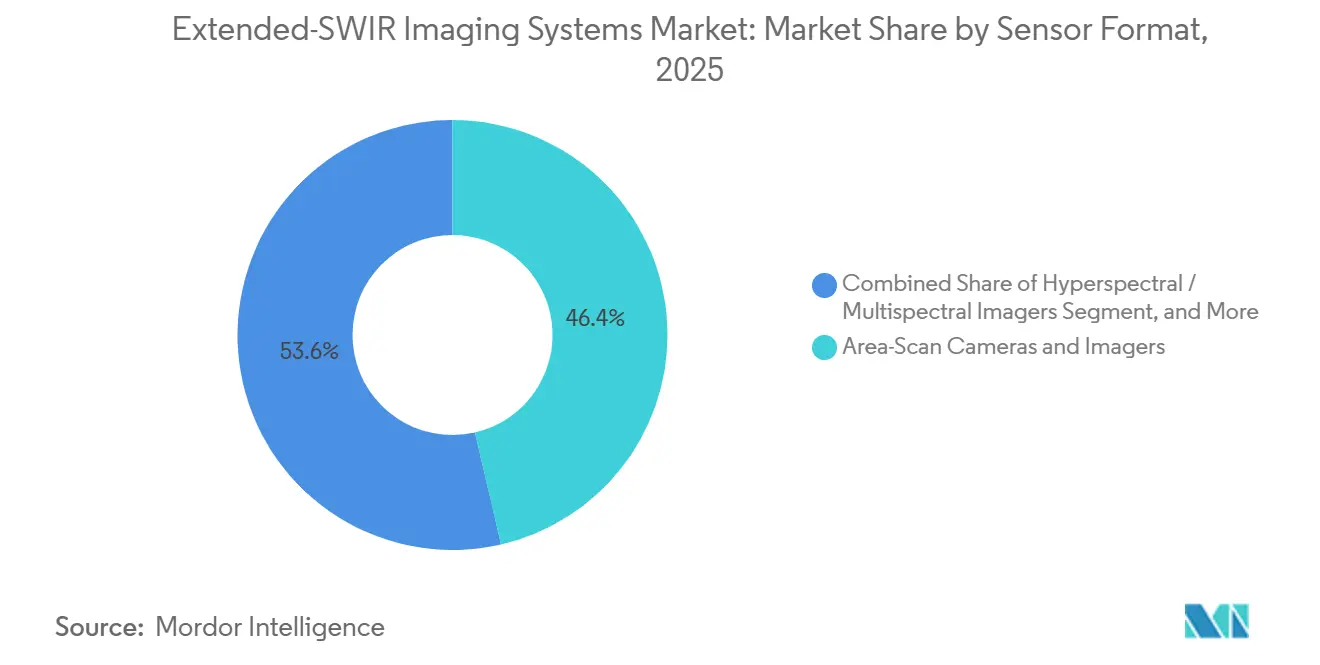
- By sensor format, area-scan cameras and imagers held 46.38% Extended-SWIR Imaging Systems Market share in 2025, while hyperspectral and multispectral imagers are forecast to grow at a 16.86% CAGR through 2031.
- By end-user industry, aerospace and defense held 35.74% share in 2025, while automotive and transportation are forecast to grow at a 15.92% CAGR through 2031.
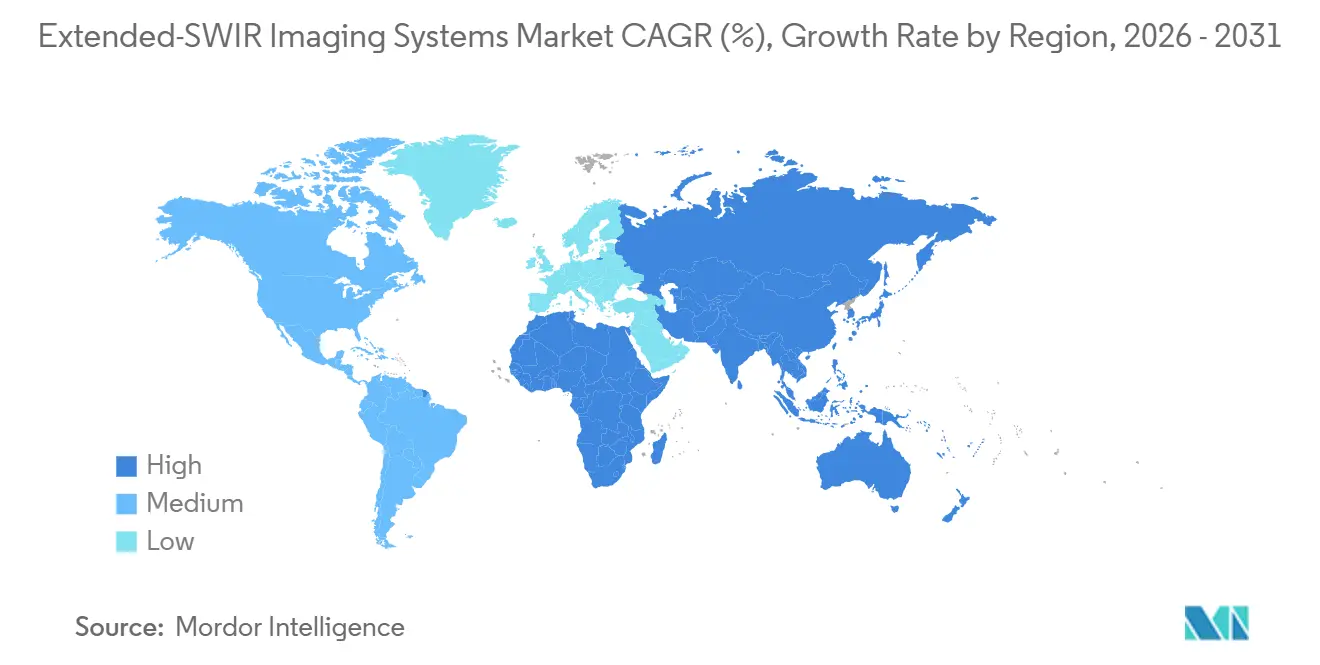
- By geography, North America held 37.16% share of the Extended-SWIR Imaging Systems Market in 2025, while Asia-Pacific is forecast to grow at a 16.48% CAGR through 2031.
Note: Market size and forecast figures in this report are generated using Mordor Intelligence’s proprietary estimation framework, updated with the latest available data and insights as of January 2026.
Global Extended-SWIR Imaging Systems Market Trends and Insights
Defense and Aerospace Modernization
Defense investment is changing system requirements for combat and intelligence, surveillance, and reconnaissance platforms. Procurement programs increasingly seek multispectral payloads instead of single-band cameras. A U.S. Navy SBIR solicitation seeks simultaneous extended-SWIR and mid-wave infrared imaging within one Dewar cooler assembly. It specifies operation between 100 K and 160 K, f/1.5 optics, and 4-megapixel resolution.[1] The requirement supports demand for systems that combine multiple sensing modes on defense platforms. The Extended-SWIR Imaging Systems Market, therefore, offers opportunities in which laser detection, target recognition, and operation through obscurants must be delivered in a single payload. SCD’s SWIFT-EI uses a neuromorphic event-detection stream to support high-frame-rate sensing with lower continuous power demand. This design addresses the weight, power, and volume limits that have restricted smaller platforms. SPIE proceedings from 2025 also described eSWIR avalanche photodiodes for remote sensing and laser spot tracking, including coded spot tracking from airborne platforms. In April 2026, MKS Instruments introduced the Ophir SWIR 50 to 1,000 mm f/5.5 to 9.5 continuous zoom lens for surveillance and security missions. The lens supports vehicle detection beyond 35 km and detects laser wavelengths at 850 nm, 905 nm, 1,064 nm, and 1,550 nm. These product choices show why suppliers are combining optical, detector, and processing capabilities for defense users.
Industrial Inspection for Difficult-to-Measure Materials
Extended-SWIR wavelengths beyond 1.9 µm can distinguish polymers, moisture patterns, and mineral species that appear similar in standard SWIR bands. This creates a clear inspection benefit in settings where material separation affects yield or compliance. The ability to inspect silicon and other materials beyond the visible spectrum is relevant to advanced packaging workflows. As 3D-NAND and high-bandwidth memory deployments increase, non-destructive inspection becomes more relevant to production yield. The Extended-SWIR Imaging Systems Market can therefore gain from factories that need inspection beyond the surface of a silicon device. In 2025, Hamamatsu Photonics commercialized an InGaAs area image sensor with a spectral response extending to 2.55 µm. The product was positioned to identify flame-retardant resins in mixed plastics, which standard SWIR classification may not effectively separate. This capability matters for recycling operators working with more complex plastic streams. These sensor capabilities can support sorting, inspection, and material verification across industrial applications. The Extended-SWIR Imaging Systems Market is thus less dependent on a single factory use case than conventional camera categories.
Expansion of AI-Enabled Spectral Classification
Machine learning is moving extended-SWIR systems from data capture toward real-time material assessment. This can reduce the need for separate spectrometer hardware and specialized post-processing. IEEE research published in 2026 described a 4.19-megapixel colloidal quantum dot-based SWIR sensor with on-chip multistep single-slope analog-to-digital converters.[2] The sensor achieved 30 fps at 20 MHz and had a fill factor above 81%. Monolithic integration can reduce the flip-chip bonding costs associated with traditional SWIR sensors. This makes lower-cost architectures more relevant to the Extended-SWIR Imaging Systems Market. Teledyne DALSA launched its Kaleido SWIR hyperspectral camera in May 2026. The camera includes onboard spectral band selection and aberration correction. These features are designed to keep calibration consistent across production settings. Band-selection research in urban driving found that a 3-band strategy improved target separability by 70% to 1,200% compared with RGB imaging. Simpler spectral designs may therefore meet requirements that once required complete spectral cubes. This widens the addressable customer base beyond specialist photonics integrators.[3]
Demand for Low-SWaP Extended-Wavelength Payloads
Uncrewed aerial vehicles, portable equipment, and small satellites have strict weight, power, and volume requirements. These constraints are moving systems away from bulky Dewar assemblies toward compact thermoelectric and Stirling-cooled formats. In 2026, Emberion introduced a serial digital interface version of its colloidal quantum dot-based eSWIR camera for defense and UAV uses. The company also presented wafer-level-packaged sensor prototypes intended to reduce volume production unit costs. These designs support lower latency and easier system interoperability. The Extended-SWIR Imaging Systems Market benefits when sensor packages can fit platforms with limited payload capacity. Raptor Photonics introduced the Kestrel 640 eSWIR in April 2026 for airborne, scientific, and surveillance uses. The Stirling-cooled camera uses an IRnova T2SL sensor and reaches 170 K. It covers 0.9-2.5 µm without requiring cryogenic infrastructure. T2SL and colloidal quantum dot architectures can work at thermoelectric or compact Stirling-cooled temperatures. This reduces the burden of the cryocooler, which historically drove much of the system weight, power use, and maintenance demand. This change supports portable deployment in the Extended-SWIR Imaging Systems Market.[4]
Restraints Impact Analysis*
| Restraint | (~) % Impact on CAGR Forecast | Geographic Relevance | Impact Timeline |
|---|---|---|---|
| High Detector, Optics, and Calibration Costs | -2.1% | Global | Short term (≤ 2 years) |
| Export Controls and Trusted-Supply Requirements | -1.5% | North America, Europe, and Asia-Pacific | Medium term (2-4 years) |
| Extended-Range Yield and Dark-Current Trade-Offs | -1.1% | Global | Long term (≥ 4 years) |
| Limited Application-Specific Software and Skilled Integrators | -0.8% | Emerging markets in Asia-Pacific and South America | Long term (≥ 4 years) |
| Source: Mordor Intelligence | |||
High Detector, Optics, and Calibration Costs
Extended-SWIR imaging has a higher entry cost than standard SWIR imaging. Extending InGaAs response beyond 1.7 µm requires greater indium content in the In1-xGaxAs alloy. This increases lattice mismatch and threading dislocation density. The result can be lower detector operability and higher array costs. Longer wavelength cutoffs also worsen dark-current trade-offs. The Extended-SWIR Imaging Systems Market remains constrained, with buyers unable to support stronger cooling or detailed per-pixel correction. Standard InGaAs arrays can achieve pixel operability above 99%, but extended-range designs need more demanding calibration. More aggressive thermoelectric cooling and correction processes add cost at component and system levels. Colloidal quantum dot production may have lower structural costs, but automotive and military qualification still requires considerable investment. A 2025 University of Limerick review of 216 commercial hyperspectral cameras found that none met AEC-Q100 requirements. This shows that automotive qualification remains a major threshold for camera suppliers. Until colloidal quantum dot yields perform consistently across temperature ranges, price-performance parity with extended InGaAs will remain limited.
Export Controls and Trusted-Supply Requirements
Extended-wavelength focal plane arrays are subject to export controls that add compliance costs and complicate transactions. The U.S. Commerce Control List includes ECCN 6A002 and 6A003 requirements for relevant imaging technologies. Licensing may be required for many destinations and end uses. These obligations divide the supplier landscape in ways not seen in standard silicon imaging. Defense agencies also favor domestic or Five Eyes supply chains for sensitive focal plane arrays. The Extended-SWIR Imaging Systems Market can therefore remain concentrated around qualified suppliers for U.S. defense programs. SWIR Vision Systems’ Acuros platform had an EAR99 classification prior to onsemi's acquisition of the company in July 2024. The CQD-on-CMOS approach may enable commercial sensing with fewer trade-offs. Its current wavelength coverage is limited to around 2.0 µm and does not address the full extended-SWIR range. The advantage is therefore concentrated in commercial applications that do not require longer wavelengths. Trusted-supply requirements still protect qualified InGaAs manufacturing in sensitive defense programs. Export controls and local-content preferences continue to influence sourcing decisions across the value chain.
*Our forecasts treat driver/restraint impacts as directional, not additive. The impact forecasts reflect baseline growth, mix effects, and variable interactions.
Segment Analysis
By Detector Technology: Extended InGaAs Leads, Quantum Dots Reshape the Outlook
Extended InGaAs held 48.62% of total revenue in 2025. It built this position through III-V semiconductor investment and established production capabilities. Its performance record includes sub-200 fA dark current at thermoelectric temperatures, high fill factors, and array operability above 99%. InGaAsSb and Type-II superlattice detectors serve similar wavelength ranges and can manage dark current at longer cutoffs. Raptor Photonics launched the Ninox eSWIR 640 in January 2026 with a T2SL sensor. The camera reached 76% peak quantum efficiency at 1,600 nm and dark current below 200 fA at −100 °C. These metrics support applications in scientific imaging, hyperspectral imaging, and surveillance. MCT and e-APD MCT detectors provide broad spectral versatility for scientific and space uses.
Lynred launched the Sirocco SW detector in January 2026 with MCT technology. The detector has quantum efficiency above 80% across 0.8 to 2.5 µm and a dark current of 150 fA at 190 K. Colloidal quantum dots are the fastest-growing detector technology, with a 15.64% CAGR through 2031. onsemi’s acquisition of SWIR Vision Systems placed CMOS-compatible CQD capabilities within a large semiconductor manufacturing base. IEEE research also demonstrated a 2,048 × 2,048-pixel PbS CQD SWIR sensor in a 0.18 µm CMOS process. Hamamatsu supports the Extended-SWIR Imaging Systems industry through cooled and uncooled products with cutoff wavelengths from 1.8 to 2.6 µm. These alternatives expand choices within the Extended-SWIR Imaging Systems Market.

By Wavelength Range: The 1.7 to Less Than 1.9 µm Band Anchors Volume, Longer Wavelengths Grow on Spectroscopy Demand The 1.7 to less than 1.9 µ
The 1.7 to less than 1.9 µm band held 28.47% of total revenue in 2025. This band is widely used in defense surveillance, semiconductor inspection, and industrial sorting. It begins beyond the standard InGaAs cutoff and has a more mature detector and optics ecosystem. The 2.5-2.7 µm range is forecast to grow at a 15.27% CAGR through 2031. Longer wavelengths support sensing of greenhouse gases, including CO₂, CH₄, and N₂O. They can also identify mineral features associated with rare-earth oxides, lithium-bearing clays, and silicates. This range supports environmental monitoring and mineral spectroscopy.
The 1.9-2.3 µm range captures increasingly specific chemical signals. Water absorption near 1.9 µm can support moisture mapping in pharmaceutical products. Hydrocarbon signatures in the 2.0-2.2 µm range can aid material identification. The 2.1-2.5 µm range covers carbonate, silicate, and clay mineral features used in geological mapping. Research on wheat kernel protein prediction achieved a test R² of 0.8725 using SWIR spectra from 982 to 2,577 nm. The work found that these spectra outperformed visible-near-infrared models by more than 1.5 times. This evidence supports wider coverage in the Extended-SWIR Imaging Systems Market.
By Sensor Format: Area-Scan Cameras Dominate, Hyperspectral Imagers Set the Pace
Area-scan cameras and imagers held 46.38% of total revenue in 2025. They are used in defense targeting, semiconductor wafer inspection, and general industrial machine vision. Two-dimensional image capture at video rates meets the needs of these applications. Established lens ecosystems can also reduce integration work. Hyperspectral and multispectral imagers are forecast to grow at a 16.86% CAGR through 2031. Onboard spectral selection, corrected spectrographs, and GigE Vision and GenICam support integration with existing machine vision software. This enables direct deployment in customer production environments.
Line-scan cameras and detectors support conveyor systems in food safety, pharmaceuticals, and recycling. They inspect materials, moving quickly past a fixed sensor array. Plastic and flame-retardant resin sorting is a growing use case for this format. Detector modules and focal plane arrays supply original equipment manufacturers that build custom instruments. Hamamatsu released its G17242 and G17243-0808T InGaAs area image sensors in February 2026. These products offer a 3,500:1 dynamic range for near-infrared hyperspectral imaging. Teledyne’s Kaleido offers 1,280-pixel spatial resolution and line rates above 2.3 kHz in an integrated form factor. The Extended-SWIR Imaging Systems Market benefits when products reduce the number of components that system builders must validate.
By End-User Industry: Defense Dominates Today, Automotive Defines the Next Cycle
Aerospace and defense commanded 35.74% of total revenue in 2025. This segment can accept higher unit costs and operates through long procurement cycles. It needs sensors that can operate through smoke, fog, and other battlefield obscurants. Demand includes airborne intelligence, surveillance, and reconnaissance, as well as naval situational awareness. The U.S. Navy solicitation for combined eSWIR and MWIR imaging also points to use on surface ships. Semiconductor and electronics inspection is a technically important mid-tier application. SWIR transparency through silicon supports the inspection of growing chip stacks without damaging the device.
Automotive and transportation are forecast to grow at a 15.92% CAGR through 2031. Potential uses include ADAS perception, in-cabin occupancy monitoring, and eye-safe LiDAR illumination. TriEye and LITEON Technology announced a partnership in August 2025 that combined the TES200 CMOS-based SWIR sensor with a 1,135 nm VCSEL array. The partnership targets automotive, industrial, and robotics applications. Mining, food and agriculture, energy and power, and healthcare and life sciences form the wider industrial demand base. Food applications include moisture mapping, contaminant detection, and nutritional-property prediction. Energy applications include photovoltaic cell inspection and composite-material defect detection. These applications broaden the Extended-SWIR Imaging Systems industry and the Extended-SWIR Imaging Systems Market beyond defense procurement.
Geography Analysis
North America held 37.16% of the Extended-SWIR Imaging Systems Market share in 2025. U.S. defense procurement, leading detector manufacturers, and a developed machine vision ecosystem support this position. The U.S. Navy’s eSWIR and MWIR camera solicitation shows institutional demand across defense programs. U.S. Army targeting applications and SBIR funding for asynchronous laser-pulse detection also support local development. Export Administration Regulations and ITAR requirements reinforce local supply preferences for classified procurement. Canada adds demand through semiconductor fabrication and mining. Mexico provides an emerging use case in food processing and agricultural quality control.
Europe has strong investment in defense optics and demand for industrial machine vision. France hosts Lynred, which introduced the Sirocco SW detector in January 2026. The product shifts MCT performance from space applications to mining, agriculture, and climate monitoring. Oxford Instruments acquired First Light Imaging in January 2024 for an initial cash consideration of EUR 15.7 million (USD 17.2 million), with up to EUR 3 million (USD 3.3 million) contingent on trading performance. The transaction expanded the Andor portfolio with e-APD MCT camera capability. Germany’s precision optics and automation base supports semiconductor and pharmaceutical inspection. The European Union’s Corporate Sustainability Reporting Directive, which applies verified climate disclosure requirements from 2026, can support demand for emissions and resource monitoring tools.
Asia-Pacific is forecast to grow at a 16.48% CAGR through 2031. Semiconductor expansion in South Korea, Taiwan, and Japan supports demand for wafer inspection. China and India add demand for agri-photonics and food safety inspection. Hamamatsu launched the G1682x non-cooled InGaAs linear sensor in August 2025 for spectrophotometry over the 0.9-2.1 µm range. It was followed by G17242 and G17243-0808T area sensors in February 2026. China’s semiconductor investment creates near-term demand for inspections and longer-term pressure for localization for foreign suppliers. South America is seeing increased demand for lithium and copper exploration in Brazil and Argentina. The regional expansion adds demand for the Extended-SWIR Imaging Systems Market.
Competitive Landscape
The Extended-SWIR Imaging Systems Market is moderately fragmented. Teledyne Technologies, Lynred, Hamamatsu Photonics K.K., and Collins Aerospace form a specialized upper tier in defense-grade detectors and cameras. Raptor Photonics, Xenics NV, Allied Vision Technologies, Princeton Infrared Technologies, and New Imaging Technologies compete through format specialization and application fit. Competition in the Extended-SWIR Imaging Systems Market is shifting from detector photometrics alone toward complete systems. Suppliers are combining sensors, spectrographs, calibration, and software in validated platforms. This approach can lower integration work for original equipment manufacturers. It also enables companies to serve industrial users without deep photonics expertise.
Teledyne DALSA’s Kaleido is a current example of this integrated approach. The camera combines sensor, spectrograph, and interface functions that were previously separate components. onsemi acquired SWIR Vision Systems in July 2024, adding CQD-based SWIR imaging to its CMOS sensor platform. Safran Defense and Space, Inc. acquired Attollo Engineering in September 2025, expanding its compact SWIR and MWIR sensing capability. These moves show continued interest in joining sensor technology with large-scale manufacturing or flight-qualified system deployment. Patent activity also supports this direction. The U.S. Patent and Trademark Office granted U.S. Patent 12,379,205 to SWIR Vision Systems in August 2025 for optical depth sensing using high-speed CQD photodetectors.
The open opportunity remains at the intersection of 2.0-2.7 µm coverage, non-ITAR classification, and AEC-Q100 qualification. No current product in the supplied research meets all 3 conditions. CQD platforms on established CMOS foundry processes may offer a route toward that combination. Safran Electronics and Defense signed a memorandum of understanding with Theon in June 2026 for a joint venture focused on airborne EO/IR systems for uncrewed aerial vehicles. The planned systems target gimbals below 8 kg. This keeps eSWIR integration for drone intelligence, surveillance, and reconnaissance platforms a near-term priority. The Extended-SWIR Imaging Systems Market remains competitive because performance requirements differ substantially among defense, industrial, environmental, and automotive customers.
Extended-SWIR Imaging Systems Industry Leaders
-
Lynred
-
Teledyne Technologies Incorporated
-
Hamamatsu Photonics K.K.
-
Collins Aerospace
-
Xenics NV
- *Disclaimer: Major Players sorted in no particular order
Recent Industry Developments
- June 2026: Safran Electronics and Defense and Theon Systems signed a memorandum of understanding to establish a joint venture for the design, development, and commercialization of airborne EO/IR systems for unmanned aerial vehicles, specifically targeting sub-8 kg gimbals for ISR and targeting. The joint venture positions eSWIR-capable sensors for the drone defense market, which is accelerating procurement following European defense modernization commitments.
- April 2026: Teledyne DALSA launched trademarked product Kaleido, a SWIR hyperspectral camera integrating sensor, spectrograph, and interface for industrial sorting applications including recycling, food safety, pharmaceuticals, and waste management, with spatial resolution of 1,280 pixels and line rates exceeding 2.3 kHz. The launch consolidates Teledyne's position in the industrial hyperspectral segment by eliminating the need for third-party spectrograph integration, reducing system cost and time-to-market for machine builders.
- April 2026: Raptor Photonics introduced the Kestrel 640 eSWIR, a Stirling-cooled extended SWIR camera powered by IRnova's T2SL sensor and cooling to 170 K, targeting scientific, airborne, and surveillance applications requiring 0.9 to 2.5 µm sensitivity without cryogenic infrastructure.
Global Extended-SWIR Imaging Systems Market Report Scope
The Extended-SWIR Imaging Systems Market refers to advanced optical technologies that operate in the 1.7 to 2.7 µm wavelength range to capture high-contrast images based on unique chemical absorption signatures. These systems utilize specialized detectors such as extended InGaAs or MCT and are available in area-scan, line-scan, or hyperspectral formats. They are critical for applications requiring deep material penetration, precise chemical composition analysis, and enhanced night vision in industries such as aerospace and defense, semiconductor inspection, mining, and healthcare.
The Extended-SWIR Imaging Systems Market Report is Segmented by Detector Technology (Extended InGaAs, InGaAsSb / Type-II Superlattice, HgCdTe (MCT) / e-APD MCT, Colloidal Quantum Dots, and Other Emerging Materials), Wavelength Range (1.7 - less than 1.9 µm, 1.9 - less than 2.1 µm, 2.1 - less than 2.3 µm, 2.3 - less than 2.5 µm, and 2.5 - less than 2.7 µm), Sensor Format (Area-Scan Cameras and Imagers, Line-Scan Cameras and Detectors, Hyperspectral / Multispectral Imagers, and Detector Modules and Focal Plane Arrays), End-User Industry (Aerospace and Defense, Semiconductor and Electronics, Industrial Manufacturing and Automation, Food and Agriculture, Mining, Energy and Power, Automotive and Transportation, Healthcare and Life Sciences, and Other End-User Industries), and Geography (North America, South America, Europe, Asia-Pacific, and Middle East and Africa). The Market Forecasts are Provided in Terms of Value (USD).
| Extended InGaAs |
| InGaAsSb / Type-II Superlattice |
| HgCdTe (MCT) / e-APD MCT |
| Colloidal Quantum Dots |
| Other Emerging Materials |
| 1.7 - Less than 1.9 µm |
| 1.9 - Less than 2.1 µm |
| 2.1 - Less than 2.3 µm |
| 2.3 - Less than 2.5 µm |
| 2.5 - Less than 2.7 µm |
| Area-Scan Cameras and Imagers |
| Line-Scan Cameras and Detectors |
| Hyperspectral / Multispectral Imagers |
| Detector Modules and Focal Plane Arrays |
| Aerospace and Defense |
| Semiconductor and Electronics |
| Industrial Manufacturing and Automation |
| Food and Agriculture |
| Mining |
| Energy and Power |
| Automotive and Transportation |
| Healthcare and Life Sciences |
| Other End-User Industries |
| North America | United States | |
| Canada | ||
| Mexico | ||
| South America | Brazil | |
| Argentina | ||
| Rest of South America | ||
| Europe | Germany | |
| United Kingdom | ||
| France | ||
| Italy | ||
| Spain | ||
| Rest of Europe | ||
| Asia-Pacific | China | |
| Japan | ||
| India | ||
| South Korea | ||
| Rest of Asia-Pacific | ||
| Middle East and Africa | Middle East | Saudi Arabia |
| United Arab Emirates | ||
| Turkey | ||
| Rest of the Middle East | ||
| Africa | South Africa | |
| Nigeria | ||
| Rest of Africa | ||
| By Detector Technology | Extended InGaAs | ||
| InGaAsSb / Type-II Superlattice | |||
| HgCdTe (MCT) / e-APD MCT | |||
| Colloidal Quantum Dots | |||
| Other Emerging Materials | |||
| By Wavelength Range | 1.7 - Less than 1.9 µm | ||
| 1.9 - Less than 2.1 µm | |||
| 2.1 - Less than 2.3 µm | |||
| 2.3 - Less than 2.5 µm | |||
| 2.5 - Less than 2.7 µm | |||
| By Sensor Format | Area-Scan Cameras and Imagers | ||
| Line-Scan Cameras and Detectors | |||
| Hyperspectral / Multispectral Imagers | |||
| Detector Modules and Focal Plane Arrays | |||
| By End-User Industry | Aerospace and Defense | ||
| Semiconductor and Electronics | |||
| Industrial Manufacturing and Automation | |||
| Food and Agriculture | |||
| Mining | |||
| Energy and Power | |||
| Automotive and Transportation | |||
| Healthcare and Life Sciences | |||
| Other End-User Industries | |||
| By Geography | North America | United States | |
| Canada | |||
| Mexico | |||
| South America | Brazil | ||
| Argentina | |||
| Rest of South America | |||
| Europe | Germany | ||
| United Kingdom | |||
| France | |||
| Italy | |||
| Spain | |||
| Rest of Europe | |||
| Asia-Pacific | China | ||
| Japan | |||
| India | |||
| South Korea | |||
| Rest of Asia-Pacific | |||
| Middle East and Africa | Middle East | Saudi Arabia | |
| United Arab Emirates | |||
| Turkey | |||
| Rest of the Middle East | |||
| Africa | South Africa | ||
| Nigeria | |||
| Rest of Africa | |||
Key Questions Answered in the Report
What is the projected size of the Extended-SWIR Imaging Systems Market?
The market is projected to grow from USD 105.06 million in 2025 to USD 225.23 million by 2031, at a 13.79% CAGR from 2026 to 2031.
Which detector technology leads extended-SWIR imaging systems?
Extended InGaAs led with 48.62% share in 2025, supported by established performance and production capabilities.
Which extended-SWIR wavelength range is growing fastest?
The 2.5 to 2.7 µm range is forecast to grow at a 15.27% CAGR through 2031, supported by greenhouse gas monitoring and mineral spectroscopy applications.
Why are extended-SWIR systems used in industrial inspection?
They can distinguish material properties, moisture patterns, polymers, and subsurface silicon features that standard imaging systems cannot identify.
Which region is expected to grow fastest through 2031?
Asia-Pacific is forecast to grow at a 16.48% CAGR, supported by semiconductor manufacturing and agricultural inspection demand.
What limits broader adoption of extended-SWIR cameras?
Detector and calibration costs, export controls, extended-range yield challenges, and a shortage of specialized software and integration skills remain key constraints.