
Europe Watch Components Manufacturing Market Size and Share
Market Overview
| Study Period | 2021 - 2032 |
|---|---|
| Forecast Data Period | 2027 - 2032 |
| Base Year Market Size (2026) | USD 9.37 Billion |
| Market Size (2027) | USD 9.84 Billion |
| Market Size (2032) | USD 13.04 Billion |
| Growth Rate (2027 - 2032) | 5.79 % |
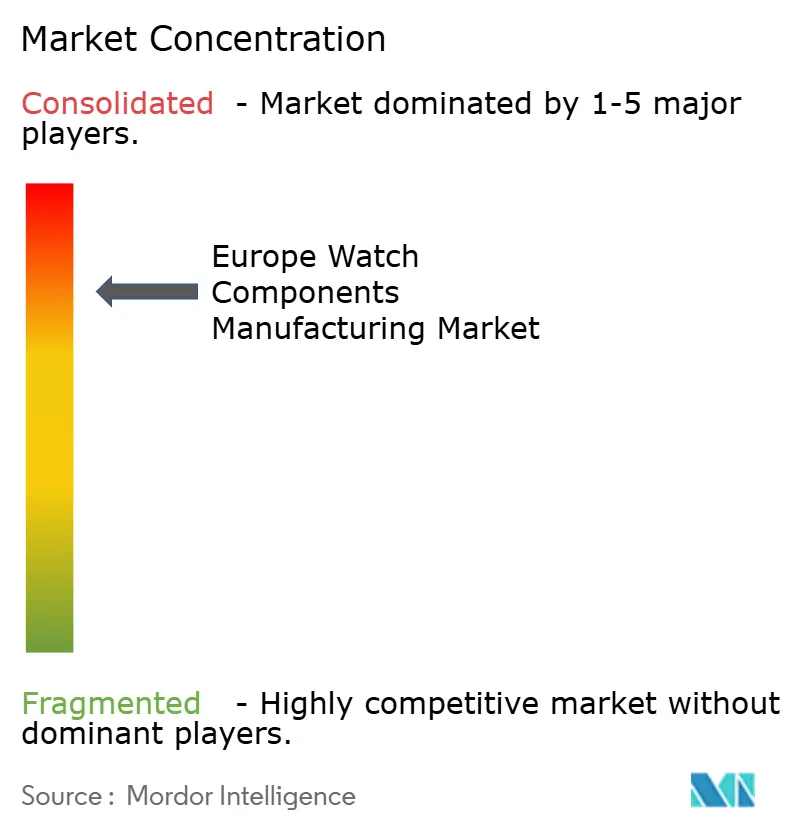
| Market Concentration | High |
Major Players *Disclaimer: Major Players sorted in no particular order Image © Mordor Intelligence. Reuse requires attribution under CC BY 4.0. | |
Europe Watch Components Manufacturing Market Analysis by Mordor Intelligence
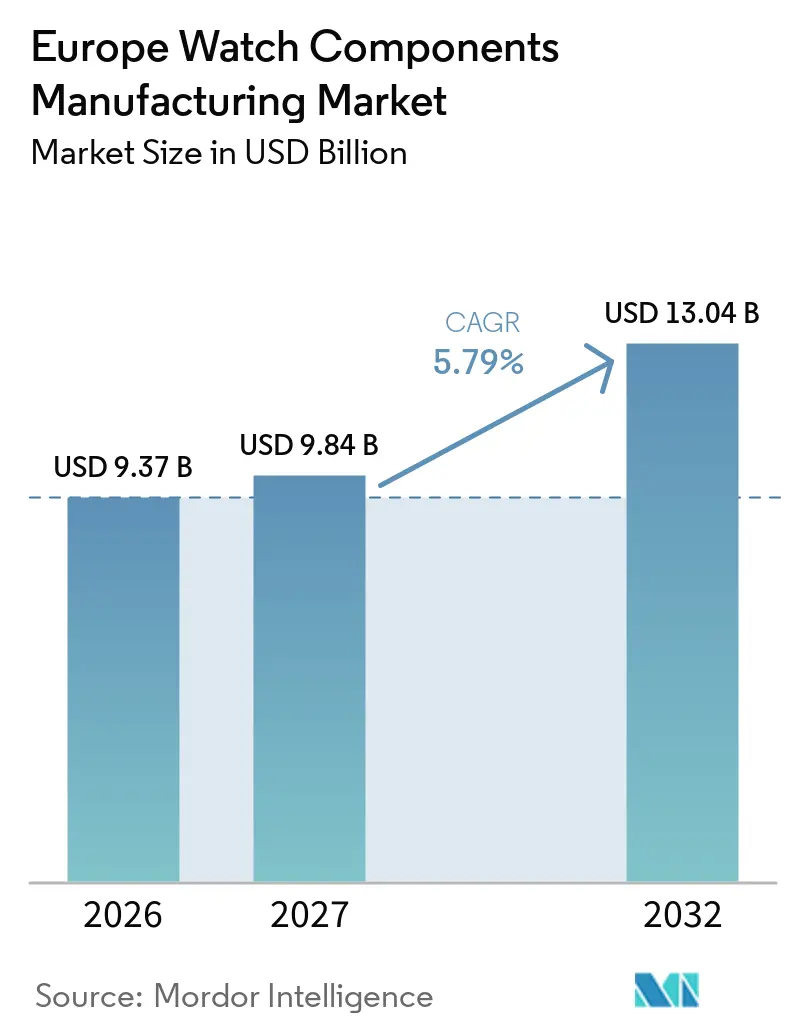
The Europe Watch Components Manufacturing Market size is projected to be USD 9.37 billion in 2026, USD 9.84 billion in 2027, and reach USD 13.04 billion by 2032, growing at a CAGR of 5.79% from 2027 to 2032.
Growth reflects a shift toward higher-value parts rather than higher watch volumes, as Swiss export volume fell to 14.6 million units in 2025 while export value reached CHF 25.6 billion (USD 32.4 billion). Demand is concentrating in precision parts, advanced materials, and exterior components that support luxury mechanical and connected watches. European brands are also strengthening internal production and selectively retaining specialist suppliers for processes that are difficult to duplicate. At the same time, manufacturers are investing in CNC machining, micro-milling, laser processing, automated finishing, and inspection systems to improve dimensional consistency and reduce dependence on manual operations. Rising requirements for traceability, surface quality, and material certification further increase technical barriers for component suppliers. Sustainability is also becoming more relevant, particularly through recycled precious metals, material-efficiency initiatives, and lower-waste machining and finishing processes. The Europe watch components manufacturing market therefore favors manufacturers that can meet stringent quality requirements, secure materials, and support short production runs for complex watches while maintaining flexible, technology-intensive production capabilities.
Key Report Takeaways
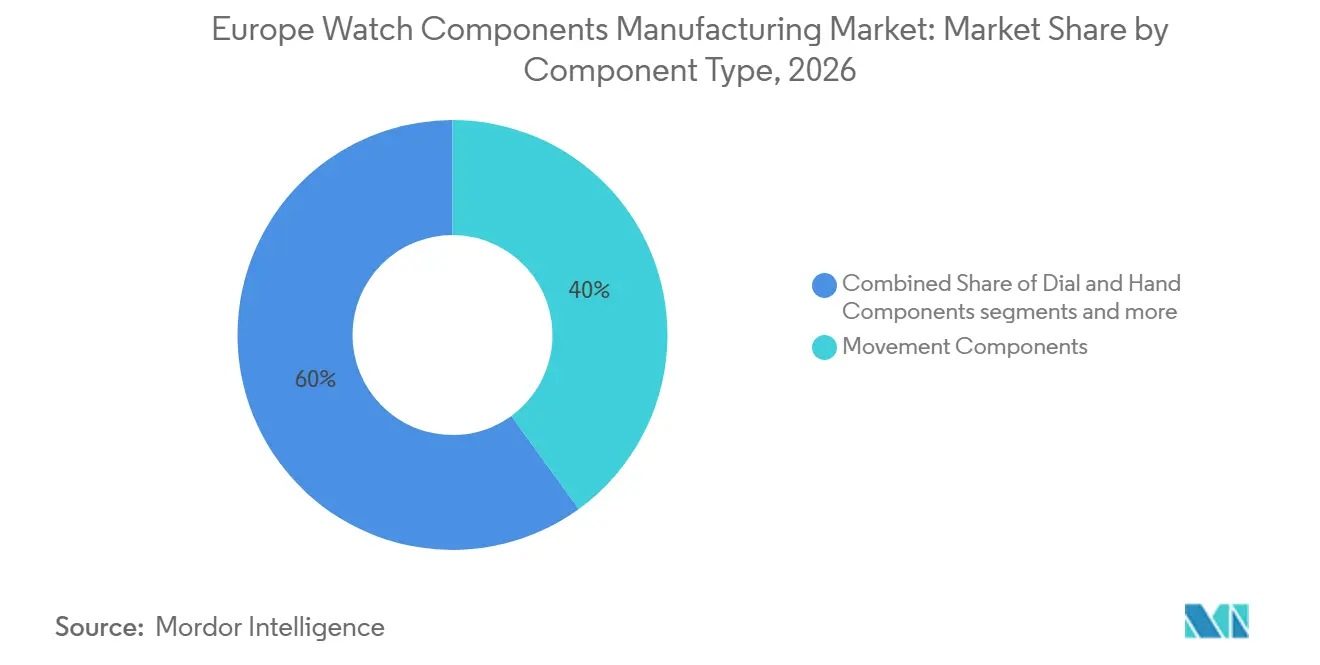
- By component type, movement components held 40% of the Europe watch components manufacturing market share in 2026, while crystal components are projected to grow at a 7% CAGR through 2032.
- By watch type, mechanical watches held 71.7% of the Europe watch components manufacturing market size in 2026, while smart and hybrid watch components are projected to grow at a 9.8% CAGR through 2032.
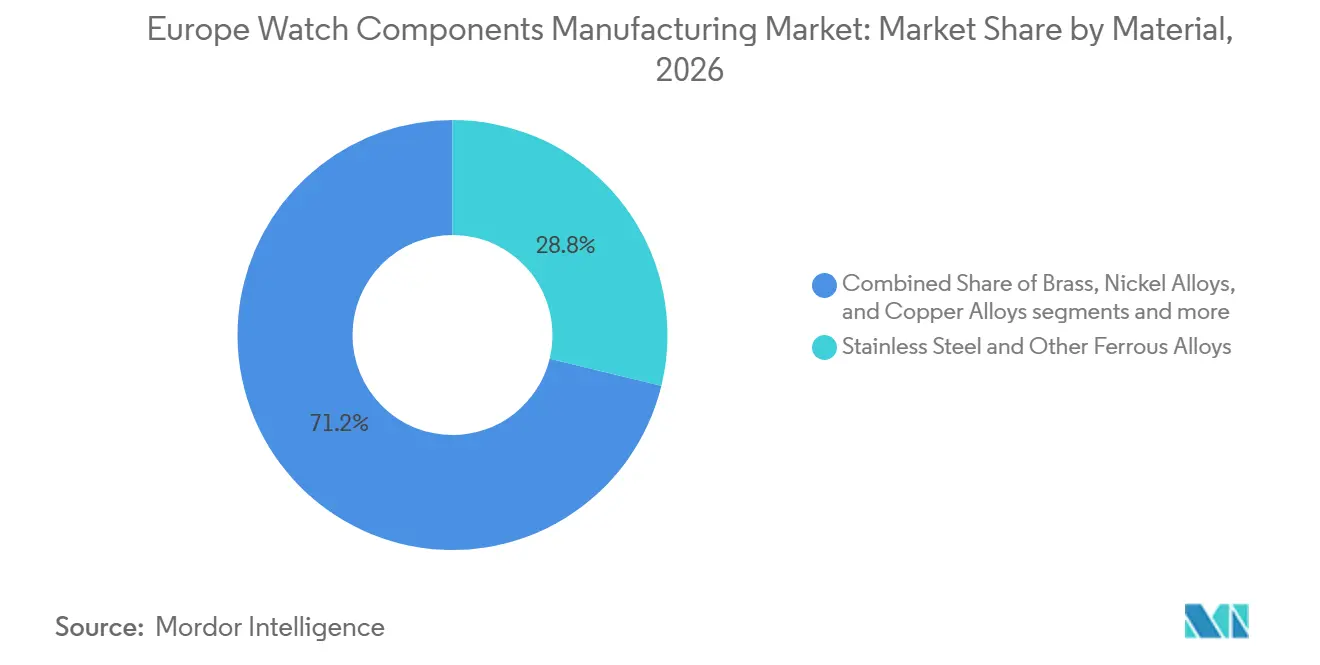
- By material, stainless steel and other ferrous alloys held 28.8% share in 2026, while silicon, nickel-phosphorus, and silicon-based materials are projected to grow at a 9.3% CAGR through 2032.
- By geography, Switzerland held 80% share in 2026, while Portugal is projected to grow at a 7.1% CAGR through 2032.
Note: Market numbers in this report are based on Mordor Intelligence's proprietary estimation framework, which combines nine months of actuals with Q4 projections for base year 2026.
Market Trends and Insights
Drivers Impact Analysis of Europe Watch Components Manufacturing Market*
| Driver | (~) % Impact on CAGR Forecast | Geographic Relevance | Impact Timeline |
|---|---|---|---|
| Luxury Mechanical Watch Premiumization | +2.0% | Switzerland, France, Germany | Long term (≥ 4 years) |
| Expansion of Vertically Integrated European Watchmaking | +1.5% | Switzerland, Germany | Medium term (2-4 years) |
| Adoption of Silicon, LIGA, and Advanced Micromachining | +1.2% | Switzerland, France | Long term (≥ 4 years) |
| Nearshoring of Critical Precision Components | +0.8% | Portugal, Italy, Germany, Switzerland | Medium term (2-4 years) |
| Rising Demand for Complex Complications and Limited Editions | +0.7% | Switzerland | Long term (≥ 4 years) |
| Hybrid Watch and Smartwatch Component Innovation | +0.5% | Switzerland, Germany, France | Medium term (2-4 years) |
| Source: Mordor Intelligence | |||
Luxury Mechanical Watch Premiumization
The Europe watch components manufacturing market is supported by a value mix that favors intricate mechanical watches over higher unit shipments. Swiss watch export value reached CHF 25.6 billion (USD 32.4 billion) in 2025 despite a decline in export volume.[1] This demand profile raises the value of regulating organs, escapements, mainplates, and other precision assemblies. A high-complication movement can require 500 to 700 individual components, which increases the importance of reliable machining, finishing, and quality control. Suppliers with proven expertise in low-volume precision work can sustain demand even when lower-priced watch output weakens.
Premiumization also makes material traceability and repeatable tolerances more important for the Europe watch components manufacturing market. Luxury brands increasingly use the movement and its visible finishing as a product distinction, including through transparent cases and decorative components. This raises demand for well-finished gear trains, bridges, cases, and casebacks rather than only for standard movement parts. The concentration of luxury watch production in Switzerland reinforces the role of supplier networks around Geneva, the Vallée de Joux, Neuchâtel, and Jura. These clusters give qualified producers close access to design teams, assembly sites, and watchmakers who can validate complex parts during development.
Expansion of Vertically Integrated European Watchmaking
European watch groups are expanding internal control over component manufacturing to protect proprietary designs and reduce supply risk. Rolex states that it follows a largely vertically integrated business model and keeps direct control over raw-material processing and component manufacturing. Richemont invested EUR 1,035 million (USD 1,217.48 million) in property, plant, and equipment in the year ended March 2025, up 20% from the prior year, with investment directed toward growing and upgrading European manufacturing facilities. These programs increase internal demand for machinery, quality systems, tooling, and selected component technologies. They also reduce the accessible volume of standard components for independent suppliers.
The resulting opportunity in the Europe watch components manufacturing market is concentrated in parts that remain difficult to reproduce internally. Specialist suppliers can serve brands with non-magnetic regulating organs, silicon escapements, advanced surface treatments, and tightly specified miniature assemblies. These parts often require process knowledge that is costly to build and difficult to maintain at smaller internal volumes. Brand investment may therefore narrow opportunities in commodity components while supporting demand for highly differentiated subcontracting. The Swiss Made rules also favor local capabilities because a watch must meet the domestic-cost condition to use the designation. [2]
Adoption of Silicon, LIGA, and Advanced Micromachining
Silicon, UV-LIGA, and related micromachining methods are becoming more important in the Europe watch components manufacturing market. Acrotec presented a fully industrialized non-magnetic regulating organ in June 2025 that combined silicon, metallic glass, and specialty ceramics in a complete assembly. The assembly includes the balance-spring, balance, and balance-staff, showing that these materials can be supplied beyond prototype applications. Silicon and nickel-phosphorus help producers address magnetic resistance, friction, and stable performance across temperature changes. These properties are particularly relevant to escapements and balance-spring systems where very small deviations affect watch performance.
The material transition creates new requirements for suppliers and reinforces the importance of specialized European fabrication capacity. French and Swiss firms involved in photolithography, deep reactive ion etching, and microforming can address parts that conventional machining cannot produce reliably. Complex complications and limited editions also expand the need for short-run precision work, decorative finishing, and exact assembly tolerances. Acrotec’s commercialized regulating organ illustrates the movement from experimental materials toward repeatable series production. The Europe watch components manufacturing market benefits when advanced materials improve performance without removing the need for skilled finishing and assembly.
Nearshoring and Connected Watch Innovation
European manufacturers are reassessing component sourcing after trade disruption and persistent logistical risk. The Swiss watch sector faced a U.S. tariff change in 2025, which added uncertainty for finished-watch demand and component order planning. Brands are responding through dual sourcing and selective production expansion within Europe, particularly for turned parts, cases, casebacks, straps, and clasps. Portugal, Italy, Germany, and the Czech Republic offer complementary manufacturing locations for selected categories. Nearshoring may reduce delivery risk while keeping suppliers close enough to support product development and quality control.
Connected and hybrid watches provide another route for the Europe watch components manufacturing market to expand beyond traditional mechanical production. Luxury connected watches can require the same exterior precision as conventional models. Smartwatch-related demand is therefore strongest in watch-specific parts such as cases, crystals, bracelets, seals, and decorative elements rather than in consumer-electronics hardware. This gives established watch component suppliers a way to apply existing materials and finishing capabilities to a growing end-use category. The segment creates demand for premium exterior components even when connected models use a different internal architecture.
Restraints Impact Analysis of Europe Watch Components Manufacturing Market*
| Restraint | (~) % Impact on CAGR Forecast | Geographic Relevance | Impact Timeline |
|---|---|---|---|
| Shortage of Skilled Horological Labor | -0.6% | Switzerland, Germany | Long term (≥ 4 years) |
| High Qualification Costs for New Component Suppliers | -0.4% | Switzerland, Rest of Europe | Medium term (2-4 years) |
| Concentration of Specialty Materials and Critical Suppliers | -0.3% | Switzerland, France | Medium term (2-4 years) |
| Swiss Franc, Precious-Metal, and Trade-Tariff Volatility | -0.2% | Switzerland, APAC-dependent exporters | Short term (≤ 2 years) |
| Source: Mordor Intelligence | |||
Shortage of Skilled Horological Labor
The shortage of skilled horological labor limits production flexibility in the Europe watch components manufacturing market. The Canton of Geneva had 450 unfilled watchmaker positions in January 2025, a 23% increase from the prior year. The Swiss watchmaking and microtechnology sector recorded its first employment decline since the post-COVID period, with notable decreases in Vaud, Neuchâtel, Jura, and Berne. Skilled trades and machine operators remain among the most widespread shortage occupations across European countries.[3] Complex assembly work has a long learning cycle, and specialized watchmaking skills cannot be replaced quickly through general technical training.
New suppliers also face substantial qualification and compliance barriers before they can join premium watch supply chains. The Swiss designation rules require at least 60% of a watch’s manufacturing costs to originate in Switzerland for the designation to be used. The calculation includes relevant materials, labor, tooling, overhead, and research and development costs, which require careful documentation and local operating capacity. Suppliers must also establish metrology, process control, and quality systems that can withstand extensive brand qualification. The burden is greatest in silicon fabrication, UV-LIGA, and advanced coating work, where the number of proven suppliers is limited.
High Qualification Costs for New Component Suppliers
Input-cost movement remains a constraint for precious-metal and specialty-material component producers. Higher gold prices in 2025 increased the bill of materials for cases, dials, bracelets, and movement parts made from precious-metal alloys. This can pressure order volumes when brands seek to preserve retail price positioning. Currency movements can also affect the competitiveness of Swiss production when the franc strengthens against customer-market currencies. These factors are especially material for exporters whose fixed production cost base is in Switzerland.
Trade-policy changes add another layer of uncertainty to component planning. Tariff exposure can influence finished-watch orders, which in turn affects manufacturers of movements, cases, crystals, and other upstream parts. The Swiss watch sector’s 2025 tariff experience shows why brands are seeking more resilient sourcing arrangements. Europe watch components manufacturing market participants, therefore, need to balance local-content requirements with the need for wider sourcing and cost control. Producers that can offer traceable materials, dependable lead times, and flexible order scheduling are better positioned to manage these conditions.
*Our forecasts treat driver/restraint impacts as directional, not additive. The impact forecasts reflect baseline growth, mix effects, and variable interactions.
Europe Watch Components Manufacturing Market Segment Analysis
By Component Type:
Movement Complexity, Anchors Value, Crystals AccelerateMovement components held 40% share in 2026, making them the largest component category. Their position reflects the high value of regulating organs, escapements, mainplates, gear trains, wheels, and pinions in mechanical watches. Regulating organs command especially high value because they combine strict tolerance requirements with demanding material and finishing specifications. Gear trains, wheels, and pinions remain the highest-volume subcategory and support specialist turning workshops across the Swiss Jura. The European watch components manufacturing industry depends on these workshops for parts that must combine dimensional accuracy with consistent surface quality. Habillage components, including cases, case middles, and casebacks, are also gaining value as brands emphasize visible finishing and transparent casebacks. Tighter visual standards increase the value of case finishing, polishing, machining, coatings, and assembly.
Crystal components are projected to expand at 7% CAGR through 2032, the fastest rate among component types. Sapphire supports this growth because it is used in mechanical watches as well as hybrid and smart models. The material can provide scratch resistance and a premium appearance while fitting a range of case designs. Krystalix presented single-crystal growth technology at EPHJ in April 2026 and stated that it already supplies colored single crystals for cases, crystals, and pivots to European luxury brands. This development supports the use of crystal technology beyond the watch glass itself. Crystal production also requires exact growth, machining, finishing, and quality control capabilities, which keep entry barriers high. CNC machining and optical inspection matter because surface flaws can affect both durability and the visual quality expected in luxury products. The faster growth of crystals also benefits suppliers of sapphire-related cases and decorative components.

By Watch Type / End Use:
Mechanical Dominance Persists as Hybrids Define the Growth StoryMechanical watches held 71.7% share in 2026. Their lead reflects the value structure of Swiss watch exports, where mechanical watches accounted for 86% of export revenue in the first half of 2025. Mechanical models require a broad set of movement, case, dial, crystal, bracelet, and sealing components. They also create demand for skilled assembly and testing because performance depends on how these components work together. The high share of mechanical watches gives the Europe watch components manufacturing market a relatively stable base in luxury products. Quartz watches serve a more pressured volume base as brands move toward either mechanical premium products or connected watches. Component producers serving quartz watches can protect value by supplying higher-quality exterior parts or specialized timing applications. Ronda and Soprod are among the suppliers that serve the broader movement ecosystem and face this need for differentiation. The outlook for quartz components is flat to mildly negative in volume terms, although the value per unit can hold when brands use premium cases, crystals, and finishes. This places more attention on product positioning than on low-cost standard movement output.
Smart and hybrid watch components are projected to grow at 9.8% CAGR through 2032, the fastest end-use rate. The opportunity centers on exterior and watch-specific mechanical components rather than on electronic modules. Luxury connected watches need cases, crystals, bezels, bracelets, seals, and finish treatments that meet the visual and tactile standards of established watch brands. TAG Heuer’s Connected Calibre E5 demonstrates this approach through its sapphire crystal, metal case, and coated-bezel specification. This design direction links connected watches to the existing capabilities of European component producers. The end-use mix creates a bridge between the traditional European watch components manufacturing industry and premium connected products. Producers with experience in cases, crystal finishing, water resistance, strap systems, and decorative coatings can serve both mechanical and connected customers. Hybrid models may also spread demand across exterior components even when their internal architectures differ from mechanical watches. This reduces dependence on one movement technology while preserving demand for Swiss and European artistry. Suppliers that can adapt designs and production schedules for shorter technology cycles are likely to be better placed in this end use.
By Material:
Steel Leads, Silicon Compounds Reshape Performance BenchmarksStainless steel and other ferrous alloys held 28.8% of the Europe watch components manufacturing market size in 2026. Their lead rests on broad use in cases, bracelets, movement plates, and other exterior and internal parts. Steel combines durable performance with practical machining and finishing characteristics across several watch price categories. Swiss exports of steel watches increased 3.8% by volume in 2025, while precious-metal watch volume declined. Steel also remains central to the exterior construction of many hybrid and connected watches. Gold, platinum, and other precious-metal alloys retain high unit value in ultra-luxury products. Higher gold costs can limit component volumes, but the segment remains important where exclusivity, finishing, and material provenance drive purchase decisions. Titanium, aluminum, and zirconium support lighter and more sports-oriented watch designs.
Silicon, nickel-phosphorus, and silicon-based materials are projected to grow at 9.3% CAGR through 2032. These materials are increasingly used in regulating organs because they can reduce friction, limit magnetic interference, and improve performance consistency. Silicon’s properties can reduce lubrication requirements and help maintain performance across changing temperatures. Acrotec’s non-magnetic regulating organ provides an example of a full assembly that combines silicon with other advanced materials. The adoption of these materials is changing the capability requirements for component manufacturers. Advanced materials do not remove the role of conventional materials, but they change the mix of processes needed for high-performance watches. Silicon parts require specialist fabrication, while metals remain important for structure, finishing, and visual character. Engineering polymers, leather, rubber, and textiles continue to serve straps, clasps, and related exterior components.
Geography Analysis
Switzerland Watch Components Manufacturing Market
Switzerland held 80% of the Europe watch components manufacturing market size in 2026. The country’s lead rests on the Arc Jurassien supplier cluster, the Swiss Made regulatory framework, established training systems, and proximity to high-value watch brands. Geneva, Neuchâtel, Vaud, and Jura contain a large share of component manufacturing capacity. The Swiss Made rules require qualifying domestic cost content and reinforce local sourcing for parts that support watches using the designation. Switzerland retains a central role in movements, regulating organs, cases, dials, and advanced micromechanical parts.
Switzerland and Europe Watch Components Manufacturing Market
Swiss export conditions were uneven in 2025, with shipments to Europe declining 0.3%, France rising 1.3%, and Germany declining 6.8%. Finished-watch export performance does not fully define component demand because Swiss suppliers can serve domestic and non-Swiss brands seeking certified Swiss-origin parts. Richemont’s EUR 1,035 million (USD 1,217.48 million) investment in manufacturing facilities provides continued support for European production infrastructure. Switzerland’s concentration also creates exposure to labor shortages and currency movements, which encourages selected supplementary capacity elsewhere in Europe.
Western Europe Watch Components Manufacturing Market
Germany and France form the second tier of the Europe watch components manufacturing market. Germany’s Glashütte cluster brings recognized expertise in movement finishing, dial work, and high-value mechanical watch production. German watch exports, including movements and components, reached EUR 2 billion (USD 2.4 billion) in 2025, supported by high-value precision manufacturing. France contributes horological capabilities around Besançon and growing advanced crystal work. Italy remains important in cases, metal bracelets, and luxury habillage components, with relevant industrial centers in Valenza, Arezzo, and Lumezzane.
Portugal Watch Components Manufacturing Market
Portugal is projected to grow at 7.1% CAGR through 2032. Its development reflects a lower initial base, growing interest in watchmaking, and its potential as an EU-based secondary production location. The Instituto Português de Relojoaria recorded 25,016 unique website visitors in 2025, illustrating greater interest in specialist education and professional development. Tempo Futuro in Lisbon created an organized platform for Portuguese microbrands and component makers in October 2025. Portugal can support nearshoring for strap, clasp, and precision-turned habillage parts.
Competitive Landscape
The Europe watch components manufacturing market exhibits a high level of market concentration. Swatch Group, Rolex, Richemont, LVMH, and Patek Philippe produce many movements and higher-value components internally. Their internal production systems provide control over quality, supply continuity, and proprietary design. Swatch Group reported an acceleration in sales during May and June 2026 that continued into July, supporting better use of its production capacity. These large groups can invest in facilities, materials, and technical development across several brands.
Independent specialists compete through process expertise, supply dependability, and advanced materials. Acrotec reported CHF 500 million (USD 632.93 million) in annual revenue in June 2026 across 30 companies and 2,600 employees. Sellita, Soprod, Mimotec, Sigatec, KIF Parechoc, Générale Ressorts, Inhotec, Décovi, Vaucher, La Joux-Perret, Ronda, and Concepto serve different parts of the movement and precision-component supply base. Specialist companies remain relevant when their tooling, technical skills, or materials knowledge would be expensive for a brand to replicate. The Europe watch components manufacturing market is becoming more concentrated in critical technologies while retaining a diverse group of smaller workshops.
Opportunities for independent suppliers are strongest in high-precision regulating organs, European-made ceramics and carbon-composite exterior components, and automated inspection for short production runs. Krystalix is pursuing single-crystal components in France, while silicon and microfabrication specialists are broadening the range of performance-focused parts available to watchmakers. Brands’ push toward internal production can reduce open-market demand for standard components, but it also creates demand for specialist processes that are not available within their own facilities. Competitive success, therefore, depends on differentiated capability, qualified capacity, and reliable delivery. The European supplier base remains anchored in Switzerland but is developing complementary strengths across France, Germany, Italy, and Portugal.
Europe Watch Components Manufacturing Industry Leaders
-
The Swatch Group Ltd.
-
ETA SA Manufacture Horlogère Suisse
-
Nivarox-FAR SA
-
Sellita SA
-
Acrotec Group
- *Disclaimer: Major Players sorted in no particular order
Europe Watch Components Manufacturing Market Companies Covered in this Report
- The Swatch Group Ltd.
- ETA SA Manufacture Horlogère Suisse
- Nivarox-FAR SA
- Sellita SA
- Acrotec Group
- Soprod SA
- Ronda AG
- Vaucher Manufacture Fleurier SA
- Manufacture La Joux-Perret SA
- Rolex SA
- Richemont International SA
- LVMH Moët Hennessy Louis Vuitton SE
- Patek Philippe SA
- Audemars Piguet Holding SA
- Chopard Group
- Glashütte Original GmbH
- A. Lange & Söhne
- Concepto Watch Factory SA
- Mimotec SA
- Sigatec SA
- KIF Parechoc SA
- Générale Ressorts SA
- Inhotec SA
- Décovi SA
- Horlyne SA
Recent Industry Developments in Europe Watch Components Manufacturing Market
- July 2026: Swatch Group's Half-Year 2026 Report confirmed a strong sales acceleration in May and June 2026, sustained into July, enabling better utilization of production capacity and significant profitability improvement projected for H2 2026. The group attributed its agility to verticalized production capabilities deliberately maintained through the demand downturn.
- June 2026: Acrotec Group, the leading independent Swiss watch component platform, celebrated its 20th anniversary, disclosing CHF 500 million (USD 632.93 million) in annual revenue across 30 companies, 37 production sites, and 2,600 employees globally. The group appointed Didier Deltort as new CEO and articulated an ambition to double revenue within ten years through expansion in Switzerland, France, Ireland, Germany, and the United States.
- April 2026: Krystalix, a French deep-tech start-up, showcased a proprietary single-crystal growth technology at EPHJ 2026, targeting a EUR 6 billion (USD 7.1 billion) high-end watch crystal market by 2030. The company already supplies colored single crystals for case middles, crystals, and pivots to European luxury brands.
- January 2026: Swatch Group reported full-year 2025 results, flagging 4.7% sales growth at constant exchange rates in H2 2025 and an acceleration across all price segments into January 2026. The performance indicated recovering utilization at ETA, Nivarox-FAR, and other group component entities after a subdued H1 2025.
Europe Watch Components Manufacturing Market Report Scope
The Europe Watch Components Manufacturing Market is Segmented by Component Type (Movement Components, Dial and Hand Components, and More), by Watch Type / End Use (Mechanical Watches, Quartz Watches, and More), by Material (Gold, Platinum, and Precious-Metal Alloys, Titanium, Aluminum, Magnesium, and Zirconium and More), by Geography (Switzerland, Germany, and More). The Market Forecasts are Provided in Terms of Value (USD).
Segmentation Overview
| Movement Components | Mainplates, Bridges, and Plates |
| Gear Trains, Wheels, and Pinions | |
| Escapements, Anchors, and Regulating Components | |
| Springs, Barrels, and Shock-Protection Components | |
| Rotors, Oscillating Weights, Screws, Jewels, and Other Movement Components | |
| Watch Exterior / Habillage Components | Cases, Case Middles, and Casebacks |
| Bezels, Lugs, Flanges, and Casing Rings | |
| Crowns, Tubes, Pushers, and Correctors | |
| Dial and Hand Components | Dial Plates, Indexes, Applied Markers, and Decorative Dial Elements |
| Hour, Minute, Seconds, and Chronograph Hands | |
| Crystal Components | Sapphire Crystals |
| Mineral Glass Crystals | |
| Acrylic and Specialty Crystals | |
| Bracelet, Strap, and Clasp Components | Metal Bracelets and Links |
| Leather, Rubber, Textile, and Polymer Straps | |
| Buckles, Clasps, Spring Bars, and End Links | |
| Sealing and Other Watch-Specific Components | Gaskets, Seals, and Water-Resistance Components |
| Decorative, Authentication, and Specialty Components |
| Mechanical Watches |
| Quartz Watches |
| Smart and Hybrid Watches, Watch-Specific Mechanical, and Exterior Components Only |
| Stainless Steel and Other Ferrous Alloys |
| Gold, Platinum, and Precious-Metal Alloys |
| Titanium, Aluminium, Magnesium, and Zirconium |
| Brass, Nickel Alloys, and Copper Alloys |
| Ceramic, Sapphire, Glass, and Carbon Composites |
| Silicon, Nickel-Phosphorus, and Silicon-Based Materials |
| Leather, Rubber, Textile, and Engineering Polymers |
| Switzerland |
| Germany |
| France |
| Italy |
| Portugal |
| Rest of Europe |
| By Component Type | Movement Components | Mainplates, Bridges, and Plates |
| Gear Trains, Wheels, and Pinions | ||
| Escapements, Anchors, and Regulating Components | ||
| Springs, Barrels, and Shock-Protection Components | ||
| Rotors, Oscillating Weights, Screws, Jewels, and Other Movement Components | ||
| Watch Exterior / Habillage Components | Cases, Case Middles, and Casebacks | |
| Bezels, Lugs, Flanges, and Casing Rings | ||
| Crowns, Tubes, Pushers, and Correctors | ||
| Dial and Hand Components | Dial Plates, Indexes, Applied Markers, and Decorative Dial Elements | |
| Hour, Minute, Seconds, and Chronograph Hands | ||
| Crystal Components | Sapphire Crystals | |
| Mineral Glass Crystals | ||
| Acrylic and Specialty Crystals | ||
| Bracelet, Strap, and Clasp Components | Metal Bracelets and Links | |
| Leather, Rubber, Textile, and Polymer Straps | ||
| Buckles, Clasps, Spring Bars, and End Links | ||
| Sealing and Other Watch-Specific Components | Gaskets, Seals, and Water-Resistance Components | |
| Decorative, Authentication, and Specialty Components | ||
| By Watch Type / End Use | Mechanical Watches | |
| Quartz Watches | ||
| Smart and Hybrid Watches, Watch-Specific Mechanical, and Exterior Components Only | ||
| By Material | Stainless Steel and Other Ferrous Alloys | |
| Gold, Platinum, and Precious-Metal Alloys | ||
| Titanium, Aluminium, Magnesium, and Zirconium | ||
| Brass, Nickel Alloys, and Copper Alloys | ||
| Ceramic, Sapphire, Glass, and Carbon Composites | ||
| Silicon, Nickel-Phosphorus, and Silicon-Based Materials | ||
| Leather, Rubber, Textile, and Engineering Polymers | ||
| By Geography | Switzerland | |
| Germany | ||
| France | ||
| Italy | ||
| Portugal | ||
| Rest of Europe | ||
Key Questions Answered in the Report
What is the projected value of the Europe watch components manufacturing market by 2032?
The Europe watch components manufacturing market is projected to reach USD 13.04 billion by 2032, from USD 9.37 billion in 2026, at a 5.79% CAGR.
Which component category leads European watch component production?
Movement components lead with 40% share in 2026 because mechanical movements need precision regulating organs, escapements, plates, wheels, and pinions.
Why are crystal components growing faster than other watch parts?
Crystal components are projected to grow at 7% CAGR through 2032, supported by sapphire use in luxury mechanical, hybrid, and smart watches.
Which country dominates European watch component manufacturing?
Switzerland leads with 80% share in 2026, supported by the Arc Jurassien supplier cluster and Swiss Made requirements.
What materials are gaining importance in European watchmaking?
Silicon, nickel-phosphorus, and silicon-based materials are projected to grow at 9.3% CAGR through 2032 because they support non-magnetic and low-friction regulating components.
How are smart and hybrid watches affecting component demand?
Smart and hybrid watch components are projected to grow at 9.8% CAGR through 2032, increasing demand for premium cases, sapphire crystals, bezels, bracelets, and seals.