
Europe Turf Protection Market Size and Share
Market Overview
| Study Period | 2021 - 2031 |
|---|---|
| Forecast Data Period | 2026 - 2031 |
| Base Year Market Size (2025) | USD 1.52 Billion |
| Market Size (2026) | USD 1.61 Billion |
| Market Size (2031) | USD 2.18 Billion |
| Growth Rate (2026 - 2031) | 6.21 % |
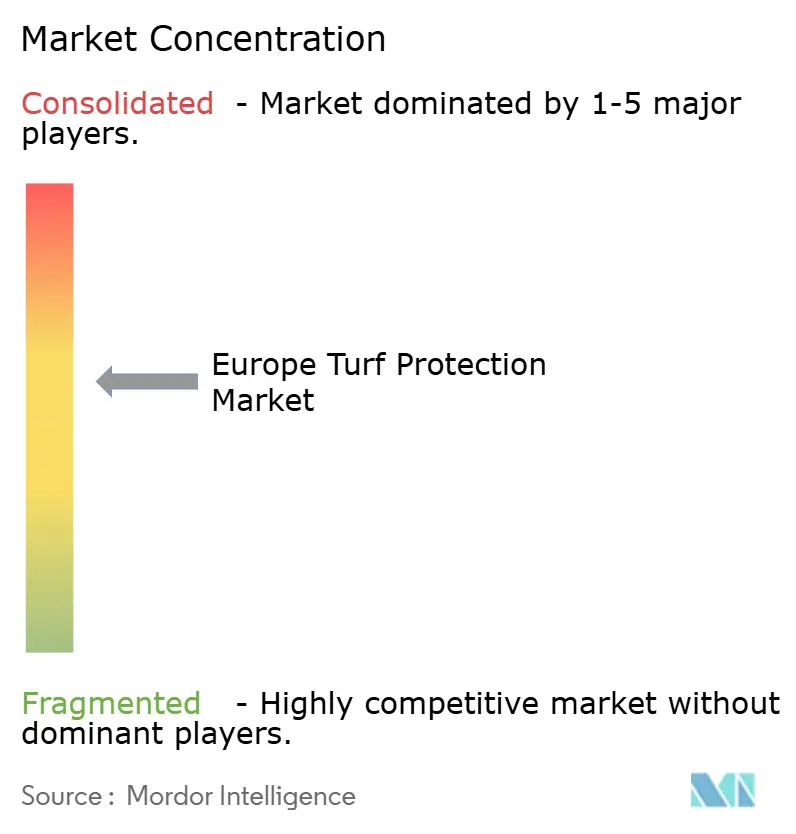
| Market Concentration | Medium |
Major Players
*Disclaimer: Major Players sorted in no particular order Image © Mordor Intelligence. Reuse requires attribution under CC BY 4.0. |
|
Europe Turf Protection Market Analysis by Mordor Intelligence
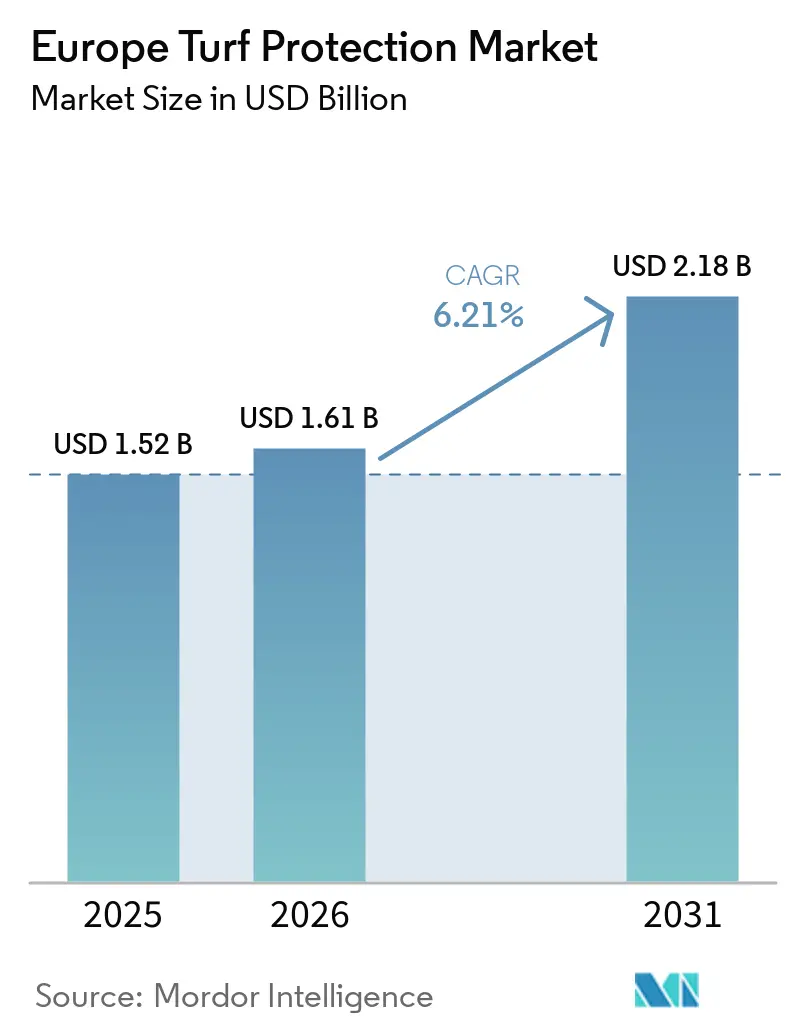
The Europe turf protection market is projected to grow from USD 1.52 billion in 2025 and USD 1.61 billion in 2026 to USD 2.18 billion by 2031, registering a CAGR of 6.21% during the forecast period 2026 and 2031. The market serves golf courses, sports pitches, commercial landscapes, municipal areas, sod farms, and residential lawns. Longer wet periods and warmer winters are extending disease pressure, making treatment timing more critical for turf managers. Regulatory restrictions on conventional active ingredients are driving demand for biological products and integrated pest management (IPM) programs. Growing investment in high-quality sports turf is also increasing the need for preventive disease management and consistent turf performance. In addition, professional turf managers are placing greater emphasis on monitoring, precision application, and preventative treatment strategies to maintain surface quality while managing input and regulatory pressures. These trends are prompting suppliers to differentiate themselves by offering integrated solutions that combine products with diagnostics, technical support, and application guidance. Providers that deliver biological solutions alongside technical expertise and tailored application support are well-positioned to capitalize on this shift. In addition, stadium renovations and increasingly stringent playing-surface standards are driving greater demand for comprehensive turf protection programs.
Key Report Takeaways
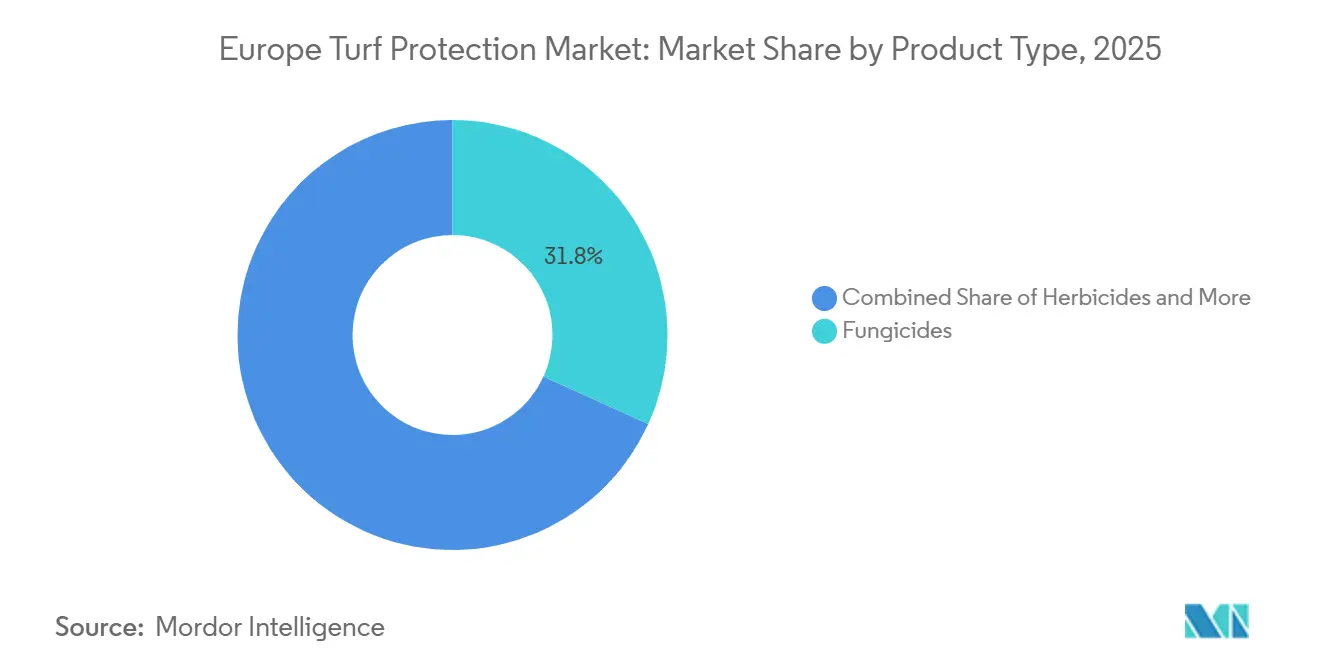
- By product type, fungicides were the largest segment and held 31.8% of the Europe turf protection market share in 2025, while biostimulants and bio-fertilizers are the fastest-growing segment and are anticipated to expand at a 9.4% CAGR between 2026 and 2031.
- By application, landscaping was the largest segment and held 34.5% of the Europe turf protection market size in 2025, while sports fields are the fastest-growing segment and are anticipated to expand at a 6.8% CAGR between 2026 and 2031.
- By end user, commercial landscape contractors were the largest segment and held 31.0% of the market share in 2025, while residential customers are the fastest-growing segment and are anticipated to expand at a 6.5% CAGR between 2026 and 2031.
- By mode of action, chemical products were the largest segment and held 54.0% of the market share in 2025, while biological products are the fastest-growing segment and are anticipated to expand at a 9.8% CAGR between 2026 and 2031.
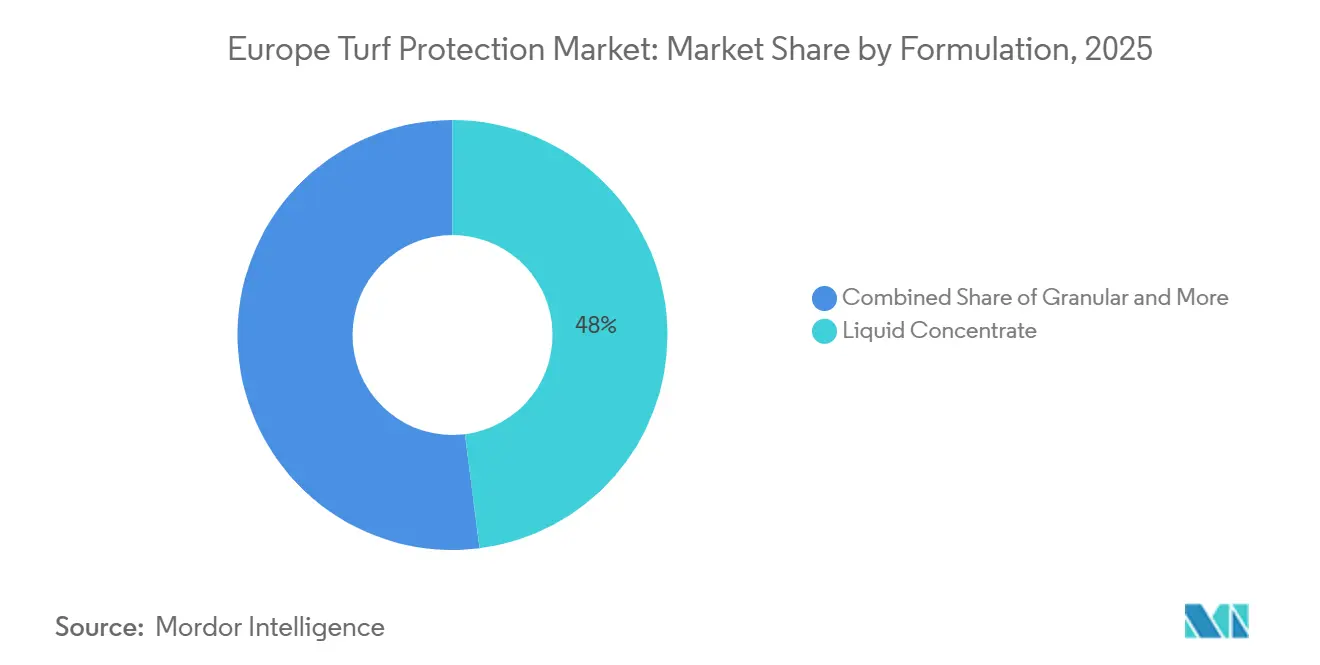
- By formulation, liquid concentrates was the largest segment, holding 48.0% of the market share in 2025, and is also the fastest-growing segment, anticipated to expand at a 6.3% CAGR between 2026 and 2031.
- By geography, Germany was the largest segment and held 28.4% of the market share in 2025, while the United Kingdom is the fastest-growing segment and is anticipated to expand at a 6.7% CAGR between 2026 and 2031.
Note: Market size and forecast figures in this report are generated using Mordor Intelligence’s proprietary estimation framework, updated with the latest available data and insights as of January 2026.
Europe Turf Protection Market Trends and Insights
Drivers Impact Analysis*
| Driver | (~) % Impact on CAGR Forecast | Geographic Relevance | Impact Timeline |
|---|---|---|---|
| Growth in professional sports and golf infrastructure | +1.2% | United Kingdom, Germany, Spain, Portugal, Ireland | Short term (≤ 2 years) |
| Rising disease and pest pressure under climate volatility | +1% | United Kingdom, Germany, Northern and Central Europe | Medium term (2-4 years) |
| Demand for high-quality commercial and residential landscapes | +0.9% | United Kingdom, Germany, France, and Western Europe | Long term (≥ 4 years) |
| Adoption of integrated turf management and biological solutions | +1.3% | France, United Kingdom, Germany, Northern Europe, Italy, and Spain | Medium term (2-4 years) |
| Precision irrigation and sensor-based turf monitoring | +0.6% | United Kingdom, Germany, Spain, and Western Europe | Long term (≥ 4 years) |
| European Union compliance spending accelerating low-residue product innovation | +0.8% | European Union, especially Germany, France, Netherlands, and Sweden | Short term (≤ 2 years) |
| Source: Mordor Intelligence | |||
Growth in Professional Sports and Golf Infrastructure
Investment in professional sports facilities, golf courses, training grounds, and multipurpose venues across Europe is supporting demand for turf protection products. New and renovated playing surfaces require intensive maintenance during establishment and throughout their operating life to manage disease, weeds, pests, and turf stress. The increasing emphasis on high-quality, durable playing surfaces also encourages venue operators to adopt structured turf-protection and maintenance programs. As professionally managed facilities place greater importance on surface consistency, playability, and rapid recovery, demand for reliable protection products and accompanying technical support is anticipated to increase. Suppliers that can provide integrated turf-management programs alongside product solutions are therefore well positioned to benefit from continued investment in European sports and golf infrastructure.
Rising Disease and Pest Pressure Under Climate Volatility
Disease pressure is increasing across managed turf in the European turf protection market. In 2024, the British and International Golf Greenkeepers Association (BIGGA) documented dollar spot on golf courses in northern France and Germany, while grey leaf spot was confirmed at sites where it had not previously caused damage [1]Source: News, "The turf disease thriving on climate change," bigga.org.uk. A 2025 study in the International Turfgrass Society Research Journal identified Clarireedia species in samples from courses in Germany, providing evidence of the disease's wider presence across Europe. Courses in northern Europe must also manage Microdochium patch during cold, wet periods, which extend the effective disease season. This overlap favors suppliers with broad disease-control portfolios and supports the rotation of product classes to manage resistance. As a result, the Europe turf protection market shows stronger demand for timely diagnosis, preventive programs, and treatment guidance.
Demand for High-Quality Commercial and Residential Landscapes
Commercial landscape contractors manage corporate campuses, retail parks, public parks, and private estates under recurring maintenance contracts. This purchasing pattern creates regular demand for turf protection products across cities and business districts. Residential demand is also rising as professional garden maintenance contractors manage private lawns to higher standards in the United Kingdom and Germany. Turf renovations completed during 2021-2024 require ongoing maintenance after establishment, supporting repeat purchases of professional inputs. The GolfBiodivers project in Germany is a EUR 2.5 million (USD 2.73 million) program supported by the Federal Agency for Nature Conservation and running until 2029[2]Source: Golf Management Verband Deutschland, "More golf clubs have joined the GolfBiodivers project," gmvd.de. It supports the use of lower-impact inputs at golf courses and reflects the broader link between landscape quality and ecological management. Sensor-based irrigation improves application timing by combining weather, moisture, and field-condition data.
Adoption of Integrated Turf Management and Biological Solutions
The Europe turf protection market is shifting toward integrated pest management (IPM) programs that combine conventional products, biological products, cultural controls, and more selective application practices. Research initiatives across Europe are supporting the development of sustainable maintenance alternatives for sports turf. In April 2026, Vivagro S.A.S. and Envu GmbH announced a European partnership to develop a biorational fungicide targeting dollar spot and snow mold in golf and sports turf. More than 30 European field trials had been completed by the date of the announcement. These developments reflect a broader shift toward incorporating biological products into routine program design rather than using them as occasional substitutes.
Restraints Impact Analysis*
| Restraint | (~) % Impact on CAGR Forecast | Geographic Relevance | Impact Timeline |
|---|---|---|---|
| Active-ingredient withdrawals and pesticide-use restrictions | -0.9% | European Union-wide; concentrated impact in Germany, France, Netherlands | Short term (≤ 2 years) |
| High registration and r&d costs for specialty turf products | -0.5% | European Union-wide; all major markets | Medium term (2–4 years) |
| Short efficacy windows of biologicals in cold, wet conditions | -0.4% | Northern and Central Europe; United Kingdom, Germany, Scandinavia, Russia | Medium term (2–4 years) |
| Fragmented national approval and municipal procurement requirements | -0.3% | European Union core markets; Germany, France, Netherlands | Long term (≥ 4 years) |
| Source: Mordor Intelligence | |||
Active-Ingredient Withdrawals and Pesticide-Use Restrictions
Withdrawals under Regulation (EC) No. 1107/2009 are reducing the number of active ingredients available to turf managers. Specialty turf registrations are difficult to support because their commercial volumes are smaller than those of major arable crops. A product authorized at the European Union level must also meet country-specific approval conditions in individual member states. Local rules can differ in approval timing, data requirements, permitted uses, and public procurement standards. Municipal buyers may require pesticide-free or low-impact programs even when a product holds a valid national registration. This fragmented access pattern raises launch costs and may delay the availability of new products across the Europe turf protection market.
High Registration and R&D Costs for Specialty Turf Products
Specialty turf-protection products face substantial regulatory and development requirements before they can be commercialized across Europe. Under the European Union plant-protection framework, active substances and finished products must undergo assessments covering efficacy, human and animal health, environmental effects, ecotoxicology, residues, and other safety parameters, while individual products require authorization in the relevant member states. The European Commission states that authorization of a plant-protection product can take up to 1.5 years from application to decision, depending on the complexity and completeness of the application, while active-substance approvals involve a separate scientific assessment and peer review[3]Source: European Commission, "Procedure to apply for authorisation of a PPP," food.ec.europa.eu. These requirements increase development and registration costs, which can be difficult to recover from the relatively specialized turf market. The burden is particularly relevant for biological and biorational products, which must also demonstrate consistent efficacy and safety under varying European turf conditions. As a result, high regulatory requirements and development costs can slow the introduction of new specialty turf-protection products and favor suppliers with established regulatory capabilities, technical data resources, and broader product portfolios.
*Our forecasts treat driver/restraint impacts as directional, not additive. The impact forecasts reflect baseline growth, mix effects, and variable interactions.
Segment Analysis
By Product Type: Fungicide Dominance Reshaped by Biological Momentum
Fungicides accounted for 31.8% of the Europe turf protection market in 2025, reflecting their central role in disease control across golf, sports, and landscape sites. Disease management programs rely on fungicides to maintain surface quality, player safety, and visual condition. Herbicides remain important for commercial landscaping and sod farms, as weeds affect appearance and grass purity. Insecticides are used where turf pests damage root systems or playing surfaces. Plant growth regulators support mowing management, canopy density, and consistent playing conditions at golf courses.
Biostimulants and bio-fertilizers are forecast to grow at a 9.4% CAGR between 2026 and 2031. These products support soil condition and plant response under compaction, drought, and heavy traffic, and can complement fungicide programs by helping turf tolerate stress. Regulatory pressure is also encouraging managers to include lower-impact products in treatment plans. The Europe turf protection market is not shifting from one product category to another in a simple sequence. Instead, turf managers are building layered programs that maintain disease control while incorporating soil health and stress management inputs. Suppliers offering fungicides, biological products, and plant growth regulators are better positioned to meet these integrated purchasing requirements.



By Application: Sports Fields Outpacing Landscaping in Growth Intensity
Landscaping accounted for 34.5% of the Europe turf protection market share in 2025. This category includes commercial, residential, and municipal green-space maintenance. Long-term contracts make demand more predictable compared to sites with irregular renovation budgets. Golf courses represent a high-value application, as greens, tees, fairways, and roughs each require distinct protection programs. Sod farms play a smaller role but supply grass to sports venues, golf courses, and landscaping projects. Their need for healthy establishment turf makes them early adopters of effective protection products. These applications support recurring demand across the Europe turf protection market.
The sports fields segment is forecast to expand at a CAGR of 6.8% between 2026 and 2031. Stadium upgrades, new training facilities, and increasingly stringent surface-quality standards are supporting this growth. Higher performance requirements for professional sports pitches make surface damage from disease and weeds less acceptable, increasing the need for reliable disease control and rapid turf recovery. Operators at these facilities, therefore, tend to prioritize consistent product performance and application outcomes, which can reduce price sensitivity for products used in professionally managed pitch programs. Suppliers also benefit when venue managers seek application guidance alongside products, strengthening the role of technical support in sports-field procurement.
By End-User: Contractors and Sports Owners Drive Volume, Residents Drive Growth
Commercial landscape contractors accounted for 31.0% the Europe turf protection market share in 2025. In Western Europe, professional green-space maintenance has increasingly shifted from local authority teams to specialist contractors through outsourcing. Contractors require products that can be applied consistently across varied client sites. Sports facility owners are a higher-spending group, as turf failure during competition can lead to high costs. Municipalities and schools purchase substantial volumes but are subject to stricter regulations on acceptable products. Local procurement criteria are directing these users toward biocontrol and low-residue options. Residential users represent a smaller base but are increasingly served by professional garden maintenance firms.
Residential customers are forecast to grow at a CAGR of 6.5% between 2026 and 2031. Demand for premium lawns is supporting professional-grade maintenance on private properties. Homeowners and estate managers who have renovated turf continue to maintain their lawns after establishment, creating recurring annual demand for selected turf management inputs. Manufacturers are responding with formulations that are easier to use across consumer and contractor channels. The Europe turf protection market can therefore reach users beyond traditional golf and municipal channels. However, the product range available to residential customers remains shaped by local pesticide regulations.
By Mode of Action: Biologicals Gaining Traction, Chemicals Anchored by Performance
Chemical products accounted for 54.0% of the Europe turf protection market share in 2025. They remain important due to their consistent performance across wet maritime winters and dry southern European summers. Integrated solutions occupy a middle position by combining chemical products with cultural controls or biological inputs, reflecting the practical limits of biological-only programs at high-performance sites. Chemical products also benefit from established registration and application knowledge, while their successors face a more demanding authorization process. As a result, chemical products remain the core disease-control option for many professional turf managers.
Biological products are forecast to expand at a 9.8% CAGR between 2026 and 2031, supported by regulation, sustainability commitments, and improvements in product performance. Biologicals are increasingly selected for pathogen and weather conditions where their use is effective and are also used between conventional applications as part of integrated pest management (IPM) plans. Cold-condition performance remains a key development area for suppliers. The Europe turf protection market will continue to use biological products alongside, rather than as a full replacement for chemical programs.
By Formulation: Liquid Concentrates Leads Across Both Volume and Growth
Liquid concentrates accounted for 48.0% of the Europe turf protection market share in 2025. Professional users favor them for their compatibility with spray equipment and precise dosing in tank mixes. Liquid formulations are particularly useful for foliar applications where uniform coverage is required. Granular products remain relevant for soil-applied growth regulators, pre-emergent herbicides, and slow-release biological products. Wettable powders continue to be used in older spray programs and situations with limited water carriers, though their role has declined as liquid formulations have improved in stability and shelf life. The Europe turf protection market continues to favor formats that fit existing application routines.
Liquid concentrates are also forecasted to grow at a CAGR of 6.3% between 2026 and 2031. Recent product developments have favored emulsifiable concentrate and suspension concentrate formats. Products such as Maxtima demonstrate how new active ingredients can be integrated into established professional spray programs. Tank mixing also allows managers to rotate modes of action within a single application pass. New microencapsulated formats aim to extend residual activity and reduce re-entry intervals, supporting more targeted applications under stricter compliance requirements. Formulation design is therefore closely tied to the operational needs of turf managers.
Geography Analysis
Germany accounted for 28.4% of the Europe turf protection market in 2025, making it the largest market in the region. Its extensive base of managed golf courses, sports facilities, commercial landscapes, and municipal green spaces supports consistent demand for professional turf management products. Integrated pest management (IPM) practices are increasingly being adopted across German golf courses, encouraging the use of integrated solutions alongside conventional crop protection products. The country's well-established turf maintenance infrastructure and emphasis on sustainable management continue to support demand for advanced turf and ornamental pesticides.
The United Kingdom is projected to register the fastest growth, at a CAGR of 6.7%, during 2026-2031. The country's maritime climate creates persistent disease pressure, necessitating regular turf protection across sports fields, golf courses, and amenity landscapes. Continued investments in maintaining high-quality playing surfaces, particularly at professional football facilities, are further driving demand for turf and ornamental pesticides. These factors are anticipated to support sustained market growth over the forecast period.
France is witnessing increased adoption of biological and low-residue turf protection products, supported by the country's emphasis on sustainable landscape management. Spain's demand is driven by its extensive network of golf resorts and sports facilities that require year-round turf maintenance under warm climatic conditions. In Italy, professional football clubs, golf courses, and sports academies continue to support demand for turf and ornamental pesticides. Poland is experiencing gradual market expansion as investments in municipal green spaces and sports infrastructure increase. The Netherlands benefits from a well-developed professional turf management sector with early adoption of integrated pest management practices, while Russia continues to generate demand from municipal landscaping and sports facilities despite challenges related to product availability.
Competitive Landscape
The Europe turf protection market is moderately concentrated in 2025, with the top five companies holding a major share in the market, and leading suppliers competing through broad product portfolios, biological innovation, and technical support services. Syngenta AG competes through its professional turf protection portfolio and digital agronomic capabilities, while BASF SE offers dedicated turf management solutions covering disease, insect, and weed control across European markets. Envu GmbH maintains a strong position in professional turf protection through fungicides, insecticides, herbicides, and specialized solutions for golf courses and sports turf. UPL Limited and Nufarm Limited also participate in the turf and ornamental protection portfolios, while Corteva, Inc. adds further competition with its professional turf and ornamental solutions. Regional specialists and biological solution providers further intensify competition by addressing specific turf disease and pest management requirements.
Competition is also expanding beyond conventional chemical protection toward biological and biorational solutions. Envu GmbH and Vivagro entered an exclusive partnership in April 2026 to develop a biorational fungicide for European golf and sports turf targeting dollar spot and snow mold. Envu GmbH subsequently partnered with Greencell in July 2026 to introduce a microbial biostimulant for golf and sports turf and ornamental plants, supporting greater emphasis on biological approaches to turf resilience. ICL Group Ltd. competes through plant-protection products alongside biostimulants, wetting agents, fertilizers, and turf-management solutions, while Koppert Biological Systems B.V. provides biological pest and disease-control solutions specifically for turf and grass. These developments demonstrate that competition is increasingly extending toward biological, biorational, and integrated turf-management solutions.
Smaller and specialized participants compete by targeting golf courses, sports facilities, turf farms, and professional landscaping customers that require tailored products and technical support. The Andersons, Inc. maintains a professional Turf & Ornamental business supplying fertilizers, soil amendments, and control products across golf, sports turf, lawn, landscape, and horticultural applications. AMVAC Chemical Corporation and Sumitomo Chemical Co., Ltd. provide additional competition through specialized crop and plant-protection capabilities. Larger suppliers retain advantages through regulatory expertise, established distribution networks, product-development capabilities, and technical support. The Europe turf protection market is therefore anticipated to favor companies that combine broad protection portfolios, biological and biorational innovation, technical support, and integrated turf-management capabilities.
Europe Turf Protection Industry Leaders
-
Syngenta AG (Syngenta Group Co., Ltd.)
-
BASF SE
-
UPL Limited
-
Nufarm Limited
-
Envu GmbH
- *Disclaimer: Major Players sorted in no particular order

Recent Industry Developments
- April 2026: Vivagro S.A.S. and Envu GmbH announced an exclusive partnership to develop and commercialize a biorational fungicide for golf and sports turf markets across Europe, targeting dollar spot and snow mold. More than 30 European field trials had already been completed, delivering efficacy results competitive with conventional and natural benchmarks. The partnership accelerates the availability of cold-condition biological alternatives and strengthens both companies' positions in premium sports-turf channels.
- March 2026: ICL Group and Syngenta renewed their strategic partnership across multiple European turf markets, including the United Kingdom, Ireland, Italy, Germany, Austria, and Spain. The agreement combines Syngenta’s turf research and technical expertise with ICL’s distribution and local turf-management capabilities, strengthening the companies’ joint offering of integrated turf-management solutions across Europe.
- January 2025: The SPOR&D (Sol Pelouse Research & Development Organization) research consortium continued developing sustainable maintenance options for French sports turf. The initiative involves the French Golf Federation, sports federations, and universities, and supports the validation of lower-impact turf-management approaches.


Europe Turf Protection Market Report Scope
The turf protection market is the sale of chemical, biological, and mechanical inputs that safeguard living turf, lawns, sports fields, golf courses, and sod farms from pests, diseases, drought, wear, and nutrient stress while enhancing vigor and playability.
The Europe Turf Protection Market Report is Segmented by Product Type (Fungicides, Herbicides, Insecticides, Plant Growth Regulators, and Biostimulants and Bio-Fertilizers), by Application (Landscaping, Golf Courses, Sports Fields, and Sod Farms), by End-User (Residential Customers, Commercial Landscape Contractors, Sports Facility Owners, and Municipalities and Schools), by Mode of Action (Chemical, Biological, and Integrated Solution), by Formulation (Granular, Liquid Concentrates and Wettable Powder) and by Geography (Germany, United Kingdom, France, Spain, Italy, Poland, Russia, Netherlands and Rest of Europe). The Report Offers Forecasts in Terms of Value (USD).
| Fungicides |
| Herbicides |
| Insecticides |
| Plant Growth Regulators |
| Biostimulants and Bio-fertilizers |
| Landscaping |
| Golf Courses |
| Sports Fields |
| Sod Farms |
| Residential Customers |
| Commercial Landscape Contractors |
| Sports Facility Owners |
| Municipalities and Schools |
| Chemical |
| Biological |
| Integrated Solutions |
| Granular |
| Liquid Concentrates |
| Wettable Powder |
| Europe | Germany |
| United Kingdom | |
| France | |
| Italy | |
| Spain | |
| Netherlands | |
| Poland | |
| Russia | |
| Rest of Europe |
| By Product Type | Fungicides | |
| Herbicides | ||
| Insecticides | ||
| Plant Growth Regulators | ||
| Biostimulants and Bio-fertilizers | ||
| By Application | Landscaping | |
| Golf Courses | ||
| Sports Fields | ||
| Sod Farms | ||
| By End-user | Residential Customers | |
| Commercial Landscape Contractors | ||
| Sports Facility Owners | ||
| Municipalities and Schools | ||
| By Mode of Action | Chemical | |
| Biological | ||
| Integrated Solutions | ||
| By Formulation | Granular | |
| Liquid Concentrates | ||
| Wettable Powder | ||
| By Geography | Europe | Germany |
| United Kingdom | ||
| France | ||
| Italy | ||
| Spain | ||
| Netherlands | ||
| Poland | ||
| Russia | ||
| Rest of Europe | ||


Key Questions Answered in the Report
What is forecasted market size of Europe turf protection?
The sector is forecasted to grow at a 6.21% CAGR between 2026 and 2031, supported by wider disease pressure, biological adoption, and investment in sports and golf facilities.
Which product type is largest in Europe turf protection?
Fungicides were the largest product category in 2025, with 31.8% share in the Europe turf protection market.
Why are biological products important for turf managers?
Regulatory change and IPM adoption are increasing biological use, although cold and wet conditions can limit biological-only programs.
Which country leads Europe turf protection?
Germany leads the Europe turf protection market with a 28.4% share in 2025.
Page last updated on:





