
Europe STATCOM Market Size and Share
Market Overview
| Study Period | 2021 - 2032 |
|---|---|
| Forecast Data Period | 2027 - 2032 |
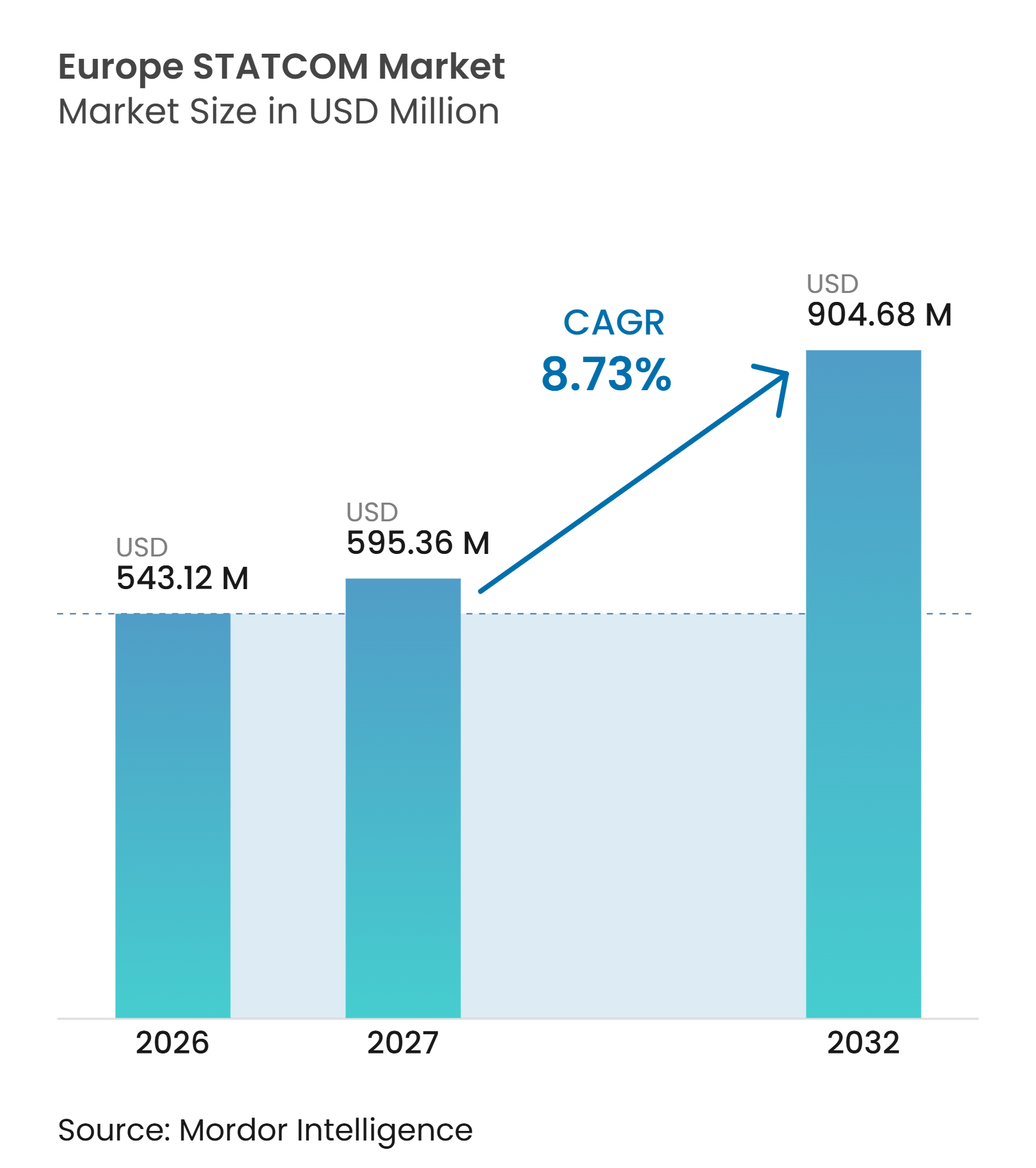
| Base Year Market Size (2026) | USD 543.12 Million |
| Market Size (2027) | USD 595.36 Million |
| Market Size (2032) | USD 904.68 Million |
| Growth Rate (2027 - 2032) | 8.73 % |
| Market Concentration | Medium |
Major Players *Disclaimer: Major Players sorted in no particular order Image © Mordor Intelligence. Reuse requires attribution under CC BY 4.0. | |
Europe STATCOM Market Analysis by Mordor Intelligence
The Europe STATCOM market size is USD 543.12 million in 2026 and is projected to reach USD 904.68 million by 2032, growing at a CAGR of 8.73% from 2027 to 2032. The Europe STATCOM market is being supported by the replacement of synchronous generation with wind and solar plants, which do not provide the same voltage control and inertia. Grid operators are therefore adding dynamic reactive power equipment at transmission nodes and renewable connections. The 28 April 2025 Iberian blackout increased attention on voltage control gaps and stabilization capability across European power systems. Procurement conditions favor suppliers that can integrate converters, transformers, controls, and grid studies into a complete project. Long engineering cycles and transformer availability may delay individual installations, but they also strengthen the position of established providers with proven delivery capacity.
Key Report Takeaways
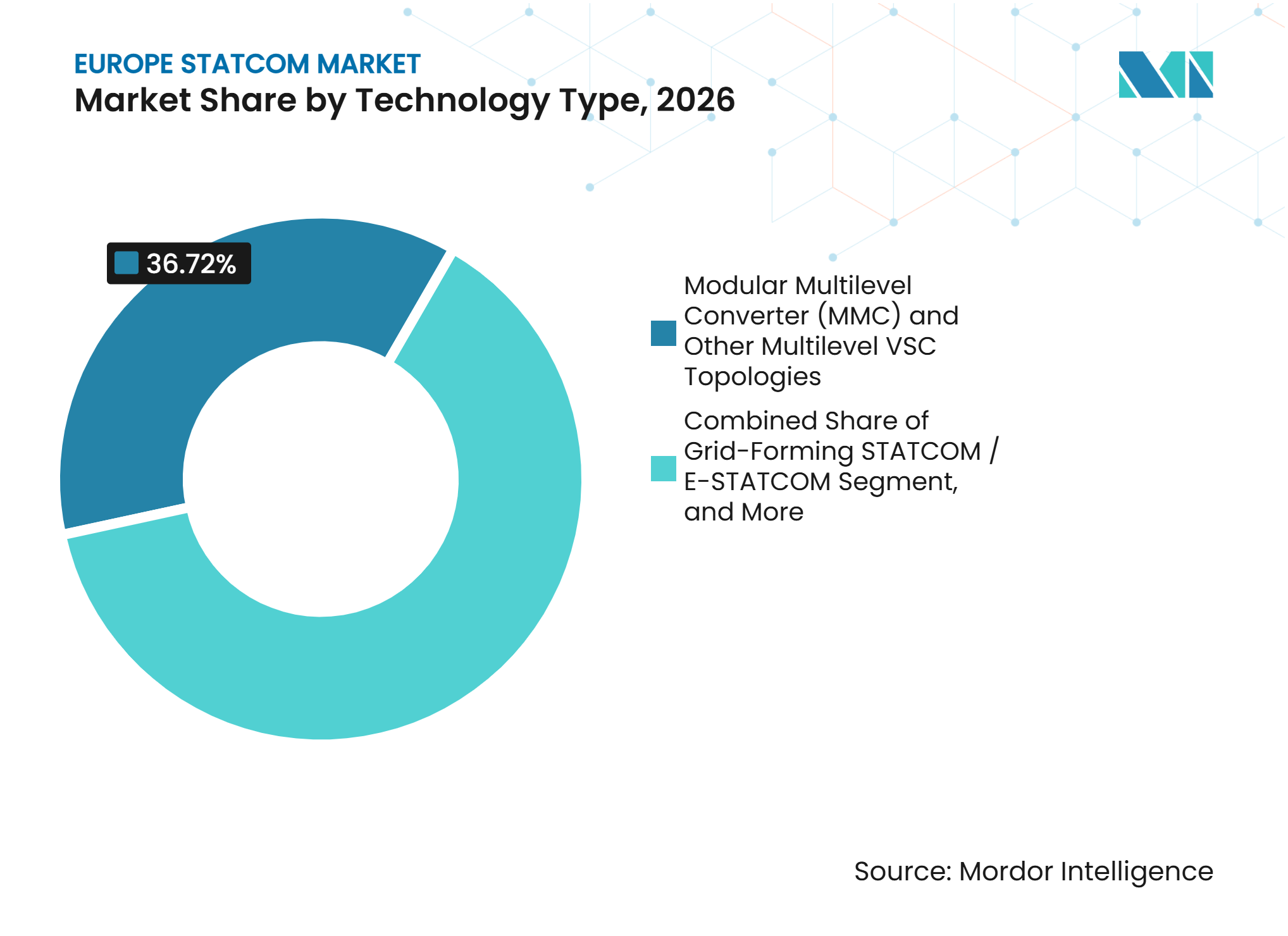
- By technology type, Modular Multilevel Converter and other multilevel VSC topologies held 36.72% of the Europe STATCOM market share in 2026, while grid-forming STATCOM and E-STATCOM are projected to expand at a 9.52% CAGR through 2032.
- By reactive power rating, large-scale transmission STATCOM accounted for 45.39% of the Europe STATCOM market share in 2026, while small-scale distribution and industrial STATCOM is projected to expand at a 9.47% CAGR through 2032.
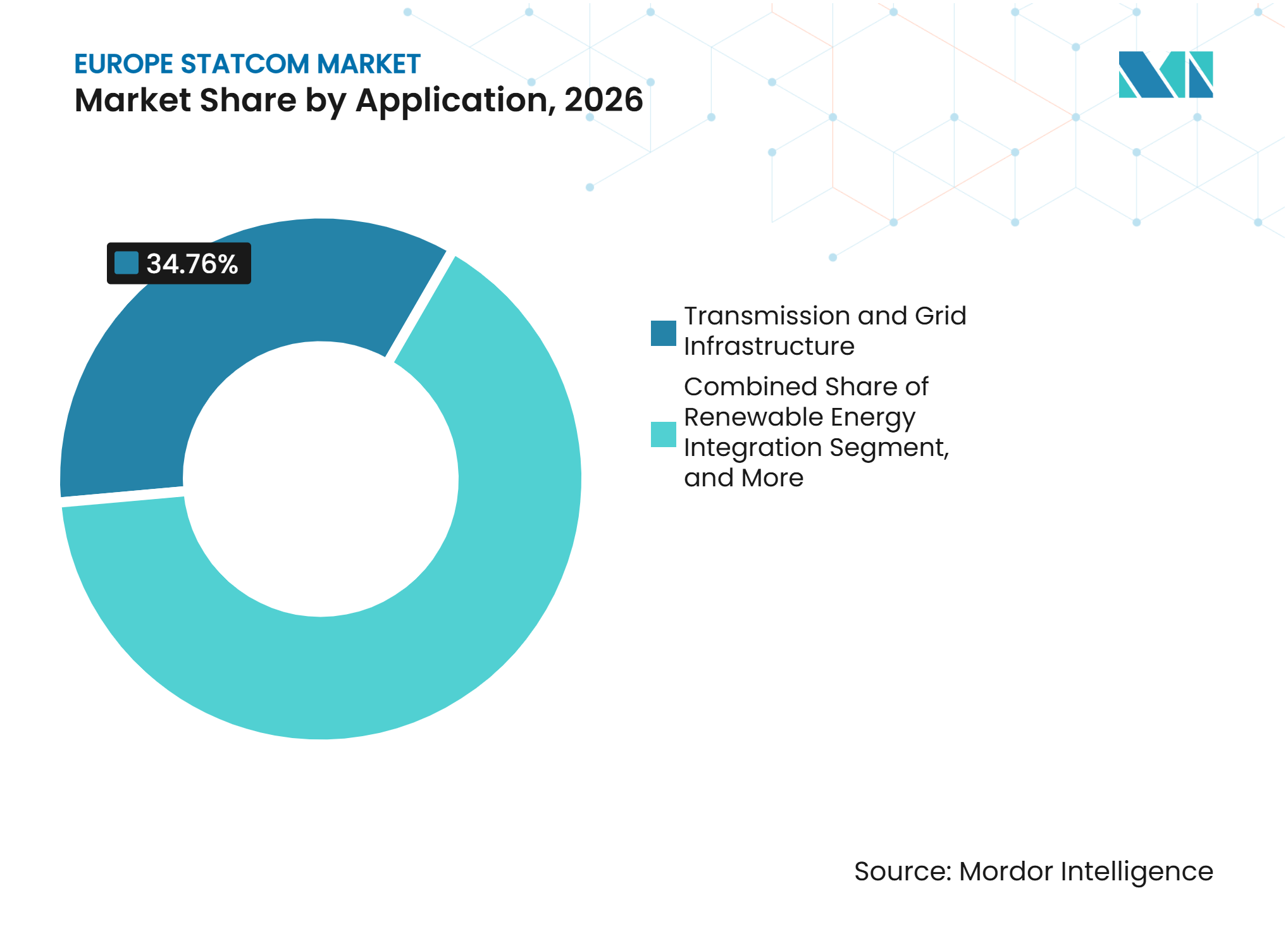
- By application, transmission and grid infrastructure accounted for 34.76% of the Europe STATCOM market size in 2026, while data centers and commercial infrastructure is projected to expand at a 9.63% CAGR through 2032.
- By component, power electronic converter valves held 38.42% share in 2026, while control, protection, and monitoring systems are projected to expand at a 9.56% CAGR through 2032.
- By geography, Germany held 25.78% share in 2026, while the United Kingdom is projected to expand at a 9.59% CAGR through 2032.
Note: Market numbers in this report are based on Mordor Intelligence's proprietary estimation framework, which combines nine months of actuals with Q4 projections for base year 2026.
Market Trends and Insights
Drivers Impact Analysis of Europe STATCOM Market*
| Driver | (~) % Impact on CAGR Forecast | Geographic Relevance | Impact Timeline |
|---|---|---|---|
| Renewable Capacity Growth and Grid-Connection Bottlenecks | +3.2% | EU-wide, with high intensity in Germany, United Kingdom, Spain, and France | Short term (≤ 2 years) |
| Replacement of Aging SVCs and Capacitor Banks | +1.9% | Germany, United Kingdom, France, and Italy | Medium term (2-4 years) |
| Stricter Dynamic Voltage and Fault-Ride-Through Requirements | +1.5% | EU-wide under ENTSO-E Network Code on Requirements for Generators 2.0 | Medium term (2-4 years) |
| North-South Power Transfers and Cross-Border Interconnectors | +1.0% | Germany, Italy, France, Benelux, and Spain | Long term (≥ 4 years) |
| Grid-Forming and Energy-Storage-Enabled STATCOM Adoption | +0.8% | Germany, United Kingdom, and Nordic markets | Long term (≥ 4 years) |
| Electrification of Industry, Transport, and Data Centers | +0.7% | Germany, France, Benelux, and United Kingdom | Medium term (2-4 years) |
| Source: Mordor Intelligence | |||
Renewable Capacity Growth and Grid-Connection Bottlenecks
Renewable capacity additions are increasing the need for dynamic voltage support in the Europe STATCOM market. Wind and solar plants are connected via power electronics and do not provide the same continuous reactive power behavior as rotating generators. Offshore wind connections place particular pressure on existing alternating-current routes from coastal areas to demand centers. ENTSO-E stated that the 28 April 2025 Iberian event involved oscillations, gaps in voltage and reactive power control, and inadequate stabilization capability. E-REDES has assessed STATCOM deployment in low-voltage networks, and the assessment shows that the requirement is moving beyond the transmission boundary.[1] This creates opportunities for both utility-scale systems and smaller equipment designed for distribution networks.
Replacement of Aging SVCs and Capacitor Banks
Aging SVCs and switched-capacitor banks are meeting replacement demand in the European STATCOM market. Many existing systems were installed when grid conditions were more predictable, and the share of inverter-based generation was lower. SVCs use discrete reactor and capacitor steps, while voltage-source converter systems can provide continuously variable reactive power. Siemens Energy commissioned a ±600 Mvar SVC PLUS installation for Amprion at Rheinau in January 2026, illustrating the use of modern converter technology for high-rating grid support. The installation demonstrates that equipment replacement can also increase an existing substation's rating and functional scope. This pattern supports procurement for higher-value systems rather than direct one-for-one replacement.
Stricter Dynamic Voltage and Fault-Ride-Through Requirements
Grid codes are making dynamic voltage performance more important across the Europe STATCOM market. ENTSO-E published its Phase II Technical Report on grid-forming requirements in November 2025, providing guidance for proposed amendments to the Network Code on Requirements for Generators. ENTSO-E later called for national connection requirements to be updated, including rules that address grid-forming converters and storage systems. These measures increase the importance of equipment that can respond rapidly during voltage events. Germany's Bundesnetzagentur has also linked its system stability work with further assessment of STATCOM deployment. Compliance requirements can shorten the time utilities allow between identifying a stability issue and initiating a tender.
North-South Power Transfers and Cross-Border Interconnectors
Long-distance power transfers are creating additional voltage-management needs in the Europe STATCOM market. Germany must move wind generation from northern regions toward industrial centers in the south. Amprion operates 11,000 km of extra-high-voltage lines and has deployed dynamic compensation at several substations on this network. Cross-border cable projects also require reactive power management because long alternating-current cables generate capacitive reactive power. An IET review identifies reactive power support as a central part of grid-support arrangements as power systems evolve. The resulting requirement is not limited to a single country, since interconnected systems require support at multiple terminals and network nodes.
Restraints Impact Analysis of Europe STATCOM Market*
| Restraint | (~) % Impact on CAGR Forecast | Geographic Relevance | Impact Timeline |
|---|---|---|---|
| Long Qualification Cycles and Utility Procurement Complexity | -1.1% | EU-wide, particularly in markets with multi-stage regulatory approvals | Short term (≤ 2 years) |
| High Project CapEx and Transformer Lead Times | -0.9% | Germany, France, and United Kingdom, markets with high volumes of concurrent transmission investments | Medium term (2-4 years) |
| Scarcity of Power-Electronics and Grid-Integration Specialists | -0.5% | EU-wide, with acute pressure in Germany and the Nordic region | Long term (≥ 4 years) |
| Cybersecurity and Interoperability Requirements for Digital Controls | -0.3% | EU-wide under emerging NIS2 and CNC 2.0 frameworks | Long term (≥ 4 years) |
| Source: Mordor Intelligence | |||
Long Qualification Cycles and Utility Procurement Complexity
Long qualification processes restrain the pace of installations in the Europe STATCOM market. Transmission projects can require three to five years from technical specification to commercial operation. Utilities need factory acceptance testing, electromagnetic transient modeling, and coordinated studies of transformers, converters, protection, and local network conditions. ENTSO-E has recognized that grid-forming technologies need clearer testing and performance frameworks. Fraunhofer ISE developed a test procedure for grid-forming inverters on behalf of Germany's transmission operators, showing the depth of validation needed before deployment. These requirements increase project certainty, but they can reduce the number of systems awarded within a planning cycle.
High Project CapEx and Transformer Lead Times
High capital expenditure and transformer lead times limit near-term project execution in the Europe STATCOM market. Utility-scale systems require custom converter transformers, specialized power electronics, and extensive civil and grid-integration work. Hitachi Energy and E.ON signed a long-term agreement in July 2025 worth up to USD 700 million to secure transformer capacity for the German grid. Bundesnetzagentur has identified transformer shortages as a risk to Germany's grid expansion timetable. Supply constraints can defer or reduce individual projects even when a transmission operator has identified a need for dynamic compensation.
*Our forecasts treat driver/restraint impacts as directional, not additive. The impact forecasts reflect baseline growth, mix effects, and variable interactions.
Europe STATCOM Market Segment Analysis
By Technology Type:
Multilevel Converters Lead High-Rating DeploymentsModular Multilevel Converter and other multilevel VSC systems accounted for 36.72% of the European STATCOM market share in 2026. Their lead reflects their ability to operate at transmission voltage levels while producing a near-sinusoidal waveform and limiting the need for extensive external harmonic filtering. Their modular structure also enables redundancy, which utilities value at critical grid nodes. Siemens Energy's ±600 Mvar Rheinau system uses SVC PLUS technology with grid-forming capability, advanced harmonic filtering, and rapid voltage response. These attributes support their use in large substations where outages and voltage deviations have wide system effects.
Grid-forming STATCOM and E-STATCOM systems are projected to record a 9.52% CAGR through 2032. CIGRE notes that synchronous grid-forming control allows a converter to operate as a voltage source and to coordinate with other voltage sources in weak grids. E-STATCOM designs add energy storage to provide short active-power injections that can support stability during rapid disturbances. Conventional VSC systems remain relevant for applications where the added capability of a multilevel design does not justify the additional cost. The European DSO Entity has advised distribution operators on integrating grid-forming inverters under the expected revised European framework.[2] The Europe STATCOM industry is therefore moving toward a wider range of converter roles rather than a single standard architecture.



By Reactive Power Rating:
Transmission Systems Anchor DemandLarge-scale transmission STATCOM held 45.39% of the Europe STATCOM market share in 2026. These units generally operate at high-voltage substations where a system-wide voltage disturbance can require immediate and substantial reactive power support. Transmission operators need equipment that can meet fault-ride-through and voltage-control requirements at key network nodes. Electromontaj completed two ±150 MVAr systems at the Sibiu Sud and Bradu substations under Romania's Modernization Fund program. The projects show how large systems are extending into European grids that previously relied on conventional reactive compensation.
Small-scale distribution and industrial STATCOM is projected to expand at a 9.47% CAGR through 2032. Distributed renewable generation and high-power industrial loads can create voltage variation in medium-voltage networks. Distribution operators are increasingly assessing dynamic support at substations instead of relying solely on capacitor banks. E-REDES evaluated STATCOM equipment as an investment option for improving low-voltage network stability. Medium-scale systems also serve wind-farm collector stations and large industrial connections where transmission-class equipment would be oversized. This expansion gives suppliers a route into a larger number of smaller projects across the Europe STATCOM market.
By Application:
Grid Infrastructure Leads While Data Centers AccelerateTransmission and grid infrastructure accounted for 34.76% of the Europe STATCOM market size in 2026. This position follows utility programs to support renewables, replace older SVCs, and stabilize high-voltage networks. Transmission tenders have long contract values and technical requirements that influence supplier revenue over multiple years. The Rheinau installation illustrates how grid operators use STATCOM systems to provide voltage support in heavily connected transmission networks. Offshore wind connections add demand because long cable systems require active management of reactive power at their grid connection points.
Data centers and commercial infrastructure are projected to record the fastest application CAGR, at 9.63%, through 2032. GPU-based computing loads can change sharply within milliseconds, creating voltage-management requirements that conventional equipment may not handle effectively. GE Vernova identifies STATCOM systems as part of a data-center substation solution and offers grid-forming technology that combines inverter control and supercapacitor storage. ENTSO-E has also identified data centers as requiring national technical connection rules that include reactive power and voltage control. Industrial plants and railway electrification continue to create demand where variable loads or single-phase traction loads affect voltage quality. CEN-CENELEC's EN 50388-2:2025 addresses the coordination of electric traction power supply systems and rolling stock.

By Component:
Converter Valves Lead Value While Controls Grow FastestPower electronic converter valves held 38.42% of the Europe STATCOM market by component value in 2026. These valves contain the switching elements that produce controllable reactive power in VSC-based systems. Multilevel configurations require multiple insulated-gate bipolar transistor or integrated gate-commutated thyristor submodules, along with redundant stacks. The technical content and validation requirements of these assemblies explain their high value within a complete system. They are particularly important in high-rating installations where reliable operation is central to the transmission operator's specification.
Control, protection, and monitoring systems are projected to expand at a 9.56% CAGR through 2032. Grid-forming functions require controllers that can regulate voltage behavior during weak-grid conditions and disturbances. Remote monitoring, digital-twin integration, and cybersecurity requirements are also being incorporated into procurement specifications. ENTSO-E's position on national connection requirements calls for harmonized rules that support the integration and interoperability of grid-forming converters and storage. This supports a longer-term service opportunity for vendors that provide control upgrades and asset-performance tools. The Europe STATCOM industry can use digital controls to deepen customer relationships after equipment commissioning.
Geography Analysis
Germany
Germany accounted for 25.78% of the Europe STATCOM market share in 2026. Coal and nuclear phase-outs have reduced the availability of rotating equipment that traditionally contributed voltage control and inertia. The country is also moving substantial wind generation from northern regions to demand centers in the south. Siemens Energy commissioned a ±600 Mvar grid-forming STATCOM for Amprion at Rheinau in January 2026. The Bundesnetzagentur stated in July 2025 that additional stability measures would be assessed as part of Germany's grid development planning. Germany is also testing supercapacitor-supported technology capable of rapidly injecting active power. Siemens Energy describes its E-STATCOM project at the former Mehrum coal plant as the first system of its type.
United Kingdom
The United Kingdom is projected to expand at a 9.59% CAGR through 2032. Its offshore wind pipeline increases the need for reactive support at the points where long cable routes connect to the onshore network. Ofgem's RIIO-T2 framework provides a defined regulatory setting for transmission investment and grid stability expenditure. The United Kingdom has also been identified as an active European setting for field deployment of grid-forming inverters. Cable-linked power flows will continue to make controllable compensation relevant at converter terminals and high-voltage substations. Compliance conditions are also evolving as national technical rules address voltage and reactive power behavior for new connected loads.
Continental Europe
France is adding offshore wind connections, which will require reactive support at the onshore end of subsea transmission infrastructure. Italy's grid modernization supports future demand as charging and distributed solar create more variable conditions in distribution networks. Spain has renewed attention on renewable plant voltage obligations after the Iberian blackout.[3] Belgium has tested a market-based approach to reactive power using ORES and Luminus at a medium-voltage substation. Romania commissioned transmission-level STATCOM installations at Sibiu Sud and Bradu, extending dynamic voltage control in its 400 kV grid. These developments broaden the Europe STATCOM market beyond the largest Western European transmission systems. EU grid codes and national connection rules will remain an important regulatory influence across these mixed geographies.
Competitive Landscape
Market Concentration
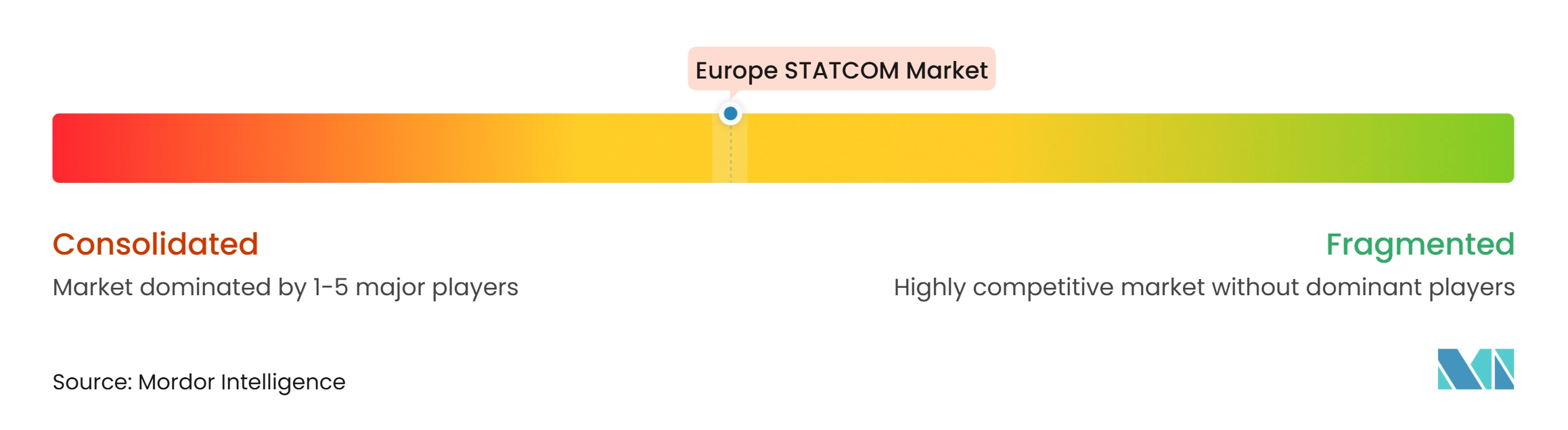
The Europe STATCOM market is moderately consolidated among leading suppliers. Siemens Energy, Hitachi Energy, GE Vernova, and ABB compete for high-rating transmission projects that require extensive system integration. Their positions are supported by power-electronics capability, grid-engineering experience, and established utility relationships. Siemens Energy's Rheinau commissioning provides a current example of a grid-forming STATCOM installation at a major European substation. Hitachi Energy's agreement with E.ON illustrates how access to transformer capacity is becoming part of the competitive offer.
Specialist European suppliers compete in distribution and industrial applications, where local service capacity and project-specific engineering can be decisive. Merus Power supplied a STATCOM for a Siemens Mobility battery-powered train charging station in Denmark.[4] Amprion has also described work on mobile E-STATCOM concepts that could be moved between substations to manage changing network needs. These approaches address smaller or specialized requirements that do not always need a large transmission-class project. Competition in these applications remains open to suppliers with targeted technical offerings.
Control software is becoming a distinct competitive area as utilities seek grid-forming behavior and secure digital monitoring. CIGRE has identified synchronous grid-forming control with and without energy storage as a relevant direction for modern STATCOM development. GE Vernova has positioned its FACTSFLEX GFMe system around grid-forming inverter capability and supercapacitor integration. Siemens Energy's E-STATCOM project similarly combines a modular multilevel converter with supercapacitors. The Europe STATCOM market consequently rewards suppliers that can pair hardware with validated control performance and service support.
Europe STATCOM Industry Leaders
-
Siemens Energy AG
-
Hitachi Energy Ltd
-
GE Vernova Inc.
-
ABB Ltd
-
Mitsubishi Electric Corporation
- *Disclaimer: Major Players sorted in no particular order
Europe STATCOM Market Companies Covered in this Report
- Siemens Energy AG
- Hitachi Energy Ltd
- GE Vernova Inc.
- ABB Ltd
- Mitsubishi Electric Corporation
- Ingeteam S.A.
- American Superconductor Corporation
- Toshiba Energy Systems and Solutions Corporation
- Nidec Conversion S.r.l.
- JEMA Energy S.A.
- Merus Power Plc
- Comsys AB
- Rongxin Power Electronic Co., Ltd.
- Sieyuan Electric Co., Ltd.
- NR Electric Co., Ltd.
- S&C Electric Company
- VEO Oy
Recent Industry Developments in Europe STATCOM Market
- October 2026: TenneT and Siemens Energy unveiled field performance insights from the 300 MVA SVC PLUS FS (E-STATCOM) installation at the Mehrum-Nord substation in Lower Saxony, Germany. Integrating supercapacitor energy storage capable of delivering ±200 MW of active power within milliseconds, the facility provides 24/7 synthetic inertia and serves as the technical blueprint for roughly 30 similar installations planned across Germany's north-south transmission corridors.
- May 2026: Electromontaj and Siemens Energy completed Romania's second transmission-level STATCOM installation at Transelectrica's 400/220/110/20 kV Bradu substation, energizing the ±150 MVAr unit ahead of its contractual deadline under a RON 260 million (approx. USD 55 million) EU Modernization Fund project.
- May 2026: GE Vernova highlighted the commercial rollout of its 300 Mvar FACTSFLEX grid-forming STATCOM technology, advancing turnkey deployments across Germany's 50Hertz transmission network at the Siedenbrünzow and Röhrsdorf substations. Designed with Modular Multilevel Converter (MMC) architecture and integrated grid-forming control software, the units autonomously counter rapid voltage and phase-angle fluctuations caused by high wind and solar penetration in eastern Germany.
- January 2026: Siemens Energy commissioned a ±600 Mvar SVC PLUS grid-forming STATCOM for transmission operator Amprion at the 380/400 kV Rheinau substation in Baden-Württemberg, Germany. The MMC-based indoor installation provides sub-cycle voltage-forming response and advanced harmonic filtering under low short-circuit conditions, while construction continues on a second identical ±600 Mvar unit at Amprion's Polsum substation in North Rhine-Westphalia.
Europe STATCOM Market Report Scope
The Europe STATCOM market covers the deployment and sale of static synchronous compensators (STATCOMs), which are power electronic devices that regulate voltage and improve power quality in electrical transmission and distribution networks. These systems provide dynamic reactive power compensation, support grid stability, and facilitate the integration of renewable energy sources.
The Europe STATCOM Market Report is Segmented by Technology Type (Modular Multilevel Converter (MMC) and Other Multilevel VSC Topologies, Conventional Voltage Source Converter (VSC)-Based STATCOM, Grid-Forming STATCOM / E-STATCOM, and Medium-Voltage and Distribution STATCOM), Reactive Power Rating (Large-Scale Transmission STATCOM, Medium-Scale STATCOM, and Small-Scale Distribution and Industrial STATCOM), Application (Transmission and Grid Infrastructure, Renewable Energy Integration, Industrial and Manufacturing, Data Centers and Commercial Infrastructure, and Railway Electrification and Other Applications), Component (Power Electronic Converter Valves, Converter Transformers and Reactors, Capacitors and Harmonic Filters, Control, Protection, and Monitoring Systems, and Cooling Systems and Auxiliary Components), and Geography (Germany, United Kingdom, France, Italy, Spain, Benelux, and Rest of Europe). The Market Forecasts are Provided in Terms of Value (USD).
Segmentation Overview
| Modular Multilevel Converter (MMC) and Other Multilevel VSC Topologies |
| Conventional Voltage Source Converter (VSC)-Based STATCOM |
| Grid-Forming STATCOM / E-STATCOM |
| Medium-Voltage and Distribution STATCOM |
| Large-Scale Transmission STATCOM |
| Medium-Scale STATCOM |
| Small-Scale Distribution and Industrial STATCOM |
| Transmission and Grid Infrastructure |
| Renewable Energy Integration |
| Industrial and Manufacturing |
| Data Centers and Commercial Infrastructure |
| Railway Electrification and Other Applications |
| Power Electronic Converter Valves |
| Converter Transformers and Reactors |
| Capacitors and Harmonic Filters |
| Control, Protection, and Monitoring Systems |
| Cooling Systems and Auxiliary Components |
| Germany |
| United Kingdom |
| France |
| Italy |
| Spain |
| Benelux |
| Rest of Europe |
| By Technology Type | Modular Multilevel Converter (MMC) and Other Multilevel VSC Topologies |
| Conventional Voltage Source Converter (VSC)-Based STATCOM | |
| Grid-Forming STATCOM / E-STATCOM | |
| Medium-Voltage and Distribution STATCOM | |
| By Reactive Power Rating | Large-Scale Transmission STATCOM |
| Medium-Scale STATCOM | |
| Small-Scale Distribution and Industrial STATCOM | |
| By Application | Transmission and Grid Infrastructure |
| Renewable Energy Integration | |
| Industrial and Manufacturing | |
| Data Centers and Commercial Infrastructure | |
| Railway Electrification and Other Applications | |
| By Component | Power Electronic Converter Valves |
| Converter Transformers and Reactors | |
| Capacitors and Harmonic Filters | |
| Control, Protection, and Monitoring Systems | |
| Cooling Systems and Auxiliary Components | |
| By Geography | Germany |
| United Kingdom | |
| France | |
| Italy | |
| Spain | |
| Benelux | |
| Rest of Europe |
Key Questions Answered in the Report
What is the Europe STATCOM market size?
The Europe STATCOM market size was USD 543.12 million in 2026 and is forecast to reach USD 904.68 million by 2032 at an 8.73% CAGR.
What is driving STATCOM demand in Europe?
Renewable grid connections, replacement of older SVCs and capacitor banks, tighter voltage-control requirements, and long-distance power flows are key factors.
Which technology holds the largest share in Europe?
Modular Multilevel Converter and other multilevel VSC topologies held 36.72% share in 2026.
Which application is projected to grow fastest?
Data centers and commercial infrastructure is projected to expand at a 9.63% CAGR through 2032.
Which country has the largest share in Europe?
Germany held 25.78% share in 2026, supported by transmission investment and the need to manage changing generation patterns.
Why are grid-forming STATCOM systems important?
They can operate as voltage sources in weak grids and, when paired with energy storage, can provide rapid active-power support during disturbances.