
Europe Short Sea Ro-Ro Ocean Freight Transport Market Size and Share
Market Overview
| Study Period | 2020 - 2031 |
|---|---|
| Forecast Data Period | 2026 - 2031 |
| Base Year Market Size (2025) | USD 6.76 Billion |
| Market Size (2026) | USD 7.20 Billion |
| Market Size (2031) | USD 9.71 Billion |
| Growth Rate (2026 - 2031) | 6.17 % |
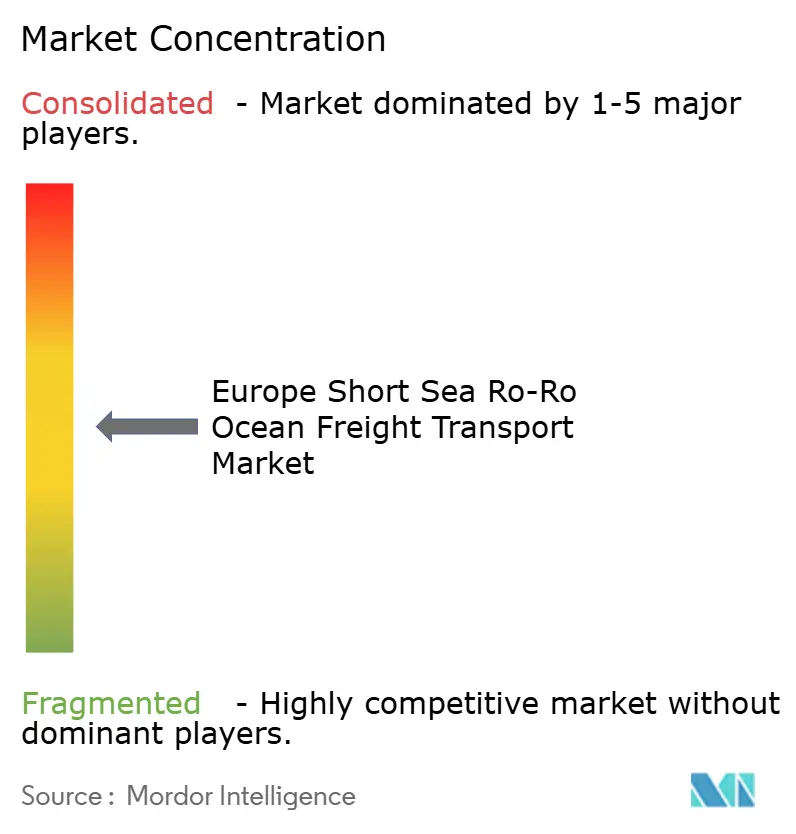
| Market Concentration | Medium |
Major Players *Disclaimer: Major Players sorted in no particular order Image © Mordor Intelligence. Reuse requires attribution under CC BY 4.0. | |
Europe Short Sea Ro-Ro Ocean Freight Transport Market Analysis by Mordor Intelligence
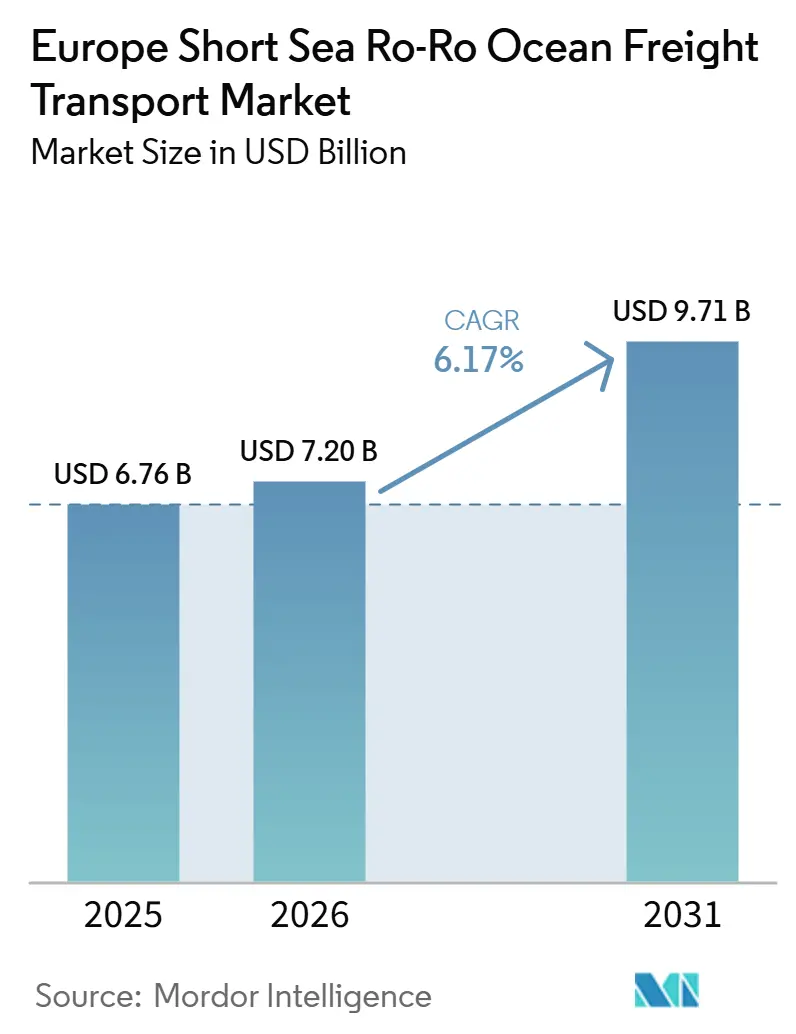
The Europe short sea Ro-Ro ocean freight transport market size was valued at USD 6.76 billion in 2025 and is projected to grow to USD 7.20 billion in 2026, reaching USD 9.71 billion by 2031, growing at a CAGR of 6.17% from 2026 to 2031.
The Europe short sea Ro-Ro ocean freight transport market is supported by automotive logistics patterns that still favor coastal vehicle movement between major production and distribution hubs across the region. It is also benefiting from the wider adoption of unaccompanied trailer services, as shippers seek lower-cost, lower-emission alternatives to long-haul trucking on dense intra-European corridors. Fleet renewal is becoming a stronger competitive factor because operators with newer vessels are better placed to manage emissions rules, protect margins, and secure long-term contracts from large freight customers. Corridor development across Iberia, the Baltic, and the North Sea is widening the commercial scope of the Europe short sea Ro-Ro ocean freight transport market, especially where terminal upgrades and service frequency improvements are already underway.
Key Report Takeaways
- By cargo type, passenger vehicles accounted for 52.39% of the Europe short sea Ro-Ro ocean freight transport market size in 2025, while off-road vehicles are forecast to expand at a 7.86% CAGR through 2031.
- By vessel size, mid-size vessels accounted for 44.62% of Europe short sea Ro-Ro ocean freight transport market share in 2025, while large vessels above 4,000 CEU are projected to record the highest CAGR at 8.24% through 2031.
- By route cluster, the United Kingdom and Continental Europe corridor captured 31.70% of the Europe short sea Ro-Ro ocean freight transport market size in 2025, while the Mediterranean intra-Europe corridor is forecast to grow at an 8.19% CAGR through 2031.
- By end-user industry, OEMs accounted for 46.03% of Europe short sea Ro-Ro ocean freight transport market share in 2025, while the other segment is projected to advance at an 8.65% CAGR through 2031.
- By country, Germany accounted for 21.82% of Europe short sea Ro-Ro ocean freight transport market size in 2025, while Spain is forecast to register the fastest CAGR of 7.25% through 2031.
Note: Market size and forecast figures in this report are generated using Mordor Intelligence’s proprietary estimation framework, updated with the latest available data and insights as of January 2026.
Market Trends and Insights
Drivers Impact Analysis of Europe Short Sea Ro-Ro Ocean Freight Transport Market*
| Driver | (~) % Impact on CAGR Forecast | Geographic Relevance | Impact Timeline |
|---|---|---|---|
| Resurgence in Intra-European Vehicle Production and Trade | +1.5% | Germany, Spain, Belgium, the United Kingdom | Medium term (2-4 years) |
| Shift From Road to Unaccompanied Short-Sea Freight | +1.4% | North Sea, Baltic, Channel corridors | Medium term (2-4 years) |
| Route Diversification Toward Iberia and Scandinavia | +0.8% | Spain, Portugal, Sweden, Finland | Medium term (2-4 years) |
| Port-Adjacent Automotive Logistics Reconfiguration | +0.5% | Germany, Belgium, Netherlands | Medium term (2-4 years) |
| Fleet Renewal Toward Lower-Emission Ro-Ro Vessels | +0.6% | Baltic, North Sea, Mediterranean | Long term (≥ 4 years) |
| Digital Berth Planning and Vehicle Flow Visibility | +0.4% | North Sea, Baltic, Mediterranean | Short term (≤ 2 years) |
| Source: Mordor Intelligence | |||
Resurgence in Intra-European Vehicle Production and Trade
The Europe short sea Ro-Ro ocean freight transport market remains closely tied to finished vehicle flows, as coastal dispatch continues to play a central role in regional automotive distribution. ACEA stated that EU-based manufacturers supplied 73% of the EU market in 2025, and more than one-third of EU-made passenger cars were sold outside the bloc, indicating that vehicle production and maritime vehicle handling remain closely linked. That structure supports steady demand at major vehicle terminals, especially in Germany, Belgium, and Spain, where export and redistribution activities feed short sea shipping networks. It also strengthens route density between production clusters and port gateways, which helps operators maintain utilization even when some export lanes soften. As more vehicle movements remain within Europe or pass through nearby coastal corridors, the region continues to generate cargo that aligns well with Ro-Ro operating patterns. This keeps automotive-linked demand as one of the clearest volume anchors for the Europe short sea Ro-Ro ocean freight transport market.
Shift From Road to Unaccompanied Short Sea Freight
The Europe short sea Ro-Ro ocean freight transport market is also benefiting from the steady shift of freight away from long-distance road transport and toward unaccompanied short sea services. This is becoming more important on North Sea, Baltic, and Channel routes, where service frequency, port access, and regular industrial demand create favorable conditions for modal substitution. The appeal is both practical and financial, because operators can move trailers without depending on the full availability of long-haul drivers across every corridor. Route diversification toward Iberia and Scandinavia adds to this shift, since new and expanded services give freight buyers more options beyond older route patterns. The DFDS decision to add capacity on the Karlshamn to Klaipeda route from September 2026 shows that demand remains strong enough to justify deploying larger vessels on the Baltic lanes. As these corridor options expand, the European short sea Ro-Ro ocean freight market is moving beyond its traditional automotive base and serving a broader mix of freight movements.
Fleet Renewal Toward Lower-Emission Ro-Ro Vessels
Fleet renewal is becoming a defining growth lever for the European short sea Ro-Ro ocean freight transport market, as newer vessels improve both operating economics and regulatory readiness. Stena RoRo ordered 2 next-generation C-Flexer RoRo vessels in January 2026, with options for 4 more, indicating that major operators still see long-term value in adding flexible capacity to European short sea networks[1]Source: Stena RoRo, “Stena RoRo Orders Next-Generation, Future-Proofed C-Flexer RoRo Vessels,” PR Newswire, prnewswire.co.uk. UECC expanded its orderbook in March 2026 to 4 multi-fuel battery hybrid vessels, with 2 units of 4,500 CEU and 2 units of 3,000 CEU scheduled for delivery in 2028. These moves matter because vessel age and fuel flexibility increasingly shape contract competitiveness, especially where emissions exposure affects voyage economics. The European Commission stated that shipping operators must surrender allowances covering 70% of verified 2025 emissions by September 30, 2026, with coverage rising to 100% of 2026 emissions from 2027 onward. In that setting, fleet renewal is not only a compliance step; it is also a commercial tool that strengthens long-term positioning across the Europe short sea Ro-Ro ocean freight transport market[2]Source: European Commission, “Reducing Emissions From the Shipping Sector,” European Commission Climate Action, climate.ec.europa.eu.
Digital Berth Planning and Vehicle Flow Visibility
Digital berth planning and improved visibility into vehicle flow are improving the operational quality of the Europe short sea Ro-Ro ocean freight market, especially at high-volume automotive gateways. Port-side logistics reconfiguration matters here because the closer integration of terminals, yards, and vessel schedules reduces friction in vehicle handling and makes service timing more dependable. Viking Line stated that the Port of Turku redevelopment includes automatic mooring systems and a joint terminal setup intended to shorten berth times and support future operational efficiency[3]Source: Viking Line Abp, “Turku Leads the Way, Port Redevelopment Advances the Green Shipping Corridor,” Cision News, news.cision.com. This kind of investment helps ports handle rising traffic with better predictability, which is valuable for customers moving large vehicle batches on fixed schedules. It also supports corridor expansion around major logistics nodes such as Bremerhaven, Zeebrugge, and Rotterdam, where throughput quality can influence cargo allocation as much as base freight rates. As digital coordination improves, operators in the Europe short sea Ro-Ro ocean freight transport market gain a more defensible service proposition than one based solely on capacity.
Restraints Impact Analysis of Europe Short Sea Ro-Ro Ocean Freight Transport Market*
| Restraint | (~) % Impact on CAGR Forecast | Geographic Relevance | Impact Timeline |
|---|---|---|---|
| Brexit Friction and Border Processing Delays | -0.8% | United Kingdom and Continental Europe corridor | Medium term (2-4 years) |
| Ukraine-Related Corridor Disruptions and Risk Re-Routing | -0.5% | Baltic and Eastern European lanes | Medium term (2-4 years) |
| EU Carbon Compliance Cost Inflation | -1.0% | Intra-EU voyages across all major corridors | Long term (≥ 4 years) |
| Limited Port-Side Ramp and Yard Capacity at Secondary Hubs | -0.4% | Mediterranean secondary ports, Irish Sea, Baltic secondary terminals | Medium term (2-4 years) |
| Source: Mordor Intelligence | |||
Brexit Friction and Border Processing Delays
Brexit-related friction continues to weigh on the Europe short sea Ro-Ro ocean freight transport market, especially on the United Kingdom and Continental Europe corridor, which held the largest route share in 2025. Administrative complexity still affects timing, planning, and buffer requirements for freight that depends on predictable cross-border movement. This matters most on short, frequent crossings, where even modest delays can erode the relative advantage of maritime services over direct road options on nearby routes. The same part of the market also remains exposed to wider corridor uncertainty in the Baltic and Eastern European region, where conflict-related disruptions can alter routing choices and force carriers to rework vessel deployments. That creates added pressure for operators serving time-sensitive freight or mixed cargo portfolios across several regional lanes. The result is a more cautious operating environment for the Europe short sea Ro-Ro ocean freight transport market, even though demand fundamentals on core corridors remain intact.
EU Carbon Compliance Cost Inflation
EU carbon compliance costs are creating a durable headwind for the Europe short sea Ro-Ro ocean freight market, as they unevenly raise voyage costs across fleets. The European Commission confirmed that shipping entered the EU ETS framework with phased surrender obligations, and that methane and nitrous oxide were added to the scope from 2026. That puts older tonnage under greater strain, while operators with newer, more efficient vessels can better absorb the cost burden. The issue is sharper at secondary hubs, where limited ramp capacity, constrained yard space, and slower infrastructure upgrades can reduce turnaround efficiency and make cost recovery harder. Where shore-side readiness is weaker, carriers also face a narrower set of near-term options to improve fuel and emissions performance. This keeps cost inflation as one of the clearest restraints on the Europe short sea Ro-Ro ocean freight transport market through the forecast period.
*Our forecasts treat driver/restraint impacts as directional, not additive. The impact forecasts reflect baseline growth, mix effects, and variable interactions.
Europe Short Sea Ro-Ro Ocean Freight Transport Market Segment Analysis
By Cargo Type:
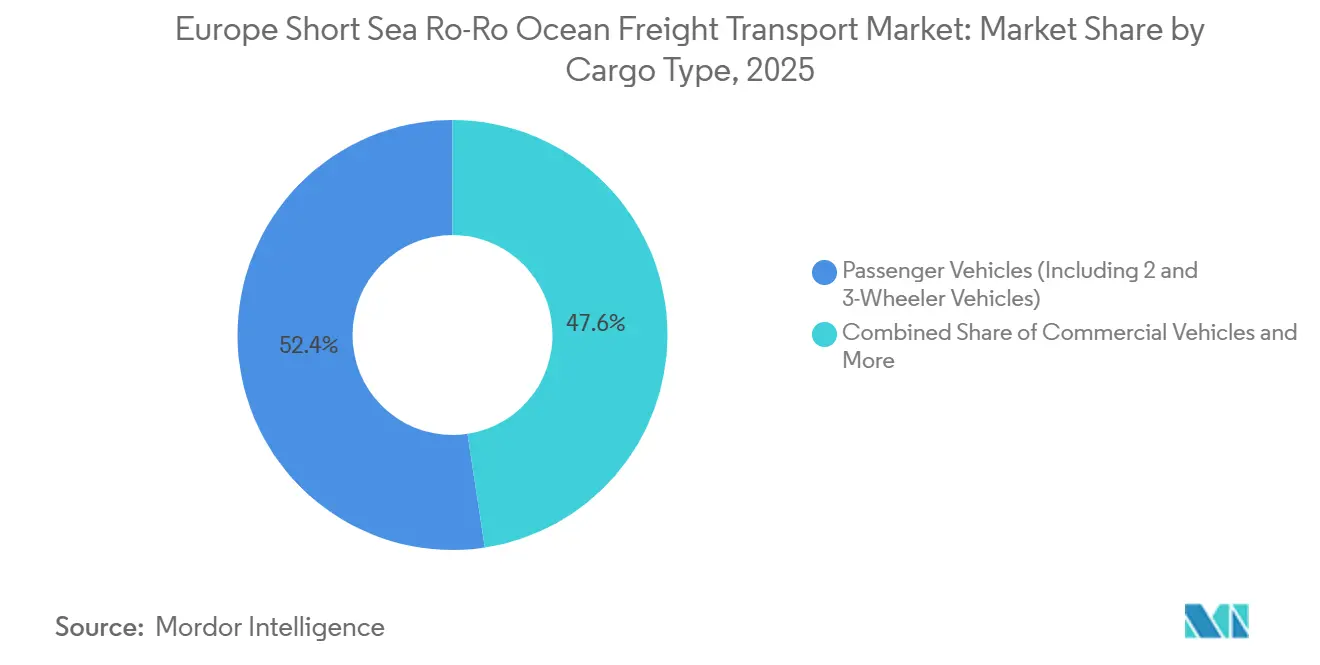
Off-Road Volumes Add Growth Beside the Passenger Vehicle BasePassenger vehicles held 52.39% of Europe short sea Ro-Ro ocean freight transport market share in 2025, keeping this segment clearly ahead of all other cargo categories. This lead reflects the concentration of established car terminal networks in ports such as Bremerhaven, Zeebrugge, and Emden, where vehicle export and redistribution flows are already embedded in regular short sea operations. The segment also benefits from the way European automotive logistics are organized, because large batches of finished vehicles move from production locations to coastal terminals before onward maritime dispatch. ACEA reported that EU passenger car exports declined 6.2% in 2025, indicating that the segment still faces pressure on some extra-European lanes even as intra-European distribution remains important. That makes operating efficiency inside Europe more valuable, since carriers can rely on dense regional routes to support baseline volumes.
Off-road vehicles are projected to grow at a 7.86% CAGR through 2031, making them the fastest-growing cargo segment in the Europe short sea Ro-Ro ocean freight transport market. This segment includes construction equipment, agricultural machinery, and other high-and-heavy units that lend themselves well to Ro-Ro loading when direct wheeled handling is important. UECC reported transporting 20,000 high-and-heavy cargo units in 2025 alongside 1.3 million passenger cars, indicating that this category is already meaningful for operators with the right vessel mix. As project cargo and specialized rolling freight gain space within existing services, off-road volumes provide a useful growth layer beyond the passenger vehicle base.



By Vessel Size:
Large Newbuilds Expand Faster Than the Established Mid-Size FleetMid-size vessels with 2,000 to 4,000 CEU accounted for 44.62% of the Europe short sea Ro-Ro ocean freight transport market size in 2025, keeping them at the center of the market. Their strong position reflects the long-standing operating profile of Baltic and North Sea corridors, where many services were built around port limits, ramp constraints, and route economics suited to mid-size ships. These vessels still offer a practical balance between frequency and capacity on established lanes that do not always require very large tonnage. At the same time, their leading share does not remove the growing pressure to modernize, because emissions rules and fuel costs are making efficiency more important across vessel classes. This is why mid-size vessels continue to dominate current deployment, while their future role increasingly depends on fleet age, fuel flexibility, and route specialization.
Large vessels above 4,000 CEU are projected to grow at an 8.24% CAGR through 2031, the fastest pace within vessel sizing, which lifts their position in the Europe short sea Ro-Ro ocean freight transport market size outlook. Stena RoRo stated that its new C-Flexer vessels were designed for flexible deck configurations across cargo types, supporting the move toward larger, more versatile ships on core routes. UECC also showed this split in strategy by ordering both 4,500-CEU and 3,000-CEU vessels, suggesting that operators are matching ship size more closely to route and cargo requirements. Small vessels below 2,000 CEU still matter on restricted-draft feeder routes and secondary terminals, but they are under greater pressure where larger ships can deliver stronger unit economics. This leaves the Europe short sea Ro-Ro ocean freight transport industry with a more divided vessel base, where size decisions are tied more directly to compliance exposure and corridor strength than in the past.
By Flows and Route Clusters:
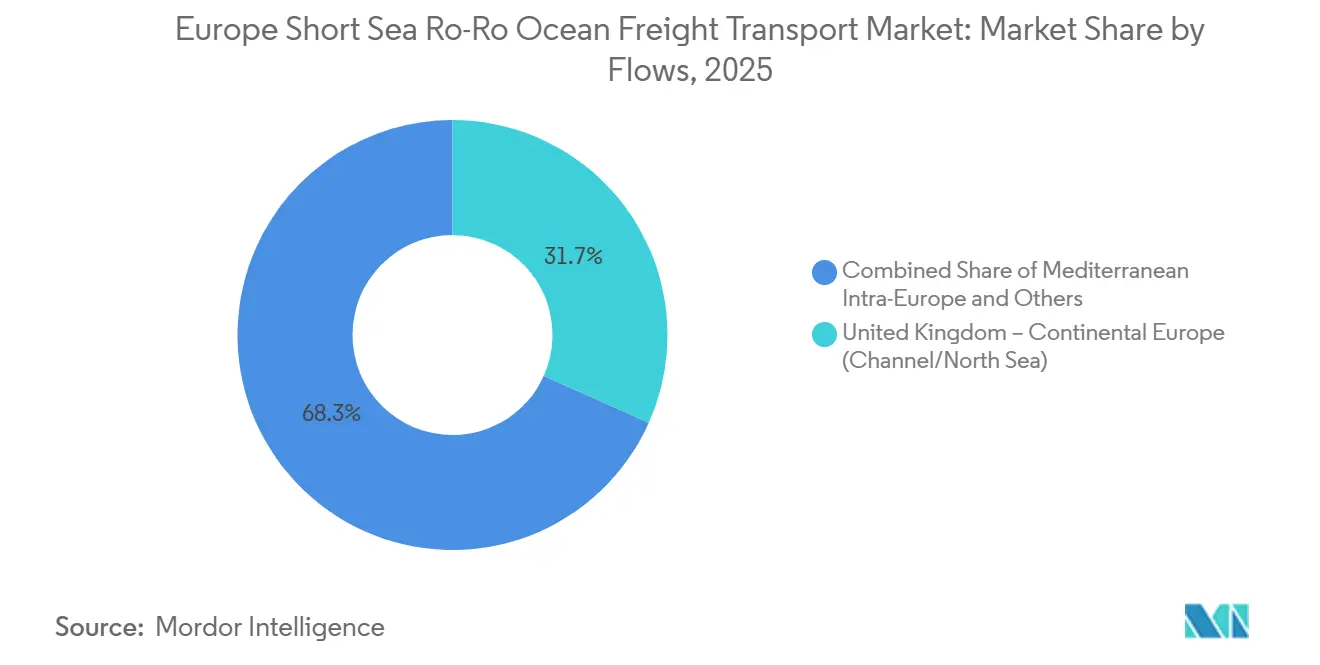
Mediterranean Growth Rises Against the Largest United Kingdom and Continental Europe CorridorThe United Kingdom and Continental Europe cluster accounted for 31.70% of the Europe short sea Ro-Ro ocean freight transport market share in 2025, making it the largest route grouping. Its lead came from the traffic density of the Dover Strait, the North Sea Channel area, and the Irish Sea, where freight demand, industrial ties, and frequent sailings have long supported high utilization. This corridor remains commercially important because it connects key distribution points in the United Kingdom, Belgium, and the Netherlands, even while it operates under heavier documentation requirements than many continental lanes. Its scale gives carriers a strong base of repeat traffic. Still, it also means regulatory friction and border delays have a broader impact on service quality than in smaller route clusters.
Mediterranean intra-Europe is forecast to expand at an 8.19% CAGR through 2031, making it the fastest-growing route cluster in the Europe short sea Ro-Ro ocean freight transport industry. This momentum reflects the repositioning of cargo toward Southern Europe and adjacent production areas, with Spain and Italy becoming more important in regional freight flows. The Port of Bilbao stated in June 2026 that Finnlines added Gdynia to its weekly North Sea and Bay of Biscay service, strengthening the link between Baltic cargo and southern European gateways. That development matters because it broadens the commercial reach of Mediterranean-facing and Iberian services rather than keeping them limited to local flows. North Sea and Baltic route groups remain deeply integrated with German and Scandinavian supply chains, but Mediterranean services are now taking a larger share of incremental growth. This creates a route mix in the Europe short sea Ro-Ro ocean freight transport market that is still led by mature northern corridors, while the south delivers the strongest forward expansion.
By End-user Industry:
OEM Contracts Still Lead While Other Fleet Buyers Grow FasterOEMs accounted for 46.03% of the Europe short sea Ro-Ro ocean freight transport market size in 2025, making them the largest end-user group. Their leading position reflects long-term volume commitments and structured logistics relationships with established Ro-Ro operators across major vehicle and trailer corridors. This creates a stable cargo base for carriers that already have deep access to automotive production and distribution networks. It also raises concentration risk for operators that rely too heavily on a narrow customer set, especially when export conditions weaken or production plans shift. ACEA reported that EU passenger car exports fell 6.2% in 2025, underscoring the continued importance of customer diversification even in a market where OEMs remain central. As a result, the strength of the OEM business continues to support core volumes, while the search for wider end-user exposure is becoming increasingly important across the European short sea Ro-Ro ocean freight transport market.
The other segment, which includes rental companies, fleet leasing operators, and government or defense fleets, is forecast to grow at an 8.65% CAGR through 2031, making it the fastest-growing end-user category. This group is gaining because its cargo profile often involves large batches of vehicles that fit Ro-Ro economics well on medium- and long-haul regional routes. That allows carriers to capture demand that historically moved by road, especially when customers are handling fleet renewal or scheduled redeployment rather than one-off deliveries. Dealers also remain relevant where import-market distribution stays active, but they do not match the current growth pace of broader fleet-based buyers. The wider mix of users helps the Europe short sea Ro-Ro ocean freight transport industry reduce dependence on any single contract structure, while still building around its strongest automotive foundations. This gradual broadening of demand makes the market more balanced, even though OEM-linked traffic remains the dominant revenue anchor.
Geography Analysis
Germany and United Kingdom Short Sea Ro-Ro Ocean Freight Transport Market
Germany held 21.82% of the Europe short sea Ro-Ro ocean freight transport market share in 2025, making it the largest national market in the region. Its lead reflects the strength of German automotive production, the central role of Bremerhaven in vehicle export activity, and the country’s close connection to both North Sea and Baltic shipping patterns. Germany also benefits from corridor density, because it links production clusters with vehicle terminals and high-frequency maritime services in a way few other markets can match. The United Kingdom remained the next major national contributor, but its position still entails additional administrative friction on cross-border routes. That friction does not diminish the corridor’s scale, though it slows the pace at which operators can convert volume strength into smoother operating performance.
Netherlands and Belgium Short Sea Ro-Ro Ocean Freight Transport Market
The Netherlands and Belgium continue to play an outsized role in the Europe short sea Ro-Ro ocean freight transport market because Rotterdam and Zeebrugge operate as key redistribution hubs. Their value comes less from domestic consumption alone and more from their position within regional cargo networks connecting the United Kingdom, Ireland, Germany, and wider continental markets. DFDS stated in 2025 that it launched a direct freight ferry route between Vilagarcía in Spain and Rotterdam in the Netherlands, which underlines Rotterdam’s continued role in linking Iberian and Northern European freight flows[4]Source: DFDS, “DFDS Launches Freight Route Between Spain and the Netherlands,” DFDS, dfds.com. These hub markets are important because they help carriers combine vehicle handling, trailer movement, and onward feeder distribution within a single operating system. That keeps them central to network design even when the fastest growth is moving elsewhere.
Spain, Italy and Northern Europe Short Sea Ro-Ro Ocean Freight Transport Market
Spain is projected to grow at a 7.25% CAGR through 2031, which makes it the fastest-growing national segment in the Europe short sea Ro-Ro ocean freight transport market size outlook. This growth reflects the rising importance of Iberian corridors, stronger links with southern route clusters, and the wider repositioning of freight toward Mediterranean-facing and Atlantic-facing services. The Port of Bilbao confirmed in June 2026 that Finnlines expanded the reach of its weekly service by adding Gdynia, thereby improving Spain’s position within a broader multi-port Ro-Ro network. Italy remains important through Adriatic and southern corridor activity, while the rest of Europe, especially the Baltic and Scandinavian area, continues to gain from route frequency and capacity improvements. DFDS stated that the newly chartered vessel for the Karlshamn to Klaipeda service will add freight capacity from September 2026, pointing to continued strength in Baltic-linked demand. Taken together, the geographic picture shows a market led by Germany, supported by Benelux hubs, and pushed forward by Spain and selected Baltic corridors.
Competitive Landscape
The Europe short sea Ro-Ro ocean freight transport market is moderately concentrated, with DFDS, CLdN, Grimaldi Group, Stena Line, and UECC forming the leading group. These companies benefit from fleet scale, corridor density, established terminal relationships, and deep exposure to automotive and trailer freight. Below this group, operators such as P&O Ferries, Brittany Ferries, Attica Group, Tallink, and Viking Line compete more selectively through regional positioning, route focus, and vessel quality. This keeps the market active rather than closed, but it also means that the largest players still set the tone for investment and service standards. The Europe short sea Ro-Ro ocean freight transport market, therefore, shows a clear upper tier without reaching the level of a highly consolidated structure.
Strategic activity is centered on capacity quality, network reach, and operational integration. DFDS agreed in June 2026 to acquire the RoPax ferry Stena Vinga from Stena Line, which supports its Channel Islands and United Kingdom-linked operations while adding crew employment under the United Kingdom flag. UECC signed for 2 additional 3,000-CEU multi-fuel battery-hybrid PCTCs in March 2026, extending its sustainable fleet pipeline and strengthening its position in vehicle-focused maritime transport. Stena RoRo also placed an order for 2 new C-Flexer vessels in January 2026, reinforcing the importance of versatile and lower-emission capacity in the next competitive cycle. These moves show that top players are not defending position only through existing routes; they are also reshaping their fleets to protect future economics.
A second layer of competition comes from how operators connect maritime services with port systems and wider logistics coverage. Viking Line’s involvement in the Turku terminal redevelopment shows how infrastructure partnerships can improve berth efficiency and support stronger service reliability over time. DFDS also demonstrated the strategic value of route expansion when it launched the Vilagarcía-Rotterdam freight connection, which widened access between Iberia and Northern Europe. UECC reported that bioLNG accounted for 71% of LNG fuel use across its dual-fuel fleet in 2025, indicating that the fuel strategy itself is becoming a competitive differentiator. The Europe short sea Ro-Ro ocean freight transport market is therefore being shaped by a mix of scale, emissions-readiness, and service integration rather than by price competition alone.
Europe Short Sea Ro-Ro Ocean Freight Transport Industry Leaders
DFDS A/S
CLdN Group
Grimaldi Group
Stena Line (Stena AB)
P&O Ferries
- *Disclaimer: Major Players sorted in no particular order
Europe Short Sea Ro-Ro Ocean Freight Transport Market Companies Covered in this Report
- DFDS A/S
- CLdN Group
- Grimaldi Group
- Stena Line (Stena AB)
- P&O Ferries
- Brittany Ferries
- Irish Ferries (Irish Continental Group plc)
- Attica Group
- GNV (Grandi Navi Veloci S.p.A.)
- Balearia Eurolineas Maritimas S.A.
- Color Line AS
- TT-Line GmbH & Co. KG
- Scandlines GmbH
- Tallink Grupp AS
- Viking Line Abp
- Naviera Armas Trasmediterranea
- UECC (United European Car Carriers)
- Polferries (Polska Zegluga Baltycka S.A.)
- Unity Line
- Eckero Line Oy
- Transfennica Ltd. (Spliethoff Group)

Recent Industry Developments in Europe Short Sea Ro-Ro Ocean Freight Transport Market
- June 2026: Finnlines (Grimaldi Group) added the Polish port of Gdynia to its weekly North Sea–Bay of Biscay Ro-Ro service, linking Bilbao with Zeebrugge, Antwerp, Helsinki, Kotka, Travemunde, Lubeck, and now Gdynia. The extension creates a new southern outlet for Polish Baltic cargo flows and connects inland European production with the Grimaldi group's global network.
- May 2026: DFDS has agreed to acquire the RoPax ferry Stena Vinga from Stena Line. The company expects to complete the acquisition in November 2026, reflag the vessel under the United Kingdom flag, and continue operating it on the Jersey–United Kingdom/France service. DFDS plans to create 70 new crew positions, underscoring its commitment to United Kingdom-flagged and Channel Islands freight operations.
- March 2026: UECC signed a newbuild contract for two additional 3,000 CEU multi-fuel battery hybrid PCTCs at China Merchants Jinling Shipyard Nanjing, bringing its total on-order fleet to four vessels. The company designed all four vessels to operate on LNG, bioLNG, and future alternative fuels, with delivery scheduled for early 2028.
- May 2025: DFDS launched a new direct freight ferry service between Vilagarcía (Spain) and Rotterdam (Netherlands), offering a direct short sea alternative to road transport on the Iberian–Northern Europe corridor and extending the company's Mediterranean and Iberian freight network.


Europe Short Sea Ro-Ro Ocean Freight Transport Market Report Scope
| Passenger Vehicles (incl. 2 and 3-wheeler vehicles) |
| Commercial Vehicles |
| Off-road Vehicles |
| Small-size Vessels (Less than 2,000 CEU) |
| Mid-size Vessels (2,000 - 4,000 CEU) |
| Large vessels (More than 4,000 CEU) |
| UK - Continental Europe (Channel/North Sea) |
| North Sea - Scandinavia/Germany Corridor |
| Baltic/Poland - Scandinavia/Germany |
| Mediterranean Intra-Europe |
| All Other Intra-European Short-sea Lanes |
| OEMs |
| Dealers |
| Others (Rental Companies, Fleet leasing companies, Government & Defense Fleets, etc.) |
| United Kingdom |
| Germany |
| Netherlands |
| Belgium |
| Spain |
| Italy |
| Rest of Europe |
| By Cargo Type | Passenger Vehicles (incl. 2 and 3-wheeler vehicles) |
| Commercial Vehicles | |
| Off-road Vehicles | |
| By Vessel-size | Small-size Vessels (Less than 2,000 CEU) |
| Mid-size Vessels (2,000 - 4,000 CEU) | |
| Large vessels (More than 4,000 CEU) | |
| By Flows/Route Clusters | UK - Continental Europe (Channel/North Sea) |
| North Sea - Scandinavia/Germany Corridor | |
| Baltic/Poland - Scandinavia/Germany | |
| Mediterranean Intra-Europe | |
| All Other Intra-European Short-sea Lanes | |
| By End-user Industry | OEMs |
| Dealers | |
| Others (Rental Companies, Fleet leasing companies, Government & Defense Fleets, etc.) | |
| By Country | United Kingdom |
| Germany | |
| Netherlands | |
| Belgium | |
| Spain | |
| Italy | |
| Rest of Europe |


Key Questions Answered in the Report
What is the expected value of the Europe short sea Ro-Ro ocean freight transport market by 2031?
The Europe short sea Ro-Ro ocean freight transport market is forecast to reach USD 9.71 billion by 2031, rising from USD 7.20 billion in 2026 at a CAGR of 6.17%.
Which cargo segment leads revenue in Europe's short-sea Ro-Ro ocean freight transport?
Passenger vehicles led revenue with a 52.39% share in 2025, supported by dense automotive terminal networks and established OEM distribution flows across Europe.
Which route cluster is growing the fastest in Europe for short-sea Ro-Ro and ocean freight transport?
Mediterranean intra-Europe is projected to post the fastest growth at an 8.19% CAGR through 2031, reflecting stronger southern corridor activity and wider route connectivity.
Why are larger Ro-Ro vessels gaining importance in Europe?
Large vessels above 4,000 CEU are forecast to grow at a 8.24% CAGR as operators seek better scale economics, stronger emissions performance, and more flexible deck use.
Which country is the largest and which is growing the fastest?
Germany held the largest national share at 21.82% in 2025, while Spain is expected to grow the fastest at a 7.25% CAGR through 2031.
What is shaping competition among leading Ro-Ro operators in Europe?
Competition is being shaped by fleet renewal, route expansion, emissions readiness, and stronger port and logistics integration, with DFDS, Grimaldi Group, Stena Line, CLdN, and UECC leading the top tier.
Page last updated on:





