
Europe Scaffolding Rental Market Size and Share
Market Overview
| Study Period | 2021 - 2032 |
|---|---|
| Forecast Data Period | 2027 - 2032 |
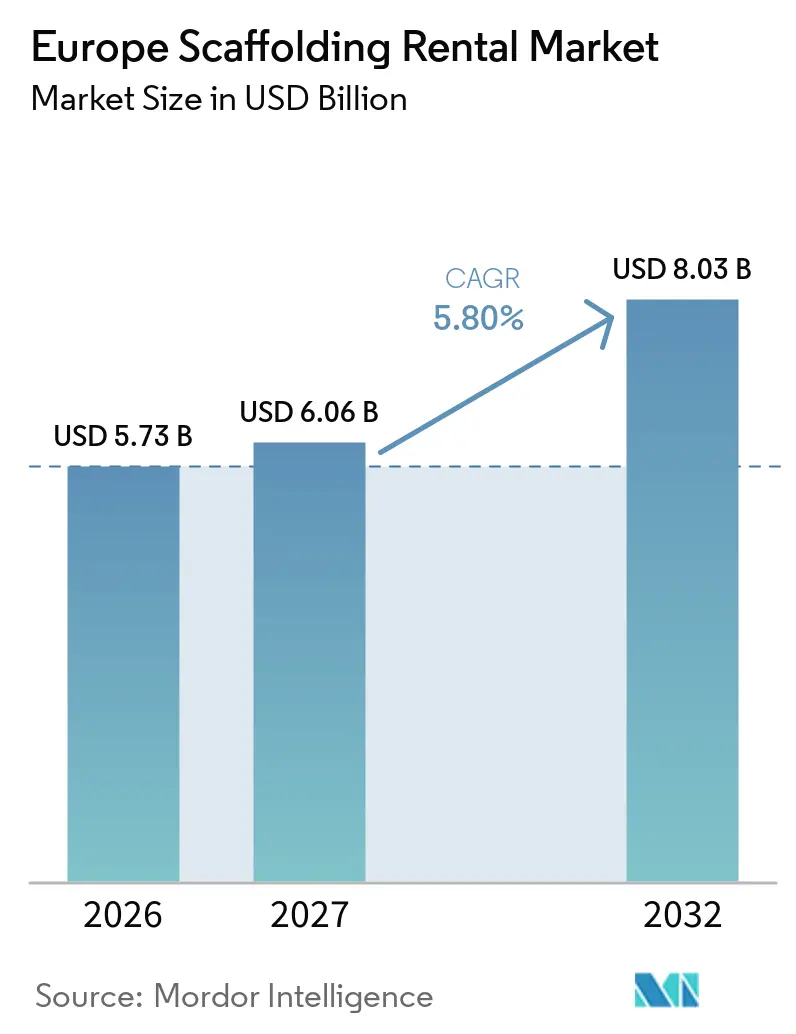
| Base Year Market Size (2026) | USD 5.73 Billion |
| Market Size (2027) | USD 6.06 Billion |
| Market Size (2032) | USD 8.03 Billion |
| Growth Rate (2027 - 2032) | 5.80 % |
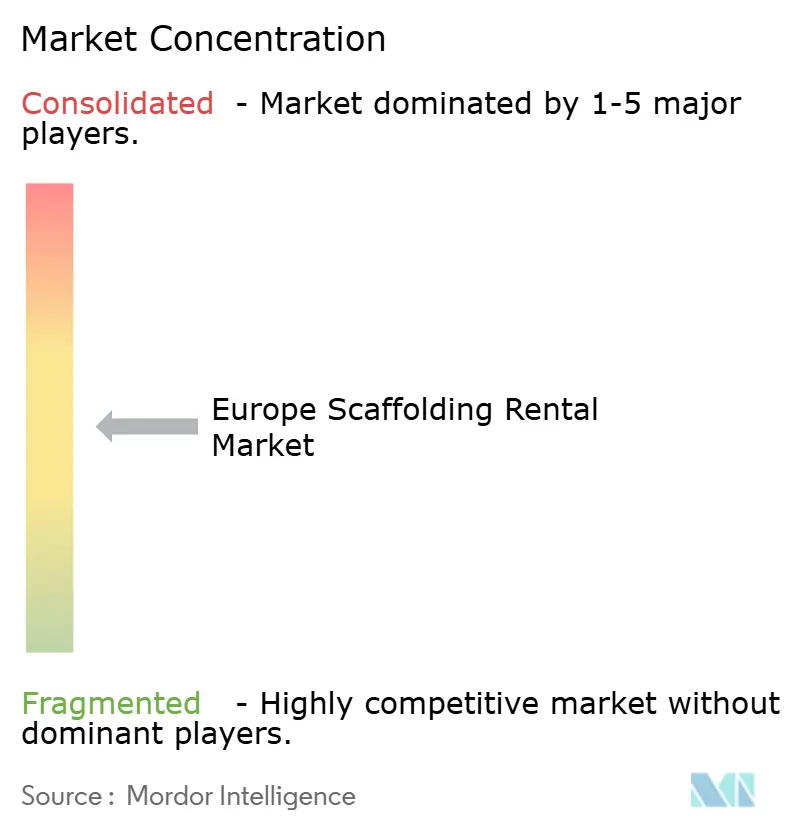
| Market Concentration | Medium |
Major Players *Disclaimer: Major Players sorted in no particular order Image © Mordor Intelligence. Reuse requires attribution under CC BY 4.0. | |
Europe Scaffolding Rental Market Analysis by Mordor Intelligence
The Europe Scaffolding Rental Market size is expected to grow from USD 5.73 billion in 2026 to USD 6.06 billion in 2027 and is forecast to reach USD 8.03 billion by 2032 at 5.80% CAGR over 2027-2032.
Building renovation, public infrastructure renewal, and the shift from owned equipment to rental fleets support this outlook. The revised Energy Performance of Buildings Directive requires member states to submit National Building Renovation Plans by December 2026, creating a clearer project pipeline for facade and roof access work. Consequently, the Europe scaffolding rental market is less dependent on new housing activity than in previous years, although housing construction remains important for fleet utilization. Contractors increasingly prefer rental services because they eliminate storage, inspection, maintenance, and resale risks while providing access to certified systems. Operators with extensive branch networks, compliant equipment fleets, and specialist access capabilities are well positioned to benefit as project requirements become increasingly complex.
Key Report Takeaways
- By type, supported scaffolds held 48% of the Europe scaffolding rental market share in 2026, while suspended scaffolds are projected to grow at a 7% CAGR through 2032.
- By system, modular and ringlock systems held 37% of the Europe scaffolding rental market share in 2026 and are projected to grow at a 7.1% CAGR through 2032.
- By material type, steel held 59% of the Europe scaffolding rental market share in 2026, while aluminum is projected to grow at a 7.2% CAGR through 2032.
- By sector, residential construction held 33% of the Europe scaffolding rental market share in 2026, while infrastructure is projected to grow at a 7.3% CAGR through 2032.
- By country, Germany held 32% of the Europe scaffolding rental market share in 2026 and is projected to grow at a 7.4% CAGR through 2032.
Note: Market numbers in this report are based on Mordor Intelligence's proprietary estimation framework, which combines nine months of actuals with Q4 projections for base year 2026.
Market Trends and Insights
Drivers Impact Analysis of Europe Scaffolding Rental Market*
| Drivers | (~) % Impact on CAGR Forecast | Geographic Relevance | Impact Timeline |
|---|---|---|---|
| Energy-Efficiency Renovation of Building Stock | +1.6% | EU-wide, led by France, Germany, and Italy | Long term (≥ 4 years) |
| Transport and Energy-Transition Infrastructure Investment | +1.4% | Germany, Spain, and Rest of Europe | Long term (≥ 4 years) |
| Strict Work-at-Height Safety Regulation | +0.9% | EU-wide, with tighter national enforcement in Germany and the United Kingdom | Short term (≤ 2 years) |
| Rising Rental Penetration Among Small and Mid-Sized Contractors | +0.7% | EU-wide, strongest in Southern Europe | Long term (≥ 4 years) |
| Heritage Restoration and Facade Refurbishment | +0.5% | United Kingdom, France, Italy, and Spain | Medium term (2-4 years) |
| Modular and Ringlock Systems and BIM-Based Planning | +0.4% | Germany, United Kingdom, and Northern Europe | Medium term (2-4 years) |
| Source: Mordor Intelligence | |||
Energy-Efficiency Renovation of the Building Stock (EPBD-Led Retrofits)
The revised Energy Performance of Buildings Directive has been in force since May 2024 and requires national implementation by May 2026[1]. Member states are due to submit their first National Building Renovation Plans by December 2026. The European Commission states that 85% of EU buildings were built before 2000 and 75% have poor energy performance. Exterior insulation, facade repair, roof work, and window replacement require safe access over sustained periods, which supports demand across the Europe scaffolding rental market. Minimum energy performance rules for non-residential buildings strengthen the timing of renovation activity, particularly for poorly performing properties. This policy framework gives rental operators a longer planning horizon than discretionary new-build activity and improves the case for maintaining compliant facade-access fleets.
Transport and Energy-Transition Infrastructure Investment
Transport maintenance and energy-transition projects are expanding the addressable work for specialist access providers in the Europe scaffolding rental market. Germany’s infrastructure program directs major funding toward railways, highways, and bridge modernization, while ageing assets require complex work around live traffic and rail corridors. In Spain, the European Investment Bank and Adif signed a USD 379.1 million equivalent loan in January 2025 to improve conventional and high-speed railway infrastructure, supporting investment above USD 900 million equivalent[2]. Suspended platforms and specialty access systems are valuable on bridge decks, undersides, and irregular structures where conventional ground-supported systems are unsuitable. These assignments often require equipment that smaller contractors do not keep in stock, which favors rental operators with dedicated fleets. Energy facilities, wind-related maintenance, refinery turnarounds, and gas infrastructure also create recurring technical access demand outside the traditional construction cycle.
Strict Work-at-Height Safety Regulation Favoring Certified Systems
Work-at-height rules make verified equipment and qualified erection practices central to procurement decisions. EN 12811 provides the European performance framework for temporary works equipment and working scaffolds[3]. In the United Kingdom, the Work at Height Regulations 2005 require work at height to be planned and supervised by competent people. The Construction Industry Scaffolders Record Scheme supports documented skills recognition for scaffolders, while clients often require these credentials in tender processes. The Europe scaffolding rental market benefits when contractors prefer pre-certified systems rather than irregular site-built arrangements with uncertain documentation. Compliance also raises the cost of informal entry, although certified rental providers still need to manage inspection quality and local enforcement differences. Heritage locations add another layer of control because access designs must protect historic fabric as well as workers and the public.
Rising Rental Penetration Among Small and Mid-Sized Contractors
Construction in Europe remains fragmented, and smaller firms often cannot justify a permanently owned scaffold fleet. The European Construction Observatory recorded 13.8 million construction workers in 2024, illustrating the scale of a sector built around many contractors and specialist trades. Rental replaces a large upfront equipment commitment with project-based access to inspected systems, transport, and technical support. This approach is especially relevant for renovation programs that involve multiple phases, changing building elevations, and intermittent work schedules. The Europe scaffolding rental market also benefits from demand for flexible fleet sizing, because contractors can return equipment after a project rather than carry it through a slow period. In Southern and Eastern Europe, where ownership has historically been more common, this logic can gradually increase rental adoption. Digital planning and modular systems reinforce this shift by making it easier to specify, assemble, and redeploy components across sites.
Restraints Impact Analysis of Europe Scaffolding Rental Market*
| Restraints | (~) % Impact on CAGR Forecast | Geographic Relevance | Impact Timeline |
|---|---|---|---|
| Weak New-Build Residential Activity | -0.9% | Germany, United Kingdom, and Nordic countries | Short term (≤ 2 years) |
| Skilled Erector Shortages and Rising Labor Costs | -0.8% | EU-wide, most acute in the United Kingdom, Germany, and Italy | Long term (≥ 4 years) |
| Steel and Aluminum Price Volatility | -0.5% | Global commodity exposure affecting EU fleet procurement | Short term (≤ 2 years) |
| Substitution by Aerial Work Platforms and Rope Access | -0.3% | Industrial and logistics sectors across the EU | Medium term (2-4 years) |
| Source: Mordor Intelligence | |||
Weak New-Build Residential Activity
Weak new-build housing activity limits a large source of volume demand for the Europe scaffolding rental market. Residential construction represented 33% of demand in 2026, so fewer multi-story projects can reduce utilization of standard supported systems. Higher construction costs and financing pressures have delayed projects in several European countries. The effect is most visible in markets where permits and completions have fallen sharply, including parts of Germany and the Nordic region. Renovation work partly offsets this reduction because energy upgrades still require facade access. However, a renovation project may use less scaffold volume than a comparable new-build project, so the offset is incomplete in the near term.
Skilled Erector Shortages and Rising Labor Costs
A limited supply of qualified erectors restricts the ability of rental providers to turn equipment quickly and safely. The European Labour Authority identified building and related trades among shortage occupations across Europe in its 2025 report. Staffing pressure is acute where projects require complex suspended, cantilevered, or industrial access designs. Germany’s scaffold trade wage increases in 2025 and 2026 reflect competition for trained labor, while the sector relies increasingly on workers with an immigration background. Higher labor costs can raise project prices and challenge operator margins when contracts are fixed. The Europe scaffolding rental market can mitigate some pressure through modular components, digital planning, and better logistics, but those measures do not remove the need for skilled on-site teams.
*Our forecasts treat driver/restraint impacts as directional, not additive. The impact forecasts reflect baseline growth, mix effects, and variable interactions.
Europe Scaffolding Rental Market Segment Analysis
By Type:
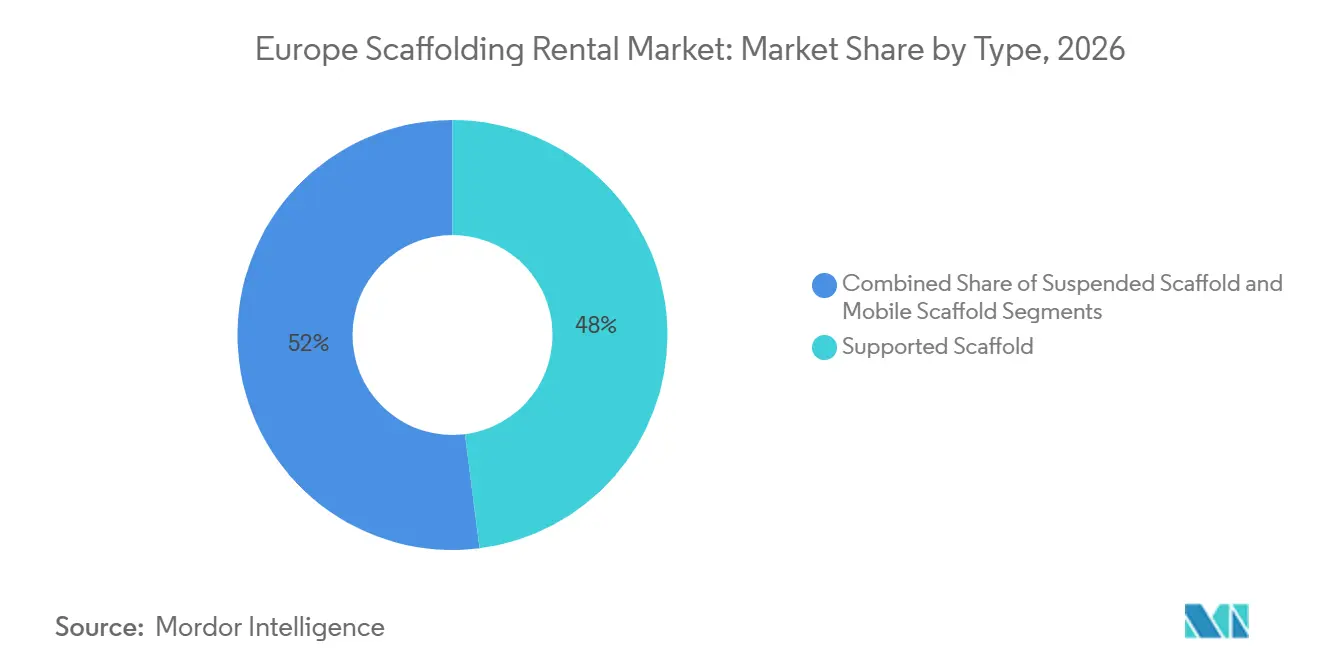
Supported Systems Retain the Largest Base While Suspended Access GrowsSupported scaffolds accounted for 48% of the Europe scaffolding rental market share in 2026. They are widely used for facade renovation, multi-story residential work, commercial construction, and planned maintenance. Their ground-based design suits repetitive elevations and allows crews to create broad working platforms. Energy-efficiency projects support this base because exterior insulation and facade repair require extended vertical access. Mobile scaffolds serve shorter interior tasks, retail maintenance, and routine inspections where rapid repositioning is more important than full facade coverage. They remain a stable part of the equipment mix, particularly for smaller contractors that use rental to meet temporary access needs.
Suspended scaffolds are projected to grow at a 7% CAGR through 2032. They are suited to bridge undersides, elevated facades, and sites where ground support would disrupt traffic or be physically impractical. The Europe scaffolding rental market size for suspended systems benefits from bridge rehabilitation and rail infrastructure work that require nonstandard access geometry. Historic England issued guidance on scaffolding for historic buildings in July 2025, which reflects the need to plan access around protected structures. Cantilevered and suspended arrangements can reduce direct contact with sensitive ground or building elements. Their technical demands favor providers that can supply engineering support, inspection, and specialist erection capability.

By System:
Modular and Ringlock Systems Combine Scale and GrowthModular and ringlock systems held 37% of the Europe scaffolding rental market share in 2026. Their standardized connections allow quick assembly and support reuse across different layouts. Doka states that its Ringlock range can reuse many components across configurations, which can improve fleet deployment efficiency. These systems are widely suited to facade, industrial, and infrastructure applications. Tube-and-coupler equipment remains necessary where heritage work or irregular structures require bespoke geometry. Cuplock systems also retain established use in some industrial and infrastructure applications, especially where contractors have long experience with the system.
The modular and ringlock category is projected to grow at a 7.1% CAGR through 2032. Digital design tools support its growth because standardized components can be planned in three-dimensional models and translated into site instructions. PERI introduced digital scaffolding management tools at Bauma 2025 to improve visibility across the construction process. Doka launched Ringlock Hybrid Standard at Bauma 2025 for facade and renovation work, extending modular systems into uses long associated with frame scaffolds. This product supports rental providers because standardized systems are easier to train crews on and redeploy. The category’s combined share and growth suggest that customers value speed, adaptable design, and predictable compliance.
By Material Type:
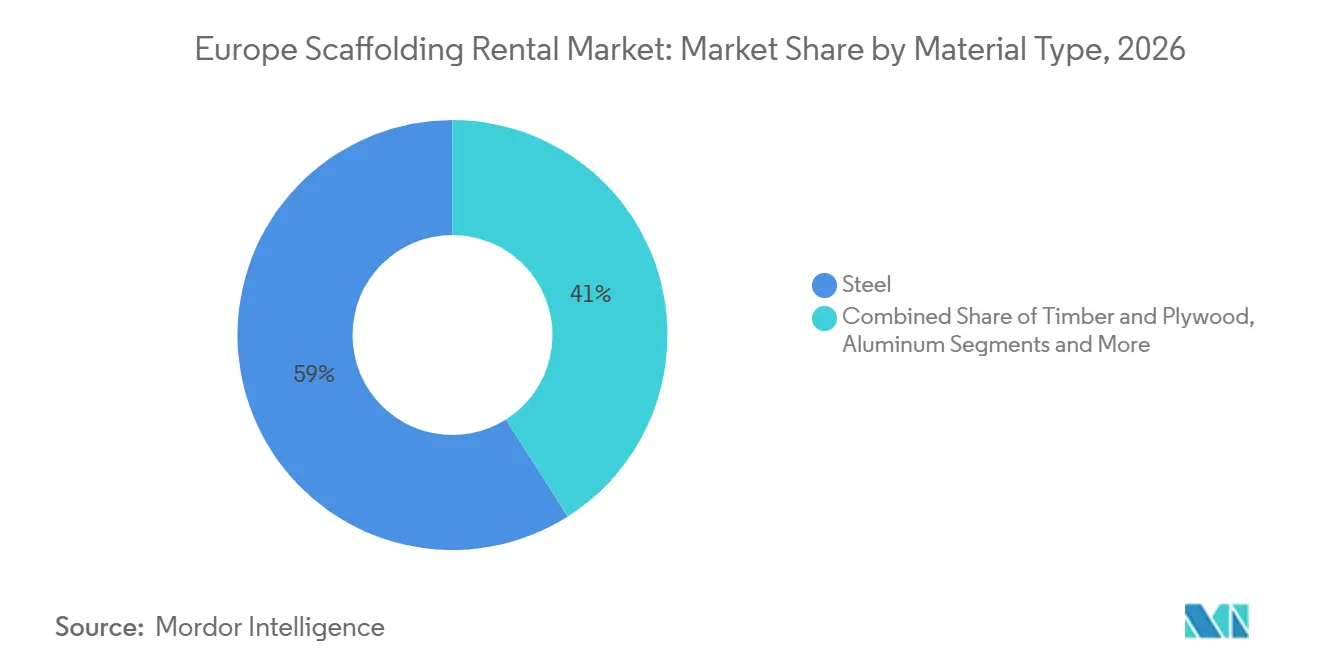
Steel Leads Volume While Aluminum Gains GroundSteel held 59% of the Europe scaffolding rental market share in 2026. Its load capacity and durability make it a common choice for heavy-duty shoring, bridge work, and large commercial sites. Steel systems also benefit from a long installed base and established contractor familiarity. Plastic and fiberglass systems remain small but serve electrical or chemical environments where nonconductive equipment is needed. Timber and plywood retain limited relevance for conservation work where traditional methods are required. Steel will remain important where high loads and wide platforms outweigh handling convenience.
Aluminum is projected to grow at a 7.2% CAGR through 2032. Its lower weight can reduce handling demands and limit the need for crane support in dense urban areas. The Europe scaffolding rental market size for aluminum systems grows where tight streets, access restrictions, and aging crews make lighter components valuable. Eurofound reported that the share of workers regularly lifting heavy loads declined from 48% in 2010 to 33% in 2024, underlining the continuing focus on manual-handling exposure. Aluminum is also recyclable and can support contractors seeking to meet circular procurement expectations. Compliance with EN 12811-1 requirements allows aluminum systems to serve many standard facade and renovation uses without sacrificing safety expectations.
By Sector:
Residential Renovation Supports Volume While Infrastructure Expands FasterResidential construction held 33% of the Europe scaffolding rental market share in 2026. Renovation activity helps sustain demand even while new housing construction remains weak. Facade insulation, roof repairs, window replacement, and building-envelope upgrades require access systems over several weeks or months. This work is distributed across many projects, which makes local branch coverage and logistics important. Commercial work provides additional opportunities in office fit-outs, retail refurbishment, and building maintenance. The mix favors providers that can manage both routine supported configurations and technically demanding site conditions.
Infrastructure is projected to grow at a 7.3% CAGR through 2032. Rail upgrades, highway repairs, bridge rehabilitation, and energy facilities require access solutions that are often more complex than residential work. The Europe scaffolding rental market size for infrastructure assignments is strengthened by publicly funded programs and long maintenance cycles. Spain’s railway investment program and Germany’s bridge and rail needs illustrate this demand base. Industrial and logistics work also benefits from work at ports, terminals, refineries, and energy sites. Providers with suspended systems, engineering support, and strong safety documentation are likely to be better placed for these assignments.
Geography Analysis
Germany
Germany held 32% of the Europe scaffolding rental market share in 2026 and is forecast to grow at a 7.4% CAGR through 2032. The country combines renovation activity with a significant transport and civil-engineering pipeline. Germany’s construction order intake rose in the first half of 2026, and civil engineering outperformed structural construction. This pattern supports demand for suspended and specialty systems used on bridges, rail assets, and difficult urban sites. The Energy Performance of Buildings Directive adds a second source of demand by requiring national renovation plans. BetrSichV and TRBS 2121 Part 1 influence procurement by emphasizing safe operation and competent erection. Rental firms with verified equipment, experienced crews, and strong local logistics are well placed to serve both types of work.
United Kingdom
United Kingdom demand is shaped by renovation, industrial maintenance, and a long-standing safety framework. The Work at Height Regulations 2005 require employers to avoid, prevent, or reduce risks from work at height. Historic England’s 2025 guidance also points to the careful access planning required for historic buildings. These projects often need custom suspended or cantilevered access rather than basic facade frames. Industrial contracts at energy and process sites create recurring work that is less tied to housing cycles. Labor availability remains a constraint, so firms that combine training, equipment availability, and project planning can gain an advantage. The country’s compliance requirements continue to favor certified systems and documented site practices.
France, Spain, Italy, and the Nordic region
France, Spain, Italy, and the Nordic region show different but complementary demand patterns. France processed 2.3 million MaPrimeRénov’ renovation dossiers between 2020 and 2023, supporting energy-upgrade activity in the existing building stock. Spain benefits from rail modernization investment, including the European Investment Bank-backed program agreed with Adif in 2025. Italy is normalizing after Superbonus, which has encouraged rental firms to build branch density ahead of a later recovery. In Norway, Equinor awarded long-term insulation, scaffolding, and surface-treatment agreements effective from January 2026, confirming the value of industrial maintenance demand. Poland, the Netherlands, and Belgium add renovation-related volume as older housing stock is upgraded. These markets reward a mix of local depot coverage, technical capacity, and systems that can be safely adapted to different regulations and site conditions.
Competitive Landscape
The Europe scaffolding rental market has moderate top-tier consolidation, with Altrad Group, BrandSafway, Loxam, and Kiloutou operating through broad branch networks. They compete on equipment availability, logistics, safety support, and the ability to manage large multi-site accounts. Many regional hire firms, family-owned erectors, and industrial service contractors remain important because access work is often local and relationship-driven. The market therefore supports both national-scale suppliers and firms with narrow geographic or technical specializations. EN 12811 compliance and ISO 45001 occupational health and safety practices increasingly act as entry requirements for major commercial and infrastructure tenders. This structure makes certification and consistent service delivery important sources of competitive strength.
Acquisitions have been a main route to increased branch density and local reach. Kiloutou completed acquisitions across Spain, France, Denmark, and Italy between October 2024 and July 2025, including companies that extended its presence in regional equipment-rental markets. Altrad combined Generation Hire & Sales and Trad UK into Altrad Hire & Sales from September 2026, creating a unified rental offering across the United Kingdom and Ireland. Loxam also acquired Toscana Noleggi in Italy in 2025 as it positioned its network for a recovery in construction activity. Such transactions help groups secure local customers, fleet locations, and trained teams. They also allow larger providers to offer more consistent equipment availability across cross-border accounts.
Digital capability is becoming more relevant as operators seek to manage labor constraints and complex access designs. PERI’s Genio research program examines robotic scaffold assembly with university partners, while its digital tools aim to improve visibility into scaffolding processes. Doka’s 2025 Ringlock launches broadened its offering for suspended, public-access, and renovation uses. BrandSafway has also won industrial framework work by combining access services with related maintenance support. These strategies show why equipment alone is insufficient for larger projects. Providers need design support, safety records, and the ability to coordinate equipment and labor across a project schedule.
Europe Scaffolding Rental Industry Leaders
-
Altrad Group
-
BrandSafway
-
Layher Holding GmbH & Co. KG
-
PERI SE
-
Doka GmbH
- *Disclaimer: Major Players sorted in no particular order
Europe Scaffolding Rental Market Companies Covered in this Report
- Altrad Group
- BrandSafway
- Layher Holding GmbH & Co. KG
- PERI SE
- Doka GmbH
- ULMA Construction
- Scafom-rux
- Loxam Group
- Kiloutou
- Pilosio S.r.l.
- MJ-Gerüst GmbH
- Altrad RMD Kwikform
- Hünnebeck GmbH
- XERVON GmbH
- Approved Access Ltd.
- CALLMAC Scaffolding UK Ltd.
- Lyndon SGB
- Kaefer Group
- Bilfinger SE
- Mills Scaffold (Benchmark Scaffolding)
Recent Industry Developments in Europe Scaffolding Rental Market
- September 2026: Altrad Group merged two UK businesses, Generation Hire & Sales and Trad UK, into a single entity operating as Altrad Hire & Sales, effective September 1, 2026. The combined business spans more than 36 branches across the United Kingdom and Ireland, covering scaffolding, access, temporary works, fencing, safety equipment, and groundworks.
- September 2026: Altrad Hire & Sales AB acquired the business and assets of A-P Ställningsprodukter AB in Sweden, adding operations in Gothenburg and Stockholm. The transaction reflects Altrad’s strategy of building national density in Scandinavian rental markets.
- February 2026: umdasch Industrial Solutions acquired Portuguese scaffolding manufacturer Catari, strengthening its European manufacturing base and expanding its scaffolding product portfolio.
Europe Scaffolding Rental Market Report Scope
Segmentation Overview
| Supported Scaffold |
| Suspended Scaffold |
| Mobile Scaffold |
| Tube and Coupler |
| Cuplock |
| Modular and Ringlock |
| Frame and H-Frame |
| Timber and Plywood |
| Steel |
| Aluminum |
| Plastic and Fiberglass |
| Others |
| Residential |
| Commercial |
| Industrial and Logistics |
| Infrastructure |
| Germany |
| United Kingdom |
| France |
| Italy |
| Spain |
| Rest of Europe |
| By Type | Supported Scaffold |
| Suspended Scaffold | |
| Mobile Scaffold | |
| By System | Tube and Coupler |
| Cuplock | |
| Modular and Ringlock | |
| Frame and H-Frame | |
| By Material Type | Timber and Plywood |
| Steel | |
| Aluminum | |
| Plastic and Fiberglass | |
| Others | |
| By Sector | Residential |
| Commercial | |
| Industrial and Logistics | |
| Infrastructure | |
| By Country | Germany |
| United Kingdom | |
| France | |
| Italy | |
| Spain | |
| Rest of Europe |
Key Questions Answered in the Report
What is the projected value of scaffolding rentals in Europe by 2032?
The Europe scaffolding rental market is projected to reach USD 8.0 billion by 2032, from USD 6.1 billion in 2027, at a 5.8% CAGR.
Which scaffold type has the largest share in Europe?
Supported scaffolds led with a 48% share in 2026 because they are widely used for facade renovation, residential work, and commercial construction.
Which scaffold material is growing fastest in Europe?
Aluminum is expected to grow at a 7.2% CAGR through 2032, supported by its lower weight and suitability for constrained urban sites.
Why is infrastructure important for scaffold rental demand?
Infrastructure is projected to grow at a 7.3% CAGR through 2032 as rail, bridge, highway, and energy projects require complex access systems.
Which country leads European scaffolding rentals?
Germany led with a 32% share in 2026 and is forecast to grow at a 7.4% CAGR through 2032.
How do building renovation rules affect demand for scaffolding?
European building rules support facade, roof, and insulation work, creating a longer pipeline for certified access equipment and rental services.