
Market Overview
| Study Period | 2021 - 2031 |
|---|---|
| Forecast Data Period | 2026 - 2031 |
| Historical Data Period | 2021 - 2024 |
| Growth Rate | 5.17 % |
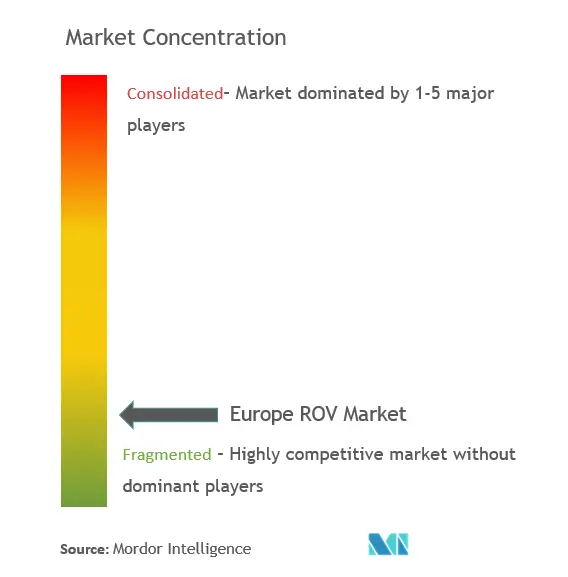
| Market Concentration | Low |
Major Players *Disclaimer: Major Players sorted in no particular order Image © Mordor Intelligence. Reuse requires attribution under CC BY 4.0. | |
Europe ROV Market Analysis by Mordor Intelligence
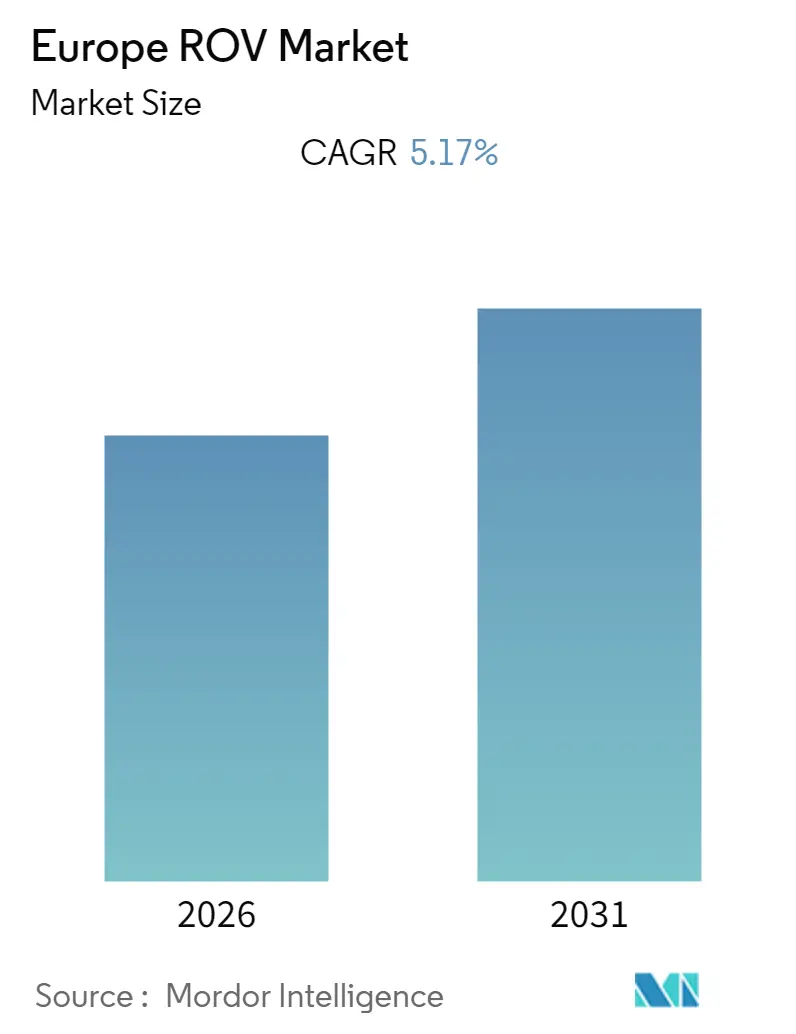
The Europe ROV Market size is expected to register a CAGR of 5.17% during the forecast period.
- The oil and gas sector is expected to hold the largest share in the Europe ROV market, owing to the demand for ROV systems across all phases of the offshore oil and gas life cycle.
- The installed offshore wind capacity in the European Union was 14.6 GW in 2021 and is set to increase by at least 25 times by 2030, which is expected to open up new avenues for the Europe ROV market during the forecast period.
- Norway is expected to witness significant growth, with the majority of the demand coming from offshore oil and gas discoveries and offshore wind energy installations.
Note: Market size and forecast figures in this report are generated using Mordor Intelligence’s proprietary estimation framework, updated with the latest available data and insights as of 2026.
Europe ROV Market Trends and Insights
Oil & Gas Application to Dominate the Market
- The North Sea is a major offshore production hydrocarbon basin in the European region with the interests of several countries in it. It has been a significant contributor to European economies for over fifty years. The basin presents exciting prospects with a potential of up to 20-30 billion boe of undiscovered resources. The availability of abundant resources, coupled with increased potential to recover oil and gas from deepwater and ultra-deepwater areas, is expected to provide a great opportunity for the Europe ROV market.
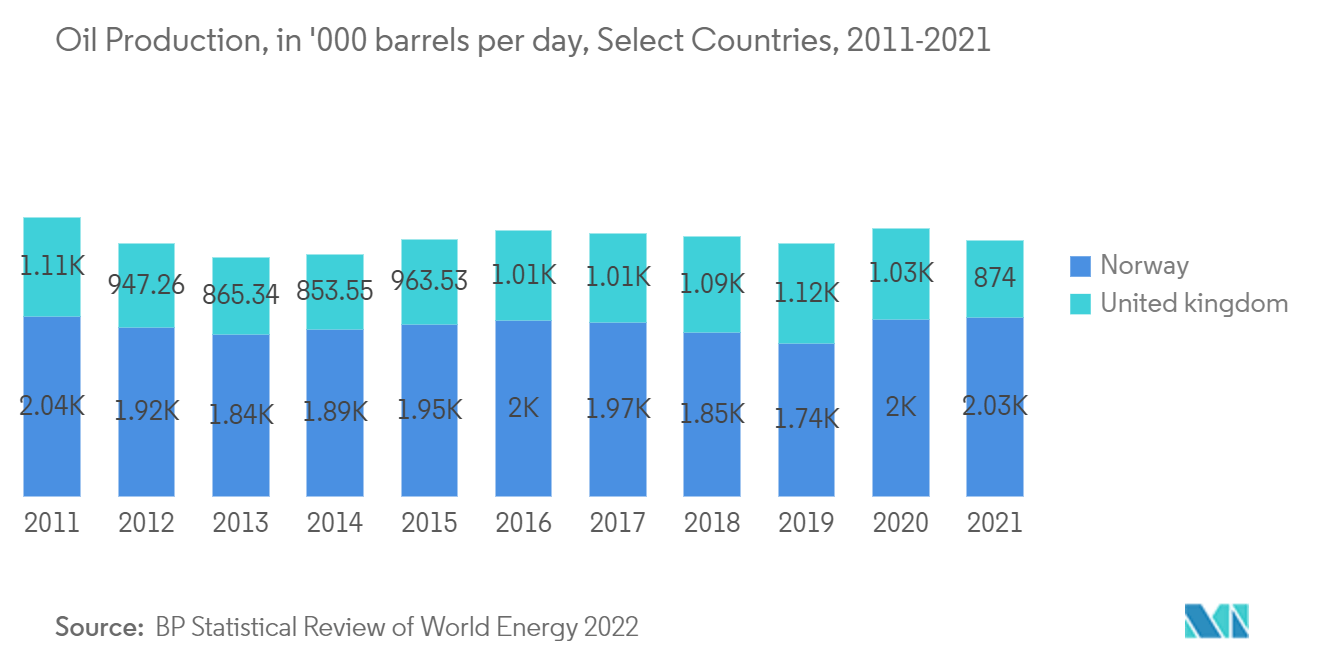
- As per the BP Statistical Review of World Energy 2022, oil production in Europe has witnessed significant growth. Denmark has produced oil of 65 '000 barrels per day, Norwayproduced oil of 2025 '000 barrels per day and the United Kingdom has produced oil of 874 '000 barrels per day.
- The United Kingdom is expected to spend around EUR 15.3 billion on decommissioning, over the next ten years. Approximately, 2,400 wells are expected to be decommissioned across the whole North Sea and West of Shetland region, by 2027. Around 914 of these wells are located across the Norwegian, Danish, and Dutch.
- As of March 2022, the United Kingdom was preparing a new energy strategy that involved more North Sea oil and gas production. The government was planning to open up the first round of exploration licenses in 2019. Even though these steps are being taken to counter the Russian dependency, they are likely to drive the Europe ROV market when players begin to develop the acreages after receiving their license.
- In February 2022, Aker BP announced its plan to drill 13 exploration wells, with a potential of around 250 mmboe, while also working to develop several projects in Norway, including a new Alvheim tieback. This field development activity is expected to drive the Europe ROV services well in the region.
- Considering the above-mentioned points, the Europe ROV market is likely to witness significant growth during the forecast period.


Norway Expected to Witness Significant Growth
- Due to its highly-developed offshore oil and gas, and wind energy sector, Europe is also a major market for ROV services. The demand for ROV services is concentrated in 2 regions, the North Sea and the Mediterranean Sea.
- The North Sea Region is a major oil and gas producing region in Europe, and the region is dominated by oil producers from neighbouring countries such as Norway, Denmark, Sweden, and the United Kingdom. Due to the maturity of the industry in the region, the upstream industry is highly developed and automated, and the demand for ROVs is high.
- Drawing from their expertise in offshore oil and gas E&P activities, many large renewable energy companies in the region are looking to harvest the wind potential in the region by creating massive offshore wind farms in the region. Due to this, the North Sea region is home to the largest under-construction offshore wind farms globally, such as the under-construction 1.2 GW Dogger Bank project.
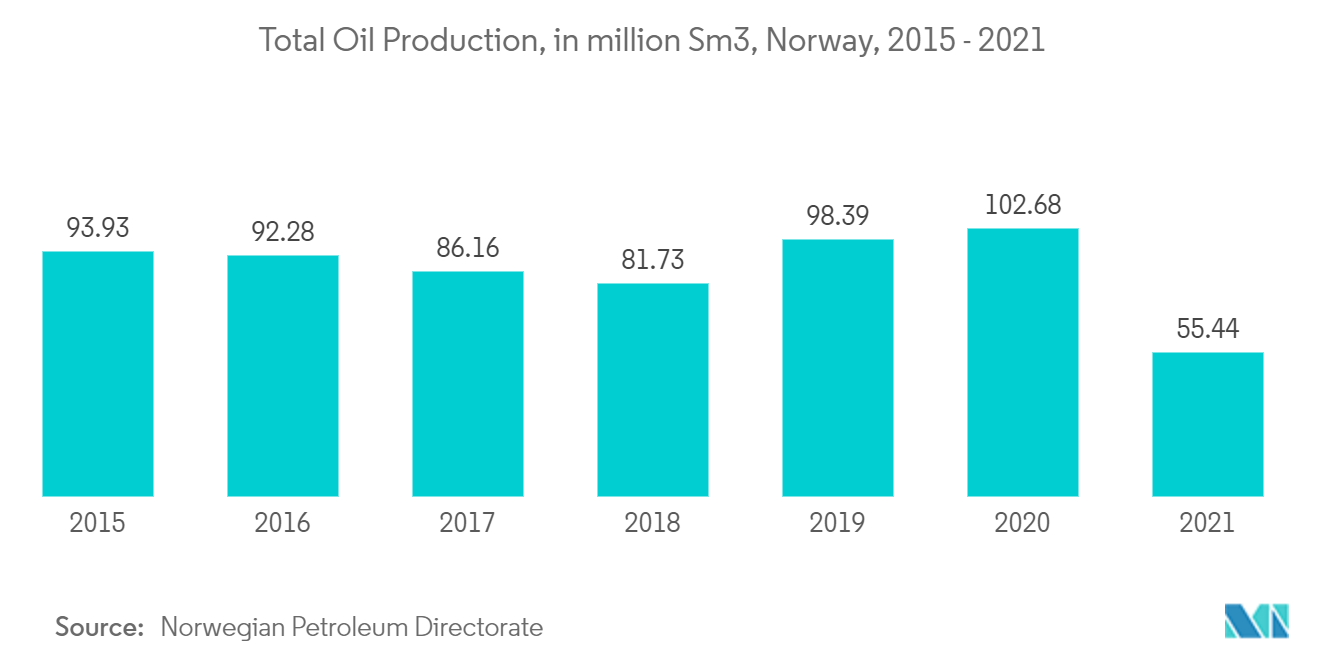
- As per Norwegian Petroleum Directorate, in 2021, the total oil production was 55.44 million Sm3. The increasing production of oil acrosss the oil field are expected to drive the Europe ROV market during the forecast period.
- As Europe transitions away from fossil fuels and increases its renewable energy capacity, countries in this region view the region and its wind resources as a critical component of their energy security strategies. Due to this, most countries are inviting bids from developers for large-scale offshore wind power plant projects.
- For instance, in February 2022, Norway announced plans to for its first auction for offshore wind. The tender is scheduled in the second half of 2022 and aims to develop 1.5 GW of offshore wind capacity to supply the country.
- In June 2022, Five oil and gas companies in Norway, partners in the Troll and Oseberg fields in the North Sea, are planning to build a 1GW floating wind farm in the Troll area, with the plan to use the wind farm to power oil and gas installations. The final investment decision is expected to be made in 2023. The wind power project, called Trollvind, is being worked on by Equinor and its partners Petoro, TotalEnergies, Shell and ConocoPhillips. The wind farm would be located 65 kilometres west of Bergen, Norway. This project creates significant opportunities for ROV services.
- Therefore, owing to the above points, the Norway is expected to witness significant growth in the Europe ROV market during the forecast period.
Regulatory Landscape
ROV operations supporting offshore oil and gas activity in Europe sit within the EU safety regime for offshore hydrocarbons, anchored by Directive 2013/30/EU on the safety of offshore oil and gas operations. The directive requires operators to maintain major accident prevention policies and safety and environmental management systems, and to submit major hazard reports, which in turn affects ROV-related planning, competency, and assurance requirements for inspection, intervention, and decommissioning scopes.
In the United Kingdom, the Offshore Installations (Offshore Safety Directive) (Safety Case etc.) Regulations 2015 embed similar requirements through safety cases, design notifications, and emergency response planning, which shapes how ROV campaigns are permitted and executed. On technical assurance, classification and testing practices commonly reference DNV rules for ROV construction and verification (including launch and recovery systems, umbilicals, and control consoles), which then feeds into procurement specifications and acceptance testing for work-class and observation-class systems across the North Sea and other European basins.
Value Chain Analysis
The Europe ROV value chain begins with ROV system and subsystem manufacturing, including vehicles, power and control electronics, tooling, sensors, umbilicals, and launch and recovery systems, and then extends into integration, testing, and classification practices aligned with established rulesets such as DNV guidance for ROV construction and trials. Fleet owners and service contractors mobilize these systems on offshore vessels, including construction, dive support, and multi-purpose support vessels, to deliver survey and inspection, repair and maintenance (IRM), installation support, and decommissioning services.
Downstream, major subsea contractors and service providers package ROVs into broader subsea delivery models, including EPCI-related support, subsea tie-backs, riser replacements, and field life extension work, along with end-of-life removals and recycling. Decommissioning work can also use alternative commercial structures, including sale and purchase agreement-style models for subsea equipment removal, while operators and developers (oil and gas and offshore wind) act as the principal buyers of ROV-enabled services across the asset life cycle.
Competitive Landscape
The Europe ROV Market is fragmented. The key players in the market include DeepOcean AS, DOF Subsea AS, Subsea 7 S.A, Saipem SpA, and Fugro N.V. among others.
Europe ROV Industry Leaders
DeepOcean AS
DOF Subsea AS
Subsea 7 S.A.
Oceaneering International Inc.
Fugro N.V
- *Disclaimer: Major Players sorted in no particular order

Market Opportunities and Future Outlook
Near-term whitespace in Europe is centered on higher-intensity IRM and decommissioning execution in mature basins, where operators continue to contract multi-year subsea work packages that embed work-class ROV spreads. DeepOcean secured subsea work packages from Equinor in May 2026 covering activities such as riser replacement and subsea installation on the Norwegian Continental Shelf, and it also won a bp decommissioning scope at Foinaven (West of Shetland) in June 2026, reinforcing commercial demand for ROV-supported removal, recycling, and intervention work.
Operational models that reduce vessel days also create additional room for growth, particularly through remote and resident operations. DeepOcean reported a remote-controlled ROV intervention milestone from an onshore center in Norway in May 2026, and resident ROV system concepts, including subsea garages operating without continuous host-vessel presence, are increasingly visible in industry discussions. Fleet modernization adds another lever for vendors and operators supplying newer work-class systems and tooling, backed by fleet investment signals such as DOF Group confirming orders for additional work-class ROV units from Forum Energy Technologies for delivery during 2026.
Recent Industry Developments
- May 2026: DeepOcean completed the first remote subsea intervention using a work-class ROV controlled from an onshore centre in Haugesund, Norway, at the Aker BP Idun Nord field. The onshore control enabled an operational efficiency gain and broadened demand for remote inspection, maintenance and repair services in Europe. The milestone indicates growing acceptance of remote IMR capabilities by operators in Europe and supports DeepOcean's position in the market.
- May 2026: DeepOcean was awarded a subsea contract package by Equinor for the Norwegian Continental Shelf, covering SIMOPRO riser replacements at Visund and template/manifold installation at Isflak, with work scheduled for 2027-2028. The contract strengthens backlog and improves fleet utilization, signaling ongoing activity in Norwegian NCS. The engagement expands DeepOcean's role in critical offshore IMR and survey work.
- March 2026: DOF Group confirmed an order of four XLX EVO III work-class ROVs from Forum Energy Technologies for delivery between April and August 2026. The fleet expansion supports deepwater IMR and installation workloads in Europe by updating the asset base. The move reinforces DOF Group's capacity to handle upcoming offshore projects across the regional market.


Research Methodology Framework and Report Scope
Market Definition and Coverage
For this study, the Europe ROV market is defined as revenue generated from remotely operated underwater vehicles and related system sales and services used for subsea inspection, intervention, and survey work across European waters and onshore support bases.
Scope exclusions: We exclude autonomous underwater vehicles, manned submersibles, and general surface vessel charter revenue that is not priced as an ROV service package.
Segmentation Overview
- Type
- Work Class ROV
- Observatory Class ROV
- Application
- Oil and Gas
- Defense
- Other Applications
- Activity
- Survey
- Inspection, Repair, and Maintenance
- Burial and Trenching
- Other Activities
- Geography
- United Kingdom
- Norway
- Netherlands
- Rest of Europe
Data Sources, Market Sizing, and Validation
Desk Research
Desk research is used to set the practical market boundaries and to build the starting demand picture across offshore energy and marine activity in Europe. We relied on public sources such as the International Energy Agency, national offshore regulators (for example, the UK Offshore Petroleum Regulator for Environment and Decommissioning), Eurostat, and European Commission energy and maritime publications to track project pipelines and safety driven inspection needs.
To translate activity into revenue logic, we also reviewed tender notices and contract language from official procurement portals, port and maritime authority releases, and non-paywalled technical papers and journals that describe typical ROV classes and operating profiles. Company annual reports, investor presentations, and reputable industry press were then used to validate capacity additions, fleet utilization commentary, and service mix statements, supported by our paid subscriptions for company financials and intelligence, news and financials, patent databases, and global contracts and tenders. These examples are not exhaustive, and we consulted additional sources to collect data, cross-check figures, and clarify assumptions.
Primary Interviews and Surveys
Primary work focuses on confirming what is actually being purchased and how pricing is structured, since ROV spend can sit inside broader subsea scopes. We spoke with a mix of operators, subsea contractors, vessel and project managers, and component and system specialists across key European offshore basins, then used follow-up checks to close gaps on utilization, day-rate behavior, and service bundling assumptions.
Distribution of primary research fieldwork respondents
| Company type | Respondent position |
|---|---|
| Top tier: 26% | CXOs: 17% |
| Mid tier: 54% | Functional/Unit leaders: 41% |
| Smaller Players: 20% | Managers: 42% |
Market-Sizing & Forecasting
Market sizing is built by reconstructing the regional demand pool from offshore activity, and then translating that activity into ROV revenue using realistic service and equipment pricing assumptions. A top-down approach is applied by mapping European subsea work volumes to ROV-intensity drivers, such as inspection frequency, decommissioning schedules, offshore wind cable and foundation checks, and typical project durations, which are then converted into service days and equipment demand.
Once the demand pool is formed, we corroborate totals with selective bottom-up approximations, such as sampled day-rate ranges by work class, a sanity check of installed fleet capability versus expected utilization, and revenue logic from publicly discussed contract scopes. Key inputs that matter in this market include offshore wind capacity build-out and O&M activity, North Sea decommissioning milestones, oil and gas subsea integrity requirements, cable length and inspection cadence, and the mix of observation versus work-class systems in active use. Where granular pricing is not consistently disclosed, gaps are handled by using triangulated ranges from primary interviews, and then stress-testing the model so outlier assumptions do not dominate the total.
For forecasting, scenario analysis is used so growth can be linked to visible project pipelines and policy backed timelines, while also reflecting uncertainty in vessel availability and offshore spending cycles. Variables are adjusted annually based on updated wind and decommissioning schedules, expected inspection intervals, and observed pricing behavior from recent tenders and field feedback.
Data Validation & Update Cycle
Validation is done through triangulation across independent signals so the final totals align with what the market can practically execute. We compare the model outputs against proxy indicators such as offshore project counts, tender volumes, utilization commentary, and known timing of major subsea campaigns, then review anomalies before sign-off.
A second analyst review is completed to re-check assumptions, unit conversions, and year alignment, followed by targeted re-contacts if a variance looks material or a new project shifts the outlook. Reports are refreshed annually, with interim updates when major events occur, and before delivery a fresh pass is completed so clients receive the latest updated view.
Mordor Intelligence's Europe Rov Market Size Compared With Other Published Estimates
Published market sizes for Europe ROVs often differ because the included revenue streams are not consistent, and because activity can be counted at different points in the offshore project cycle. Differences in currency timing, what is treated as equipment versus services, and how bundled subsea contracts are split out can all move the final number.
The main gap drivers in this market are whether inspection, repair, and maintenance packages are counted only when priced as ROV-led scopes, how decommissioning work is timed across multi-year campaigns, and whether cable inspection linked to offshore wind O&M is treated as recurring service revenue or a one-time project value. Some estimates also apply aggressive utilization and day-rate increases without enough checks against fleet availability and tender realities, which changes the base-year size and the forecast slope.
Benchmark comparison
| Source | Market Size | Gaps in Research Methodology |
|---|---|---|
| Mordor Intelligence | USD 0.00 B (2024) | |
| Trade Journal A | USD 0.85 B (2025) | Uses a forward base year and appears to blend broader subsea and vessel-linked scopes into the ROV total, which can overstate value when contracts are not priced specifically around ROV deliverables. |
| Regional Consultancy B | USD 0.71 B (2024) | Likely focuses on system sales and a narrower set of commercial applications, and it is less clear how recurring offshore wind O&M inspections and decommissioning campaigns are treated in the base-year build. |
The table points to scope and timing as the practical reasons for the spread, especially around bundled subsea packages and multi-year decommissioning work. By separating ROV-priced service activity from adjacent vessel costs and rechecking utilization against tender signals, the estimate stays repeatable and traceable to clear drivers, which is the modeling choice applied by Mordor Intelligence.


Key Questions Answered in the Report
What is the current Europe ROV Market size?
The Europe ROV Market is projected to register a CAGR of 5.17% during the forecast period (2026-2031)
Who are the key players in Europe ROV Market?
DeepOcean AS, DOF Subsea AS, Subsea 7 S.A., Oceaneering International Inc. and Fugro N.V are the major companies operating in the Europe ROV Market.
What years does this Europe ROV Market cover?
The report covers the Europe ROV Market historical market size for years: 2020, 2021, 2022, 2023 and 2024. The report also forecasts the Europe ROV Market size for years: 2026, 2027, 2028, 2029, 2030 and 2031.
Page last updated on:





