
Europe Protective and Defense Technical Textile Market Size and Share
Market Overview
| Study Period | 2021 - 2032 |
|---|---|
| Forecast Data Period | 2027 - 2032 |
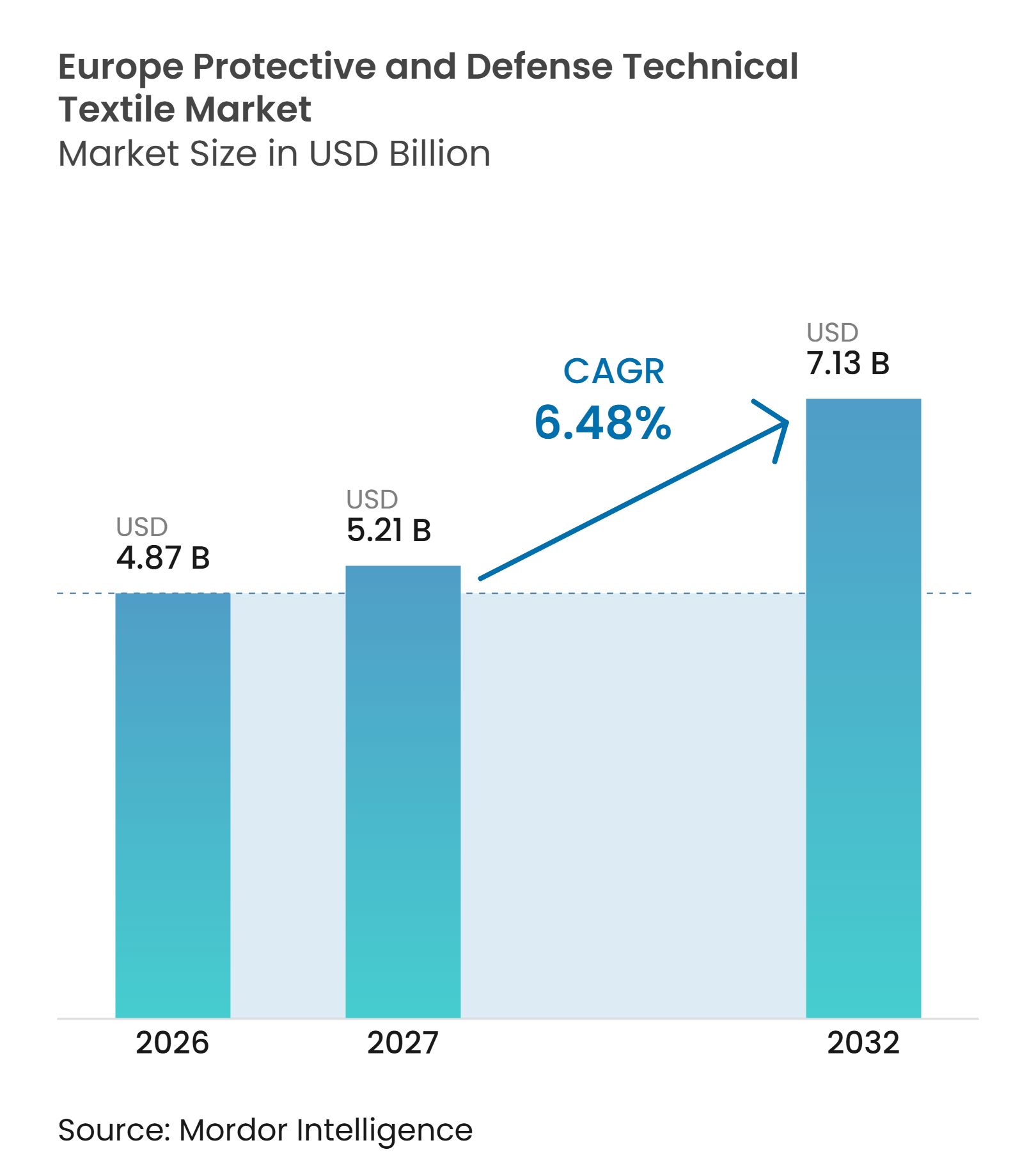
| Base Year Market Size (2026) | USD 4.87 Billion |
| Market Size (2027) | USD 5.21 Billion |
| Market Size (2032) | USD 7.13 Billion |
| Growth Rate (2027 - 2032) | 6.48 % |
| Market Concentration | Medium |
Major Players *Disclaimer: Major Players sorted in no particular order Image © Mordor Intelligence. Reuse requires attribution under CC BY 4.0. | |
Europe Protective and Defense Technical Textile Market Analysis by Mordor Intelligence
The Europe Protective And Defense Technical Textile Market size is expected to grow from USD 4.87 billion in 2026 to USD 5.21 billion in 2027 and is forecast to reach USD 7.13 billion by 2032 at 6.48% CAGR over 2027-2032.
The Europe protective and defense technical textile market is being supported by higher equipment spending, which reached EUR 115 billion (USD 135.3 billion) in the European Union in 2025. This spending creates demand for ballistic fabrics, CBRN clothing, flame-resistant garments, and camouflage systems. European sourcing requirements are also becoming more important in tender decisions. Suppliers that control fiber, fabric, coating, and garment production can respond more readily to traceability requirements. The Europe protective and defense technical textile market also faces constraints from separate national specifications, testing costs, concentrated raw-material supply, and limited specialist finishing capacity.
Key Report Takeaways
- By product type, flame, heat, and arc protective textiles held 27% of the Europe protective and defense technical textile market share in 2026, while ballistic, fragmentation, and penetration-resistant textiles are forecast to expand at an 8.4% CAGR through 2032.
- By material type, aramid fibers held 30.5% revenue share in 2026, while UHMWPE is forecast to grow at a 9% CAGR through 2032.
- By end-use application, defense and armed forces accounted for 28.5% of the Europe protective and defense technical textile market size in 2026 and are projected to advance at an 8.2% CAGR through 2032.
- By geography, Germany held a 23% share in 2026, while Poland is forecast to grow at an 8.8% CAGR through 2032.
Note: Market numbers in this report are based on Mordor Intelligence's proprietary estimation framework, which combines nine months of actuals with Q4 projections for base year 2026.
Market Trends and Insights
Drivers Impact Analysis of Europe Protective and Defense Technical Textile Market*
| Driver | (~) % Impact on CAGR Forecast | Geographic Relevance | Impact Timeline |
|---|---|---|---|
| NATO and European Defense Modernization Procurement | +2.0% | Germany, Poland, France, and the UK | Short term (≤ 2 years) |
| European Strategic Autonomy and Local Textile Sourcing | +1.5% | EU-wide, with early-mover advantages in Belgium, Netherlands, and France | Medium term (2-4 years) |
| Multihazard Soldier-System Integration | +1.2% | Europe-wide, with highest uptake in Germany, Italy, and Nordic states | Medium term (2-4 years) |
| Traceable and Tender-Ready Technical Textile Qualification | +0.9% | EU-wide, with disproportionate impact on cross-border defense procurement tenders | Medium term (2-4 years) |
| Lightweight Protection and Wearer-Mobility Requirements | +0.7% | European R&D programs leading specifications for UHMWPE and hybrid composites | Long term (≥ 4 years) |
| Expansion of CBRN and Civil-Protection Readiness | +0.5% | EU-wide, concentrated in Germany, France, Belgium, and Eastern European NATO members. | Short term (≤ 2 years) |
| Source: Mordor Intelligence | |||
NATO and European Defense Modernization Procurement
European defense spending is increasing, creating favorable procurement conditions for the protective and defense technical textile market. According to the European Defence Agency, EU Member States' defense expenditure reached EUR 134 billion (USD 157.6 billion) in 2025, with EUR 115 billion (USD 135.3 billion) allocated to equipment procurement and EUR 17 billion (USD 20.0 billion) to research and development. Additionally, NATO Allies committed in 2025 to raise defense and security-related spending to 5% of GDP by 2035, including 3.5% for core defense requirements. Germany's FASER program, with EUR 21 billion (USD 24.7 billion) approved for 2026–2034, further supports procurement across 115 article categories, including ballistic vests, helmets, base layers, field clothing, and personal protective equipment. These spending commitments and procurement programs are expected to strengthen demand for ballistic protection materials, flame-resistant fabrics, combat clothing, and other specialized protective textiles, creating opportunities for established European manufacturers to secure long-term defense supply contracts.
European Strategic Autonomy and Local Textile Sourcing
European-content requirements are becoming more prominent in defense textile tenders. EURATEX has called for a European value chain that runs from fiber to finished product for defense textile contracts.[3] Sioen met a French firefighter-clothing requirement through European weaving, coating, and garment production. OUVRY’s 2026 French armed forces contract covers 10,000 Polycombi CBRN suits with more than 80% French content and 100% European sourcing. These requirements and collaborative procurement favor suppliers that can document origin and operate across several European countries. This condition can shift competition away from commodity suppliers and toward vertically integrated producers in the Europe protective and defense technical textile market.
Multihazard Soldier-System Integration and Tender Qualification
European soldier programs increasingly combine several protection functions in one system. Italy’s Individual Combat System has more than 60 components and uses textiles in ballistic protection, camouflage layers, and sensor-carrying fabrics. The PESCO Next Generation Dismounted Soldier System also gives priority to integrated protection and lower cognitive and physical burden. Belgium’s NANO-PROTECTION project is developing functionalized nanofibers that can neutralize chemical warfare agents and filter aerosols in a breathable layer. Tender requirements increasingly require origin documentation from fiber through finished garment. NATO STANAG 2920 and STANAG 4548, together with national specifications, add testing and audit requirements that raise entry costs in the Europe protective and defense technical textile market.
Traceable and Tender-Ready Technical Textile Qualification
Increasing emphasis on supply-chain transparency, material traceability, and standardized product qualification is driving demand for certified protective and defense technical textiles across Europe. Defense procurement authorities are placing greater importance on documented material origins, manufacturing consistency, product performance, and compliance with military and occupational safety specifications. Requirements for traceable fibers, validated fabric treatments, and verifiable ballistic, flame-retardant, and chemical-protection performance are encouraging manufacturers to strengthen quality management systems and digital documentation capabilities. Additionally, growing scrutiny of PFAS-containing materials, chemical composition, and environmental compliance is increasing the importance of material-level traceability and testing documentation. These requirements favor established European manufacturers with certified production facilities, established testing capabilities, and the ability to meet complex public procurement and defense tender conditions, supporting demand for qualified technical textile suppliers across the region.
Restraints Impact Analysis of Europe Protective and Defense Technical Textile Market*
| Restraint | (~) % Impact on CAGR Forecast | Geographic Relevance | Impact Timeline |
|---|---|---|---|
| Fragmented National Procurement and Interoperability Gaps | -1.2% | EU-wide, most acute across Eastern European NATO members and in cross-border EDA collaborative programs | Medium term (2-4 years) |
| High Certification, Testing, and Lifecycle-Cost Burden | -0.8% | EU-wide, with disproportionate impact on SMEs and new entrants in Category III PPE segments | Medium term (2-4 years) |
| Critical Fiber, Chemical, and Battery Input Dependence | -0.6% | EU-wide, with concentrated supply risk for para-aramid and UHMWPE inputs | Long term (≥ 4 years) |
| Limited European Production Capacity for Specialized Textile Finishing | -0.4% | EU-wide, most acute for PFAS-free durable water repellent finishing and advanced membrane lamination | Long term (≥ 4 years) |
| Source: Mordor Intelligence | |||
Fragmented National Procurement and Interoperability Gaps
The European protective and defense technical textile market faces procurement fragmentation because individual countries maintain different military specifications, certification procedures, purchasing frameworks, and equipment requirements. Although EU-level defense cooperation initiatives aim to improve standardization, differences in national procurement priorities and budget allocation continue to limit demand consolidation. Manufacturers must often adapt ballistic protection systems, combat uniforms, chemical protective clothing, and other specialized textiles to country-specific requirements, increasing product customization, testing, and compliance costs. Additionally, differences in equipment interfaces, protective performance specifications, and compatibility requirements restrict cross-border standardization and limit economies of scale. These challenges complicate supplier expansion across European markets, extend procurement cycles, and create barriers for manufacturers seeking to establish consistent regional product portfolios.
High Certification, Testing, and Lifecycle-Cost Burden
Protective and defense technical textiles in Europe face stringent certification and performance-testing requirements to comply with standards covering flame resistance, ballistic protection, chemical resistance, thermal insulation, and mechanical durability. Manufacturers must conduct extensive laboratory testing, product validation, and periodic recertification to meet military procurement specifications and occupational safety regulations. These requirements increase product development costs, lengthen commercialization timelines, and create additional compliance expenses, particularly for smaller manufacturers. Furthermore, the high cost of specialized fibers, advanced coatings, multilayer fabric construction, and lifecycle maintenance increases the overall procurement burden for defense agencies and industrial end users. This can delay replacement cycles, restrict adoption of premium protective solutions, and limit market entry for new suppliers.
*Our forecasts treat driver/restraint impacts as directional, not additive. The impact forecasts reflect baseline growth, mix effects, and variable interactions.
Europe Protective and Defense Technical Textile Market Segment Analysis
By Product Type:
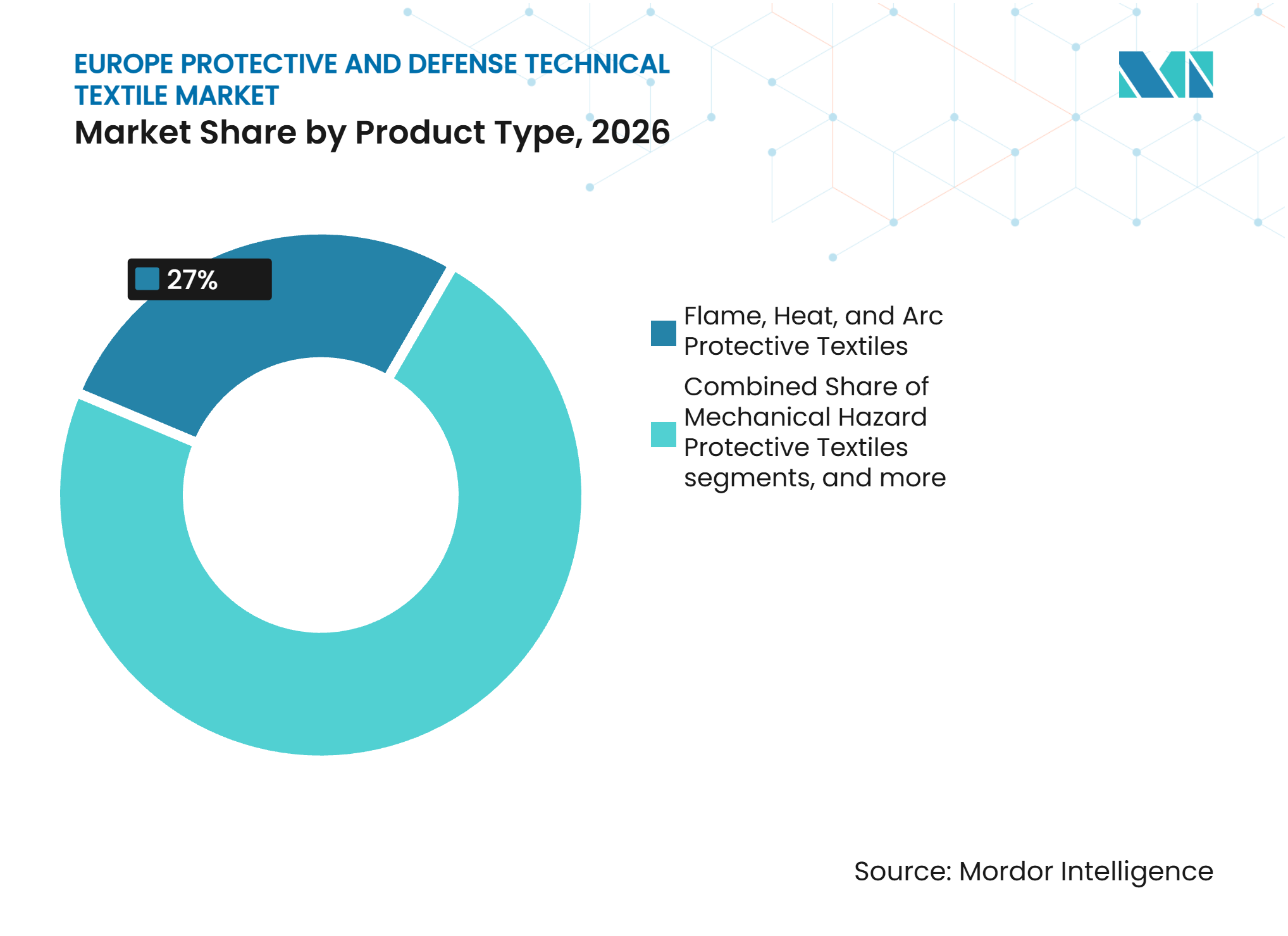
Defense Procurement Accelerates Ballistic Textile DemandFlame, heat, and arc protective textiles held a 27% revenue share in 2026. Their use in oil and gas, utilities, metalworking, firefighting, and military applications supports the leading position. Ballistic, fragmentation, and penetration-resistant textiles are forecast to grow at an 8.4% CAGR from 2027 to 2032, supported by FASER in Germany and Poland’s Technical Modernization Plan. Poland’s plan identifies USD 131 billion of new equipment spending through 2035. UHMWPE adoption supports lighter body armor that retains required protective performance.
Chemical, biological, and CBRN protective textiles are a secondary growth category in the Europe protective and defense technical textile market, supported by EDA frameworks across several member states. Mechanical hazard protective textiles serve construction, logistics, and law enforcement users. High-visibility and reflective protective textiles remain relevant in construction, transportation, and infrastructure under EN ISO 20471. Defense signature-management and specialized survivability textiles remain a strategic niche, illustrated by Sioen’s EUR 580 million (USD 682.3 million) German camouflage contract in 2025. EU PPE Regulation 2016/425 is the overarching compliance framework, with Category III certification applying to high-risk products.



By Material Type:
UHMWPE Gains as Weight Budgets Tighten Across Soldier ProgramsAramid fibers held 30.5% revenue share in 2026. Their long qualification history supports military and industrial flame and ballistic applications. Meta-aramid remains important in high-temperature protection, while para-aramid supports ballistic systems. UHMWPE is forecast to grow at a 9% CAGR from 2027 to 2032 because its lower density supports weight-optimized body armor. High energy absorption also supports its use in high-velocity ballistic systems.
Cotton, cellulosic fibers, FR-viscose, modacrylic, and FR-acrylic fibers serve flame-resistant workwear and combat clothing. They are commonly blended to balance protection, comfort, and durability. Polyester and polyamide are used in base layers, rainwear, and load-bearing carrier construction. Glass, carbon, PBI, PBO, and other specialist fibers support structural fire protection, composite panels, and extreme-temperature applications. The IMMUNE project introduces recyclability as a material-selection criterion through FILAVA-based armor components.
By End-Use Application:
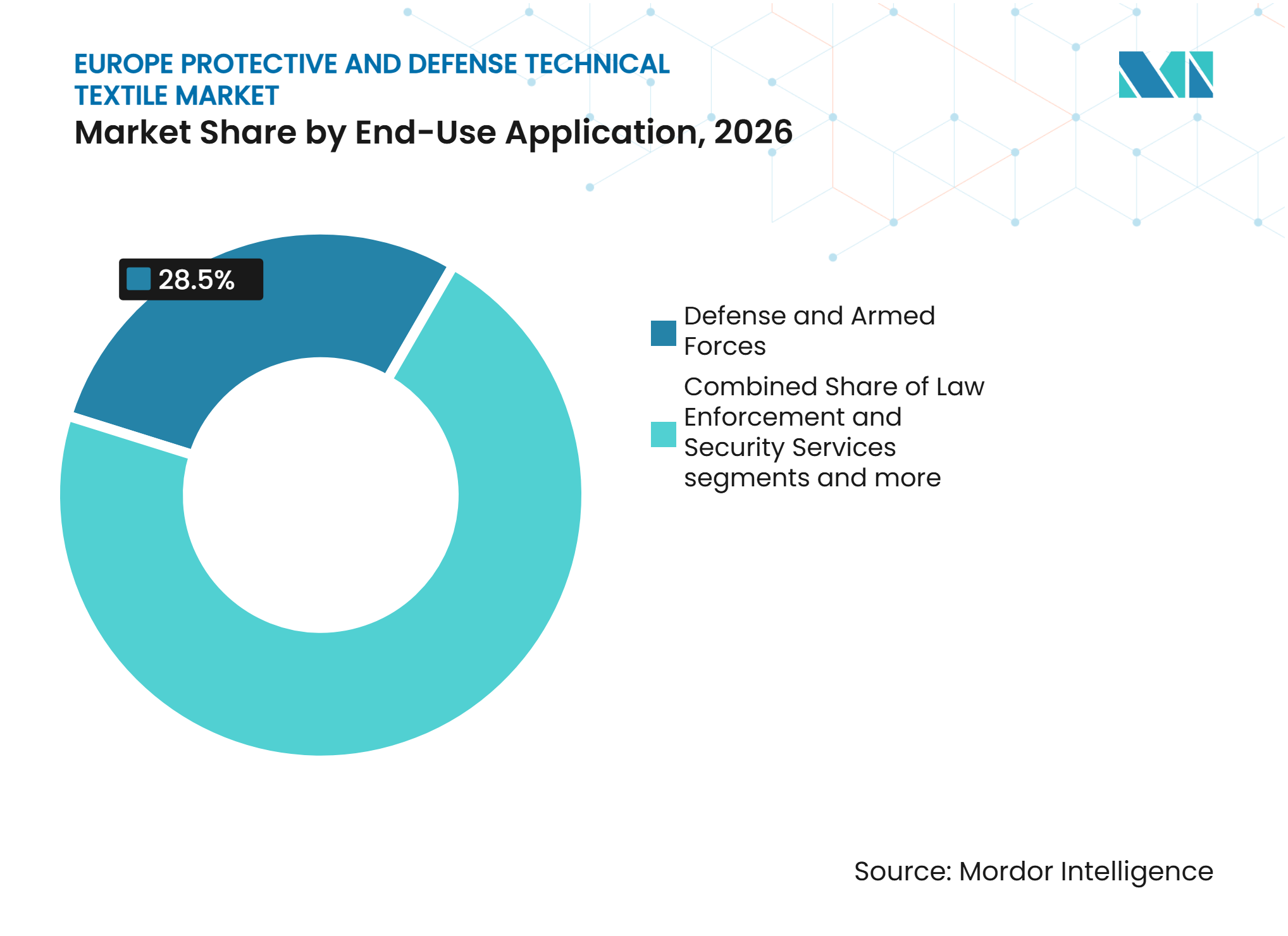
Defense Segment Drives Both Volume and ValueDefense and armed forces accounted for 28.5% of the Europe protective and defense technical textile market size in 2026 and are forecast to grow at an 8.2% CAGR from 2027 to 2032. European defense investment is projected to reach EUR 163 billion (USD 191.7 billion) in 2026. Multi-year framework agreements are converting budget growth into protective-textile procurement. Law Enforcement and Security Services provide steady demand, illustrated by Sioen’s Netherlands police framework with potential value above EUR 150 million (USD 176.4 million). Firefighting and Emergency Response also procure EN 469-compliant ensembles through multi-year contracts.
Oil, gas, petrochemicals, and chemical processing use arc-rated, FR-viscose blend, and chemical-barrier textiles. Utilities and electrical services require electrostatic and arc-flash garments under EN 61482 and EN 1149. Manufacturing, industrial processing, construction, mining, and infrastructure use welding, mechanical-hazard, high-visibility, and cut-resistant products. EU PPE Regulation 2016/425 applies across end uses, with notified-body certification and product surveillance required for high-risk applications.

Geography Analysis
Germany: Largest Market, FASER Program Anchors Structural Demand
Germany held 23% of the Europe protective and defense technical textile market share in 2026. The FASER program has EUR 21 billion (USD 24.7 billion) approved for 2026 to 2034 and covers 115 article categories for up to 460,000 soldiers and 80,000 civilian employees. In February 2026, BwBM opened a field-clothing procedure with separate lots for European supply-chain providers. Sioen’s EUR 580 million (USD 682.3 million) camouflage framework, awarded in December 2025, reinforces the depth of defense demand. Germany’s automotive, chemical processing, and electrical-utilities sectors also support consumption of workwear aligned with EN ISO 11612 and EN 1149.
Poland: Fastest Growth Driven by Force Expansion
Poland is forecast to grow at an 8.8% CAGR from 2027 to 2032. Its 2026 defense budget reached PLN 201 billion (USD 55.9 billion), or 4.83% of GDP. Cumulative defense spending is projected to reach PLN 1.9 trillion (USD 528.8 billion) from 2025 to 2035. Planned force expansion toward 300,000 personnel by 2035 increases demand for combat clothing, ballistic systems, CBRN garments, and cold-weather equipment. Domestic procurement reached PLN 30.4 billion (USD 8.5 billion) in 2025, which supports local partnerships while increasing barriers for suppliers without established Polish participation.
Regional Diversification and Smaller Markets Add Structural Depth
The United Kingdom maintains a professional firefighting and police protective-clothing base, illustrated by the National Firefighter PPE Lot 4 award. France emphasizes European and French industrial content and is increasing pressure for PFAS-free water-repellent treatments. Italy’s Individual Combat System supports demand for protection, camouflage, and load-carrying components. Belgium, Sweden, and Spain add supply, research, and partnership capacity through Sioen, Seyntex, smart-soldier projects, and the NFM Group combat-clothing partnership.
Competitive Landscape
Market Concentration
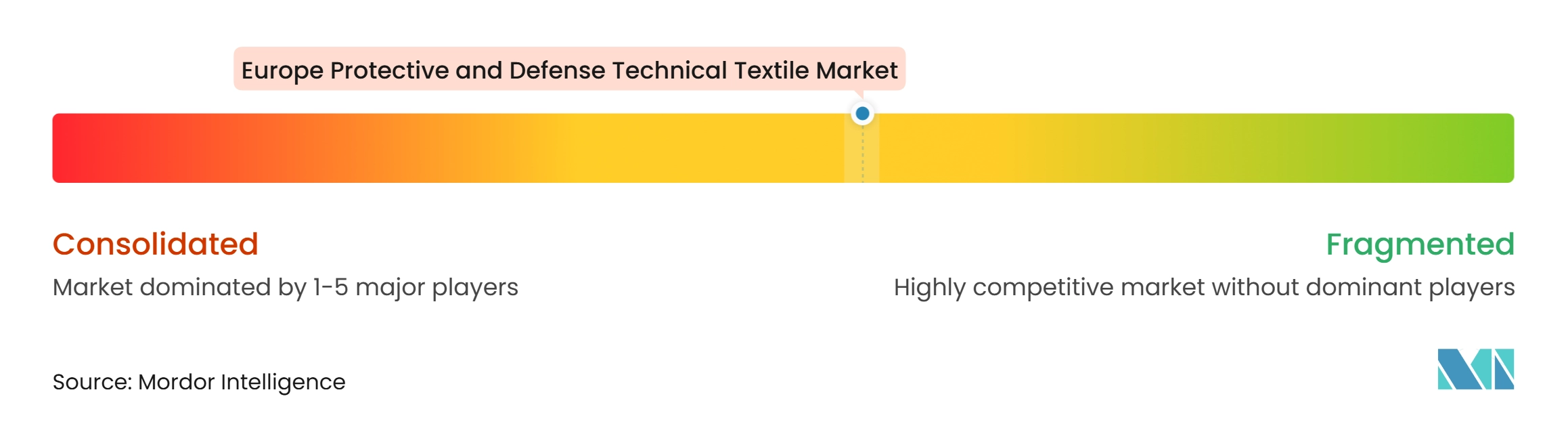
The Europe protective and defense technical textile market exhibits a medium level of market concentration. A small group of vertically integrated European suppliers has won successive large tenders, while industrial flame protection and high-visibility textiles remain more fragmented. Sioen has accumulated contracts across military, police, and firefighter categories. Its German camouflage contract was awarded in December 2025, and its Dutch police body-armor framework was awarded in July 2026. Its UK firefighter framework provides a further civil-protection route.
Seyntex has an established CBRN clothing position and coordinates the NANO-PROTECTION research project. The project began in December 2025 with a EUR 1.829 million (USD 2.15 million) budget. Avient’s Dyneema supplies UHMWPE fiber and unidirectional ballistic laminates from NATO territory for the European market. Its position illustrates the limited number of specialist ballistic material suppliers. NFM Group’s Hexonia shows how focused suppliers can secure high-volume contracts when manufacturing location and product capability align with procurement requirements.
PFAS-free durable water repellency, female-fit soldier systems, and digital-product-passport-ready traceability are development areas in the Europe protective and defense technical textile market. French regulation has strengthened the case for PFAS-free textile development, while PPE treatment remains subject to the European framework. ISO 9001, AQAP 2110, and EU PPE Regulation 2016/425 Category III requirements are core qualification thresholds. These standards support established suppliers that can manage testing, documentation, and production control.
Europe Protective and Defense Technical Textile Industry Leaders
-
Sioen Industries NV
-
Utexbel NV
-
Seyntex N.V.
-
Concordia Textiles NV
-
TenCate Protective Fabrics
- *Disclaimer: Major Players sorted in no particular order
Europe Protective and Defense Technical Textile Market Companies Covered in this Report
- Sioen Industries NV
- Utexbel NV
- Seyntex NV
- Concordia Textiles NV
- TenCate Protective Fabrics
- Teijin Aramid B.V.
- DuPont de Nemours, Inc.
- Honeywell International Inc.
- 3M Company
- Gentex Corporation
- Avon Protection plc
- Rheinmetall AG
- BAE Systems plc
- Safran SA
- Thales
- Saab AB
- PGD International
- Mehler Vario System GmbH
- NFM Group AS
- Morgan Advanced Materials plc
- CeramTec GmbH
- Envalior
- Gurit Holding AG
- Integris Composites
Recent Industry Developments in Europe Protective and Defense Technical Textile Market
- July 2026: Sioen Industries awarded Netherlands police body armor contract. Sioen won the European public tender issued by the Dutch police for ballistic and stab-resistant body armor with a MOLLE system. The framework agreement may run for up to 15 years, with potential contract value exceeding EUR 150 million (USD 176.4 million). First deliveries are expected from 2027, deepening Sioen’s position across European law enforcement procurement.
- July 2026: NFM Group’s Hexonia secures Bundeswehr combat helmet contract. Hexonia GmbH, the helmet center of excellence within NFM Group, received an order from Bw Bekleidungsmanagement GmbH for up to 1.4 million combat helmets, with a minimum call-off of 700,000 units, in High Cut and Low Cut variants. Manufacturing is planned in Nettetal, Germany, and Lębork, Poland.
- June 2026: EDA signs CBRN framework contracts for EU member states. The European Defence Agency signed 3 framework contracts for CBRN filters in summer 2026, following earlier framework contracts for CBRN suits covering multiple EU member states. The collaborative procurement program covers 11 member states, with an initial CBRN suits order of EUR 3.6 million (USD 4.23 million) for 4 member states.
- June 2026: OUVRY awarded French Armed Forces CBRN contract. France’s Ministry of the Armed Forces awarded OUVRY a contract for 10,000 Polycombi CBRN protective suits for the French Army, Air and Space Force, and Navy. Each suit has more than 80% French content and 100% European sourcing. The suit provides up to 12 hours of protection against chemical warfare agents under NATO standards.
Europe Protective and Defense Technical Textile Market Report Scope
The Europe Protective and Defense Technical Textile Market Report is Segmented by Product Type (Flame, Heat, and Arc Protective Textiles, Mechanical Hazard Protective Textiles, and More), by Material Type (Aramid Fibers, Polyamide, and More), by End-Use Application (Utilities and Electrical Services, and More), and by Geography (Germany, France, Italy, and More). The Market Forecasts are Provided in Terms of Value (USD).
Segmentation Overview
| Flame, Heat, and Arc Protective Textiles | Flame-Resistant and Flash Fire Protective Textiles |
| Firefighter Protective Textiles | |
| Arc-Rated Protective Textiles | |
| Welding and Molten Metal Protective Textiles | |
| Textile Fire Blankets, Welding Curtains, and Thermal Safety Barriers | |
| Ballistic, Fragmentation, and Penetration-Resistant Textiles | Ballistic Protection Fabrics and Laminates |
| Textile-Based Soft Body Armor Components and Panels | |
| Others (Textile Reinforcement for Ballistic Helmets/ Hard Armor Systems, Blast-Related Protective Textile Components, etc.) | |
| Chemical, Biological, and CBRN Protective Textiles | Chemical Protective Fabrics and Clothing |
| Biological and Particulate Barrier Protective Textiles | |
| CBRN Protective Textiles and Clothing | |
| Mechanical Hazard Protective Textiles | Cut- and Slash-Resistant Textiles |
| Puncture- and Needle-Resistant Textiles | |
| Abrasion- and Impact-Resistant Textile Components | |
| Other Mechanical Hazard Protective Textiles | |
| High-Visibility and Reflective Protective Textiles | Fluorescent High-Visibility Fabrics and Apparel |
| Retroreflective Textile Materials | |
| Combined High-Visibility Protective Textile Products | |
| Extreme-Cold and Adverse-Weather Protective Textiles | |
| Defense Signature-Management and Specialized Survivability Textiles | |
| Other Protective Technical Textiles (Antistatic and Electrostatic-Dissipative, Electromagnetic Shielding Protective, etc.) |
| Aramid Fibers |
| Ultra-High-Molecular-Weight Polyethylene |
| Cotton and Other Natural Cellulosic Fibers |
| Regenerated Cellulosic and Flame-Resistant Viscose Fibers |
| Modacrylic and Other Flame-Resistant Acrylic Fibers |
| Polyester |
| Polyamide |
| Glass, Carbon, and Other Inorganic Fibers |
| Other High-Performance Synthetic Fibers (PBI, PBO, Heat-Resistant Fibers, etc.) |
| Defense and Armed Forces | |
| Law Enforcement and Security Services | |
| Firefighting and Emergency Response | Firefighting Services |
| Hazmat and Disaster Response Services | |
| Oil, Gas, Petrochemicals, and Chemical Processing | |
| Utilities and Electrical Services | |
| Manufacturing and Industrial Processing | Metalworking, Fabrication, and Heavy Manufacturing |
| Automotive and General Manufacturing | |
| Other Industrial Processing | |
| Construction, Mining, and Infrastructure | |
| Transportation, Warehousing, and Logistics Operations | |
| Other Occupational and Institutional End Users |
| Germany |
| United Kingdom |
| France |
| Italy |
| Spain |
| Belgium |
| Netherlands |
| Poland |
| Sweden |
| Rest of Europe |
| By Product Type | Flame, Heat, and Arc Protective Textiles | Flame-Resistant and Flash Fire Protective Textiles |
| Firefighter Protective Textiles | ||
| Arc-Rated Protective Textiles | ||
| Welding and Molten Metal Protective Textiles | ||
| Textile Fire Blankets, Welding Curtains, and Thermal Safety Barriers | ||
| Ballistic, Fragmentation, and Penetration-Resistant Textiles | Ballistic Protection Fabrics and Laminates | |
| Textile-Based Soft Body Armor Components and Panels | ||
| Others (Textile Reinforcement for Ballistic Helmets/ Hard Armor Systems, Blast-Related Protective Textile Components, etc.) | ||
| Chemical, Biological, and CBRN Protective Textiles | Chemical Protective Fabrics and Clothing | |
| Biological and Particulate Barrier Protective Textiles | ||
| CBRN Protective Textiles and Clothing | ||
| Mechanical Hazard Protective Textiles | Cut- and Slash-Resistant Textiles | |
| Puncture- and Needle-Resistant Textiles | ||
| Abrasion- and Impact-Resistant Textile Components | ||
| Other Mechanical Hazard Protective Textiles | ||
| High-Visibility and Reflective Protective Textiles | Fluorescent High-Visibility Fabrics and Apparel | |
| Retroreflective Textile Materials | ||
| Combined High-Visibility Protective Textile Products | ||
| Extreme-Cold and Adverse-Weather Protective Textiles | ||
| Defense Signature-Management and Specialized Survivability Textiles | ||
| Other Protective Technical Textiles (Antistatic and Electrostatic-Dissipative, Electromagnetic Shielding Protective, etc.) | ||
| By Material Type | Aramid Fibers | |
| Ultra-High-Molecular-Weight Polyethylene | ||
| Cotton and Other Natural Cellulosic Fibers | ||
| Regenerated Cellulosic and Flame-Resistant Viscose Fibers | ||
| Modacrylic and Other Flame-Resistant Acrylic Fibers | ||
| Polyester | ||
| Polyamide | ||
| Glass, Carbon, and Other Inorganic Fibers | ||
| Other High-Performance Synthetic Fibers (PBI, PBO, Heat-Resistant Fibers, etc.) | ||
| By End-Use Application | Defense and Armed Forces | |
| Law Enforcement and Security Services | ||
| Firefighting and Emergency Response | Firefighting Services | |
| Hazmat and Disaster Response Services | ||
| Oil, Gas, Petrochemicals, and Chemical Processing | ||
| Utilities and Electrical Services | ||
| Manufacturing and Industrial Processing | Metalworking, Fabrication, and Heavy Manufacturing | |
| Automotive and General Manufacturing | ||
| Other Industrial Processing | ||
| Construction, Mining, and Infrastructure | ||
| Transportation, Warehousing, and Logistics Operations | ||
| Other Occupational and Institutional End Users | ||
| By Geography | Germany | |
| United Kingdom | ||
| France | ||
| Italy | ||
| Spain | ||
| Belgium | ||
| Netherlands | ||
| Poland | ||
| Sweden | ||
| Rest of Europe | ||
Key Questions Answered in the Report
What is the projected value of Europe’s protective and defense technical textile sector by 2032?
The Europe protective and defense technical textile market is forecast to reach USD 7.13 billion by 2032, growing at a 6.48% CAGR from 2027.
Which product category is growing fastest in Europe’s protective textile sector?
Ballistic, fragmentation, and penetration-resistant Textiles are projected to grow at an 8.4% CAGR through 2032.
Why is UHMWPE gaining use in protective systems?
UHMWPE is projected to grow at a 9% CAGR because lower weight and high energy absorption support modern body armor requirements.
Which end-use category has the greatest demand for protective and defense textiles?
Defense and armed forces held a 28.5% share in 2026 and are projected to grow at an 8.2% CAGR through 2032.
Which European country is expected to record the fastest expansion?
Poland is forecast to grow at an 8.8% CAGR through 2032, supported by force expansion and higher defense procurement.
What makes entry difficult for new suppliers?
Category III certification, national specifications, traceability requirements, and recurring audits increase time and cost for new suppliers.