
Europe Pre-engineered Buildings (PEB) Construction Market Size and Share
Market Overview
| Study Period | 2020 - 2031 |
|---|---|
| Forecast Data Period | 2026 - 2031 |
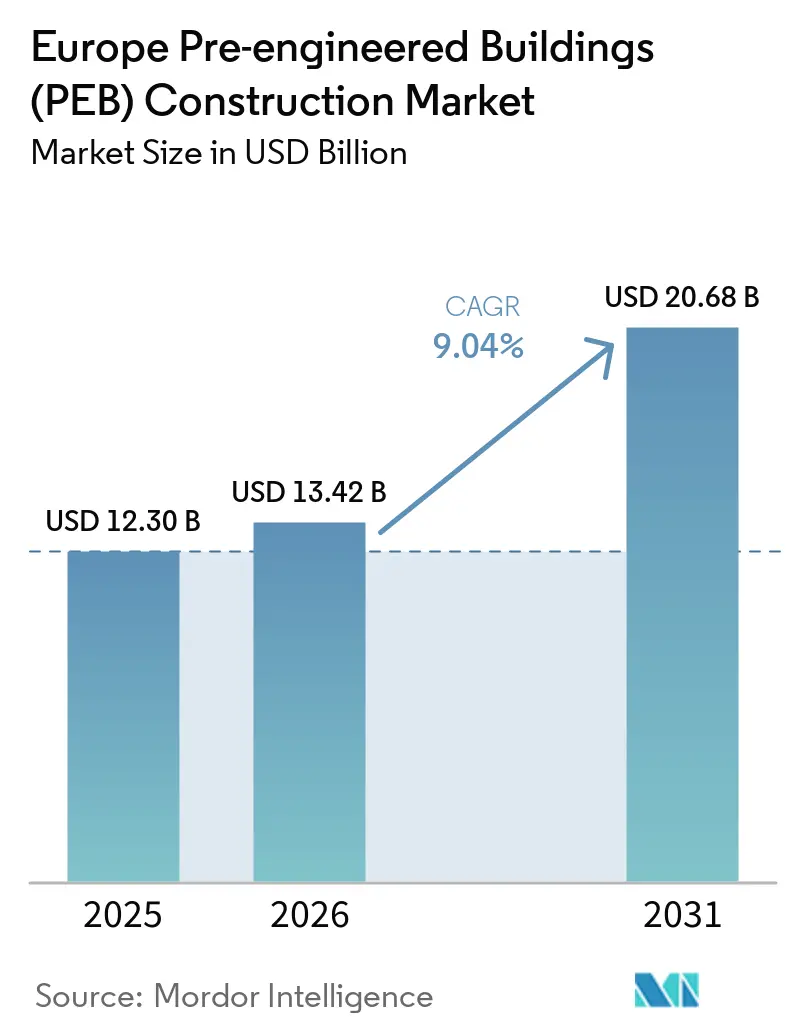
| Base Year Market Size (2025) | USD 12.30 Billion |
| Market Size (2026) | USD 13.42 Billion |
| Market Size (2031) | USD 20.68 Billion |
| Growth Rate (2026 - 2031) | 9.04 % |
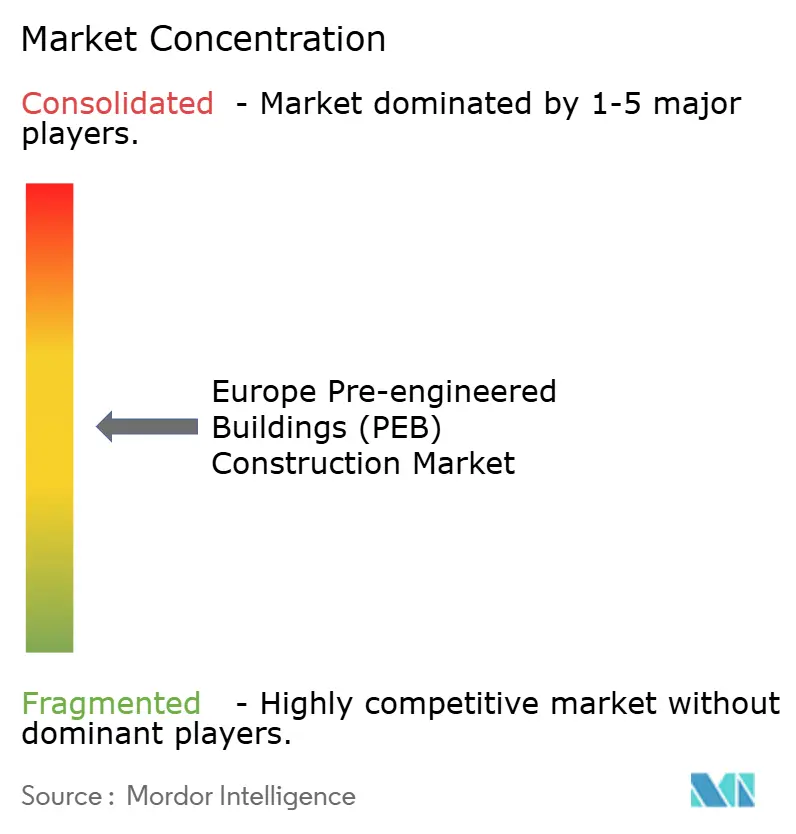
| Market Concentration | Medium |
Major Players *Disclaimer: Major Players sorted in no particular order Image © Mordor Intelligence. Reuse requires attribution under CC BY 4.0. | |
Europe Pre-engineered Buildings (PEB) Construction Market Analysis by Mordor Intelligence
The Europe Pre-engineered Buildings Construction Market size was valued at USD 12.30 billion in 2025 and is estimated to grow from USD 13.42 billion in 2026 to reach USD 20.68 billion by 2031, at a CAGR of 9.04% during the forecast period (2026-2031).The Europe pre-engineered building (PEB) construction market is being shaped by rules that place greater weight on energy performance, lifecycle carbon disclosure, and traceable construction materials. The recast Energy Performance of Buildings Directive requires member states to apply measures for the energy performance of buildings. At the same time, the related EU framework introduces lifecycle global-warming-potential disclosure for new buildings from 2028. Factory-made steel systems can help developers document envelope performance and material information before installation. Large industrial projects, logistics redevelopment, battery manufacturing, and data-center investment also support demand for rapid construction programs. The skilled labor shortage makes predictable fabrication and faster site assembly more valuable to owners and contractors.
Key Report Takeaways
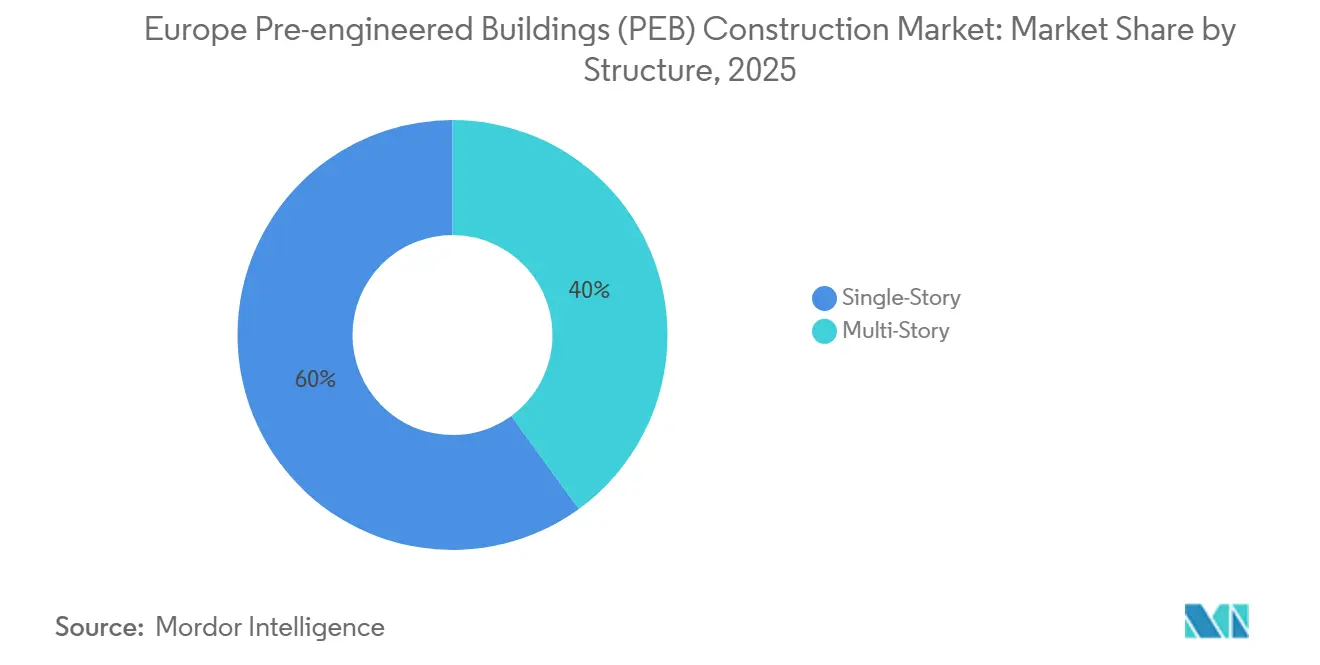
- By structure, single-story buildings held 60% of the Europe pre-engineered building (PEB) construction market share in 2025, while multi-story buildings are forecast to grow at a 10.2% CAGR through 2031.
- By product type, panelized and componentized systems held 40% of the Europe pre-engineered building (PEB) construction market share in 2025, while modular buildings are forecast to grow at an 11.0% CAGR through 2031.
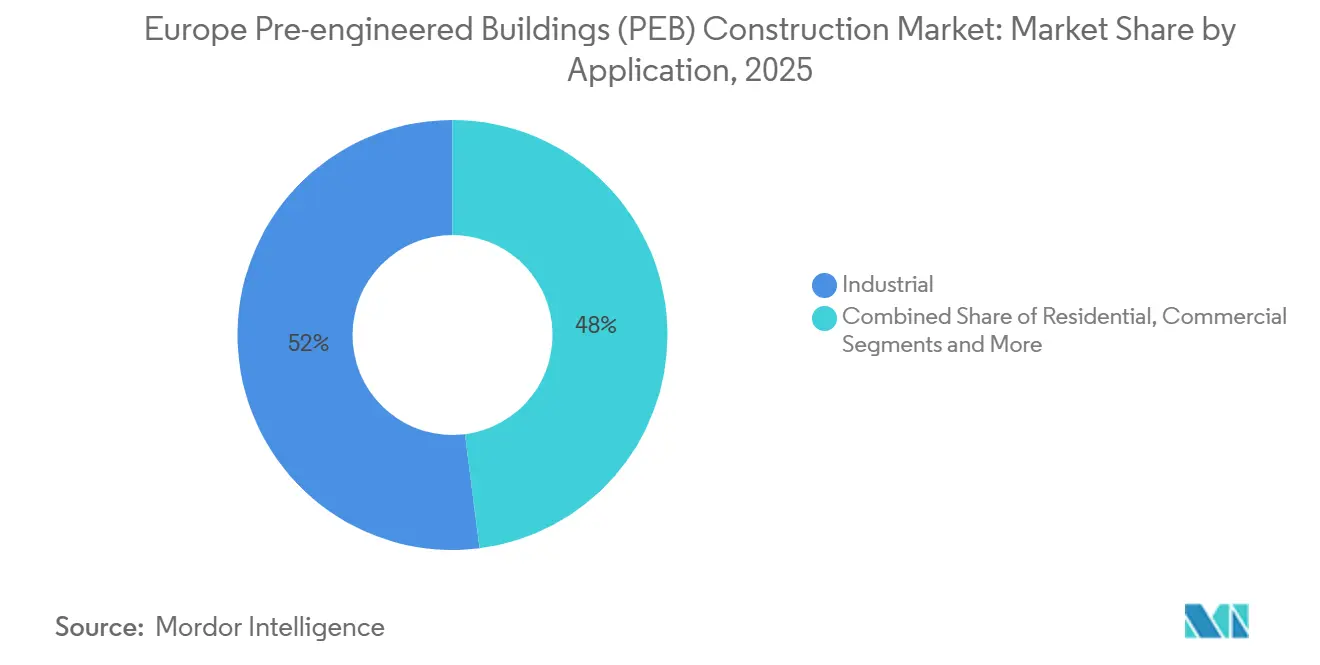
- By application, industrial buildings accounted for 52% of the Europe pre-engineered building (PEB) construction market size in 2025, while commercial buildings are forecast to expand at a 9.8% CAGR through 2031.
- By geography, Germany held 22% of the Europe pre-engineered building (PEB) construction market share in 2025, while the rest of Europe is forecast to grow at a 9.4% CAGR through 2031.
Note: Market size and forecast figures in this report are generated using Mordor Intelligence’s proprietary estimation framework, updated with the latest available data and insights as of January 2026.
Europe Pre-engineered Buildings (PEB) Construction Market Trends and Insights
Drivers Impact Analysis*
| Drivers | (~) % Impact on CAGR Forecast | Geographic Relevance | Impact Timeline |
|---|---|---|---|
| EU Building Renovation and Embodied-Carbon Disclosure | +2.2% | EU-wide, strongest in Germany, France, and the Nordics | Medium term (2-4 years) |
| Brownfield Redevelopment and Last-Mile Logistics | +1.9% | Germany, Netherlands, Czech Republic, Poland, France | Short term (≤ 2 years) |
| Circular-Steel Procurement and Design for Disassembly | +1.5% | Nordic core, the Netherlands, Belgium, and Central and Eastern Europe | Medium term (2-4 years) |
| Data-Center and Battery-Plant Development | +1.1% | United Kingdom, France, Sweden, Finland, Germany, Portugal | Short term (≤ 2 years) |
| Urban Infill, Social Housing, and Off-Site Construction | +0.8% | Ireland, Netherlands, United Kingdom, Scandinavia, Spain | Medium term (2-4 years) |
| Source: Mordor Intelligence | |||
EU Building Renovation Wave and Embodied-Carbon Disclosure Requirements
The recast Energy Performance of Buildings Directive is a central policy factor for the Europe pre-engineered building (PEB) construction market. Member states faced a May 29, 2026, deadline to transpose new or amended provisions into national law. The European Commission’s Delegated Regulation 2026/52 established a common approach for reporting lifecycle global warming potential in energy performance certificates for new buildings from January 2028. This requirement increases the value of building systems that have defined material records and documented thermal performance. Factory-made envelopes can offer product information and environmental declarations in a format that supports project documentation. The Council of the European Union noted in 2026 that embodied emissions can exceed operational emissions over the life of an energy-efficient building, which makes material selection more important in project decisions.
Brownfield Industrial Redevelopment and Last-Mile Logistics Expansion
The EU objective of no net land take by 2050 encourages more reuse of previously developed land. Brownfield sites often have irregular boundaries, existing infrastructure, and nearby occupied uses that make construction speed important. Prologis began the first phase of its DC4WARD redevelopment in Dortmund in December 2025 on a former coal-mining and heavy-machinery site. The project is planned to provide 130,000 square meters of logistics and light-industrial space through August 2028 and targets DGNB Platinum certification. The Europe pre-engineered building (PEB) construction market can benefit where fabricated structural systems are designed around constrained plots. Shorter assembly programs can also reduce disruption around operating urban sites.
Circular-Steel Procurement and Design for Disassembly Targets
Circular procurement is increasingly connected to the ability to dismantle and reuse building components. A 2026 University of Liège database documented demountable structural connections across steel, timber, and concrete construction. Standardized, reversible connections can support reuse when buildings are modified or removed. Ruukki Construction and Peab delivered a building in Lund, Sweden, using fossil-free HYBRIT steel in sandwich-panel walls and roofs. The project showed that lower-emission steel was moving from a technical demonstration toward a customer project. Suppliers that can pair steel components with lifecycle information and disassembly options are better placed for specifications that emphasize circularity.
Nordic and Western European Data-Center and Battery-Plant Development
Battery plants and data centers create demand for large spans, process infrastructure, and defined completion dates. ProLogium held a 2026 groundbreaking ceremony for its Dunkirk battery gigafactory in France, with capacity targets of 4 gigawatt-hours by 2030 and 12 gigawatt-hours by 2032. These developments require industrial buildings and supporting structures over several construction phases. Their scale can support longer supply relationships for capable building-system providers. The Europe pre-engineered building (PEB) construction market can also serve ancillary space for cooling, power equipment, security, and operations. Demand from repeat purchasers may favor suppliers that can repeat engineered details across locations.
Restraints Impact Analysis*
| Restraint | (~) % Impact on CAGR Forecast | Geographic Relevance | Impact Timeline |
|---|---|---|---|
| Steelmaking Energy Costs and Carbon-Cost Volatility | -1.8% | EU-wide, strongest for manufacturers sourcing from non-EU blast-furnace producers | Short term (≤ 2 years) |
| Aging Fabrication Workforce and Skilled-Labor Mobility | -1.4% | Germany, Finland, Sweden, France, Belgium, and Central and Eastern Europe | Medium term (2-4 years) |
| Eurocode, CE-Marking, and Planning-Approval Complexity | -0.9% | EU-wide, particularly for cross-border project packages | Medium term (2-4 years) |
| Whole-Life Carbon, Digital Product Passport, and Green-Taxonomy Compliance | -0.7% | EU-wide, with early pressure in the Nordics and Germany | Long term (≥ 4 years) |
| Source: Mordor Intelligence | |||
EU Energy-Intensive Steelmaking and Carbon-Cost Volatility
Carbon cost exposure is a procurement concern for steel-intensive construction systems. The European Commission identifies iron and steel among the sectors covered by the Carbon Border Adjustment Mechanism[1]. The mechanism entered its definitive period on January 1, 2026. Imported conventional steel can face higher cost exposure where its embedded emissions are high. This can make price planning more difficult for manufacturers with international supply chains. Producers with domestic or electric-arc-furnace supply can have lower exposure and may gain an advantage in bids that require carbon documentation.
Aging Fabrication Workforce and Cross-Border Skilled-Labor Mobility
Labor availability remains a constraint across European construction and fabrication work. FIEC stated that the sector needs approximately 2 million additional workers by 2030. A European Commission analysis found that 31% of the construction workforce was aged 50-64 in 2024[2]. Experienced welders, detailers, and crane operators are important to steel fabrication and erection. Retirements and tighter cross-border labor availability can add pressure to schedules and labor costs. Off-site production can reduce some site labor needs, but it still depends on skilled workers in plants and erection teams.
*Our forecasts treat driver/restraint impacts as directional, not additive. The impact forecasts reflect baseline growth, mix effects, and variable interactions.
Segment Analysis
By Structure: Single-Story Buildings Lead Volume While Multi-Story Formats Grow
Single-story buildings accounted for 60% of the Europe pre-engineered building (PEB) construction market size in 2025. They are widely used in logistics parks, light-industrial facilities, and agricultural projects. Their share reflects the need for large, low-rise footprints that can be delivered with direct site access and simple internal layouts. They also suit former industrial sites where height limits and surrounding infrastructure shape building design. P3 handed over a 38,000-square-meter logistics facility in Ebersbach, Germany, in February 2025 on the revitalized site of a former automotive plant. The company reported that 90% of demolished material from the predecessor structures was recycled on site. That project illustrates the role of single-story steel systems in brownfield logistics redevelopment. The format remains the main revenue base because it matches the requirements of many industrial tenants.
Multi-story buildings are the fastest-growing structural format, with a forecast CAGR of 10.2% from 2026 to 2031. Their use is increasing where land is constrained, and projects need more floor area within a smaller footprint. Battery plants require tall, wide-span spaces with high process loads and controlled internal environments. These needs make multi-story steel framing relevant for selected manufacturing facilities. Multi-story modular housing is another source of demand. Daiwa House Modular Europe began construction in September 2025 on 379 relocatable social rental homes in Hilversum, Netherlands. The project uses stacked modules and allows relocation after the site lease. These applications expand the role of multi-story systems beyond traditional warehouse construction.
By Product Type: Panelized Systems Retain Scale While Modular Buildings Grow Faster
Panelized and componentized systems held 40% of the Europe pre-engineered building (PEB) construction market size in 2025. They remain established in industrial and commercial projects that require design flexibility and phased site assembly. Panels and components allow teams to adjust dimensions while detailed design and approvals are still progressing. This is useful on brownfield sites where surveys, boundaries, and existing services can affect final layouts. The product type also supports a wide range of roof, wall, and frame combinations. It can be used in logistics, manufacturing, commercial, and agricultural settings. The system’s familiarity supports its continuing share of the Europe pre-engineered building (PEB) construction market. Its role is based on adaptable delivery rather than a fully volumetric factory solution.
Modular buildings are the fastest-growing product type, with a forecast CAGR of 11.0% from 2026 to 2031. They are suited to buyers who treat completion timing as a direct cost consideration. Public housing agencies, data-center operators, and social-infrastructure buyers can value the ability to produce repeatable units in controlled factory conditions. Ireland’s Roadmap for Modern Methods of Construction aims to apply these methods to most of its 10,000 annual social-housing units[3]. Modular systems can shorten on-site activities and provide repeatable quality records. Construction Products Regulation 2024/3110 applies from January 8, 2026, and supports a stronger documentation requirement for building products. This can favor manufacturers with certified systems and structured product data.
By Application: Industrial Buildings Lead While Commercial Demand Gains Pace
Industrial buildings accounted for 52% of the Europe pre-engineered building (PEB) construction market size in 2025. Logistics facilities, light manufacturing, and battery-related infrastructure are major sources of demand. EUROFER reported that construction represented 38.1% of total EU steel end use in 2026. Industrial applications require clear spans, durable envelopes, and practical loading layouts. These requirements fit steel building systems used in warehouses and manufacturing facilities. Brownfield redevelopment adds another demand source because existing sites often need replacement buildings with limited disruption. The Europe pre-engineered building (PEB) construction market, therefore, remains closely tied to industrial property activity. Industrial applications continue to anchor market volume.
Commercial buildings are the fastest-growing application, with a forecast CAGR of 9.8% from 2026 to 2031. Data-center campuses, mixed-use technology parks, and distribution-related facilities support this growth. Many projects need rapid fitout, documented performance, and large internal spans. The boundary between light-industrial and commercial activity is also becoming less clear for support buildings around technology and battery sites. Ruukki completed a 4,500-square-meter production and office building in Pirkkala, Finland, in the summer of 2026 using a three-dimensional facade profile system. The project shows how production and office requirements can be combined in one building program. Commercial demand is rising where performance standards and design requirements converge with industrial construction needs.

Geography Analysis
Germany held 22% of the Europe pre-engineered building (PEB) construction market share in 2025. Its position reflects a large logistics and light-industrial property base, active brownfield redevelopment, and a manufacturing culture that supports factory-produced components. Germany also has sites where redevelopment must be managed around existing urban infrastructure. Prologis’s Dortmund project is one example of a former industrial area being developed for logistics and light-industrial use. The Europe pre-engineered building (PEB) construction market is supported in Germany, where short construction programs can reduce site disruption. The country’s replacement and redevelopment pipeline keeps demand centered on practical structural and envelope solutions.
Spain has a separate opportunity linked to the conversion of former industrial sites into logistics and manufacturing facilities. VGP identifies brownfield redevelopment as a core part of its development approach, including its La Naval project in Sestao, Bilbao. Such sites can reward steel systems that are designed around irregular boundaries and existing site conditions. Labor shortages also strengthen the case for systems that shift work from the site into controlled manufacturing settings. FIEC identified substantial construction labor needs across Europe, including Spain and Italy. Italy has a related need for efficient construction delivery as its building investment and workforce needs remain significant. Russia remains constrained by geopolitical and sanctions-related disruption, which limits the active exposure of Western suppliers.
The rest of Europe is the fastest-growing regional group, with a forecast CAGR of 9.4% from 2026 to 2031. The group includes Central and Eastern European countries, as well as Nordic markets. Ruukki’s LowCarbon sandwich panels were used in City Point Okęcie, an 11,000-square-meter build-to-suit logistics building in Warsaw that entered use in July 2025. This provided a commercial reference for lower-carbon building envelopes in Poland. The Nordic countries are notable for early use of circular-steel specifications and fossil-free material sourcing. These requirements can shape product design and documentation for suppliers serving the wider region. The Europe pre-engineered building (PEB) construction market is also supported by logistics and manufacturing investment across Central and Eastern Europe. Regional growth reflects the modernization of industrial and logistics real estate stock.
Competitive Landscape
The Europe pre-engineered building (PEB) construction market is moderately concentrated at the higher-value end of the sector. Large integrated suppliers can combine engineering, manufacturing, building envelopes, and installation support. Smaller national fabricators compete through local relationships and price. Kingspan illustrates an integrated building-envelope model. The company acquired full ownership of Nordic Waterproofing. It also acquired Mercor’s ventilation and daylighting business in Poland in 2025. These moves expanded its envelope and Central and Eastern European capabilities.
Ruukki Construction, part of SSAB, operates 13 specialized manufacturing sites across 10 European countries. In May 2026, the company announced a new automated punching line at Vimpeli, Finland, under a multiyear investment program. The investment supports more versatile production of purlins and facade components for commercial, industrial, and warehouse buildings. Ruukki also announced in May 2026 that it would combine the Plannja Landsbro and Designtak operations into a shared production facility in Vetlanda, Sweden. Such investments show that capacity, customization, and service remain important competitive factors. The Europe pre-engineered building (PEB) construction market is increasingly influenced by the ability to manufacture repeatable components with reliable delivery. Players with regional plants can serve local needs while maintaining standardized systems.
Digital product information and circular design are becoming more important in competition. Construction Products Regulation 2024/3110 sets a framework for CE marking and digital product-passport requirements through phased implementation. Suppliers that organize lifecycle information and environmental product records can better support procurement requirements. Lower-emission steel and recycled content can also differentiate envelope products where customers need to document embodied carbon. Research published in 2026 confirmed the technical basis for demountable connections in structural engineering. This supports offers that include disassembly and reuse potential alongside initial construction performance. No combined market-share data for the largest suppliers was provided, so a market concentration score cannot be assigned under the required methodology.
Europe Pre-engineered Buildings (PEB) Construction Industry Leaders
-
Donges SteelTec GmbH
-
Ruukki Construction
-
Astron Buildings S.A.
-
Lindab International AB
-
Metek UK Ltd
- *Disclaimer: Major Players sorted in no particular order
Recent Industry Developments
- May 2026: Ruukki Construction announced it will consolidate Plannja Landsbro and Designtak operations into a new shared production facility in Vetlanda, Sweden, to strengthen its premium roofing product offering and improve customer service. The new facility is to be built by an external investor and leased by Ruukki, with production integration expected to improve capacity utilization for customized roofing and prefabricated entrance-roof products.
- May 2026: Astron Buildings S.A. supplied pre-engineered steel structures for a 32,000-square-meter warehouse center in Trąbki, Poland, for Zignago Vetro Polska, designed to comply with 2026 energy standards and built in a strategic partnership between the client and Grupa Antczak.
- February 2026: ProLogium held the groundbreaking ceremony for its gigafactory in Dunkirk, France, launching a construction program targeting 4 gigawatt-hours capacity by 2030 and 12 gigawatt-hours by 2032, creating an extended steel building and industrial construction program in Northern France.
Europe Pre-engineered Buildings (PEB) Construction Market Report Scope
| Single-Story |
| Multi-Story |
| Modular Buildings |
| Panelized and Componentized Systems |
| Other Prefabricated Building Types |
| Residential |
| Commercial |
| Industrial |
| Institutional |
| Others |
| Germany |
| United Kingdom |
| France |
| Italy |
| Spain |
| Russia |
| Rest of Europe |
| By Structure | Single-Story |
| Multi-Story | |
| By Product Type | Modular Buildings |
| Panelized and Componentized Systems | |
| Other Prefabricated Building Types | |
| By Application | Residential |
| Commercial | |
| Industrial | |
| Institutional | |
| Others | |
| By Country | Germany |
| United Kingdom | |
| France | |
| Italy | |
| Spain | |
| Russia | |
| Rest of Europe |
Key Questions Answered in the Report
What is the 2026 value of the European pre-engineered building construction sector?
The Europe pre-engineered building (PEB) construction market is valued at USD 13.42 billion in 2026 and is forecast to reach USD 20.68 billion by 2031.
What growth rate is forecast through 2031?
The sector is forecast to grow at a 9.04% CAGR from 2026 to 2031.
Which building structure held the largest share in 2025?
Single-story buildings held 60% of the 2025 value, supported by logistics, light-industrial, and agricultural construction.
Which product type is growing fastest?
Modular buildings are forecast to grow at an 11.0% CAGR through 2031 as buyers seek faster and repeatable delivery.
Which application accounted for the largest share?
Industrial buildings accounted for 52% of the 2025 value, driven by logistics, light manufacturing, and battery-related infrastructure.
Which geography is growing fastest?
The rest of Europe is forecast to grow at a 9.4% CAGR through 2031, supported by industrial and logistics real estate modernization.