
Europe Packaging Technical Textile Market Size and Share
Market Overview
| Study Period | 2021 - 2032 |
|---|---|
| Forecast Data Period | 2027 - 2032 |
| Base Year Market Size (2026) | USD 3.56 Billion |
| Market Size (2027) | USD 3.73 Billion |
| Market Size (2032) | USD 4.61 Billion |
| Growth Rate (2027 - 2032) | 4.33 % |
| Market Concentration | Medium |
Major Players *Disclaimer: Major Players sorted in no particular order Image © Mordor Intelligence. Reuse requires attribution under CC BY 4.0. | |
Europe Packaging Technical Textile Market Analysis by Mordor Intelligence
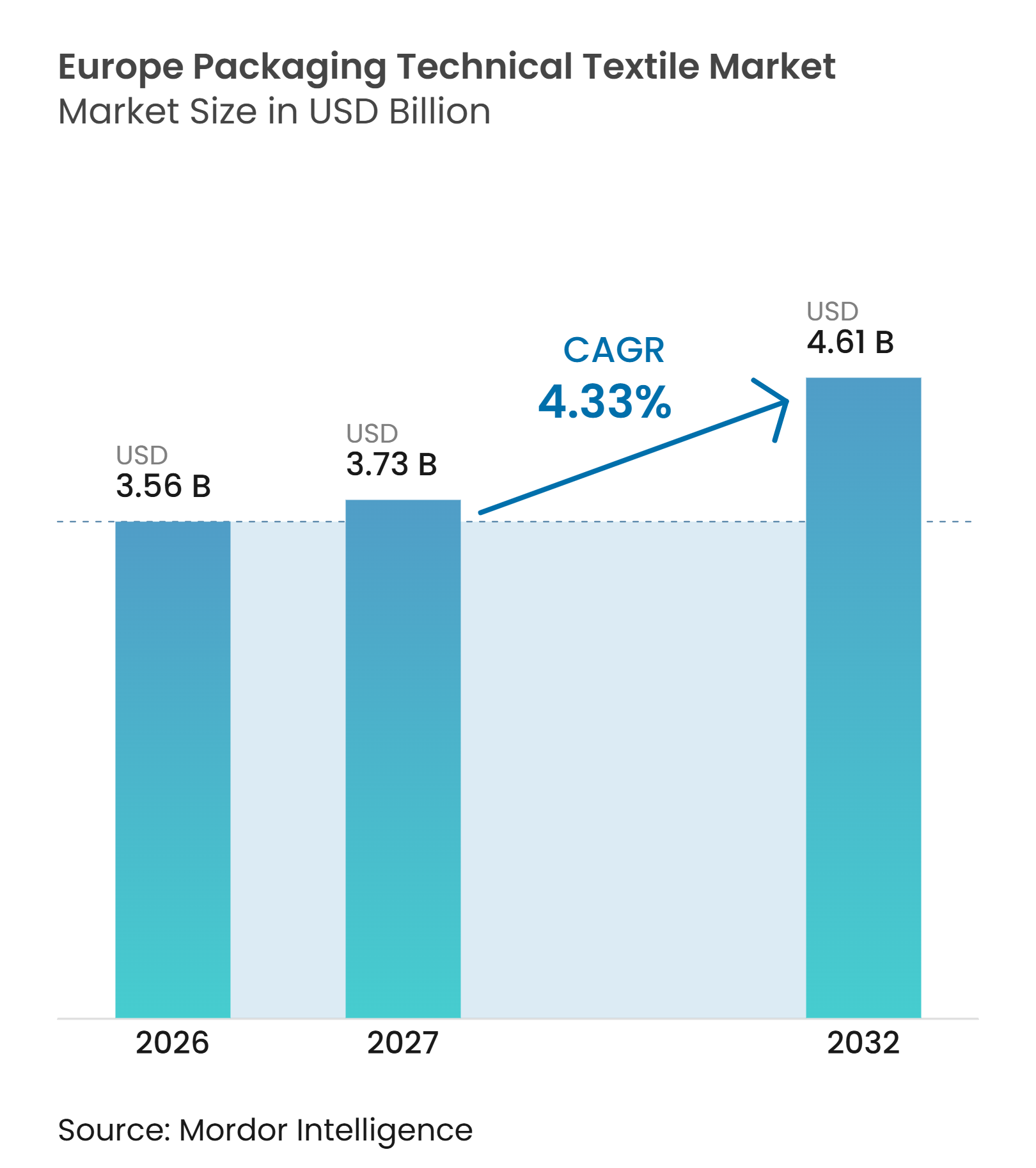
The Europe Packaging Technical Textile Market size is projected to be USD 3.56 billion in 2026, USD 3.73 billion in 2027, and reach USD 4.61 billion by 2032, growing at a CAGR of 4.33% from 2027 to 2032.
The Europe packaging technical textile market is moving from standard single-use formats toward products that support reuse, traceability, and material compliance. Regulation (EU) 2025/40 entered into force on February 11, 2025, and it is changing procurement requirements for industrial transport packaging across the region. Buyers are giving more weight to cleanable multi-trip bags, documented supply chains, and certified food and pharmaceutical formats. This favors producers that can meet detailed quality requirements, while standard formats remain exposed to import competition. The Europe packaging technical textile market also has room to grow through reconditioning services, recycled-content solutions, and regional supply networks.
Key Report Takeaways
- By product type, flexible intermediate bulk containers held 30.0% of the Europe packaging technical textile market share in 2026, while nonwoven and specialty textile packaging products are forecast to grow at a 6.2% CAGR through 2032.
- By material type, polypropylene accounted for 45.0% of the Europe packaging technical textile market size in 2026, while regenerated cellulosic fibers are forecast to grow at a 6.8% CAGR through 2032.
- By end-use application, food and beverage processing held 23.0% of the Europe packaging technical textile market share in 2026, while pharmaceuticals and healthcare products are forecast to grow at a 6.5% CAGR through 2032.
- By geography, Germany accounted for 22.0% of the Europe packaging technical textile market share in 2026, while Poland is forecast to grow at a 6.0% CAGR through 2032.
Note: Market numbers in this report are based on Mordor Intelligence's proprietary estimation framework, which combines nine months of actuals with Q4 projections for base year 2026.
Market Trends and Insights
Drivers Impact Analysis of Europe Packaging Technical Textile Market*
| Driver | (~) % Impact on CAGR Forecast | Geographic Relevance | Impact Timeline |
|---|---|---|---|
| PPWR-Led Reusable Transport Packaging | +1.1% | EU-wide, with early adoption in Germany, the Netherlands, and France | Short term (≤ 2 years) |
| Certified Food, Pharmaceutical, and Chemical Bulk Handling | +0.9% | EU-wide, especially Ireland, Germany, and Belgium | Medium term (2-4 years) |
| Nearshoring and Supply-Chain Resilience | +0.7% | Central and Eastern Europe, Poland, Türkiye, and Serbia | Medium term (2-4 years) |
| High-Specification FIBCs for Hazardous Materials | +0.5% | Germany, the Netherlands, and Belgium | Medium term (2-4 years) |
| FIBC Reconditioning and Closed-Loop Systems | +0.4% | Western Europe, with spillover into Central and Eastern Europe | Long term (≥ 4 years) |
| Import-Substitution Demand for Traceable and Short-Lead-Time Supply | +0.3% | EU-wide, especially Eastern Europe and Nordic markets | Long-term (≥ 4 years) |
| Source: Mordor Intelligence | |||
PPWR-Led Shift Toward Reusable Transport Packaging
Regulation (EU) 2025/40 brings reusable transport packaging into the compliance plans of industrial buyers across Europe. It entered into force in February 2025 and sets a 40% reuse target for transport packaging from January 1, 2030[1]. The European Commission’s 2026 guidance confirms that FIBC transport of dry bulk materials can fall within the reuse requirements where filling does not change the container interior. This increases demand for multi-trip bags that can be cleaned, inspected, and tracked through repeated use. It also puts pressure on suppliers of single-trip formats that cannot demonstrate a reuse pathway. The Europe packaging technical textile market is therefore likely to place greater value on documented rotation histories and reconditioning-ready designs.
Certifies Food, Pharmaceutical, and Chemical Grade Bulk-Handling
Demand for qualified bulk packaging is rising because hygiene and contamination-control rules require more than a standard container. EU GMP Annex 1 requires closed systems and contamination control for sterile medicinal product manufacturing. These requirements support the use of cleanroom-manufactured FIBCs for active pharmaceutical ingredient handling. Food-contact packaging must also meet the general safety framework under Regulation (EC) No 1935/2004. Commission Regulation (EU) No 10/2011 adds specific migration controls for plastic food-contact materials. These compliance requirements support higher-value packaging formats and strengthen the position of certified suppliers in the European packaging technical textile market.
Nearshoring and Supply-Chain Resilience
European industrial buyers are reassessing long supply chains for bulk packaging because lead times and supply continuity have become more important. Poland’s industrial production rose 3.1% year over year in January through May 2026. Its manufacturing output had already increased 3.4% in 2025, after 0.2% growth in 2024. This industrial expansion creates demand for packaging used in chemicals, construction materials, and food processing. Buyers also need suppliers that can provide auditable product records and respond quickly to specification changes. This supports regional and near-regional converting capacity, even as imported commodity supply continues to serve part of the European packaging technical textile market.
Higher-Specification FIBCs for Hazardous and Static-Sensitive Materials
Chemical buyers increasingly require Type C and Type D FIBCs for materials that create electrostatic or ignition risks. IEC 61340-4-4 sets the electrostatic classification framework for FIBCs used in these applications. ADR requirements also shape transport choices for dangerous goods moving through European chemical clusters. These bags need specialized fabrics, conductive components, and validated performance testing. ISO 21898:2024 establishes a service-category framework for flexible intermediate bulk containers. These technical demands make supplier qualification more demanding and improve retention for specialist producers serving the Europe packaging technical textile market.
Restraints Impact Analysis of Europe Packaging Technical Textile Market*
| Restraint | (~) % Impact on CAGR Forecast | Geographic Relevance | Impact Timeline |
|---|---|---|---|
| Dependence on Imported Commodity-Grade FIBCs | -0.9% | EU-wide, especially the Netherlands, Spain, and Germany | Short term (≤ 2 years) |
| Recycled-Content and Food-Contact Compliance Complexity | -0.7% | EU-wide, with a higher regulatory burden in Germany, France, and the Netherlands | Medium term (2-4 years) |
| Resin Price Volatility and Margin Compression | -0.5% | Global, with acute exposure in EU polymer-converting and weaving plants | Short term (≤ 2 years) |
| Fragmented Reuse, Inspection, and Reverse Logistics | -0.3% | Western Europe, with limited reverse logistics in Eastern Europe | Long term (≥ 4 years) |
| Source: Mordor Intelligence | |||
Structural Dependence on Imported Commodity-Grade FIBCs
Imported standard FIBCs remain a constraint on value retention for European converters. They create price competition in applications that do not need specialized hygiene, reuse, or hazardous-goods features. This limits the revenue opportunity for domestic producers of standard woven formats. It also makes it harder for buyers to simplify supply chains where distant suppliers have different documentation practices. European producers can respond through certified formats, service offerings, and faster delivery. The Europe packaging technical textile market will remain exposed to this pressure until premium specifications or reuse systems become more widely adopted.
Recycled-Content and Food-Contact Compliance Complexity
Packaging producers face difficult compliance choices when food-contact requirements and recycled-content goals overlap. Regulation (EU) 2022/1616, as amended by Regulation (EU) 2025/2269, sets requirements for recycled plastic intended for food contact. The framework requires eligible recycling technologies and supporting assessment processes. Manufacturers must also maintain food-contact compliance records for woven sacks, liners, and related materials. This can increase material qualification time, documentation work, and production cost. The resulting complexity can slow product redesign in the Europe packaging technical textile market.[2]
*Our forecasts treat driver/restraint impacts as directional, not additive. The impact forecasts reflect baseline growth, mix effects, and variable interactions.
Europe Packaging Technical Textile Market Segment Analysis
By Product Type:
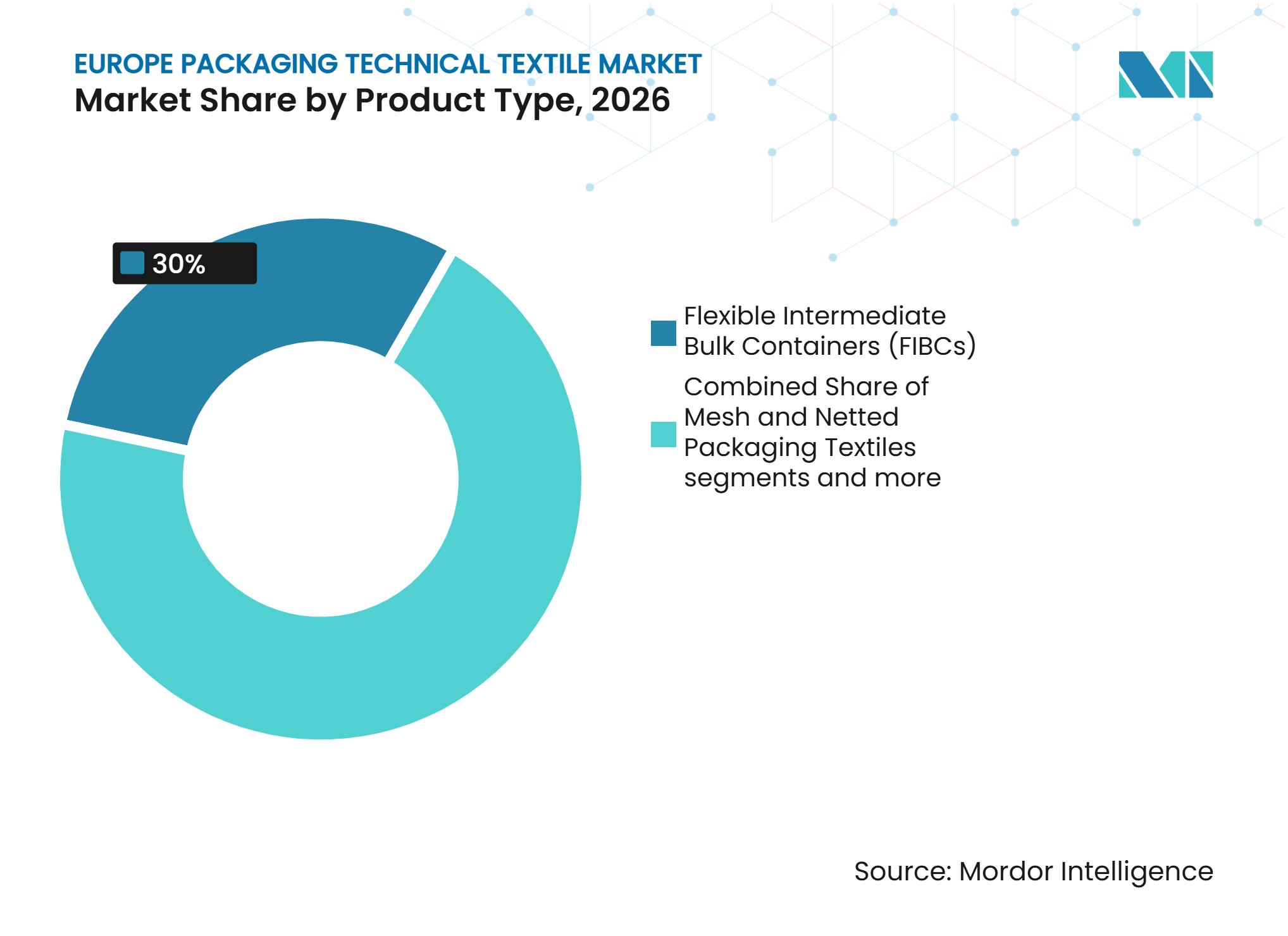
FIBCs Lead as Specialty Formats AccelerateFlexible intermediate bulk containers held 30.0% of the Europe packaging technical textile market share in 2026, equal to USD 1.068 billion. The segment serves agri-chemicals, food ingredients, construction minerals, and agricultural commodities. Conventional bulk formats remain widely used because they support high-volume freight flows. Baffle FIBCs are gaining relevance where users need improved pallet stability and cube efficiency. Ventilated FIBCs also support produce logistics for potatoes, onions, and other root vegetables. PPWR is increasing interest in multi-trip designs and cleanable liner systems for these applications.
Nonwoven and specialty textile packaging products are forecast to grow at a CAGR of 6.2% from 2027 to 2032. Their expansion is linked to retail carry packaging, pharmaceutical transport pouches, and protective packaging. Spunbond nonwoven formats can support recycling within established polypropylene streams. Woven polyolefin sacks and bags continue to serve cement, flour, and feed applications. Jute and natural-fiber products retain a defined position in premium food and agricultural uses. Mesh and netted products serve fresh produce, while wrapping and transit-protection textiles benefit from automation in logistics. These product groups give the Europe packaging technical textile market a mix of high-volume and higher-specification demand.



By Material Type:
Polypropylene Anchors Volume as Cellulosics Gain MomentumPolypropylene accounted for 45.0% of the Europe packaging technical textile market share in 2026, equal to USD 1.602 billion. It is the central material in FIBC fabric, woven sacks, leno bags, and industrial pallet films. Tape extrusion and circular weaving systems are widely designed around its processing properties. Polypropylene also benefits from established collection and reprocessing pathways. This makes it important to design-for-recycling work under PPWR. Polyethylene is the next material group in stretch hood film, cargo wrap, and container liners, while polyester serves high-tenacity lifting straps and load-bearing structures.
Regenerated cellulosic fibers are forecast to grow at a CAGR of 6.8% through 2032. They are gaining attention in premium packaging formats where buyers seek fiber-based alternatives to fossil-based structures. Lyocell and viscose-based materials can offer moisture management and biodegradable characteristics. The European Investment Bank backed PulPac in July 2025 to scale cellulose-based packaging alternatives. Jute, cotton, and other natural fibers remain relevant in selected produce, seed, and retail uses. Polyamide and other specialty synthetic fibers continue to support hazardous-goods and high-performance industrial formats in the Europe packaging technical textile market.[3]
By End-Use Application:
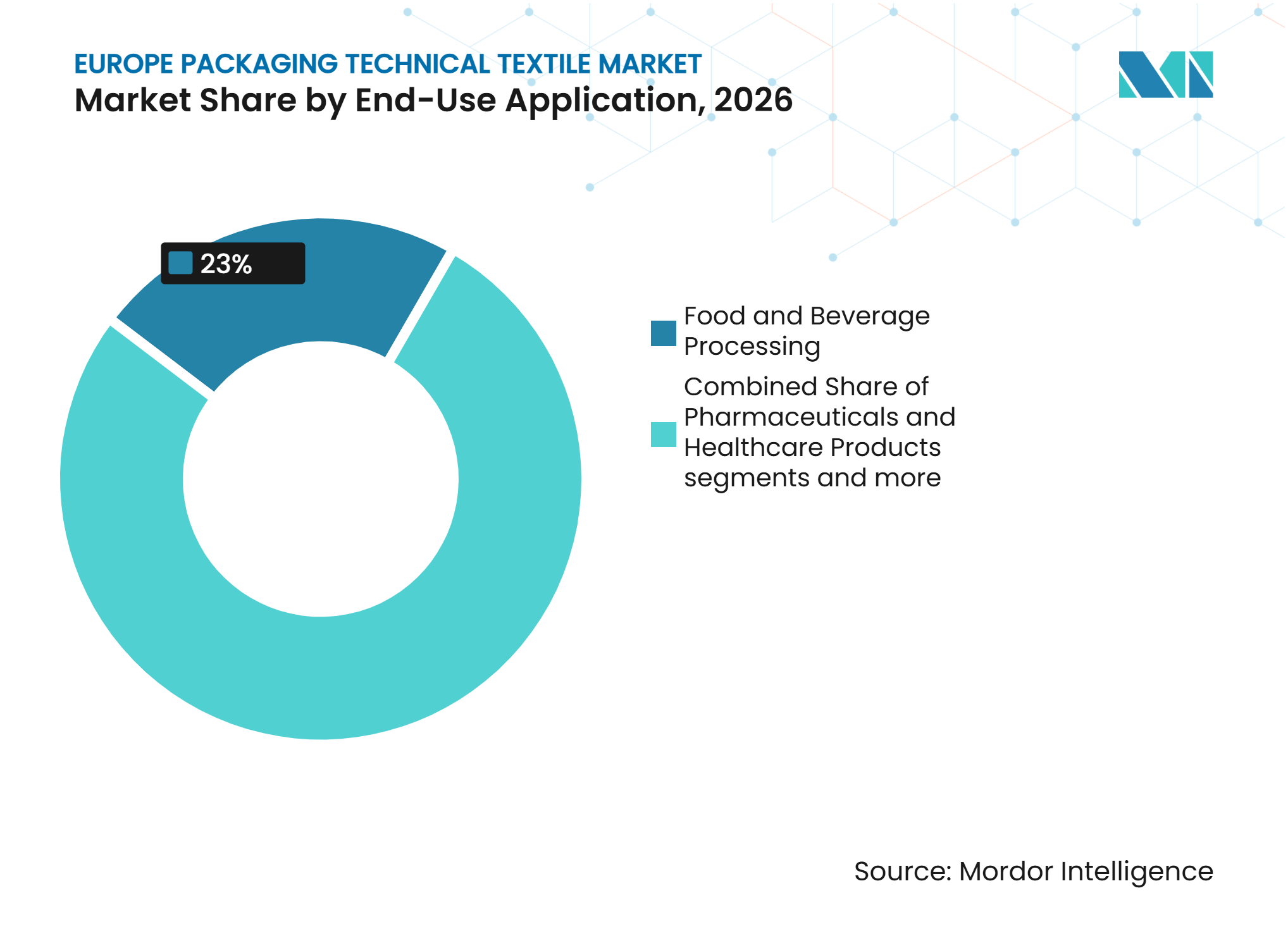
Food and Beverage Anchors Demand While Pharma AcceleratesFood and beverage processing held 23.0% of the Europe packaging technical textile market share in 2026, contributing USD 818.8 million. The segment includes packaging for grain, flour, sugar, food ingredients, animal feed, and beverage inputs. Regulation (EC) No 1935/2004 provides the general framework for materials that contact food. This creates continuing demand for qualified food-contact materials. Animal feed and pet food producers also use printed and UV-resistant woven sacks. Processed food ingredients often need barrier-coated sacks for moisture and contamination control.
Pharmaceuticals and healthcare products are forecast to grow at a CAGR of 6.5% through 2032. EU GMP Annex 1 supports demand for closed powder-transfer systems and cleanroom-made FIBCs in active pharmaceutical ingredient handling. Biosimilars, generics, and specialty chemical-pharma intermediates create demand across Ireland, Germany, and Belgium. Chemicals, petrochemicals, and fertilizers remain another major source of revenue because hazardous-goods requirements raise product specifications. Construction materials, minerals, and mining are volume-led uses. Agriculture, fresh produce, retail, e-commerce, consumer goods, and other industrial uses complete the end-use mix in the Europe packaging technical textile market.

Geography Analysis
Germany
Germany held 22.0% of the Europe packaging technical textile market share in 2026, with a market size of USD 783.2 million. Its chemical exports, pharmaceutical production, and food-processing base sustain demand for high-specification FIBCs and woven packaging. Type C and Type D products are important for buyers managing electrostatic risks under ADR requirements. The Joint Committee of German Packaging Manufacturers reported higher packaging activity in 2025. The same source reported 5.5% nominal growth in packaging for pharmacies, cosmetics, and pharmaceutical products. PPWR and the German Packaging Act are encouraging earlier product qualification and documentation work. This gives established suppliers an opportunity to set product standards before the wider market adopts them.
Poland
Poland is forecast to grow at a CAGR of 6.0% from 2027 to 2032. Its industrial base is expanding across chemicals, construction, and food processing. Sold industrial production rose 3.1% year over year in January through May 2026. Manufacturing output had risen 3.4% in 2025, following 0.2% growth in 2024. Poland’s deposit-return system began on October 1, 2025, adding to the focus on packaging compliance and recovery. Nearshoring also supports investment in local converting and related supply chains. These factors make Poland a growing demand center for woven and nonwoven formats in the Europe packaging technical textile market.
Other European Geographies
France and Italy retain substantial demand from chemical, food, and industrial users. The Netherlands and Belgium are important for distribution and chemical-cluster activity, which creates demand for specialist FIBCs. Romania is notable for the FPS Circularity Hub and the growth of FIBC collection and reconditioning capability. Nordic buyers support certified and sustainable bulk packaging through green-procurement priorities. The United Kingdom follows separate packaging rules, while maintaining sustainability requirements that are close to European practice. Türkiye and Serbia can support regional sourcing because they are close to Central European demand centers. These varied demand patterns broaden the Europe packaging technical textile market beyond the largest national markets.
Competitive Landscape
Market Concentration
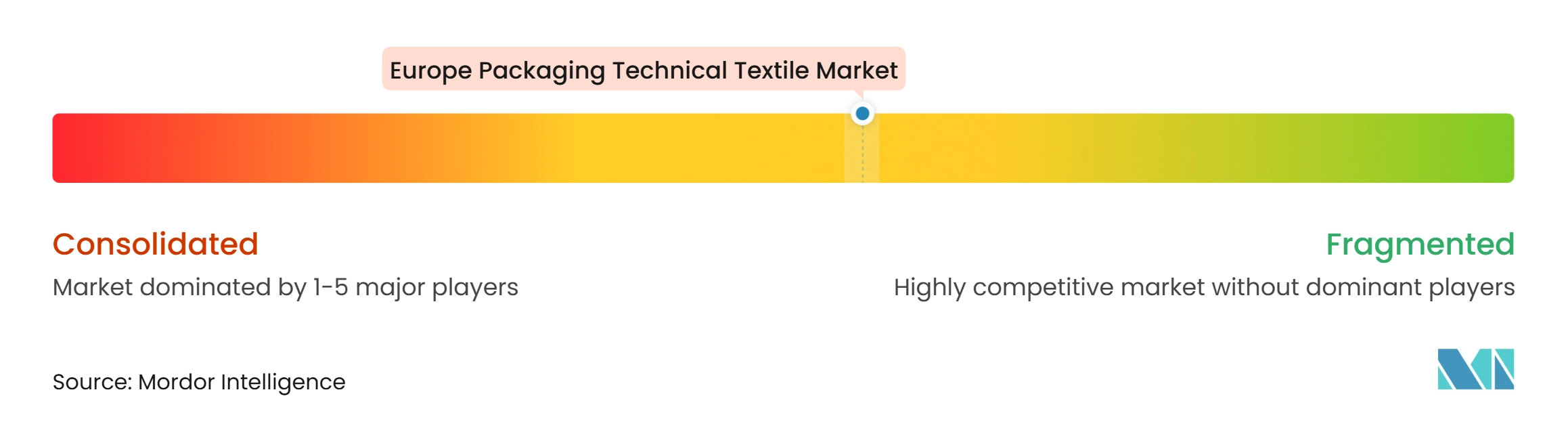
The Europe packaging technical textile market is moderately fragmented. Mondi plc, LC Packaging International BV, and Thrace Group serve premium demand through sustainability, technical qualification, and service capabilities. Mondi offers paper-based and hybrid packaging solutions for industrial and food-related applications. The company presented Ad/Vantage StretchWrap and re/cycle FunctionalBarrier Papers at Interpack 2026. LC Packaging has developed its WorldBag approach around FIBC reuse and reconditioning. This positioning reflects the demand for reusable formats under PPWR.
Specialist converters compete where customers need hazardous-goods FIBCs, food-grade sacks, or chemical-grade containers. Empac GmbH, TiszaTextil, Bag Corp, Conitex Sonoco, and RDA Bulk Packaging serve defined application niches. ISO 21898 and ADR-related compliance needs increase the importance of product testing and supplier approval. Smaller producers may find it harder to fund recycled-content qualification, digital documentation, and reuse services. This can support consolidation among suppliers that cannot independently manage compliance costs. The Europe packaging technical textile market rewards firms that combine material knowledge with reliable service.
Amcor expanded its European packaging presence after completing the acquisition of Berry Global in April 2025. Greif redirected capital toward industrial packaging and FIBC-related operations after divesting its containerboard business in July 2025. Thrace Group completed its acquisition of BHA Holdings in 2026, expanding its FIBC distribution footprint. Reconditioning infrastructure remains a strategic gap, and the FPS model illustrates the opportunity for specialized operators. Competition is likely to remain differentiated between commodity supply and certified, service-led formats. Buyers will continue to assess suppliers on traceability, testing, material compliance, and delivery flexibility.
Europe Packaging Technical Textile Industry Leaders
-
Greif, Inc.
-
LC Packaging International BV
-
Berry Global Group, Inc. (Amcor)
-
Mondi plc
-
Schoeller Allibert Group BV
- *Disclaimer: Major Players sorted in no particular order
Europe Packaging Technical Textile Market Companies Covered in this Report
- Greif, Inc.
- LC Packaging International BV
- Berry Global Group, Inc. (Amcor)
- Mondi plc
- Schoeller Allibert Group BV
- TiszaTextil Kft.
- TiszaTextil Packaging SAS
- Empac GmbH
- Louis Blockx NV
- J&HM Dickson Ltd.
- Sackmaker J&HM Dickson Ltd.
- RDA Bulk Packaging Ltd.
- Bulk Container Europe BV
- Isbir Sentetik Dokuma Sanayi A.S.
- Rishi FIBC Solutions Pvt. Ltd.
- Intertape Polymer Group Inc.
- Conitex Sonoco
- Bag Corp.
- ATEA Ambalaj Sanayi ve Ticaret A.S.
- Thrace Group
- United Bags, Inc.
- Packem Umasree Pvt. Ltd.
Recent Industry Developments in Europe Packaging Technical Textile Market
- April 2026: Mondi showcased sustainable packaging innovations at Interpack 2026 in Düsseldorf, including Ad/Vantage StretchWrap, a kraft paper pallet-wrapping solution designed as a fully recyclable alternative to plastic stretch film, alongside its re/cycle FunctionalBarrier Papers portfolio for form-fill-seal food packaging applications.
- October 2025: FPS Flexible Packaging Solutions won the UN Global Compact NL Best Sustainability Initiative Award for its FPS Circularity Hub, which the company describes as a large-scale FIBC circularity system capable of processing up to 15% of Europe’s end-of-life FIBC volumes and targeting 270,000 bags per year by 2026.
- July 2025: The European Investment Bank backed PulPac to scale Dry Molded Fiber technology for renewable cellulose-fiber packaging.
Europe Packaging Technical Textile Market Report Scope
The Europe Packaging Technical Textile Market Report is Segmented by Product Type (Flexible Intermediate Bulk Containers (FIBCs), Woven Polyolefin Sacks and Bags, and More), by Material Type (Polypropylene and More), by End-Use Application (Agriculture and Fresh Produce Packaging and More), and by Geography (Germany, United Kingdom, and More). The Report Offers Market Size and Forecasts in Value (USD) for all the Above Segments.
Segmentation Overview
| Flexible Intermediate Bulk Containers (FIBCs) | Conventional Bulk FIBCs |
| Form-Stable and Baffle FIBCs | |
| Ventilated FIBCs | |
| Other Specialized FIBCs | |
| Woven Polyolefin Sacks and Bags | |
| Jute and Other Natural-Fiber Packaging Textiles | Jute Sacking and Finished Packaging Bags |
| Others (Hessian, Burlap, Natural-Fiber Packaging Cloth, Speciality Packaging) | |
| Mesh and Netted Packaging Textiles | Leno Woven Packaging Bags |
| Raschel Knitted Packaging Bags | |
| Tubular Knitted Packaging Nets and Sleeves | |
| Other Textile Mesh Packaging Products | |
| Wrapping and Transit-Protection Textiles | Industrial Bale and Goods Wrapping Fabrics |
| Textile Packaging Covers and Protective Wraps | |
| Textile-Based Container Liners and Cargo Protection Fabrics | |
| Textile Pallet Netwrap and Load-Securing Materials | |
| Textile Packaging Sleeves, Padding, and Dunnage | |
| Nonwoven and Specialty Textile Packaging Products (Shopping and Carrying Bags, Protective Packaging Bags and Pouches, etc.) |
| Polypropylene |
| Polyethylene |
| Polyester |
| Jute |
| Cotton and Other Natural Fibers |
| Regenerated Cellulosic Fibers |
| Polyamide and Other Specialty Synthetic Fibers |
| Other Materials |
| Agriculture and Fresh Produce Packaging | Fresh Fruits and Vegetables |
| Seeds and Other Agricultural Commodities | |
| Food and Beverage Processing | Food Grains, Flour, and Sugar |
| Processed Food and Food Ingredients | |
| Animal Feed and Pet Food | |
| Beverage Ingredients and Infusion Products | |
| Chemicals, Petrochemicals, and Fertilizers | |
| Construction Materials, Minerals, and Mining | |
| Pharmaceuticals and Healthcare Products | |
| Retail, E-Commerce, and Consumer Goods | |
| Other Industrial Products and Materials |
| Germany |
| United Kingdom |
| France |
| Italy |
| Spain |
| Netherlands |
| Belgium |
| Poland |
| Rest of Europe |
| By Product Type | Flexible Intermediate Bulk Containers (FIBCs) | Conventional Bulk FIBCs |
| Form-Stable and Baffle FIBCs | ||
| Ventilated FIBCs | ||
| Other Specialized FIBCs | ||
| Woven Polyolefin Sacks and Bags | ||
| Jute and Other Natural-Fiber Packaging Textiles | Jute Sacking and Finished Packaging Bags | |
| Others (Hessian, Burlap, Natural-Fiber Packaging Cloth, Speciality Packaging) | ||
| Mesh and Netted Packaging Textiles | Leno Woven Packaging Bags | |
| Raschel Knitted Packaging Bags | ||
| Tubular Knitted Packaging Nets and Sleeves | ||
| Other Textile Mesh Packaging Products | ||
| Wrapping and Transit-Protection Textiles | Industrial Bale and Goods Wrapping Fabrics | |
| Textile Packaging Covers and Protective Wraps | ||
| Textile-Based Container Liners and Cargo Protection Fabrics | ||
| Textile Pallet Netwrap and Load-Securing Materials | ||
| Textile Packaging Sleeves, Padding, and Dunnage | ||
| Nonwoven and Specialty Textile Packaging Products (Shopping and Carrying Bags, Protective Packaging Bags and Pouches, etc.) | ||
| By Material Type | Polypropylene | |
| Polyethylene | ||
| Polyester | ||
| Jute | ||
| Cotton and Other Natural Fibers | ||
| Regenerated Cellulosic Fibers | ||
| Polyamide and Other Specialty Synthetic Fibers | ||
| Other Materials | ||
| By End-Use Application | Agriculture and Fresh Produce Packaging | Fresh Fruits and Vegetables |
| Seeds and Other Agricultural Commodities | ||
| Food and Beverage Processing | Food Grains, Flour, and Sugar | |
| Processed Food and Food Ingredients | ||
| Animal Feed and Pet Food | ||
| Beverage Ingredients and Infusion Products | ||
| Chemicals, Petrochemicals, and Fertilizers | ||
| Construction Materials, Minerals, and Mining | ||
| Pharmaceuticals and Healthcare Products | ||
| Retail, E-Commerce, and Consumer Goods | ||
| Other Industrial Products and Materials | ||
| By Geography | Germany | |
| United Kingdom | ||
| France | ||
| Italy | ||
| Spain | ||
| Netherlands | ||
| Belgium | ||
| Poland | ||
| Rest of Europe | ||
Key Questions Answered in the Report
What is the forecast growth rate for packaging technical textiles in Europe?
The Europe packaging technical textile market is forecast to grow at a CAGR of 4.33% from 2027 to 2032.
Which product category leads demand in Europe?
Flexible intermediate bulk containers lead product demand with a 30.0% share in 2026, equal to USD 1.068 billion.
Which material has the largest role in technical textile packaging?
Polypropylene held 45.0% of revenue in 2026, supported by its use in FIBCs, woven sacks, leno bags, and industrial pallet films.
What is driving pharmaceutical packaging demand?
Pharmaceuticals and healthcare products are forecast to grow at a 6.5% CAGR through 2032 as GMP requirements increase demand for cleanroom-manufactured FIBCs.
Which European country has the strongest forecast growth?
Poland is forecast to grow at a 6.00% CAGR through 2032, supported by industrial production, nearshoring, and packaging compliance needs.
How does PPWR affect FIBC suppliers?
PPWR supports reuse, traceability, and compliance requirements, favoring FIBCs that can be cleaned, inspected, and documented for repeated use.