
Europe OTT Market Size and Share
Market Overview
| Study Period | 2020 - 2031 |
|---|---|
| Base Year Market Size (2025) | USD 100.61 Billion |
| Historical Data Period | 2020 - 2024 |
| Market Size (2026) | USD 110.85 Billion |
| Market Size (2031) | USD 167.5 Billion |
| Market Concentration | Medium |
Major Players *Disclaimer: Major Players sorted in no particular order Image © Mordor Intelligence. Reuse requires attribution under CC BY 4.0. | |
Europe OTT Market Analysis by Mordor Intelligence
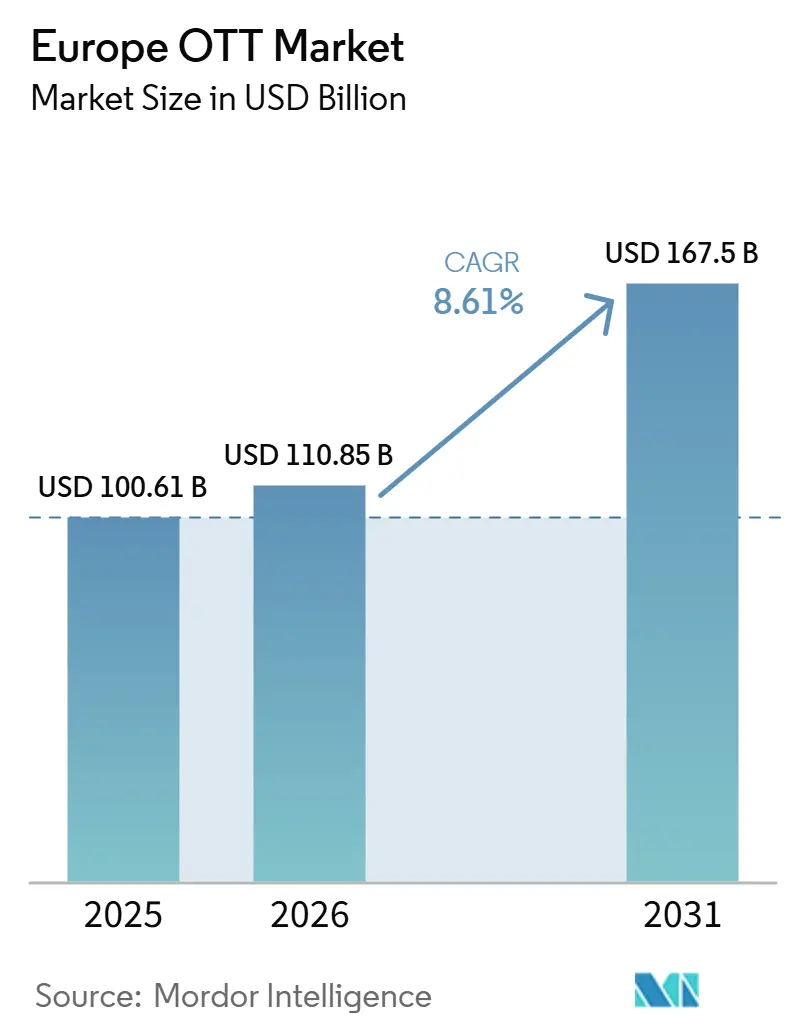
The Europe OTT market size is projected to be USD 100.61 billion in 2025, USD 110.85 billion in 2026, and reach USD 167.50 billion by 2031, growing at a CAGR of 8.61% from 2026 to 2031. The Europe OTT market is moving beyond subscriber acquisition and placing greater weight on revenue per account. Subscription platforms are adding advertising-supported options as repeated price increases meet greater consumer resistance. This model gives providers access to advertising budgets while retaining recurring subscription revenue. The Europe OTT market also faces higher content costs, particularly for live sports, which limits the flexibility of mid-sized services. Platform partnerships, local productions, and telecom bundles are becoming more important routes to reach and retain households.
Key Report Takeaways
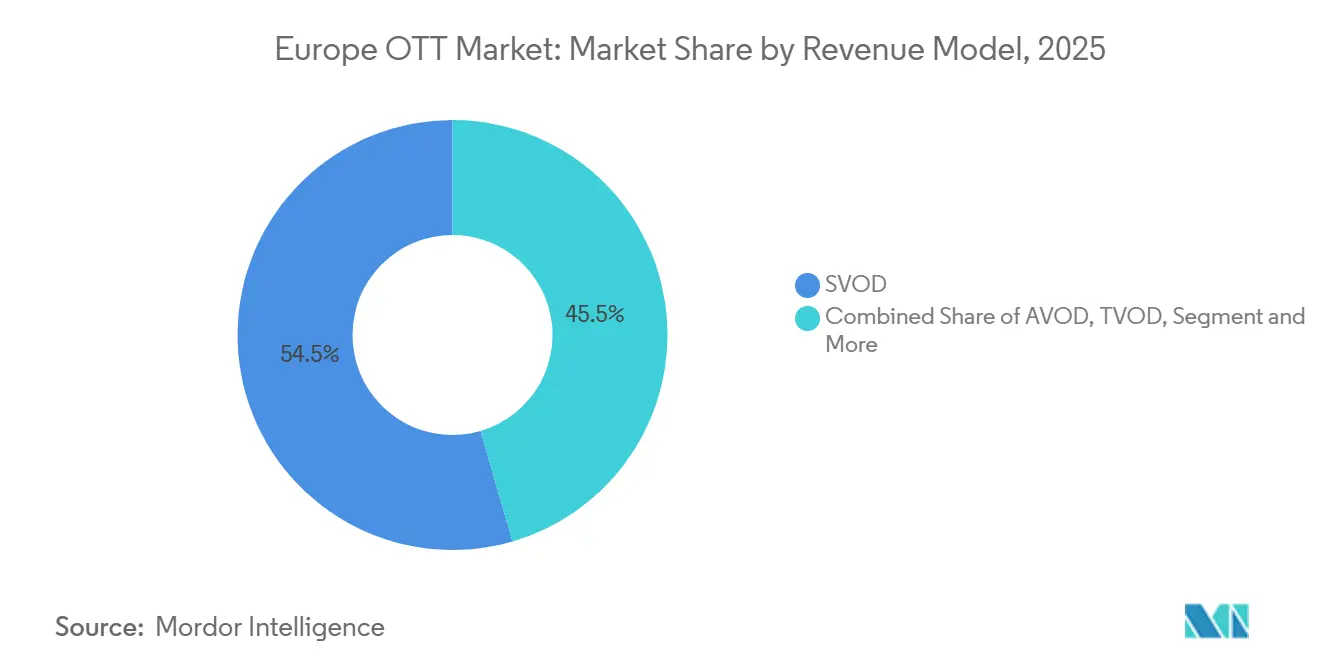
- By revenue model, SVOD held 54.50% of the Europe OTT market share in 2025, while hybrid subscription and advertising is projected to expand at a 9.58% CAGR through 2031.
- By device type, smart TVs accounted for 46.50% of Europe OTT market share in 2025 and are projected to grow at a 9.73% CAGR through 2031.
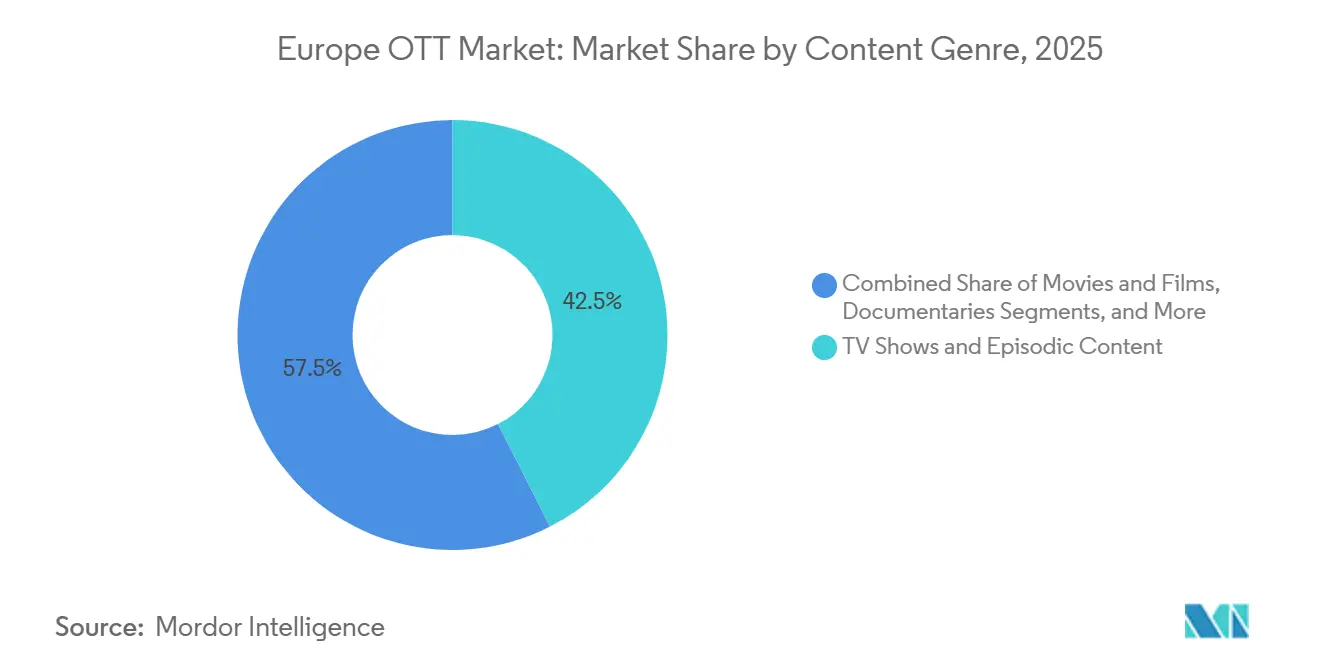
- By content genre, TV shows and episodic content accounted for 42.50% of genre revenue in 2025, while documentaries are projected to grow at a 9.68% CAGR through 2031.
- By geography, Germany held 22.50% of regional streaming revenue in 2025, while Spain is projected to expand at a 10.19% CAGR through 2031.
Note: Market size and forecast figures in this report are generated using Mordor Intelligence’s proprietary estimation framework, updated with the latest available data and insights as of January 2026.
Europe OTT Market Trends and Insights
Drivers Impact Analysis*
| Driver | (~) % Impact on CAGR Forecast | Geographic Relevance | Impact Timeline |
|---|---|---|---|
| Rising Adoption Of Ad-Supported Streaming Tiers | +2.1% | Global, particularly the United Kingdom, Germany, and France | Short term (≤ 2 years) |
| Broad Smart TV And Connected Device Penetration | +1.8% | Global, particularly Southern and Central Europe | Medium term (2-4 years) |
| Expansion Of Local And Original Content Budgets | +1.5% | France, Spain, Germany, and Italy | Medium term (2-4 years) |
| Growing Multi-Service Subscription Stacking | +1.2% | Western Europe, including the United Kingdom, Germany, and France | Short term (≤ 2 years) |
| Telecom And Pay-TV Bundling Across Europe | +0.9% | Germany, Spain, France, and Italy | Medium term (2-4 years) |
| Data-Driven Personalization And Recommendation Engine Monetization | +0.7% | Global | Long term (≥ 4 years) |
| Source: Mordor Intelligence | |||
Rising Adoption Of Ad-Supported Streaming Tiers
Ad-supported plans are bringing price-sensitive households into the Europe OTT market without requiring a full subscription payment. They also give established services a way to protect subscriptions when households review recurring expenses. A 2026 consumer study found that FAST channels reached 27% household adoption across the United Kingdom, Germany, France, Italy, Spain, and the Netherlands. This usage shows that advertising-funded viewing has become part of routine household viewing rather than a temporary response to prices. The Digital Services Act also sets transparency and accountability requirements for targeted advertising across member states.[1]European Commission, “Digital Services Act Package,” European Commission, digital-strategy.ec.europa.eu The Europe OTT market can therefore broaden its paid and free audiences, although platforms must build advertising systems that meet these requirements.
Broad Smart TV And Connected Device Penetration
Smart TVs serve as the primary channel through which the Europe OTT market reaches living-room viewers. In Germany, internet-based television is expected to cover a larger share of households in 2026 compared with 2025. OTT streaming is expected to become a more prominent television reception method for German households in 2026 than a year earlier. Older televisions also drive demand for external streaming devices when their software no longer supports current applications. Smart TV home screens now influence which services viewers discover first, making application placement an important commercial consideration. Therefore, the Europe OTT market must compete not only for programming rights but also for visibility on device interfaces.
Expansion Of Local And Original Content Budgets
Local productions are becoming more central to competition in the Europe OTT market, as major global services offer broadly similar international catalogs. Global streaming platforms have substantially increased their spending on original European programming in recent years. Netflix has made a significant multi-year commitment in Spain, covering collaborations with numerous domestic production companies and following the success of Spanish productions in global non-English rankings. In France, Netflix continues to invest heavily in French content each year. These spending commitments make domestic creative relationships a more durable source of differentiation in the Europe OTT market.
Growing Multi-Service Subscription Stacking
Households with several services have become an important source of Europe OTT market revenue. The shift means providers increasingly seek to become part of a household portfolio rather than replace every competing service. Telecom arrangements and bundled offers help services reach customers who may not subscribe directly. These arrangements also reduce the cost of customer acquisition for services with smaller brands. Households that maintain several subscriptions are more sensitive to price changes because an increase on one service can lead to a review of the whole portfolio. The Europe OTT market benefits from wider service use, but each platform must show a clear reason to remain in the monthly budget.
Restraints Impact Analysis*
| Restraint | (~) % Impact on CAGR Forecast | Geographic Relevance | Impact Timeline |
|---|---|---|---|
| Fragmented Language And Rights Licensing Complexity | -1.3% | All of Europe, most severe in Central and Eastern Europe | Long term (≥ 4 years) |
| Premium Content Inflation And Sports Rights Escalation | -1% | Germany, the United Kingdom, and Italy | Short term (≤ 2 years) |
| Subscription Fatigue In Mature Western European Markets | -0.8% | The United Kingdom, Germany, and France | Medium term (2-4 years) |
| Cross-Border Regulatory And Advertising Compliance Burden | -0.7% | France, Germany, and Belgium | Long term (≥ 4 years) |
| Source: Mordor Intelligence | |||
Fragmented Language And Rights Licensing Complexity
The Europe OTT market operates across separate national rights environments, rather than as one fully unified content territory. Each agreement can require language versions, country-specific release windows, and compliance with domestic genre rules. This structure raises legal and administrative costs for services that want a broad regional offer. It also makes catalog depth depend partly on licensing capacity rather than on direct spending on programs. Large platforms can spread these compliance costs across many countries and subscribers. Smaller regional services and language-specific providers face a more difficult path to scale in the Europe OTT market.
Premium Content Inflation And Sports Rights Escalation
Sports rights are a major cost pressure in the Europe OTT market because live events can distinguish a service from a standard catalog. Large platforms can use sports programming to retain customers across broader memberships, while sports-only providers have fewer ways to manage the cost. Higher auction prices limit the ability of smaller services to compete for primary live sports packages. The resulting pressure is strongest where football rights are central to subscription decisions. It also directs a larger share of content budgets toward recurring auction cycles. This reduces capital available for other programming and product improvements.
*Our forecasts treat driver/restraint impacts as directional, not additive. The impact forecasts reflect baseline growth, mix effects, and variable interactions.
Segment Analysis
By Revenue Model: Hybrid Tiers Change Subscription Economics
SVOD held 54.50% of regional streaming revenue in 2025, reflecting the established subscriber bases of Netflix, Amazon Prime Video, and Disney+. Hybrid subscription and advertising offers are projected to expand at a 9.58% CAGR through 2031, the fastest pace among revenue models. This arrangement combines recurring subscription revenue with advertising income from the same program inventory. It also allows platforms to offer lower-priced tiers without withdrawing paid access altogether. Germany showed the continuing importance of the subscription model, where SVoD spending exceeded EUR 3 billion, equivalent to USD 3.24 billion, in 2025.[2]German Film Funding Institute, “FFA Home-Video-Markt 2025,” German Film Funding Institute, ffa.de SVoD accounted for 81% of German home-video revenue that year. The pure subscription model remains the largest source of revenue because it is familiar to both platforms and households. Hybrid tiers do not replace that foundation. They extend it to viewers who want a lower entry price and to advertisers seeking connected television audiences.
AVOD is smaller than subscription video in revenue terms, but it serves viewers who may not accept a paid plan. This audience can increase advertising reach without requiring a subscription conversion. TVOD is declining because broad subscription catalogs reduce the need to rent or buy many titles separately. Digital electronic sell-through revenue in Germany fell 2% in 2025. Live-event subscriptions remain important because sports and concert programming can support higher-priced tiers. Movistar Plus+ showed this logic in Spain after expanding live sports. The Europe OTT industry is therefore using different price points to preserve recurring revenue while serving households with different spending limits.



By Device Types: Smart TVs Lead Home Viewing
Smart TVs held 46.50% of Europe OTT market share in 2025 and are projected to grow at a 9.73% CAGR through 2031. Their leading position reflects the preference for larger screens for premium programs and shared household viewing. A 2026 study found that 58% of Europeans use the smart TV homepage as their preferred gateway to video content.[3]RTL Ad Alliance, “Living Room 2026 Whitepaper,” RTL Ad Alliance, rtl-adalliance.com This behavior gives television operating systems an important role in deciding which applications viewers open. Samsung and LG have large installed bases in Europe, which gives their interfaces influence over service discovery. Providers need placement and promotion on these interfaces to improve their chance of being selected. Prominent placement can affect the first program a household considers at the start of a viewing session. Services that depend on application searches may have a weaker route to discovery. Device relationships are therefore part of commercial planning, alongside content and pricing.
Smartphones and tablets reach many users but tend to generate lower revenue per viewer than television screens. Mobile viewing is more commonly linked to advertising-funded services and lower-priced plans. Laptops and desktops retain a role among younger viewers and in Eastern European markets with lower connected-TV use. Gaming consoles, streaming sticks, and set-top boxes provide complementary ways to access programs. Many older television sets no longer receive current application support, which keeps demand for external devices in place. The Europe OTT market can use this broad device base to reach viewers across different settings, but television screens remain the main premium viewing environment.
By Content Genre: Episodic Programs Support Retention
TV shows and episodic content held 42.50% of Europe OTT market size in 2025. Their position reflects the ability of serial programs to bring viewers back over several episodes and seasons. European audiences spent 78% of streaming time on series and 22% on films. Spanish series have also created global visibility for Netflix and supported the company's content investment in Spain. Movies and films are losing relative weight as release windows change and subscriptions give access to broad film libraries. This leaves serial programming as a central tool for retention and subscriber acquisition. A series can encourage repeat visits over a longer period than a standalone film. It also allows platforms to promote new seasons to viewers who have already engaged with earlier episodes. These viewing patterns support continued spending on local episodic programs.
Documentaries are projected to grow at a 9.68% CAGR through 2031, the fastest rate among content genres. France revised its content rules in January 2026 and doubled required platform investment in documentaries, animation, and live performance. The policy creates an additional supply route for documentaries, regardless of individual platform commissioning preferences. Live events, news, and sports-related formats also have strategic value because viewers need to watch them when they are available. Such programming can reduce switching between services that offer similar on-demand catalogs. The Europe OTT industry is thus balancing long-running series, regulated content investment, and time-sensitive viewing formats.
Geography Analysis
Germany held 22.50% of regional streaming revenue in 2025, making it the largest country segment. Internet-based television covered 54% of German households in 2026, compared with 45% in 2025. OTT streaming became a key household reception method. SVoD spending remained substantial in Germany. SVoD accounted for the dominant share of the country's home-video revenue.
Spain is projected to grow at a 10.19% CAGR through 2031, the fastest country rate in the Europe OTT market. Movistar Plus+ added subscribers in the first quarter of 2026 and expanded its subscriber base. Atresplayer expanded its paying subscriber base during the 2025-2026 season and launched several original productions. Netflix's content commitment supports Spain's domestic production network. The United Kingdom has a broad catalog offering, while high sports-rights spending shapes competition between services.
France and Italy have distinct positions in the Europe OTT market, shaped by regulation and sports programming. France requires streaming platforms to invest a portion of local revenue in French and European programs. Netflix, Amazon Prime Video, and Disney+ appealed new French content sub-quotas in July 2026. Netflix and TF1 launched their distribution partnership in 2026. Italy is more closely linked to sports-led differentiation, including Amazon Prime Video's UEFA Champions League rights. Central and Eastern European markets remain less mature than Western Europe, providing further room for subscriptions and bundled offers.
Competitive Landscape
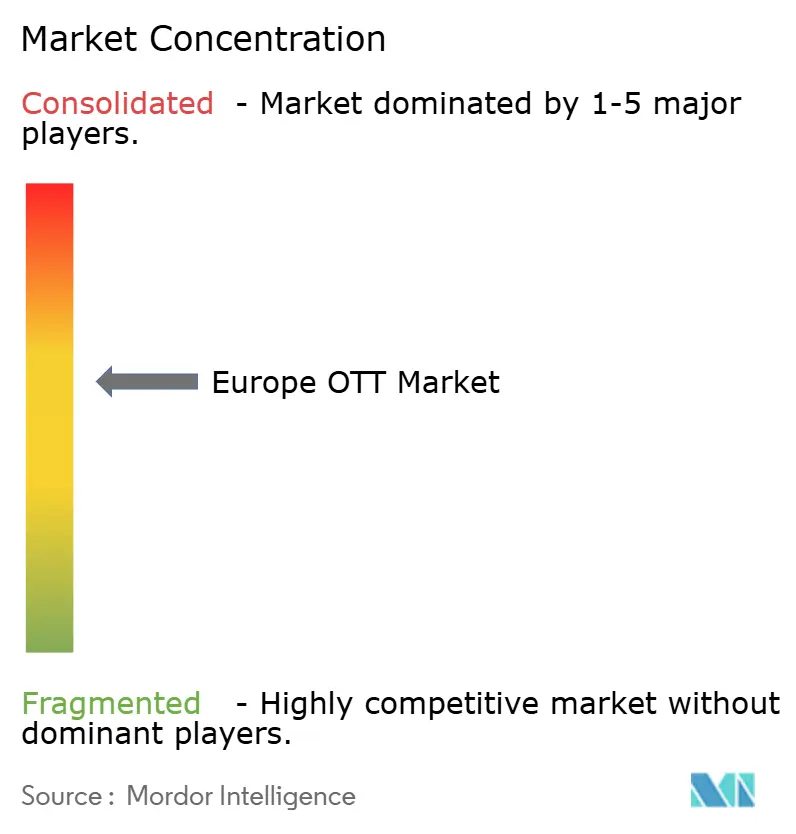
The Europe OTT market has moderate concentration across the region but remains strongly contested within each country. Netflix and Amazon Prime Video held leading positions in the German streaming audience, while Disney+ also maintained a strong presence. These global platforms compete through catalog scale, technology, and brand awareness. European broadcasters compete through local programming, established audience ties, and distribution relationships. Telecom providers add another layer by acting as household aggregators for several services.
RTL Group completed its acquisition of Sky Deutschland on June 1, 2026, after European Commission approval in April. E The transaction created a combined DACH business with 12.3 million paying subscribers RTL Group expects EUR 250 million, equivalent to USD 275 million, in annual synergies within 3 years. Netflix and TF1 also began their French partnership in June 2026, combining TF1 programming with Netflix distribution. This type of arrangement lets broadcasters retain programming and advertising roles while using the reach and recommendation tools of global platforms. It also shows that distribution partnerships can be an alternative to direct competition for audience attention.
CANAL+ announced a multi-year partnership with Google Cloud in March 2026 to use generative AI in its platform and production workflows. The company began deploying natural-language discovery and personalized homepages from June 2026. Disney+ also has content agreements with RTVE in Spain and ITV in the United Kingdom. Smaller providers face a funding gap when sports rights costs are supported by the wider businesses of larger platforms. Opportunities remain in live-event delivery, language-specific services in Central and Eastern Europe, and advertising technology. The Europe OTT market is therefore rewarding businesses that combine local relevance with strong distribution and customer discovery tools.
Europe OTT Industry Leaders
Netflix, Inc.
Amazon.com, Inc.
The Walt Disney Company
Warner Bros. Discovery, Inc.
Paramount Skydance Corporation
- *Disclaimer: Major Players sorted in no particular order

Recent Industry Developments
- July 2026: Amazon Prime Video expanded its add-on subscription service to Denmark, Norway, and Switzerland, making HBO Max, SkyShowtime, Apple TV+, MGM+, Lionsgate+, MUBI, Hayu, Crunchyroll, and BritBox available within the Prime Video app. The expansion advances Amazon's stated ambition of becoming Europe's primary entertainment destination and follows prior Channel launches in the United Kingdom, Germany, Australia, and New Zealand.
- July 2026: Netflix, Amazon Prime Video, and Disney+ filed a joint appeal with France's Council of State against new content genre diversity sub-quotas introduced January 1, 2026, which doubled overnight streaming platforms' compulsory investment in animation, documentaries, and live performance under France's 2021 AVMS Directive implementation. A Netflix appeal against Belgium's local content rules was simultaneously rejected by the Constitutional Court of Belgium in 2026.
- June 2026: Netflix and TF1 formally launched their France distribution partnership on June 19, making the complete TF1+ catalog, including live channels, live sports, and thousands of on-demand titles, accessible within Netflix. TF1+ subsequently reached 44 million monthly streamers following the integration.
- June 2026: CANAL+ began deploying Google Cloud and OpenAI generative AI technologies across its European and African markets from June 2026, enabling natural-language content discovery and AI-powered personalized homepages for its 42.3 million global subscribers, with intellectual property protections built into the partnership.


Europe OTT Market Report Scope
Europe OTT market refers to the revenue and ecosystem generated by internet-delivered video services subscription, ad-supported, transactional, and hybrid across European countries. It includes OTT TV and video platforms, streaming apps, and connected-TV services that bypass traditional broadcast and pay‑TV distribution.
The Europe OTT Market Report is Segmented by Revenue Model (Recurring Subscription Billing (SVOD), Transactional Billing (TVOD/PPV), Advertising-Supported Billing (AVOD/FAST), and Hybrid Monetization Billing), Device Types (Smartphones and Tablets, Smart TVs, and Laptops and Desktops), Content Genre (Movies and Films, TV Shows and Episodic Content, and Documentaries), and Country (Germany, United Kingdom, France, Italy, and Spain). The Market Forecasts are Provided in Terms of Value (USD).
| SVOD |
| AVOD |
| TVOD |
| Hybrid, Subscription and Ads |
| Smartphones and Tablets |
| Smart TVs |
| Laptops and Desktops |
| Other Device Types |
| Movies and Films |
| TV Shows and Episodic Content |
| Documentaries |
| Other Content Genres |
| Germany |
| United Kingdom |
| France |
| Italy |
| Spain |
| Rest of Europe |
| By Revenue Model | SVOD |
| AVOD | |
| TVOD | |
| Hybrid, Subscription and Ads | |
| By Device Types | Smartphones and Tablets |
| Smart TVs | |
| Laptops and Desktops | |
| Other Device Types | |
| By Content Genre | Movies and Films |
| TV Shows and Episodic Content | |
| Documentaries | |
| Other Content Genres | |
| By Country | Germany |
| United Kingdom | |
| France | |
| Italy | |
| Spain | |
| Rest of Europe |


Key Questions Answered in the Report
What is the Europe OTT market size?
The Europe OTT market size is projected to be USD 110.85 billion in 2026 and USD 167.50 billion by 2031, at an 8.61% CAGR. The expansion reflects a shift toward recurring subscription revenue combined with advertising income and wider connected television use. The forecast period runs from 2026 to 2031.
Which revenue model leads European OTT services?
SVOD led with 54.50% revenue share in 2025, while hybrid subscription and advertising offers are projected to grow at a 9.58% CAGR through 2031. Hybrid tiers support lower prices without removing subscription revenue, which helps platforms serve different household budgets. They also provide access to connected television advertising demand.
Why are advertising-supported streaming tiers expanding in Europe?
Lower-priced plans can retain price-sensitive households and give platforms an additional advertising revenue source. FAST channels reached 27% household adoption across 6 major European countries in 2026, showing that free advertising-supported viewing has become more established. Advertising transparency requirements also affect how these plans are operated.
Which device is most important for streaming services in Europe?
Smart TVs led with 46.50% share in 2025 and are projected to grow at a 9.73% CAGR through 2031. Their home screens have become an important route for viewers to find applications, compare options, and begin a viewing session. Operating-system placement can influence service visibility.
Which country is growing fastest for European OTT services?
Spain is projected to grow at a 10.19% CAGR through 2031, supported by domestic production, telecom bundles, and content investment. Movistar Plus+ reached 3.9 million subscribers in the first quarter of 2026, while local platforms continue to invest in originals. Its production base is also attracting global platform investment.
How are European broadcasters responding to global platforms?
Broadcasters are using consolidation and distribution partnerships, including RTL Group's Sky Deutschland acquisition and the Netflix-TF1 partnership. They are also using local programming, live channels, and bundled distribution to retain viewer relationships and improve access to new audiences. These approaches complement direct investment in platform capabilities for major providers and broadcasters alike.
Page last updated on:





