
Europe Online Lottery Market Size and Share
Market Overview
| Study Period | 2021 - 2031 |
|---|---|
| Forecast Data Period | 2026 - 2031 |
| Base Year Market Size (2025) | USD 5.67 Billion |
| Market Size (2026) | USD 6.11 Billion |
| Market Size (2031) | USD 9.36 Billion |
| Growth Rate (2026 - 2031) | 8.90 % |
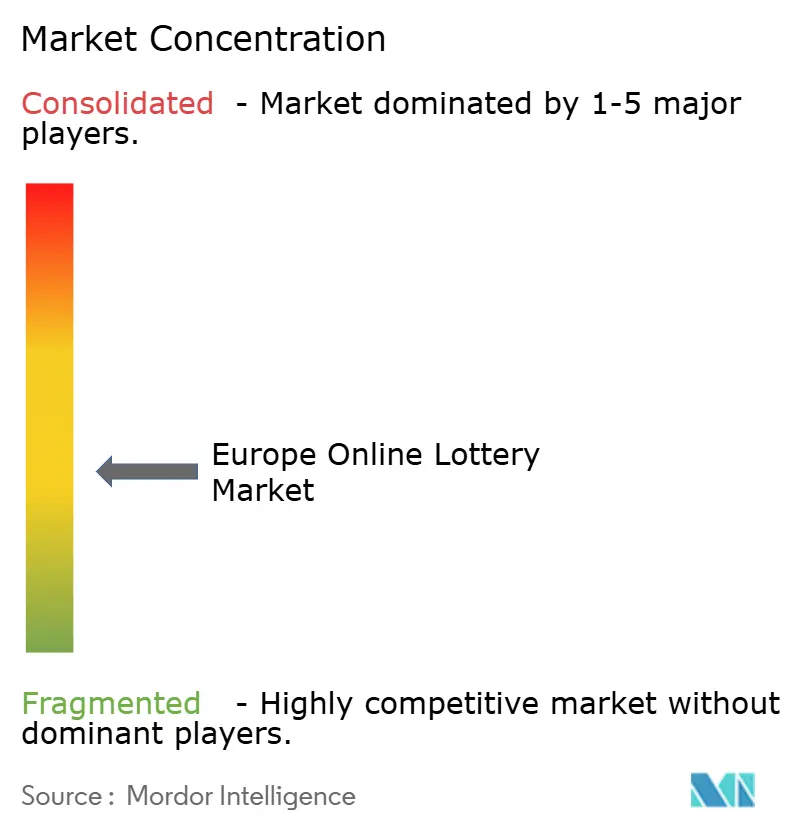
| Market Concentration | Medium |
Major Players *Disclaimer: Major Players sorted in no particular order Image © Mordor Intelligence. Reuse requires attribution under CC BY 4.0. | |
Europe Online Lottery Market Analysis by Mordor Intelligence
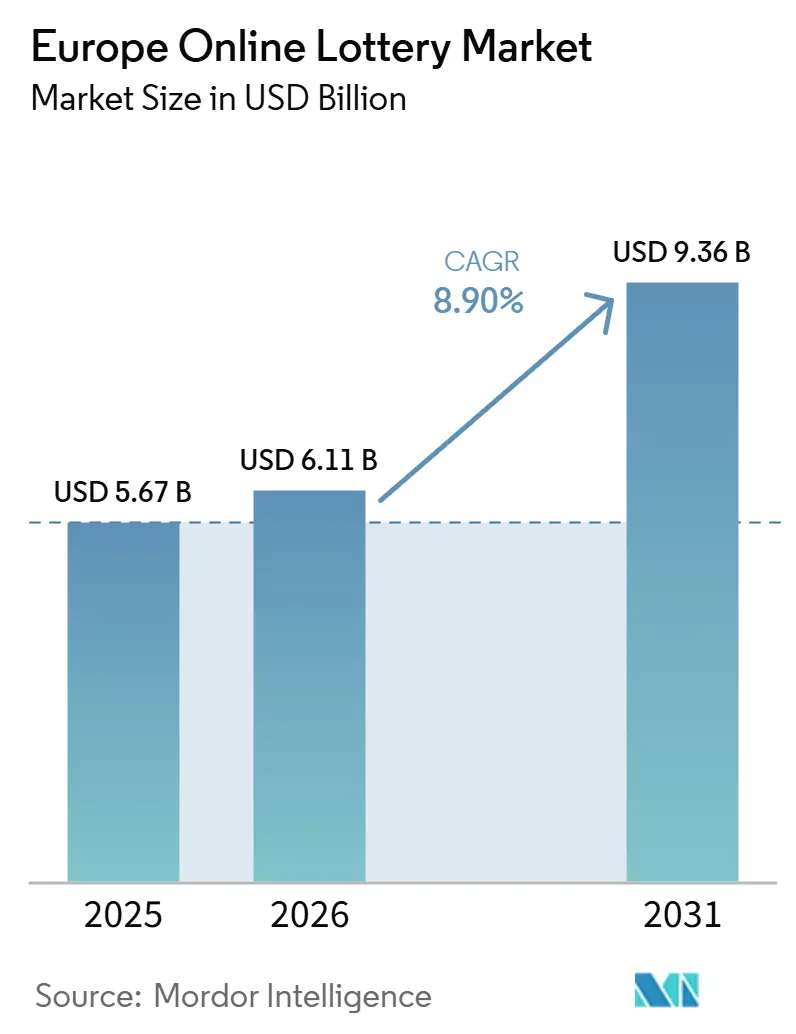
The Europe online lottery market size is projected to be USD 5.67 billion in 2025, USD 6.11 billion in 2026, and reach USD 9.36 billion by 2031, growing at a CAGR of 8.9% from 2026 to 2031. Digital lottery is taking a larger share of online gambling spend because established national operators are moving customers from retail channels to connected services. Online gross gaming revenue among European Lotteries members rose 19% to EUR 6.2 billion in 2024, while total lottery sales reached EUR 109.9 billion across 67 member organizations. Mobile participation, large jackpot cycles, easier payments, and timely results are making digital entry more routine for players. Operators are investing in mobile applications, account systems, payments, and responsible gaming controls because customer retention now depends on the quality of the digital service. The Europe online lottery market also faces higher compliance costs and separate national rules, which favor licensed operators with established technology and local market access.
Key Report Takeaways
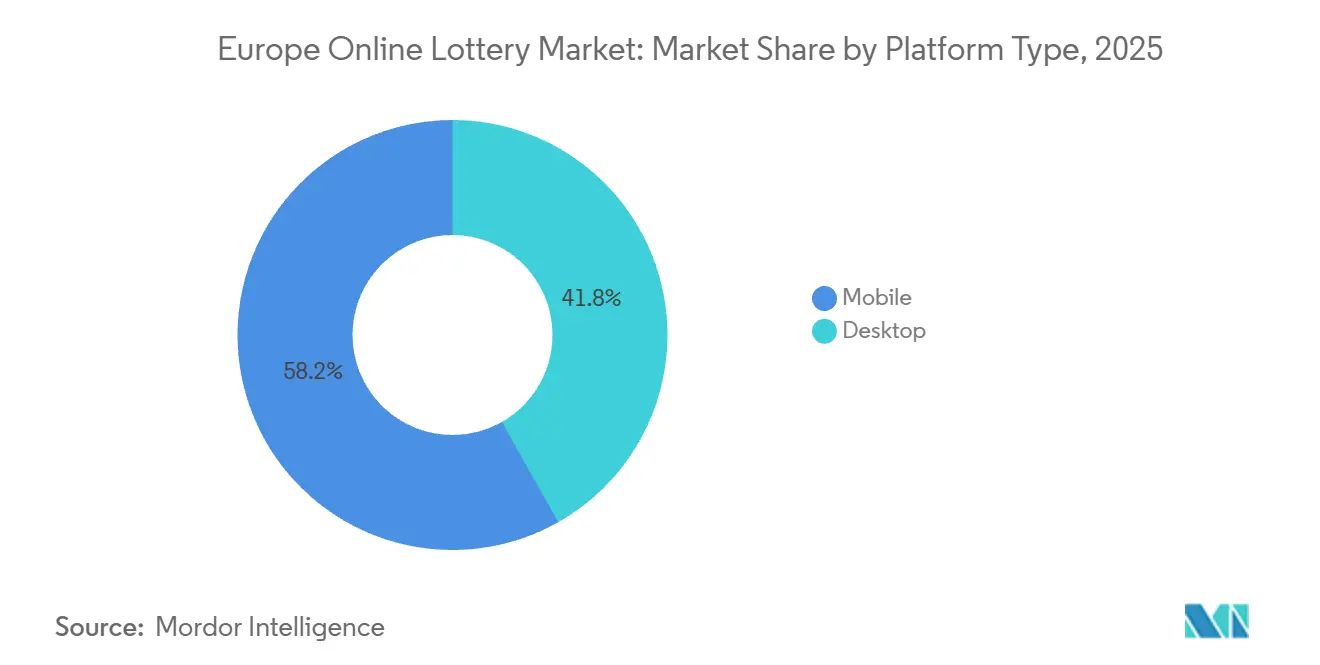
- By platform type, mobile held 58.2% of the Europe online lottery market share in 2025, while desktop is forecast to grow at a 10.2% CAGR through 2031.
- By game type, draw-based lottery held 55.3% of the Europe online lottery market share in 2025, while spots lottery is forecast to grow at a 9.7% CAGR through 2031.
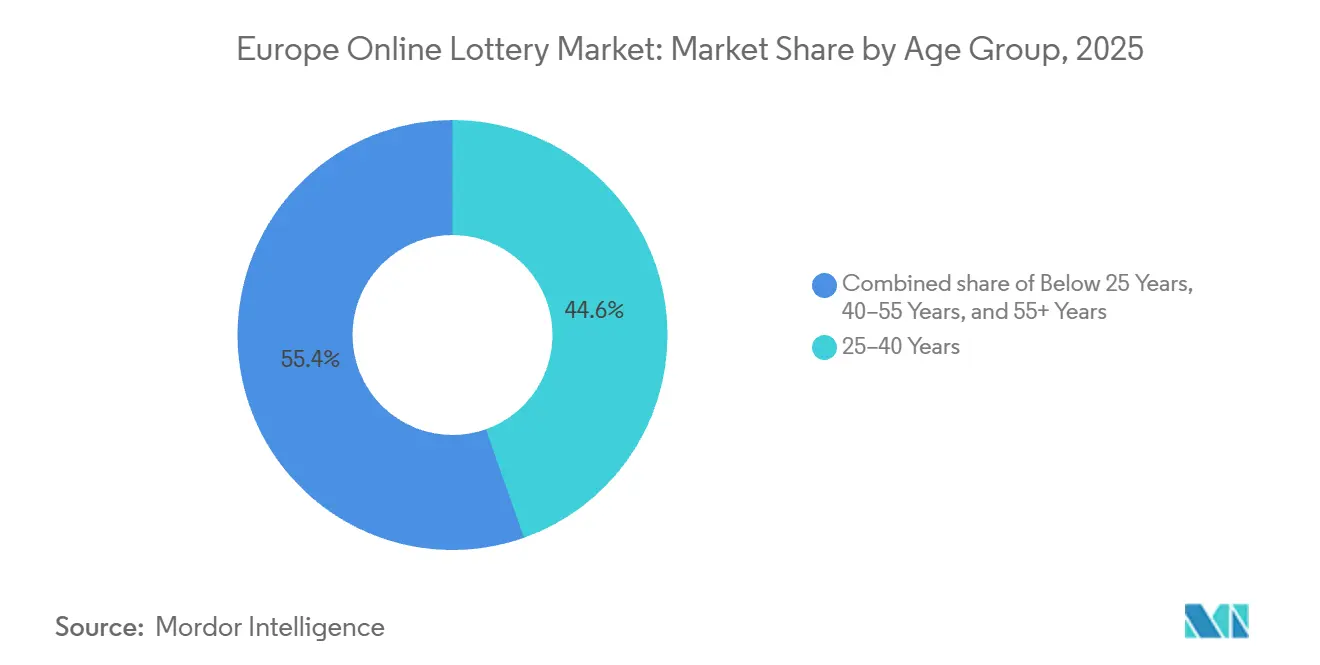
- By age group, the 25-40 years group held 44.6% of the share of the Europe online lottery market in 2025, while the 55+ years group is forecast to grow at a 10.8% CAGR through 2031.
- By end user, male players held 72.7% of the share of the Europe online lottery market in 2025, while female participation is forecast to grow at a 10.4% CAGR through 2031.
Note: Market size and forecast figures in this report are generated using Mordor Intelligence’s proprietary estimation framework, updated with the latest available data and insights as of January 2026.
Market Trends and Insights
Drivers Impact Analysis of Europe Online Lottery Market*
| Drivers | (~) % Impact on CAGR Forecast | Geographic Relevance | Impact Timeline |
|---|---|---|---|
| Rising Digital Platform Adoption | +2.5% | Pan-European, led by Germany, UK, Sweden | Medium term (2-4 years) |
| Popularity Of Draw-Based And Instant Games | +1.8% | Global | Short term (≤ 2 years) |
| Increased Consumer Convenience | +1.5% | Western and Northern Europe | Short term (≤ 2 years) |
| Younger-Generation Participation | +1.2% | Western Europe, Spain, Italy | Medium term (2-4 years) |
| Product Innovation And Broader Game Portfolios | +1.0% | Pan-European | Long term (≥ 4 years) |
| Better Digital Security And Encryption | +0.6% | EU-wide | Long term (≥ 4 years) |
| Source: Mordor Intelligence | |||
Rising Digital Platform Adoption
Digital infrastructure has become a central area of competition in the Europe online lottery market, as operators move beyond basic websites toward mobile-led and data-supported customer services that keep account activity, payments, and draw information in one place. Svenska Spel reported that online channels generated 67% of group revenue in the first half of 2026, compared with 62% in the first half of 2025. Its Luck business area recorded lottery revenue growth of 7% during the same period. These results explain why lottery operators are prioritizing mobile design, jackpot alerts, simplified payment journeys, and customer communication that does not depend solely on large draw events. Germany remains a major opening because online lottery penetration was 31% in 2025 despite a large retail customer base. ZEAL reported 1.558 million monthly active users in fiscal 2025, showing that product investment can support engagement even when jackpot conditions are less favorable.
Popularity Of Draw-Based And Instant Games
Draw-based games remain the commercial base of the Europe online lottery market, while instant products give operators more ways to retain customers between major draws and keep players active when jackpot interest declines. European Lotteries reported that instant game sales rose 6.1% and gross gaming revenue rose 5.9% in 2024. Instant games represented almost 29% of total lottery sales among its members that year. Faster-result products can maintain participation when draw-based jackpots are lower or less frequent, because they provide a result without waiting for the next scheduled draw. FDJ UNITED's medium-term plan includes a EUR 10 instant game for launch in 2027, alongside planned changes to Euromillions and Loto. European Lotteries also reported that sports game sales rose 12.9% and gross gaming revenue rose 9.1% in 2024, reinforcing demand for products with quicker feedback.
Increased Consumer Convenience
Convenient digital access is lowering the effort required to participate in the Europe online lottery market, particularly where players can use familiar payment methods and receive timely account information on a mobile device. The UK Gambling Commission found that 26% of adults bought National Lottery tickets online in the 4 weeks before its 2025 survey, compared with 16% who bought tickets in person[1]Source: UK Gambling Commission, “Great Britain Gambling Survey 2025”, casinos.com. Payment choices, stored account details, and draw notifications make the purchase journey easier for regular and occasional players without requiring a separate retail visit. Operators are also seeking to place lottery services within wider digital payment, loyalty, and subscription environments that customers already use. Allwyn migrated around 18 million UK National Lottery player accounts to a new platform in the first quarter of 2026, which shows the scale of infrastructure needed for a national digital service. Providers with dated payment flows or limited access options risk losing customers because the purchase process is less convenient.
Younger-Generation Participation
Younger adults use online lottery products as part of a broader digital entertainment mix in the Europe online lottery market, rather than treating lottery participation as a separate and occasional activity. The UK Gambling Commission reported that adults aged 25-34 had the highest cross-product online gambling participation at 35% in its 2025 survey, excluding lottery-only participants. This group has many competing options for entertainment and gambling spending, so product discovery and a clear user experience carry more weight. Spain's regulator reported that average annual spending by an active online gambling player increased from EUR 730 in 2024 to EUR 788 in 2025. Personalized jackpot alerts, group-play tools, social features, and low entry values can make lottery products more relevant to these customers. Traditional television-led jackpot advertising is less likely to reach players who discover products through mobile applications and digital services.
Restraints Impact Analysis of Europe Online Lottery Market*
| Restraint | (~) % Impact on CAGR Forecast | Geographic Relevance | Impact Timeline |
|---|---|---|---|
| Divergent National Gambling Laws | -1.5% | Pan-European | Long term (≥ 4 years) |
| Anti-Money Laundering And Fraud Controls | -1.2% | EU-wide, with acute near-term pressure in Germany, Netherlands, Spain | Medium term (2-4 years) |
| Geo-Blocking And IP-Based Access Restrictions | -0.8% | Germany, Netherlands, France | Medium term (2-4 years) |
| Competition From Illegal And Unlicensed Operators | -1.0% | Eastern Europe, Southern Europe | Short term (≤ 2 years) |
| Source: Mordor Intelligence | |||
Divergent National Gambling Laws
The Europe online lottery market is constrained by national licensing structures, product rules, taxes, and advertising standards that differ across countries. Gambling services remain outside the European Union's internal-market harmonization rules, so national restrictions and geo-blocking remain a lasting part of the operating environment. Operators must often maintain separate legal, technical, commercial, and customer-support arrangements for each country in which they operate. These requirements increase fixed costs even when operators use similar digital products and customer journeys in several markets. State monopolies in some markets also limit private operator entry into online lottery. The result is slower cross-border scaling and a greater advantage for operators with existing licenses, local infrastructure, and established relationships with national authorities.
Anti-Money Laundering And Fraud Controls
Anti-money laundering requirements will raise the compliance baseline for the Europe online lottery market. Regulation (EU) 2024/1624 introduces a single rulebook with customer due diligence for transactions of EUR 2,000 or more and financial penalties that can reach 10% of total annual turnover or EUR 10 million for serious non-compliance[2]Source: European Union, “Regulation (EU) 2024/1624 on the Prevention of the Use of the Financial System for Money Laundering or Terrorist Financing”, eur-lex.europa.eu. Operators must monitor deposits and prize payments because lottery tickets can be misused in schemes involving false prize claims, which requires attention on both entry and payout activity. Automated identity checks and transaction monitoring are therefore becoming essential parts of digital operations and not simply additional administrative processes. Smaller operators may face greater costs because lottery ticket values are generally low and the same controls must be applied across many transactions. This difference can encourage consolidation around established companies and technology providers that already have compliance systems.
*Our forecasts treat driver/restraint impacts as directional, not additive. The impact forecasts reflect baseline growth, mix effects, and variable interactions.
Europe Online Lottery Market Segment Analysis
By Platform Type:
Mobile Leads, Desktop Supports Higher-Value PlayMobile held 58.2% share of the Europe online lottery market in 2025. National operators have invested in application-based jackpot alerts, e-wallet integration, biometric login, and real-time results that make the service available throughout the day. These tools make it easier to enter draws and check outcomes without visiting a retail outlet, while also supporting repeated engagement between draws. ZEAL stated that around 85% of new customer acquisitions came through mobile channels in fiscal 2025, even during a less favorable jackpot period. Operators still need loyalty tools, instant games, and relevant messages to limit customer losses during quieter jackpot cycles.
Desktop is projected to expand at a 10.2% CAGR from 2026 to 2031. Larger screens can make detailed ticket selections, syndicate management, subscriptions, and multiple-entry review easier for players handling more complex entries. Desktop therefore remains important during large jackpot periods, even though mobile leads everyday participation. Allwyn's migration of around 18 million UK accounts to a cross-platform system in the first quarter of 2026 reflects the need to provide a consistent service across devices. The Europe online lottery industry is likely to retain both channels because they serve different parts of the player journey and different types of sessions.


By Game Type:
Draw-Based Lottery Leads, Spots Lottery Gains MomentumDraw-based lottery accounted for a 55.3% share of the Europe online lottery market in 2025. EuroJackpot, EuroMillions, and Lotto 6aus49 have strong recognition in established national lottery systems, where large jackpots can bring occasional retail customers into digital channels. European Lotteries recorded total lottery sales of EUR 109.9 billion in 2024 and identified draw-based products as the largest category by sales and gross gaming revenue. ZEAL reported EUR 1.1 billion in lottery billings in fiscal 2025, while lottery-specific revenue rose 16% to EUR 195.3 million. The established draw format consequently remains central to acquisition, brand recognition, and recurring operator revenue.
Spots lottery is forecast to grow at a 9.7% CAGR from 2026 to 2031. The format combines number selection with shorter draw cycles and faster result feedback, offering a familiar lottery proposition with a more immediate digital experience. It can appeal to customers who expect rapid outcomes and to older consumers moving from retail lottery play to online services. European Lotteries reported that sports game sales rose 12.9% in 2024, supporting the broader demand for faster-cycle lottery-related products. FDJ UNITED's planned 2027 program shows that large operators continue to develop quicker digital games alongside traditional draw products.
By Age Group:
25-40 Years Leads, 55+ Years Grows FastestThe 25-40 years group held 44.6% share of the Europe online lottery market in 2025. This cohort combines familiarity with digital services and meaningful discretionary spending capacity, so lottery use often sits alongside wider digital entertainment and gambling activity. The UK Gambling Commission reported that adults aged 25-34 had 35% cross-product online gambling participation in 2025, after excluding lottery-only participants. Loyalty programs, group-play features, and digital partnerships can support recurring engagement with this group. Operators also compete directly with sports betting and online casino products for the time and attention of these customers.
The Europe online lottery market size for the 55+ years group is forecast to advance at a 10.8% CAGR from 2026 to 2031. Older customers have a long-established connection with traditional lottery products, but their online conversion was slower because of access and digital skills barriers. The Spanish Banking Association and Cibervoluntarios Foundation trained more than 10,000 people aged 55 and over in digital tools across 30 provinces by 2025. Simpler onboarding, clear payment steps, and accessible application design can help players continue participation when retail access is less convenient. This group can add loyal and frequent participants to digital lottery services as confidence with smartphones increases.

By End User:
Male Players Lead, Female Participation Broadens DemandMale players accounted for 72.7% share of the Europe online lottery market in 2025. The result reflects the historical profile of lottery audiences and advertising that has often appeared around sports media, rather than a fixed limit on who may participate. Digital product design can reduce barriers that have limited broader participation through simpler checkouts, flexible payments, and shared-play features. The Europe online lottery industry can reach a wider audience when applications use clear navigation rather than legacy player assumptions. Operators can therefore improve participation without changing the underlying lottery proposition or the established draw experience.
Female participation is forecast to grow at a 10.4% CAGR from 2026 to 2031. Eurostat reported that 77.93% of EU adults aged 25-34 conducted online transactions in 2025, supporting easier access to digital services among adult users. Research published in Frontiers in Public Health linked productive digital engagement among adults aged 55-74 with economic participation across European countries. Small entry values, immediate-result products, and gifting tools can be useful where operators seek first-time digital participation. The faster growth rate supports continued attention to usability, product presentation, and accessible digital engagement for this customer group.
Geography Analysis
Germany Online Lottery Market
Germany held a 20.6% share of the Europe online lottery market in 2025. Online lottery penetration was 31% in 2025, compared with 60% in Norway and 45% in the UK, which indicates further room for digital conversion. ZEAL held around 44% of Germany's online lottery brokerage segment and reported fiscal 2025 revenue of EUR 218.5 million, up 16%, with 1.558 million monthly active users. Germany's large retail player base gives established brokers a considerable conversion opportunity, while local regulatory requirements favor operators with established capabilities.
Spain Online Lottery Market
Spain is forecast to grow at a 9.8% CAGR from 2026 to 2031, the highest rate among the geographies described in this Europe online lottery market assessment. Spain's regulated online gambling gross gaming revenue reached EUR 1.7 billion in 2025, up 16.99%, with 2.15 million active players. Reserved games and state lotteries generated EUR 5.1 billion in gross gaming revenue during the year, showing the scale of the country's established lottery base. Advertising restrictions increase customer-acquisition costs and strengthen the position of recognized state operators as online participation rises.
Broader European Markets
The UK, France, Italy, the Netherlands, Sweden, Belgium, Poland, and the Rest of Europe contribute substantial volume to the regional picture. Allwyn reported 3% net revenue growth in its UK business during the first quarter of 2026 and group online net gaming revenue of EUR 540 million, equal to 48% of total net gaming revenue. Svenska Spel reported 11% growth in its online sales channel in the first half of 2026, with Eurojackpot supporting lottery growth. Poland's state monopoly limits private online lottery entry despite growing consumer demand. Norway introduced DNS blocking of unlicensed gambling websites in 2025, reinforcing the regional focus on channeling play toward licensed services.
Competitive Landscape
The Europe online lottery market is moderately fragmented in nature. No operator holds pan-European pricing power, while state-linked incumbents retain strong positions in their home markets. Long lottery concessions, recognized national brands, local regulatory knowledge, and established retail networks create high entry barriers, especially where players prefer trusted national brands and familiar draw products. Allwyn is expected to complete its merger with OPAP in March 2026 to form Allwyn AG, a EUR 16 billion equity-value company operating across the United Kingdom, Austria, the Czech Republic, Italy, Greece, and Cyprus. The deal will expand its geographic reach, but national concessions and country-specific operating models will remain important.
Technology suppliers play a key role because operators depend on them for digital games, payment systems, account services, and secure back-end functions. Pollard Banknote is expected to begin work on a gaming-system contract for Belgium Lottery, with resource deployment set to increase during 2026. ZEAL has built proprietary charitable raffle products alongside its brokerage operations. Its Traumhausverlosung and Traumautoverlosung products recorded billings margins of around 43%, compared with 17.7% for brokered lottery products. This shows why operators are investing in differentiated products and modern platforms rather than relying only on licensed lottery distribution.
Compliance capability will increasingly shape competition ahead of the July 2027 AMLR application date. The rules will raise barriers for new entrants and smaller operators that lack automated identity and transaction-monitoring tools. ZEAL agreed in July 2026 to acquire the remaining 96.5% of SevenCanyon Limited for an initial GBP 33.8 million, with an earnout of up to GBP 4.8 million, to expand in the UK digital prize-draw segment. FDJ UNITED's 2026-2028 plan includes product changes and a new instant game, while Allwyn is widening its cross-country operating base. However, national rules on licenses, products, advertising, and customer access will keep the market less concentrated than a single European platform market.
Europe Online Lottery Industry Leaders
Allwyn International AG
FDJ UNITED
ZEAL Network SE
Sisal S.p.A.
Lottomatica S.p.A.
- *Disclaimer: Major Players sorted in no particular order
Europe Online Lottery Market Companies Covered in this Report
- FDJ UNITED
- Allwyn International AG
- ZEAL Network SE
- Sisal S.p.A.
- Lottomatica S.p.A.
- INTRALOT S.A.
- International Game Technology PLC
- Scientific Games Holdings LLC
- NeoGames S.A.
- Pollard Banknote Limited
- Lottoland Holdings Limited
- Premier Lotteries Ireland DAC
- Nederlandse Loterij Organisatie B.V.
- Svenska Spel AB
- Norsk Tipping AS
- Danske Spil A/S
- Veikkaus Oy
- OPAP S.A.
- Österreichische Lotterien GmbH
- Lotto24 GmbH

Recent Industry Developments in Europe Online Lottery Market
- July 2026: ZEAL Network SE agreed to acquire the remaining 96.5% of UK prize draw operator SevenCanyon Limited for an initial cash payment of GBP 33.8 million, plus an earnout of up to GBP 4.8 million, entering the UK digital prize draw market through SevenCanyon's established platforms, including 7days Performance, Redline Competitions, and UK Carp Competitions, and extending ZEAL's footprint beyond German online lottery into the broader British digital gaming ecosystem.
- April 2026: ZEAL Network SE launched its third proprietary charity lottery, Traumautoverlosung, through wholly owned nonprofit subsidiary Dreamify gGmbH, building on the EUR 38.9 million generated by the Traumhausverlosung real estate raffle format in fiscal 2025 and expanding its high-margin proprietary product portfolio.
- March 2026: Allwyn International AG completed its merger with OPAP S.A. to form Allwyn AG, valued at EUR 16 billion and listed on the Athens Stock Exchange under the ticker ALWN, creating the second-largest listed lottery and gaming operator globally and combining Allwyn's UK, Austrian, Czech, and Italian lottery portfolio with OPAP's Greek and Cypriot operation.


Europe Online Lottery Market Report Scope
| Desktop |
| Mobile |
| Draw-based Lottery |
| Instant Lottery |
| Spots Lottery |
| Others |
| Below 25 Years |
| 25–40 Years |
| 40–55 Years |
| 55+ Years |
| Male |
| Female |
| Germany |
| United Kingdom |
| Italy |
| France |
| Spain |
| Netherlands |
| Poland |
| Belgium |
| Sweden |
| Rest of Europe |
| By Platform Type | Desktop |
| Mobile | |
| By Game Type | Draw-based Lottery |
| Instant Lottery | |
| Spots Lottery | |
| Others | |
| By Age Group | Below 25 Years |
| 25–40 Years | |
| 40–55 Years | |
| 55+ Years | |
| By End User | Male |
| Female | |
| By Geography | Germany |
| United Kingdom | |
| Italy | |
| France | |
| Spain | |
| Netherlands | |
| Poland | |
| Belgium | |
| Sweden | |
| Rest of Europe |


Key Questions Answered in the Report
What is the expected value of the Europe online lottery market by 2031?
The Europe online lottery market is forecast to reach USD 9.36 billion by 2031, growing at an 8.9% CAGR from 2026.
Which platform has the largest share of online lottery participation in Europe?
Mobile led with 58.2% share in 2025, supported by alerts, mobile payments, and real-time results.
Which game type leads digital lottery revenue in Europe?
Draw-based lottery led with 55.3% share in 2025, supported by established formats such as EuroJackpot and EuroMillions.
Which customer age group is growing fastest in European digital lottery?
The 55+ years group is forecast to grow at a 10.8% CAGR through 2031 as digital skills and smartphone use expand.
Page last updated on:





