
Europe Metal Forming Equipment Market Size and Share
Market Overview
| Study Period | 2020 - 2031 |
|---|---|
| Forecast Data Period | 2026 - 2031 |
| Base Year Market Size (2025) | USD 7.24 Billion |
| Market Size (2026) | USD 7.58 Billion |
| Market Size (2031) | USD 9.27 Billion |
| Growth Rate (2026 - 2031) | 4.09 % |
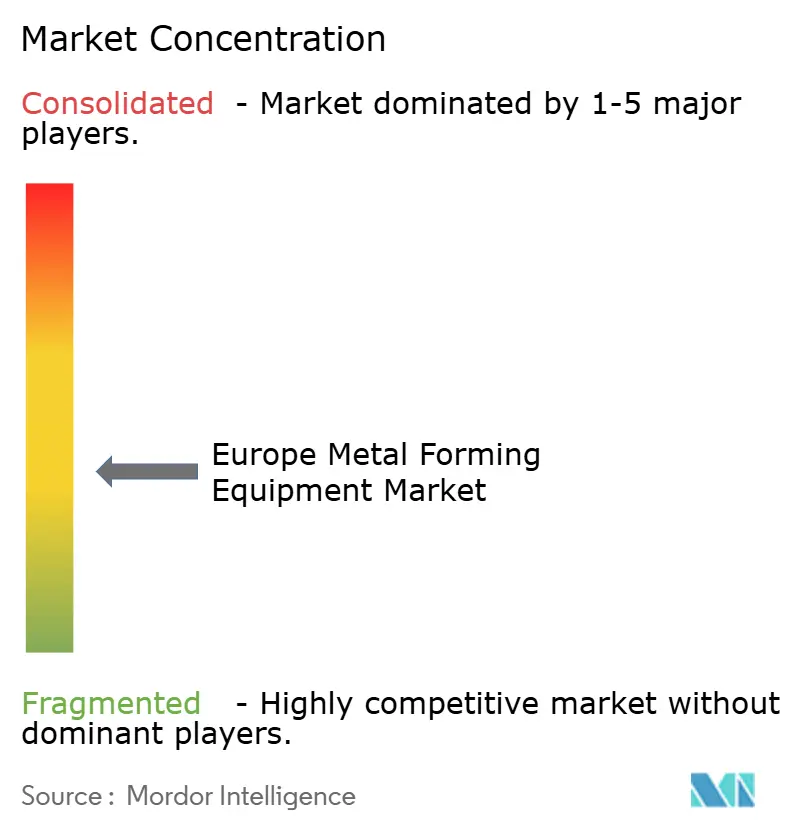
| Market Concentration | Medium |
Major Players *Disclaimer: Major Players sorted in no particular order Image © Mordor Intelligence. Reuse requires attribution under CC BY 4.0. | |
Europe Metal Forming Equipment Market Analysis by Mordor Intelligence
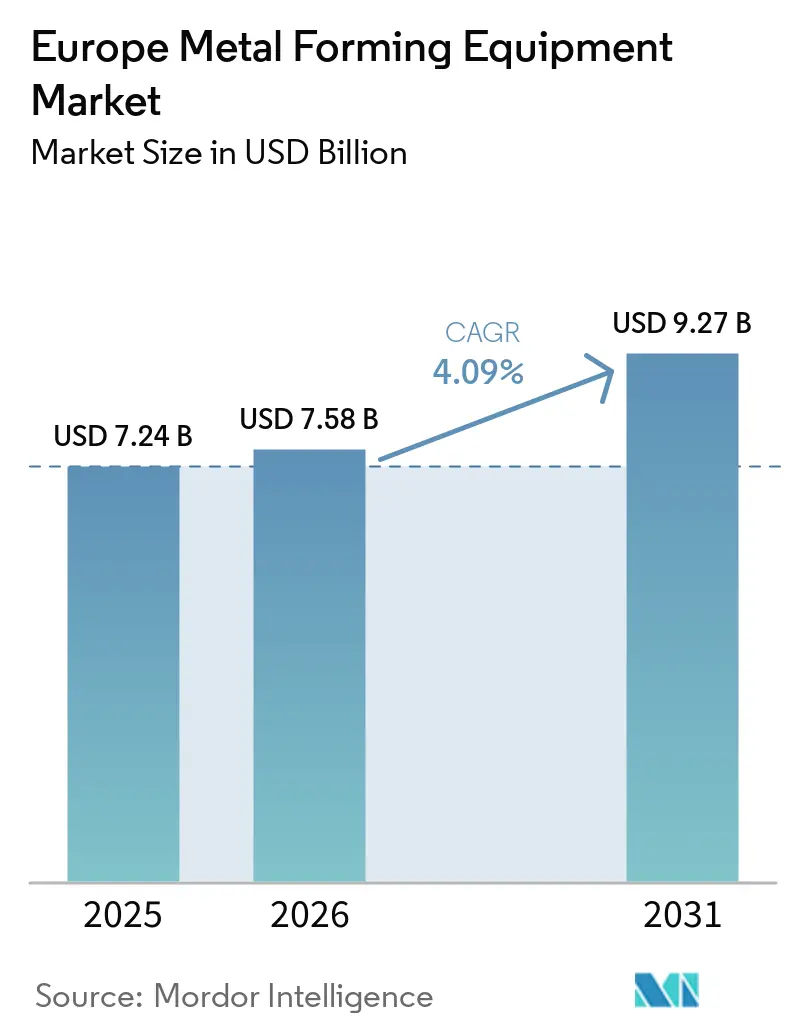
The Europe metal forming equipment market size was USD 7.24 billion in 2025 and is projected to grow from USD 7.58 billion in 2026 to reach USD 9.27 billion by 2031, growing at a CAGR of 4.09% from 2026 to 2031.
Demand is supported by the retooling of press shops for electrified vehicle platforms, higher defense procurement, and industrial capacity investment closer to European end markets. Investment is extending across large-tonnage press upgrades in Germany and Spain, precision forging capacity in Poland and the Czech Republic, and flexible bending cells in Italy and France. Servo-electric equipment is becoming more important because it combines lower energy use with the controls needed for connected production environments. This shift gives suppliers an opportunity to serve both new facilities and installed bases that need modern controls, energy recovery, and traceability functions.
Key Report Takeaways
- By equipment type, press machines held 43.5% of the Europe metal forming equipment market share in 2025, while servo presses are forecast to grow at a 6.1% CAGR through 2031.
- By forming process, stamping and punching held 32.5% of the Europe metal forming equipment market size in 2025, while hydroforming is forecast to grow at a 5.8% CAGR through 2031.
- By material formed, carbon and low-alloy steel held 44.5% of the Europe metal forming equipment market share in 2025, while aluminum and aluminum alloys are forecast to grow at a 6% CAGR through 2031.
- By end-use industry, automotive and transportation held 34.5% of the Europe metal forming equipment market size in 2025, while aerospace and defense are forecast to grow at a 5.9% CAGR through 2031.
- By geography, Germany held 26.9% of the Europe metal forming equipment market share in 2025, while Poland is forecast to grow at a 5.7% CAGR through 2031.
Note: Market size and forecast figures in this report are generated using Mordor Intelligence’s proprietary estimation framework, updated with the latest available data and insights as of January 2026.
Europe Metal Forming Equipment Market Trends and Insights
Drivers Impact Analysis*
| Driver | (~) % Impact on CAGR Forecast | Geographic Relevance | Impact Timeline |
|---|---|---|---|
| Electric Vehicle, Battery, and Lightweight-Component Manufacturing | +1.2% | Germany, Spain, France, Hungary, Slovakia | Medium term (2-4 years) |
| Industry 4.0, Robotics and Connected Press Shops | +0.9% | Germany, Italy, Sweden, Austria | Medium term (2-4 years) |
| Aerospace, Defense, and Renewable-Energy Manufacturing | +0.7% | France, United Kingdom, Germany, Poland, Czech Republic | Short term (≤ 2 years) |
| European Nearshoring and Industrial Resilience Investment | +0.5% | Germany, Netherlands, Poland, Romania, Spain | Medium term (2-4 years) |
| Retrofit Demand from Aging Hydraulic and Mechanical Press Fleets | +0.3% | Germany, Italy, France, the United Kingdom | Short term (≤ 2 years) |
| Digital Traceability Requirements for High-Value Formed Components | +0.2% | Global, with early adoption in Germany, Italy, and France | Long term (≥ 4 years) |
| Source: Mordor Intelligence | |||
Electric Vehicle, Battery, and Lightweight-Component Manufacturing
Battery enclosure production needs deep-draw and servo transfer presses that can hold wall planarity deviations within ±0.2 mm. Conventional hydraulic lines cannot consistently maintain those tolerances at high production speeds. Aluminum body-in-white stampings also need equipment that can manage springback in high-strength alloys. The European Commission Innovation Fund provided EUR 852 million (USD 1,002.2 million) for 6 battery manufacturing projects, supporting 56 GWh of annual capacity additions and an estimated 91 million tons of lifetime CO₂ reduction. ANDRITZ Schuler commissioned a 1.5 GW, 22-meter automated line for cylindrical EV booster cells for a German premium automaker in January 2026. The project places the Europe metal forming equipment market closer to battery production infrastructure as vehicle manufacturers expand electrified platforms.
Industry 4.0, Robotics and Connected Press Shops
European press shops increased their use of in-die sensors, vision inspection, and connected predictive maintenance systems during 2025. OEM traceability requirements and the cost of preventing die damage support this equipment investment. ANDRITZ Schuler uses its Metris Visual Die Protection system at the Smart Press Shop joint venture with Porsche in Halle, where cameras and real-time image processing identify foreign objects, cracks, and scrap accumulation before tools are damaged. A survey of more than 300 machine builders found that 79% considered skills shortages to have a significant or very significant operational impact. Automation can reduce reliance on controls engineers during startup and changeovers. Connected equipment also supports software and data services that strengthen supplier relationships across the Europe metal forming equipment market.
Aerospace, Defense, and Renewable-Energy Manufacturing
European defense expenditure reached EUR 381 billion (USD 448.2 billion) in 2025, with equipment procurement exceeding EUR 88 billion (USD 103.5 billion).[1]European Parliament Research Service, “European Defence Industry,” European Parliament, europarl.europa.eu This spending supports demand for precision tube forming, titanium forging, and structural sheet metal equipment across major defense supply chains. MBDA has announced a EUR 5 billion (USD 5.9 billion) investment program for 2026 to 2030 and targeted a 40% rise in missile production during 2026. The program indicates a multi-year requirement for qualified forming capacity. Thales planned EUR 830 million (USD 976.3 million) to EUR 850 million (USD 999.9 million) in capital expenditure during 2026 across radar, effector, and sonar sites in France, Germany, Belgium, and the Netherlands. Wind tower flanges and solar mounting structures add demand for plate rolling and heavy presses, widening the Europe metal forming equipment market beyond conventional industrial applications.
European Nearshoring and Industrial Resilience Investment
Supply-chain reconfiguration is shifting equipment demand toward Central and Eastern Europe. Eurostat reported that 29.2% of EU enterprises engaged in nearshoring during 2024, exceeding farshoring rates in every member state.[2]Eurostat, “Global Value Chain Disruptions and Enterprise Responses in the EU,” Eurostat Statistics Explained, ec.europa.eu Pratt & Whitney is investing USD 25 million to expand precision tubular assembly production in Niepołomice, Poland, alongside a USD 100 million investment in isothermal forging upgrades in Rzeszów. These sites require forging presses, tube bending, and precision stamping equipment from local or nearby suppliers. Aging hydraulic and mechanical fleets create a separate retrofit requirement in established manufacturing centers. The Europe metal forming equipment market can therefore benefit from new capacity in the east and modernization activity in Germany, Italy, France, and the United Kingdom.
Restraints Impact Analysis*
| Restraint | (~) % Impact on CAGR Forecast | Geographic Relevance | Impact Timeline |
|---|---|---|---|
| Energy-Price Volatility and Carbon-Compliance Costs | -0.7% | Germany, Italy, France, the United Kingdom, and energy-intensive forming hubs | Short term (≤ 2 years) |
| High Capital Costs and Delayed SME Investment | -0.5% | All EU markets, acute in Central and Southern Europe | Medium term (2-4 years) |
| Skilled-Operator and Controls-Engineering Shortages | -0.3% | Germany, Netherlands, Belgium, Nordics | Medium term (2-4 years) |
| Dependence on Imported Motion-Control and Precision Components | -0.2% | Germany, Italy, exposure to Japan- and Taiwan-sourced drives | Long term (≥ 4 years) |
| Source: Mordor Intelligence | |||
Energy-Price Volatility and Carbon-Compliance Costs
Energy costs remain a direct concern for European forming operations and their capital spending decisions. The European Commission reported that industrial electricity and gas prices in the EU remained 2 to 4 times higher than those of the bloc’s principal trading partners, despite falling below their 2022 and 2023 peaks.[3]European Commission, “Report on Energy Prices and Costs in Europe,” EUR-Lex, eur-lex.europa.eu The cost difference weakens returns from hot forging, aluminum extrusion, and conventional hydraulic presses. Emissions Trading System allowance costs also weigh on operators using older equipment without energy-recovery drives. Larger Tier 1 suppliers can justify servo-electric upgrades that cut electricity consumption by 70% to 85% per cycle. Smaller fabricators often delay replacement decisions because energy-price volatility makes the payback period less predictable in the Europe metal forming equipment market.
High Capital Costs, Skills Gaps, and Imported Component Exposure
Small and medium-sized fabricators face high acquisition costs for modern servo presses and automated bending cells. Such equipment can carry list prices 40% to 80% above the hydraulic systems it replaces. The European Investment Bank found that 19% of EU importing firms diversified sourcing as a resilience measure while facing constrained domestic capital expenditure, particularly among manufacturers with fewer than 250 employees.[4]European Investment Bank, “EIB Investment Survey 2025,” European Investment Bank, eib.org Retrofit packages costing 30% to 50% of a new machine provide a lower-cost alternative but reduce revenue per new equipment sale. Skills shortages extend commissioning timelines, while dependence on imported motion-control and precision components exposes manufacturers to supply constraints. These factors sustain a two-speed pattern in the Europe metal forming equipment market, where larger suppliers modernize while mid-sized firms defer complete line replacement.
*Our forecasts treat driver/restraint impacts as directional, not additive. The impact forecasts reflect baseline growth, mix effects, and variable interactions.
Segment Analysis
By Equipment Type: Press Machines Lead Demand While Servo Presses Grow Fastest
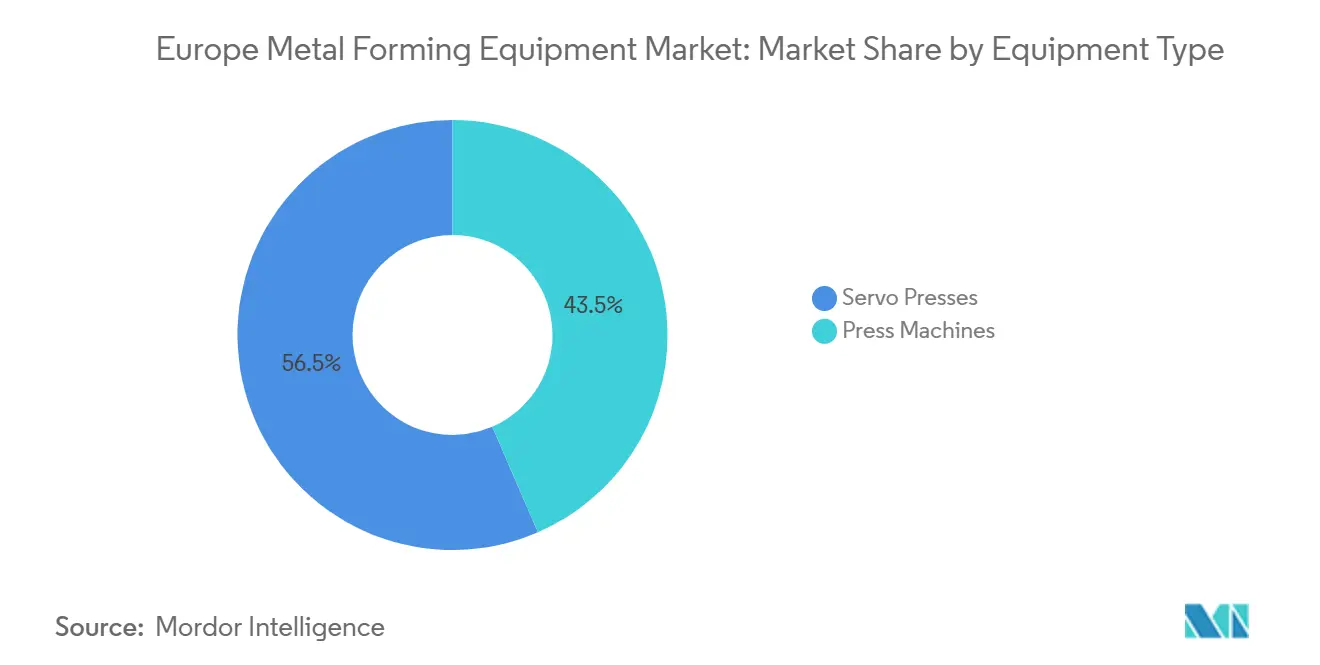
Press machines accounted for 43.5% of the Europe metal forming equipment market share in 2025. Their installed base serves automotive stamping, appliance production, and structural fabrication. Their lower energy use and compatibility with in-die sensors support a faster pace. ANDRITZ Schuler introduced next-generation HFA fineblanking presses in January 2026 with servo-controlled hydraulic pump drives and double-digit energy-efficiency improvements.
Servo presses are forecast to grow at a 6.1% CAGR from 2026 to 2031. The launch shows that established hydraulic equipment is being upgraded with electrified controls rather than being replaced in every application. This approach can retain the mechanical value of a press while improving its operating profile and data capabilities. MSV Metal Studénka launched a CZK 280 million robotic forging line in May 2025, increasing annual capacity from 14,000 tons to more than 18,000 tons. Breitenfeld Edelstahl commissioned a new 40MN forging press in 2026. These projects show continued demand for heavy-duty systems alongside more flexible press technologies. They also demonstrate that investment decisions differ by component size, production volume, and the material being formed. The Europe metal forming equipment market continues to reward suppliers that combine equipment durability, automation, and lower operating costs.


By Forming Process: Stamping Holds Volume While Hydroforming Leads Growth
Stamping and punching held 32.5% of the Europe metal forming equipment market size in 2025. Automotive producers rely on high-speed sheet metal stamping for body panels and structural closures. The process supports hollow components with complex geometries, including drive shafts, instrument panel carriers, and aircraft sub-frame tubes. It also delivers wall-thickness uniformity that multi-step stamping cannot reproduce.
Hydroforming is forecast to grow at a 5.8% CAGR between 2026 and 2031. Servo-electric bending systems can reduce energy use by 70% to 85% per cycle compared with hydraulic alternatives. Fraunhofer IWU modernized its hydroforming test facility in Chemnitz in October 2025 to reduce energy costs. This focus reflects the operational pressure on high-pressure forming equipment. Demand is moving toward precision processes for EV and aerospace applications. That movement raises the equipment value required for each unit of metal processed in the Europe metal forming equipment market. Buyers increasingly assess process capability and quality control alongside nominal throughput.
By Material Formed: Carbon Steel Retains Scale While Aluminum Gains Momentum
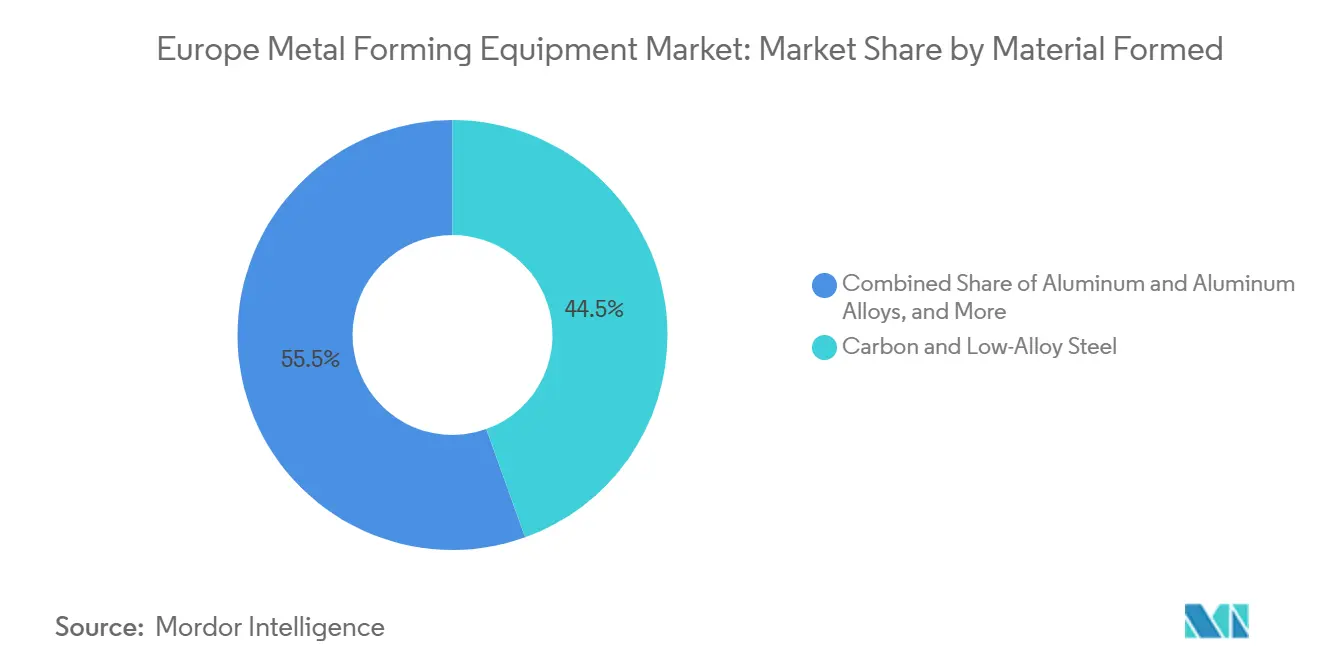
Carbon and low-alloy steel retained 44.5% of the Europe metal forming equipment market share in 2025. Structural fabrication, construction, and industrial machinery supported its use. Battery enclosures, floor pans, and cooling plates require aluminum alloys that can be formed under controlled temperature conditions. The installed equipment base in Europe remains largely configured for ferrous materials. This configuration shapes replacement choices and slows the full transition toward equipment optimized only for light alloys.
Aluminum and aluminum alloys are forecast to grow at a 6% CAGR through 2031. That base preserves carbon steel’s importance even as aluminum gains use in EV and aerospace programs. Titanium, nickel, and other non-ferrous metals are also used in aerospace and defense applications. Pratt & Whitney’s investment in Poland illustrates the tubular assembly demand associated with nickel-superalloy applications. Stainless steel supports food processing, medical, and pharmaceutical manufacturing. These applications increasingly specify oil-free servo-electric forming because of production and quality requirements. The Europe metal forming equipment industry must therefore support a wider material mix without losing the productivity needed for steel-based volume production.
By End-Use Industry: Automotive Leads While Aerospace and Defense Accelerate
Automotive and transportation accounted for 34.5% of the Europe metal forming equipment market size in 2025. Investment in combustion-engine-related forming declined during 2025. EV-specific equipment for battery enclosures, aluminum body structures, and e-motor laminations expanded. Safran announced a EUR 50 million (USD 58.8 million) investment in a new defense equipment facility in Ludwigsburg, Germany, that is planned to be operational by early 2028.
Aerospace and defense are forecast to grow at a 5.9% CAGR from 2026 to 2031. The facility is intended to create 200 jobs across engineering, production, and quality functions. MBDA’s planned investment program also indicates continuing requirements for tube forming, titanium forming, and structural stamping. Metal products and fabrication companies across the Benelux continue to consume press brakes and roll-forming equipment. Energy and power applications include wind turbine components and solar structures. Medical and precision manufacturers also require oil-free servo-electric systems, broadening the Europe metal forming equipment market beyond its automotive base. These applications emphasize cleanliness, repeatability, and controlled production conditions.
Geography Analysis
Germany held 26.9% of the Europe metal forming equipment market size in 2025. Its position rests on a dense automotive OEM and Tier 1 supplier base and an established automation ecosystem. ANDRITZ reported a group order backlog of EUR 12.6 billion (USD 14.8 billion) in the first half of 2026, 20.5% higher than at year-end 2025. The company also announced planned reductions of 500 jobs at Schuler’s German operations because conventional automotive press demand was weaker. The contrast points to pressure on legacy hydraulic press supply alongside continuing orders for EV-related servo equipment.
Poland is forecast to record the fastest regional CAGR at 5.7% from 2026 to 2031. Aerospace, defense, and automotive supply-chain investment supports this growth. Pratt & Whitney’s investments in Niepołomice and Rzeszów signal increased demand for precision tubular assembly and isothermal forging capacity. MSV Metal Studénka’s robotic forging line in the Czech Republic and a new Diehl Aviation components plant in Romania indicate that the Rest of Europe is absorbing more equipment capital expenditure.
France and the United Kingdom remain major markets because their aerospace and defense clusters require specialized forming capacity. Italy is both a major equipment consumer and a center for forming technology supply. Prima Power, Salvagnini, Faccin, Gasparini, LVD, and BLM GROUP form an important regional cluster for press, bending, and related technologies. Private investment in Faccin during October 2025 reflected continued interest in precision plate-rolling and bending assets serving energy and defense-linked customers. Spain’s demand is increasingly connected with EV manufacturing, including SEAT’s EUR 10 billion (USD 11.8 billion) Future: Fast Forward electrification program and its Martorell PXL press installation during October 2025. Austria hosts ANDRITZ’s global headquarters and remains a key engineering base for the Europe metal forming equipment market.
Competitive Landscape
The Europe metal forming equipment market is moderately fragmented. Large integrated suppliers lead high-tonnage press and bending automation, while specialists serve forging, roll forming, and precision bending applications. ANDRITZ Schuler, TRUMPF, and AMADA defend their positions through servo-electric systems and digital integration. Prima Power and Salvagnini differentiate through panel bending and flexible sheet metal cells. The competitive focus in 2025 and 2026 includes energy efficiency, in-die sensing, predictive maintenance, and retrofit support.
ANDRITZ Schuler moved toward a general contractor model for turnkey HFA fineblanking systems in January 2026. Its servo-driven configuration delivered double-digit energy-efficiency improvements. The company also commissioned a battery-cell mass formation line for a German premium automaker, extending its role beyond conventional body shell press supply. Prima Power announced its EuroBLECH 2026 presence with flexible manufacturing systems that integrate bending, laser, and punching operations. These moves combine individual machines with broader production systems, controls, and related services.
Retrofit-as-a-service remains an opening for customers with early-2000s hydraulic presses that are mechanically sound but lack servo controls and connectivity. Such retrofits can cost 30% to 50% of a new machine and fit SME capital constraints more closely than full replacement. Battery-enclosure cells that combine progressive stamping, laser trimming, and vision inspection remain an emerging category without a clear European leader.
Europe Metal Forming Equipment Industry Leaders
ANDRITZ Schuler Group
TRUMPF SE + Co. KG
AMADA Co., Ltd.
Bystronic AG
Fagor Arrasate S. Coop.
- *Disclaimer: Major Players sorted in no particular order

Recent Industry Developments
- September 2026: Pratt & Whitney invested USD 25 million to expand precision tubular assembly manufacturing in Niepołomice, Poland, to become operational in 2028 and create over 120 jobs. The investment supports commercial and military engine demand. It complements a concurrent USD 100 million upgrade at Rzeszów for isothermal forging of GTF, F135, and F100 engine parts, reinforcing Poland’s role as a high-precision aerospace forming hub.
- June 2026: Safran Electronics & Defense announced a EUR 50 million (USD 58.8 million) investment in a new defense equipment facility in Ludwigsburg, Germany. The site is planned to create 200 jobs across engineering, production, and quality functions and become operational by early 2028.
- January 2026: ANDRITZ Schuler commissioned a 1.5 GW battery cell mass formation line for a German premium automaker. The 22-meter automated system produces cylindrical EV booster cells and extends the company’s role in gigafactory production equipment.
- January 2026: ANDRITZ Schuler and Feintool introduced HFA fineblanking presses with servo-controlled hydraulic pump drives, double-digit energy-efficiency improvements, and higher stroke rates. ANDRITZ Schuler supplies the systems as turnkey installations.


Europe Metal Forming Equipment Market Report Scope
| Press Machines | Mechanical Presses |
| Hydraulic Presses | |
| Servo Presses | |
| Other General-Purpose Presses | |
| Press Brakes and Bending Machines | Hydraulic Press Brakes |
| Servo / Electric Press Brakes | |
| Mechanical Press Brakes | |
| Other Bending Machines | |
| Forging Equipment | Forging Presses |
| Forging Hammers | |
| Upsetting and Heading Machines | |
| Other Forging Equipment | |
| Roll Forming and Plate/Profile Rolling Equipment | Roll Forming Machines |
| Plate Rolling Machines | |
| Section and Profile Rolling Machines | |
| Other Secondary Rolling/Forming Equipment | |
| Wire, Tube and Profile Forming Equipment | Wire and Bar Drawing/Forming Equipment |
| Tube Forming and Bending Equipment | |
| Profile Forming Equipment | |
| Extrusion Presses | |
| Hydroforming Equipment | |
| Other Metal Forming Equipment |
| Stamping and Punching |
| Deep Drawing |
| Bending |
| Forging |
| Rolling and Roll Forming |
| Extrusion |
| Hydroforming |
| Other Forming Processes |
| Carbon and Low-Alloy Steel |
| Stainless Steel |
| Aluminum and Aluminum Alloys |
| Copper and Copper Alloys |
| Titanium, Nickel and Other Non-Ferrous Metals |
| Other Materials |
| Automotive and Transportation |
| Aerospace and Defense |
| Industrial Machinery and Capital Equipment |
| Metal Products and Fabrication |
| Electrical and Electronics |
| Construction and Infrastructure |
| Energy and Power |
| Consumer Appliances and Durable Goods |
| Medical and Precision Manufacturing |
| Other End-Use Industries |
| Germany |
| Italy |
| France |
| Spain |
| Austria |
| United Kingdom |
| Rest of Europe |
| By Equipment Type | Press Machines | Mechanical Presses |
| Hydraulic Presses | ||
| Servo Presses | ||
| Other General-Purpose Presses | ||
| Press Brakes and Bending Machines | Hydraulic Press Brakes | |
| Servo / Electric Press Brakes | ||
| Mechanical Press Brakes | ||
| Other Bending Machines | ||
| Forging Equipment | Forging Presses | |
| Forging Hammers | ||
| Upsetting and Heading Machines | ||
| Other Forging Equipment | ||
| Roll Forming and Plate/Profile Rolling Equipment | Roll Forming Machines | |
| Plate Rolling Machines | ||
| Section and Profile Rolling Machines | ||
| Other Secondary Rolling/Forming Equipment | ||
| Wire, Tube and Profile Forming Equipment | Wire and Bar Drawing/Forming Equipment | |
| Tube Forming and Bending Equipment | ||
| Profile Forming Equipment | ||
| Extrusion Presses | ||
| Hydroforming Equipment | ||
| Other Metal Forming Equipment | ||
| By Forming Process | Stamping and Punching | |
| Deep Drawing | ||
| Bending | ||
| Forging | ||
| Rolling and Roll Forming | ||
| Extrusion | ||
| Hydroforming | ||
| Other Forming Processes | ||
| By Material Formed | Carbon and Low-Alloy Steel | |
| Stainless Steel | ||
| Aluminum and Aluminum Alloys | ||
| Copper and Copper Alloys | ||
| Titanium, Nickel and Other Non-Ferrous Metals | ||
| Other Materials | ||
| By End-Use Industry | Automotive and Transportation | |
| Aerospace and Defense | ||
| Industrial Machinery and Capital Equipment | ||
| Metal Products and Fabrication | ||
| Electrical and Electronics | ||
| Construction and Infrastructure | ||
| Energy and Power | ||
| Consumer Appliances and Durable Goods | ||
| Medical and Precision Manufacturing | ||
| Other End-Use Industries | ||
| By Geography | Germany | |
| Italy | ||
| France | ||
| Spain | ||
| Austria | ||
| United Kingdom | ||
| Rest of Europe | ||


Key Questions Answered in the Report
Which equipment type leads demand in Europe?
Press machines led with 43.5% share in 2025, while servo presses are expected to record the fastest growth at 6.1% CAGR through 2031.
Why are servo presses gaining adoption?
Servo presses support lower electricity use, connected controls, and in-die sensor networks for demanding production environments. These features are important where manufacturers need better traceability, lower energy consumption, and reliable process control.
Which forming process is expected to grow the fastest?
Hydroforming is forecast to grow at a 5.8% CAGR through 2031 because it supports complex hollow components with controlled wall thickness. Automotive lightweighting and aerospace assemblies support the need for this process capability.
Which country is expected to grow fastest through 2031?
Poland is forecast to record a 5.7% CAGR, supported by aerospace, defense, and automotive supply-chain investment. Precision tubular assembly and isothermal forging projects are contributing to the demand for local forming capacity.
What limits investment in new metal forming equipment?
High energy prices, high equipment costs, skills gaps, and reliance on imported motion-control components can delay replacement decisions. These conditions encourage many smaller fabricators to prioritize retrofits over full-line replacements.
Page last updated on:





