
Europe Medical and Healthcare Technical Textile Market Size and Share
Market Overview
| Study Period | 2021 - 2032 |
|---|---|
| Forecast Data Period | 2027 - 2032 |
| Base Year Market Size (2026) | USD 5.61 Billion |
| Market Size (2027) | USD 5.93 Billion |
| Market Size (2032) | USD 7.68 Billion |
| Growth Rate (2027 - 2032) | 5.31 % |
| Market Concentration | Medium |
Major Players *Disclaimer: Major Players sorted in no particular order Image © Mordor Intelligence. Reuse requires attribution under CC BY 4.0. | |
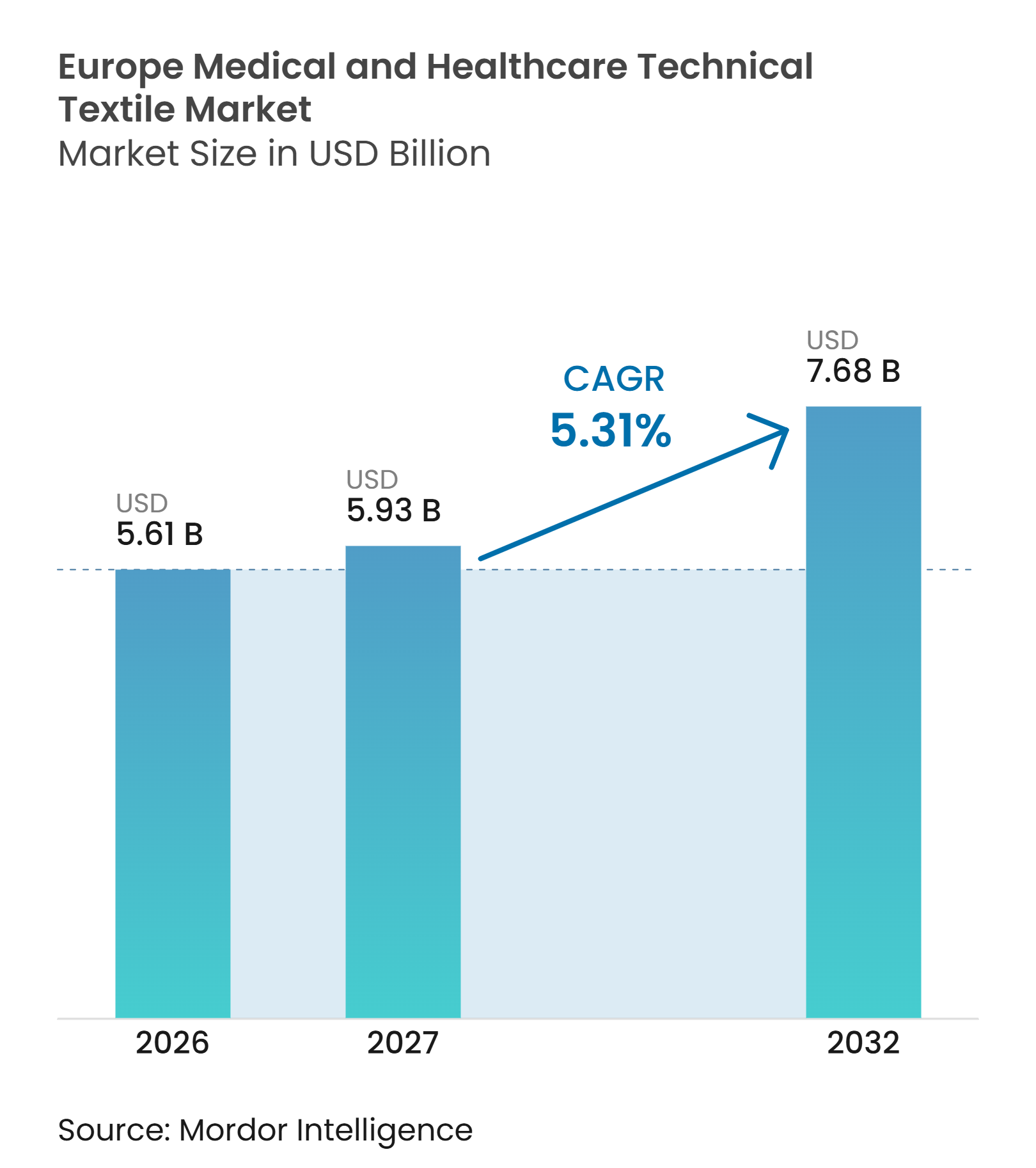
Europe Medical and Healthcare Technical Textile Market Analysis by Mordor Intelligence
The Europe Medical And Healthcare Technical Textile Market size was valued at USD 5.61 billion in 2026 and is estimated to grow from USD 5.93 billion in 2027 to reach USD 7.68 billion by 2032, at a CAGR of 5.31% during the forecast period (2027-2032).
Demand is supported by an aging population, chronic wound care needs, and hospital requirements for clinically validated textile products that can perform consistently in surgical, therapeutic, hygiene, and patient-care settings, where changing product specifications can affect supplier qualification and where product availability directly affects routine care delivery across hospitals, outpatient facilities, home care programs, and industrial laundering systems throughout Europe and across recurring hospital purchasing cycles. Regulation is also raising the performance threshold for gowns, drapes, dressings, and implantable products, which favors suppliers that can document quality, safety, material consistency, and appropriate product testing. Procurement practices are shifting toward lifecycle criteria, chemical safety, traceability, and service reliability, which creates opportunities for products with credible environmental credentials and clear supporting records. This shift can move purchasing decisions away from basic commodity materials toward specialized textiles that meet clinical and sustainability requirements across the full period of use, including material selection, product handling, laundering where relevant, sterilization, and end-of-life management.
Key Report Takeaways
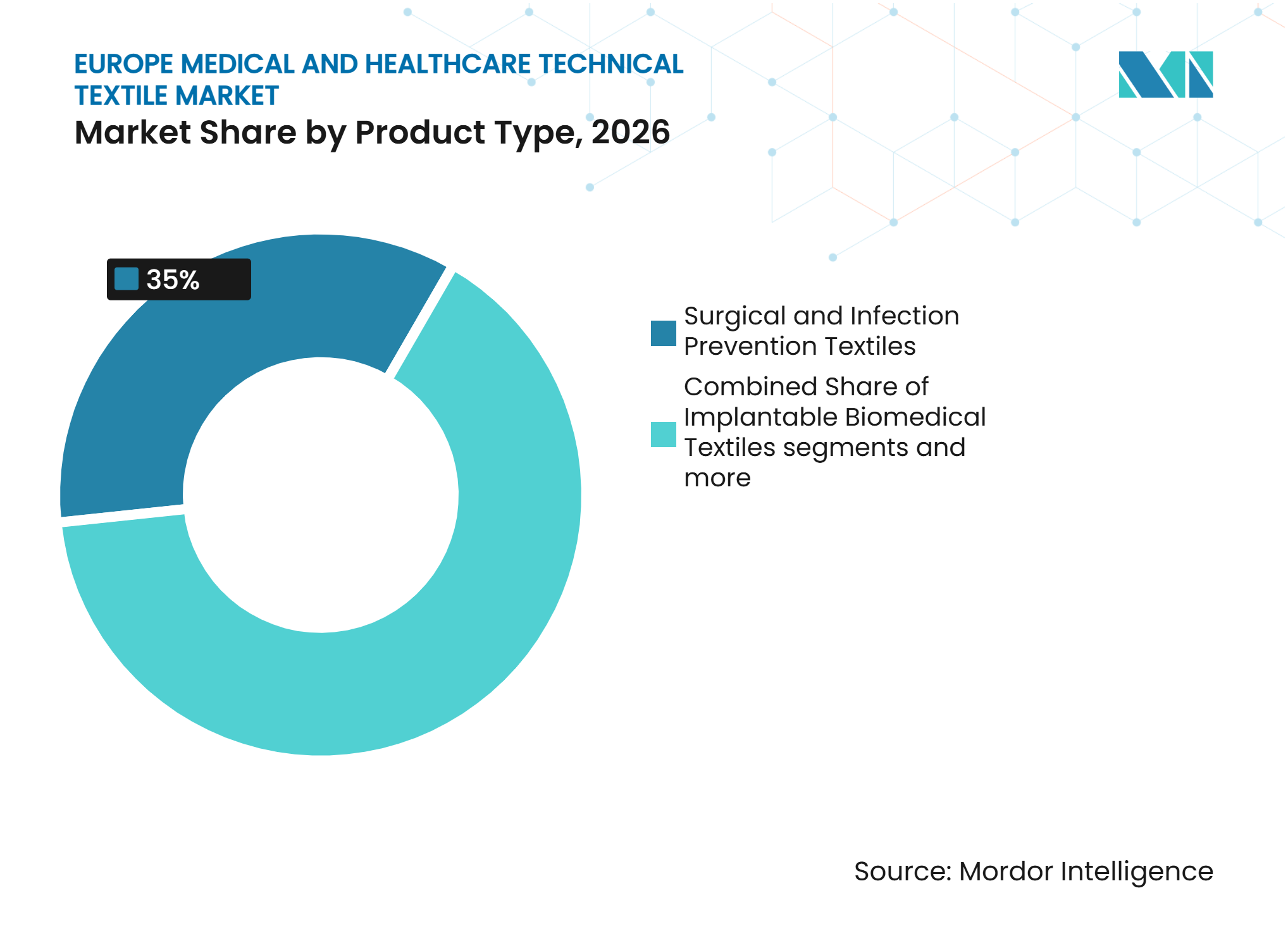
- By product type, surgical and infection prevention textiles held 35% of the Europe medical and healthcare technical textile market share in 2026, while implantable biomedical textiles are projected to grow at a 7.2% CAGR through 2032.
- By material type, polypropylene held 30% of the Europe medical and healthcare technical textile market size in 2026, while bioresorbable synthetic fibers and polymers are projected to grow at a 7.5% CAGR through 2032.
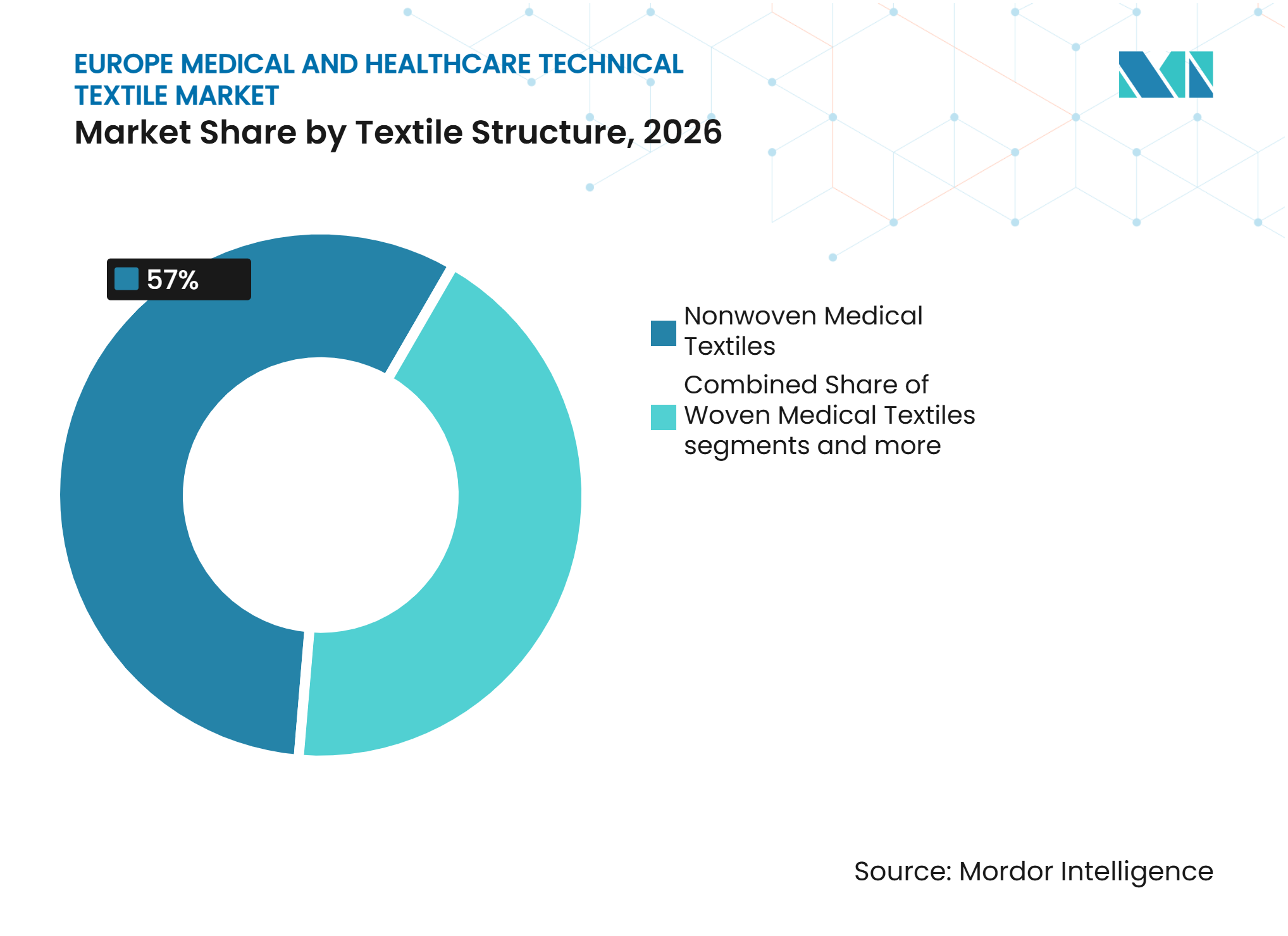
- By textile structure, nonwoven medical textiles held a 57% share in 2026, while knitted medical textiles are projected to grow at a 6.2% CAGR through 2032.
- By geography, Germany held a 21% share in 2026, while the rest of Europe is projected to grow at a 6.5% CAGR through 2032.
Note: Market numbers in this report are based on Mordor Intelligence's proprietary estimation framework, which combines nine months of actuals with Q4 projections for base year 2026.
Market Trends and Insights
Drivers Impact Analysis of Europe Medical and Healthcare Technical Textile Market*
| Driver | (~) % Impact on CAGR Forecast | Geographic Relevance | Impact Timeline |
|---|---|---|---|
| Aging Population and Chronic Wound Burden | +1.5% | Germany, France, Italy, and the United Kingdom | Long term (≥ 4 years) |
| Demand for Nonwoven Surgical and Hygiene Textiles | +1.2% | Germany, the United Kingdom, and France | Short term (≤ 2 years) |
| Textile-Based Implants and Advanced Wound Care | +0.9% | Western Europe, with expansion into Central and Eastern Europe | Medium term (2-4 years) |
| Healthcare Sustainability and Green Procurement | +0.8% | European Union, with early adoption in the Nordics, Germany, and the Netherlands | Medium term (2-4 years) |
| Reusable Textile-as-a-Service Models | +0.5% | Northern and Western Europe | Medium term (2-4 years) |
| Smart and Sensor-Integrated Medical Garments | +0.4% | Germany, the Netherlands, the United Kingdom, and Italy | Long term (≥ 4 years) |
| Source: Mordor Intelligence | |||
Aging Population and Rising Chronic Wound Burden
Europe’s aging population supports a durable need for wound care textiles because chronic wounds require continuing management rather than a single treatment. Chronic wounds affect 7.4 million to 14.9 million people across Europe, while 4 million new wounds develop each year.[1] Annual expenditure per patient ranges from EUR 6,000 (USD 7,057.9) to EUR 10,000 (USD 11,763.1), and complications increase this cost, particularly when wounds require longer clinical management. Pressure ulcers alone cost European healthcare systems EUR 25 billion (USD 29.4 billion) each year, which places greater attention on products that support prevention and reliable wound management. The same source states that wound care represents 2% to 4% of European healthcare spending, while the expected shortfall of 4.1 million healthcare professionals by 2030 increases the need for care formats that can be managed outside acute settings. As the share of people aged 65 years or older approaches 30% by 2050 and care moves further into community settings, the Europe medical and healthcare technical textile market can benefit from extended-wear, atraumatic, self-adhesive, and moisture-managing textile dressings.
Demand for Nonwoven Surgical and Hygiene Textiles
Nonwoven products remain central to surgical and hygiene applications because they combine scalable production with disposable use. Greater Europe produced 2,976,400 tons of nonwovens in 2024, with output volume increasing 2.6% from the previous year.[2] Spunmelt continued to account for the largest surface area within European nonwoven production, which reflects the material’s established role in high-volume medical and hygiene formats. The European Commission’s trade dashboard shows that the European Union’s net import reliance for nonwoven garments rose from 42.5% in 2015 to 88.7% in 2025; import dependence is creating interest in regional supply for products that include disposable surgical gowns. Commission Implementing Decision EU 2025/2078 lists EN 13795-1:2025 and EN 13795-2:2025 as harmonized standards under the Medical Device Regulation, updating performance and test requirements for surgical drapes, gowns, and clean air suits.[3] Suppliers that can show current certification can address hospital replacement demand as older products are reassessed, which supports the Europe medical and healthcare technical textile market in the near term.
Growth of Textile-Based Implants and Advanced Wound Care
Implantable and therapeutic textiles have higher technical barriers than basic disposable products because their performance is tied to clinical outcomes and biological safety. Implantable Biomedical Textiles are projected to grow at a 7.2% CAGR from 2027 to 2032, supported by vascular prostheses, hernia meshes, and ligament scaffolds that serve demanding clinical uses. A European clinical study published in 2026 reported complete closure for 93.8% of treated chronic wounds using a bioresorbable polylactic acid matrix, with a mean closure time of 72.9 days and no skin graft requirement. Evonik processes its RESOMER bioresorbable polymer range under ISO 13485 quality management and offers grades with degradation periods ranging from under 4 weeks to more than 2 months. Existing biocompatibility, extractables, and leachables data can reduce the effort required to extend a qualified material family into related product designs. In contrast, new entrants must build those data packages from the start. MDR 2017/745 and ISO 13485 nonetheless keep entry requirements high for the Europe medical and healthcare technical textile market, especially in Class IIb and Class III applications.
EU Healthcare Sustainability and Green Procurement
European procurement requirements increasingly consider environmental performance alongside price and clinical function. The European Commission’s textiles strategy calls for harmonized extended producer responsibility rules and a digital product passport framework that can document material composition, chemical treatments, and end-of-life information for textiles. Ecodesign for Sustainable Products Regulation (EU) 2024/1781 sets restrictions on the destruction of unsold textiles by large enterprises from July 2026, creating obligations that reach across textile supply chains. Sweden’s National Agency for Public Procurement has published healthcare textile criteria covering chemical safety, lifecycle climate impact, supply chain traceability, PFAS limits, and biocide restrictions. These criteria create a clearer route for suppliers that can provide material and treatment data throughout the product life cycle. PFAS restrictions under REACH add pressure for fluid-resistant surgical textile solutions that still meet EN 13795 performance requirements, making material innovation relevant to the Europe medical and healthcare technical textile market.
Restraints Impact Analysis of Europe Medical and Healthcare Technical Textile Market*
| Restraint | (~) % Impact on CAGR Forecast | Geographic Relevance | Impact Timeline |
|---|---|---|---|
| Medical Device Compliance and Clinical Evidence Costs | -1% | European Union, with higher pressure on smaller firms in Germany, France, and Spain | Long term (≥ 4 years) |
| Volatility in Medical-Grade Polymer Supply and Pricing | -0.6% | Global, with higher exposure in Germany, the Netherlands, and Belgium | Short term (≤ 2 years) |
| Limited Collection, Laundering, and Sterilization Infrastructure | -0.4% | Southern and Eastern Europe | Medium term (2-4 years) |
| Lowest-Upfront-Price Procurement Bias | -0.3% | Europe, particularly public hospital tenders | Long term (≥ 4 years) |
| Source: Mordor Intelligence | |||
Medical Device Compliance and Clinical Evidence Costs
MDR 2017/745 has increased the cost and complexity of maintaining medical textile product lines in Europe. MedTech Europe reported in 2025 that certification and maintenance costs had risen by up to 100% compared with the earlier directives. MedTech Europe's 2025 survey modeled EUR 136,981 (USD 161,132) for quality management system qualification and EUR 176,202 (USD 207,268) for technical documentation audits under Notified Body review, costs that must be absorbed before ongoing surveillance and maintenance activity. It also found that the projected five-year compliance cycle costs 50% more than initial certification and that the European Union has become a less common first-launch geography for large device manufacturers. The cost is more difficult for smaller implant textile specialists to absorb because higher-risk devices need extensive clinical evidence and post-market follow-up that existing lower-risk wound-care products were not designed to generate. This can limit new product launches in the Europe medical and healthcare technical textile market and favor firms that already have established regulatory systems, clinical evidence, and the resources to maintain their dossiers.
Lowest-Upfront-Price Procurement Bias
Public hospitals often retain tender processes that give strong weight to the initial purchase price of gowns, drapes, and linen products. This approach can make it harder for reusable and higher-specification products to compete even when they provide better lifecycle performance. The European Commission’s textile strategy places more attention on circularity, durability, and information transparency, but these goals still need to be translated into local procurement choices. Swedish healthcare textile criteria show that procurement can include chemical safety, climate impact, and traceability rather than price alone. The gap between these criteria and price-led purchasing can slow wider adoption of managed reusable textile services. The Europe medical and healthcare technical textile market will depend on hospitals recognizing clinical, environmental, and operating costs across the full use cycle.
*Our forecasts treat driver/restraint impacts as directional, not additive. The impact forecasts reflect baseline growth, mix effects, and variable interactions.
Europe Medical and Healthcare Technical Textile Market Segment Analysis
By Product Type:
Infection Control Textiles Lead, Implants Support Faster GrowthSurgical and Infection Prevention Textiles held 35% of the Europe medical and healthcare technical textile market share in 2026. Demand is sustained by the need for compliant surgical drapes and gowns across hospital networks, where infection prevention requirements cannot be deferred. EN 13795-1:2025 and EN 13795-2:2025 provide the updated harmonized framework for surgical drapes, gowns, and clean air suits under MDR, including the performance and testing context for these products. This regulatory update supports product replacement and reassessment among hospital buyers, particularly where products were qualified to previous editions of the standards. The Europe medical and healthcare technical textile market size for surgical and infection prevention products is also underpinned by the broad use of disposable nonwoven materials in operating rooms and other controlled care settings.
Implantable Biomedical Textiles are projected to grow at a 7.2% CAGR from 2027 to 2032. Braided and woven vascular prostheses, hernia meshes, and ligament scaffolds support this demand because they provide specialized alternatives to metallic and solid polymer implants. Wound Care and Non-Implantable Therapeutic Textiles remain a major block, supported by 4 million new chronic wounds each year across Europe. Healthcare Hygiene and Absorbent Care Textiles also benefit from home care needs among older populations. Hospital and Patient Care Textiles increasingly face lifecycle and chemical-content requirements, which can reduce the role of undifferentiated products in the Europe medical and healthcare technical textile industry.



By Material Type:
Polypropylene Supports Scale, Bioresorbable Build Higher-Value Use CasesPolypropylene held a 30% share of the Europe medical and healthcare technical textile market in 2026. Its position reflects its cost-effectiveness, use in spunmelt production, and the availability of established ISO 10993 biocompatibility documentation for standard applications. Polypropylene supports surgical nonwovens and hygiene textiles at high volumes, giving converters a familiar material base for disposable products. Bioresorbable Synthetic Fibers and Polymers are forecast to expand at a 7.5% CAGR through 2032. Clinical experience with a polylactic acid matrix in chronic wounds provides evidence for bioresorbable materials in advanced care settings. At the same time, their potential to avoid a secondary removal procedure supports interest in implant-related applications.
Polyester remains important for compression hosiery and woven surgical meshes because it combines mechanical performance with dye affinity. Regenerated cellulosic fibers are gaining use in wound contact layers and patient-facing absorbent products where tenders favor sustainably sourced materials. Cotton and other natural fibers remain relevant for linen and patient care applications that require comfort and moisture management. Polyurethane and elastomeric fibers are important in compression therapy garments, where stretch recovery affects product function. The European Commission’s Joint Research Centre identifies bio-based textiles as a strategic area for development, which supports continued attention to polylactic acid and other alternative materials.
By Textile Structure:
Nonwovens Retain Scale, Knits Grow Through Compression ApplicationsNonwoven Medical Textiles accounted for 57% of the Europe medical and healthcare technical textile market share in 2026. Their scale comes from broad use in disposable surgical, hygiene, and wound dressing products. Mature spunmelt and SMS capacity in Germany, the Netherlands, and Belgium supports large-volume output for clinically validated applications. European nonwoven production increased 2.6% in 2024, showing continued capacity across the wider supply base. The Europe medical and healthcare technical textile market size linked to nonwovens remains closely tied to hospital infection prevention and patient hygiene needs.
Knitted Medical Textiles are projected to grow at a 6.2% CAGR from 2027 to 2032. Compression therapy products, smart compression garments, and tubular bandages support the category as the population ages and care extends beyond hospitals. Woven structures serve high-strength applications including vascular prostheses, meshes, and bandage supports. Braided structures address technically demanding sutures, vascular devices, and ligament replacement scaffolds, where material consistency and braid precision are important. ITV Denkendorf develops textile-based implants including sutures, meshes, and vascular prostheses under EN ISO 13485 certification, showing the continued role of specialized structures in the European medical and healthcare technical textile industry.

Geography Analysis
Germany
Germany held 21% of the Europe medical and healthcare technical textile market share in 2026. The country has a concentrated supplier base that includes Paul Hartmann, medi GmbH & Co. KG, Freudenberg Performance Materials, Lohmann & Rauscher, and ITV Denkendorf, spanning compression, wound care, nonwoven, and implant-related applications. High surgical activity and the country’s role as the European Union’s largest medical device market support domestic demand for specialized textiles. A 2025 industry survey found that manufacturers were considering moving activities outside Europe because of regulatory, energy, and labor cost pressures, which makes MDR compliance a significant regulatory influence on German suppliers. Sustainability scoring in procurement further encourages suppliers to develop documented lifecycle and chemical information.
Rest of Europe
The rest of Europe is forecast to grow at a 6.5% CAGR from 2027 to 2032. The segment includes Central and Eastern European countries and the Benelux area beyond the Netherlands, where hospital infrastructure investment and changing procurement requirements support demand for surgical drapes, gowns, and wound care textiles. Sweden’s procurement authority provides a model for supplier requirements on PFAS substitution, traceability, chemical safety, and lifecycle impact. Central and Eastern Europe have a longer path for wider adoption of advanced formats such as bioresorbable implants. At the same time, managed reusable textile services can strengthen demand where hospitals use longer-term linen and surgical textile contracts.
Western European Markets
The United Kingdom, France, Italy, Spain, and the Netherlands show different patterns in the Europe medical and healthcare technical textile market. A 2025 study of NHS operating theaters identified cost modeling and sterilization logistics as major barriers to reusable surgical textiles. France contributes through knitted prosthetic textile development and hospital environmental objectives, while Italy combines high home care needs with a developed industrial laundry base for hospital linen programs. A Spanish analysis estimated chronic wound care costs at EUR 34.9 million (USD 41.1 million) across 54 primary care centers over 3 years and EUR 1.76 billion (USD 2.1 billion) nationally.
Competitive Landscape
Market Concentration
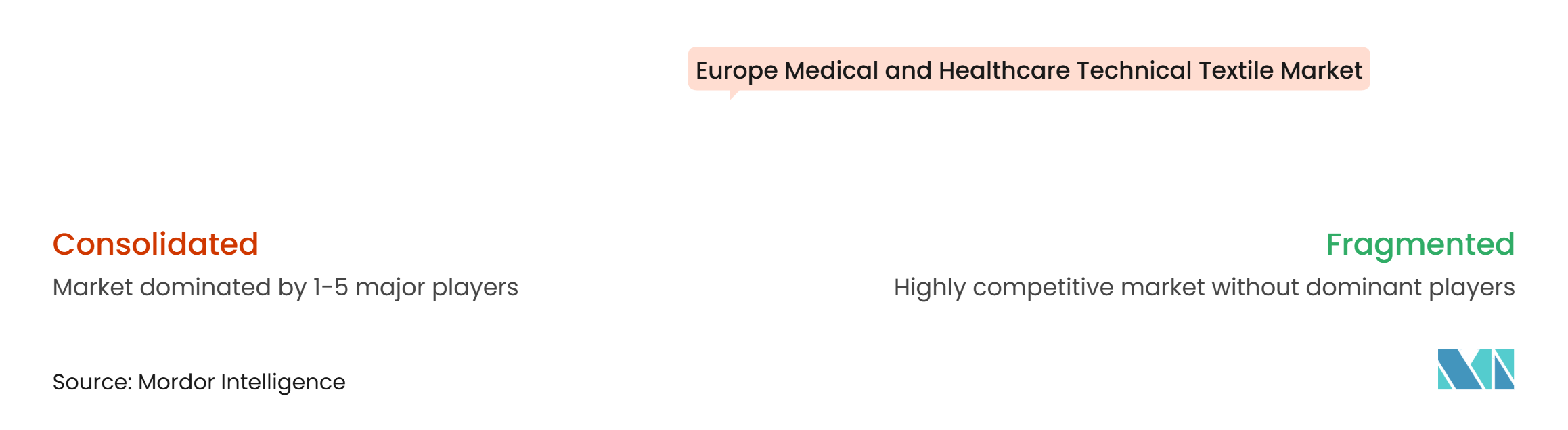
The Europe medical and healthcare technical textile market is moderately consolidated. European specialists, including Paul Hartmann, Mölnlycke Health Care, Freudenberg Performance Materials, Lohmann & Rauscher, medi GmbH, and Ahlstrom compete with larger MedTech companies such as Kimberly-Clark, 3M, DuPont, Cardinal Health, and Medline. Large suppliers are strengthening sustainability and digital capabilities, while specialist firms focus on difficult applications such as bioresorbable implants and sensor-enabled compression garments. MDR 2017/745 and ISO 13485 remain important compliance factors because they increase entry requirements for medical textile products. These requirements can favor suppliers with established technical documentation, clinical evidence, and qualified manufacturing systems.
Mölnlycke announced a USD 8 million investment in Siren in January 2025, supporting temperature-sensing textile socks for monitoring diabetic foot ulcer risk. This move shows how companies are combining textile products with continuous monitoring technology. Fraunhofer IZM is developing a smart textile vest with Charité University Hospital to monitor more than 110 parameters continuously. The development points to possible clinical uses beyond standard monitoring devices. In implant textiles, smaller firms such as MDB Texinov, Tytex, Confluent Medical Technologies, and ITV Denkendorf can compete through application-specific manufacturing knowledge and qualified supply relationships.
Circular sterile gown programs are another opportunity in the Europe medical and healthcare technical textile market because they can align managed services with hospital sustainability goals. The European Commission’s textiles strategy creates a stronger policy basis for durability, traceability, and circular management of textile products. Freudenberg launched bio-based polylactic acid and wood pulp nonwoven materials without chemical binders in October 2025 for wound dressing and healthcare uses, while Ahlstrom’s October 2025 acquisition of EBF added converting and specialty card manufacturing capabilities in life sciences and diagnostics. The market structure supports continued competition between scale-based suppliers and specialists with advanced technical or regulatory capabilities.
Europe Medical and Healthcare Technical Textile Industry Leaders
-
Freudenberg Performance Materials
-
Mölnlycke Health Care AB
-
Ahlstrom Oyj
-
Lohmann & Rauscher GmbH & Co. KG
-
Smith & Nephew plc
- *Disclaimer: Major Players sorted in no particular order
Europe Medical and Healthcare Technical Textile Market Companies Covered in this Report
- Freudenberg Performance Materials
- Mölnlycke Health Care AB
- Ahlstrom Oyj
- Lohmann & Rauscher GmbH & Co. KG
- Smith & Nephew plc
- Medline Industries, LP
- Cardinal Health, Inc.
- 3M Company
- DuPont de Nemours, Inc.
- TWE GmbH & Co. KG
- Tytex A/S
- ATEX Technologies, Inc.
- Bally Ribbon Mills
- Confluent Medical Technologies
- MDB Texinov
- Sefar AG
- ITV Denkendorf Produktservice GmbH
- Revolution-ZERO
- ADA Group
- Paul Hartmann AG
- medi GmbH & Co. KG
- Trelleborg AB
Recent Industry Developments in Europe Medical and Healthcare Technical Textile Market
- June 2026: Mölnlycke announced a combined investment of approximately EUR 40 million (USD 47.1 million) in its Mikkeli, Finland, and Oldham, United Kingdom, facilities to expand wound-care manufacturing capacity, improve production quality, and strengthen supply-chain resilience.
- February 2026: Polaroid Therapeutics received CE marking for POLTX_Fiber, an antimicrobial gelling fibre wound dressing incorporating its Antimicrobial Polymer Technology (APT). The cellulose-based nonwoven dressing targets chronic and acute wound management, including diabetic ulcers and pressure ulcers.
Europe Medical and Healthcare Technical Textile Market Report Scope
The Europe Medical and Healthcare Technical Textile Market Report is segmented by Product Type (Hospital and Patient Care Textiles, Implantable Biomedical Textiles, and More), by Material Type (Polypropylene (PP), Polyester (PET), and More), by Textile Structure (Nonwoven Medical Textiles, Woven Medical Textiles, and More), and by Geography (Germany, France, and more). The Market Forecasts are Provided in Terms of Value (USD).
Segmentation Overview
| Surgical and Infection Prevention Textiles |
| Wound Care and Non-Implantable Therapeutic Textiles |
| Healthcare Hygiene and Absorbent Care Textiles |
| Implantable Biomedical Textiles |
| Extracorporeal and Medical Device-Integrated Textiles |
| Hospital and Patient Care Textiles |
| Polypropylene (PP) |
| Polyester (PET) |
| Polyethylene (PE) |
| Polyamide (Nylon) |
| Cotton and Other Natural Fibers |
| Regenerated Cellulosic Fibers |
| Polyurethane and Other Elastomeric Fibers |
| Bioresorbable Synthetic Fibers and Polymers |
| Other Specialty Fibers and Materials |
| Nonwoven Medical Textiles |
| Woven Medical Textiles |
| Knitted Medical Textiles |
| Braided Medical Textiles |
| Other Engineered Medical Textile Structures and Products |
| Germany |
| United Kingdom |
| France |
| Italy |
| Spain |
| Netherlands |
| Rest of Europe |
| By Product Type | Surgical and Infection Prevention Textiles |
| Wound Care and Non-Implantable Therapeutic Textiles | |
| Healthcare Hygiene and Absorbent Care Textiles | |
| Implantable Biomedical Textiles | |
| Extracorporeal and Medical Device-Integrated Textiles | |
| Hospital and Patient Care Textiles | |
| By Material Type | Polypropylene (PP) |
| Polyester (PET) | |
| Polyethylene (PE) | |
| Polyamide (Nylon) | |
| Cotton and Other Natural Fibers | |
| Regenerated Cellulosic Fibers | |
| Polyurethane and Other Elastomeric Fibers | |
| Bioresorbable Synthetic Fibers and Polymers | |
| Other Specialty Fibers and Materials | |
| By Textile Structure | Nonwoven Medical Textiles |
| Woven Medical Textiles | |
| Knitted Medical Textiles | |
| Braided Medical Textiles | |
| Other Engineered Medical Textile Structures and Products | |
| By Geography | Germany |
| United Kingdom | |
| France | |
| Italy | |
| Spain | |
| Netherlands | |
| Rest of Europe |
Key Questions Answered in the Report
What is the projected value of the Europe medical and healthcare technical textile market by 2032?
The market is forecast to reach USD 7.68 billion by 2032, growing at a 5.31% CAGR from 2027 to 2032.
Which product category holds the leading share in Europe?
Surgical and infection prevention textiles lead with a 35% share in 2026 because hospitals require compliant gowns and drapes.
Which material type is growing fastest in medical textiles?
Bioresorbable synthetic fibers and polymers are forecast to grow at a 7.5% CAGR through 2032, supported by implant and advanced wound care applications.
Why are nonwoven medical textiles widely used?
Nonwoven medical textiles held a 57% share in 2026 because they are used across disposable surgical, hygiene, and wound dressing products.
Which European geography is growing fastest?
The rest of Europe is forecast to grow at a 6.5% CAGR through 2032, supported by hospital investment and procurement reform.
How does MDR affect medical textile suppliers?
MDR adds certification, documentation, and clinical evidence requirements, which can raise costs but also favor established suppliers with qualified systems.