
Europe Liquid Packaging Cartons Market Size and Share
Market Overview
| Study Period | 2021 - 2032 |
|---|---|
| Forecast Data Period | 2027 - 2032 |
| Base Year Market Size (2026) | USD 1.88 Billion |
| Market Size (2027) | USD 1.91 Billion |
| Market Size (2032) | USD 2.33 Billion |
| Growth Rate (2027 - 2032) | 4.06 % |
| Market Concentration | Medium |
Major Players *Disclaimer: Major Players sorted in no particular order Image © Mordor Intelligence. Reuse requires attribution under CC BY 4.0. | |
Europe Liquid Packaging Cartons Market Analysis by Mordor Intelligence
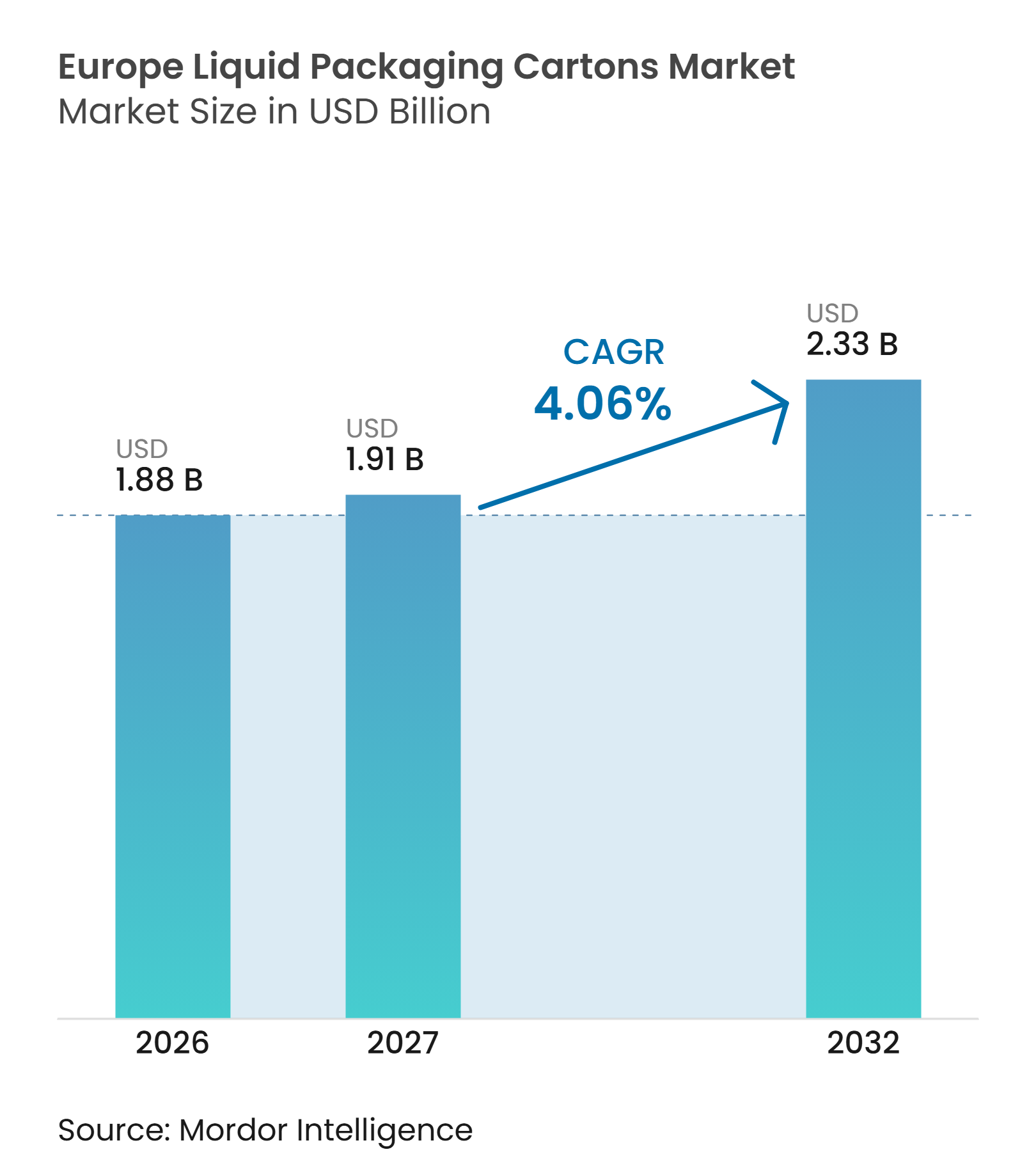
The Europe liquid packaging cartons market size is projected to be USD 1.88 billion in 2026, USD 1.91 billion in 2027, and reach USD 2.33 billion by 2032, growing at a CAGR of 4.06% from 2027 to 2032. Demand is shifting toward carton structures that use more paper-based barriers and less aluminum, as brands prepare for recyclability requirements, retailer sustainability assessments, and packaging reviews that increasingly consider both material composition and product protection. Ambient distribution supports this shift by enabling milk, juices, plant-based drinks, soups, and cooking creams to move through retail channels without a full chilled supply chain, which is useful for both national retail networks and discount-led formats with limited refrigerated shelf space.
Key Report Takeaways
- By product type, aseptic cartons held 62.74% of the Europe liquid packaging cartons market share in 2026 and are projected to expand at a 4.84% CAGR through 2032.
- By application, milk accounted for 41.38% of the Europe liquid packaging cartons market size in 2026, while plant-based beverages are projected to record the highest CAGR at 4.96% through 2032.
- By pack size, above 500 ml formats held 58.46% of market value in 2026, while 250-500 ml formats are expected to expand at a 4.79% CAGR through 2032.
- By geography, Germany accounted for 27.29% of market value in 2026, while the United Kingdom is projected to grow at a 4.92% CAGR through 2032.
Note: Market numbers in this report are based on Mordor Intelligence's proprietary estimation framework, which combines nine months of actuals with Q4 projections for base year 2026.
Market Trends and Insights
Expansion of Ambient and Extended-Shelf-Life Beverage Distribution
Ambient beverage distribution is strengthening demand for aseptic cartons across Europe, especially where retail networks favor products that can remain on shelf for long periods. Discount retailers can stock UHT dairy, juices, and plant-based drinks without dedicating comparable space to chilled aisles, which reduces distribution complexity and supports a broad private-label offer. This model is particularly relevant in price-conscious markets, including Spain, Italy, and Central Europe, where private-label beverage ranges continue to rely on shelf-stable supply. Liquid packaging board also supports ambient use in soups, broths, cooking creams, and similar liquid food products, which gives cartons a wider role beyond standard dairy formats.[1] The Europe liquid packaging cartons market therefore benefits when retailers seek lower-complexity distribution for everyday liquid products and want to manage inventory across smaller store footprints. The format’s competitive position improves when brands can combine long shelf life, product protection, transport efficiency, and packaging choices that fit retailer sustainability programs.
Growth of Plant-Based, Lactose-Free, and Functional Beverages
Plant-based, lactose-free, and functional drinks support carton demand because many products require stable ambient distribution across large retail networks. These categories often use aseptic filling to protect product quality during storage and transport, including during periods when chilled handling would add cost or limit geographic reach. The growth opportunity is strongest where consumers buy plant-based beverages through mainstream grocery and discount channels rather than only specialty retail. Functional beverages add a further requirement because carton opacity can help protect light-sensitive formulations and support consistent product presentation on shelf. The Europe liquid packaging cartons market can gain from this product mix because brands need packages that support shelf life, handling, visual differentiation, and retail-ready distribution. This demand is not limited to dairy alternatives, as high-protein drinks and value-added liquid foods use similar filling, transport, and distribution capabilities.
EU Recyclability and Circularity Compliance Pull
Regulation (EU) 2025/40 entered into force on February 11, 2025, and applies broadly from August 12, 2026.[2] The regulation makes recyclability a practical market-access issue for packaging suppliers serving European brands and retailers. Its future recyclability performance requirements are influencing material choices well before the relevant deadlines, particularly for cartons that use composite material structures. The Food and Beverage Carton Alliance introduced its RECY:CHECK protocol in July 2025 to help demonstrate recyclability of fiber-based composite packaging and support design decisions.[3] This regulatory influence encourages suppliers to simplify carton structures, build evidence for their recycling claims, and align product development with emerging compliance factors. It also makes collection, sorting, and material-recovery partnerships important alongside improvements in the carton itself, particularly where local recycling systems need further investment.
Premiumization of Single-Serve and On-the-Go Formats
The 250-500 ml format is projected to grow at 4.79% through 2032, supported by portioned plant-based drinks, food-service products, and functional beverages. These packs can generate higher revenue per unit than large household cartons because they support convenience, product variety, and branded positioning for individual use occasions. SIG introduced its DomeMini on-the-go carton bottle with SalzburgMilch for specialty dairy drinks, protein drinks, and plant-based alternatives in Europe in 2026. The format gives brands a carton option that is more suitable for individual consumption occasions while retaining the product-protection attributes associated with aseptic packaging. In the United Kingdom, Extended Producer Responsibility fees also encourage attention to recyclable carton design and the material choices used in convenience formats. The resulting combination of convenience, product protection, design flexibility, and material development supports a broader role for midsize packs in the Europe liquid packaging cartons market.
Restraints Impact Analysis of Europe Liquid Packaging Cartons Market*
| Restraint | (~) % Impact on CAGR Forecast | Geographic Relevance | Impact Timeline |
|---|---|---|---|
| High Cost and Complexity of Multilayer Carton Recycling | -0.6% | Europe, with greater pressure in Italy and Southern Europe | Medium term (2-4 years) |
| Mature Per-Capita Dairy Consumption and Volume Substitution | -0.5% | Germany, France, and the United Kingdom | Long term (≥ 4 years) |
| Volatile Paperboard, Polymer, Aluminum, and Energy Costs | -0.4% | Europe, especially energy-intensive production areas | Short term (≤ 2 years) |
| Fragmented National Collection and Recycling Rules | -0.2% | Southern and Eastern Europe | Long term (≥ 4 years) |
| Source: Mordor Intelligence | |||
High Cost and Complexity of Multilayer Carton Recycling
Liquid cartons combine paperboard fiber, polyethylene, and, in many formats, aluminum. Separating these materials requires specialized mills, sorting equipment, and PolyAl processing capacity that are not uniformly available across Europe. This creates a cost burden in markets that do not have established recovery systems or reliable flows of sorted carton material. The challenge is more evident in parts of Southern Europe, where collection and sorting systems remain less consistent than in Northern and Western markets. The PPWR also raises the importance of actual recycling infrastructure, rather than relying only on technical recyclability claims or laboratory-based assessments. Producers may therefore need to support collection, sorting, and recovery investments while continuing to reduce the complexity of carton structures and preserve required barrier performance.
Mature Per-Capita Dairy Consumption and Volume Substitution
Conventional milk remains the largest application in the Europe liquid packaging cartons market, but dairy consumption in some Western European markets is mature. Slower population growth and changing preferences can limit volume expansion in the products that have historically supported high-speed carton filling and stable use of large household packs. Plant-based beverages can offset part of this pressure, although they do not always replace dairy volume on a one-for-one basis or use identical pack sizes. The result is a mixed demand environment where cartons gain relevance in new categories while standard dairy volumes face limited growth in established markets. Suppliers need to protect utilization of established filling lines while developing packages for functional drinks, plant-based products, liquid foods, and other ambient categories. The restraint is strongest in mature Western markets, where competition from rigid plastics and metal cans also remains present across several beverage segments.
*Our forecasts treat driver/restraint impacts as directional, not additive. The impact forecasts reflect baseline growth, mix effects, and variable interactions.
Europe Liquid Packaging Cartons Market Segment Analysis
By Product Type:
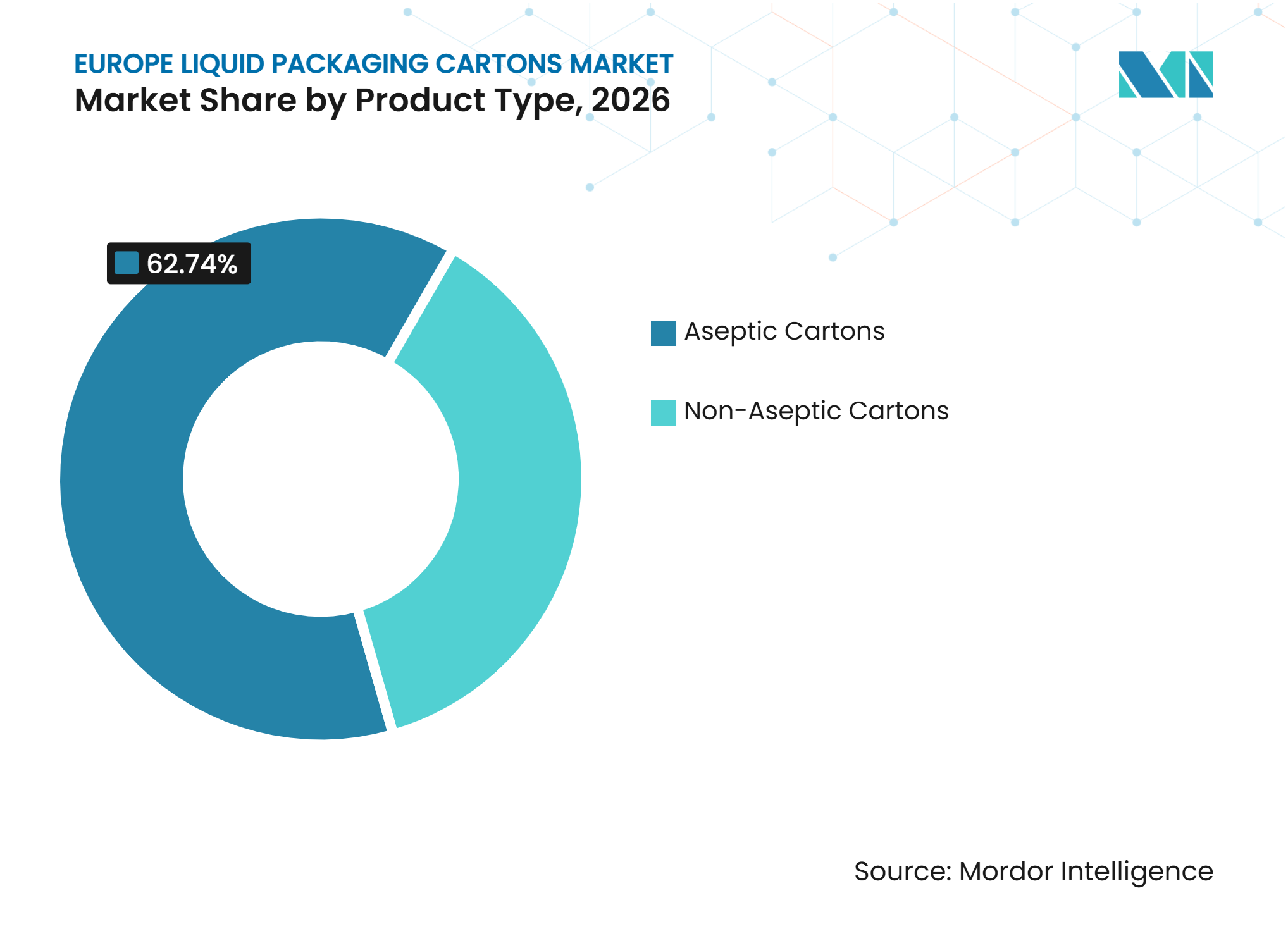
Aseptic Cartons Combine Scale With Faster GrowthAseptic cartons held 62.74% of the Europe liquid packaging cartons market share in 2026 and are projected to grow at a 4.84% CAGR through 2032. Their position comes from the ability to fill sterilized products into sterilized packs under controlled conditions. This process supports a shelf life of 6-12 months without refrigeration or preservatives for suitable products. It makes aseptic packs relevant for UHT milk, juices, plant-based beverages, liquid foods, and high-protein drinks. The Europe liquid packaging cartons industry relies on this capability because it reduces dependence on the cold chain and supports broad geographic distribution.
Aseptic cartons are also central to current material changes. Suppliers are working to replace aluminum-layer structures with solutions that use paper and polymer barriers while preserving the performance required for ambient products. Tetra Pak launched a 1-liter aseptic carton with a paper-based barrier with Sterilgarda Alimenti in April 2026, reporting 90% renewable content when used with plant-based polymers. Non-aseptic cartons continue to serve chilled milk, cream, and juice applications where gable-top formats fit established cold-chain retail systems. Elopak’s investment in Blue Ocean Closures in March 2025 shows that suppliers are also reducing plastic content in closure systems for chilled formats.


By Application:
Milk Provides the Volume Base While Plant-Based Drinks Lead GrowthMilk accounted for 41.38% of the Europe liquid packaging cartons market size in 2026. Household use, broad retail availability, and efficient high-speed filling lines make UHT milk a major source of carton volume. Its scale gives suppliers a stable installed base for multi-serve formats. The category is also beginning a material redesign cycle as brands pursue lower-carbon barriers and renewable-content claims. Tetra Pak’s 2026 Sterilgarda launch illustrates how a mainstream 1-liter milk carton can become an early commercial application for paper-based barrier technology.
Plant-based beverages are projected to expand at a 4.96% CAGR through 2032, the fastest rate among applications. The category fits aseptic cartons because producers need shelf-stable distribution that can serve conventional stores and discount retailers. Juices also provide an important route for carton innovation, particularly where brands want to reduce aluminum use. Tetra Pak and García Carrión launched a paper-based barrier carton for Don Simón juice in December 2025, with the company reporting 92% renewable content. Dairy products other than milk, energy and functional drinks, and liquid foods add demand diversity, which reduces reliance on any single beverage category.
By Pack Size:
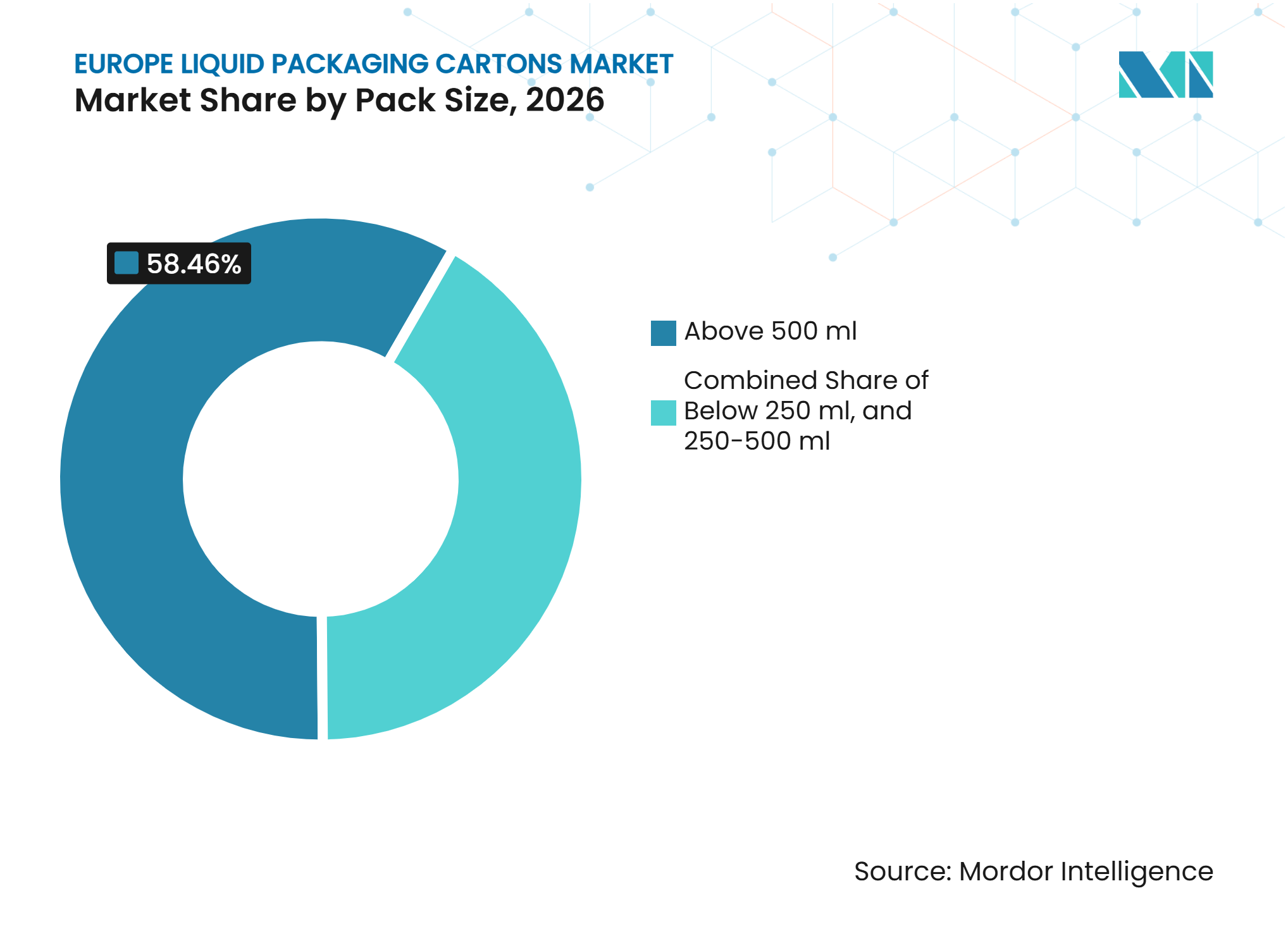
Large Household Formats Lead and Midsize Formats Add ValueAbove 500 ml formats accounted for 58.46% of the Europe liquid packaging cartons market share in 2026. These packs mainly serve household UHT milk and juice, which remain the volume base for the regional carton business. Their large size supports efficient filling, transport, and retail stocking for repeat-purchase products. The segment is no longer defined only by commodity packs because mainstream brands and retailers are adopting improved barrier structures. SIG launched SIG Terra Alu-free Full Barrier for multi-serve aseptic cartons in May 2025, stating that the material can run on existing filling lines.
The 250-500 ml band is expected to grow at a 4.79% CAGR through 2032. It serves portioned plant-based beverages, food-service packs, functional drinks, and products consumed away from home. These uses allow brands to apply more differentiated pack designs and charge for convenience. Smaller than 250 ml packs remain relevant in school catering, travel retail, and nutritional products, where controlled portions and ease of handling matter. As the Europe liquid packaging cartons market develops, small packs can also help introduce new barrier technology before suppliers extend it to higher-volume household formats.

Geography Analysis
Germany
Germany held 27.29% of the Europe liquid packaging cartons market size in 2026. Its scale reflects demand for UHT milk and a retail structure in which discount chains support ambient products. Germany also remains an important site for carton manufacturing and alternative supply development. Wintipak broke ground on an 11,800 m² production hall at its Halle-Saale site in November 2025, with planned completion in June 2026. Packaging regulation is shaping decisions because the PPWR makes recyclable design and recovery evidence more important for brands and packaging suppliers.
United Kingdom
The United Kingdom is projected to grow at a 4.92% CAGR through 2032, the fastest geographic rate in the Europe liquid packaging cartons market. England’s Simpler Recycling policy brought workplace requirements into effect from March 2025 and requires household collection changes from March 2026. The policy improves the basis for broader carton collection and strengthens evidence behind recyclability claims. Tetra Pak announced GBP 1.4 million in sorting investments at United Kingdom materials recovery facilities in 2025, including optical sorting technology. Regulatory influence, retailer commitments, and improved sorting capacity make the United Kingdom an important test market for recyclable carton design.
France, Italy, Spain, and Other European Markets
France provides a commercial setting for aluminum-free cartons, with SIG and LSDH introducing the technology into filling operations in Alsace during 2026. Italy combines growing interest in plant-based products with a need for stronger carton collection and material recovery. Spain has become a launch market for paper-based barrier juice cartons through the Don Simón introduction in 2025. The Netherlands, Belgium, and Germany benefit from regional recovery networks, including a EUR 3 million, 20,000-tonne PolyAl facility announced by Tetra Pak and Yellow Dreams in January 2025.
Competitive Landscape
Market Concentration
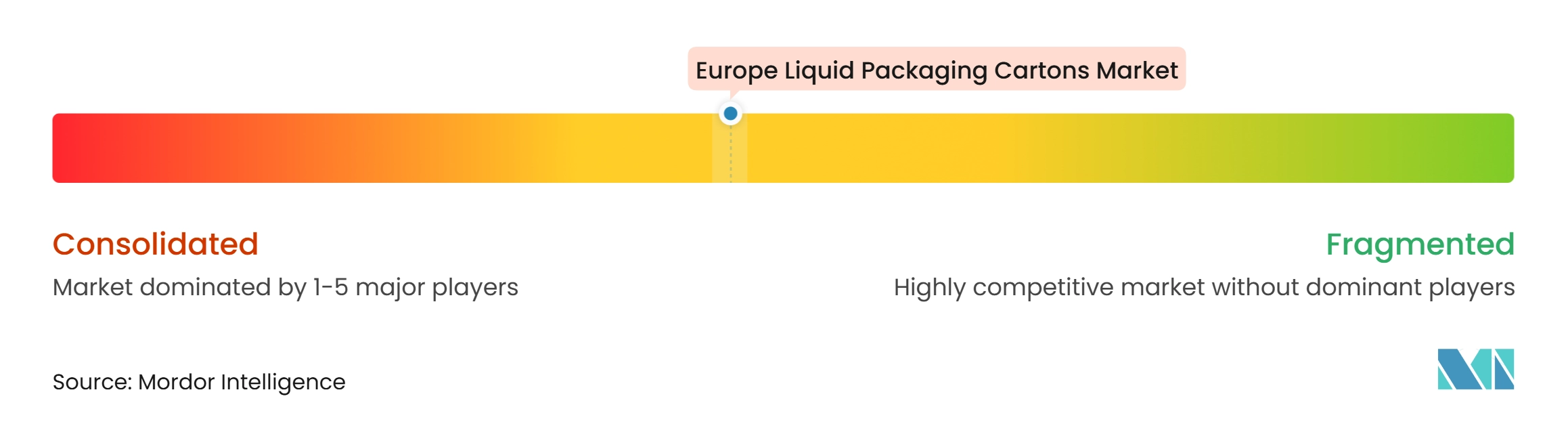
The Europe liquid packaging cartons market is concentrated around Tetra Pak International S.A., SIG Group AG, and Elopak ASA. Their integrated model combines packaging materials, filling equipment, technical service, and long-standing customer relationships. This structure creates high switching costs because a supplier change can affect filling operations as well as packaging procurement. Competition now centers on barrier materials, renewable content, recyclability, and the ability to use new materials on existing filling lines. Tetra Pak committed EUR 60 million, equivalent to USD 65 million, to a paper-based barrier pilot plant in Lund, Sweden, in January 2026.
SIG is pursuing aluminum-free aseptic solutions that can be processed on installed equipment. Its May 2025 SIG Terra Alu-free Full Barrier launch targeted multi-serve cartons and was designed for existing filling lines. Elopak is addressing similar pressure through fiber-based closure development. Its investment in Blue Ocean Closures offers a route to reduce the plastic component of carton closures. The Food and Beverage Carton Alliance’s RECY:CHECK protocol provides a shared method for recyclability evidence.
Expansion potential remains in Central and Eastern Europe, where filling-line installations and localized service can support new customers. Liquid foods, functional beverages, and plant-based drinks also provide openings because their packaging needs are less tied to conventional dairy volumes. Wintipak offers a mid-tier alternative in Germany through its planned capacity increase. The leading suppliers retain an advantage because their systems combine package development, filling technology, and compliance support.
Europe Liquid Packaging Cartons Industry Leaders
-
Tetra Pak International S.A.
-
SIG Group AG
-
Elopak ASA
-
Greatview Aseptic Packaging Company Limited
-
IPI S.r.l.
- *Disclaimer: Major Players sorted in no particular order
Europe Liquid Packaging Cartons Market Companies Covered in this Report
- Tetra Pak International S.A.
- SIG Group AG
- Elopak ASA
- Greatview Aseptic Packaging Company Limited
- Nippon Paper Industries Co., Ltd.
- IPI S.r.l.
- Mondi plc
- Stora Enso Oyj
- Billerud AB (publ)
- Lamipak International Co., Ltd.
- NewJF Packaging Co., Ltd.
- Shandong Bihai Packaging Materials Co., Ltd.
- Adam Pack S.A.
- Italpack S.r.l.
Recent Industry Developments in Europe Liquid Packaging Cartons Market
- April 2026: Tetra Pak International S.A. and Italian dairy company Sterilgarda Alimenti launched the first-ever 1-liter aseptic carton with a paper-based barrier, the Tetra Brik Aseptic 1000 Edge LightWing 30, achieving 90% renewable content in combination with plant-based polymers and reducing carbon footprint by up to 50%, transitioning from a three-material to a two-material structure.
- January 2026: Tetra Pak International S.A. announced a EUR 60 million, equivalent to USD 65 million, investment in a new pilot plant for paper-based barrier technology at its Lund, Sweden facility, as part of a commitment to invest EUR 100 million, equivalent to USD 109 million, annually through 2030, targeting scale-up of paper-based barrier to mainstream multi-serve carton volumes.
- December 2025: Tetra Pak, in collaboration with Spanish beverage producer García Carrión, launched the first-ever aseptic carton with a paper-based barrier for juice, the Tetra Brik Aseptic 200 ml Slim Leaf, available under the Don Simón brand, achieving 92% renewable content and a 43% carbon footprint reduction versus conventional aluminum-foil aseptic cartons, and representing the global first deployment of paper-based barrier technology in juice packaging.
- November 2025: Wintipak, formerly Greatview Aseptic Packaging Company Limited, broke ground on a new 11,800 m² production hall at its Star Park Halle-Saale, Germany facility, expected to increase aseptic carton production capacity by 30% upon planned completion in June 2026, reinforcing Germany as a European manufacturing base for alternative carton supply.
Europe Liquid Packaging Cartons Market Report Scope
The Europe Liquid Packaging Cartons Market encompasses the manufacturing and supply of paperboard-based packaging solutions designed for the safe storage, transportation, and distribution of liquid beverages and food products. These cartons provide product protection, extended shelf life, and convenient handling while supporting efficient packaging and distribution. The market includes packaging solutions designed to maintain product freshness, prevent contamination, and meet evolving food safety and sustainability requirements.
The Europe Liquid Packaging Cartons Market Report is segmented by Product Type (Aseptic Cartons, and Non-Aseptic Cartons), Applications (Milk, Juices, Plant Based Beverages, Dairy Products Excluding Milk, Energy and Functional Drinks, Liquid Food, and Other Applications), Pack Size (Below 250 ml, 250-500 ml, and Above 500 ml), and Geography (Germany, France, United Kingdom, Italy, Spain, and Rest of Europe). The Market Forecasts are Provided in Terms of Value (USD).
Segmentation Overview
| Aseptic Cartons |
| Non-Aseptic Cartons |
| Milk |
| Juices |
| Plant Based Beverages |
| Dairy Products (Excluding Milk) |
| Energy and Functional Drinks |
| Liquid Food |
| Other Applications |
| Below 250 ml |
| 250-500 ml |
| Above 500 ml |
| Germany |
| France |
| United Kingdom |
| Italy |
| Spain |
| Rest of Europe |
| By Product Type | Aseptic Cartons |
| Non-Aseptic Cartons | |
| By Applications | Milk |
| Juices | |
| Plant Based Beverages | |
| Dairy Products (Excluding Milk) | |
| Energy and Functional Drinks | |
| Liquid Food | |
| Other Applications | |
| By Pack Size | Below 250 ml |
| 250-500 ml | |
| Above 500 ml | |
| By Geography | Germany |
| France | |
| United Kingdom | |
| Italy | |
| Spain | |
| Rest of Europe |
Key Questions Answered in the Report
What is the Europe liquid packaging cartons market size?
The Europe liquid packaging cartons market is projected to be USD 1.91 billion in 2027 and USD 2.33 billion by 2032, at a 4.06% CAGR. Growth is linked to shelf-stable beverage and liquid-food packaging needs.
Which product type leads demand for liquid packaging cartons in Europe?
Aseptic cartons lead with 62.74% share in 2026 and are projected to grow at a 4.84% CAGR through 2032. Their ability to support long ambient shelf life remains central to their position.
Which application is growing fastest for carton packaging in Europe?
Plant-based beverages are projected to grow at a 4.96% CAGR through 2032. The category benefits from packaging that supports shelf-stable distribution through mainstream grocery and discount retail channels.
Why are paper-based barriers important for liquid cartons?
They can reduce reliance on aluminum layers while helping suppliers prepare for recyclability requirements and retailer sustainability reviews. They may also support simpler material structures without changing established filling operations.
Which European country has the largest carton packaging demand?
Germany holds 27.29% of market value in 2026, supported by UHT milk demand and ambient retail distribution. The country is also an important location for carton production capacity expansion.
Which geography is expected to grow fastest through 2032?
The United Kingdom is projected to grow at a 4.92% CAGR, supported by collection policy changes and sorting investments. These factors can improve conditions for carton recovery and recyclable design.