
Europe Kitchen Sink Market Size and Share
Market Overview
| Study Period | 2021 - 2032 |
|---|---|
| Forecast Data Period | 2027 - 2032 |
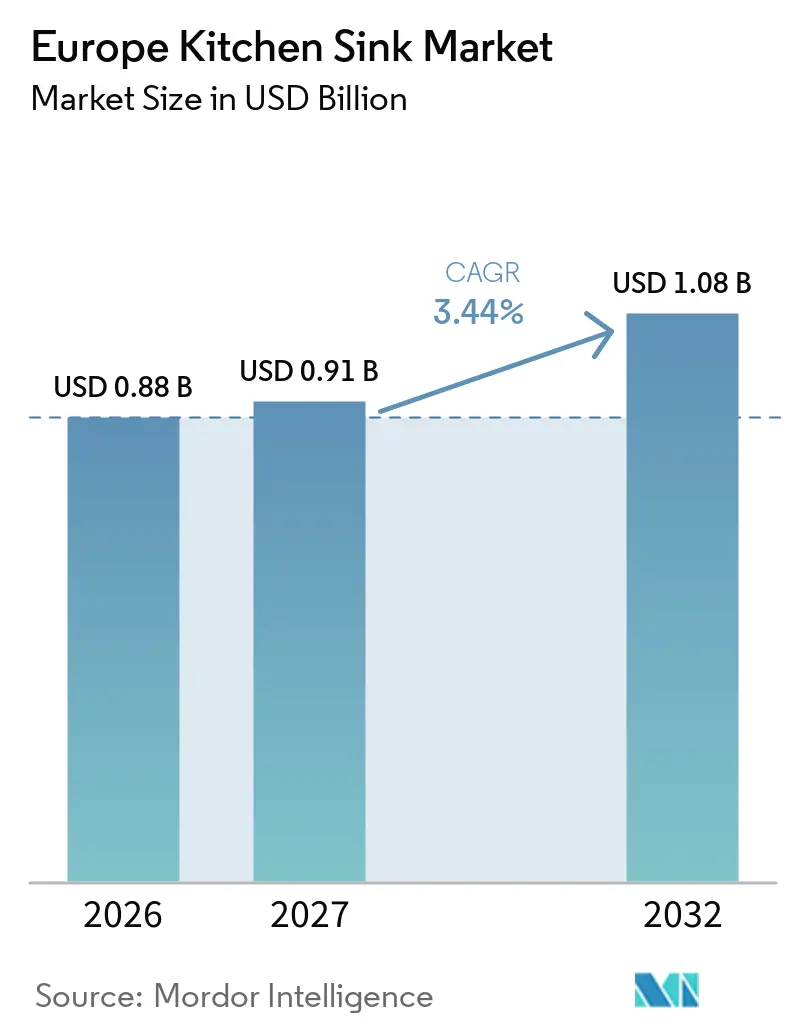
| Base Year Market Size (2026) | USD 0.88 Billion |
| Market Size (2027) | USD 0.91 Billion |
| Market Size (2032) | USD 1.08 Billion |
| Growth Rate (2027 - 2032) | 3.44 % |
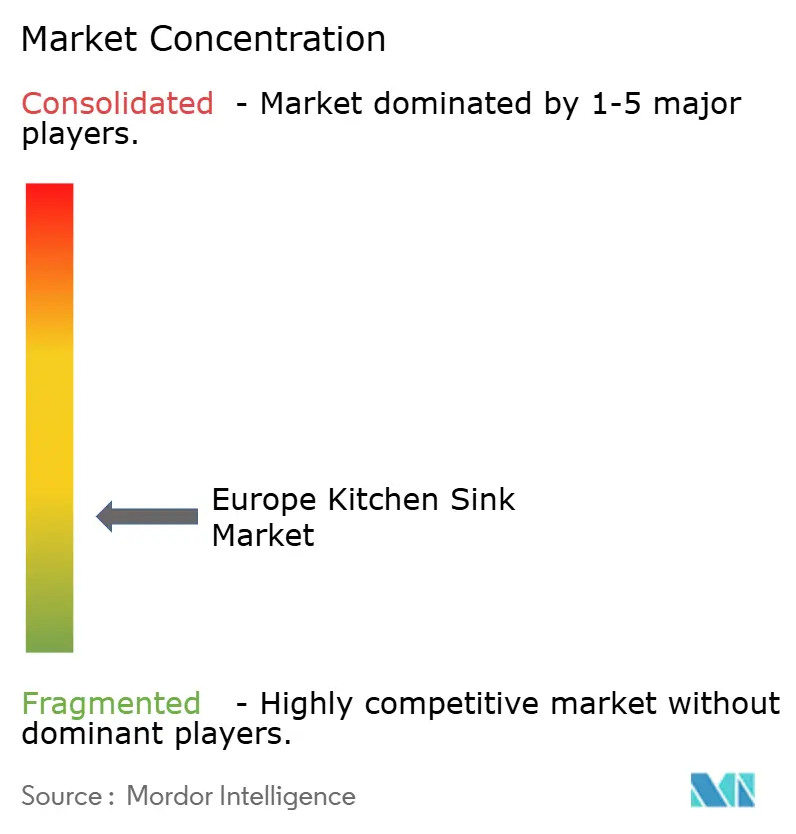
| Market Concentration | Low |
Major Players *Disclaimer: Major Players sorted in no particular order Image © Mordor Intelligence. Reuse requires attribution under CC BY 4.0. | |
Europe Kitchen Sink Market Analysis by Mordor Intelligence
The Europe kitchen sink market was valued at USD 0.88 billion in 2026, is estimated at USD 0.91 billion in 2027, and is forecast to reach USD 1.08 billion by 2032, growing at a 3.44% CAGR during 2027–2032. The European kitchen sink market is supported mainly by renovation and replacement activity rather than by new housing construction. Germany illustrates this pattern, as domestic kitchen retail revenue increased 3.9% in 2025 while unit volumes declined 1.3%, and the average kitchen purchase reached EUR 12,177, showing that buyers are choosing higher-value projects[1]. The large stock of older kitchens sustains replacement demand, with 16 million German homes containing kitchens that are more than 20 years old. Manufacturers are responding through integrated sink, tap, waste, and storage offers, while durability, hygiene, and recycled-content requirements increasingly shape product design[2]. Slower home completions and changing input costs limit demand in some locations, but they also reinforce the importance of renovation-led sales in the European kitchen sink market.
Key Report Takeaways
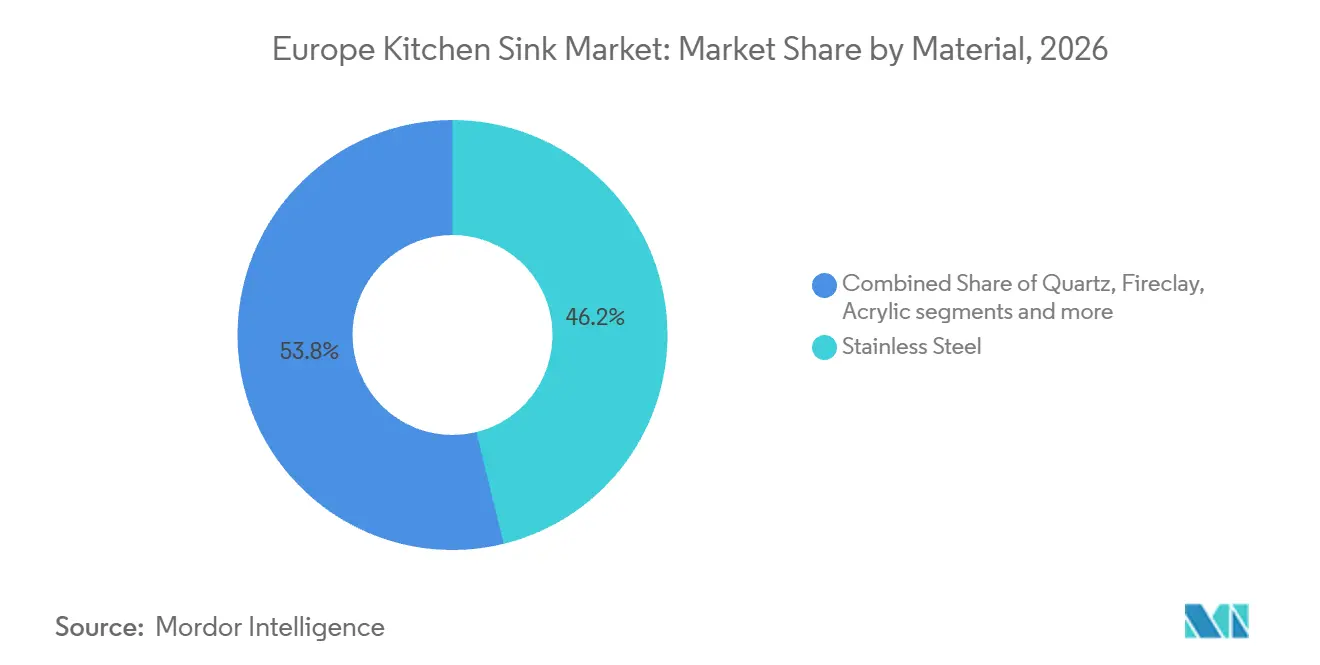
- By material, stainless steel held 46.17% of the Europe kitchen sink market share in 2026, while quartz composite is projected to grow at a 4.52% CAGR through 2032.
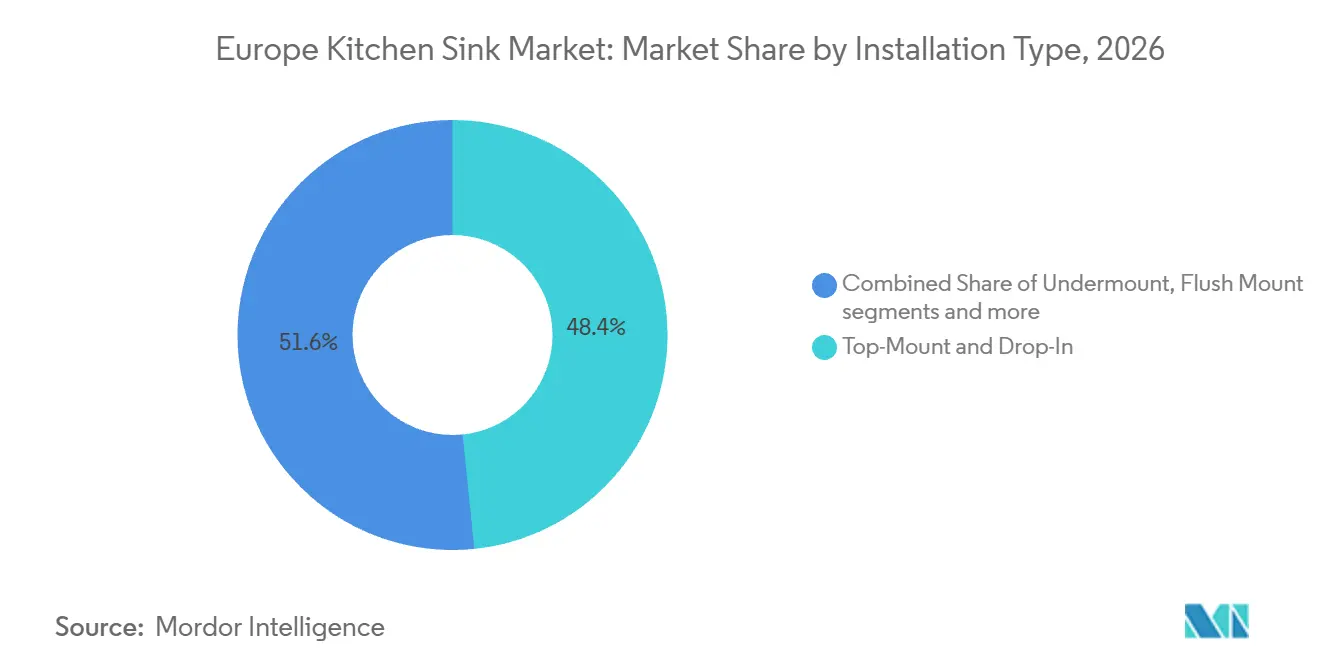
- By installation type, top-mount and drop-in products held 48.38% of the Europe kitchen sink market share in 2026, while flush-mount products are projected to grow at a 4.16% CAGR through 2032.
- By bowl configuration, single-bowl products held 42.73% of the Europe kitchen sink market share in 2026 and are projected to grow at a 4.07% CAGR through 2032.
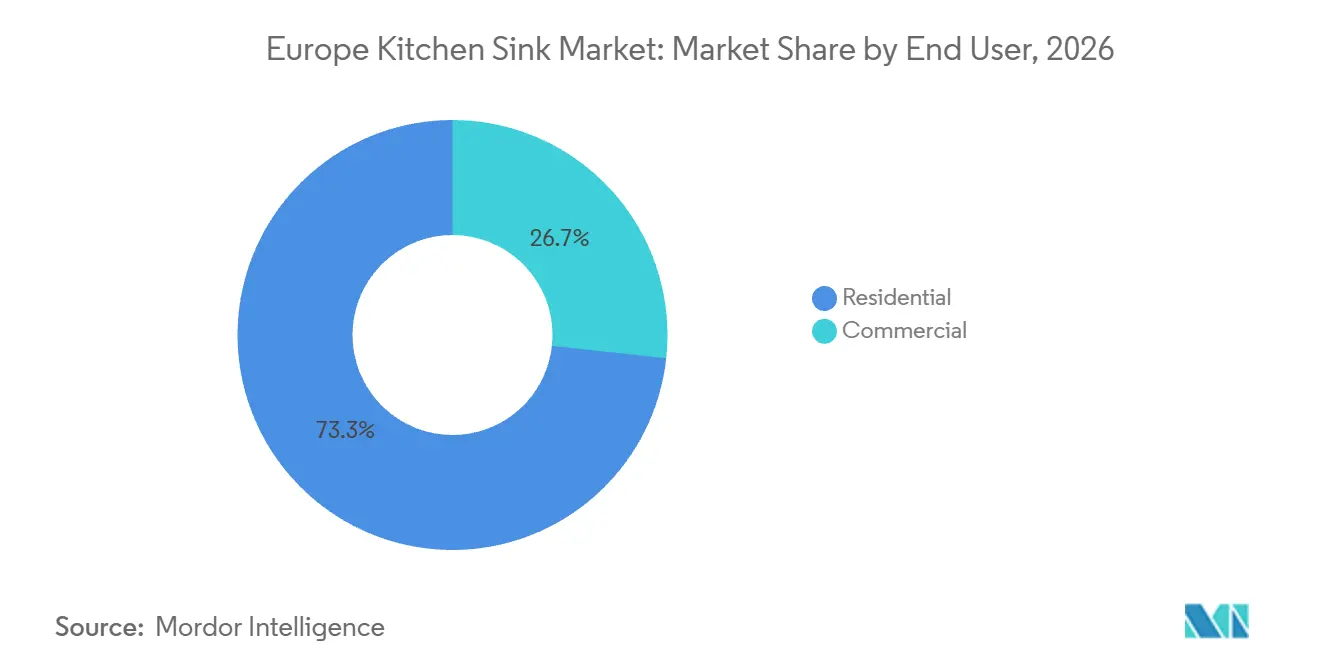
- By end user, residential products held 73.27% of the Europe kitchen sink market share in 2026, while commercial products are projected to grow at a 3.92% CAGR through 2032.
- By distribution channel, B2C and retail held 76.36% of the Europe kitchen sink market share in 2026 and are projected to grow at a 3.71% CAGR through 2032.
- By geography, Germany held 22.64% of the Europe kitchen sink market share in 2026, while Spain is projected to grow at a 4.27% CAGR through 2032.
Note: Market numbers in this report are based on Mordor Intelligence's proprietary estimation framework, which combines nine months of actuals with Q4 projections for base year 2026.
Market Trends and Insights
Drivers Impact Analysis of Europe Kitchen Sink Market*
| Driver | (~) % Impact on CAGR Forecast | Geographic Relevance | Impact Timeline |
|---|---|---|---|
| Kitchen Renovation and Premium Replacement Demand | +1.2% | Pan-European, strongest in Germany, UK, and France | Short term (≤ 2 years) |
| Preference for Durable, Hygienic, and Design-Led Materials | +0.9% | Germany, Italy, Nordics, and UK | Medium term (2-4 years) |
| Growth of Workstation and Integrated Kitchen Systems | +0.7% | Western Europe, BENELUX, Germany, and UK | Medium term (2-4 years) |
| Sustainability, Recycled Content, and Circular-Design Demand | +0.5% | EU-wide, Brussels-driven regulatory push | Long term (≥ 4 years) |
| Hospitality and Foodservice Refurbishment | +0.4% | Spain, Italy, France, and the Mediterranean corridor | Short term (≤ 2 years) |
| E-Commerce and Specialist Kitchen-Showroom Expansion | +0.4% | Western Europe, UK, BENELUX, and Nordics | Short term (≤ 2 years) |
| Source: Mordor Intelligence | |||
Kitchen Renovation and Premium Replacement Demand
The Europe kitchen sink market is shaped by replacement demand because the region has a mature housing base and a substantial installed kitchen stock. In Germany, 16 million homes have kitchens that are more than 20 years old, which creates a continuing pool of households that may renew fixtures during kitchen upgrades. German domestic kitchen retail revenue rose 3.9% in 2025 even as sales volumes decreased 1.3%, and the average purchase value reached EUR 12,177. This pattern favors sinks that form part of a broader premium kitchen specification rather than basic replacement purchases. Spain also offers a renovation demand base, as the Ministry of Housing reported EUR 676.9 million in residential renovation permit budgets in the second quarter of 2025[3]. The Europe kitchen sink market therefore benefits when owners combine new worktops, cabinetry, taps, and sinks within a single renovation project.
Durable, Hygienic, and Design-Led Materials
Material selection increasingly combines functional performance with the appearance required by contemporary kitchen designs. Stainless steel remains widely used because its nonporous surface, broad worktop compatibility, and fabrication flexibility fit both entry-level and premium products. Quartz composite is gaining attention through its scratch resistance, heat resistance, antibacterial surface characteristics, and wider color choices. Teka introduced the Be Linea PureClean sink in January 2025 with a nano-coating designed to repel water and reduce bacterial adhesion, together with a revised basket intended to improve drainage[4]. The EN 13310 standard provides a shared baseline for drainage, resistance to temperature changes, loading, and chemical resistance, so manufacturers seek differentiation through performance above that baseline. These choices give the Europe kitchen sink market a route to value growth even where unit demand is restrained.
Workstation Systems and Integrated Kitchen Offers
Workstation formats extend the sink from a washing point into a food preparation area through accessory ledges, cutting boards, colanders, and drying racks. BLANCO introduced the INTEOS workstation system in February 2025 with a common cutout approach across stainless steel and SILGRANIT models, which can simplify planning for kitchen projects. The product direction is particularly relevant to open-plan homes where the sink must work with both kitchen design and daily preparation needs. Integrated offers also bring together the sink, tap, drain, and storage system, making the kitchen water area a larger specification decision. The Europe kitchen sink market gains from this approach because manufacturers can compete on a complete solution rather than on bowl design alone.
Sustainability, Recycled Content, and Circular Design
The Ecodesign for Sustainable Products Regulation creates a European framework for more durable, repairable, and recyclable products. Ireland’s Department of Enterprise, Trade and Employment notes that the 2025-2030 working plan prioritizes iron and steel, which is relevant to stainless steel sink production. Kohler reported in 2025 that its enameled cast iron and stainless steel kitchen sinks use more than 80% recycled material. These product disclosures provide a reference point for architects, institutional purchasers, and buyers that want documented material information. Digital product information will become more important as rules progress from a broad framework toward product-specific measures. Sustainability requirements therefore affect the Europe kitchen sink market through design, sourcing, supplier disclosure, and specification processes.
Restraints Impact Analysis of Europe Kitchen Sink Market*
| Restraint | (~) % Impact on CAGR Forecast | Geographic Relevance | Impact Timeline |
|---|---|---|---|
| Mature Housing Stock and Long Replacement Intervals | -0.8% | Germany, France, UK, and Nordics | Short term (≤ 2 years) |
| High Energy, Labor, and Compliance Costs | -0.5% | Pan-European, concentrated in Germany | Medium term (2-4 years) |
| Volatile Stainless-Steel and Composite Input Prices | -0.4% | Global supply chain, felt in Germany and Italy | Short term (≤ 2 years) |
| Complex Country-Level Standards and Installer Requirements | -0.2% | EU peripheral markets and Eastern Europe | Long term (≥ 4 years) |
| Source: Mordor Intelligence | |||
Long Replacement Cycles and Weak Housing Completion Activity
Long product lives can delay a sink purchase until a household undertakes a full kitchen renovation or replaces a worktop. This reduces the frequency of stand-alone replacement purchases in established European housing markets. AMK expects fewer than 200,000 German home completions in 2026, compared with the national policy target of 400,000 homes. The same association reported that building permits in January 2026 rose 8.4% from a year earlier, which indicates an improving construction pipeline but not immediate completion activity. Demand from a permit recovery reaches appliance and fixture suppliers later than the initial approval stage. The Europe kitchen sink market remains exposed to this timing effect because kitchen specification is concentrated in later stages of residential construction.
Input Costs and Country-Level Compliance Requirements
Stainless steel sink producers are exposed to nickel, energy, labor, and transport costs, while composite suppliers depend on resin and other petrochemical inputs. Price changes can complicate product pricing at a time when household renovation budgets remain selective. Material requirements also vary across applications, as products need to meet technical, hygiene, installation, and warranty expectations in different countries. EN 13310 gives a European performance reference for kitchen sinks, but installation practices and channel requirements continue to differ across national markets. Larger manufacturers can manage these pressures through broader material portfolios and established supplier relationships. Smaller specialists may have less flexibility when costs change or when a project needs country-specific documentation. These conditions can slow the Europe kitchen sink market, where price-sensitive buyers defer renovation work.
*Our forecasts treat driver/restraint impacts as directional, not additive. The impact forecasts reflect baseline growth, mix effects, and variable interactions.
Europe Kitchen Sink Market Segment Analysis
By Material:
Stainless Steel Maintains Scale While Quartz Composite GrowsStainless steel held 46.17% of the Europe kitchen sink market share in 2026, making it the largest material category. Its established position reflects compatibility with a wide range of worktops, hygienic properties, easy fabrication, and availability from entry-level to premium designs. Steel products serve volume renovation activity through home centers, kitchen studios, and contractor channels. The category also includes premium versions with sound insulation, advanced drainage, and surface coatings. These features allow suppliers to retain relevance as more buyers seek a higher-specification kitchen. Stainless steel therefore remains central to the European kitchen sink market size across both replacement and project sales.
Quartz composite is projected to record a 4.52% CAGR through 2032, the highest rate among materials. It supports a premium offer because it combines a wider color palette with resistance to scratches, heat, and staining. Carysil reported that European customers increased quartz composite orders in the fourth quarter of fiscal year 2025. Fireclay and ceramic retain a smaller premium position in farmhouse and apron-front designs, especially in Italy, France, the United Kingdom, and rural Spain. Granite composite and acrylic products serve buyers seeking a stone appearance or a lower entry price. The material mix shows that manufacturers can address several price points without relying on a single material platform.

By Installation Type:
Flush-Mount Products Gain Ground in Premium RenovationsTop-mount and drop-in products held 48.38% of the Europe kitchen sink market share in 2026, which reflects their broad compatibility and comparatively simple installation. They work with laminate and other worktop materials, making them suitable when a homeowner replaces a sink without changing the counter. This practical fit supports their role in budget-conscious renovations and mass-market residential projects. The format also has established installer familiarity across European markets. Technical requirements under EN 13310 apply across installation methods, providing common performance expectations.
Flush-mount sinks are projected to grow at a 4.16% CAGR through 2032. They suit quartz, ceramic, natural stone, and other solid surfaces that allow precise alignment with the worktop edge. This format offers an uninterrupted surface and supports contemporary kitchen designs that prioritize clean lines and easier counter cleaning. Undermount products address a similar high-value worktop segment, although their visual result and fitting approach are different. Flexible products that accommodate more than one mounting method can reduce planning complexity for designers and installers. The Europe kitchen sink market benefits when installation choice becomes part of a premium worktop package.
By Bowl Configuration:
Single-Bowl Products Lead Demand and GrowthSingle-bowl products held 42.73% of the Europe kitchen sink market share in 2026 and are projected to grow at a 4.07% CAGR through 2032. This combined position reflects the fit between a large uninterrupted bowl and the workstation format. A continuous bowl edge can support accessories across its width, including boards, racks, and colanders. This configuration also accommodates large cookware, which is useful in smaller urban kitchens that need flexible preparation space. Manufacturers can offer the format in stainless steel, composite, ceramic, and other materials. Its broad design scope supports sales at several price levels.
Dual-bowl sinks continue to serve homes and commercial settings where users need separate areas for washing, rinsing, or soaking. Their value is strongest where workflow separation is more important than a full-width accessory ledge. Triple and multi-bowl products have a smaller role and are more closely connected to professional or semi-commercial work patterns. They need larger cabinet footprints and are often sold through project or B2B channels. The bowl choice depends on kitchen size, household behavior, worktop design, and the level of integrated accessories. The Europe kitchen sink industry therefore has a balanced configuration mix even though single-bowl designs lead current demand.
By End User:
Residential Demand Remains Largest While Commercial Use ExpandsResidential products held 73.27% of the Europe kitchen sink market share in 2026. The segment is supported by the large housing base, aging installed kitchens, and spending on renovation-led design upgrades. German data show that buyers are placing greater value on kitchen projects even as unit volumes are weaker. Urban households in Germany, BENELUX, and the United Kingdom can favor compact premium formats that fit smaller kitchen plans. Residential buyers also often select the sink with a tap, worktop, and cabinetry at the same time. This makes showroom advice and integrated product offers important to the segment.
Commercial products are projected to grow at a 3.92% CAGR through 2032, the fastest rate among end users. Hospitality and foodservice refurbishment supports demand for durable, hygiene-focused products with clear technical documentation. The USDA’s 2025 report on Spain identified continuing modernization in the hotel, restaurant, and institutional foodservice sector. Commercial projects often have larger order sizes, fixed installation schedules, and stricter specifications than household renovations. Suppliers that can support these requirements can build durable relationships with project buyers. The Europe kitchen sink market gains from commercial refurbishment even when residential construction is slower.
By Distribution Channel:
B2C and Retail Combine Reach With GrowthB2C and retail held 76.36% of the European kitchen sink market share in 2026 and are projected to expand at a 3.71% CAGR through 2032. Specialist kitchen showrooms, home centers, and online stores all contribute to this channel. Showrooms remain important when buyers need to compare materials, colors, sink depth, accessories, and matching taps. Online research can inform the choice before a buyer visits a physical store or places an order. The retail route supports the replacement cycle because consumers often begin with a product search rather than a contractor-led tender. It also gives suppliers a platform to explain premium product features.
European e-commerce supports the digital part of this buying journey, although the sink is often purchased within a wider kitchen project. European B2C e-commerce reached EUR 911 billion in 2025, up 7%, and is forecast to grow 5% to EUR 961 billion in 2026. The B2B and project channel remains important for contractors, hospitality buyers, and institutional customers who require volume commitments or technical coordination. Manufacturers use direct relationships in these situations to support specifications and delivery schedules. Home centers continue to serve lower-priced steel replacement demand, while exclusive outlets support premium lines. The European kitchen sink market uses both channels because consumer-led renovation and project work have different purchasing patterns.
Geography Analysis
Germany held 22.64% of the Europe kitchen sink market share in 2026, making it the largest country market. Domestic kitchen retail revenue increased 3.9% in 2025 while volumes fell 1.3%, showing that project values are rising even in a constrained construction setting. Germany also has 16 million homes with kitchens that are more than 20 years old, supporting a long-term replacement pool. Fewer than 200,000 home completions are expected in 2026, which limits new-build sales. The United Kingdom and France also add meaningful renovation-led demand.
Spain is projected to grow at a 4.27% CAGR through 2032, the highest rate among the listed geographies. Residential renovation permit budgets reached EUR 676.9 million in the second quarter of 2025, the highest second-quarter figure in the ministry’s historical series. Italy contributes design-led demand for flush-mount, undermount, ceramic, and composite formats. Nordic markets show a gradual improvement in renovation activity, and Swedish kitchen furniture sales increased 5% in 2025. The Europe kitchen sink market size in these countries benefits when renovation incentives and established kitchen retail channels support replacement spending.
BENELUX combines high household income with demand for bespoke kitchen design and integrated worktop solutions. The Netherlands and Luxembourg can be receptive to workstation and composite formats, particularly where kitchen studios lead product specification. Poland, Romania, and the Czech Republic support a different opportunity through residential construction and growing home improvement budgets. Portugal, Greece, and Balkan markets add rural renovation activity that can support basic replacement demand. These geographic differences require suppliers to balance premium design offers with accessible products, local distribution, and installer support.
Competitive Landscape
The Europe kitchen sink market is fragmented. Franke Group and BLANCO are prominent European specialists with portfolios that extend beyond sinks to taps, waste systems, and related kitchen products. BLANCO introduced the INTEOS workstation system in 2025 and later presented VELGRANIT material in its product innovation program. These moves show how established suppliers compete through material, functionality, and system design.
Other European companies compete through regional presence, responsive service, and selected material expertise. Teka’s integration into Midea Group in April 2025 increased its access to a larger research and supply chain network. Mid-tier suppliers retain a role in stainless steel and granite composite categories, where value, availability, and local service remain important. This mix prevents a small set of premium brands from controlling all parts of the European kitchen sink market.
Asian-origin producers are extending their reach in the mid-market retail channel. Carysil, an IKEA quartz sink supplier since 2020, won an expanded 2025 award covering roughly 70% of IKEA’s global non-US quartz sink requirement and began supplies in late 2025. This development can make composite formats available to a wider buyer base. The EU working plan’s focus on iron and steel increases the value of early preparation for material disclosures and circular design requirements.
Europe Kitchen Sink Industry Leaders
-
Franke Group
-
BLANCO GmbH + Co KG
-
Kohler Co.
-
Teka Industrial S.A.
-
Reginox B.V.
- *Disclaimer: Major Players sorted in no particular order
Europe Kitchen Sink Market Companies Covered in this Report
- Franke Group
- BLANCO GmbH + Co KG
- Teka Industrial S.A.
- Roca Sanitario, S.A.
- Reginox B.V.
- Alveus d.o.o.
- Kohler Co.
- Carysil Limited
- Villeroy & Boch AG
- Naber GmbH
- LIXIL Corporation
- SCHOCK GmbH
- Laveo
- systemceram
- Elleci
- Pyramis Metallourgia
- Plados Telma
- Granitan
- Foster S.p.A.
- Deante
Recent Industry Developments in Europe Kitchen Sink Market
- March 2026: BLANCO launched the OOVALON/LUNEOO UNIT featuring its new patented VELGRANIT® granite composite material and the leverless LUNEOO-S smart tap with LED water-temperature indicator and touch-sensor measurement dial. The unit received the iF Design Award 2026 in the kitchen appliances category. The OOVALON sink is available in undermount and flush-mount installation in a 33-inch minimum cabinet configuration, in new colors Mystic Black and Cloud White.
- April 2025: Teka Industrial S.A. was formally integrated into the Midea Group, providing access to Midea's global R&D and supply chain scale. Teka showcased its new G1 Edition, designed by Italdesign Giugiaro, and the Van Gogh Museum Edition at IFA 2025 in Berlin, alongside full-black sinks, PVD-finish stainless steel sinks, and new PureClean-coated models targeting the premium design segment.
- January 2025: Teka introduced the Be Linea PureClean stainless steel sink, extending its lotus-inspired hydrophobic PureClean nano-coating to the Be Linea range, reducing bacterial proliferation and limescale adhesion and improving drainage through a redesigned HelixPro basket.
Europe Kitchen Sink Market Report Scope
Segmentation Overview
| Stainless Steel |
| Quartz |
| Fireclay |
| Granite and Marble |
| Acrylic |
| Other Materials |
| Top-Mount and Drop-In |
| Undermount |
| Farmhouse and Apron-Front |
| Flush Mount |
| Dual Mount |
| Other Installation Types |
| Single Bowl |
| Dual Bowl |
| Triple /Multi-bowl |
| Residential |
| Commercial |
| B2C/Retail | Home Centers/DIY |
| Exclusive Brand Outlets | |
| Local Hardware Shops/Unorganized Market | |
| Online | |
| Other Distribution Channels | |
| B2B/Project (Direct from the Manufacturers) |
| United Kingdom |
| Germany |
| France |
| Spain |
| Italy |
| BENELUX (Belgium, Netherlands, Luxembourg) |
| NORDICS (Denmark, Finland, Iceland, Norway, Sweden) |
| Rest of Europe |
| By Material | Stainless Steel | |
| Quartz | ||
| Fireclay | ||
| Granite and Marble | ||
| Acrylic | ||
| Other Materials | ||
| By Installation Type | Top-Mount and Drop-In | |
| Undermount | ||
| Farmhouse and Apron-Front | ||
| Flush Mount | ||
| Dual Mount | ||
| Other Installation Types | ||
| By Bowl Configuration | Single Bowl | |
| Dual Bowl | ||
| Triple /Multi-bowl | ||
| By End User | Residential | |
| Commercial | ||
| By Distribution Channel | B2C/Retail | Home Centers/DIY |
| Exclusive Brand Outlets | ||
| Local Hardware Shops/Unorganized Market | ||
| Online | ||
| Other Distribution Channels | ||
| B2B/Project (Direct from the Manufacturers) | ||
| By Geography | United Kingdom | |
| Germany | ||
| France | ||
| Spain | ||
| Italy | ||
| BENELUX (Belgium, Netherlands, Luxembourg) | ||
| NORDICS (Denmark, Finland, Iceland, Norway, Sweden) | ||
| Rest of Europe | ||
Key Questions Answered in the Report
What is the forecast growth rate for kitchen sinks in Europe?
The category is projected to grow at a 3.44% CAGR from 2027 to 2031, rising from USD 0.88 billion in 2026 to USD 1.08 billion in 2032.
Which material leads kitchen sink sales in Europe?
Stainless steel led with a 46.17% share in 2026 because it offers broad worktop compatibility, hygienic properties, and a wide price range.
Why is quartz composite growing faster than other sink materials?
Quartz composite is projected to grow at 4.52% CAGR through 2032 because of its color range, scratch resistance, heat resistance, and premium positioning.
Which installation format is growing fastest in Europe?
Flush-mount sinks are projected to grow at 4.16% CAGR through 2032 as solid-surface worktops become more common in premium renovations.
Which country is expected to grow fastest through 2032?
Spain is projected to grow at a 4.27% CAGR, supported by residential renovation spending and hospitality refurbishment activity.