
Europe GPU Liquid Cooling Market Size and Share
Market Overview
| Study Period | 2020 - 2031 |
|---|---|
| Forecast Data Period | 2026 - 2031 |
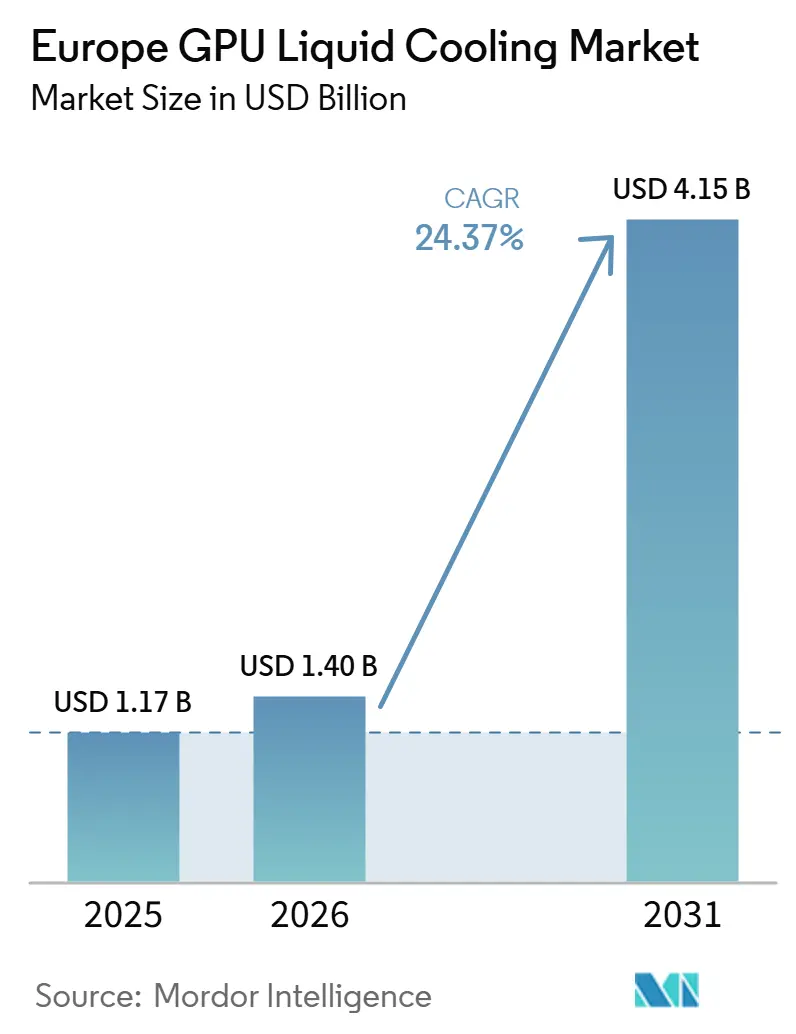
| Base Year Market Size (2025) | USD 1.17 Billion |
| Market Size (2026) | USD 1.40 Billion |
| Market Size (2031) | USD 4.15 Billion |
| Growth Rate (2026 - 2031) | 24.37 % |
| Market Concentration | Medium |
Major Players *Disclaimer: Major Players sorted in no particular order Image © Mordor Intelligence. Reuse requires attribution under CC BY 4.0. | |
Europe GPU Liquid Cooling Market Analysis by Mordor Intelligence
The Europe GPU liquid cooling market is expected to increase from USD 1.17 billion in 2025 to USD 1.40 billion in 2026 and reach USD 4.15 billion by 2031, growing at a CAGR of 24.37% over 2026-2031. Growth is closely tied to Europe’s pivot toward sovereign artificial-intelligence infrastructure, where generative-AI clusters require thermal solutions that air cooling cannot deliver economically. Revised European Union energy-efficiency rules now obligate data centers above 500 kilowatts to report granular performance metrics, pushing operators to adopt liquid cooling to meet power-usage-effectiveness targets. GPU power density has already crossed the 700-watt threshold in production systems, and hyperscalers view liquid cooling as a prerequisite for hosting NVIDIA’s GB200 and similar accelerators. The rapid emergence of district-heating partnerships further strengthens the business case by converting waste heat into a revenue stream.
Key Report Takeaways
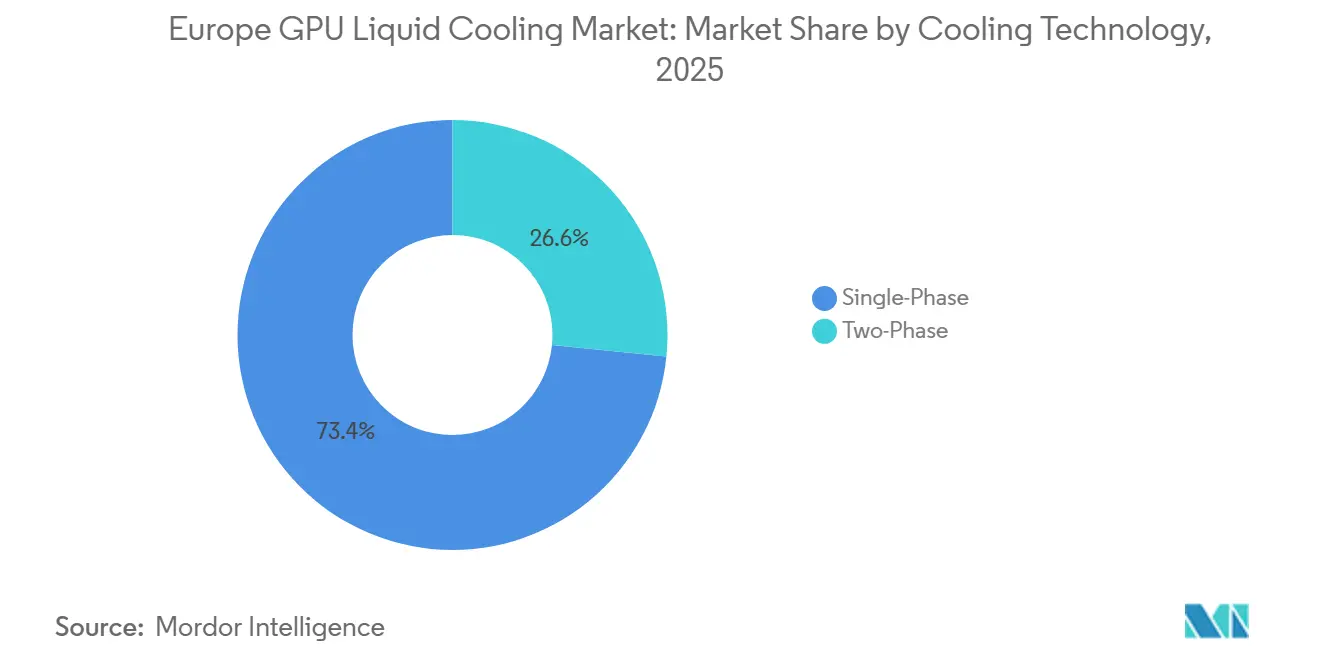
- By cooling type, single-phase liquid cooling accounted for 73.40% of the GPU liquid-cooling market share in 2025, while the two-phase liquid cooling segment is projected to expand at a CAGR of 25.70% over the forecast period.
- By cooling level, component-level solutions accounted for 57.60% of the GPU liquid-cooling market in 2025, and the rack-level systems segment is the fastest-growing, with a CAGR of 26.80% through 2031.
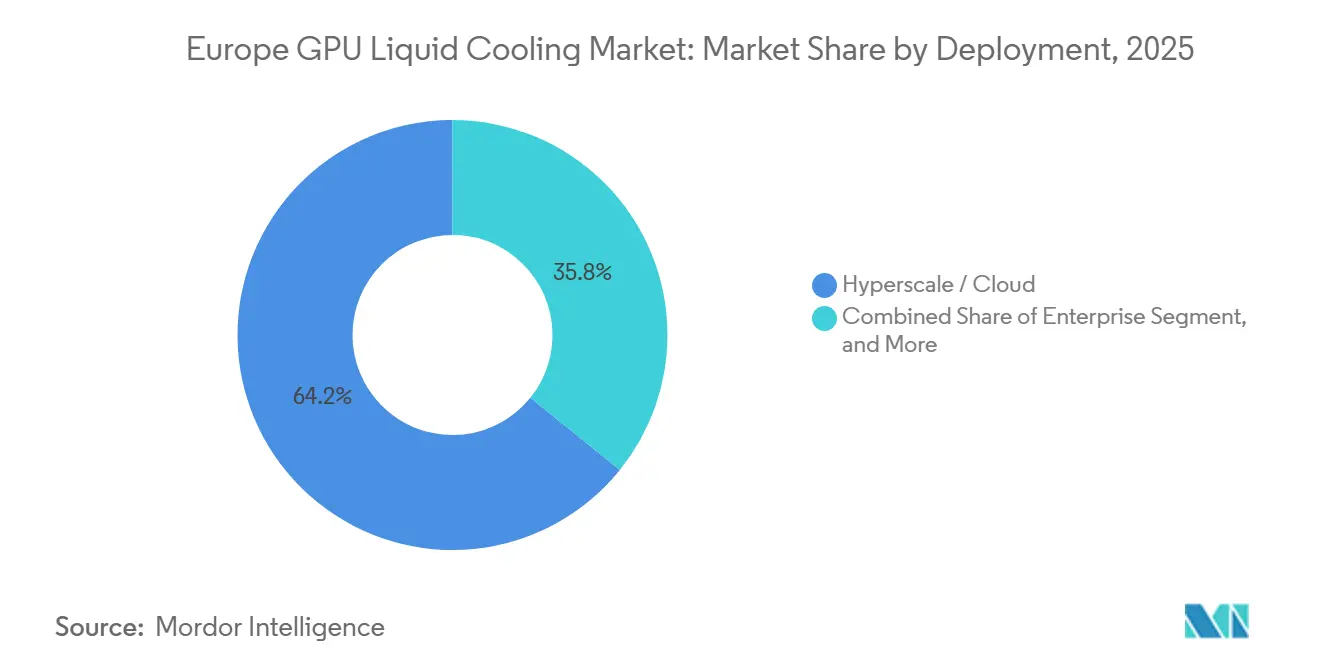
- By deployment, hyperscale and cloud installations led with 64.20% revenue share in 2025, while the enterprise segment is projected to expand at a 27.30% CAGR to 2031.
- By GPU power density, the 300-700 watt class accounted for 51.70% of the graphics processing unit (GPU) liquid cooling market in 2025, whereas the above-700 watt category is forecast to grow at a 26.90% CAGR through 2031.
- By geography, Germany captured 26.80% of 2025 revenue, while France is anticipated to grow at a 27.10% CAGR during 2026-2031.
Note: Market size and forecast figures in this report are generated using Mordor Intelligence’s proprietary estimation framework, updated with the latest available data and insights as of January 2026.
Europe GPU Liquid Cooling Market Trends and Insights
Drivers Impact Analysis*
| Driver | (~) % Impact on CAGR Forecast | Geographic Relevance | Impact Timeline |
|---|---|---|---|
| Rapid Proliferation of Generative AI Workloads in European Data Centers | +5.80% | Germany, France, Netherlands, Sweden, Southern Europe | Short term (≤ 2 years) |
| Stringent EU Energy Efficiency Directives Favoring Liquid Cooling Adoption | +4.20% | EU-wide, early enforcement in Germany, France, Netherlands | Medium term (2-4 years) |
| Rising GPU Power Density Exceeding 700 W | +3.90% | Frankfurt, Paris, Amsterdam, HPC centers | Short term (≤ 2 years) |
| Carbon Reduction Targets Driving Shift From Air to Liquid Cooling | +3.50% | Northern and Western Europe | Long term (≥ 4 years) |
| Accelerated Deployment of Edge AI Inference Nodes in Telecom Networks | +2.10% | Pan-European telecom footprints | Medium term (2-4 years) |
| Availability of EU Recovery Funds for HPC Upgrades | +1.80% | EuroHPC JU member states | Medium term (2-4 years) |
| Source: Mordor Intelligence | |||
Rapid Proliferation of Generative AI Workloads in European Data Centers
Large language-model training clusters are scaling fast, with individual deployments running well above 50 kilowatts per rack, a density that air cooling fails to support. Projects such as the 13,800-GPU build in Paris and the 100,000-processor campus in Norway highlight how sovereign-AI ambitions are translating into concrete capital spend. Liquid cooling removes heat at the chip, lowering power-usage-effectiveness ratios to below 1.15 and mitigating stranded-asset risk for facilities designed around air handling. Operators able to offer liquid-cooled capacity secure premium utilization rates because generative-AI tenants now specify liquid cooling as mandatory. This workload shift is cascading beyond hyperscalers, prompting mid-market enterprises to evaluate liquid cooling earlier in their refresh cycles. As model sizes grow, demand for higher coolant-return temperatures that support district-heating integration is also accelerating adoption.
Stringent EU Energy Efficiency Directives Favoring Liquid Cooling Adoption
The 2024 revision of the Energy Efficiency Directive mandates annual disclosure of power-usage-effectiveness, water-usage-effectiveness, energy-reuse factor, and renewable-energy factor for data centers exceeding 500 kilowatts.[1]European Commission, “Energy Efficiency Directive,” EUROPEAN COMMISSION, energy.ec.europa.eu Operators must present waste-heat recovery plans, and only facilities meeting power-usage-effectiveness below 1.3 qualify as green investments under the EU Taxonomy. Liquid cooling, with outlet temperatures above 40 °C, enables operators to sell thermal energy to municipal grids, improving project returns. Early adopters in Germany and France already integrate heat-exchange interfaces into the initial design, reducing retrofit complexity later. The directive also incentivizes hyperscalers to cluster GPU loads in liquid-ready zones within multiregion footprints, concentrating demand and accelerating supply-chain standardization.
Rising GPU Power Density Exceeding 700 W Necessitating Advanced Thermal Solutions
NVIDIA’s H200 and incoming B200 GPUs draw between 700 and 1,000 watts, levels that overwhelm high-velocity air systems. Rack-scale solutions such as the GB200 NVL72 integrate 72 GPUs and require coordinated coolant distribution across compute and networking layers.[2]NVIDIA Corp., “H200 Tensor Core GPU,” NVIDIA, nvidia.com Warm-water cooling proved viable at Forschungszentrum Jülich’s JUPITER exascale installation, which operates with return temperatures suitable for district heating.[3]EuroHPC Joint Undertaking, “JUPITER: First European Exascale Supercomputer,” EUROHPC, eurohpc-ju.europa.eu These public demonstrations shorten procurement cycles for commercial buyers who previously viewed liquid cooling as experimental. Component suppliers now embed leak detection and quick-disconnect features to align with enterprise maintenance processes, further reducing adoption barriers. As chip roadmaps push beyond 1 kilowatt per device, liquid cooling ceases to be optional.
Carbon Reduction Targets Driving Shift From Air to Liquid Cooling in Hyperscale Facilities
Signatories to the Climate Neutral Data Center Pact commit to climate neutrality by 2030, including power-usage-effectiveness below 1.3 for new builds. Liquid cooling directly lowers cooling-fan electricity, shrinking overall facility demand by up to 30%. Examples include the Borlänge site in Sweden, where hydro-powered, liquid-cooled GPU clusters reach power-usage-effectiveness under 1.10 while providing heat to the local district network. Southern Europe is following suit, evidenced by Brescia’s residential heating pilot that feeds 300 apartments using server waste heat. Regulatory preference for on-site renewable integration further positions liquid cooling as the default thermal strategy for next-generation hyperscale campuses.
Restraints Impact Analysis*
| Restraint | (~) % Impact on CAGR Forecast | Geographic Relevance | Impact Timeline |
|---|---|---|---|
| High Initial Capital Expenditure for Retrofit in Legacy European Data Centers | -1.90% | Germany, United Kingdom, France, Netherlands | Short term (≤ 2 years) |
| Stringent Safety Certification Requirements for Two-Phase Coolants | -1.20% | EU-wide, stricter in Germany and Nordics | Medium term (2-4 years) |
| Limited Standardization of Cold Plate and Manifold Interfaces Across Vendors | -0.80% | Pan-European | Medium term (2-4 years) |
| Concerns Around Dielectric Fluid Environmental Disposal Regulations | -0.60% | EU-wide, stronger in Northern Europe | Long term (≥ 4 years) |
| Source: Mordor Intelligence | |||
High Initial Capital Expenditure for Retrofit in Legacy European Data Centers
Raised-floor facilities built for air distribution often lack the structural support and plumbing needed for distributed coolant units, making retrofits costlier than the new cooling hardware itself. Operators must weigh downtime against relocation expenses, with some choosing greenfield projects such as the EUR 2 billion (USD 2.29 billion) expansion in Frankfurt and Berlin that arrives liquid-ready from day one. Financing hurdles particularly affect colocation providers that rely on tenant commitments to justify upgrades. The result is a bifurcated market in which hyperscalers accelerate the deployment of liquid cooling while legacy multi-tenant facilities defer investment until utilization pressure forces a decision. This delay marginally tempers short-term growth yet opens long-term retrofit opportunities.
Stringent Safety Certification Requirements for Two-Phase Coolants
Dielectric fluids used in two-phase immersion must comply with EU F-gas phase-down quotas and leak-detection mandates, adding documentation and technician-training costs. Under REACH, suppliers must register chemical safety data and prove limited bioaccumulation, a process that can delay commercialization by more than a year.[4]European Chemicals Agency, “Understanding REACH,” ECHA, echa.europa.eu These requirements favor single-phase water-glycol systems for risk-averse enterprises, even though two-phase cooling delivers better thermal efficiency at extreme densities. Vendors now bundle compliance consulting with hardware sales, but the additional complexity still dampens uptake among smaller operators.
*Our forecasts treat driver/restraint impacts as directional, not additive. The impact forecasts reflect baseline growth, mix effects, and variable interactions.
Segment Analysis
By Cooling Type: Single-Phase Dominance Masks Two-Phase Momentum
Single-phase solutions accounted for 73.40% of 2025 revenue, underscoring their role as the default retrofit path in the GPU liquid-cooling market. Operators leverage existing chilled-water plants by adding direct-to-chip cold plates without re-engineering facility infrastructure, keeping capital costs predictable. As GPU power envelopes creep upward, single-phase cooling maintains efficiency for devices up to 700 watts, helping colocation providers extend the life of air-cooled halls. Demand is also buoyed by standardized quick-disconnect couplings that simplify maintenance and minimize spill risk.
Two-phase immersion, while only a quarter of the 2025 total, is forecast to outpace overall Europe GPU liquid cooling market growth at a 25.70% CAGR. Hyperscalers adopt it for racks hosting NVIDIA GB200 configurations, where vapor-phase heat transfer removes the pump-power penalties facing single-phase water loops. Vendors such as Submer and LiquidStack offer turnkey tanks that eliminate chassis fans, cutting rack-level acoustic output to near-silent levels. Telecom operators value these characteristics for street-side and metro-edge sites with strict noise limits. As Open Compute Project standards mature, interoperability gains will chip away at current vendor lock-in concerns.


By Cooling Level: Component-Level Retrofits Yield to Rack-Level Designs
Component-level cold plates accounted for 57.60% of shipments in 2025, reflecting enterprise buyers’ preference for incremental upgrades in the Europe GPU liquid-cooling market. Asetek and CoolIT supply cold-plate kits that bolt onto standard GPU reference boards, reducing junction temperatures by up to 30 °C without altering the rack layout. Enterprises appreciate the minimal operational disruption, especially when cooling upgrades coincide with scheduled maintenance windows. Retrofits also preserve depreciated air-cooling assets, such as computer room air handlers, protecting balance sheets.
Rack-level systems, while smaller in installed base, are expanding at a 26.80% CAGR to 2031. Schneider Electric, Rittal, and Vertiv integrate pumps, manifolds, and heat exchangers inside the rack envelope, enabling 100-kilowatt densities that meet hyperscale capacity targets. The approach accelerates site build-outs, as racks ship pre-plumbed and only require two facility water hookups. Deutsche Telekom’s 10,000-GPU Munich build reached readiness in weeks using this architecture, illustrating time-to-value advantages that can outweigh higher bill-of-materials costs.
By Deployment: Enterprise Adoption Accelerates After Hyperscale Validation
In 2025, hyperscalers and cloud providers accounted for 64.20% of the GPU liquid-cooling market, demonstrating the technology's scalability and driving significant reductions in supplier learning curves. Major players like Microsoft, Google, and Amazon adopted standardized coolant distribution units and actively contributed design files to open-hardware forums. These efforts streamlined installation processes and reduced cycle times for subsequent deployments. Additionally, the availability of public reference designs provided smaller buyers with confidence in the technology's maturity and ensured access to spare parts. This collaborative approach has accelerated innovation and fostered greater adoption across the market. As a result, the graphics processing unit (GPU) liquid cooling market continues to evolve, driven by the combined efforts of industry leaders and smaller enterprises.
Enterprises are now the fastest-growing buyers, projected to grow at a 27.30% CAGR through 2031. CFOs see liquid cooling as an investment that delays costly data-center expansions and supports double-digit power-density gains within existing footprints. Government and research high-performance computing centers continue to absorb EU recovery funds, anchoring demand in public procurement cycles that ripple into commercial co-location contracts. Edge AI is emerging as a fourth leg, with telecom carriers installing sealed immersion enclosures in central offices to support latency-sensitive 5G and industrial IoT applications.
By GPU Power Density: Extreme-Density Accelerators Gain Traction
The 300-700 watt band retained the largest slice of 2025 revenue at 51.70%, driven by the widespread adoption of H100 and H200 GPUs. This range has become a preferred choice for balancing performance and energy efficiency, particularly for AI inference and mixed workloads. Single-phase cold plates in this segment achieve a power-usage effectiveness (PUE) of approximately 1.20, making them a cost-effective upgrade over traditional air-cooling systems. These solutions are particularly attractive to operators looking to optimize throughput while managing electricity budgets effectively. The segment's dominance highlights its suitability for a variety of applications, ensuring its continued relevance in the graphics processing unit (GPU) liquid cooling market.
Above-700-watt accelerators are projected to grow at a 26.90% compound annual growth rate (CAGR), significantly impacting the GPU liquid cooling market size by 2031. NVIDIA’s B200 and GB200 GPU families, which exceed 1 kilowatt per chip, are driving the demand for advanced cooling solutions, making rack-level coolant distribution systems essential. Warm-water cooling designs are gaining traction because they offer additional value by repurposing return streams for district heating loops, creating new revenue opportunities that help offset the high capital costs. While sub-300-watt devices remain relevant for edge inference applications, their market share is gradually declining as training clusters increasingly adopt higher-power silicon. This shift underscores the growing importance of high-performance cooling solutions in meeting the demands of next-generation workloads.
Geography Analysis
Germany led regional revenue with a 26.80% share in 2025, supported by large-scale AI and high-performance computing investments, including Schwarz Digits’ EUR 11 billion (USD 12.61 billion) AI campus and the JUPITER exascale system. These projects publicly validated the use of liquid cooling at warm-water temperatures and strengthened confidence in advanced cooling architectures for dense GPU deployments. Frankfurt’s strong interconnection density continues to support sustained hyperscale investment, as operators prioritize locations with robust connectivity, established digital infrastructure, and proximity to enterprise customers. At the same time, demand from Germany’s industrial manufacturing base anchors enterprise GPU rollouts across use cases that require accelerated computing. Government incentives focused on energy reuse further accelerate adoption, as data center facilities can improve project economics by monetizing waste heat streams through district heating networks.
France is positioned as the fastest-growing regional market, with a projected CAGR of 27.10%, supported by large GPU deployments, public funding, and favorable policy support. Sesterce’s forthcoming 40,000-GPU site in Valence and the publicly funded Alice Recoque system highlight the country’s expanding role in AI infrastructure and high-performance computing. National AI strategy grants reduce financing costs for liquid-ready builds, making France more attractive for both domestic operators and foreign hyperscalers planning new campuses. Waste-heat integration also strengthens the economic case for adoption, as several municipalities have earmarked data center discharge as a reliable winter heat source. This alignment between digital infrastructure development and municipal energy planning improves the long-term value proposition for liquid-cooled facilities.
The United Kingdom, the Netherlands, Spain, and Italy form the next tier, each supported by distinct demand drivers and infrastructure conditions. In the United Kingdom, London’s financial services workloads favor GPU acceleration, but costly legacy data center retrofits are pushing operators toward new hubs outside the M25 corridor. Amsterdam benefits from major exchange-point proximity, yet grid constraints encourage operators to evaluate Nordic spillover options. Southern Europe lags in installed capacity but shows promise where renewable power and land remain underutilized. Brescia’s district-heating pilot shows how liquid-cooled, heat-reuse-ready data centers can support local energy systems. Smaller markets in the Nordics, Balkans, and Eastern Europe leverage abundant hydropower, cooler climates, and lenient zoning to attract overflow demand from congested primary hubs.
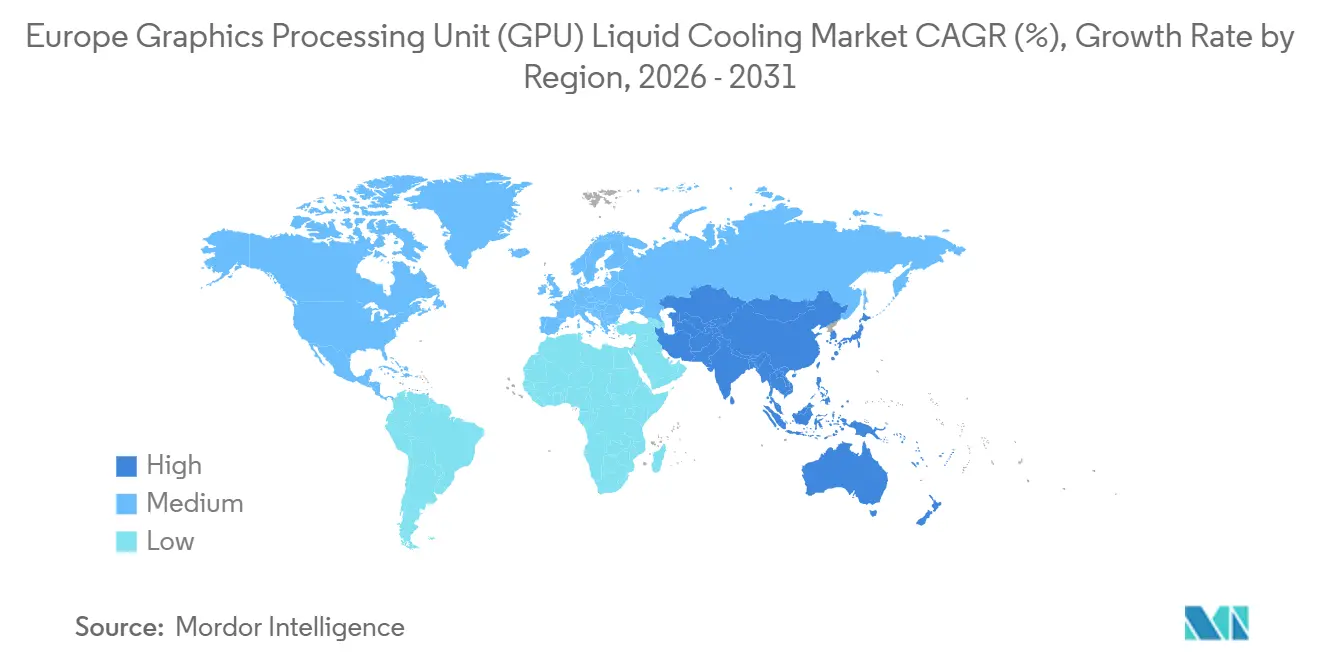

Competitive Landscape
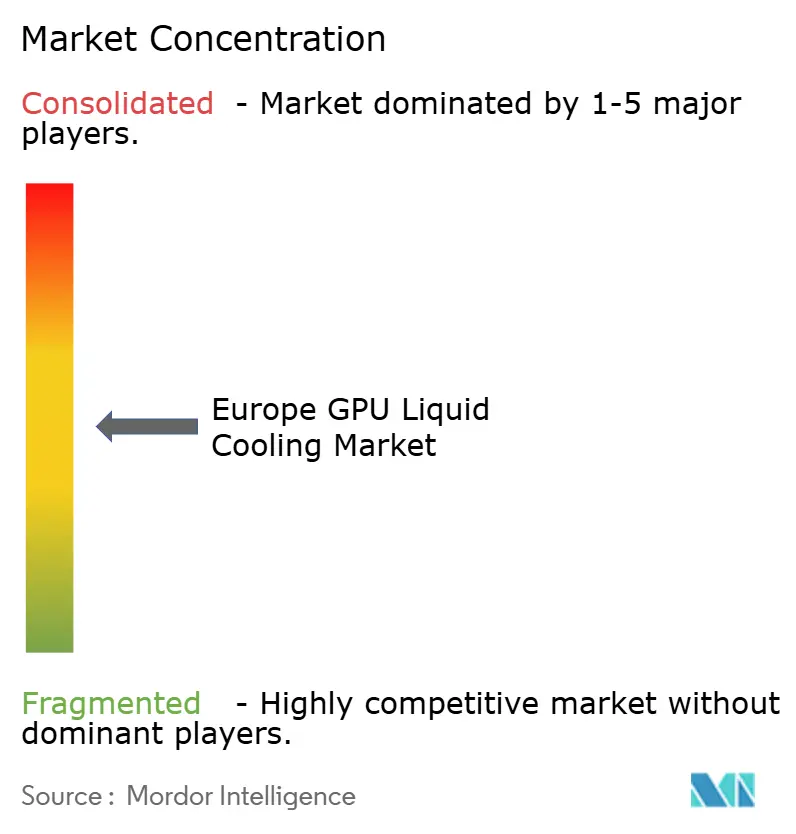
The European GPU liquid cooling market remains moderately fragmented, but supplier consolidation is gaining momentum as hyperscalers streamline their approved vendor lists. Key players such as Asetek, CoolIT, and Submer dominate the direct-to-chip and immersion-cooling niches, supported by design wins on NVIDIA reference platforms. Asetek’s 2024 acquisition of SimSports has enhanced its precision-machining capabilities, which are critical to developing next-generation cold plates. Companies like Vertiv, Schneider Electric, Lenovo, Hewlett Packard Enterprise, and Dell Technologies are focusing on integrated rack solutions. These solutions bundle power, cooling, and monitoring systems, simplifying procurement processes for enterprise buyers and enhancing their market competitiveness.
Edge AI is creating opportunities for new entrants, including Iceotope, EKWB, and Midas Immersion Cooling, which offer sealed, fanless enclosures tailored for telecom real estate. The Pan-European Edge Continuum consortium’s planned 2026 demonstration highlights the scale of upcoming distributed inference deployments. However, interoperability challenges persist, as proprietary quick-disconnects hinder multi-vendor compatibility. The Open Compute Project is working on establishing cold-plate and manifold standards to address these issues. This shift in focus underscores the growing importance of standardized solutions in enabling seamless integration across the ecosystem.
Cooling intellectual property has shifted from a cost factor to a significant profit center, altering the dynamics of market bargaining power. Specialized thermal-engineering firms are now gaining leverage as their expertise becomes increasingly valuable. The market is witnessing a shift where innovation in cooling technologies is driving competitive differentiation. This trend is expected to intensify as companies prioritize advanced thermal management solutions to meet the demands of high-performance computing. The evolving landscape underscores the critical role of thermal engineering in shaping the future of the graphics processing unit (GPU) liquid cooling market.
Europe GPU Liquid Cooling Industry Leaders
Asetek A/S
CoolIT Systems Inc.
Submer Technologies SL
LiquidStack Inc.
Schneider Electric SE
- *Disclaimer: Major Players sorted in no particular order

Recent Industry Developments
- April 2026: EKWB partnered with a European colocation provider to ship modular direct-to-chip kits aimed at enterprises retrofitting existing halls.
- March 2026: Rittal launched an updated LCP rack platform featuring integrated leak detection and automated fluid management.
- March 2026: The Pan-European Edge Continuum consortium showcased liquid-cooled edge nodes with sub-20 ms latency at Mobile World Congress Barcelona.
- February 2026: Iceotope secured a telecom design win for precision immersion enclosures in cell-tower edge sites.


Europe GPU Liquid Cooling Market Report Scope
The Europe GPU Liquid Cooling Market comprises the development, production, integration, and deployment of liquid-based thermal management solutions designed to dissipate heat generated by graphics processing units (GPUs) in high-performance computing environments across Europe. These solutions are essential for supporting the increasing thermal demands of AI, machine learning, cloud computing, high-performance computing (HPC), and edge AI applications while improving energy efficiency, system reliability, and computing density.
The Europe GPU Liquid Cooling Market Report is Segmented by Cooling Type (Single-Phase Liquid Cooling, and Two-Phase Liquid Cooling), Cooling Level (Component-Level Cooling, and Server/Rack-Level Cooling), Deployment (Hyperscale/Cloud, Enterprise, Government and Research HPC, and Edge AI), GPU Power Density (Below 300W, 300W-700W, and Above 700W), and Geography (Germany, France, United Kingdom, Italy, and Rest of Europe). The Market Forecasts are Provided in Terms of Value (USD).
| Single-Phase Liquid Cooling |
| Two-Phase Liquid Cooling |
| Component-Level Cooling |
| Server / Rack-Level Cooling |
| Hyperscale / Cloud |
| Enterprise |
| Government and Research (HPC) |
| Edge AI |
| Below 300W |
| 300W - 700W |
| Above 700W |
| Germany |
| France |
| United Kingdom |
| Italy |
| Rest of Europe |
| By Cooling Type | Single-Phase Liquid Cooling |
| Two-Phase Liquid Cooling | |
| By Cooling Level | Component-Level Cooling |
| Server / Rack-Level Cooling | |
| By Deployment | Hyperscale / Cloud |
| Enterprise | |
| Government and Research (HPC) | |
| Edge AI | |
| By GPU Power Density | Below 300W |
| 300W - 700W | |
| Above 700W | |
| By Geography | Germany |
| France | |
| United Kingdom | |
| Italy | |
| Rest of Europe |


Key Questions Answered in the Report
What is the current GPU liquid cooling market size in Europe?
The Europe GPU liquid cooling market size stood at USD 1.17 billion in 2025 and is projected to reach USD 1.40 billion in 2026, according to Mordor Intelligence.
Which cooling type leads adoption across European data centers?
Single-phase liquid cooling dominates with 73.40% share of 2025 deployments, reflecting its retrofit compatibility with existing chilled-water plants.
How fast is enterprise uptake of GPU liquid cooling expected to grow?
Enterprise installations are forecast to expand at a 27.30% CAGR through 2031 as mid-market firms seek higher rack densities without constructing new halls.
Why are operators shifting to liquid cooling for GPUs above 700 watts?
Accelerators such as NVIDIA's B200 and GB200 draw up to 1 kilowatt, a thermal load that air cooling cannot manage economically, making liquid cooling essential for reliability.
Which European country is forecast to grow fastest in liquid-cooled GPU deployments?
France is expected to post a 27.10% CAGR from 2026 to 2031, buoyed by sovereign-AI funding and large hyperscale investments.
What role does waste-heat recovery play in liquid cooling economics?
Many new facilities integrate return coolant into district-heating grids, generating additional revenue while helping operators meet EU sustainability mandates.
Page last updated on:





