
Europe Geotextiles and Civil Engineering Technical Textile Market Size and Share
Market Overview
| Study Period | 2021 - 2032 |
|---|---|
| Forecast Data Period | 2027 - 2032 |
| Base Year Market Size (2026) | USD 0.8 Billion |
| Market Size (2027) | USD 0.84 Billion |
| Market Size (2032) | USD 1.10 Billion |
| Growth Rate (2027 - 2032) | 5.54 % |
| Market Concentration | Medium |
Major Players *Disclaimer: Major Players sorted in no particular order Image © Mordor Intelligence. Reuse requires attribution under CC BY 4.0. | |
Europe Geotextiles and Civil Engineering Technical Textile Market Analysis by Mordor Intelligence
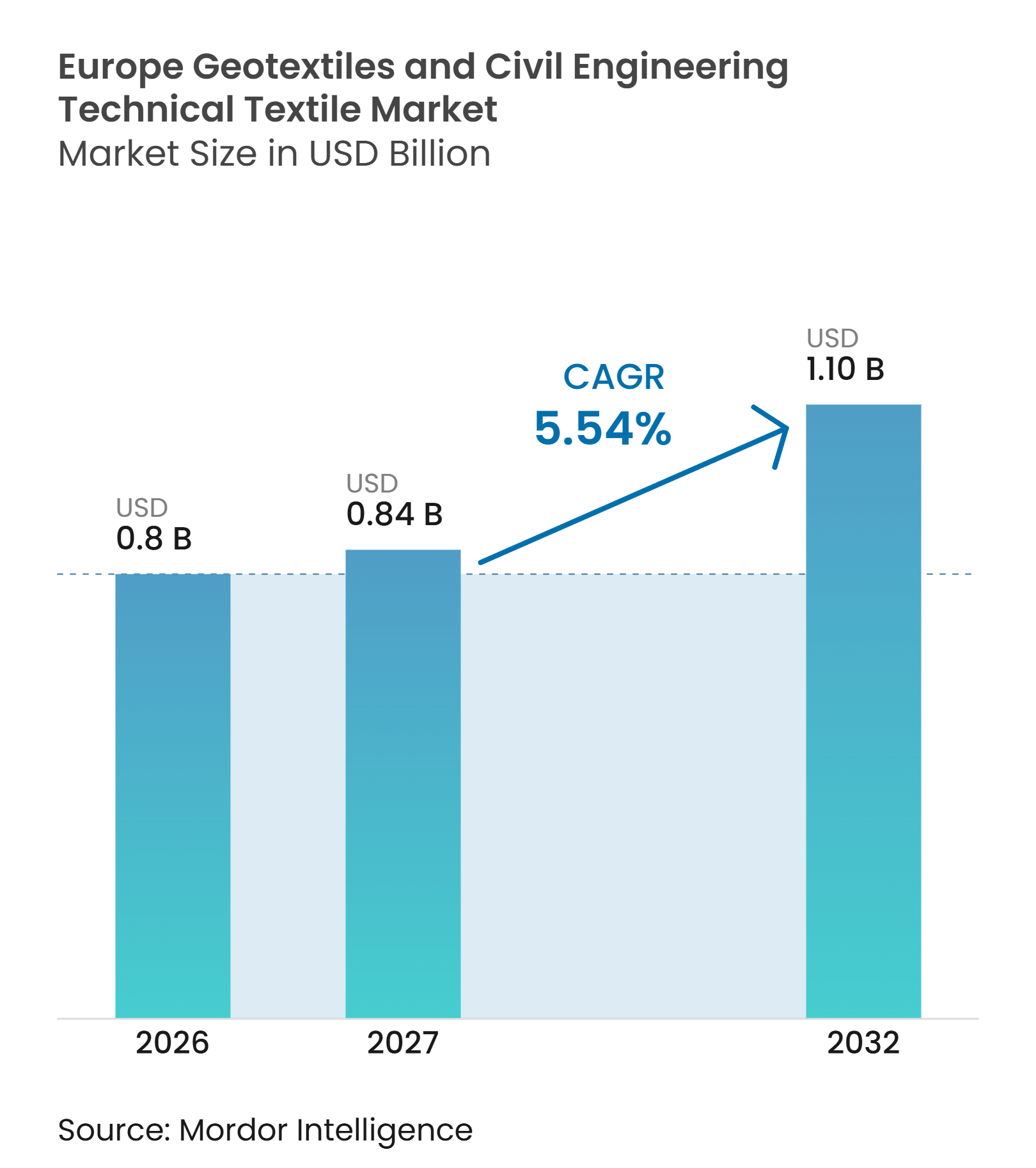
The Europe Geotextiles And Civil Engineering Technical Textile Market size is expected to grow from USD 0.8 billion in 2026 to USD 0.84 billion in 2027 and is forecast to reach USD 1.10 billion by 2032 at 5.54% CAGR over 2027-2032.
The Europe geotextiles and civil engineering technical textile market benefits from long-running road, rail, water, and landfill renewal programs, particularly in Western and Central Europe where maintenance needs are substantial. Textile systems can reduce the need for aggregate, concrete, and drainage pipes, which lowers material movement, reduces logistics needs, and can shorten construction schedules. Climate adaptation is moving demand toward higher-specification products for coastal, riverbank, stormwater, and containment projects that require filtration, reinforcement, separation, and protection functions. Producers are strengthening their portfolios through acquisitions, product-system evidence, and digital design support, while public buyers increasingly assess lifecycle carbon and documented performance. Volatile polymer and energy inputs, fragmented national approval practices, and shortages of qualified engineers can delay the conversion of funded projects into installed volumes.
Key Report Takeaways
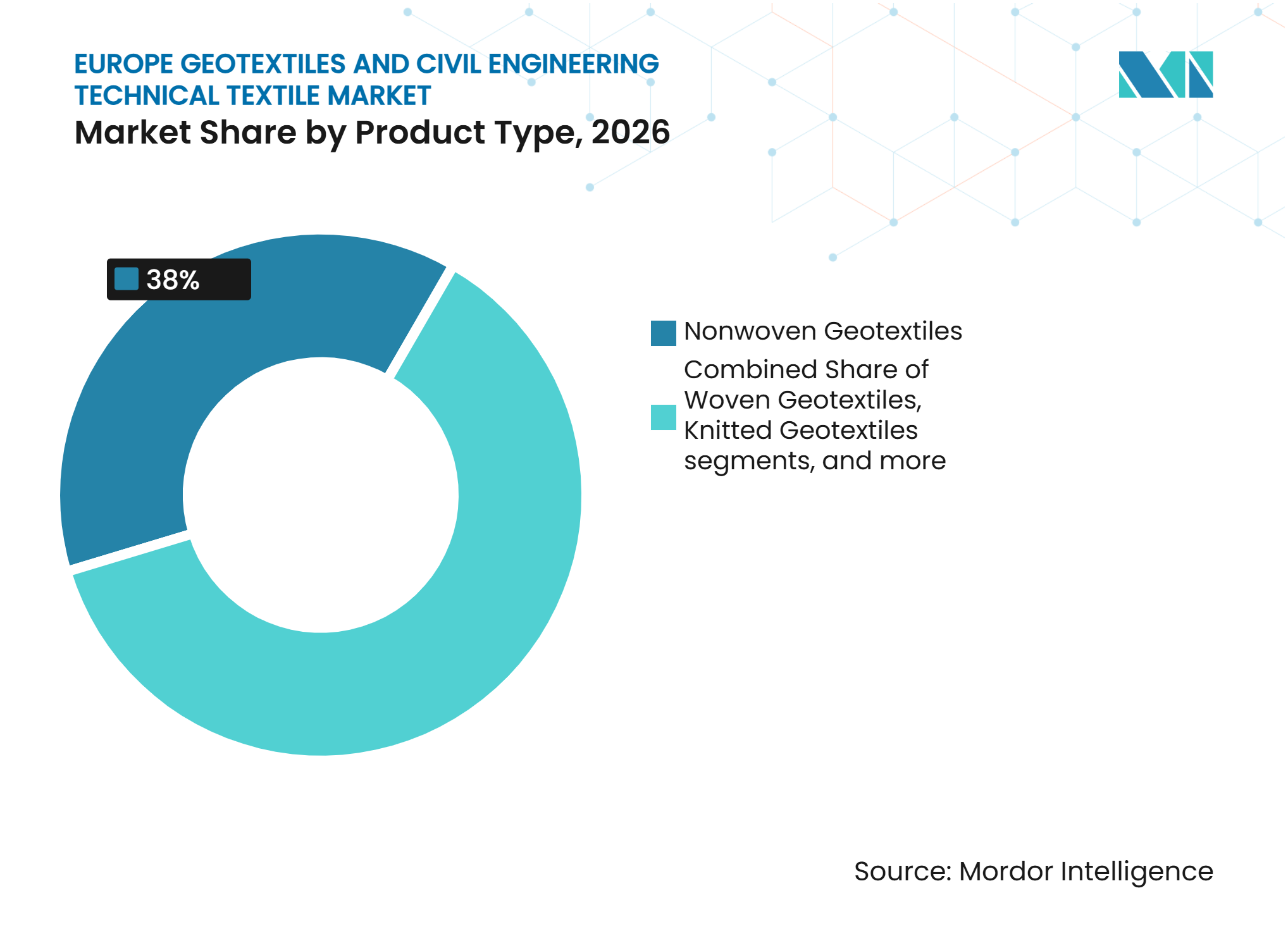
- By product type, nonwoven geotextiles held 38% of the Europe geotextiles and civil engineering technical textile market share in 2026, while textile-based erosion control products are forecast to grow at a 7% CAGR through 2032.
- By material type, polypropylene accounted for 45% of the Europe geotextiles and civil engineering technical textile market size in 2026, while natural fibers are forecast to expand at a 7.5% CAGR through 2032.
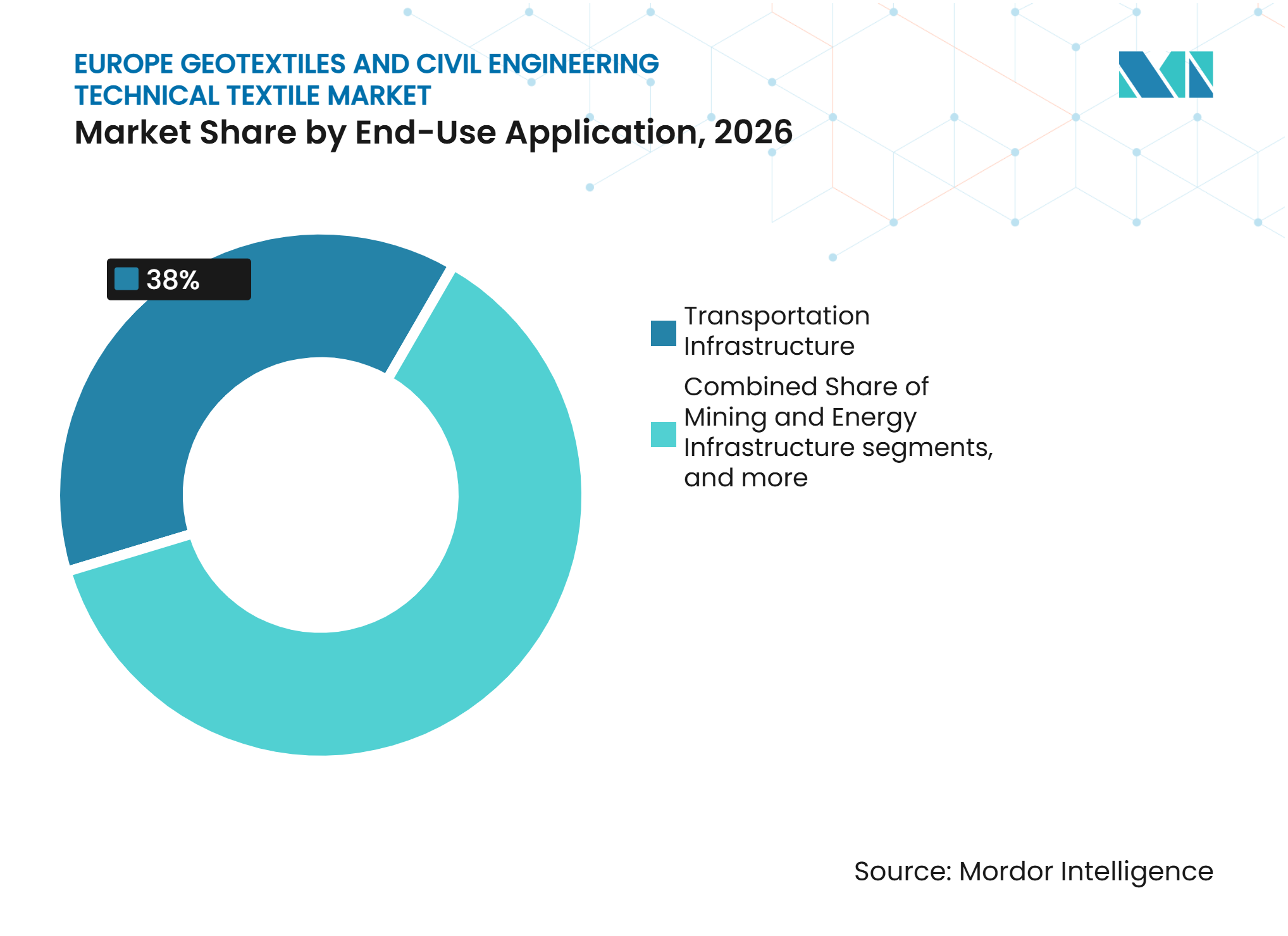
- By end-use application, transportation infrastructure held 38% of the Europe geotextiles and civil engineering technical textile market share in 2026, while water and coastal infrastructure is forecast to grow at a 7% CAGR through 2032.
- By geography, Germany accounted for 22% of the Europe geotextiles and civil engineering technical textile market size in 2026, while Poland is forecast to expand at a 7% CAGR through 2032.
Note: Market numbers in this report are based on Mordor Intelligence's proprietary estimation framework, which combines nine months of actuals with Q4 projections for base year 2026.
Market Trends and Insights
Drivers Impact Analysis of Europe Geotextiles and Civil Engineering Technical Textile Market*
| Driver | (~) % Impact on CAGR Forecast | Geographic Relevance | Impact Timeline |
|---|---|---|---|
| Aging Road and Rail Assets Requiring Rehabilitation | +1.4% | EU-wide, concentrated in Germany, France, Poland | Short term (≤ 2 years) |
| Climate-Resilient Flood, Erosion and Coastal Protection | +1.2% | Netherlands, France, Italy, Germany, Spain | Medium term (2-4 years) |
| EU Landfill, Wastewater and Stormwater Compliance | +1% | EU-wide, concentrated in Germany, France, United Kingdom | Medium term (2-4 years) |
| Replacement of Aggregate with Lower-Carbon Textile Systems | +0.8% | Germany, Netherlands, France | Long term (≥ 4 years) |
| Recycled and Bio-Based Geotextile Adoption in Public Procurement | +0.6% | Netherlands, France, Germany, Scandinavia | Long term (≥ 4 years) |
| Digital Performance Specification and Lifecycle Tendering | +0.3% | United Kingdom, Germany, Netherlands | Long term (≥ 4 years) |
| Source: Mordor Intelligence | |||
Aging Road and Rail Assets Requiring Rehabilitation
Germany's 2025-2029 investment plan commits EUR 166 billion (USD 187.35 billion) to transport infrastructure, including EUR 107 billion (USD 120.76 billion) for rail renewal and EUR 52 billion (USD 58.69 billion) for federal roads[1]. Rail maintenance in Germany receives EUR 21.9 billion (USD 24.71 billion) in 2026, covering work where separation, filtration, and drainage layers are standard elements. These applications place nonwoven materials within the basic renewal scope instead of treating them as an optional addition. The Connecting Europe Facility selected 94 transport projects for EUR 2.8 billion (USD 3.16 billion) in July 2025, with rail receiving 77% of funding. The projects cover Poland, Greece, Slovakia, Czechia, and the Baltic states, widening the geographic base for recurring rehabilitation demand. Continued maintenance needs make the Europe geotextiles and civil engineering technical textile market less dependent on new construction cycles.
Climate-Resilient Flood, Erosion and Coastal Protection
Coastal flooding causes EUR 1.2 billion (USD 1.35 billion) in annual economic damage across the European Union. The European Commission states that annual damage could reach EUR 1 trillion (USD 1.12 trillion) by 2100 without adequate protection measures. The Floods Directive third cycle requires continued flood risk management programs through 2027. All 21 assessed states included climate scenario modeling in their second Flood Risk Management Plans, which gives climate risk a clearer place in project selection. Geotextile tubes, revetment geocomposites, and woven fabrics support embankment, riverbank, and coastal reinforcement. The European geotextiles and civil engineering technical textile market gains from concurrent coastal, river, and urban flood programs in several large countries.
EU Landfill, Wastewater and Stormwater Compliance
Directive EU 2024/3019 requires integrated urban wastewater plans for agglomerations of 100,000 person-equivalents and above. The directive limits stormwater overflow pollution to no more than 2% of annual collected wastewater in dry-weather conditions. The rule supports drainage geocomposites, nonwoven filtration layers, and textile-based sustainable drainage systems in dense urban catchments. The United Kingdom Environment Agency requires protective geotextiles in landfill engineering guidance. It also requires CE marking for geosynthetics used in licensed facilities, making compliance documentation central to qualification. Certification requirements favor verified products in major public contracts across Germany, France, the United Kingdom, and the Netherlands.
Replacement of Aggregate with Lower-Carbon Textile Systems
Geotextile-reinforced systems can replace part of the aggregate, concrete, and drainage material used in conventional civil works. NAUE reported in October 2026 that geogrid-reinforced retaining structures reduce concrete use, emissions, construction cost, and construction time compared with concrete cantilever walls. This system comparison gives public buyers evidence beyond a product-level materials claim. The Netherlands Enterprise Agency opened a 2025 market consultation for bio-based geotextiles with Rijkswaterstaat, TenneT, and the Union of Water Boards. It targets 30-50% bio-based geotextile adoption in road and water construction by 2030. Environmental Product Declarations and lifecycle carbon calculations are becoming more relevant in organized public procurement.
Restraints Impact Analysis of Europe Geotextiles and Civil Engineering Technical Textile Market*
| Restraint | (~) % Impact on CAGR Forecast | Geographic Relevance | Impact Timeline |
|---|---|---|---|
| Polymer and Energy Cost Volatility | -0.9% | EU-wide | Short term (≤ 2 years) |
| Fragmented National Approval and Procurement Practices | -0.7% | EU-wide | Long term (≥ 4 years) |
| Engineering Skills and Certification Bottlenecks | -0.5% | Germany, United Kingdom, Poland | Medium term (2-4 years) |
| Recycled PET Competition from Beverage Packaging | -0.3% | Germany, Netherlands, Belgium | Medium term (2-4 years) |
| Source: Mordor Intelligence | |||
Polymer and Energy Cost Volatility
Polypropylene and polyester form most of the polymer input base for European geotextile production, so their pricing has a direct effect on manufacturing economics. The Clean Industrial Deal recognizes that high energy costs weaken the cost position of energy-intensive manufacturing. This pressure is significant for polymer conversion activities, which combine feedstock exposure with power-intensive processing. Eurostat reported that industrial energy prices for large consumers remained elevated through 2025 compared with pre-2022 levels. The European Chemical Industry Council also identified a feedstock and energy cost disadvantage against Middle Eastern and Asian competitors. Cost increases are difficult to pass through in price-sensitive public tenders. This can limit margin protection in the Europe geotextiles and civil engineering technical textile market.[2]
Fragmented National Approval and Procurement Practices
Regulation EU 2024/3110 established revised rules for CE marking and harmonized technical specifications from January 2026. Member States can still impose national technical requirements beyond the harmonized scope, particularly through project specifications and qualification rules. The European Organisation for Technical Assessment operates through 24 national notified bodies. Administrative procedures and timelines differ across these bodies, even where product performance requirements are similar. Suppliers working in Germany, France, Italy, Poland, and the United Kingdom must manage separate specifications and procurement qualification practices. This adds cost and time without necessarily changing the engineering need. The burden favors larger producers that can absorb multi-country certification costs.
*Our forecasts treat driver/restraint impacts as directional, not additive. The impact forecasts reflect baseline growth, mix effects, and variable interactions.
Europe Geotextiles and Civil Engineering Technical Textile Market Segment Analysis
By Product Type:
Nonwovens Lead While Erosion Control Records the Fastest GrowthNonwoven geotextiles accounted for 38% of the market value in 2026. They support separation in road subbases, filtration in drainage systems, landfill protection, and erosion control. This broad use provides steady demand across public infrastructure work for the Europe geotextiles and civil engineering technical textile market. Needle-punched and thermally bonded routes are the main production methods. Thermally bonded grades are preferred where stable dimensions and consistent hydraulic performance are important.
Textile-based erosion control products are forecast to grow at a 7% CAGR through 2032. Textile-based geogrids and geocomposites serve reinforcement and drainage requirements. Geotextile containers and fabricated products are used in coastal and dewatering projects. NAUE's 2026 comparative study supports wider use of hybrid textile and aggregate systems by documenting lower concrete demand and emissions. Woven geotextiles provide tensile reinforcement for steep slopes and rail subgrades.



By Material Type:
Polypropylene Remains the Main Material While Natural Fibers Grow FastestPolypropylene held 45% of the market size in 2026. It combines chemical resistance, durability, processability, and low unit cost. These properties support its use in nonwoven road, rail, and drainage applications throughout the Europe geotextiles and civil engineering technical textile market. Polyester is the second most used material for reinforcement work. Its tensile strength and lower creep suit retaining walls and steep-slope geogrids.
Natural fibers are forecast to grow at a 7.5% CAGR through 2032. Polyethylene is used in geomembrane composite systems. Polyamide is used in abrasion-resistant filtration applications in mining and coastal settings. Public procurement is incorporating bio-based material criteria, including the Netherlands' target for 30-50% bio-based adoption by 2030. Coir and jute are suitable for temporary erosion control because they biodegrade as vegetation is established. NAUE's Secumat Green 3D Mesh shows the use of PLA-based filaments in this direction.
By End-Use Application:
Transportation Leads While Water and Coastal Projects AccelerateTransportation infrastructure accounted for 38% of the market size in 2026. Roads, highways, and railways form the main demand base in Germany, France, Poland, and the United Kingdom. These assets use geotextiles for separation, filtration, and drainage in subgrade construction and rehabilitation across the Europe geotextiles and civil engineering technical textile market. Germany's 2026 rail allocation and the 2025 CEF grant package provide a visible pipeline for specification. Airport and airfield projects remain a smaller but consistent source of demand for certified, heavier products.
Earthworks and geotechnical engineering include retaining walls, slope stabilization, and foundation works. Water and coastal infrastructure is forecast to grow at a 7% CAGR through 2032. The Floods Directive program requires EUR 6 billion (USD 6.77 billion) in annual expenditure across member states. Geotextile tubes, revetment systems, and woven reinforcement products serve dams and embankments. Environmental and waste containment remains supported by EU compliance needs. Mining and energy infrastructure is also expanding as producers address critical-mineral extraction requirements.

Geography Analysis
Germany
Germany held 22% of the overall sector value in 2026. Its 2025-2029 plan allocates EUR 166 billion (USD 187.35 billion) to roads, rail, and inland waterways, including EUR 107 billion (USD 120.76 billion) for rail renewal. Aging rail lines and federal highways create recurring subgrade work. Lifecycle-based specifications are increasing demand for higher-performance products that also support sustainability reporting across the Europe geotextiles and civil engineering technical textile market. This combination sustains activity in its largest national geography.
France and the United Kingdom
France and the United Kingdom are the second and third largest national markets, with rehabilitation and selected new-build demand. France's TEN-T activity and flood exposure support water-management and coastal applications. Network Rail published a June 2025 pipeline for GBP 38 million (USD 48 million) of geosynthetics procurement for December 2026 through November 2030. The United Kingdom landfill guidance supports protective geotextiles and CE-marked products in licensed facilities.[3]
Poland and Rest of Europe
Poland is forecast to grow at a 7% CAGR through 2032. The FEnIKS 2021-2027 program has a EUR 29.3 billion (USD 33.06 billion) budget, with EUR 12.9 billion (USD 14.55 billion) directed to transport. CEF grants selected in July 2025 include Polish rail upgrades and high-speed rail development. Italy, Spain, and the Netherlands contribute water, coastal, and environmental infrastructure demand, while the Netherlands advances bio-based procurement. Austria, Belgium, Sweden, Czechia, and other markets add TEN-T and flood-management demand under the CE-marking framework in Regulation EU 2024/3110.
Competitive Landscape
Market Concentration
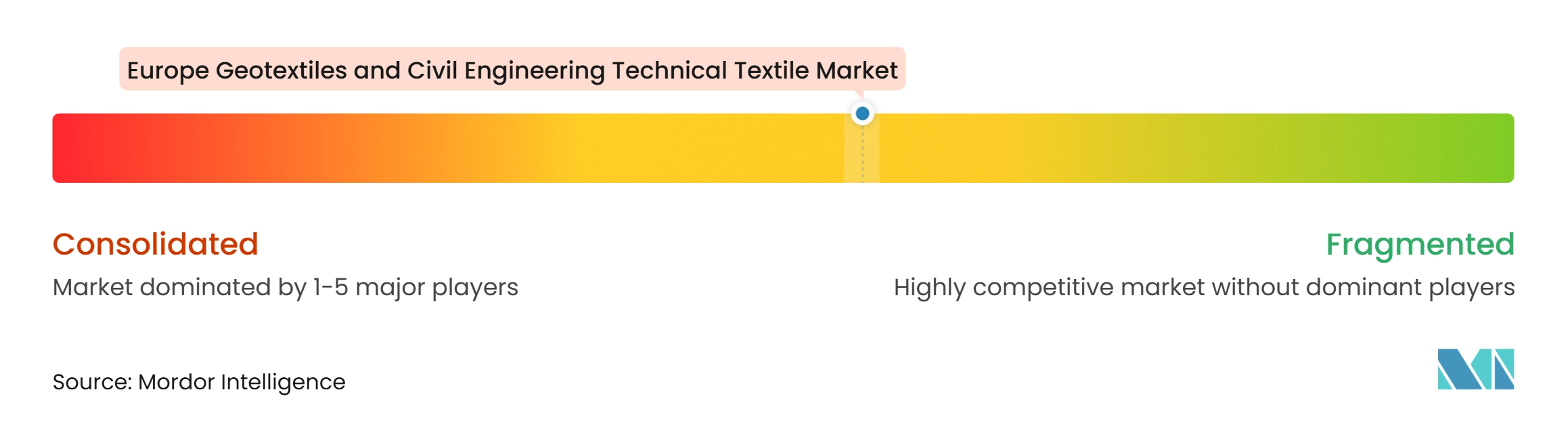
The Europe geotextiles and civil engineering technical textile market is moderately consolidated among Solmax, HUESKER International, NAUE, and Officine Maccaferri. These suppliers combine pan-European reach with product portfolios across geotextile formats. AFITEXINOV in France, Thrace Nonwovens and Geosynthetics in Southern Europe, and BontexGeo in the Benelux retain strong local specification relationships. Their presence keeps regional tendering competitive. Larger suppliers still have an advantage where multi-country certification is required.
HUESKER acquired Sineco International in April 2025, adding 3D thermoplastic monofilament technology for drainage and erosion control. Officine Maccaferri acquired Ovattificio Alpino in September 2026, adding Italian nonwoven manufacturing capability. Solmax launched its Performance Materials platform in June 2025 to integrate the TenCate Geosynthetics and Propex industrial-fabrics legacy. These moves expand technical coverage and bring specialized production closer to the acquirers' core portfolios. They also reflect competition centered on system capability instead of a single product category.
NAUE reported lower concrete use, emissions, cost, and construction time for geogrid-reinforced retaining structures in October 2026. Its bearing-capacity calculators support project-specific design work across national methods. Solmax, HUESKER, NAUE, and Freudenberg are examining high-pH effects on PET reinforcement products. Bio-based and circular products may gain importance as public procurement develops.
Europe Geotextiles and Civil Engineering Technical Textile Industry Leaders
-
Solmax
-
HUESKER International
-
NAUE GmbH & Co. KG
-
Freudenberg Performance Materials
-
Fibertex Nonwovens A/S
- *Disclaimer: Major Players sorted in no particular order
Europe Geotextiles and Civil Engineering Technical Textile Market Companies Covered in this Report
- Solmax
- HUESKER International
- NAUE GmbH & Co. KG
- Freudenberg Performance Materials
- Fibertex Nonwovens A/S
- BontexGeo
- Officine Maccaferri S.p.A.
- TenCate Geosynthetics
- AGRU Kunststofftechnik GmbH
- AFITEXINOV
- ABG Ltd
- Teragéos
- Thrace Nonwovens & Geosynthetics S.A.
- BTT SA Technical Textiles
- Berry Global, Inc.
- Ahlstrom
- Toray Industries, Inc.
- Asahi Kasei Corporation
- DuPont de Nemours, Inc.
- Sioen Industries NV
- MDB Texinov
Recent Industry Developments in Europe Geotextiles and Civil Engineering Technical Textile Market
- October 2026: Solmax completed a comprehensive refinancing of its capital structure, providing the financial foundation for the next phase of its integration and growth strategy following the consolidation of TenCate Geosynthetics and Propex under the Solmax platform.
- September 2026: Officine Maccaferri acquired 100% of Ovattificio Alpino S.r.l., a Cittadella-based Italian specialist in non-woven geotextiles and technical felts with over 50 years in the technical textiles sector, adding in-house non-woven manufacturing capability and creating a platform for further investment in non-woven technology for infrastructure and environmental applications across Europe.
Europe Geotextiles and Civil Engineering Technical Textile Market Report Scope
Segmentation Overview
| Woven Geotextiles |
| Nonwoven Geotextiles |
| Knitted Geotextiles |
| Textile-Based Geogrids |
| Geotextile-Based Geocomposites |
| Geotextile Containers and Fabricated Products |
| Textile-Based Erosion Control Products |
| Other Civil Engineering Technical Textiles |
| Polypropylene (PP) |
| Polyester (PET) |
| Polyethylene (PE) |
| Polyamide (Nylon) |
| Natural Fibers (Coir, Jute, and Other Natural Fibers) |
| Other Specialty Fibers and Materials |
| Transportation Infrastructure | Roads and Highways |
| Railways | |
| Airports and Airfield Infrastructure | |
| Earthworks and Geotechnical Engineering | |
| Water and Coastal Infrastructure (Including Dams and Water management Infrastructure) | |
| Environmental and Waste Containment (Landfills, Waste Containment, etc.) | |
| Mining and Energy Infrastructure | |
| Other Civil Engineering Applications |
| Germany |
| France |
| United Kingdom |
| Italy |
| Spain |
| Netherlands |
| Poland |
| Rest of Europe |
| By Product Type | Woven Geotextiles | |
| Nonwoven Geotextiles | ||
| Knitted Geotextiles | ||
| Textile-Based Geogrids | ||
| Geotextile-Based Geocomposites | ||
| Geotextile Containers and Fabricated Products | ||
| Textile-Based Erosion Control Products | ||
| Other Civil Engineering Technical Textiles | ||
| By Material Type | Polypropylene (PP) | |
| Polyester (PET) | ||
| Polyethylene (PE) | ||
| Polyamide (Nylon) | ||
| Natural Fibers (Coir, Jute, and Other Natural Fibers) | ||
| Other Specialty Fibers and Materials | ||
| By End-Use Application | Transportation Infrastructure | Roads and Highways |
| Railways | ||
| Airports and Airfield Infrastructure | ||
| Earthworks and Geotechnical Engineering | ||
| Water and Coastal Infrastructure (Including Dams and Water management Infrastructure) | ||
| Environmental and Waste Containment (Landfills, Waste Containment, etc.) | ||
| Mining and Energy Infrastructure | ||
| Other Civil Engineering Applications | ||
| By Geography | Germany | |
| France | ||
| United Kingdom | ||
| Italy | ||
| Spain | ||
| Netherlands | ||
| Poland | ||
| Rest of Europe | ||
Key Questions Answered in the Report
What is the forecast growth rate for Europe geotextiles and civil engineering technical textiles?
The Europe geotextiles and civil engineering technical textile market is forecast to grow at a 5.54% CAGR from 2027 to 2032 and reach USD 1.10 billion by 2032. Transport rehabilitation, flood protection, and water-management work form the principal sources of demand.
Which product type has the largest position in Europe?
Within the Europe geotextiles and civil engineering technical textile market, nonwoven geotextiles led with 38% share in 2026. Their position reflects use in road subbases, drainage systems, landfill protection, embankments, and erosion-control work.
Which material is used most widely in European geotextiles?
The Europe geotextiles and civil engineering technical textile market used polypropylene most widely, with a 45% share in 2026. Its chemical resistance, durability, processability, and unit cost suit road, rail, and drainage applications.
Which application is growing fastest in Europe?
Water and coastal infrastructure is forecast to grow at a 7% CAGR through 2032 in the Europe geotextiles and civil engineering technical textile market. Flood-risk programs support demand for geotextile tubes, revetment systems, and woven reinforcement materials.
Which country has the largest demand base?
Germany held a 22% share in 2026. Its rail, road, and inland-waterway programs support recurring subgrade rehabilitation and higher-performance product specifications.
What is supporting natural fiber adoption in civil engineering textiles?
Natural fibers are forecast to grow at a 7.5% CAGR through 2032. Public procurement criteria, including the Netherlands 2030 bio-based target, support temporary erosion-control and slope-stabilization applications.