
Europe Feed Flavors and Sweeteners Market Size and Share
Market Overview
| Study Period | 2021 - 2031 |
|---|---|
| Forecast Data Period | 2026 - 2031 |
| Base Year Market Size (2025) | USD 240 Million |
| Market Size (2026) | USD 250 Million |
| Market Size (2031) | USD 310 Million |
| Growth Rate (2026 - 2031) | 4.40 % |
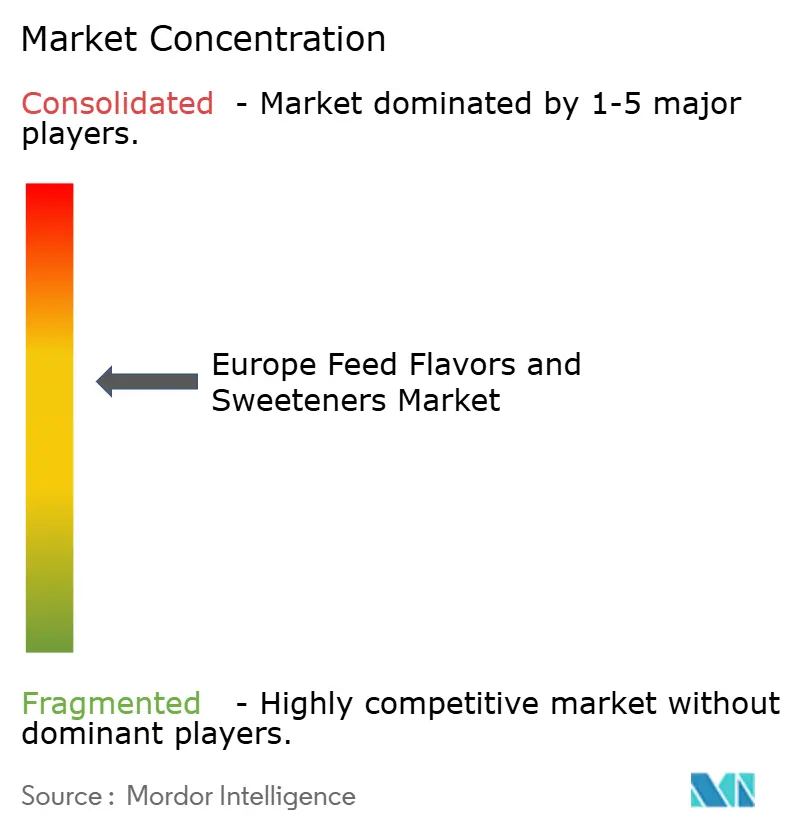
| Market Concentration | Medium |
Major Players *Disclaimer: Major Players sorted in no particular order Image © Mordor Intelligence. Reuse requires attribution under CC BY 4.0. | |
Europe Feed Flavors and Sweeteners Market Analysis by Mordor Intelligence
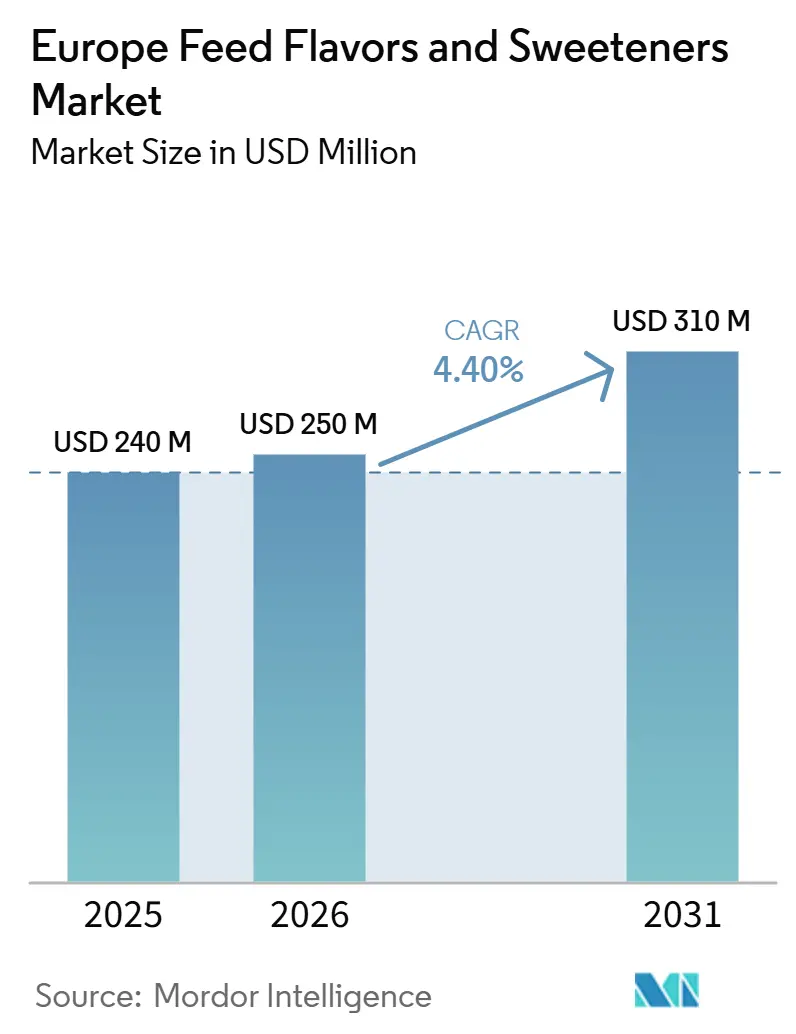
The Europe feed flavors and sweeteners market size stood at USD 240 million in 2025 and is projected to reach USD 250 million in 2026 and USD 310 million by 2031, at a compound annual growth rate (CAGR) of 4.40%. Market growth is being shaped by a clearer shift toward compliance-led formulation, higher scrutiny on additive quality systems, and broader use of palatability tools in precision livestock feeding. Adisseo Europe stated in 2025 that post-weaning piglet feeding behavior remains highly sensitive to diet changes[1]Source: Adisseo Europe, “Understanding Post-Weaning Piglet Feeding Behavior and Nutrition to Address Post-Weaning Anorexia,” adisseo.com, and that palatability support is central when functional ingredients alter feed acceptance in commercial programs. The Europe feed flavors and sweeteners market is also benefiting from stronger demand for validated, species-specific solutions rather than generic additive blends, especially where dairy, swine, and young animal diets require stable intake performance. Quality assurance systems are becoming increasingly important as supplier qualification moves beyond formulation efficacy alone into traceability, auditability, and regulatory readiness. At the same time, the Europe feed flavors and sweeteners market continues to face pressure from higher input costs for natural ingredients and longer commercialization timelines for specialized additive systems, which makes scale and compliance capability more important in competition.
Key Report Takeaways
- By sub additive, flavors held 51.7% of the Europe feed flavors and sweeteners market share in 2025, while sweeteners is projected to expand at a 4.6% CAGR through 2031.
- By animal, ruminants accounted for 38.0% of the Europe feed flavors and sweeteners market size in 2025, while swine is projected to grow at a 4.8% CAGR through 2031.
- By geography, Spain held 23.0% of the Europe feed flavors and sweeteners market share in 2025, while the United Kingdom is projected to record the fastest growth at a 4.7% CAGR through 2031.
Note: Market size and forecast figures in this report are generated using Mordor Intelligence’s proprietary estimation framework, updated with the latest available data and insights as of January 2026.
Europe Feed Flavors and Sweeteners Market Trends and Insights
Drivers Impact Analysis*
| Driver | (~) % Impact on CAGR Forecast | Geographic Relevance | Impact Timeline |
|---|---|---|---|
| Rising Demand for Palatable Feed to Improve Intake and Performance | +0.6% | European Union wide, concentrated in Spain, Germany, and France | Short term (≤ 2 years) |
| Expansion of Livestock Production and Intensification of Commercial Farming | +0.5% | Spain, Netherlands, Germany, and Poland | Medium term (2-4 years) |
| Shift Toward Antibiotic-Free and Clean-Label Feed Formulations | +0.7% | European Union wide, with early gains in Germany, Netherlands, and Denmark | Short term (≤ 2 years) |
| Growth in Specialty Nutrition for High-Value Dairy and Beef Systems | +0.6% | France, Germany, Netherlands, and United Kingdom | Medium term (2-4 years) |
| Increased Use of Feed Flavors to Mask Off-Notes in Functional Additives | +0.6% | European Union wide | Short term (≤ 2 years) |
| Premiumization of Feed for Young Animal and Stress-Prone Diets | +0.5% | Germany, France, Netherlands, and Spain | Medium term (2-4 years) |
| Source: Mordor Intelligence | |||
Rising Demand for Palatable Feed to Improve Intake and Performance
Voluntary feed intake remains a basic driver of growth efficiency and feed conversion across commercial livestock systems. The Merck Veterinary Manual, accessed in 2025, states that lactating dairy cows must maximize intake quickly after calving to reduce the severity and duration of negative energy balance, and that prolonged intake depression harms body condition and reproductive performance. That clinical principle helps explain why the Europe feed flavors and sweeteners market continues to gain relevance in diets where performance losses from weak intake can be immediate and measurable. Adisseo Europe wrote in 2025 that post-weaning anorexia in piglets can delay development and affect lifetime performance when diet transition stress is not managed through palatability support. Norel Animal Nutrition also reported in 2025 that targeted flavoring compounds in nursery diets improved sow return-to-estrus timing by 0.5 days. The company also reported improved piglet fecal consistency and feed efficiency trends at the 16th International Symposium on Digestive Physiology of Pigs. These results support a broader move toward performance-backed flavor inclusion rather than discretionary additive use.
Shift Toward Antibiotic-Free and Clean-Label Feed Formulations
The Europe feed flavors and sweeteners market is also gaining support from the shift away from pharmacological growth support in feed programs. A January 2026 review in Antibiotics stated that European livestock policy has pushed producers toward nutritional alternatives by restricting antibiotic growth promoters and tightening prophylactic use rules. GMP+ International announced in 2025 that the Good Manufacturing Practice TS2.2 Antibiotic-Free Feed standard expanded from a Dutch national framework into a globally applicable certification standard, which gives buyers a clearer basis to verify antibiotic-free supply chain claims. The European Medicines Agency reported in March 2025 that a 12-year voluntary effort reduced European Union veterinary antibiotic sales by 50% [2]Source: European Medicines Agency, “First Report on EU-Wide Sales and Use of Antimicrobials in Animals,” ema.europa.eu, confirming that lower antibiotic dependency is already embedded in the operating environment. As antibiotic use recedes, palatability solutions become more important in maintaining intake and supporting performance through nutritional management. That makes the Europe feed flavors and sweeteners market more relevant in formulations where clean-label positioning and operational performance must work together.
Growth in Specialty Nutrition for High-Value Dairy and Beef Systems
Premium dairy and beef chains across Europe rely on tighter formulation control than lower-value feed programs, which supports more consistent use of palatability inputs. Regulation (EU) 2024/1143 on geographical indications entered into force in May 2024, and the European Commission explains that these quality schemes require traceability and rule-based production standards across protected food systems. In that setting, flavor inclusion supports intake stability when Total Mixed Ration programs include bypass fat, buffers, binders, or other functional ingredients that may reduce acceptance. The Europe feed flavors and sweeteners market therefore benefits from the overlap between quality-controlled livestock systems and intake-sensitive production windows. Demand is especially durable in ruminant value chains where feed consistency is tied not only to farm performance, but also to traceability expectations in branded dairy and beef production.
Premiumization of Feed for Young Animal and Stress-Prone Diets
Young animal diets remain among the most valuable areas for palatability support because performance setbacks in the first feeding stages have long-lasting carryover effects. Adisseo Europe reported in 2025 that piglets may go 1 to 2 days without consuming feed after weaning, which can delay development and weaken lifetime performance when the transition is poorly managed. The Europe feed flavors and sweeteners market is therefore seeing stronger interest in solutions tailored to early-life intake support rather than only broad ration masking. Feed quality systems also reinforce this premium tier. That environment favors suppliers that can combine traceability, technical documentation, and species-specific formulation support in higher-value starter and transition diets.
Restraints Impact Analysis*
| Restraint | (~) % Impact on CAGR Forecast | Geographic Relevance | Impact Timeline |
|---|---|---|---|
| Volatility in Raw Material Costs for Flavor and Sweetener Inputs | -0.40% | European Union wide | Short term (≤ 2 years) |
| Regulatory Scrutiny on Feed Additive Approval and Claims | -0.50% | European Union wide | Long term (≥ 4 years) |
| Limited Perceived Value in Price-Sensitive Commodity Livestock Segments | -0.40% | Eastern Europe, Russia, and Turkey | Medium term (2-4 years) |
| Reformulation Complexity Across Diverse Animal Diets and Dosage Needs | -0.50% | European Union wide, with early impact in Germany and Netherlands | Medium term (2-4 years) |
| Source: Mordor Intelligence | |||
Volatility in Raw Material Costs for Flavor and Sweetener Inputs
Natural inputs remain a real cost risk for the Europe feed flavors and sweeteners market. Symrise stated in 2024 that natural ingredient supply chains face year-on-year shortages and cost increases because of climate instability and geopolitical disruption, which is why the company has built multi-origin sourcing programs for botanicals and other natural extractives. This matters for feed formulations moving toward a more natural positioning or away from older, low-cost synthetic inputs. Higher raw material volatility is harder for mid-tier suppliers to absorb, as they lack the same procurement scale or sourcing flexibility as global players. The Europe feed flavors and sweeteners market, therefore, shows a cost structure that can widen the gap between large suppliers and smaller specialists. As input complexity rises, margin pressure becomes a practical restraint even when demand conditions remain favorable.
Regulatory Scrutiny on Feed Additive Approval and Claims
Regulatory compliance remains another structural restraint for the Europe feed flavors and sweeteners market. AGROLAB GROUP reported in 2025 that Delegated Regulation (EU) 2024/1229 introduced mandatory maximum levels for antimicrobial cross-contamination in feed and added a stricter analytical documentation burden for manufacturers operating in European supply chains. FAMI-QS International also confirmed in July 2025 that supplier qualification standards remain rigorous under Certification System Version 9, which raises the operational importance of audit readiness and traceability. These requirements raise the cost of commercializing specialized products, especially when technical dossiers, validation work, and plant controls must be maintained in parallel. Smaller formulators can still compete, but they often need sharper species focus or stronger niche positioning to offset the compliance burden. This keeps the market open to innovation, but not at a pace that allows easy entry or rapid scaling without regulatory discipline.
*Our forecasts treat driver/restraint impacts as directional, not additive. The impact forecasts reflect baseline growth, mix effects, and variable interactions.
Segment Analysis
By Sub Additive: Flavors Lead While Sweeteners Build Value Through More Specialized Formulation
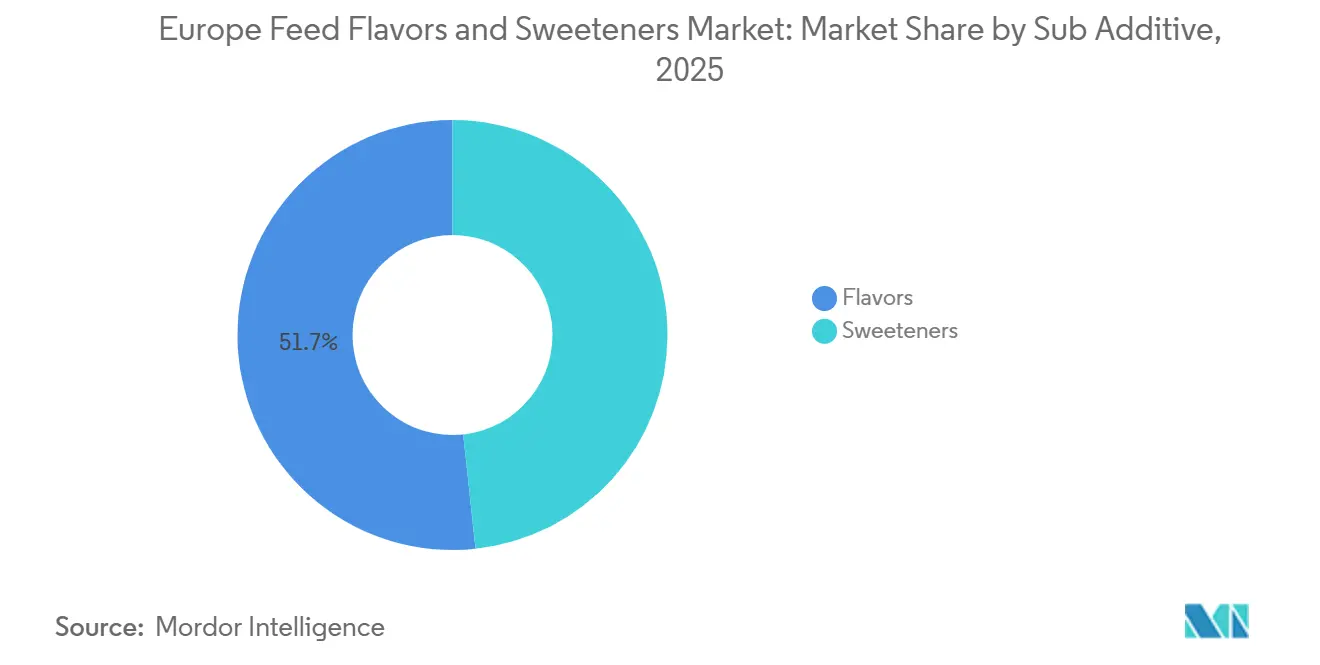
Flavors held 51.7% of the Europe feed flavors and sweeteners market share in 2025, making them the largest sub-additive category. Their strength comes from broad use across lactation diets, finisher rations, and calf starters, which gives them wider application than many narrowly targeted inputs. The Europe feed flavors and sweeteners market size for flavors remains supported by this versatility, because buyers can use one platform across several animal groups while still addressing intake, masking, and formulation acceptance. Flavors also fit well into systems that prioritize stable feed behavior rather than short-term ration adjustment. That makes them the more established side of the category in both species coverage and operational use.
Sweeteners are growing from a smaller base, with a projected CAGR of 4.6% during 2026-2031, but their value per unit is rising as formulations become more specialized. The Europe feed flavors and sweeteners market size for sweeteners is benefiting from demand in young animal diets and transition feeding, where intake response matters quickly and poor acceptance has visible production costs. Adisseo stated in 2025 that products such as Optisweet and Krave reflect a move toward documented, application-specific solutions rather than generic performance claims. In practice, this means sweeteners are becoming more strategic even where volumes are lower than flavors. The category is moving toward higher-value blends, stronger documentation, and tighter alignment with stress-prone feeding applications.



By Animal: Ruminants Retain Scale While Swine Drives the Strongest Growth Momentum
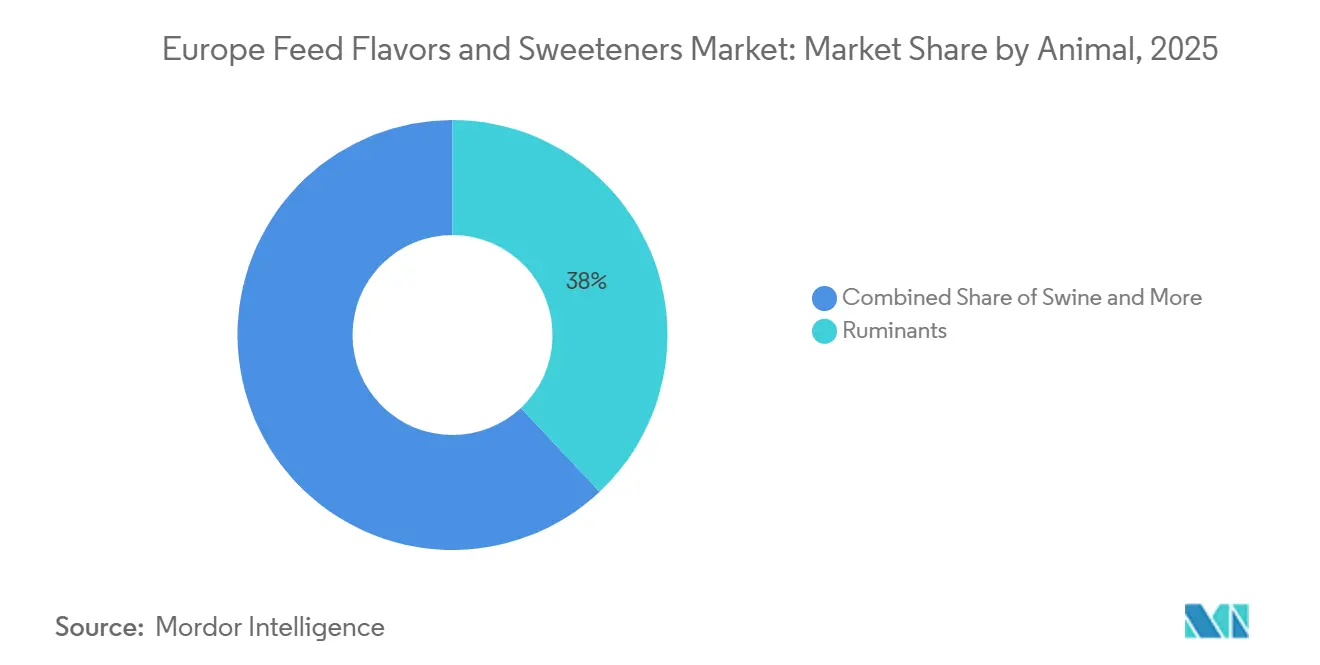
Ruminants accounted for 38.0% of the Europe feed flavors and sweeteners market share in 2025, which made them the largest animal segment. Their position is linked to the high value of European dairy and beef systems and to the sensitivity of intake in early lactation and high-performance feeding. The Merck Veterinary Manual, accessed in 2025 [3]Source: Merck Veterinary Manual, “Nutritional Requirements of Dairy Cattle,” merckvetmanual.com, states that dairy cows must increase dry matter intake rapidly after calving to reduce postpartum negative energy balance, which directly supports the role of palatability in production management. The Europe feed flavors and sweeteners market share in ruminants also reflects the need to maintain consistent intake when functional ingredients are added to Total Mixed Ration programs. In quality-controlled dairy and beef value chains, feed consistency matters for both productivity and traceability. This supports steady demand for flavors and sweeteners that enhance acceptance without altering the ration's broader nutritional intent.
Swine is the fastest-growing animal segment, with a projected 4.8% CAGR through 2031. The Europe feed flavors and sweeteners market for swine is expanding because post-weaning diets are highly sensitive to feed acceptance, and commercial pig systems place a premium on predictable intake. Adisseo Europe noted in 2025 that post-weaning anorexia remains a major technical challenge in piglet nutrition, which keeps palatability support near the center of early-stage swine feeding strategies. Other animals, including poultry and aquaculture, also contribute stable demand where dense production systems require reliable feed intake behavior. Together, these patterns keep swine at the center of the growth story while ruminants preserve the larger installed demand base.
Geography Analysis
Spain held 23.0% of the Europe feed flavors and sweeteners market share in 2025, making it the largest national market in the region. Its lead reflects the scale of its commercial livestock base and the depth of its compound feed use across major species. France remains important for a different reason, because protected origin systems create a more traceability-driven environment for premium feed decisions. The French Ministry of Agriculture reported in 2025, using Institut National de l'Origine et de la Qualité data, that France’s 52 Appellation d'Origine Protégée dairy products generated EUR 2.71 billion (USD 2.94 billion) in revenue and covered 238,854 metric tons of commercialized output in 2024. Regulation (EU) 2024/1143, which entered into force in May 2024, also reinforces the role of traceability in geographical indication systems across Europe. This supports the Europe feed flavors and sweeteners market in premium ruminant chains where feed quality control is part of broader product assurance. Germany also remains a major demand center because of its large livestock base and industrial feeding structure.
The United Kingdom is the fastest-growing geography in the market, with a projected 4.7% CAGR through 2031. United Kingdom Government agricultural statistics published by the Department for Environment, Food and Rural Affairs in 2025 showed that compound feed production volumes rose 4.4% from 2023 to 2024, while cattle and calf feed volumes also increased 4.4% between July 2024 and January 2025. The United Kingdom Met Office reported in its 2025 Spring Seasonal Review that spring 2025 was the sixth driest spring since records began in 1836, which reduced roughage availability and increased reliance on compound feed in ruminant systems. The Europe feed flavors and sweeteners market is therefore finding support in the United Kingdom from both structural feed demand and practical ration adjustment needs. The Veterinary Medicines Directorate also announced in May 2024 that new Great Britain veterinary medicines regulations had entered into force, which created a compliance environment that differs from the European Union renewal-based model and increases the importance of dual-market awareness for suppliers. This makes the United Kingdom both a growth market and a regulatory adaptation market.
The Netherlands and Italy add value through more specialized channels. In March 2026, Denkavit Ingredients and Adisseo expanded their Benelux offer to more than 40 Adisseo products, which shows the Netherlands’ role as a distribution and formulation hub for advanced feed additive categories in Northern and Western Europe. Italy’s premium livestock systems are supported by strict production specifications, and the Consorzio del Parmigiano Reggiano confirmed in its April 2025 specification that at least 75% of forage dry matter for dairy cows must come from the designated production zone. That kind of rule-based feeding environment supports consistent demand for documented, quality-aligned additives. Across the rest of Europe, adoption is more uneven and remains more price-sensitive, but intensifying livestock systems are still creating room for premium palatability solutions over time.
Competitive Landscape
The Europe feed flavors and sweeteners market shows moderate concentration, with large multinationals operating alongside specialized regional suppliers. Archer Daniels Midland Company, Alltech, Inc., Cargill, Incorporated, Kerry Group plc, and DSM-Firmenich AG form the top tier, while Adisseo, Kemin Industries, Inc., Lesaffre Group, and other specialists compete through narrower technical focus. Competition is increasingly shaped by compliance readiness, formulation documentation, and the ability to support multiple species with one platform. The Europe feed flavors and sweeteners market is therefore not defined solely by scale, because buyers also value traceability, application support, and audit confidence. Suppliers with stronger technical documentation are better positioned as customer qualification standards become more demanding. This gives well-established additive platforms an advantage over smaller suppliers that rely mainly on price or single-use formulations.
Recent strategic moves by leading companies also show how competition is shifting. DSM-Firmenich AG announced on Euronext in February 2026 that it had agreed to divest its Animal Nutrition and Health division to CVC Capital Partners, signaling continued portfolio reshaping around core priorities. Kerry Group opened an expanded biotechnology manufacturing hub in Ireland in April 2026, strengthening fermentation and enzyme capacity that supports its broader sensory solutions platform. Alltech introduced Olerix in 2026 for swine production, which shows continued investment in application-led solutions for performance-sensitive livestock systems. These moves point to a market where product strategy is becoming more targeted and platform-based. They also show that leading companies are investing in scale, specialization, or portfolio reshaping rather than competing on commodity positioning.
Specialist players still matter because they can move with greater species focus and tighter application design. The Europe feed flavors and sweeteners market therefore rewards companies that can connect science, compliance, and species-specific performance in one commercial offer. Encapsulation, nature-identical aroma chemistry, fermentation expertise, and documented trial support are becoming more important as buyers screen suppliers more carefully. The result is a competitive field where premium contracts are more likely to concentrate with suppliers that combine regulatory readiness with clear technical differentiation.
Europe Feed Flavors and Sweeteners Industry Leaders
Archer Daniels Midland Company
Alltech, Inc.
Cargill, Incorporated
Kerry Group plc
DSM-Firmenich AG
- *Disclaimer: Major Players sorted in no particular order

Recent Industry Developments
- October 2025: Norel Animal Nutrition presented findings from a controlled swine nutrition trial at the 16th International Symposium on Digestive Physiology of Pigs in 2025, documenting that targeted flavoring compounds in nursery diets improved sow feed return-to-estrus timing by 0.5 days and showed positive trends in piglet fecal consistency and feed efficiency.
- November 2024: Adisseo continued commercial deployment of its Appetite Activation Range, including Addarome, Maxarome, Palarome, Aromax, Optisweet, Krave, Delistart, and Gusti-Plus, across European livestock nutrition customers through its documented palatability platform for swine, ruminants, and young animals.
- November 2024: ADM highlighted its saccharin-free Sucram sweetener range, including Sucram Specifeek and Sucram M'I Sweet, at EuroTier 2024 in Hanover, Germany, marking the European commercial debut of swine-specific sweeteners developed through scientific identification.


Europe Feed Flavors and Sweeteners Market Report Scope
Feed flavors and sweeteners are additives that improve feed taste, aroma, and palatability. The Europe feed flavors and sweeteners market Report is segmented by sub additive (flavors and sweeteners), by animal (ruminants, swine, and more), and by geography (France, Germany, Italy, Netherlands, Russia, Spain, Turkey, United Kingdom, and more). The market forecasts are provided in terms of value (USD) and volume (metric tons).
| Flavors |
| Sweeteners |
| Ruminants | Beef Cattle |
| Dairy Cattle | |
| Other Ruminants | |
| Swine | |
| Other Animals |
| France |
| Germany |
| Italy |
| Netherlands |
| Russia |
| Spain |
| Turkey |
| United Kingdom |
| Rest of Europe |
| By Sub Additive | Flavors | |
| Sweeteners | ||
| By Animal | Ruminants | Beef Cattle |
| Dairy Cattle | ||
| Other Ruminants | ||
| Swine | ||
| Other Animals | ||
| By Geography | France | |
| Germany | ||
| Italy | ||
| Netherlands | ||
| Russia | ||
| Spain | ||
| Turkey | ||
| United Kingdom | ||
| Rest of Europe | ||


Key Questions Answered in the Report
What is driving demand for feed flavors and sweeteners in Europe?
Demand is being supported by stronger focus on feed intake, cleaner-label livestock production, and higher use of documented palatability systems in dairy, swine, and young animal diets.
Which sub additive segment is the largest in this space?
Flavors led the category with 51.7% share in 2025 because they are used across multiple species and feeding stages.
Which animal segment is growing the fastest?
Swine is the fastest-growing segment, with a projected 4.8% CAGR through 2031, supported by the sensitivity of post-weaning diets to feed acceptance.
Why is the United Kingdom growing quickly in this space?
Official United Kingdom data showed stronger compound feed volumes, and the 2025 spring forage shortfall increased reliance on compound feed inputs in ruminant systems.
Page last updated on:





