
Europe E-Commerce Last-Mile Delivery Market Size and Share
Market Overview
| Study Period | 2020 - 2031 |
|---|---|
| Forecast Data Period | 2026 - 2031 |
| Base Year Market Size (2025) | USD 30.93 Billion |
| Market Size (2026) | USD 33.57 Billion |
| Market Size (2031) | USD 49.65 Billion |
| Growth Rate (2026 - 2031) | 8.14 % |
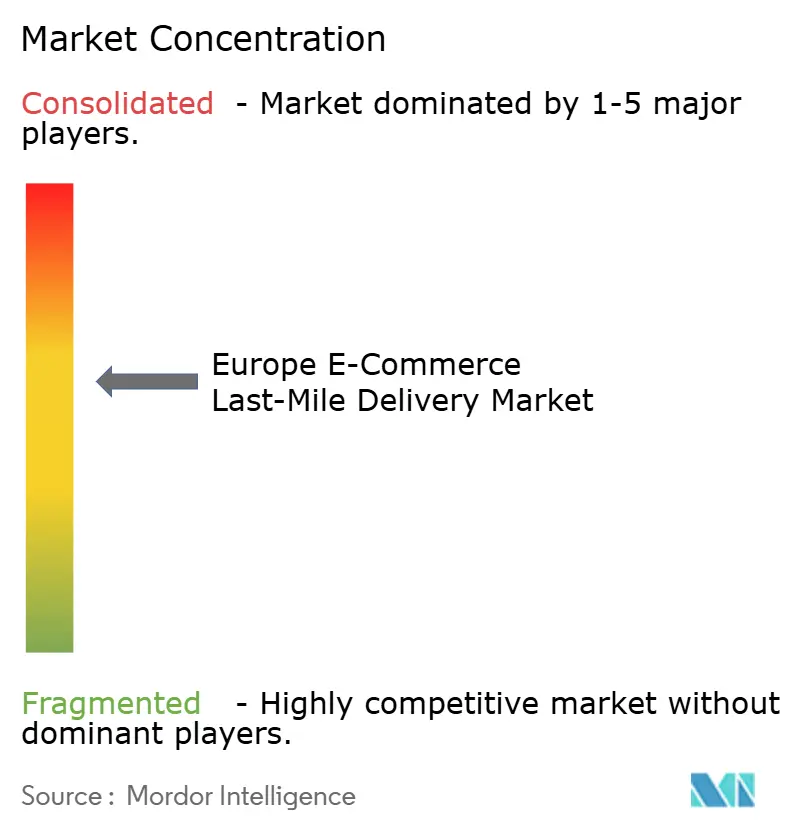
| Market Concentration | Medium |
Major Players *Disclaimer: Major Players sorted in no particular order Image © Mordor Intelligence. Reuse requires attribution under CC BY 4.0. | |
Europe E-Commerce Last-Mile Delivery Market Analysis by Mordor Intelligence
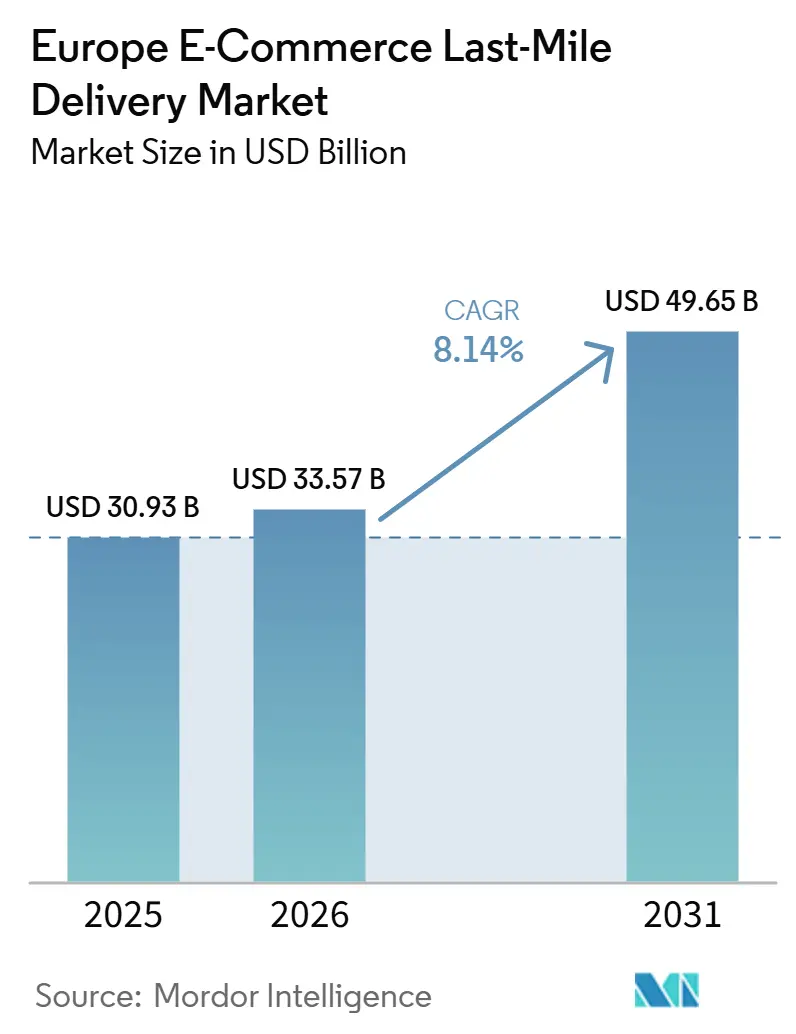
The Europe e-commerce last-mile delivery market was valued at USD 30.93 billion in 2025 and is expected to reach USD 33.57 billion in 2026 and USD 49.65 billion by 2031, registering a CAGR of 8.14% between 2026 and 2031.
The Europe e-commerce last-mile delivery market is moving toward networks that combine doorstep services with parcel lockers, pickup points, and local delivery hubs. This shift helps carriers raise first-attempt delivery rates and reduce the cost per stop. Online retail demand continues to raise the need for dependable final-mile services, while consumers still balance speed against delivery charges. Large operators are simultaneously investing in locker capacity, electric vehicles, and routing systems. These investments make scale, network density, and access to capital more important in the Europe e-commerce last-mile delivery market.
Key Report Takeaways
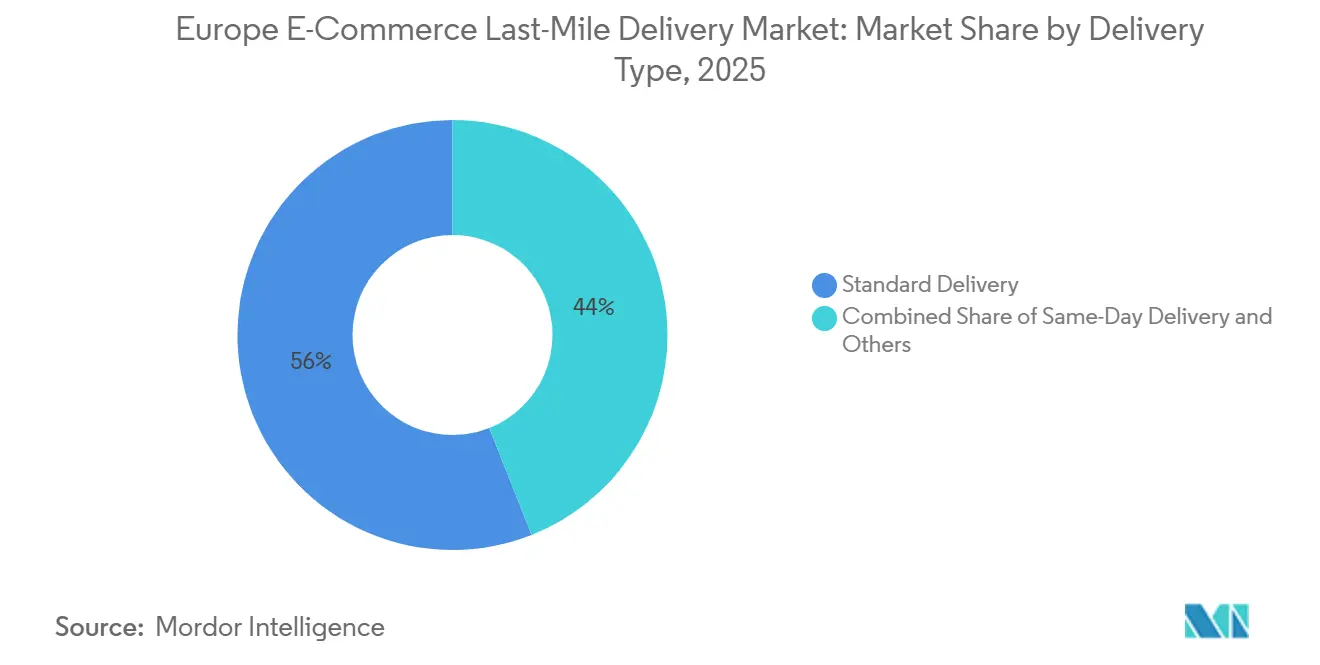
- By delivery type, standard delivery held 56% of the Europe e-commerce last-mile delivery market share in 2025, while same-day delivery is forecast to grow at an 11.59% CAGR through 2031.
- By delivery model, B2C accounted for 47.96% of the Europe e-commerce last-mile delivery market size in 2025, while C2C is projected to expand at a 14.26% CAGR through 2031.
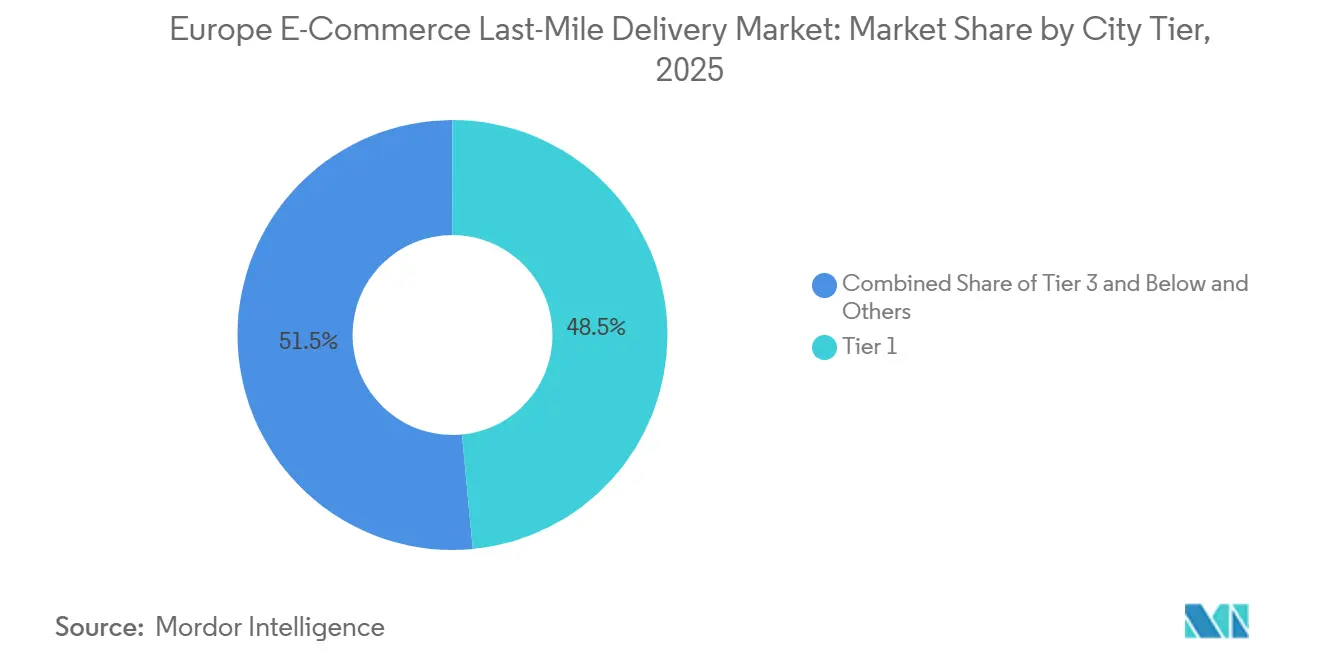
- By city tier, Tier 1 cities held 48.50% of the Europe e-commerce last-mile delivery market share in 2025, while Tier 3 and below cities are forecast to grow at an 11.19% CAGR through 2031.
- By product type, fashion and lifestyle accounted for 28.22% of the Europe e-commerce last-mile delivery market size in 2025, while consumer electronics and household appliances are forecast to grow at a 10.39% CAGR through 2031.
- By country, Germany held 22.11% of the Europe e-commerce last-mile delivery market share in 2025, while Spain is projected to grow at a 9.22% CAGR through 2031.
Note: Market size and forecast figures in this report are generated using Mordor Intelligence’s proprietary estimation framework, updated with the latest available data and insights as of January 2026.
Market Trends and Insights
Drivers Impact Analysis of Europe E-Commerce Last-Mile Delivery Market*
| Driver | (~) % Impact on CAGR Forecast | Geographic Relevance | Impact Timeline |
|---|---|---|---|
| E-Commerce Parcel Density Expansion | +2.8% | Global; concentrated in Germany, the United Kingdom, France, Spain, Nordics | Short term (≤ 2 years) |
| Out-of-Home Pickup and Locker Network Expansion | +2.0% | Germany, France, the United Kingdom, Poland, Italy, Belgium, the Nordics | Medium term (2–4 years) |
| Same-Day and Next-Day Service Penetration | +1.4% | Tier 1 cities across Germany, the United Kingdom, France, the Netherlands, and Spain | Short term (≤ 2 years) |
| Electrification of Urban Delivery Fleets | +0.9% | Germany, the Netherlands, the United Kingdom, and France; spill-over to Spain and Italy | Medium term (2–4 years) |
| Real-Time Route Optimization and Visibility Expectations | +0.7% | Global; primary gains in urban Tier 1 and Tier 2 markets | Short term (≤ 2 years) |
| Cross-Border Marketplace Fulfillment Complexity | +0.5% | Germany, France, the Netherlands, and Spain; spill-over to the rest of Europe | Long term (≥ 4 years) |
| Source: Mordor Intelligence | |||
E-Commerce Parcel Density Expansion
Parcel density is improving the economics of the Europe e-commerce last-mile delivery market because carriers can serve more addresses on each route. Retailers are also placing greater value on delivery performance because failed or delayed deliveries can affect customer conversion and repeat orders. First-attempt delivery success in Europe rose from 82.1% in the first quarter of 2025 to 86.4% in the second quarter. On-time delivery remained above 98% during the same period. Carriers with dense networks can use these operating gains to improve service reliability without incurring proportional labor costs. The same advantage is encouraging investment in pickup and locker coverage outside the largest cities.
Out-of-Home Pickup and Locker Network Expansion
Out-of-home delivery is becoming a central part of the Europe e-commerce last-mile delivery market because it consolidates deliveries at accessible collection points. Geopost operated more than 150,000 pickup points, including 50,000 lockers, across Europe in 2025, and its out-of-home volumes rose 31%. InPost delivered 1.4 billion parcels in 2025 and added 14,200 automated parcel machines, bringing its European network to 61,196 lockers. GLS expanded its network from 70,000 to 130,000 out-of-home points in 24 months and set a target of 30,000 owned lockers by 2030[1]. DPD Germany and GLS launched the inbox shared network in March 2026, aiming to reach 20,000 shared points by the end of 2027. Shared networks can widen consumer access while lowering the infrastructure burden on each carrier.
Same-Day and Next-Day Service Penetration
Same-day and next-day services are shaping customer expectations in the Europe e-commerce last-mile delivery market, especially in large urban areas. Next-day delivery remains a common premium option for fashion and consumer electronics orders in the United Kingdom, Germany, and the Netherlands. Same-day delivery is growing faster because retailers can support it through local inventory, dark stores, and smaller fulfillment sites. Its operating model requires high demand density, tightly planned routes, and inventory near the customer. This limits broad rollout across lower-density areas, even as demand rises in major cities. Carriers are therefore likely to retain tiered service options, with standard, next-day, and same-day delivery serving different price and urgency needs.
Electrification of Urban Delivery Fleets
Fleet electrification is changing capital spending priorities in the Europe e-commerce last-mile delivery market. DHL Group had 32,400 electric vehicles for mail and parcel delivery in Germany in 2025, and more than 50% of routes in its Post & Parcel Germany division were electric. Austrian Post completed fully carbon-dioxide-free postal delivery in Vienna in June 2026, using 1,000 electric vehicles that cover 8 million km each year. PostNL put its 2,000th electric delivery van into service in March 2026. Electric fleets can reduce emissions and support access to restricted urban areas. Their benefits are strongest where route density and access to charging support regular vehicle utilization.
Restraints Impact Analysis of Europe E-Commerce Last-Mile Delivery Market*
| Restraint | (~) % Impact on CAGR Forecast | Geographic Relevance | Impact Timeline |
|---|---|---|---|
| Last-Mile Labor Availability and Driver Retention Pressure | −2.3% | Europe-wide, most acute in Germany, Spain, the United Kingdom, and Poland | Short term (≤ 2 years) |
| Urban Access Constraints and Low-Emission Zone Compliance Costs | −1.8% | Paris, London, Amsterdam, Brussels, Berlin, Barcelona; spill-over to 300+ EU cities | Medium term (2–4 years) |
| Rural Density Penalties for Zero-Emission Delivery Economics | −0.9% | Rest of Europe, Nordics rural zones, Spain, and Italy's inland regions | Long term (≥ 4 years) |
| Packaging, Returns, and Reverse-Logistics Cost Inflation | −0.8% | Germany, the United Kingdom, France, and the Nordics have the highest return-rate markets. | Short term (≤ 2 years) |
| Source: Mordor Intelligence | |||
Last-Mile Labor Availability and Driver Retention Pressure
Labor availability remains a restraint on the Europe e-commerce last-mile delivery market because final-mile service depends on reliable driver coverage. The IRU reported 502,000 unfilled truck driver positions across Europe in 2025, equal to a 13% shortage rate. It also stated that 660,000 drivers are expected to retire by 2030. Shortages can increase recruitment, training, and overtime costs for delivery operators[2]. They also make it harder for carriers to add service capacity during seasonal peaks. Lockers, route-planning tools, and flexible delivery models can reduce the number of doorstep stops, but they do not eliminate the need for trained personnel.
Urban Access Constraints and Low-Emission Zone Compliance Costs
Urban access rules require carriers to adjust fleets, depots, and routes across the Europe e-commerce last-mile delivery market. European air-quality policy continues to put pressure on cities to reduce transport emissions. Amsterdam's zero-emission zone took effect in January 2025, while Brussels tightened its low-emission zone rules in January 2026. These rules can require earlier replacement of diesel vehicles and more careful scheduling of deliveries. Compliance costs are particularly difficult for small operators with limited access to capital. Urban micro-hubs and out-of-home delivery can help carriers reduce restricted-zone mileage, but these approaches also require network investment.
*Our forecasts treat driver/restraint impacts as directional, not additive. The impact forecasts reflect baseline growth, mix effects, and variable interactions.
Europe E-Commerce Last-Mile Delivery Market Segment Analysis
By Delivery Type:
Standard Delivery Maintains Volume While Same-Day Delivery Raises Service ExpectationsStandard delivery held 56% of the Europe e-commerce last-mile delivery market share in 2025. Its position reflects continued consumer attention to delivery charges, even where faster options are available. Standard services give retailers a lower-cost option for routine orders and allow carriers to consolidate routes. They are also increasingly linked to lockers and pickup points rather than doorstep delivery. This change can improve first-attempt delivery performance and reduce missed delivery costs. Next-day delivery sits between standard and same-day services in both price and urgency.
Same-day delivery is forecast to grow at an 11.59% CAGR through 2031, making it the fastest-growing delivery type in the Europe e-commerce last-mile delivery market. It is most viable in large cities, where short travel distances and local stock support frequent dispatches. Retailers use it most often for urgent orders for food, household, fashion, and electronics. The model requires local fulfillment capacity before volume can reach an efficient level. As a result, same-day delivery is likely to remain selective outside dense urban areas. Operators can protect margins by offering it as a paid option while keeping standard delivery broadly available.

By Delivery Model:
B2C Leads While C2C Expands Through Resale ActivityB2C accounted for 47.96% of the Europe e-commerce last-mile delivery market size in 2025. Retail e-commerce, grocery fulfillment, and direct-to-consumer brands continue to create the largest parcel flows in this model. Geopost reported 9% B2C volume growth in 2025 across its 5 major European markets. B2C delivery requires a mix of doorstep, locker, and parcel-shop services, as well as return services. Retailers benefit when carriers provide reliable delivery choices at checkout. This keeps consumer delivery the core volume base for national parcel networks.
C2C is forecast to grow at a 14.26% CAGR through 2031. Second-hand platforms and the wider use of peer-to-peer resale channels support the segment. Germany's 2026 KEP study identified C2C as the segment with the greatest longer-term potential[3]. These parcels are often smaller and well-suited to locker or pickup-point delivery. That profile fits the networks carriers are building for B2C delivery. InPost's 2025 acquisitions of Yodel in the United Kingdom and Sending in Spain expanded its doorstep capabilities alongside its locker base. Carriers that handle both outbound and reverse flows can serve resale platforms more effectively.
By City Tier:
Tier 1 Cities Lead Revenue While Smaller Cities Drive GrowthTier 1 cities held 48.50% of the Europe e-commerce last-mile delivery market share in 2025. London, Paris, Berlin, Madrid, and Amsterdam combine high online shopping activity with dense delivery routes. Higher stop density improves delivery economics and makes premium services easier to support. These cities also have established parcel shops and locker networks. Urban demand supports the use of micro-hubs, electric vans, and time-specific delivery windows. Access restrictions, however, can raise operating costs in the same locations.
Tier 3 and below cities are forecast to grow at an 11.19% CAGR through 2031. Online shopping is reaching consumers in smaller cities and rural areas, where local retail options are limited. National postal networks and third-party pickup points help extend coverage to these areas. The operating model is more difficult because routes are longer and parcel density is lower. A 2026 study in the European Transport Research Review found that urban consolidation methods require careful optimization, as they can increase vehicle kilometers traveled in lower-density settings. Carriers will need flexible delivery arrangements where fully electrified, dedicated routes remain uneconomic.
By Product Type:
Fashion Leads Parcel Volumes While Electronics Strengthen Fulfillment DemandFashion and lifestyle accounted for 28.22% of the Europe e-commerce last-mile delivery market size in 2025. Apparel, footwear, and accessories generate frequent consumer orders and regular returns. This makes reverse logistics important for carriers serving fashion retailers. Returns require clear collection choices, sorting capacity, and coordination with retailers. Lockers and parcel shops can simplify consumer returns while reducing collection costs. Product handling remains relatively straightforward compared with bulky goods or temperature-controlled products.
Consumer electronics and household appliances are forecast to grow at a 10.39% CAGR through 2031. Their growth supports demand for reliable delivery, secure handling, and localized inventory. Electronics may require product safety checks and specialized handling, especially for batteries and larger appliances. Food and beverages also need temperature-controlled delivery and narrow service windows. Geopost reported 7% growth in food-delivery volumes and 11% growth in temperature-controlled activity across 8 European countries in 2025. Large and bulky items require dedicated capabilities, such as DHL's two-person handling services, rather than a conventional parcel-network model.
Geography Analysis
Germany E-Commerce Last-Mile Delivery Market
Germany held 22.11% of the Europe e-commerce last-mile delivery market share in 2025. Its position reflects a mature e-commerce base, a broad parcel network, and extensive out-of-home infrastructure. DHL plans to expand its Packstation network from 15,500 units to 30,000 by 2030, while DPD Germany and GLS target 20,000 inboxx points by the end of 2027. Germany's established delivery network supports domestic and cross-border parcel flows. Its high return activity also creates demand for efficient returns processing.
Spain E-Commerce Last-Mile Delivery Market
Spain is forecast to grow at a 9.22% CAGR through 2031, the fastest country rate in the Europe e-commerce last-mile delivery market. Its growth is supported by B2C e-commerce, faster delivery services, and expanding out-of-home capacity. InPost strengthened its position in Spain by acquiring Sending in 2025. The CTT and DHL eCommerce joint venture received approval in March 2026 and was formally completed in May 2026. The intention is to build a broad parcel distribution network across the Iberian Peninsula.
Broader European Markets
France, the United Kingdom, the Nordics, Benelux, and Central and Eastern Europe have different network conditions. The merger of DHL eCommerce United Kingdom and Evri created a business that delivers more than 1 billion parcels and 1 billion letters annually, with 8,000 vehicles. PostNL delivered 376 million parcels in 2025 and had 2,000 electric vans in service by March 2026[4]. Nordic markets have strong sustainability expectations, while Poland had 28,165 InPost lockers, and Geopost sales grew 13.1% in Croatia and 10.8% in Poland during 2025.
Competitive Landscape
The Europe e-commerce last-mile delivery market is moderately fragmented, with domestic operations increasingly giving way to large cross-border networks led by Geopost, DHL Group, GLS, UPS, and Amazon Logistics. Geopost had more than 150,000 out-of-home points in 2025, while InPost had 61,196 lockers. These networks can improve utilization and delivery choice. Smaller carriers may struggle to match investment in lockers, low-emission fleets, and technology.
Partnerships and acquisitions are changing the competitive structure of the Europe e-commerce last-mile delivery market. DPD Germany and GLS launched inboxx in 2026 to create a shared open-access network. InPost acquired Yodel and Sending in 2025, expanding doorstep capacity in the United Kingdom and Spain. DHL Group merged DHL eCommerce United Kingdom with Evri in 2025. These moves extend competition across parcels, returns, lockers, and local fulfillment.
Technology and sustainability investments are separating the leading operators in the Europe e-commerce last-mile delivery market. DHL Group is using electric vehicles for low-emission urban access, while Austrian Post has completed fully electric postal delivery in Vienna. La Poste Groupe identifies Geopost as a core growth business under its Ambitions 2031 plan. Leading carriers use data, route planning, and network access to improve service consistency. Operators unable to fund these investments may depend on partnerships or narrowly focused domestic positions.
Europe E-Commerce Last-Mile Delivery Industry Leaders
-
DHL Group
-
Geopost
-
UPS
-
Amazon Logistics
-
GLS Group
- *Disclaimer: Major Players sorted in no particular order
Europe E-Commerce Last-Mile Delivery Market Companies Covered in this Report
- DHL Group
- GLS Group
- Amazon Logistics
- United Parcel Service, Inc.
- FedEx
- InPost
- La Poste Group
- Correos Group
- PostNL
- Poste Italiane
- Geopost (DPDgroup Parent)
- Evri
- PostNord
- Bnode
- Bring
- Swiss Post Ltd.
- Cainiao
- Colis Prive
Recent Industry Developments in Europe E-Commerce Last-Mile Delivery Market
- May 2026: FedEx committed EUR 46 million (USD 54.1 million) to expand its road hub in Duiven, Netherlands.
- March 2026: The European Commission unconditionally approved the CTT and DHL eCommerce joint venture under EU Merger Regulation, with the transaction formally sealed in May 2026.
- February 2026: GLS expanded its European out-of-home delivery network from 70,000 to 130,000 points in 24 months.
- October 2025: DHL eCommerce United Kingdom completed its merger with Evri following unconditional CMA approval in September 2025. The combined Evri Group delivers over 1 billion parcels and 1 billion letters annually, with a team of 30,000+ couriers and a fleet of 8,000 vehicles.
Europe E-Commerce Last-Mile Delivery Market Report Scope
Segmentation Overview
| Standard Delivery |
| Same-Day Delivery |
| Next-Day Delivery |
| Business-to-Consumer (B2C) |
| Business-to-Business (B2B) |
| Consumer-to-Consumer (C2C) |
| Tier 1 |
| Tier 2 |
| Tier 3 and Below |
| Foods and Beverages |
| Personal and Household Care |
| Fashion and Lifestyle (accessories, apparel, footwear) |
| Furniture |
| Consumer Electronics and Household Appliances |
| Other Products |
| United Kingdom |
| Germany |
| France |
| Spain |
| Italy |
| Belgium |
| Netherlands |
| NORDICS (Denmark, Finland, Iceland, Norway, and Sweden) |
| Rest of Europe |
| By Delivery Type | Standard Delivery |
| Same-Day Delivery | |
| Next-Day Delivery | |
| By Delivery Model | Business-to-Consumer (B2C) |
| Business-to-Business (B2B) | |
| Consumer-to-Consumer (C2C) | |
| By City Tier | Tier 1 |
| Tier 2 | |
| Tier 3 and Below | |
| By Product Type | Foods and Beverages |
| Personal and Household Care | |
| Fashion and Lifestyle (accessories, apparel, footwear) | |
| Furniture | |
| Consumer Electronics and Household Appliances | |
| Other Products | |
| By Country | United Kingdom |
| Germany | |
| France | |
| Spain | |
| Italy | |
| Belgium | |
| Netherlands | |
| NORDICS (Denmark, Finland, Iceland, Norway, and Sweden) | |
| Rest of Europe |
Key Questions Answered in the Report
What is the forecast growth rate for e-commerce last-mile delivery in Europe?
The sector is forecast to grow at an 8.14% CAGR from 2026 to 2031, increasing from USD 33.57 billion in 2026 to USD 49.65 billion by 2031.
Which delivery service is growing fastest in Europe?
Same-day delivery is forecast to grow at an 11.59% CAGR through 2031, supported by demand in dense urban areas and local fulfillment capacity.
Why are parcel lockers important for e-commerce delivery?
Lockers and pickup points consolidate deliveries, reduce missed doorstep deliveries, and give consumers more collection options.
Which delivery model has the highest forecast growth?
C2C delivery is projected to grow at a 14.26% CAGR through 2031 as resale platforms increase peer-to-peer parcel volumes.
Which country is the largest European last-mile delivery location?
Germany held 22.11% share in 2025, supported by its mature parcel infrastructure and its extensive Packstation network.
What is the main operating challenge for delivery carriers?
Labor shortages and non-compliance with low-emission zones can increase costs and limit delivery capacity, particularly in major cities.