
Europe Data Center Sustainable Cooling Market Size and Share
Market Overview
| Study Period | 2021 - 2032 |
|---|---|
| Base Year Market Size (2026) | USD 4.52 Billion |
| Market Size (2027) | USD 5.19 Billion |
| Market Size (2032) | USD 9.47 Billion |
| Growth Rate (2027 - 2032) | 15.94 % |
| Fastest Growing Market | Asia-Pacific |
| Largest Market | North America |
Major Players *Disclaimer: Major Players sorted in no particular order Image © Mordor Intelligence. Reuse requires attribution under CC BY 4.0. | |
Europe Data Center Sustainable Cooling Market Analysis by Mordor Intelligence
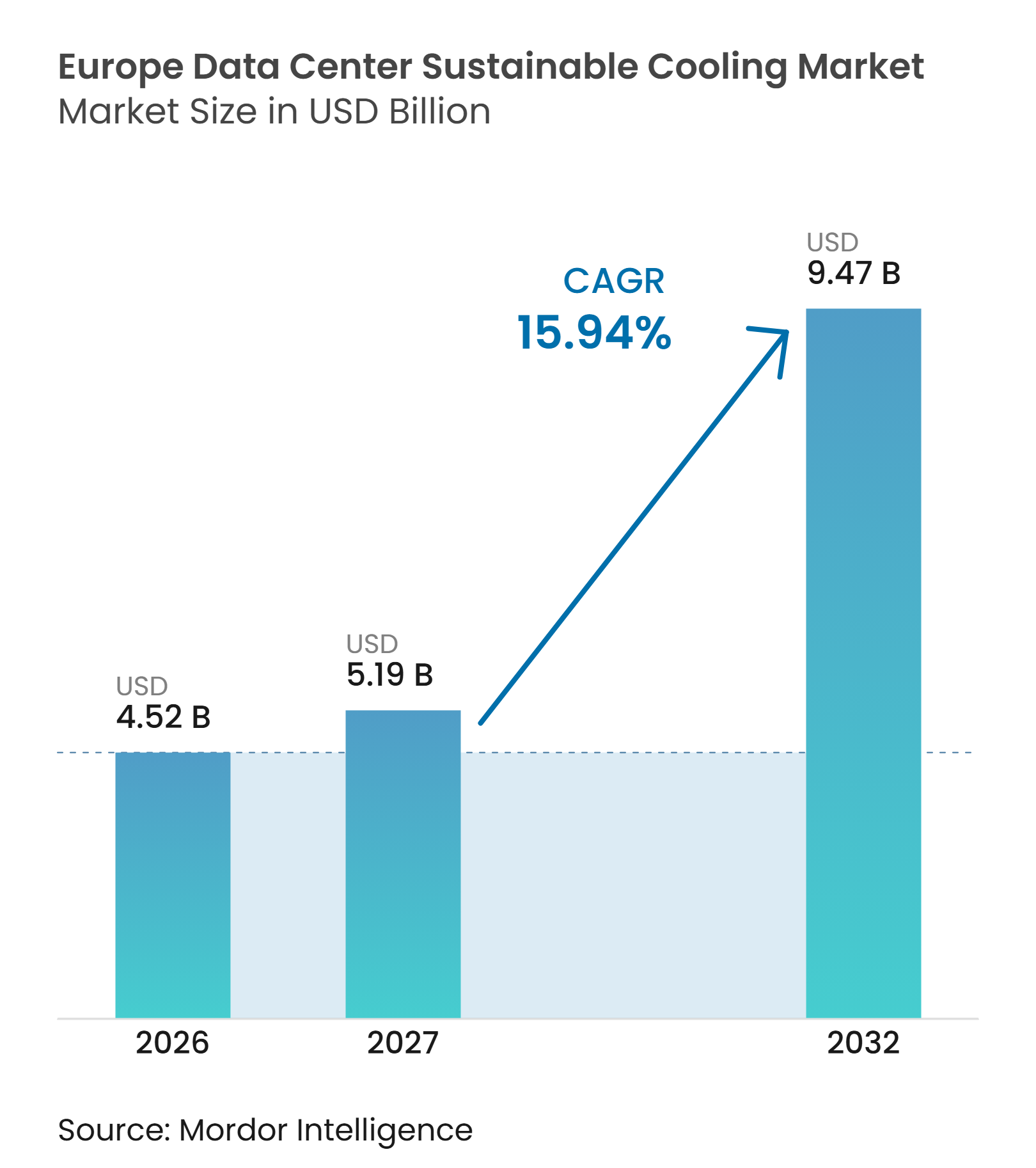
The Europe data center sustainable cooling market size is USD 4.52 billion in 2026 and is projected to reach USD 9.47 billion by 2032, expanding at a CAGR of 15.94% from 2027 to 2032. The Europe data center sustainable cooling market is being reshaped by AI platforms that place far more heat in each rack than legacy air-cooled equipment can manage. This is making liquid cooling, heat reuse, and tighter cooling controls part of new-site design rather than later upgrades. Compliance requirements on energy, water, refrigerants, and waste heat are also bringing cooling choices into capital planning. Suppliers that can combine liquid loops, dry cooling, monitoring, and low-GWP refrigerants are better placed to meet the needs of cloud, colocation, and sovereign AI projects. The Europe data center sustainable cooling market also faces pressure on engineering capacity because operators often need to qualify new cooling systems and new refrigerants at the same time.
Key Report Takeaways
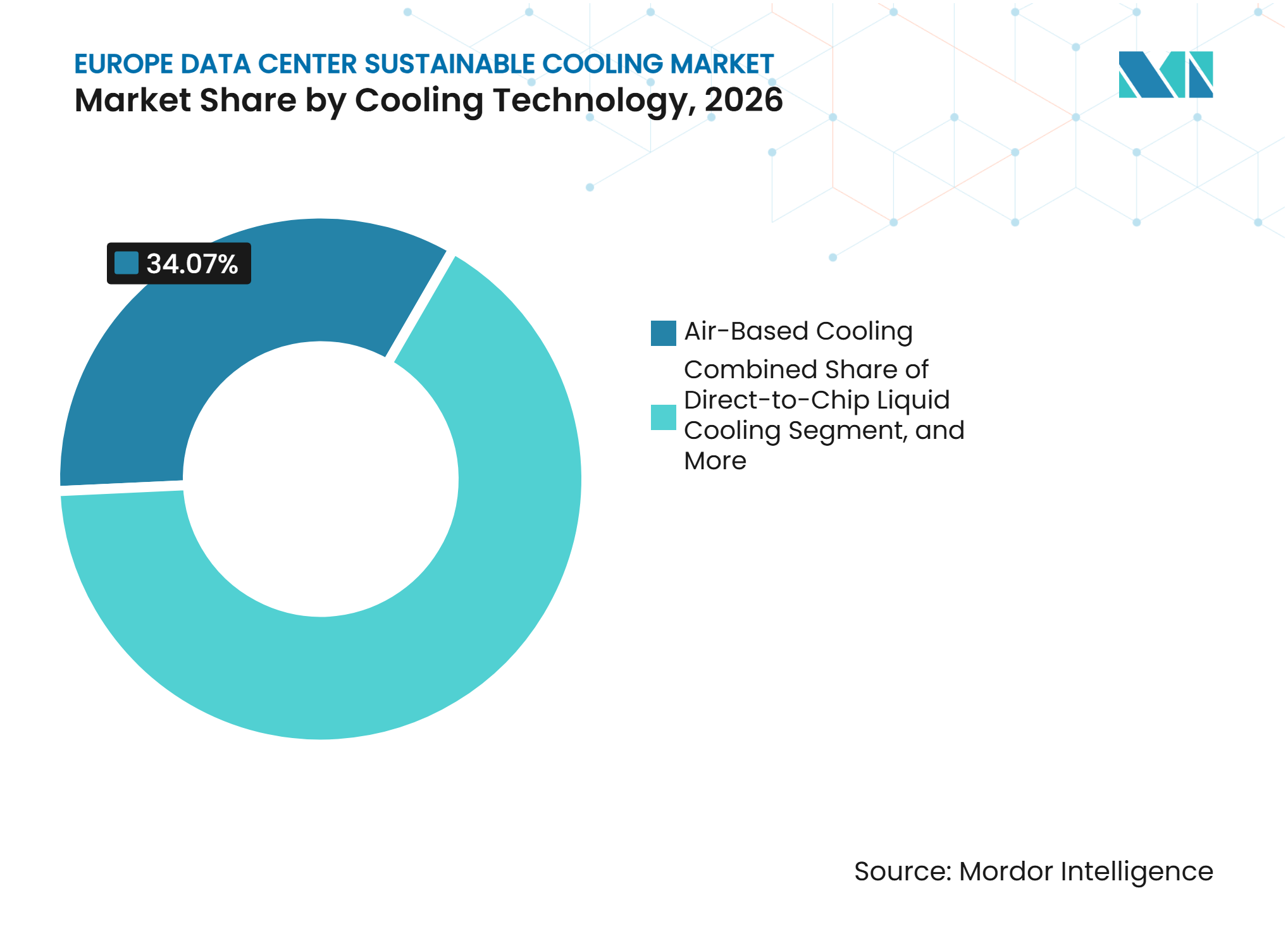
- By cooling technology, air-based cooling held a 34.07% revenue share in the Europe data center sustainable cooling market in 2026, while direct-to-chip liquid cooling is projected to expand at a 16.23% CAGR through 2032.
- In the heat rejection technology segment, air-cooled systems held a 40.49% revenue share in 2026, while hybrid heat rejection systems are projected to expand at a 16.52% CAGR through 2032.
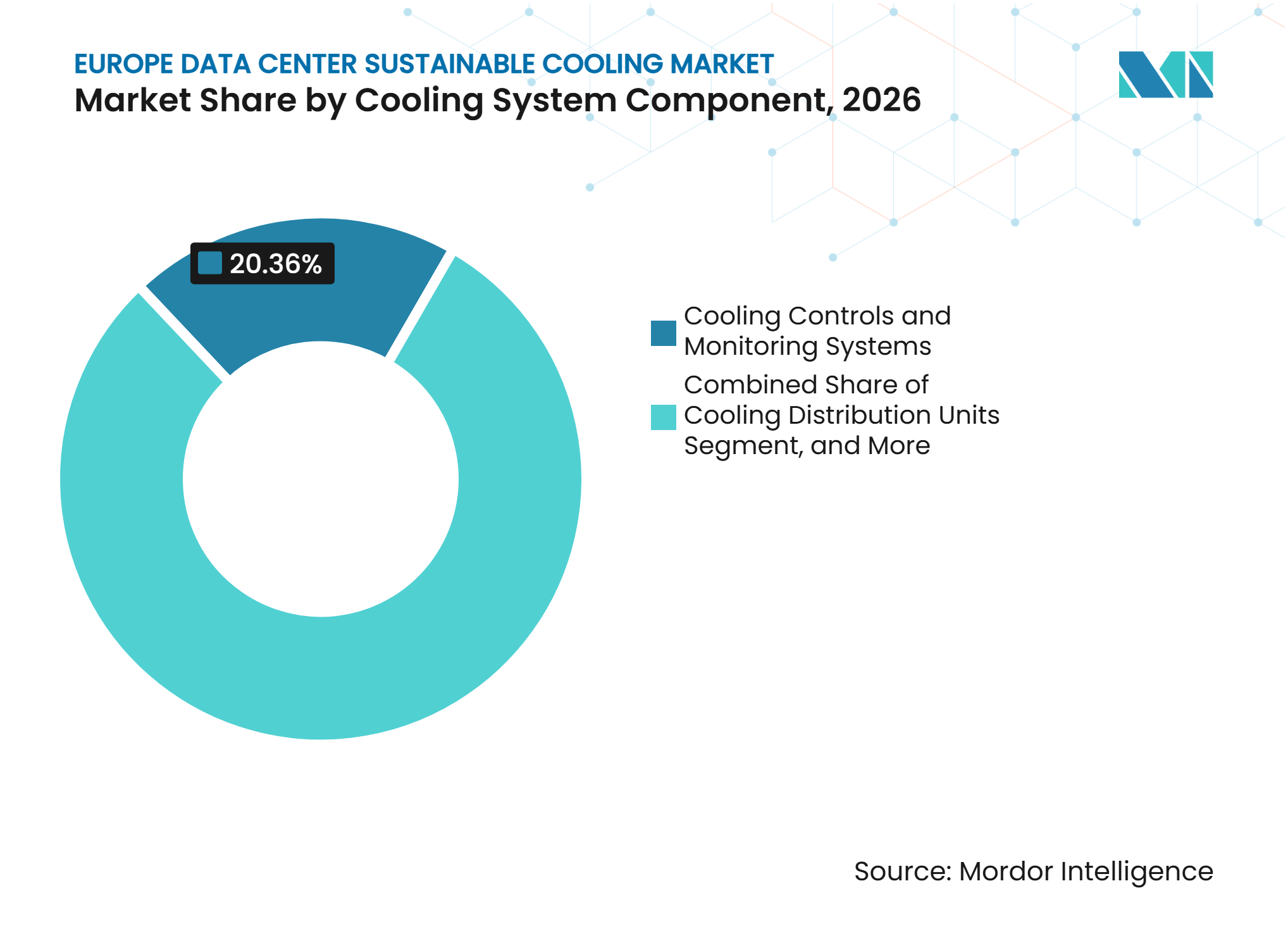
- By cooling system component, cooling controls and monitoring systems accounted for 20.35% of revenue in the Europe data center sustainable cooling market in 2026, while cooling distribution units are projected to expand at a 16.64% CAGR through 2032.
- By sustainability approach, energy-efficient cooling held a 44.91% revenue share in 2026, while heat recovery-enabled cooling is projected to expand at a 16.62% CAGR through 2032.
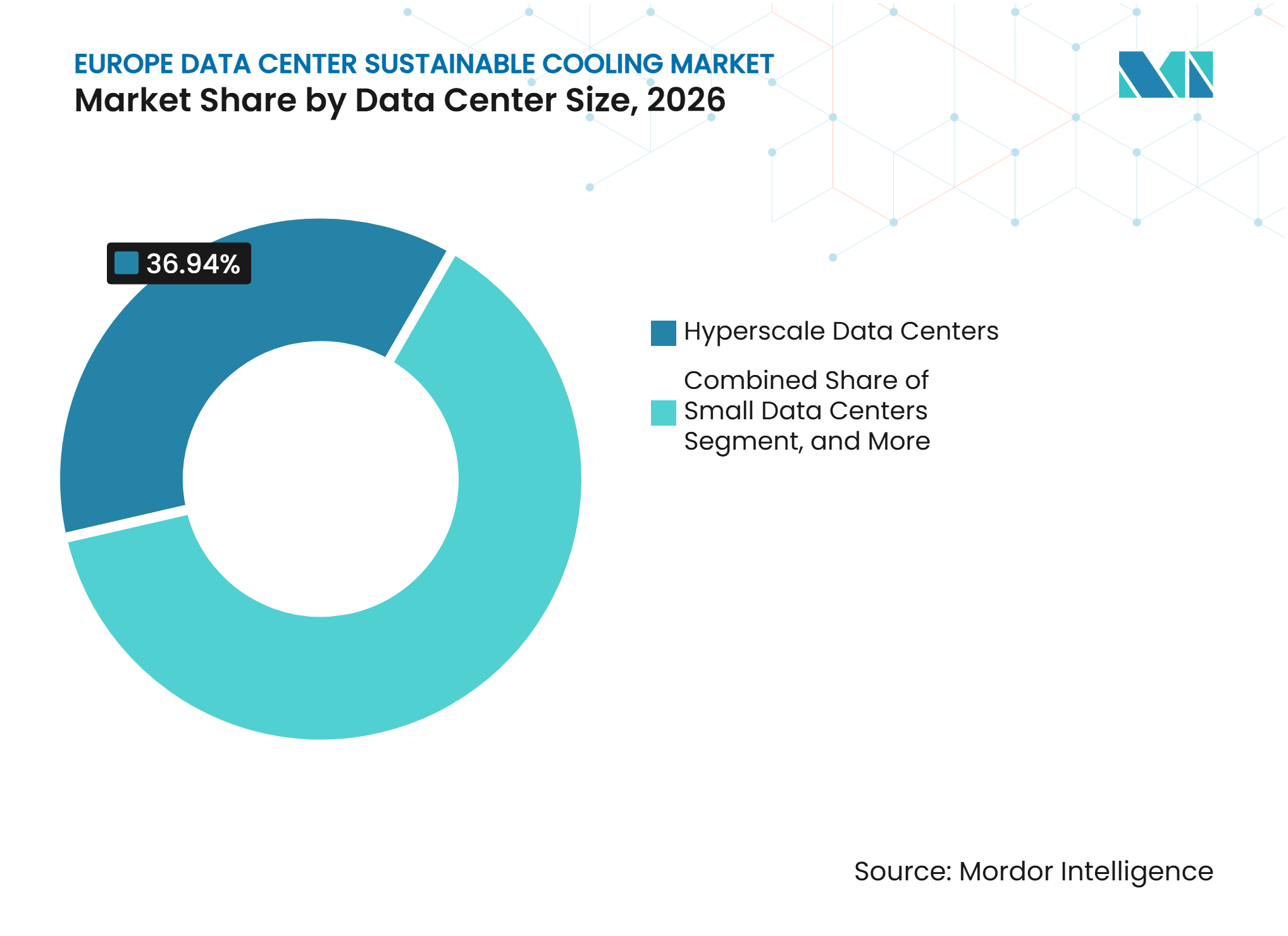
- By data center size, hyperscale data centers accounted for 36.95% of the European data center sustainable cooling market in 2026 and are projected to expand at a 16.27% CAGR through 2032.
- By data center type, cloud service providers held 41.81% revenue share in 2026 and are projected to expand at a 16.18% CAGR through 2032.
- By geography, the United Kingdom held a 22.57% revenue share in 2026, while Spain is projected to expand at a 16.47% CAGR through 2032.
Note: Market numbers in this report are based on Mordor Intelligence's proprietary estimation framework, which combines nine months of actuals with Q4 projections for base year 2026.
Market Trends and Insights
Drivers Impact Analysis of Europe Data Center Sustainable Cooling Market*
| Driver | (~) % Impact on CAGR Forecast | Geographic Relevance | Impact Timeline |
|---|---|---|---|
| AI and High-Performance Computing Rack Density Expansion | +4.8% | United Kingdom, Germany, France, Netherlands, and Nordics | Short term (≤ 2 years) |
| Hyperscale and Colocation Capacity Build-Outs | +3.9% | United Kingdom, Spain, Ireland, Nordics, and Germany | Medium term (2-4 years) |
| EU Energy Efficiency and Sustainability Compliance | +2.8% | EU27, with early enforcement in Germany, Netherlands, and France | Medium term (2-4 years) |
| Northern Europe Free-Cooling and Renewable Energy Advantages | +2.1% | Iceland, Norway, Sweden, Finland, Denmark, and Scotland | Long term (≥ 4 years) |
| Waste Heat Reuse and District Energy Integration | +1.6% | Germany, Finland, Sweden, Netherlands, and Italy | Long term (≥ 4 years) |
| Sovereign AI and Digital Infrastructure Investment | +1.2% | France, Germany, Spain, Poland, and EuroHPC AI Factory sites | Medium term (2-4 years) |
| Source: Mordor Intelligence | |||
AI and High-Performance Computing Rack Density Expansion
The Europe data center sustainable cooling market is responding to AI training and inference systems that have changed the heat loads facilities must manage. Purpose-built AI deployments are being designed for very high per-rack power densities, while advanced AI platforms operate at exceptionally high thermal design power and can reach even higher levels at peak load. Conventional hall air cooling becomes constrained at high rack densities, so new high-density projects increasingly require direct-to-chip liquid cooling. A single direct-to-chip loop, including cold plates, cooling distribution units, and piping, can involve substantial costs. This places cooling equipment in the initial capital plan for each AI cluster. A peer-reviewed review found that direct-to-chip cooling and rear-door heat exchangers were commercially mature options for near-term AI deployments, while immersion and two-phase systems remained in the earlier stages of commercial rollout. Continuous inference workloads add to the need for stable thermal management because they can maintain high utilization beyond a discrete training cycle.
Hyperscale and Colocation Capacity Build-Outs
The Europe data center sustainable cooling market benefits from new hyperscale and colocation construction across established and emerging locations. Greenfield projects allow operators to specify liquid loops, cooling distribution units, and heat rejection systems at the design stage rather than adapt legacy layouts. Cloud providers and colocation operators also need liquid-cooling-ready shells when serving GPU-as-a-service tenants. New sites outside established hubs face different choices on climate, water availability, grid access, and district heating connections. These conditions favor modular systems that can be tuned to individual sites. The growing number of sovereign AI and EuroHPC projects adds another procurement stream for cooling vendors because high-density compute must be built with reliable heat removal from the outset.
EU Energy Efficiency and Sustainability Compliance
The Europe data center sustainable cooling market is increasingly influenced by EU rules that make energy and water performance part of documented facility operations. The revised Energy Efficiency Directive requires data centers to report key performance data through a European database, creating a consistent basis for comparing energy use, water use, renewable energy, and waste heat use.[1] The European Commission adopted a data center rating scheme in September 2026 that uses an A-to-G scale for facilities with at least 500 kW of installed IT power. Germany’s Energy Efficiency Act adds a direct requirement for new facilities to meet a PUE ceiling of 1.2 and establish energy reuse within defined timelines. The Europe data center sustainable cooling market therefore has a compliance-led reason to adopt efficient controls, liquid cooling, and heat recovery equipment. The EU Code of Conduct guidance also gives operators a recognized set of practices for measuring and improving energy efficiency.[2]
Northern Europe Free-Cooling and Renewable Energy Advantages
Northern Europe gives operators favorable conditions for dry cooling and free-air cooling because low ambient temperatures reduce the need for mechanical refrigeration. Facilities can use outdoor air and dry coolers for longer periods than sites in warmer climate zones. This lowers energy use and supports low-water designs for liquid-cooled AI equipment. NVIDIA’s DSX reference designs combine closed-loop direct-to-chip cooling with dry coolers, a configuration intended to reduce cooling water use at large AI facilities. The model is relevant outside the Nordics because higher coolant temperatures can reduce chiller hours in other European cities. Operators in the region can also connect renewable electricity, heat recovery, and cooling design in the same site plan, which strengthens the long-term appeal of the Europe data center sustainable cooling market.
Restraints Impact Analysis of Europe Data Center Sustainable Cooling Market*
| Restraint | (~) % Impact on CAGR Forecast | Geographic Relevance | Impact Timeline |
|---|---|---|---|
| High Upfront Cost of Liquid-Cooling Retrofits | -0.9% | United Kingdom, Germany, France, and Netherlands | Medium term (2-4 years) |
| F-Gas Phase-Down and Refrigerant Transition Complexity | -0.7% | EU27, with early pressure in Germany and France | Short term (≤ 2 years) |
| Limited Local Heat Off-Takers for Recovered Heat | -0.5% | Spain, Italy, United Kingdom outer regions, and secondary markets | Medium term (2-4 years) |
| Cooling Water Trade-Offs and Site-Specific Water Stress | -0.4% | Spain, Italy, southern France, and semi-arid inland sites | Long term (≥ 4 years) |
| Source: Mordor Intelligence | |||
High Upfront Cost of Liquid-Cooling Retrofits
Retrofitting a live facility with liquid cooling can delay adoption, as operators cannot absorb construction work and service disruption. A direct-to-chip loop can require significant upfront investment before accounting for building changes, operating procedures, and downtime. Existing facilities may also need new piping routes, flush-and-fill rooms, reinforced floors, and revised insurance arrangements for dense AI hardware. Rear-door heat exchangers can serve as an interim step because they capture heat at the cabinet boundary without a full-facility liquid loop. This approach lowers near-term disruption but can defer the deeper efficiency improvements expected from a full upgrade. The restraint is strongest among medium and small operators, which generally have less purchasing leverage and fewer opportunities to redesign live space in phases.
F-Gas Phase-Down and Refrigerant Transition Complexity
The F-Gas Regulation, EU 2024/573, requires that new cooling units use refrigerants with a GWP below 150 from January 1, 2027, and sets a broader phase-out for F-gases in new units. This affects operators that rely on direct-expansion precision cooling in established air-based estates. R454C has a GWP of 148, but its A2L classification can require ventilation and leak-detection measures that older buildings may not have. R290 offers a GWP of 3 for centralized chiller applications but has an A3 flammability classification, which creates more demanding building requirements.[3] An interim refrigerant change may reduce environmental impact, yet it may not fully meet the next compliance threshold. Procurement teams must therefore assess equipment design, safety systems, service skills, and long-term regulation instead of treating the change as a simple gas replacement.
*Our forecasts treat driver/restraint impacts as directional, not additive. The impact forecasts reflect baseline growth, mix effects, and variable interactions.
Europe Data Center Sustainable Cooling Market Segment Analysis
By Cooling Technology:
Air-Based Systems Lead While Liquid Cooling ScalesAir-based cooling held 34.07% of the Europe data center sustainable cooling market share in 2026, supported by the installed base of conventional facilities. It remains suitable for many existing workloads that run at lower power density. Its position is increasingly linked to compatibility with legacy layouts rather than the requirements of new AI halls. Direct-to-chip liquid cooling is projected to expand at a 16.23% CAGR through 2032 as new GPU platforms require heat removal far beyond the practical range of conventional airflow. NVIDIA’s high-density AI reference designs support closed-loop direct-to-chip cooling and dry-cooler heat rejection for large deployments. This makes liquid cooling a core infrastructure choice for purpose-built AI campuses.
Rear-door heat exchangers offer colocation operators a less disruptive path for supporting higher-density racks in existing rooms. They remove heat at the cabinet boundary and can be introduced without fully rebuilding a facility loop. Free cooling and economizer systems remain important in northern greenfield locations where weather conditions support long operating periods with limited mechanical cooling. A peer-reviewed review found that direct-to-chip cooling and rear-door heat exchangers were the most mature choices for near-term deployments. The same review identified immersion and two-phase cooling as high-potential technologies at an earlier stage of commercial adoption. The Europe data center sustainable cooling industry is likely to use several cooling approaches because retrofit needs differ from those of greenfield AI sites.



By Heat Rejection Technology:
Hybrid Systems Address Regional Climate DifferencesAir-cooled systems held 40.49% of the heat rejection technology segment in 2026, reflecting prior investment in dry coolers and air-handling equipment. Hybrid heat rejection systems are projected to expand at a 16.52% CAGR through 2032. They allow operators to balance air and water use across Europe’s different climate conditions. A hybrid configuration can also limit dependence on evaporative cooling in places with water constraints. NVIDIA’s DSX design pairs direct-to-chip liquid cooling with outdoor dry coolers that reject heat without evaporation. The approach supports high-density infrastructure while addressing water-use concerns.
Water-cooled systems and evaporative rejection remain relevant at campuses with existing chilled-water equipment. Dry coolers are more attractive in the Nordics because weather conditions limit the need for supplemental refrigeration through much of the year. In warmer locations, hybrid systems can manage short periods of elevated ambient temperature without relying on water-intensive operation year-round. Cooling decisions also affect reporting under the Energy Efficiency Directive because operators must document energy and water performance. This makes hybrid heat rejection useful for operators seeking both operational resilience and better measured efficiency. The Europe data center sustainable cooling industry is therefore moving toward site-specific heat rejection rather than a single standard design.
By Cooling System Component:
Controls and Cooling Distribution Units Serve Different NeedsCooling controls and monitoring systems held 20.36% of the component segment in 2026. The category is important because software-led optimization can improve cooling performance before a facility undergoes major hardware replacement. Operators need reliable monitoring to document PUE, WUE, equipment status, and thermal conditions. Cooling distribution units are projected to expand at a 16.64% CAGR through 2032 because liquid-cooled rack clusters require controlled coolant flow between the facility loop and server cold plates. Alfa Laval launched an external liquid cooling system that combines pumps, heat exchangers, and filtration to support data center cooling. This illustrates the increasing focus on integrated cooling hardware.
Chillers and cooling towers remain relevant where facilities already use chilled-water infrastructure. Their upgrade cycle is increasingly linked to low-GWP refrigerants and heat recovery outputs. OVHcloud reported that its Smart Datacenter design combined AI-driven control with cooling design to reduce water consumption by 30% and cooling electricity consumption by 50% at its Roubaix site. Fans and air-handling equipment are still needed in hybrid halls that support both legacy air-cooled racks and newer liquid-cooled zones. The Europe data center sustainable cooling market size for components is shaped by this coexistence of old and new infrastructure. As all-liquid campuses increase, the share of equipment designed only for conventional airflow may decline.

By Sustainability Approach:
Energy Efficiency Leads While Heat Recovery AdvancesEnergy-efficient cooling held 44.91% of the sustainability approach segment in 2026. The leading position reflects the importance of PUE improvement in data center operations and reporting. Heat recovery-enabled cooling is projected to expand at a 16.62% CAGR through 2032 as liquid-cooled servers provide higher-temperature heat that can be used outside the facility. The European reporting framework includes information on waste-heat reuse, thereby making recovery systems more visible to policymakers and customers. Germany’s efficiency rules add a further reason for operators to assess heat reuse when planning new sites.
TIM Enterprise and GETEC launched a heat recovery system at the Rozzano data center, supplying thermal energy to more than 5,000 homes near Milan. CSC and Loiste Lämpö Oy also agreed to direct heat from the LUMI AI Factory into Kajaani’s district heating network from 2027. These projects show that recovery depends on local heat networks and credible off-takers, not cooling equipment alone. Water-efficient systems and low-GWP refrigerant options are also becoming more relevant as operators address water reporting and refrigerant compliance. Integrated controls can help document efficiency gains while larger hardware upgrades are planned. The Europe data center sustainable cooling industry has a clear opportunity where cooling design and district energy planning can be coordinated.
By Data Center Size:
Hyperscale Sites Lead Demand and AdoptionHyperscale data centers accounted for 36.94% of the Europe data center sustainable cooling market in 2026 and are projected to expand at a 16.27% CAGR through 2032. They are the only size segment that leads both in share and growth. Large cloud campuses can specify direct-to-chip cooling during construction, which avoids the retrofit constraints faced by operating facilities. Their volume procurement can also support wider availability of cooling distribution units, cold plates, heat exchangers, and service expertise. This can lower barriers for later adoption by smaller operators. The Europe data center sustainable cooling market is therefore influenced heavily by hyperscale design standards.
Large data centers are the next group to adopt liquid cooling as equipment becomes more standardized. Medium and small facilities are moving more carefully because their retrofit costs are high relative to their available budgets. Power constraints and compliance requirements increase the value of energy-efficient designs when operators secure capacity. The sustainability rating scheme applies to facilities with at least 500 kW of installed IT power, which also creates a compliance trigger for many mid-sized sites. Hyperscale systems may set the technical direction, but the wider installed base determines how rapidly retrofit solutions can scale.
By Data Center Type:
Cloud Service Providers Lead Cooling InvestmentCloud service providers held 41.81% of the Europe data center sustainable cooling market share in 2026 and are projected to expand at a 16.18% CAGR through 2032. Their share reflects large-scale deployments for cloud services and AI workloads. AWS announced plans in March 2026 to invest EUR 33.7 billion (USD 39.8 billion) in Spain’s Aragón region to expand its AWS Europe region. Such projects create demand for equipment capable of managing dense AI infrastructure from the design stage. CSPs can also use standardized cooling specifications across multiple campuses. This gives them a strong role in setting supplier requirements across the cooling stack.
Colocation operators are under pressure to accommodate GPU-focused tenants while continuing to serve conventional customers. Their near-term solutions include liquid-cooling-ready shells, shared cooling distribution infrastructure, and retrofit-friendly rear-door heat exchangers. Global Switch opened a liquid-cooling showcase at its London Docklands campus with Liquidstack, Supermicro, and Vertiv to demonstrate direct-to-chip and immersion cooling options. Enterprise and edge facilities have more mixed workloads and longer budget cycles, so their adoption is likely to be slower. AI-driven controls can deliver early efficiency improvements before a full liquid-loop investment. Europe’s data center cooling industry must therefore serve both standardized hyperscale demand and varied retrofit requirements.
Geography Analysis
United Kingdom
The United Kingdom held a 22.57% share of the Europe data center sustainable cooling market in 2026. Demand around London is encouraging investment in high-density cooling, while policy support is extending attention to new clusters beyond the capital. The UK government’s AI Growth Zones program aims to speed access to power for eligible AI infrastructure projects and supports investment in North East England and Scotland. Operators also use the European Code of Conduct for Data Centers as a voluntary signal of energy-management practice. Liquid cooling is becoming relevant for AI-focused deployments, while rear-door heat exchangers and controls remain practical for existing colocation estates.
Spain
Spain is projected to expand at a 16.47% CAGR through 2032, making it the fastest-growing geography in the Europe data center sustainable cooling market. AWS’s planned EUR 33.7 billion (USD 39.8 billion) investment in Aragón supports a new phase of cloud capacity development. The country’s warmer, semi-arid locations make water management central to cooling strategies, favoring direct-to-chip cooling paired with dry coolers and hybrid heat rejection. Spain was selected as an additional EuroHPC AI Factory location in 2025, while EU reporting continues to make energy and water metrics visible as capacity is added.
Continental Europe
Germany’s PUE and energy-reuse rules are creating a compliance-led upgrade cycle for data center cooling. Finland and Italy show how cooling investments can link to district heating where local networks and customers are available. CSC and Loiste Lämpö Oy plan to route excess heat from the LUMI AI Factory to Kajaani’s heating network. The Nordics retain an advantage for dry cooling because of their climate and renewable power options. France, the Netherlands, Ireland, and Italy each face different conditions around grid access, planning, regulation, or local heat networks, requiring cooling suppliers to adapt the equipment mix to local compliance factors.
Competitive Landscape
Market Concentration
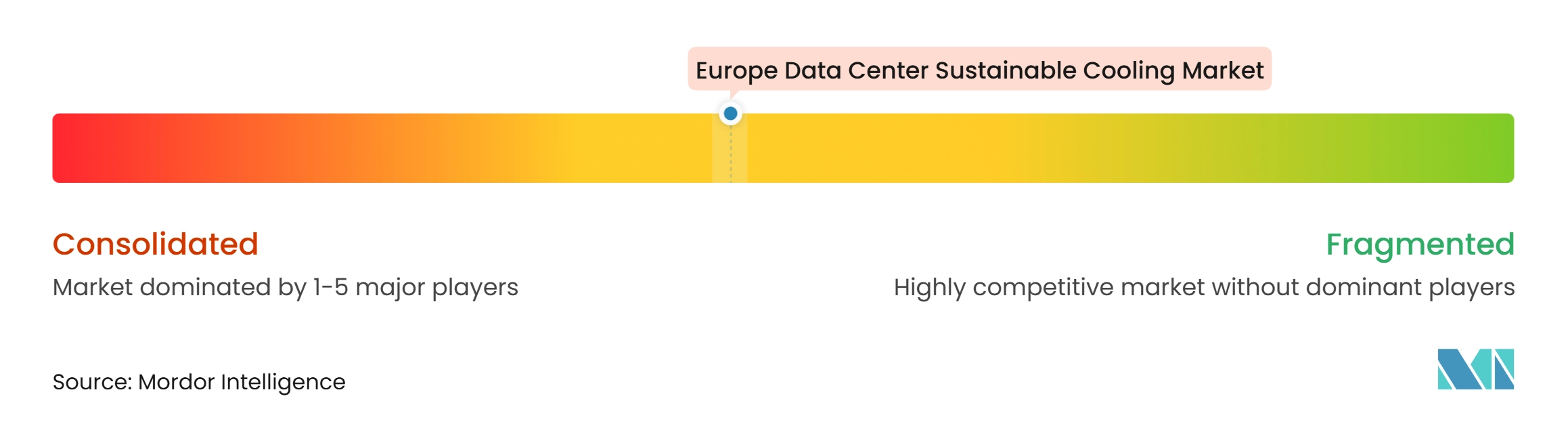
The Europe data center sustainable cooling market has moderate concentration, with Vertiv Group Corp., Schneider Electric SE, and Alfa Laval AB holding broad portfolios across thermal management hardware and services. Schneider Electric completed the acquisition of a controlling interest in Motivair in February 2025 and later introduced a liquid cooling portfolio that included cooling distribution units, rear-door heat exchangers, cold plates, chillers, and technology cooling loops. Alfa Laval launched FreeWaterLoop in March 2026, combining pumps, heat exchangers, and filtration for external liquid cooling. These moves show that large suppliers are building more complete facility-to-chip offerings. Digital controls, BMS integration, and measured efficiency data are also becoming important competitive requirements.
Vertiv expanded its EMEA liquid cooling portfolio with the CoolCenter Immersion system in November 2025. Immersion specialists such as Submer Technologies and Asperitas BV address the highest-density use cases, while CoolIT Systems and Chilldyne serve direct-to-chip and retrofit requirements. NVIDIA’s DSX initiative names Trane Technologies, Schneider Electric, and Vertiv as cooling ecosystem partners. This increases the value of interoperable equipment for AI factory projects. Vendors without a broad product range can still compete through specialized technology or site integration expertise.
Heat recovery integration remains an important opening because successful deployment requires cooling systems, local networks, and end users to align. Suppliers also need to address low-GWP refrigerants, water constraints, and live-site retrofits in addition to high-density AI cooling. This favors vendors that can manage both new construction and the established European base. The Europe data center sustainable cooling market is not dominated by one supplier because different facilities need different cooling architectures.
Europe Data Center Sustainable Cooling Industry Leaders
-
Vertiv Group Corp.
-
Schneider Electric SE
-
STULZ GmbH
-
Rittal GmbH & Co.
-
Alfa Laval AB
- *Disclaimer: Major Players sorted in no particular order
Europe Data Center Sustainable Cooling Market Companies Covered in this Report
- Vertiv Group Corp.
- Schneider Electric SE
- STULZ GmbH
- Rittal GmbH & Co. KG
- Alfa Laval AB
- Asetek A/S
- Iceotope Technologies Ltd.
- Green Revolution Cooling Inc.
- Chilldyne Inc.
- Airedale International Air Conditioning Ltd.
- Johnson Controls International plc
- Daikin Europe NV
- Munters Group AB
- Submer Technologies SL
- CoolIT Systems Inc.
- Danfoss A/S
- Parker Hannifin Corp.
- Trane Technologies plc
- Sensata Technologies Inc.
- Asperitas BV
Recent Industry Developments in Europe Data Center Sustainable Cooling Market
- October 2026: NVIDIA announced its DSX reference designs, with European AI cloud operators including Firmus, Nscale, Nebius, CoreWeave, IREN, and Google Cloud as adopters. The DSX architecture pairs closed-loop direct-to-chip liquid cooling with dry-cooler heat rejection, enabling near-zero facility cooling water consumption. DSX MaxLPS software reduces power by up to 30% for the same AI output volume. Trane Technologies, Schneider Electric, and Vertiv were engaged as certified cooling ecosystem partners.
- September 2026: The European Commission adopted a mandatory A-to-G sustainability label for data centers under Directive EU 2023/1791, applicable to all facilities with at least 500 kW of installed IT power. The label grades operators on PUE and WUE and displays indicators for waste-heat reuse readiness and energy sourcing. First individual site labels are expected in 2027, and a minimum-performance-standards proposal is planned for Q2 2027.
- May 2026: CSC - IT Center for Science and Loiste Lämpö Oy signed an agreement to channel waste heat from the LUMI AI Factory under construction in Kajaani, Finland, into the city’s district heating network from 2027. The deal extends a model proven by the existing LUMI supercomputer, which supplies approximately one-fifth of Kajaani’s district heat.
- March 2026: Alfa Laval launched FreeWaterLoop at Data Center World in London, a fully integrated liquid-based external cooling system combining pump engineering, high-performance heat exchanger technology, and filtration. The system minimizes net water consumption and reduces physical plant footprint versus air-based facility-loop cooling.
Europe Data Center Sustainable Cooling Market Report Scope
The Europe Data Center Sustainable Cooling Market refers to the regional market for energy-efficient, low-carbon, and water-conscious cooling technologies, systems, and services designed to manage thermal loads in data centers across Europe while minimizing environmental impact, covering liquid cooling (direct-to-chip, immersion, rear-door heat exchangers), free/air-side economization, evaporative and adiabatic cooling, low-GWP refrigerant chillers, waste-heat recovery, AI-driven thermal optimization, and water-efficient closed-loop systems.
The Europe Data Center Sustainable Cooling Market Report is Segmented by Cooling Technology (Air-Based Cooling, Direct-to-Chip Liquid Cooling, Immersion Cooling, Rear-Door Heat Exchangers, Evaporative and Adiabatic Cooling, Free Cooling and Economizer Systems, and Other Sustainable Cooling Technologies), Heat Rejection Technology (Air-Cooled Systems, Water-Cooled Systems, Evaporative Heat Rejection, Dry Coolers, and Hybrid Heat Rejection Systems), Cooling System Component (Cooling Distribution Units (CDUs), Chillers, Cooling Towers, Heat Exchangers, Pumps and Fluid Distribution Systems, Fans and Air Handling Equipment, and Cooling Controls and Monitoring Systems), Sustainability Approach (Energy-Efficient Cooling, Water-Efficient Cooling, Low-Global-Warming-Potential Refrigerant Solutions, Heat Recovery-Enabled Cooling, and Integrated Cooling Optimization and Controls), Data Center Size (Small, Medium, Large, and Hyperscale), Data Center Type (Colocation, Cloud Service Providers (CSPs), and Enterprise and Edge), and Geography (United Kingdom, Germany, France, Netherlands, Ireland, Spain, Italy, Nordics, and Rest of Europe). The Market Forecasts Are Provided in Terms of Value (USD).
Segmentation Overview
| Air-Based Cooling |
| Direct-to-Chip Liquid Cooling |
| Immersion Cooling |
| Rear-Door Heat Exchangers |
| Evaporative and Adiabatic Cooling |
| Free Cooling and Economizer Systems |
| Other Sustainable Cooling Technologies |
| Air-Cooled Systems |
| Water-Cooled Systems |
| Evaporative Heat Rejection |
| Dry Coolers |
| Hybrid Heat Rejection Systems |
| Cooling Distribution Units (CDUs) |
| Chillers |
| Cooling Towers |
| Heat Exchangers |
| Pumps and Fluid Distribution Systems |
| Fans and Air Handling Equipment |
| Cooling Controls and Monitoring Systems |
| Energy-Efficient Cooling |
| Water-Efficient Cooling |
| Low-Global-Warming-Potential Refrigerant Solutions |
| Heat Recovery-Enabled Cooling |
| Integrated Cooling Optimization and Controls |
| Small |
| Medium |
| Large |
| Hyperscale |
| Colocation |
| Cloud Service Providers (CSPs) |
| Enterprise and Edge |
| United Kingdom |
| Germany |
| France |
| Netherlands |
| Ireland |
| Spain |
| Italy |
| Nordics |
| Rest of Europe |
| By Cooling Technology | Air-Based Cooling |
| Direct-to-Chip Liquid Cooling | |
| Immersion Cooling | |
| Rear-Door Heat Exchangers | |
| Evaporative and Adiabatic Cooling | |
| Free Cooling and Economizer Systems | |
| Other Sustainable Cooling Technologies | |
| By Heat Rejection Technology | Air-Cooled Systems |
| Water-Cooled Systems | |
| Evaporative Heat Rejection | |
| Dry Coolers | |
| Hybrid Heat Rejection Systems | |
| By Cooling System Component | Cooling Distribution Units (CDUs) |
| Chillers | |
| Cooling Towers | |
| Heat Exchangers | |
| Pumps and Fluid Distribution Systems | |
| Fans and Air Handling Equipment | |
| Cooling Controls and Monitoring Systems | |
| By Sustainability Approach | Energy-Efficient Cooling |
| Water-Efficient Cooling | |
| Low-Global-Warming-Potential Refrigerant Solutions | |
| Heat Recovery-Enabled Cooling | |
| Integrated Cooling Optimization and Controls | |
| By Data Center Size | Small |
| Medium | |
| Large | |
| Hyperscale | |
| By Data Center Type | Colocation |
| Cloud Service Providers (CSPs) | |
| Enterprise and Edge | |
| By Geography | United Kingdom |
| Germany | |
| France | |
| Netherlands | |
| Ireland | |
| Spain | |
| Italy | |
| Nordics | |
| Rest of Europe |
Key Questions Answered in the Report
What is the Europe data center sustainable cooling market size?
The market is USD 4.52 billion in 2026 and is projected to reach USD 9.47 billion by 2032, expanding at a 15.94% CAGR from 2027 to 2032.
What is driving demand for sustainable data center cooling in Europe?
AI rack density, hyperscale construction, efficiency reporting, refrigerant requirements, and heat-reuse rules are increasing demand for liquid cooling, controls, and efficient heat rejection.
Which cooling technology leads European data centers?
Air-based cooling held 34.07% share in 2026 because of the installed base, while direct-to-chip liquid cooling is projected to expand at a 16.23% CAGR through 2032.
Why are cooling distribution units important for AI data centers?
Cooling distribution units regulate flow and temperature between facility cooling loops and server cold plates. They are projected to expand at a 16.64% CAGR through 2032.
Which country is the largest and fastest-growing European location?
The United Kingdom held 22.57% share in 2026, while Spain is projected to expand at a 16.47% CAGR through 2032.
How does heat recovery affect data center cooling choices?
Heat recovery can support energy reuse targets and local district heating, especially where a suitable heat network and reliable off-taker are available.