
Europe Data Center Risk Engineering and Management Market Size and Share
Market Overview
| Study Period | 2021 - 2032 |
|---|---|
| Forecast Data Period | 2027 - 2032 |
| Base Year Market Size (2026) | USD 0.64 Billion |
| Market Size (2027) | USD 0.73 Billion |
| Market Size (2032) | USD 1.39 Billion |
| Growth Rate (2027 - 2032) | 13.75 % |
| Market Concentration | Medium |
Major Players *Disclaimer: Major Players sorted in no particular order Image © Mordor Intelligence. Reuse requires attribution under CC BY 4.0. | |
Europe Data Center Risk Engineering and Management Market Analysis by Mordor Intelligence
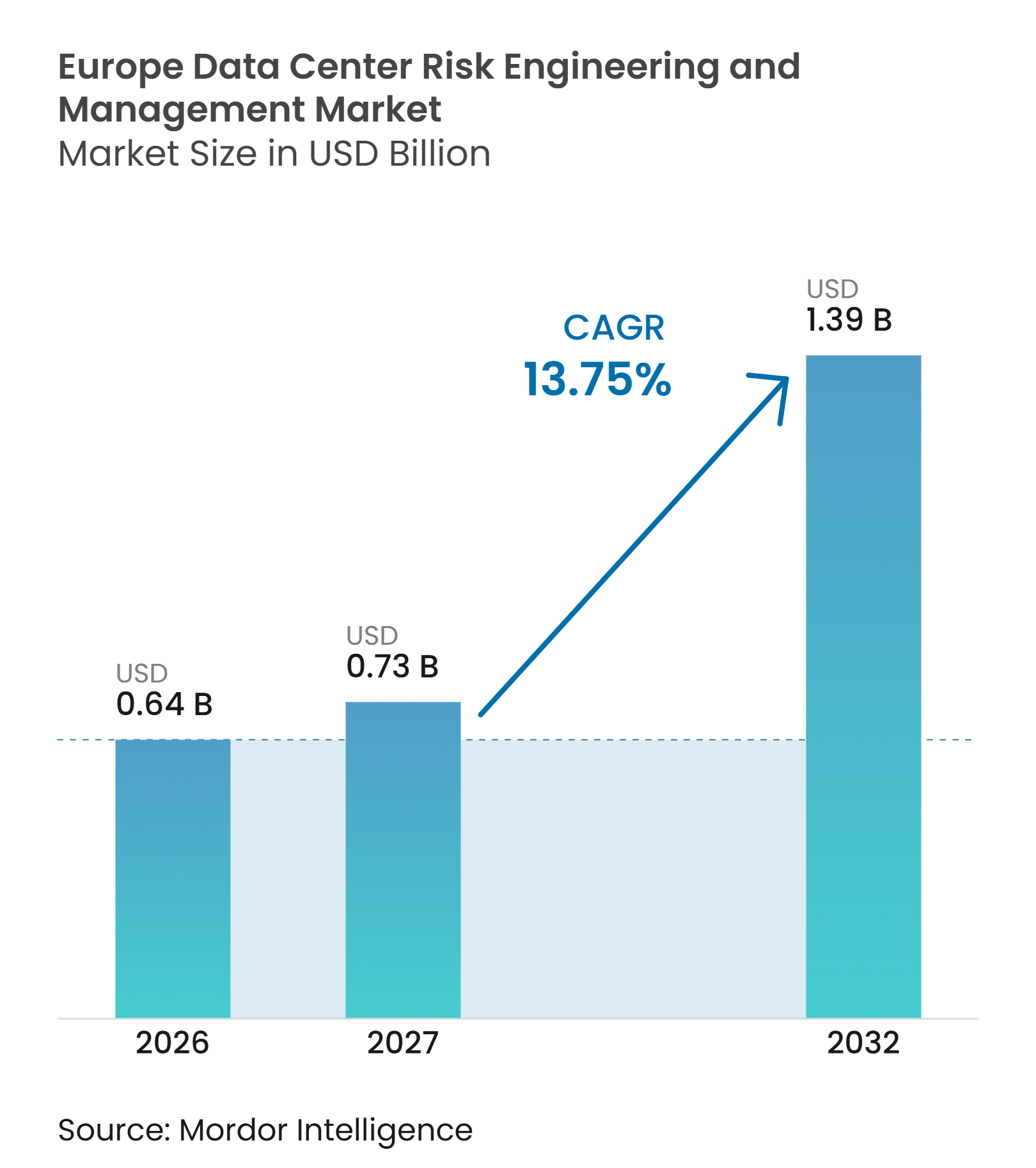
The Europe data center risk engineering and management market size is projected to be USD 0.64 billion in 2026, USD 0.73 billion in 2027, and reach USD 1.39 billion by 2032, growing at a CAGR of 13.75% from 2027 to 2032. The move from conventional colocation facilities toward AI compute campuses is changing the work required to assess, document, and manage infrastructure risk. Operators are dealing with larger capital commitments, more interdependent systems, and more frequent upgrades to power and cooling equipment. This makes the Europe data center risk engineering and management market relevant through design, commissioning, operations, and retrofit work rather than only at project handover. Insurers, lenders, and customers are also placing greater value on documented reliability programs, which supports recurring engagements. The strongest opportunity lies with providers that can connect engineering analysis with compliance, operational resilience, and continuous monitoring. The shift rewards providers who can turn technical findings into documentation suitable for investment, insurance, and operational decisions across multiple sites.
Key Report Takeaways
- By service type, risk assessment and auditing accounted for 28.69% of the Europe data center risk engineering and management market share in 2026, while reliability and availability engineering is projected to expand at a 14.93% CAGR through 2032.
- By risk category, electrical and power infrastructure risk accounted for 26.47% of the Europe data center risk engineering and management market size in 2026, while cooling and thermal management risk is projected to grow at a 15.34% CAGR through 2032.
- By assessment method, qualitative risk assessment held a 30.72% share in 2026, while continuous risk assessment and monitoring is expected to expand at a 14.86% CAGR through 2032.
- By engagement model, one-time assessment and audit accounted for 32.83% in 2026, while continuous risk management services are projected to grow at a 14.97% CAGR through 2032.
- By project lifecycle stage, operational risk management accounted for 34.96% in 2026, while expansion, retrofit, and modernization are projected to grow at a 14.42% CAGR through 2032.
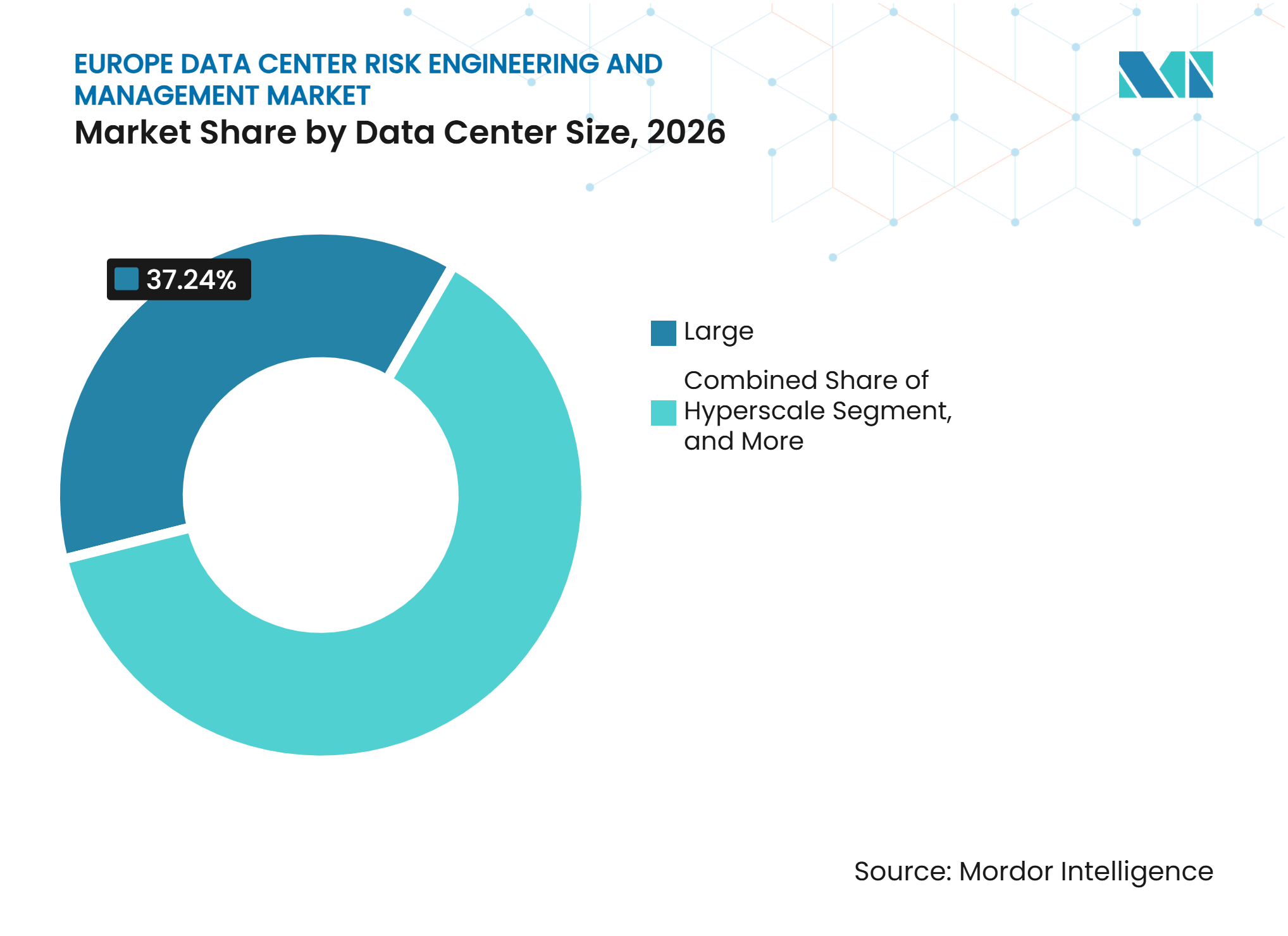
- By data center size, large facilities held a 37.24% share in 2026, while hyperscale facilities are projected to expand at a 14.91% CAGR through 2032.
- By data center type, colocation operators held a 40.38% share in 2026, while cloud service providers are projected to grow at a 15.06% CAGR through 2032.
- By geography, Germany held a 24.15% share in 2026, while Sweden is projected to grow at a 14.95% CAGR through 2032.
Note: Market numbers in this report are based on Mordor Intelligence's proprietary estimation framework, which combines nine months of actuals with Q4 projections for base year 2026.
Market Trends and Insights
Drivers Impact Analysis of Europe Data Center Risk Engineering and Management Market*
| Driver | (~) % Impact on CAGR Forecast | Geographic Relevance | Impact Timeline |
|---|---|---|---|
| Increasing Complexity of Power, Cooling, Networking, and Facility Infrastructure | +3.2% | Global, concentrated in Germany, United Kingdom, Sweden, and France | Short term (≤ 2 years) |
| Rising Risk Exposure From AI Workloads and High-Density Computing Environments | +2.8% | EU colocation hubs in Germany, Sweden, and the Netherlands | Short term (≤ 2 years) |
| Growing Demand for Reliability Engineering and Critical Infrastructure Assessments | +2.1% | Global, elevated in Germany and Nordic markets | Medium term (2-4 years) |
| Insurer, Investor, and Customer Expectations for Documented Risk Mitigation Programs | +1.8% | EU and United Kingdom, especially colocation markets | Medium term (2-4 years) |
| Digitalization of Continuous Risk Monitoring and Asset Telemetry | +1.4% | Global, with early adoption in hyperscale-heavy markets | Medium term (2-4 years) |
| Increasing Demand for Integrated Physical, Operational, and Cyber Resilience Assurance | +1.1% | EU-wide, with regulatory lift in Germany and France | Long term (≥ 4 years) |
| Source: Mordor Intelligence | |||
Increasing Complexity of Power, Cooling, Networking, and Facility Infrastructure
Modern facilities combine electrical, thermal, and network systems whose failures can interact across the site. ENTSO-E reported that AI-led power changes can move by tens of megawatts within milliseconds, creating voltage and frequency challenges that link facility operations to grid conditions.[1] Germany's data centers consumed 21.3 billion kWh in 2025, while mechanical and power infrastructure investment totaled EUR 2.5 billion (USD 2.83 billion). Liquid cooling loops, high-capacity UPS systems, and multi-megawatt power trains therefore require a joined-up review of potential failure paths. The Europe data center risk engineering and management market benefits as clients need specialists who can assess switchgear, cooling circuits, structural loads, network dependencies, fire controls, and operating procedures within a single scope. This requirement also favors providers that can continue support after commissioning rather than deliver a single discipline-specific review.
Rising Risk Exposure From AI Workloads and High-Density Computing Environments
AI training clusters are changing the operating risk profile of European facilities. The European Data Centre Association reported that AI rack density often exceeds 30-80 kW per rack and that 14.8% of European sites operate above 100 kW per rack. A cooling interruption at these loads can place high-value GPU equipment at risk and disrupt contracted availability. Direct liquid cooling was used by 47.1% of European operators for high-power racks, posing risks of leakage, corrosion, inhibitor depletion, and particulate fouling. Research on liquid-cooled facilities shows why physics-of-failure analysis is needed besides visual inspection for these systems. The Europe data center risk engineering and management market is consequently moving toward pre-commissioning reviews and monitored operating controls for AI-capable sites.
Growing Demand for Reliability Engineering and Critical Infrastructure Assessments
Insurers, lenders, and institutional investors increasingly require formal risk programs before they place coverage or approve debt. Aon expanded its Data Center Lifecycle Insurance Program to USD 3.5 billion in April 2026 and incorporated risk engineering assessments with cyber impact modeling into the placement process. Allianz Commercial has noted that hyperscale and colocation projects can create accumulation risk across property, construction, business interruption, liability, and cyber policies. The resulting scrutiny supports recurring analysis using failure mode and effects analysis, fault tree analysis, and scenario testing. Reliability engineering is becoming part of the operating case for capacity that is expensive to replace and difficult to reserve. This supports the Europe data center risk engineering and management market as operators seek evidence that the site can sustain agreed service levels.
Insurer, Investor, and Customer Expectations for Documented Risk Mitigation Programs
Documented risk programs are increasingly part of the evidence investors and insurers expect from large facilities. Lockton identified equipment faults, cooling failures, and electrical incidents as sources of recurring data center losses in its 2026 update. Zurich expanded its Data Center Project Guard offering across Germany, Italy, the Nordics, and Spain in 2026, thereby extending the role of insurance in project risk reviews. AI hardware refresh cycles also require reassessment when power density or cooling assumptions change. This gives providers with multi-standard and lifecycle capabilities an advantage in securing retained client relationships. The Europe data center risk engineering and management market gains from this commercial need for consistent evidence across campus portfolios.
Restraints Impact Analysis of Europe Data Center Risk Engineering and Management Market*
| Restraint | (~) % Impact on CAGR Forecast | Geographic Relevance | Impact Timeline |
|---|---|---|---|
| High Cost of Specialist Risk Engineering and Difficulty Demonstrating Financial Return | -1.8% | Global, most acute for mid-market and enterprise-owned facilities | Medium term (2-4 years) |
| Limited Availability of Engineers With Data Center-Specific Expertise | -1.3% | EU-wide, with shortages in Nordic expansion markets and secondary hubs | Short term (≤ 2 years) |
| Fragmented Risk Data and Inconsistent Risk-Scoring Methods Across Stakeholders | -0.8% | EU-wide, affected by different NIS2 national transposition timelines | Long term (≥ 4 years) |
| Difficulty Integrating Assessments Into Live Facilities and Rapidly Changing AI Infrastructure | -0.5% | Global, especially hyperscale operating environments | Medium term (2-4 years) |
| Source: Mordor Intelligence | |||
High Cost of Specialist Risk Engineering and Difficulty Demonstrating Financial Return
A detailed, multi-system assessment can represent a meaningful share of the maintenance budget for a facility with less than 10 MW of IT load. These operators may not receive a visible insurance credit that offsets the immediate cost. The IEA's 2026 liquid-cooling report identified high initial costs and long-term reliability concerns as barriers to newer cooling designs. Similar cost uncertainty affects the uptake of specialist engineering programs before a problem has occurred. Smaller operators in Spain, Italy, and Poland can face the strongest constraints because they cannot spread program costs across a broad portfolio. EN 50600 and ISO 22301 requirements may make formal programs more common over time, but the near-term return remains difficult to demonstrate.
Limited Availability of Engineers With Data Center-Specific Expertise
The availability of suitably qualified staff limits delivery capacity for risk engineering providers. Uptime Institute reported in 2026 that more than half of survey respondents had difficulty finding qualified candidates for open roles. The required skill set spans high-voltage systems, thermal management, structural integrity, and fire and life safety. This combination is uncommon even among experienced engineering professionals. Shortages in Sweden and Finland are especially material because pipeline construction is expanding quickly. Longer project schedules can limit the extent to which demand becomes billable work in the Europe data center risk engineering and management market.
*Our forecasts treat driver/restraint impacts as directional, not additive. The impact forecasts reflect baseline growth, mix effects, and variable interactions.
Europe Data Center Risk Engineering and Management Market Segment Analysis
By Service Type:
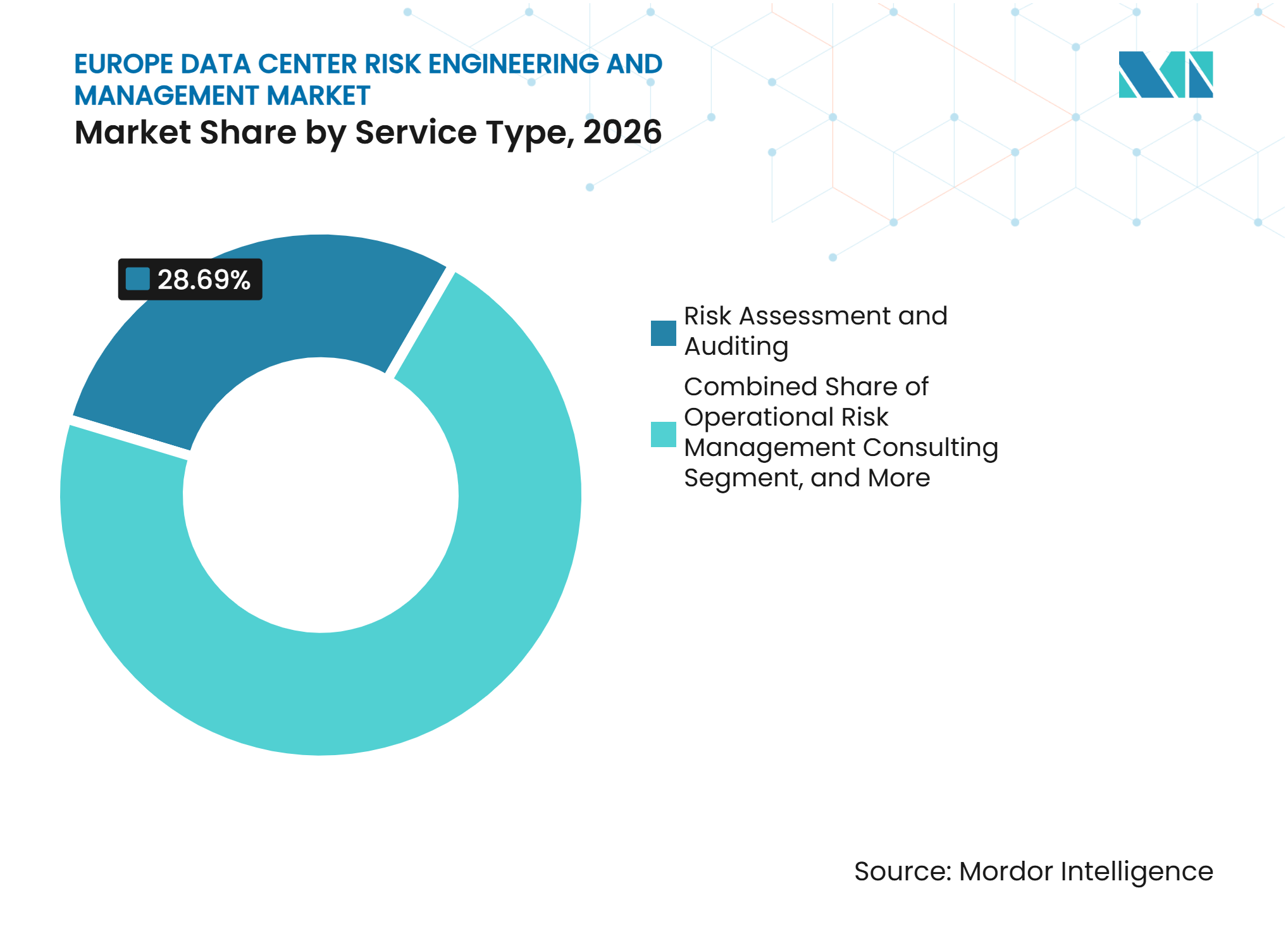
Risk Auditing Remains the Main Service NeedRisk assessment and auditing held 28.69% of service demand in 2026. Operators and investors use these reviews to establish a documented baseline before a facility starts operations, changes ownership, or renews insurance. One-time assessments have historically led engagement volumes because they align with openings, transactions, and certification events. Reliability and availability engineering is projected to grow at a 14.93% CAGR through 2032, supported by closer insurer attention to modeled resilience. Aon's expanded USD 3.5 billion program includes risk engineering and cyber impact modeling as part of its coverage process.
Failure mode and effects analysis, fault tree analysis, root cause analysis, and hazard identification are increasingly bundled into a single scope. This makes it less practical for clients to purchase separate, narrowly defined assessments. Operational consulting and certification support also expand as documentation requirements become more structured across Europe. NIS2 requires covered operators to establish cybersecurity risk-management measures, which strengthens the case for services that connect physical and operational technology risks. Providers that combine these capabilities can support a broader share of the Europe data center risk engineering and management market.



By Risk Category:
Power Exposure Leads While Thermal Exposure GrowsElectrical and power infrastructure risk accounted for 26.47% of the Europe data center risk engineering and management market size in 2026. Uptime depends on stable power quality, redundant distribution, and credible backup arrangements. ENTSO-E found that AI-led load shifts can cause power changes of tens of megawatts within milliseconds. That finding extends the risk framework beyond a building's electrical room to the relationship between the site and the wider grid. Cooling and thermal management risk is projected to expand at a 15.34% CAGR through 2032 as liquid-cooling equipment becomes more common.
Leakage, cold-plate fouling, corrosion, and glycol management create failure paths that differ from conventional air-cooled facilities. The relevant assessments need to examine materials, water chemistry, sensor coverage, maintenance practices, and response procedures. Fire, life safety, and structural risk remain important when older sites are redesigned for higher rack density. Climate resilience also receives more attention where flood, wind, or heat could affect physical continuity. Supply-chain tracking has also become part of the category as operators seek to identify equipment delays before they affect construction and commissioning plans.
By Assessment Method:
Qualitative Reviews Lead While Monitoring Becomes More CommonQualitative risk assessment held 30.72% of demand in 2026 because it is accessible for initial audits, insurance renewals, and compliance submissions. It helps operators organize hazards and control gaps without building a complex probabilistic model. Continuous risk assessment and monitoring is expected to grow at a 14.86% CAGR through 2032. This shift follows the broader use of telemetry from cooling, electrical, and backup systems. The Europe data center risk engineering and management market can use these feeds to identify thermal hotspots, glycol drift, and UPS battery degradation before they become service events.
Quantitative assessment and reliability-centered methods are gaining relevance among hyperscale operators. These operators need loss models that can support exposure limits and wider insurance decisions. Scenario analysis also supports business continuity planning and recovery documentation. Simulation and digital modeling remain smaller in revenue terms, but their system-level integration makes them more useful in AI-oriented facilities. Johnson Controls published reference designs for 1 GW AI data centers in February 2026, including thermal-chain configurations from chillers to cooling distribution units.[2]
By Engagement Model:
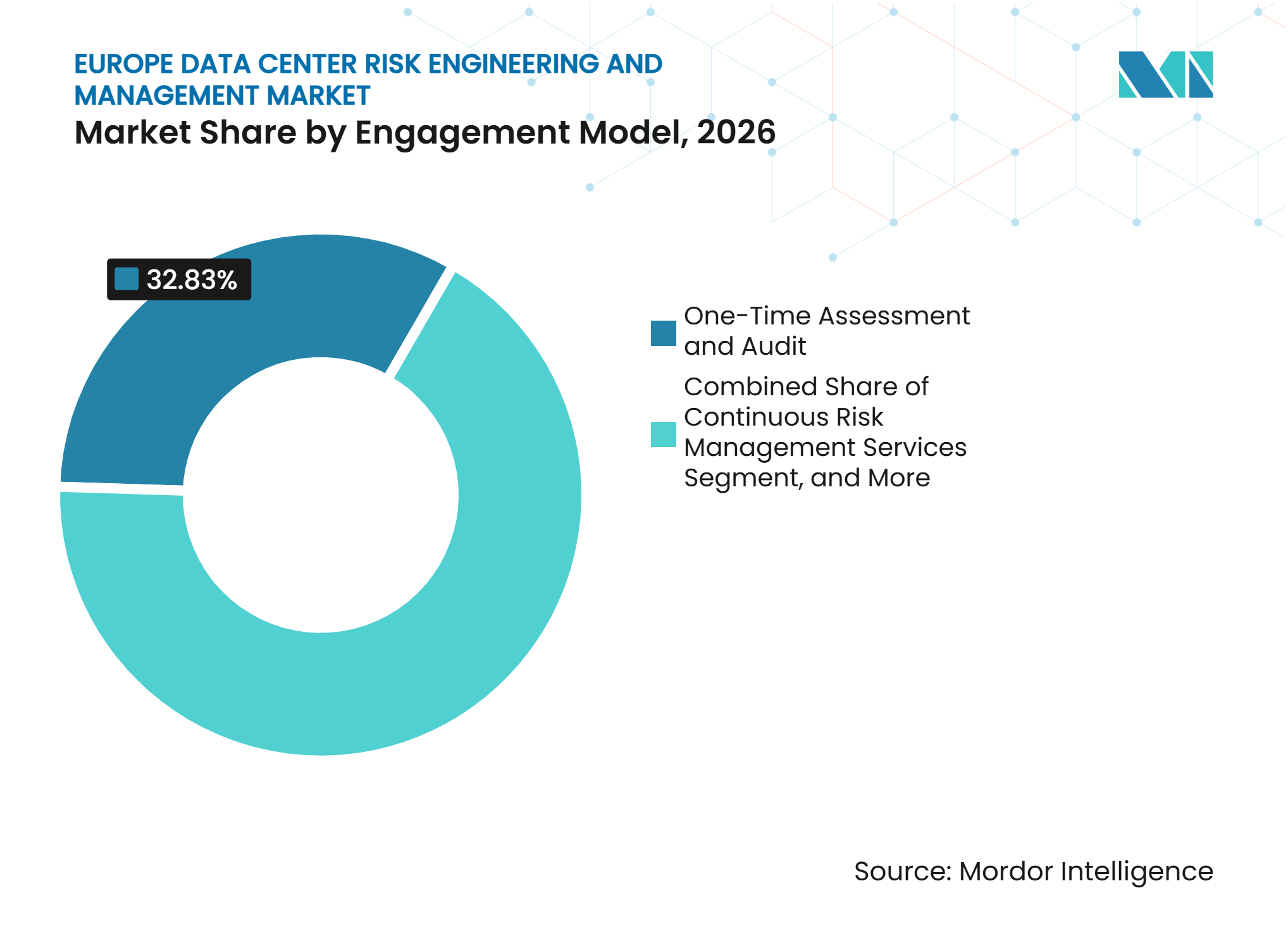
One-Time Audits Lead, Continuous Services Gain GroundOne-time assessment and audit accounted for 32.83% in 2026, making it the largest engagement model. Facility openings, acquisition reviews, insurer requests, and certification events commonly trigger these assignments. Continuous risk management services are projected to grow at a 14.97% CAGR through 2032. Clients are moving from event-led review toward recurring risk governance. Lockton reported that smaller incidents can create business-interruption losses that exceed physical damage, encouraging closer review of redundancy and incident response.
Periodic reviews are relevant to mid-market operators that are formalizing audit cycles. Managed risk engineering and integrated advisory work serve hyperscale clients that prefer one accountable partner across campuses. Retained relationships improve revenue visibility for service providers and reduce the need for clients to onboard a new assessor for every site. Real-time asset health visibility is widening the definition of managed engineering services. RINA provides services for reliable and sustainable data centers, which reflects the growing use of monitored engineering support across the Europe data center risk engineering market

By Project Lifecycle Stage:
Operations Lead, Modernization Creates New WorkOperational risk management accounted for 34.96% in 2026 because Europe has a large installed base of mature colocation and enterprise facilities. These sites require ongoing control reviews, maintenance governance, and evidence for customers and insurers. Expansion, retrofit, and modernization are projected to grow at a 14.42% CAGR through 2032. Existing sites must reassess their structural, electrical, and thermal assumptions when adding higher-density equipment. Germany's installed IT capacity is projected to increase from 2,980 MW in 2025 to nearly 5,000 MW by 2030.
Design and engineering work is important before a project commits to equipment and layout choices. Construction and commissioning work is equally material because incomplete testing can leave early faults unresolved. Allianz Commercial identifies realistic schedules, strong quality assurance, and coordinated contractor controls as important construction risk practices. Site selection is gaining importance where grid capacity is constrained. Early risk work can help developers avoid committing capital to locations that cannot receive a timely power connection.
By Data Center Size:
Large Facilities Lead While Hyperscale Demand BuildsLarge facilities accounted for 37.24% of service demand in 2026. Their established position in colocation hubs and their multi-tenant operating model require detailed evidence across several infrastructure layers. Hyperscale facilities are expected to expand at a 14.91% CAGR through 2032. Growth is tied to AI-oriented build programs by hyperscalers and neocloud operators. The European Data Centre Association reports that high-density racks frequently operate at 30-80 kW and that a portion of sites exceed 100 kW.
These loads make conventional enterprise assessment methods less sufficient for new campuses. Providers need purpose-built fault analysis and cooling-system reliability work. Medium and small sites remain relevant due to insurance renewals, aging-asset assessments, and sector-specific compliance needs. Their growth is slower, partly because comprehensive programs remain expensive. Tech-enabled, more standardized assessments could broaden access without requiring an equal increase in specialist labor.
By Data Center Type:
Colocation Operators Create the Largest Service DemandColocation operators held 40.38% of risk engineering service demand in 2026. Their multi-tenant structure creates risk allocation issues among operators, tenants, and insurers. Shared power, cooling, security, and access systems need documentation at both infrastructure and tenant boundaries. Research on leased data centers identifies critical infrastructure protection as a central security priority, with local regulatory and geopolitical conditions changing site-level priorities. This framework supports layered rather than single-site assessments.
Cloud service providers are projected to grow at a 15.06% CAGR through 2032 as new European facilities support sovereign cloud obligations and AI inference demand. GPU refresh cycles of 18-36 months can require reassessment when power and cooling conditions change. Enterprise and edge data centers continue to require operational reviews and modernization planning. Financial services, healthcare, and public-sector users also face documented expectations for resilience. DORA and NIS2 increase the need for clear control evidence where applicable
Geography Analysis
Germany
Germany held 24.15% of the Europe data center risk engineering and management market share in 2026. Frankfurt's exchange ecosystem and hyperscale expansion support a large installed base, while Germany reached 2,980 MW of installed IT capacity in 2025 and is projected to approach 5,000 MW by 2030. Building and technical infrastructure investment reached EUR 3.3 billion (USD 3.73 billion) in 2025, and Google's EUR 5.5 billion (USD 6.22 billion) commitment through 2029 adds demand across the asset lifecycle.[3] The Energy Efficiency Act, critical-facility ownership rules, and constrained grid access increase the value of technical reviews that also address compliance and site feasibility.
Sweden
Sweden is projected to grow at a 14.95% CAGR through 2032. Its renewable power base and AI compute pipeline are positioning it as a Nordic compute hub, with 1,248 MW planned and 250 MW under construction, against 171 MW of operational capacity. Brookfield's planned 750-MW Strängnäs campus and Microsoft's USD 3.2 billion commitment to 3 GPU-dense facilities demonstrate the scale of incoming work. Grid interfaces, thermal design, and commissioning controls will shape demand, while DNV's recruitment for a Northern Europe data center lead signals the need for regional delivery capacity
United Kingdom, France, Italy, Spain, and Other European Markets
The United Kingdom remains the second-largest individual data center location in the region. Its January 2026 critical national infrastructure designation allows large projects to use the Nationally Significant Infrastructure Project consenting route, increasing the importance of structured risk documentation. France attracted more than EUR 60 billion (USD 67.8 billion) in foreign data center investment in 2025 through hyperscale transactions. Italy and Spain are growing from a lower base through simplified authorization and strategic investment measures. Grid reforms can lower development barriers but require detailed assessment of connection timing and power risks. Poland, the Netherlands, and Ireland benefit from demand shifting away from saturated FLAP-D hubs, while Russia remains distinct because sovereign infrastructure requirements limit cross-border service opportunities.
Competitive Landscape
Market Concentration
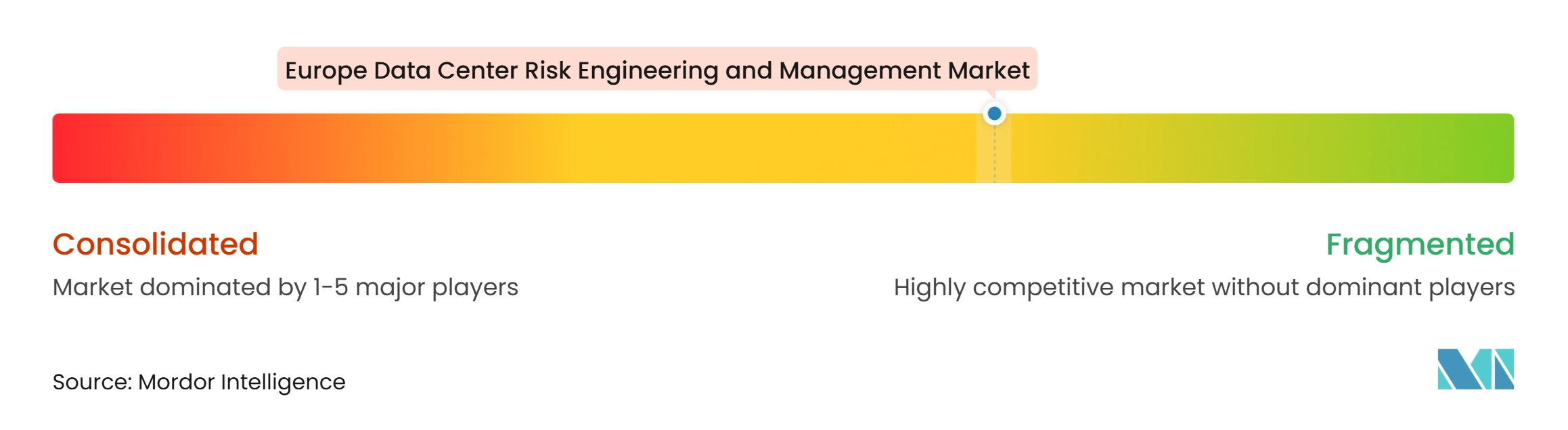
The Europe data center risk engineering and management market is moderately fragmented. DNV, TÜV SÜD, Bureau Veritas, DEKRA, and SGS compete with specialist engineering firms and insurance-linked advisers across assessments, certification, reliability modeling, and monitoring. Their multi-country delivery networks help hyperscale customers apply consistent approaches across several campuses. TÜV SÜD uses a five-level testing and commissioning method aligned with EN 50600, ISO/IEC 22237, and ANSI/TIA-942.[4] DEKRA provides EN 50600 design review, integrated systems testing, and EPMS and BMS validation.
Specialists compete where technical depth is more valuable than broad coverage. Jensen Hughes participates in NFPA 3, 4, 13, 72, 75, and 76 technical committees, which supports its fire and life-safety position. Aon's April 2026 expansion of its insurance program to USD 3.5 billion more directly connects risk assessment to coverage placement. RINA is pursuing ongoing risk work through services focused on data center reliability and sustainability. These examples show the value of monitoring, compliance depth, and demonstrable engineering evidence.
Liquid cooling, high-voltage distribution, and AI GPU clusters raise the technical threshold for credible providers. Open research on RADiCe found that data-driven scenario simulation can evaluate selected risk scenarios up to 330 times faster than traditional methods. Digital tools could reshape continuous risk analysis, although established certification practices remain a barrier for entrants without standards authority. Competition will remain active between broad TIC providers, insurance-linked advisers, and specialists with technical depth.
Europe Data Center Risk Engineering and Management Industry Leaders
-
AECOM
-
Aon plc
-
Bureau Veritas SA
-
BSI Group
-
DEKRA SE
- *Disclaimer: Major Players sorted in no particular order
Europe Data Center Risk Engineering and Management Market Companies Covered in this Report
- AECOM
- Aon plc
- Bureau Veritas SA
- BSI Group
- DEKRA SE
- DNV AS
- Intertek Group plc
- Jensen Hughes, Inc.
- Johnson Controls International plc
- Minimax GmbH
- RINA S.p.A.
- Schneider Electric SE
- SGS Société Générale de Surveillance SA
- TÜV SÜD AG
- UL Solutions Inc.
- VdS Schadenverhütung GmbH
Recent Industry Developments in Europe Data Center Risk Engineering and Management Market
- October 2026: Bureau Veritas SA launched its Mission Critical Data Centers brochure, consolidating its full-lifecycle offering across feasibility studies, regulatory compliance, project delivery advisory, commissioning, sustainability services, cybersecurity, and operational resilience for data center clients. The launch formalizes Bureau Veritas's positioning as an integrated assurance partner for the AI-era data center build wave.
- September 2026: Johnson Controls International plc and the University of Texas at Arlington advanced a joint initiative for the C3H2-AI Center, a planned 15,000 sq ft research facility at 8 to 10 MW power capacity, targeting chip-to-facility thermal management systems for AI data centers. The partnership signals Johnson Controls' intent to embed research-validated thermal risk frameworks into its data center advisory services.
- June 2026: Schneider Electric SE completed the phased delivery of more than USD 290 million in AI infrastructure solutions, including Motivair liquid cooling systems and integrated power infrastructure, at TeraWulf's Lake Mariner campus, a facility projected to support up to 750 MW of power demand at full buildout. The delivery scale illustrates how thermal management risk engineering is integrating into large-scale infrastructure supply contracts.
- May 2026: Johnson Controls International plc announced a Global Framework Agreement with Armada, outlining plans for modular AI data center production at a dedicated Arizona factory expected to create more than 500 jobs. Armada's focus on sovereign AI infrastructure deployment makes this partnership directly relevant to Europe's emerging sovereign cloud build programs, where risk engineering programs must satisfy local regulatory requirements.
Europe Data Center Risk Engineering and Management Market Report Scope
The Europe data center risk engineering and management market comprises services and solutions that help data center operators identify, assess, mitigate, and manage operational, environmental, cybersecurity, and infrastructure-related risks. These services support business continuity, regulatory compliance, asset protection, and the reliable operation of data center facilities across Europe.
The Europe Data Center Risk Engineering and Management Market Report is Segmented by Service Type (Risk Assessment and Auditing, Reliability and Availability Engineering, Failure Mode and Effects Analysis (FMEA), Fault Tree and Root Cause Analysis, Hazard Identification and Risk Evaluation, Risk Mitigation Planning, Operational Risk Management Consulting, and Compliance and Engineering Certification Support), Risk Category (Electrical and Power Infrastructure Risk, Cooling and Thermal Management Risk, Fire and Life Safety Risk, Structural and Building Infrastructure Risk, Environmental and Climate Risk, Operational and Human Error Risk, Supply Chain and Equipment Availability Risk, and Physical Security and Access Risk), Assessment Method (Qualitative Risk Assessment, Quantitative Risk Assessment, Reliability-Centered Assessment, Scenario-Based Risk Analysis, Simulation and Digital Modeling, and Continuous Risk Assessment and Monitoring), Engagement Model (One-Time Assessment and Audit, Periodic Risk Review, Continuous Risk Management Services, Managed Risk Engineering, and Integrated Engineering and Advisory Services), Project Lifecycle Stage (Site Selection and Feasibility, Design and Engineering, Construction and Commissioning, Operational Risk Management, and Expansion, Retrofit, and Modernization), Data Center Size (Small, Medium, Large, and Hyperscale), Data Center Type (Colocation, Cloud Service Providers (CSPs), and Enterprise and Edge), and Geography (Germany, United Kingdom, France, Italy, Spain, Sweden, Russia, and Rest of Europe). The Market Forecasts are Provided in Terms of Value (USD).
Segmentation Overview
| Risk Assessment and Auditing |
| Reliability and Availability Engineering |
| Failure Mode and Effects Analysis (FMEA) |
| Fault Tree and Root Cause Analysis |
| Hazard Identification and Risk Evaluation |
| Risk Mitigation Planning |
| Operational Risk Management Consulting |
| Compliance and Engineering Certification Support |
| Electrical and Power Infrastructure Risk |
| Cooling and Thermal Management Risk |
| Fire and Life Safety Risk |
| Structural and Building Infrastructure Risk |
| Environmental and Climate Risk |
| Operational and Human Error Risk |
| Supply Chain and Equipment Availability Risk |
| Physical Security and Access Risk |
| Qualitative Risk Assessment |
| Quantitative Risk Assessment |
| Reliability-Centered Assessment |
| Scenario-Based Risk Analysis |
| Simulation and Digital Modeling |
| Continuous Risk Assessment and Monitoring |
| One-Time Assessment and Audit |
| Periodic Risk Review |
| Continuous Risk Management Services |
| Managed Risk Engineering |
| Integrated Engineering and Advisory Services |
| Site Selection and Feasibility |
| Design and Engineering |
| Construction and Commissioning |
| Operational Risk Management |
| Expansion, Retrofit, and Modernization |
| Small |
| Medium |
| Large |
| Hyperscale |
| Colocation |
| Cloud Service Providers (CSPs) |
| Enterprise and Edge |
| Germany |
| United Kingdom |
| France |
| Italy |
| Spain |
| Sweden |
| Russia |
| Rest of Europe |
| By Service Type | Risk Assessment and Auditing |
| Reliability and Availability Engineering | |
| Failure Mode and Effects Analysis (FMEA) | |
| Fault Tree and Root Cause Analysis | |
| Hazard Identification and Risk Evaluation | |
| Risk Mitigation Planning | |
| Operational Risk Management Consulting | |
| Compliance and Engineering Certification Support | |
| By Risk Category | Electrical and Power Infrastructure Risk |
| Cooling and Thermal Management Risk | |
| Fire and Life Safety Risk | |
| Structural and Building Infrastructure Risk | |
| Environmental and Climate Risk | |
| Operational and Human Error Risk | |
| Supply Chain and Equipment Availability Risk | |
| Physical Security and Access Risk | |
| By Assessment Method | Qualitative Risk Assessment |
| Quantitative Risk Assessment | |
| Reliability-Centered Assessment | |
| Scenario-Based Risk Analysis | |
| Simulation and Digital Modeling | |
| Continuous Risk Assessment and Monitoring | |
| By Engagement Model | One-Time Assessment and Audit |
| Periodic Risk Review | |
| Continuous Risk Management Services | |
| Managed Risk Engineering | |
| Integrated Engineering and Advisory Services | |
| By Project Lifecycle Stage | Site Selection and Feasibility |
| Design and Engineering | |
| Construction and Commissioning | |
| Operational Risk Management | |
| Expansion, Retrofit, and Modernization | |
| By Data Center Size | Small |
| Medium | |
| Large | |
| Hyperscale | |
| By Data Center Type | Colocation |
| Cloud Service Providers (CSPs) | |
| Enterprise and Edge | |
| By Geography | Germany |
| United Kingdom | |
| France | |
| Italy | |
| Spain | |
| Sweden | |
| Russia | |
| Rest of Europe |
Key Questions Answered in the Report
How large is the Europe data center risk engineering and management market?
It is projected to be USD 0.64 billion in 2026 and USD 0.73 billion in 2027, reaching USD 1.39 billion by 2032 at a 13.75% CAGR.
What is driving demand for data center risk engineering in Europe?
AI-related rack density, liquid cooling adoption, grid constraints, insurer scrutiny, and resilience requirements are increasing demand for risk assessment, lifecycle documentation, and ongoing monitoring across new and modernized facilities.
Which service type is expanding fastest in Europe?
Reliability and availability engineering is projected to expand at a 14.93% CAGR through 2032 as clients seek evidence of uptime and resilience.
Why are cooling risks becoming more important for European facilities?
Cooling and thermal management risk is projected to grow at a 15.34% CAGR because high-density AI equipment requires direct liquid cooling and more complex failure analysis.
Which country has the largest demand for data center risk engineering services in Europe?
Germany held 24.15% share in 2026, supported by Frankfurt, large investment programs, and rising power and compliance requirements.