
Europe Corporate Training Market Size and Share
Market Overview
| Study Period | 2022 - 2031 |
|---|---|
| Forecast Data Period | 2026 - 2031 |
| Base Year Market Size (2025) | USD 46.67 Billion |
| Market Size (2026) | USD 50.81 Billion |
| Market Size (2031) | USD 72.34 Billion |
| Growth Rate (2026 - 2031) | 7.32 % |
| Market Concentration | Low |
Major Players *Disclaimer: Major Players sorted in no particular order Image © Mordor Intelligence. Reuse requires attribution under CC BY 4.0. | |
Europe Corporate Training Market Analysis by Mordor Intelligence
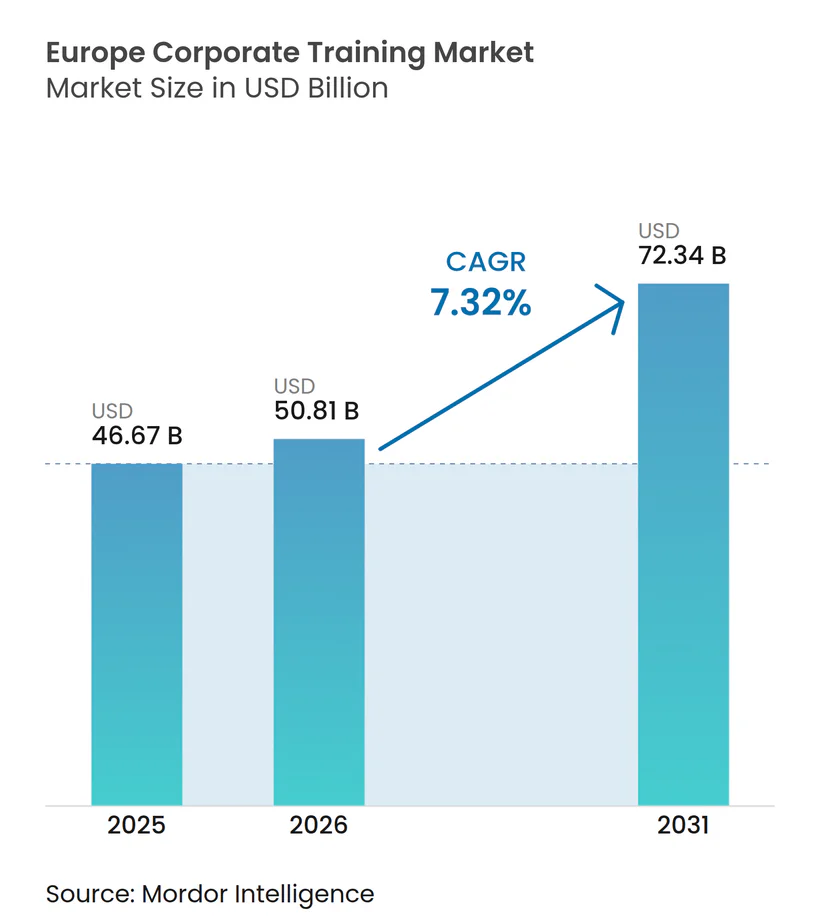
The Europe Corporate Training Market size is expected to increase from USD 46.67 billion in 2025 to USD 50.81 billion in 2026 and reach USD 72.34 billion by 2031, growing at a CAGR of 7.32% over 2026-2031.
Demand is being strengthened by a clear shift in enterprise learning from optional HR spending to a more formal operating requirement, especially as Article 4 of the EU AI Act requires providers and deployers of AI systems to ensure sufficient AI literacy across staff from February 2, 2025. The market is also supported by widening shortages in AI, cybersecurity, and broader ICT roles across Europe, which continue to push companies toward structured reskilling and certification programs rather than ad hoc learning activity. At the same time, companies are reorganizing workforce planning around skills rather than only job titles, which supports repeat training demand across technical, compliance, and management functions. Capital activity is also increasing the strategic value of scalable learning platforms, raising competitive pressure and encouraging greater product-led differentiation across the European corporate training market. This combination of regulation, labor market pressure, and platform development is giving the Europe corporate training market a more durable growth base than a purely discretionary learning budget would normally provide.[1]
Key Report Takeaways
- By training program, Technical Training led with 38.7% revenue share in 2025, while Soft Skills Training is projected to expand at an 8.1% CAGR through 2031.
- By delivery mode, E-Learning held 44.1% of revenue in 2025, while Blended Learning is forecast to grow at a 9.3% CAGR through 2031.
- By organization size, Large Enterprises accounted for 68.9% of revenue in 2025, while SMEs are projected to record the fastest growth at an 8.5% CAGR through 2031.
- By industry vertical, Information Technology led with a 21.6% share in 2025, while Pharmaceutical and Healthcare is forecast to grow at a 9.9% CAGR through 2031.
- By geography, the United Kingdom held 22.9% share in 2025, while Spain is projected to expand at an 8.7% CAGR through 2031.
Note: Market size and forecast figures in this report are generated using Mordor Intelligence’s proprietary estimation framework, updated with the latest available data and insights as of January 2026.
Market Trends and Insights
Drivers Impact Analysis of Europe Corporate Training Market*
| Drivers | (~) % Impact on CAGR Forecast | Geographic Relevance | Impact Timeline |
|---|---|---|---|
| Accelerated Digital Transformation in European Enterprises | +1.8% | EU-wide, with the highest intensity in the United Kingdom, Germany, France, and the Nordics | Short term (≤ 2 years) |
| Persistent Skills Mismatch Across Industrial and Knowledge Workforces | +1.3% | EU-wide, with stronger pressure in Eastern Europe, the DACH region, and BENELUX | Medium term (2-4 years) |
| Compliance-Linked Workforce Certification Across Regulated Sectors | +1.1% | EU-wide, with the highest regulatory density in the United Kingdom, Germany, and the Netherlands | Short term (≤ 2 years) |
| Rising Demand for Hybrid and Blended Learning Delivery Models | +0.9% | EU-wide, with faster adoption in France, Spain, and Italy | Medium term (2-4 years) |
| ESG and Sustainability Capability Building Across Corporate Functions | +0.6% | EU-wide, especially in DACH and BENELUX | Medium term (2-4 years) |
| AI-Enabled Personalization and Skills Graph Adoption in Learning Platforms | +0.8% | EU-wide, with earlier adoption in the United Kingdom, the Nordics, and Germany | Long term (≥ 4 years) |
| Source: Mordor Intelligence | |||
Accelerated Digital Transformation in European Enterprises
Enterprise digitalization across Europe has created a durable demand for technical upskilling, as cloud, cybersecurity, analytics, and AI tools are adopted faster than traditional learning cycles can absorb. The draft links this shift to broader regional investment in digital capability, including massive funding mobilized for digital transformation and workforce skilling through the EU's Recovery and Resilience Facility (RRF) and the Digital Europe Program. That matters because enterprise learning is now more closely tied to business transformation programs than treated as a stand-alone HR activity. In practice, technical curricula are being refreshed more frequently, especially for roles exposed to software change, automation, and AI-assisted workflows. This supports recurring demand in the European corporate training market for providers that can update content quickly and deliver it to large employee populations.
Persistent Skills Mismatch Across Industrial and Knowledge Workforces
Skills shortages remain broad across the region, and the pressure is no longer limited to a few advanced digital occupations. CEDEFOP’s Labor and Skills Shortage Index showed widespread occupational shortages across EU member states in early 2025, which supports the need for more structured workforce development. The European Commission also stated that Europe needs 6.2 million to 7 million AI-related workers by 2027, still faces a cybersecurity gap of 300,000 specialists, and had nearly 500,000 unfilled ICT vacancies at the end of 2025. In that setting, training becomes the fastest route for employers that cannot recruit enough ready talent from the external market. This keeps the Europe corporate training market anchored in a need that persists even when broader hiring conditions become uneven.[2]
Compliance-Linked Workforce Certification Across Regulated Sectors
Compliance-linked training is moving into a more structural role across enterprise budgets as regulations increasingly require documented workforce capability. Article 4 of the EU AI Act took effect on February 2, 2025, and requires providers and deployers of AI systems to ensure sufficient AI literacy among staff, moving AI training closer to mandatory enterprise practice. The draft also ties this driver to CSRD-linked workforce disclosure requirements, thereby increasing internal visibility into training hours and development spending. That combination matters most in regulated sectors, where training is not only a productivity tool but also a control mechanism tied to audit readiness and operating discipline. As a result, the European corporate training market is benefiting from compliance cycles that are less flexible and less easy to postpone than general learning budgets.
Rising Demand for Hybrid and Blended Learning Delivery Models
Enterprises across Europe increasingly prefer learning models that combine digital reach with live instruction and applied assessment. This is consistent with the draft’s view that companies are resolving the trade-off between the scale economics of digital delivery and the behavioral depth of instructor-led interaction. A 7-year collaboration study published in Frontiers in Pharmacology in 2024 found that blended e-learning models performed better than single-mode delivery in complex, regulated settings, providing procurement teams with stronger evidence for a mixed learning architecture. SAP’s 1H 2026 SuccessFactors Learning release also shows how major platforms are embedding AI tutoring into daily workflows while preserving live sessions for application and evaluation. This is helping blended learning move from an optional format to a default design principle in the European corporate training market.
Restraints Impact Analysis of Europe Corporate Training Market*
| Restraints | (~) % Impact on CAGR Forecast | Geographic Relevance | Impact Timeline |
|---|---|---|---|
| Fragmented GDPR, Labor, and Works-Council Compliance Requirements | -0.5% | EU-wide, with strongest structural friction in Germany and France | Medium term (2-4 years) |
| Weak Measurement of Training ROI and Capability Transfer | -0.4% | EU-wide, across all organization sizes | Long term (≥ 4 years) |
| Multilingual Localization Burden Across European Markets | -0.3% | Highest in Belgium, Switzerland, Spain, and Central and Eastern Europe | Medium term (2-4 years) |
| Legacy LMS Integration and Data Interoperability Friction | -0.4% | Strongest in large enterprises using legacy SAP or Oracle ecosystems | Long term (≥ 4 years) |
| Source: Mordor Intelligence | |||
Fragmented GDPR, Labor, and Works-Council Compliance Requirements
Regulatory fragmentation remains a significant brake on rollout speed because no single platform can treat Europe as a single, uniform compliance market. The draft highlights how GDPR, labor law, and works council requirements can force platform redesign, local review, or slower approvals before deployment can move ahead. ISACA’s 2025 European research also showed that privacy and compliance teams faced major capability gaps in diverse technology applications and technical expertise, which compounds the challenge when AI-enabled learning tools require both HR and IT governance clearance. This raises implementation cost and lengthens enterprise procurement cycles even when the learning demand itself is strong. In the Europe corporate training market, the result is slower revenue conversion and a clear advantage for vendors with stronger compliance support.
Weak Measurement of Training ROI and Capability Transfer
Most enterprise buyers still struggle to show exactly how training improves business outcomes after program completion. The draft argues that many organizations continue to rely on completion metrics and satisfaction scores rather than stronger measures such as error reduction, audit performance, productivity changes, or time-to-competence. That makes it harder for learning teams to defend budget expansion beyond what is required for formal compliance or certification. It also shifts spending toward programs with pass-fail outcomes that are easier to document, while leadership and behavioral programs face greater budget pressure. This keeps a portion of the European corporate training market tied to measurable compliance value instead of broader capability development.
*Our forecasts treat driver/restraint impacts as directional, not additive. The impact forecasts reflect baseline growth, mix effects, and variable interactions.
Europe Corporate Training Market Segment Analysis
By Training Program:
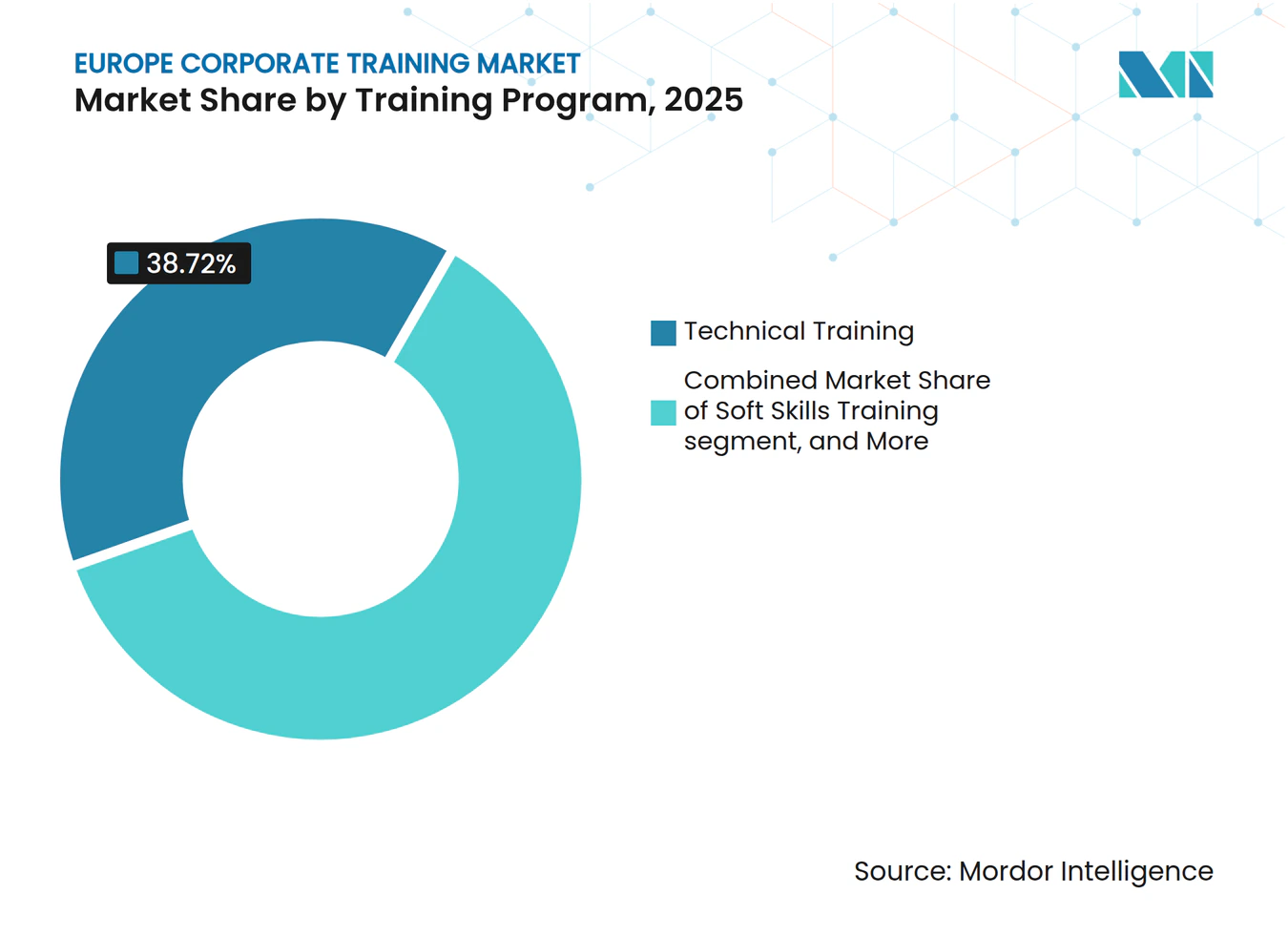
Technical Expertise Anchors Revenue While Soft Skills Lead GrowthTechnical Training accounted for 38.7% of the training program mix in 2025, making it the largest component of Europe's corporate training market share in this segmentation. Its lead reflects steady demand for IT certifications, engineering upskilling, cybersecurity programs, and AI-readiness training linked to enterprise software deployment and operational change. The segment also benefits from the fact that technical roles face faster skill obsolescence than many other functions, which keeps refresher cycles active even without headcount growth. The draft further shows that compliance and quality-related training continue to absorb a material share of spending in regulated environments such as pharmaceuticals, manufacturing, and critical business operations. This keeps technical and rules-based learning at the center of annual budget allocation across the Europe corporate training market.
Soft Skills Training is projected to grow at an 8.1% CAGR through 2031, making it the fastest-growing training program segment in the draft. Growth is being supported by a shift in enterprise demand toward communication, leadership, negotiation, collaboration, and change management as AI tools automate a larger share of routine cognitive work. In that setting, companies are placing greater value on capabilities that support judgment, coordination, trust, and cross-functional execution rather than on narrow task proficiency alone. The segment is also benefiting from the fact that leadership gaps and behavioral issues can reduce the return on technical investment if teams cannot apply new tools effectively inside real operating settings. For the Europe corporate training market, that means soft skills are moving from a secondary development category into a more central part of workforce capability planning.



By Delivery Mode:
E-Learning Commands Volume While Blended Architecture AcceleratesE-Learning retained 44.1% of delivery mode revenue in 2025, which made it the largest format by scale and the clearest driver of reach across the European corporate training market. Its lead reflects lower per-learner variable cost, easier deployment across dispersed workforces, stronger self-paced access, and better alignment with recurring certification needs. The draft also indicates that digital delivery gained stronger structural acceptance as platform user experience improved and enterprises became more comfortable with large-scale remote learning operations. Even so, the segment does not eliminate the need for live instruction, because some regulated contexts still require direct interaction, applied discussion, or formal assessment by an instructor. E-Learning, therefore, continues to dominate volume, but it now operates more as part of a broader delivery mix than as a standalone replacement for other formats.
Blended Learning is forecast to grow at a 9.3% CAGR through 2031, making it the fastest-growing delivery format in the draft and a rising share of the Europe corporate training market by delivery mode. Companies are increasingly using blended formats to achieve digital efficiency without losing the reinforcement, practice, and accountability that live sessions provide. Evidence from Frontiers in Pharmacology supports this preference by showing stronger performance from blended e-learning models in complex regulated training environments. Major platform design is moving in the same direction, with SAP showing how AI support can handle content access inside workflows while live sessions focus on application and evaluation. This is why blended delivery is no longer a niche model in the European corporate training market and is instead becoming a preferred architecture for higher-value learning programs.
By Organization Size:
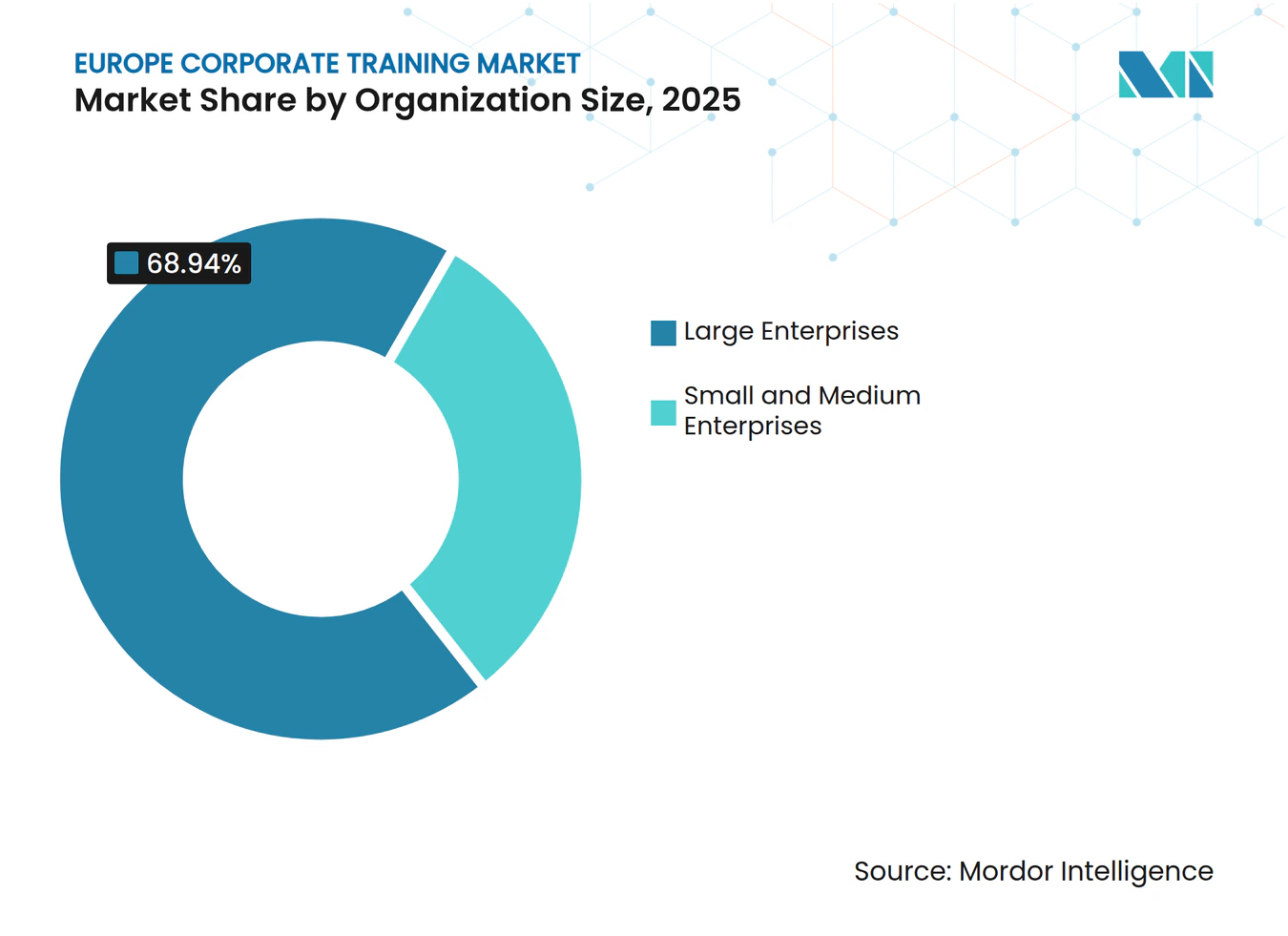
Large Enterprises Fund Scale While SMEs Close the GapLarge Enterprises held a 68.9% share in 2025, indicating that the European corporate training market still depends heavily on large-account spending and structured learning systems. Their dominance reflects higher per-employee training intensity, stronger compliance requirements, wider geographic spread, and the budget capacity needed to maintain dedicated L&D infrastructure. These organizations are also more likely to need auditable learning records across several business units and countries, which supports spending on enterprise-grade platforms and recurring content refresh. The draft further indicates that large enterprises face multi-jurisdictional obligations that make it harder to avoid formal training architecture. As a result, large accounts continue to provide the deepest revenue pool for the European corporate training market.
SMEs accounted for 31.1% of revenue in 2025 and are projected to grow at an 8.5% CAGR through 2031, expanding the Europe corporate training market within smaller enterprise accounts. Growth in this segment is being supported by lower entry barriers, greater subscription-based delivery, and stronger public co-financing support compared with earlier years. The European Commission launched a EUR 14.5 million Skills Guarantee Pilot in November 2025, which supports workers in strategic sectors during transition and signals a broader policy commitment to reskilling access. For SMEs, such support matters because it reduces the cost hurdle that often limits the adoption of formal training despite clear skills gaps. This suggests that the European corporate training market will gradually become less concentrated in very large enterprises, even though large accounts will remain the primary revenue base.

By Industry Vertical:
IT Leads Spend While Pharma and Healthcare Outpaces in GrowthPharmaceutical and Healthcare is forecast to grow at a 9.9% CAGR through 2031, which makes it the fastest-growing industry vertical in the draft. The segment is benefiting from the combined effects of GxP compliance obligations, recurring certification requirements, and the growing use of AI-enabled processes in drug development and regulated healthcare operations. The draft also notes that compliance content in this vertical has very low price sensitivity because the cost of audit failure, delay, or non-conformance is far greater than the cost of training. That view is consistent with the 2024 ECCRT and Boehringer Ingelheim collaboration to co-develop foundational ICH-GCP E6 (R3) eLearning for global teams, which shows how regulated employers are investing in scalable compliance learning assets. In the European corporate training market, Healthcare and pharma therefore stand out as a segment in which formal learning demand is driven by operational necessity rather than discretionary development choices.
Information Technology retained the largest vertical share at 21.6% in 2025, making it the single largest spending vertical in the European corporate training market. Its lead reflects ongoing recertification needs across cloud, cybersecurity, data engineering, software operations, and AI tools. The vertical is also benefiting from the AI literacy obligation introduced under the EU AI Act, because companies using AI systems must ensure sufficient staff capability rather than relying only on a small technical specialist group. At the same time, the draft suggests that some AI-related training spend may gradually move out of IT budgets and into HR, finance, legal, and operations as AI literacy becomes enterprise-wide rather than purely technical. This means IT should remain a major anchor segment in the European corporate training market even if spending responsibility becomes more distributed across functions.
Geography Analysis
Western Europe Corporate Training Market
The United Kingdom held 22.9% of Europe corporate training market share in 2025, which kept it as the largest country segment in the draft. Its lead reflects a dense base of specialist corporate learning providers, large enterprise training budgets, and a strong concentration of structured L&D demand among major employers. Germany remains one of the region’s largest training economies because its industrial base, vocational culture, and formal employee representation system all support sustained learning activity across technical and operational roles. France also remains central to regional demand, with France Compétences reporting 4.6 million employer-co-financed training actions in 2024, which shows the depth of formal training activity in the country. Together, these large Western European markets provide the scale base that still defines much of the Europe corporate training market.
Southern Europe Corporate Training Market
Spain is projected to grow at an 8.7% CAGR through 2031, which makes it the fastest-growing country market in the draft. That growth reflects a stronger digital upskilling push, improving enterprise adoption, and a market structure where training providers can still gain share as demand broadens. Italy sits in a similar growth tier, supported by continued demand for technical, quality, and operational training across manufacturing-linked sectors. BENELUX remains strategically important because it combines high-value enterprise accounts with dense compliance and multilingual delivery requirements. This means that while the largest revenue pools still sit in the United Kingdom, Germany, and France, some of the strongest growth momentum in the Europe corporate training market is now coming from markets that are still deepening formal enterprise learning adoption.
Northern and Central and Eastern Europe Corporate Training Market
The Nordics represent a high-value segment with strong digital readiness, high per-employee training intensity, and a workforce culture that treats structured learning as a standard part of employment rather than an occasional program. These markets are not the biggest by volume, but they are important because they tend to adopt digital learning architecture and AI-enabled capability tools earlier than many other parts of Europe. The rest of Europe, including Central and Eastern Europe, the Baltics, and the Balkans, remains a growing opportunity set as enterprise training procurement becomes more formal and skills shortages remain visible across several labor markets. CEDEFOP’s 2025 Labor and Skills Shortage Index highlighted significant talent shortages across multiple member states, supporting the case for stronger employer-led reskilling in emerging regional markets. In the Europe corporate training market, that means the long-term expansion path is no longer limited to the largest Western European economies and is increasingly including countries where formal training systems are still building scale.[3]
Competitive Landscape
Market Concentration
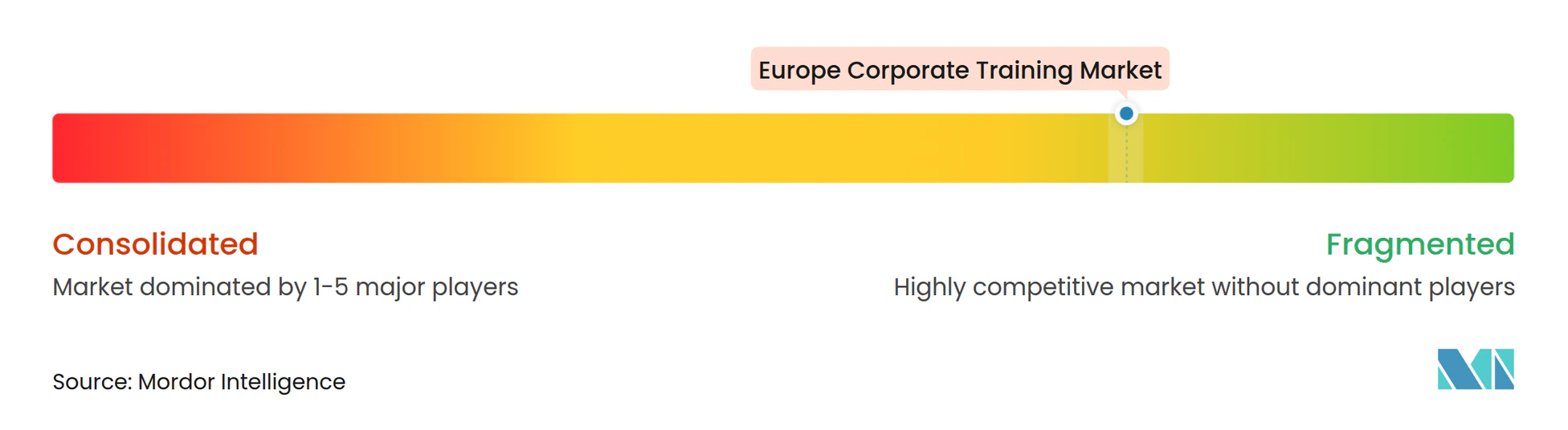
The European corporate training market remains moderately fragmented at the provider level, but competitive pressure is rising as consolidation occurs through ownership, platform design, and enterprise software integration. Large advisory and professional services firms benefit from existing enterprise relationships, while specialist learning providers compete on local depth, multilingual content, and compliance capability. This creates a market structure where distribution reach and regulatory credibility matter almost as much as course content. The result is not a winner-takes-all market, but it is becoming harder for independent content vendors to compete without stronger platform capability or sector specialization. In the Europe corporate training market, scale is therefore being built through account access, product breadth, and system integration rather than through content volume alone.
Strategic activity across the market shows how leading companies are trying to strengthen those advantages. SAP completed the acquisition of WalkMe in late 2024, extending digital adoption and learning capabilities within SuccessFactors and tightening its position with large enterprise buyers regarding software upskilling workflows. NIIT Learning Systems completed the acquisition of Germany-based MST Group in July 2025, expanding its managed learning services portfolio in Europe and strengthening its DACH presence. Alchemist Group also acquired The Experiential Learning Group in March 2026, adding simulation-based and immersive executive learning capability to its portfolio. These moves show that competition in the European corporate training market is increasingly shaped by portfolio extension, geographic strengthening, and higher-value learning formats.
White-space opportunities remain visible across several parts of the market despite the growing activity of larger players. SME-oriented platforms that combine affordable content, stronger reporting, and compliance-ready learning records still look underserved relative to larger enterprise solutions. There is also room for providers that can deliver multilingual blended learning at consistent quality across Central and Eastern Europe, where demand is growing, but local supply remains uneven. AI literacy and AI governance training remain especially attractive because enforcement has already begun, yet many enterprises still need auditable, scalable delivery rather than one-off awareness sessions. This means the European corporate training market still has space for specialist growth even as consolidation at the platform and capital layers continues.
Europe Corporate Training Industry Leaders
-
Skillsoft Corp.
-
Cegos Group
-
Accenture Plc
-
Capgemini SE
-
Korn Ferry
- *Disclaimer: Major Players sorted in no particular order
Europe Corporate Training Market Companies Covered in this Report
- Accenture Plc
- Adobe Inc.
- Allen Communication Learning Services
- BTS Group AB
- Capgemini SE
- Cegos Group
- City and Guilds Group
- Cornerstone OnDemand, Inc.
- Dale Carnegie and Associates, Inc.
- Deloitte Touche Tohmatsu Limited
- D2L Inc.
- Franklin Covey Co.
- Coursera, Inc.
- Hemsley Fraser
- Korn Ferry
- KPMG International Limited
- Learning Technologies Group Plc
- Learning Tree International, Inc.
- Mind Gym Plc
- NIIT Limited
- Oracle Corporation
- PricewaterhouseCoopers LLP
- PulseLearning Ltd.
- QA Limited
- Readynez
- SAP SE
- Skillsoft Corp.
- Udemy, Inc.
- Wilson Learning Worldwide, Inc.
Recent Industry Developments in Europe Corporate Training Market
- March 2026: Alchemist Group, a prominent player in the European corporate learning and development sector, officially completed the acquisition of The Experiential Learning Group.
- October 2025: Coursera partnered with OpenAI to embed Coursera's learning capabilities into the first generation of ChatGPT-integrated apps, enabling enterprise learners to access curated, credential-linked content through conversational AI interfaces and expanding Coursera's European enterprise business use case.
- August 2025: SAP announced its agreement to acquire SmartRecruiters, a leading talent acquisition software provider, to augment SAP SuccessFactors with AI-enabled high-volume recruiting and candidate experience automation, extending its platform from skills development into full talent lifecycle management.
- July 2025: NIIT Learning Systems (NIIT MTS) completed the acquisition of Munich-based MST Group for EUR 22.37 million (USD 24.6 million), expanding its managed learning services across the DACH region and adding 7 market-leading automotive and industrial sector clients to its portfolio, alongside Hungary as a nearshore multilingual capability center.
Europe Corporate Training Market Report Scope
Segmentation Overview
| Technical Training |
| Soft Skills Training |
| Compliance Training |
| Quality Training |
| Blended Learning |
| E-Learning |
| Instructor-Led Training |
| Large Enterprises |
| Small and Medium Enterprises |
| Financial Services |
| Pharmaceutical and Healthcare |
| Information Technology |
| Professional Services |
| Retail |
| Public Enterprises |
| United Kingdom |
| Germany |
| France |
| Spain |
| Italy |
| BENELUX |
| NORDICS |
| Rest of Europe |
| By Training Program | Technical Training |
| Soft Skills Training | |
| Compliance Training | |
| Quality Training | |
| By Delivery Mode | Blended Learning |
| E-Learning | |
| Instructor-Led Training | |
| By Organization Size | Large Enterprises |
| Small and Medium Enterprises | |
| By Industry Vertical | Financial Services |
| Pharmaceutical and Healthcare | |
| Information Technology | |
| Professional Services | |
| Retail | |
| Public Enterprises | |
| By Country | United Kingdom |
| Germany | |
| France | |
| Spain | |
| Italy | |
| BENELUX | |
| NORDICS | |
| Rest of Europe |
Key Questions Answered in the Report
What is the 2026 value of the Europe corporate training market?
The Europe corporate training market is valued at USD 50.81 billion in 2026 and is projected to reach USD 72.34 billion by 2031 at a 7.3% CAGR.
Which training program leads revenue in Europe corporate training?
Technical Training led the training program mix with 38.7% share in 2025, supported by IT certification, engineering upskilling, and AI readiness demand.
Which delivery mode is growing the fastest in Europe corporate training?
Blended Learning is forecast to grow the fastest at a 9.3% CAGR through 2031, as enterprises combine digital scale with live assessment and application.
Which organization size contributes the most revenue?
Large Enterprises accounted for 68.9% of revenue in 2025, reflecting stronger compliance obligations, bigger budgets, and more formal learning systems.
Which country leads the Europe corporate training market?
The United Kingdom held the largest country share at 22.9% in 2025, supported by a dense provider base and structured enterprise learning budgets.
Which industry vertical is expanding the fastest?
Pharmaceutical and Healthcare is projected to grow at a 9.9% CAGR through 2031, driven by GxP compliance, recurring certification cycles, and AI-related training needs.