
Europe Container Depot Logistics Market Size and Share
Market Overview
| Study Period | 2020 - 2031 |
|---|---|
| Forecast Data Period | 2026 - 2031 |
| Base Year Market Size (2025) | USD 11.92 Billion |
| Market Size (2026) | USD 12.57 Billion |
| Market Size (2031) | USD 16.21 Billion |
| Growth Rate (2026 - 2031) | 5.21 % |
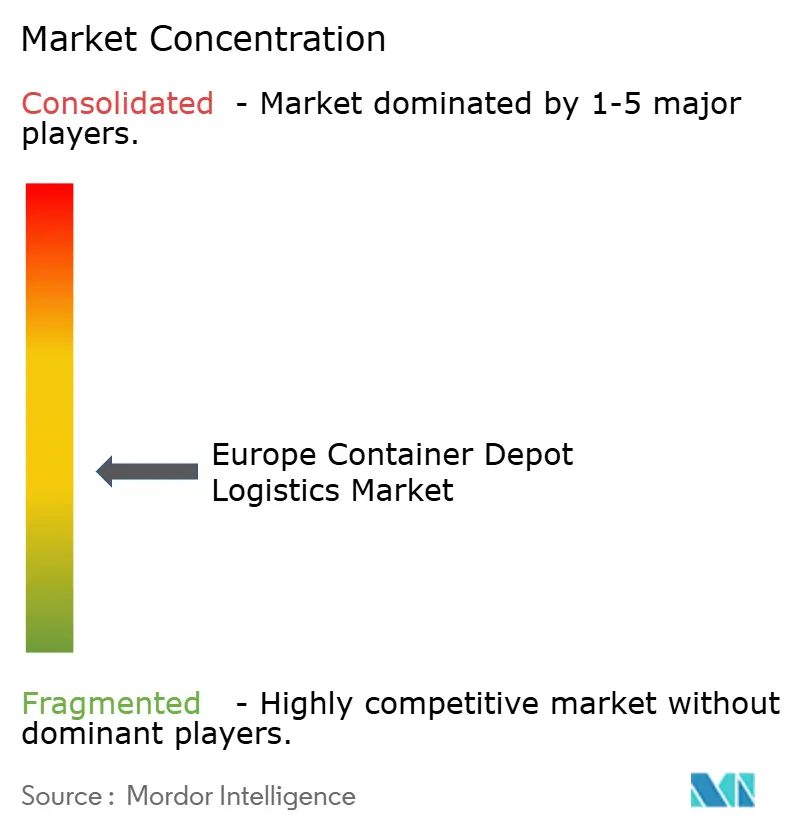
| Market Concentration | Medium |
Major Players *Disclaimer: Major Players sorted in no particular order Image © Mordor Intelligence. Reuse requires attribution under CC BY 4.0. | |
Europe Container Depot Logistics Market Analysis by Mordor Intelligence
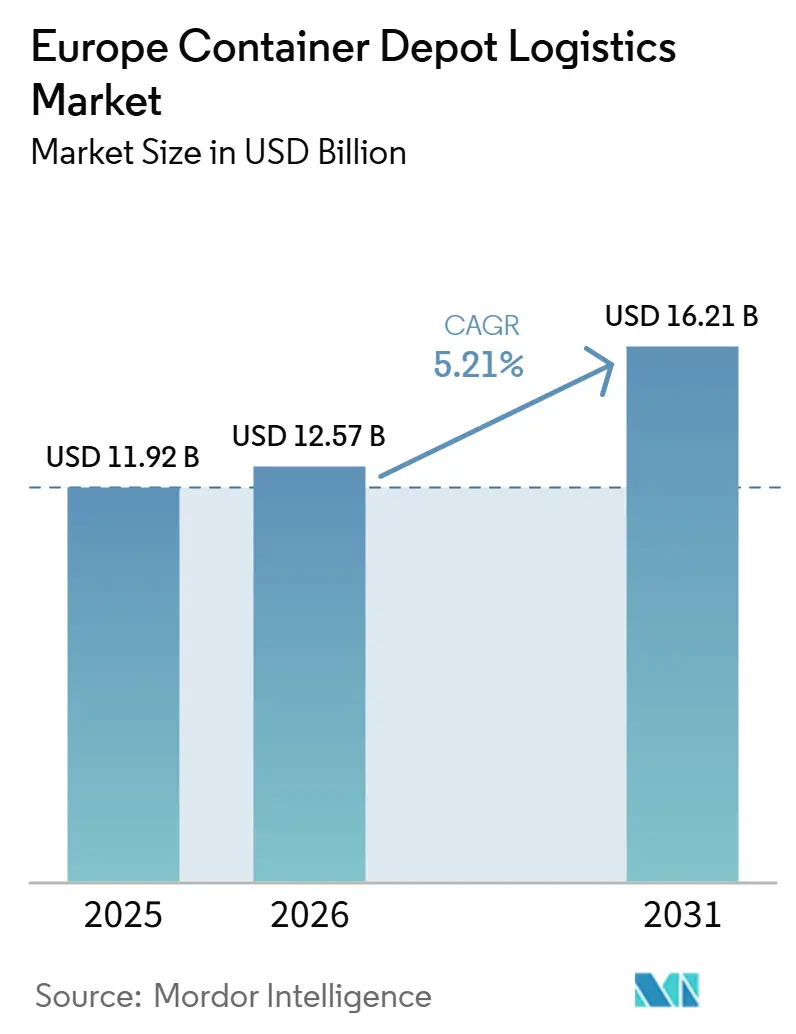
The Europe container depot logistics market size was USD 11.92 billion in 2025 and is projected to reach USD 12.57 billion in 2026 and USD 16.21 billion by 2031 at a CAGR of 5.21% from 2026 to 2031.
The Europe container depot logistics market is expanding because persistent congestion at the region’s largest gateways has made inland and off-port buffering a core operating need rather than a temporary workaround. The growth path also reflects higher investment by terminal operators and carrier-linked logistics arms that are adding capacity, modernizing terminals, and building tighter inland links to improve asset rotation and reduce dwell time. Service quality is becoming more important because reefer handling, repair cycles, and data visibility now shape contract value more clearly than standardized storage alone. Margin pressure remains real because land near core corridors is limited, labor costs remain elevated, and permitting delays continue to slow site expansion across several countries. As a result, the Europe container depot logistics market is moving toward denser, more specialized, and more technology-enabled depot networks that can support both port overflow and inland intermodal demand.
Key Report Takeaways
- By depot type, inland container depots led with 39.81% of Europe container depot logistics market size in 2025, while empty container depots are forecast to expand at an 8.07% CAGR through 2031.
- By service type, container storage services held 34.02% of Europe container depot logistics market share in 2025, while container maintenance and repair services recorded the highest projected CAGR at 9.22% through 2031.
- By container type, dry containers accounted for 72.33% of Europe container depot logistics market size in 2025, while reefer containers are advancing at a 7.64% CAGR through 2031.
- By trade orientation, international container handling accounted for 63.18% of Europe container depot logistics market share in 2025, and is also the fastest-growing category at a 7.35% CAGR through 2031.
- By country, Germany held 18.21% of Europe container depot logistics market size in 2025, while the Netherlands is projected to grow at a 7.07% CAGR through 2031.
Note: Market size and forecast figures in this report are generated using Mordor Intelligence’s proprietary estimation framework, updated with the latest available data and insights as of January 2026.
Europe Container Depot Logistics Market Trends and Insights
Drivers Impact Analysis*
| Driver | (~) % Impact on CAGR Forecast | Geographic Relevance | Impact Timeline |
|---|---|---|---|
| Growth in inland and off-port buffering demand | +1.1% | Global, strongest in Northwest Europe, including Rotterdam, Antwerp, and Hamburg | Short term (≤ 2 years) |
| Rising reefer-ready depot utilization | +0.9% | Northwest Europe, especially the ARA range, and Mediterranean gateways such as Genoa, Barcelona, and Valencia | Medium term (2-4 years) |
| Rail-linked hinterland consolidation | +0.7% | Germany, the Netherlands, Belgium, and France, with spillover to Central and Eastern Europe | Medium term (2-4 years) |
| Depot digitization and yard visibility requirements | +0.5% | APAC-connected Northwest Europe corridors, Germany, and Italy | Medium term (2-4 years) |
| EU supply chain emissions reporting pressures | +0.4% | EU-wide, with stronger relevance in larger industrial economies | Long term (≥ 4 years) |
| Container pooling and leasing asset rotation complexity | +0.3% | Global, with structural exposure in Northern Europe and the Mediterranean | Short term (≤ 2 years) |
| Source: Mordor Intelligence | |||
Growth in Inland and Off-Port Buffering Demand: Port Saturation, Exports, Capacity Demand, Inland
Port pressure across Northwest Europe has become a recurring operating condition, keeping inland and off-port depots active for longer periods. The Europe container depot logistics market benefits when terminal overflow shifts boxes away from quay-side sites and into buffer locations that can handle storage, customs activity, and onward movement. Antwerp-Bruges reported a 3.7% rise in TEU volumes in the first half of 2025, while congestion remained an issue, suggesting that volume growth and flow disruption are occurring simultaneously. Hutchison Ports’ European segment also reported higher storage revenue in 2025, as containers stayed longer in the system, supporting the same pattern of depot dependence. The EUR 2.9 billion (USD 3.1 billion) Extra Container Capacity Antwerp project will add capacity over time. Still, its multi-year build schedule means inland depots will remain important through much of the forecast period.
Rising Reefer-Ready Depot Utilization: Cold Chain Intensity Reshapes the Depot Mix
Reefer-capable depots are taking a larger role because temperature-controlled containers require closer monitoring, shorter inspection cycles, and more electrical support than standard dry boxes. The Europe container depot logistics market is seeing stronger demand for sites that can combine storage with pre-trip inspection, plug monitoring, and technical repair for cold chain equipment. The International Institute of Refrigeration expects global refrigerated container volumes to rise from 4 million TEUs in 2023 to 7.1 million TEUs by 2030, which supports the broader case for reefer-linked infrastructure[1]Source: International Institute of Refrigeration, “Refrigerated Containers Throughput in Main European Ports in Q1 and Q2 2025,” IIF, iifiir.org. Maersk’s new 35,000 m² cold store at Maasvlakte II, located next to its Star Depot, also shows how operators are integrating cold chain and depot functions more closely within the same logistics corridor. This is one reason maintenance and repair are growing faster than basic storage in the container depot logistics market in Europe.
Rail-Linked Hinterland Consolidation: Intermodal Networks Become the Depot's Distribution Spine
Rail-linked inland terminals are gaining importance because each new shuttle service needs staging, interchange, and repair capacity at both ends of the move. The Europe container depot logistics market is therefore tied more closely to intermodal development than before, especially in Germany, France, Belgium, and the Netherlands. UIRR data for 2025 showed nearly 3.9 million consignments and 81 million gross tons moved in European intermodal transport, which confirms that rail volumes are still expanding. MSC’s MEDLOG Inland Terminal Paris-Bruyeres opened in June 2025 with rail, river, storage, reefer, and maintenance functions, which makes it a clear example of how carriers are using inland terminals to extend control away from seaports. The revised TEN-T framework is also pulling investment toward longer trains and better terminal access, which should keep depot-linked rail assets central to future network design.
Depot Digitization and Yard Visibility Requirements: Cloud Platforms Alter the Unit Economics of Depot Operations
Depot digitization is becoming a commercial requirement because shipping lines want faster gate processing, cleaner data, and fewer disputes over damage, location, and service events. The Europe container depot logistics market is now rewarding operators that can provide real-time yard visibility and accurate billing, rather than relying on manual yard records. Addicks & Kreye in Bremerhaven deployed EUROGATE IT’s operateMybox Depot with CONROO integration in September 2025, which automated truck scheduling, gate handling, and yard assignment[2]Source: Eurogate, “Addicks & Kreye Brings the Module OperateMybox Depot to Bremerhaven with CONROO Integration,” Eurogate Newsroom, eurogate.de. DepoLink in Koper also introduced OCR gate technology in 2025, allowing more consistent container capture with timestamps and images. These systems lower queue time, improve invoice accuracy, and make higher-throughput depots easier to run without a similar increase in labor intensity.
Restraints Impact Analysis*
| Restraint | (~) % Impact on CAGR Forecast | Geographic Relevance | Impact Timeline |
|---|---|---|---|
| Land scarcity near core port corridors | -0.8% | Northwest Europe, including the Netherlands, Belgium, and Northern Germany, along with Mediterranean port zones | Long term (≥ 4 years) |
| High labor and utility cost structure | -0.7% | EU-wide, with sharper pressure in Germany, the Netherlands, and the United Kingdom | Short term (≤ 2 years) |
| Fragmented permitting across European countries | -0.4% | Belgium, France, Germany, and localized pockets across other member states | Medium term (2-4 years) |
| Low margin sensitivity in standard dry container services | -0.2% | EU-wide, especially in high-throughput dry container clusters | Short term (≤ 2 years) |
| Source: Mordor Intelligence | |||
Land Scarcity Near Core Port Corridors: Infrastructure Demand Outpaces Available Ground
Land availability is one of the most significant constraints on expansion near major port corridors. The Europe container depot logistics market may have healthy demand, but depots still need sites close enough to key gateways to remain operationally relevant. In markets such as the Netherlands and Belgium, zoning restrictions and environmental approval hurdles have slowed new logistics projects and pushed operators toward denser use of existing yards rather than conventional greenfield growth. This is why vertical stacking, tighter layouts, and multi-use inland sites are becoming more common in the Europe container depot logistics market.
High Labor and Utility Cost Structure: Wage Inflation Undermines Standard Depot Margins
Cost inflation remains a direct challenge because many depot services are priced on throughput and have limited pass-through. The Europe container depot logistics market is especially exposed in dry container operations, where service differentiation is weaker, and buyer bargaining power is higher. Transport Intelligence data showed that European warehousing costs remained more than 25% above the 2022 baseline in 2025, while Germany’s statutory minimum wage rises a further 8.4% in 2026, adding pressure to labor-intensive depot activities. Operators with automation or premium reefer and tank-adjacent capabilities can recover more of these costs, but generic yards have less protection. As a result, the Europe container depot logistics market is likely to see a wider margin gap between specialized depots and standard dry-box storage sites.
*Our forecasts treat driver/restraint impacts as directional, not additive. The impact forecasts reflect baseline growth, mix effects, and variable interactions.
Segment Analysis
By Depot Type: Inland Capacity, Anchors Volume, Empty Depots Lead Growth
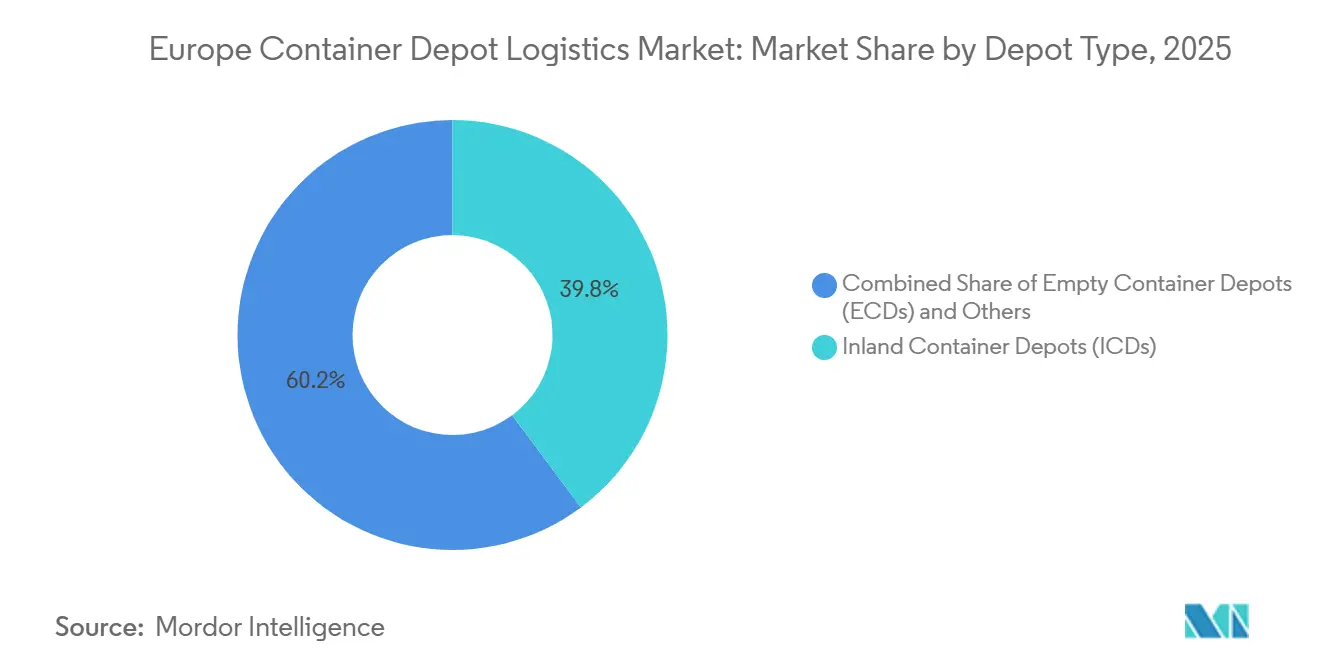
Inland container depots held 39.81% of the Europe container depot logistics market share in 2025, keeping them in the lead among depot types. Their role extends beyond storage because they support customs clearance, cargo inspection, de-stuffing, intermodal interchange, and cargo consolidation in inland locations. That operating mix gives ICDs a stable position in the Europe container depot logistics market, especially where port congestion pushes cargo away from quay-side terminals.
Empty container depots are projected to grow at a 8.07% CAGR from 2026 to 2031, making them the fastest-growing depot type in the Europe container depot logistics market. That growth reflects rising repositioning complexity, longer equipment imbalances, and the need for quicker turnaround of empties moving between export and import corridors. Sogese reported elevated depot congestion and longer dwell times in early 2026 because equipment was being repositioned toward Asia, which shows why empty depots are becoming more important as asset rotation nodes.



By Service Type: Storage Commands Scale, Maintenance and Repair Services Commands Growth
Container storage services accounted for 34.02% share of the Europe container depot logistics market size in 2025, making storage the largest service category. That result aligns with the operating reality of the Europe container depot logistics industry, as storage remains the primary revenue stream for most depots handling overflow, staging, and dwell-related demand. Cleaning, washing, and other value-added services accounted for a smaller share, but they helped operators improve revenue quality by bundling more services into each container visit.
Container maintenance and repair services are expected to grow at a 9.22% CAGR from 2026 to 2031, which makes this the fastest-growing service segment. The main reason is that higher fleet utilization leaves less room for deferred inspection and repair, so more of that work shifts to depots rather than staying at seaport terminals. DR Depots already operates more than 140 reefer plug points in Rotterdam and 60 in Antwerp, which shows how concentrated reefer maintenance demand has become in ARA-range hinterland locations.
By Container Type: Dry Containers Dominate, Reefer Segment Outpaces
Dry containers held 72.33% of the Europe container depot logistics market share in 2025, which made them the largest container type by a wide margin. This leadership comes from the structure of European trade, where manufactured goods, automotive parts, consumer products, and general cargo still move largely in standard 20-foot and 40-foot dry boxes. The Europe container depot logistics market, therefore, remains anchored in dry-container storage, handling, and repositioning volumes. Even so, dry-container services tend to have weaker pricing power because many sites can handle them, and large customers often buy on scale.
Reefer containers are projected to expand at a 7.64% CAGR from 2026 to 2031, making them the fastest-growing container type. Growth is being supported by stronger refrigerated trade flows and by the technical requirements of reefer equipment, which need more frequent checks and better site infrastructure. The International Institute of Refrigeration expects refrigerated container volumes to continue rising globally, which supports sustained reefer activity through European gateways. Maersk Container Industry also reported around 100,000 reefers booked in the first half of 2025, pointing to higher fleet deployment.
By Trade Orientation: International Flows Dominate and Accelerate
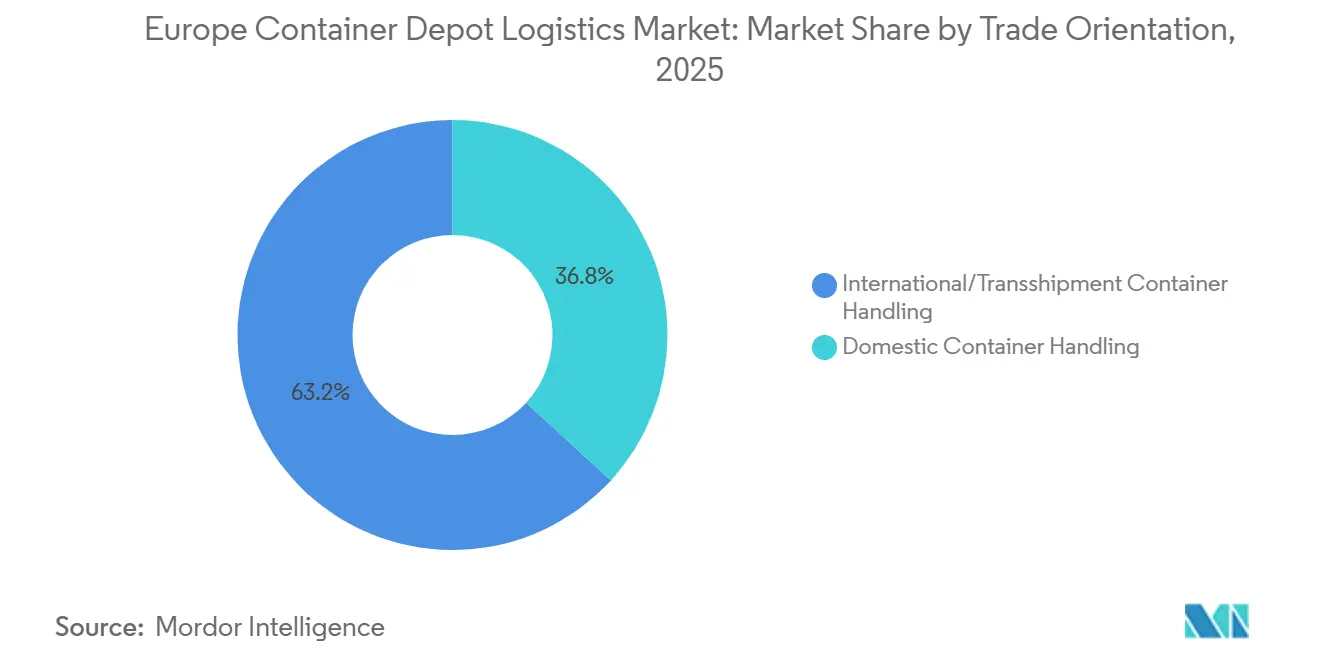
International container handling accounted for 63.18% of the Europe container depot logistics market in 2025 and is forecast to grow at a 7.35% CAGR through 2031. That combination is unusual because the leading segment is also the fastest-growing one. It shows that the Europe container depot logistics market is increasingly tied to Europe’s role as a relay and sorting platform for global liner networks, rather than just an import and export destination. Changes in alliance structures during 2024 and 2025 increased the need for cargo re-sorting, empty repositioning, and relay support around major hubs. That operating shift increases demand for depots that can stage containers outside crowded terminals while keeping release times short.
Domestic flows depend less on large port-side concentration and more on a denser map of inland touchpoints. That creates room for smaller regional depots that serve as pool distribution points for domestic intermodal operators. In the Europe container depot logistics market, those sites are less visible than port-adjacent depots, but they remain important for route flexibility and modal shift. Their role should become more relevant as carriers and logistics operators try to extend inland coverage without adding more pressure to the largest gateways.
Geography Analysis
Germany held 18.21% of the Europe container depot logistics market share in 2025, making it the largest contributor in the region. Its position is supported by the throughput scale of Duisburg and by the wider terminal and intermodal network around Hamburg and Bremen, as well as the inland rail corridors. HHLA’s 2026 capital expenditure guidance of EUR 430 million to EUR 480 million (USD 473 million to USD 528 million) shows that container and intermodal investment remains active in Germany’s port and rail system[3]Source: HHLA, “HHLA Shows Growth in a Difficult Market Environment,” HHLA Newsroom, hhla.de. The Netherlands is the fastest-growing geography at a 7.07% CAGR through 2031, and that outlook is tied to the Maasvlakte II capacity-doubling program in Rotterdam. The arrival of 5 new automated rail-mounted gantry cranes in March 2026 supports this expansion and strengthens the inland pull that follows higher terminal throughput.
Belgium remains one of the most strategically important parts of the Europe container depot logistics market because Antwerp-Bruges continues to generate strong inland demand even while congestion persists. The approved EUR 2.9 billion (USD 3.1 billion) ECA project will reshape capacity over time, but it also confirms that the current system needs more room and better inland support. H. Essers opened a EUR 75 million (USD 82.5 million), container terminal in Bergen op Zoom in June 2026 on the Scheldt-Rhine Canal between Antwerp and Rotterdam, which adds inland waterway-linked capacity in one of the region’s busiest corridors. Van Moer Logistics also announced EUR 185 million (USD 200 million) of logistics investment in Belgium in late 2025, including Beringen Logistics & Terminal and additional warehouse capacity tied to terminal growth. France and the United Kingdom add different forms of support, with France benefiting from multimodal inland development and the United Kingdom shaped by post-Brexit customs needs and expansion at London Gateway.
Spain, Italy, the Nordic countries, and the rest of Europe cluster to complete the regional picture for the Europe container depot logistics market. Spain is benefiting from stronger transshipment and intermodal links, and Hutchison Ports BEST continues to build Barcelona’s terminal capacity with new crane investment in 2026. Italy is strengthening its Mediterranean and inland links through PSA’s USD 1 billion commitment to Genoa Pra’ and the EUR 75 million (USD 82.5 million) Padova joint venture with Logtainer. Interporto Bologna’s EUR 24.5 million (USD 26.5 million) expansion also supports future inland rail capacity. At the same time, Nordic depots continue to serve short-sea and Baltic feeder routes with a smaller but growing base.
Competitive Landscape
The Europe container depot logistics market is moderately fragmented, with a limited group of large infrastructure owners coexisting alongside a long list of regional and independent operators. APM Terminals, PSA International, DP World, HHLA, Eurogate, and Hutchison Ports control much of the heavy terminal-linked capacity around the region’s largest gateways. These companies are not dispersing investment widely. Instead, they are deepening assets in strategic corridors through modernization, automation, and larger terminal footprints. APM Terminals and Eurogate extended their North Sea Terminal Bremerhaven partnership in 2026 with a EUR 1 billion (USD 1.2 billion) modernization plan that will raise annual capacity from 3 million to 4 million TEUs. PSA also committed USD 1 billion to Genoa Pra’ in February 2026, reinforcing the pattern that leading groups are concentrating capital in key nodes rather than spreading it evenly across the map.
Carrier-linked logistics arms are also changing the Europe container depot logistics market, as ocean carriers seek tighter control over inland repositioning and terminal-adjacent services. MSC’s MEDLOG network, CMA CGM’s logistics expansion, and Maersk’s Star Depot model all support this shift toward captive or closely aligned inland capacity[4]Source: MSC, “MSC Officially Opens MEDLOG Inland Terminal Paris-Bruyères,” MSC Newsroom, msc.com. CMA CGM agreed to take a 20% stake in Eurogate Container Terminal Hamburg, and Hapag-Lloyd’s Hanseatic Global Terminals signed a term sheet for a separate 20% stake in the same facility in 2026, showing how equity participation is becoming part of the competitive model. The planned western expansion of Container Terminal Hamburg to 6 million TEUs will strengthen one of the largest terminal-linked ecosystems in Northern Europe. This matters because control over inland support assets can shorten empty dwell time and keep more service volume inside the carrier’s own network.
Regional operators still hold a place in the Europe container depot logistics market by competing on location, specialization, and service flexibility. Contargo, Van Moer Logistics, H. Essers, Contship Italia, Bertschi, Den Hartogh, BLG Logistics, and others show that mid-tier groups can remain relevant when they tie depots to rail, barge, reefer, or niche cargo flows. Digitization is also becoming a sharper dividing line because operators with cloud yard tools and automated gate systems can reduce queue time and improve billing accuracy more consistently than manual yards. DSV’s completion of the Schenker acquisition in 2025 adds another layer because contract logistics scale can influence how freight is routed through supporting inland container networks. The clearest open space appears in reefer-ready, rail-linked inland depots serving pharma and agri-food traffic in France, Spain, and selected Central and Eastern European corridors, where service depth still matters more than pure yard size.
Europe Container Depot Logistics Industry Leaders
APM Terminals
DP World
PSA International
Hamburger Hafen und Logistik AG (HHLA)
Eurogate GmbH & Co. KGaA, KG
- *Disclaimer: Major Players sorted in no particular order

Recent Industry Developments
- June 2026: Hapag-Lloyd's Hanseatic Global Terminals (HGT) signed a term sheet to acquire a 20% stake in Eurogate Container Terminal Hamburg (CTH), the latest in a sequence of ocean carrier equity stakes in Europe's largest port hub, following MSC's 49.9% acquisition of HHLA in late 2024 and CMA CGM's 20% stake agreement in CTH signed in late 2025.
- June 2026: H. Essers officially opened its EUR 75 million (USD 82.5 million) container terminal in Bergen op Zoom, Netherlands, positioned on the Scheldt-Rhine Canal between Antwerp and Rotterdam. The facility targets an annual capacity of 325,000 TEUs and is designed to remove approximately 260 trucks per day from road networks by shifting container flows to inland waterway transport.
- May 2026: CMA CGM joined Logistiek Centrum Zwevegem (LCZ) in Belgium as a carrier partner at the container yard depot near Antwerp. The collaboration focuses on intermodal transport via inland waterway, targeting CO₂ reduction and greater booking flexibility for shippers and forwarders at the Antwerp corridor.
- April 2026: APM Terminals and Eurogate formally extended their joint partnership at North Sea Terminal Bremerhaven (NTB), committing EUR 1 billion (USD 1.19 billion) to modernize the terminal, increase annual handling capacity from 3 million to 4 million TEUs, and convert operations to zero greenhouse gas emissions through full equipment electrification. The Outer Weser deepening process is running concurrently to unlock the upgraded terminal's full potential.


Europe Container Depot Logistics Market Report Scope
| Inland Container Depots (ICDs) |
| Container Freight Stations (CFS) |
| Empty Container Depots (ECDs) |
| Port-Based Container Depots |
| Container Storage Services |
| Container Handling Services |
| Container Maintenance and Repair (M&R) Services |
| Container Cleaning & Washing Services |
| Other Value-Added Logistics Services |
| Dry Containers |
| Reefer Containers |
| International/Transshipment Container Handling |
| Domestic Container Movement |
| United Kingdom |
| Germany |
| France |
| Spain |
| Italy |
| Belgium |
| Netherlands |
| NORDICS (Denmark, Finland, Iceland, Norway, and Sweden) |
| Rest of Europe |
| By Depot Type | Inland Container Depots (ICDs) |
| Container Freight Stations (CFS) | |
| Empty Container Depots (ECDs) | |
| Port-Based Container Depots | |
| By Service Type | Container Storage Services |
| Container Handling Services | |
| Container Maintenance and Repair (M&R) Services | |
| Container Cleaning & Washing Services | |
| Other Value-Added Logistics Services | |
| By Container Type | Dry Containers |
| Reefer Containers | |
| By Trade Orientation | International/Transshipment Container Handling |
| Domestic Container Movement | |
| By Country | United Kingdom |
| Germany | |
| France | |
| Spain | |
| Italy | |
| Belgium | |
| Netherlands | |
| NORDICS (Denmark, Finland, Iceland, Norway, and Sweden) | |
| Rest of Europe |


Key Questions Answered in the Report
What is the current outlook for container depot logistics in Europe through 2031?
The Europe container depot logistics market was valued at USD 11.92 billion in 2025 and is projected to reach USD 16.21 billion by 2031, growing at a 5.21% CAGR from 2026 to 2031.
Which depot type generates the most revenue in Europe?
Inland container depots led with 39.81% share in 2025 because they combine customs, de-stuffing, inspection, and intermodal functions in inland locations.
Which service area is growing fastest in depot operations?
Container maintenance and repair is the fastest-growing service type, with a projected 9.22% CAGR through 2031, supported by higher fleet utilization and reefer inspection needs.
Why are reefer-related services gaining importance across European depots?
Reefer containers are expected to grow at a 7.64% CAGR through 2031, and each unit needs plug monitoring, pre-trip inspection, and more frequent maintenance than a dry container.
Which country is the largest and which is the fastest growing?
Germany held the largest country share at 18.21% in 2025, while the Netherlands is forecast to grow the fastest at a 7.07% CAGR through 2031.
What are the main risks facing depot operators in Europe?
The main risks are land scarcity near major corridors, elevated labor and utility costs, and permitting delays that slow site expansion even when demand remains strong.
Page last updated on:





