
Europe Construction Technical Textile Market Size and Share
Market Overview
| Study Period | 2021 - 2032 |
|---|---|
| Forecast Data Period | 2027 - 2032 |
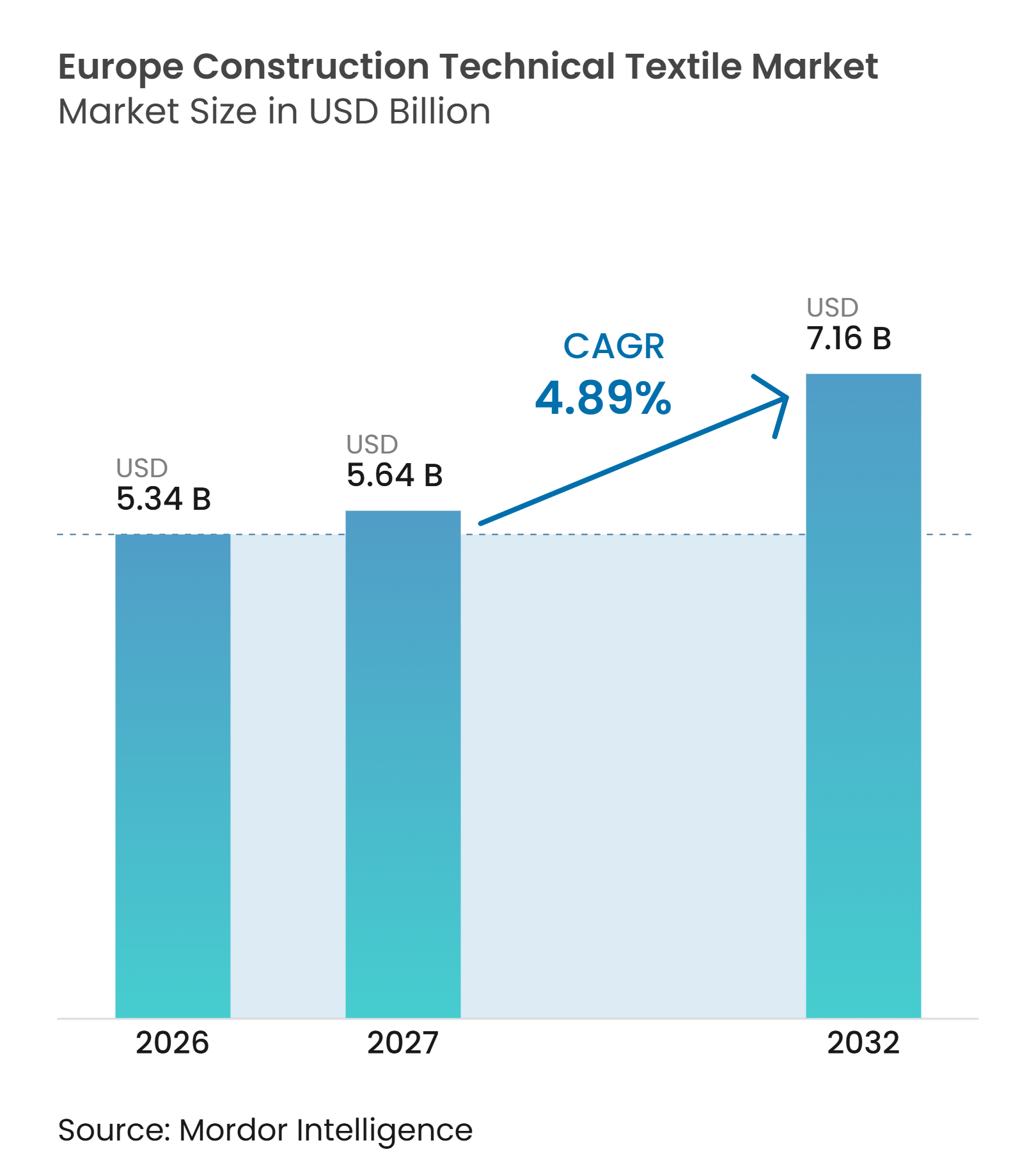
| Base Year Market Size (2026) | USD 5.34 Billion |
| Market Size (2027) | USD 5.64 Billion |
| Market Size (2032) | USD 7.16 Billion |
| Growth Rate (2027 - 2032) | 4.89 % |
| Market Concentration | Medium |
Major Players *Disclaimer: Major Players sorted in no particular order Image © Mordor Intelligence. Reuse requires attribution under CC BY 4.0. | |
Europe Construction Technical Textile Market Analysis by Mordor Intelligence
The Europe Construction Technical Textile Market size is projected to be USD 5.34 billion in 2026, USD 5.64 billion in 2027, and reach USD 7.16 billion by 2032, growing at a CAGR of 4.89% from 2027 to 2032.
The Europe construction technical textile market serves structural, protective, and performance needs that conventional building materials do not address. Demand is supported by transport investment, energy-efficient building renovation, and specialized industrial construction. The recast Energy Performance of Buildings Directive supports the use of breathable membranes, insulation textiles, and weather-resistive barriers in renovation work. Public procurement is also placing greater emphasis on CE certification, environmental product declarations, and documented product performance. Suppliers that pair application engineering with compliant and digitally documented portfolios have stronger access to large project specifications.
Key Report Takeaways
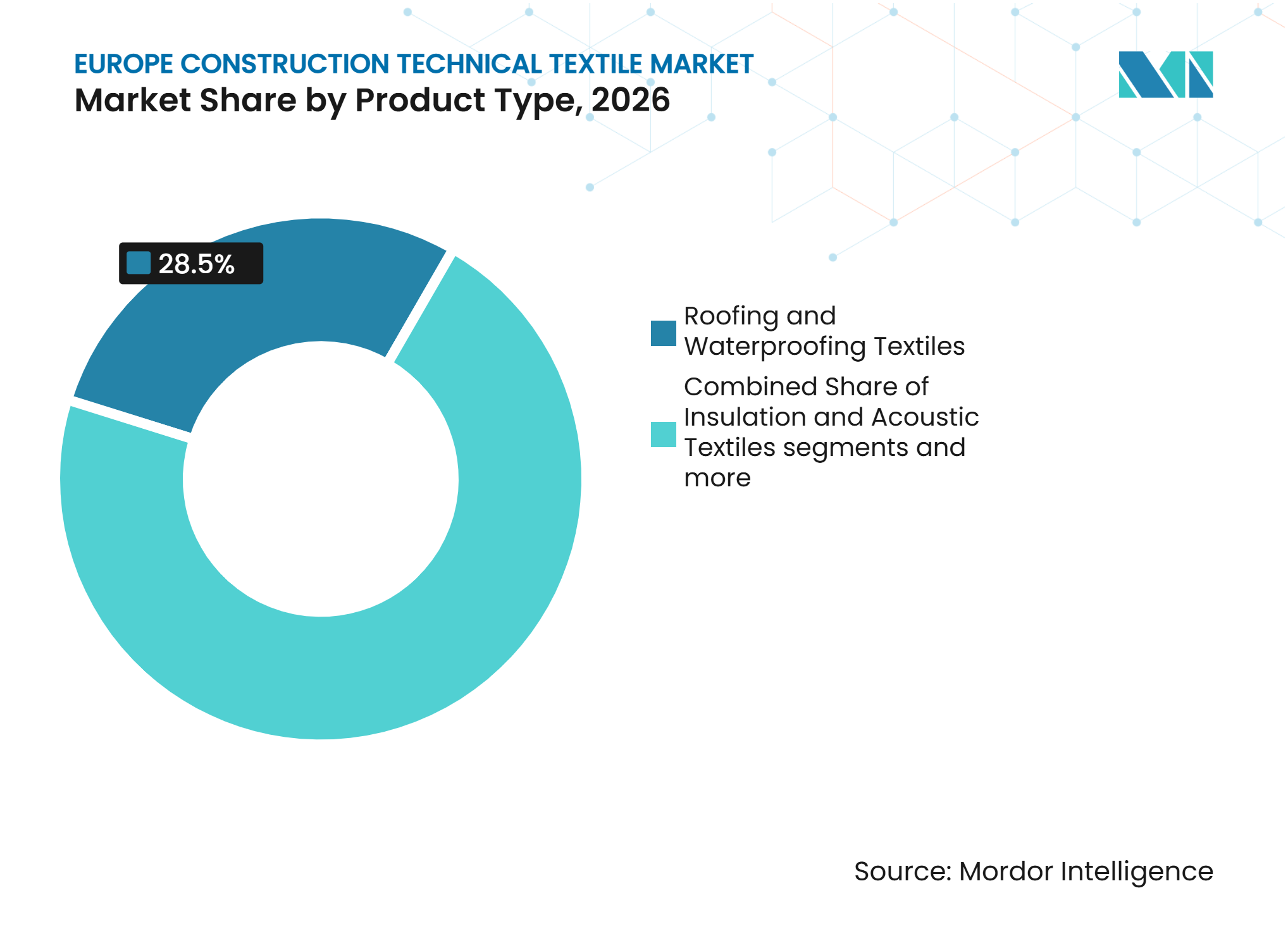
- By product type, roofing and waterproofing textiles held 28.5% of the Europe construction technical textile market share in 2026, while architectural membranes and tensile fabrics are forecast to grow at a 6.5% CAGR through 2032.
- By material type, polyester held a 30.4% share of the Europe construction technical textile market size in 2026, while carbon, aramid, and other high-performance fibers are forecast to grow at a 6.8% CAGR through 2032.
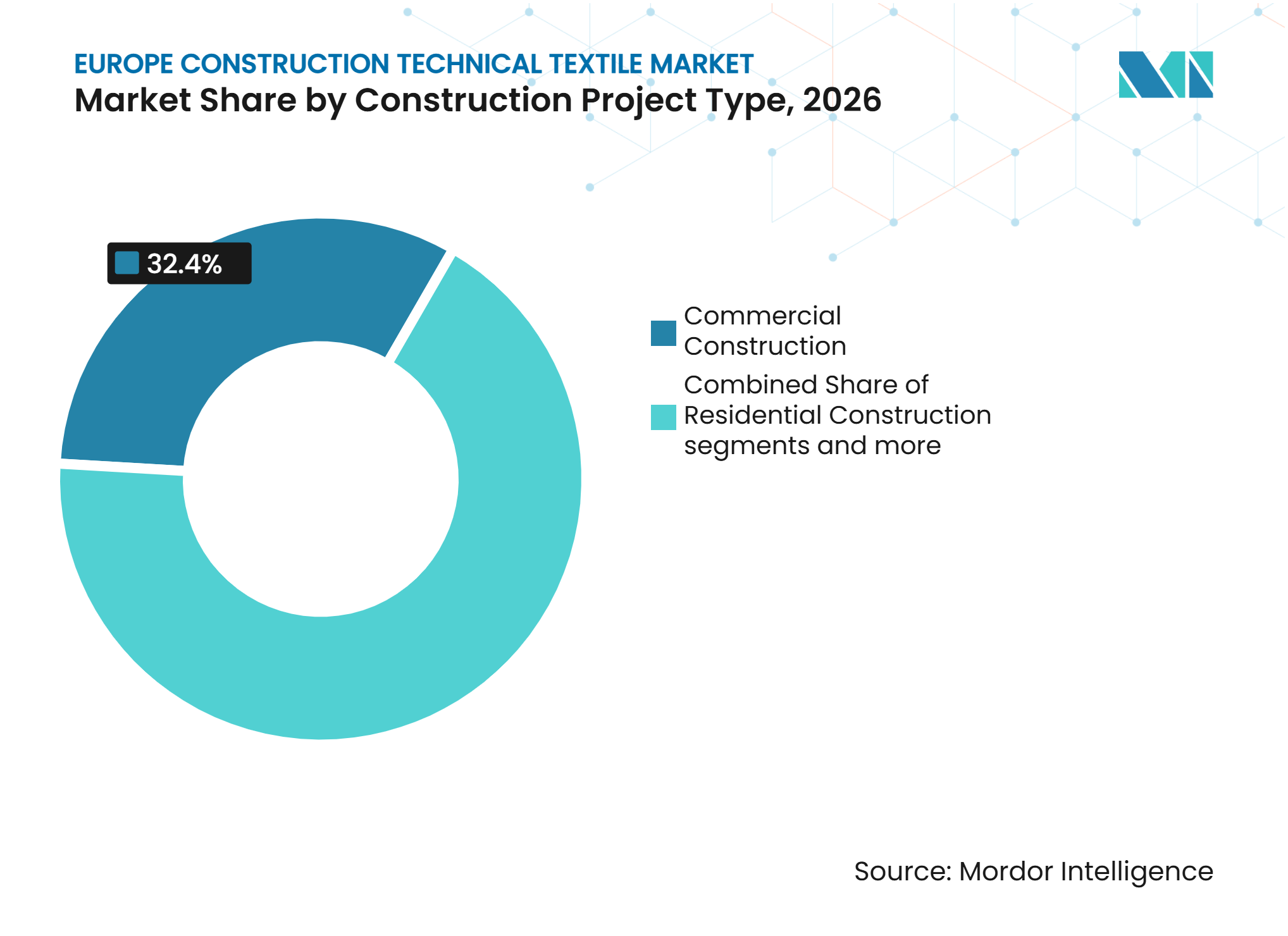
- By construction project type, commercial construction held a 32.4% share in 2026, while industrial and logistics construction is forecast to grow at a 6.2% CAGR through 2032.
- By geography, Germany held a 21.7% share in 2026, while Spain is forecast to grow at a 6% CAGR through 2032.
Note: Market numbers in this report are based on Mordor Intelligence's proprietary estimation framework, which combines nine months of actuals with Q4 projections for base year 2026.
Market Trends and Insights
Drivers Impact Analysis of Europe Construction Technical Textile Market*
| Driver | (~) % Impact on CAGR Forecast | Geographic Relevance | Impact Timeline |
|---|---|---|---|
| European Transport Infrastructure Renewal | +1.1% | Germany, France, Poland, Baltic States, Italy | Medium term (2-4 years) |
| Climate-Resilient Flood, Coastal, and Erosion-Control Construction | +0.9% | Netherlands, France, Spain, Italy, coastal states | Medium term (2-4 years) |
| Energy-Efficient Building Envelope Requirements | +0.8% | EU-wide, strongest in Germany, France, Italy, Spain | Short term (≤ 2 years) |
| Textile Solutions for Data Centers and Advanced Industrial Facilities | +0.7% | United Kingdom, Germany, France, Netherlands, Sweden, Norway | Short term (≤ 2 years) |
| Lightweight and Rapid-Installation Construction Systems | +0.7% | EU-wide, with early gains in modular construction markets | Long term (≥ 4 years) |
| Digital Building Design and BIM-Based Material Specification | +0.5% | Germany, Spain, Czech Republic, Italy | Medium term (2-4 years) |
| Source: Mordor Intelligence | |||
European Transport Infrastructure Renewal
In July 2025, the European Commission selected 94 transport projects for nearly EUR 2.8 billion (USD 3.3 billion) in Connecting Europe Facility grants, with rail receiving 77% of the funding across Germany, France, Italy, Austria, Poland, and the Baltic states.[1] The 2021-2027 Connecting Europe Facility has a EUR 25.8 billion (USD 30.3 billion) transport budget. The Commission proposed EUR 51.5 billion (USD 60.6 billion) in transport commitments for the 2028-2034 facility in December 2025. These commitments support demand for geotextiles in rail sub-base stabilization, road rehabilitation, slope erosion control, and drainage structures. The Europe construction technical textile market also benefits from TEN-T work plans that identify network gaps requiring resolution.
Climate-Resilient Flood, Coastal, and Erosion-Control Construction
The European Commission reported in February 2025 that Member States need to increase investment in flood prevention as flood events become more frequent and severe. The EU Blue Economy Report 2025 states that coastal flooding causes EUR 1.2 billion (USD 1.4 billion) in annual economic damage and could reach EUR 1 trillion (USD 1.2 trillion) annually by 2100 under a high-emissions scenario.[2] The same report places annual adaptation costs at EUR 1.1 billion (USD 1.3 billion) compared to EUR 1.8 billion (USD 2.1 billion). Romania's Phase II coastal erosion program has a EUR 841 million (USD 989.3 million) budget, including EUR 602.7 million (USD 709.0 million) from the EU Cohesion Fund. The program shows the size of contracted work that can require geosynthetic materials. The Europe construction technical textile market has room to grow in Southern and Central-Eastern Europe, where these products have lower historical penetration than in Northern Europe.
Energy-Efficient Building Envelope Requirements
The recast Energy Performance of Buildings Directive (EPBD) had a main transposition deadline of 29 May 2026, and the European Commission published its implementation support package in June 2025. The directive requires Member States to establish minimum energy performance standards targeting the 16% worst-performing non-residential buildings by 2030 and the 26% worst-performing buildings by 2033. For residential buildings, Member States must reduce average primary energy use by at least 16% by 2030 compared with 2020 levels. According to the European Commission, 75% of EU buildings have poor energy performance, while buildings account for 40% of EU energy consumption and 36% of energy-related greenhouse gas emissions. These requirements support demand for construction technical textiles, including membrane wraps, weather-resistive barriers and textile insulation, as building owners undertake energy-efficiency renovations. In November 2025, the Commission initiated infringement proceedings against Estonia, Italy and Hungary for failing to fully transpose the EPBD provision requiring the phase-out of financial incentives for standalone fossil-fuel boilers, which had a separate, earlier deadline of 1 January 2025.
Textile Solutions for Data Centers and Advanced Industrial Facilities
Data centers and advanced industrial facilities require certified fire barriers, insulation materials, acoustic components, and structural membrane systems. The Europe construction technical textile market can therefore benefit from industrial buildings that demand several performance functions from a single construction assembly. Brookfield announced a SEK 95 billion (USD 10.3 billion) AI data center campus in Sweden in 2025. OpenAI also announced a USD 1 billion Stargate facility in Norway in 2025. These facilities require environmental envelopes that manage temperature, humidity, acoustics, and fire performance.
Restraints Impact Analysis of Europe Construction Technical Textile Market*
| Restraint | (~) % Impact on CAGR Forecast | Geographic Relevance | Impact Timeline |
|---|---|---|---|
| Fragmented National Fire and Building-Code Requirements | -0.6% | Germany, France, United Kingdom, Italy | Long term (≥ 4 years) |
| Volatility in Polymer, Coating, and Energy Costs | -0.5% | EU-wide | Short term (≤ 2 years) |
| PFAS and Chemical-Regulatory Uncertainty | -0.4% | EU-wide | Medium term (2-4 years) |
| Limited Product-Specific Harmonized Standards for Advanced Textile Systems | -0.3% | EU-wide | Long term (≥ 4 years) |
| Source: Mordor Intelligence | |||
Fragmented National Fire and Building-Code Requirements
The revised Construction Products Regulation, Regulation (EU) 2024/3110, was published on December 18, 2024. National rules still differ for fire resistance, tensile structures, and acoustic performance. Germany uses DIN-based fire standards, France applies NF DTU requirements, and the United Kingdom has its own post-Brexit Building Regulations. These differences can extend the time to market for novel textile systems by 12-36 months. Changes to fiber blends, coating chemistry, or layer counts may require a further European Technical Assessment process. The Europe construction technical textile market faces a heavier compliance burden for smaller specialists than for larger suppliers.
Volatility in Polymer, Coating, and Energy Costs
Polymer feedstocks, chemical coatings, and energy account for 50–65% of production costs for construction technical textile manufacturers. European industrial energy prices remained above pre-2021 levels, particularly for natural-gas-intensive extrusion, thermal bonding, and coating processes. PET feedstock prices follow global paraxylene margins and Asian polyester capacity utilization, exposing European producers to international supply-demand fluctuations and raw-material price volatility. High-value membrane suppliers with long-term procurement agreements can pass through some cost increases, while commodity geotextile converters face stronger margin pressure from lower-cost Asian imports. These cost pressures also influence production planning, pricing strategies, and investment decisions, as manufacturers balance inventory costs against procurement risks. Investments in energy-efficient equipment, heat recovery, and process automation can reduce operating expenses, but upfront capital requirements may constrain smaller manufacturers. Consequently, producers with diversified sourcing networks, efficient manufacturing facilities, and established customer relationships are better positioned to protect margins, while specialization in high-performance technical textiles can help reduce direct price competition with standard imported materials.[3]
*Our forecasts treat driver/restraint impacts as directional, not additive. The impact forecasts reflect baseline growth, mix effects, and variable interactions.
Europe Construction Technical Textile Market Segment Analysis
By Product Type:
Roofing Leads Volume as Tensile Architectures Accelerate GrowthRoofing and waterproofing textiles held 28.5% of the Europe construction technical textile market size in 2026. Flat-roof commercial and industrial work in Northern and Central Europe supports this position. The Energy Performance of Buildings Directive also supports demand as older buildings move through renovation cycles. Architectural membranes and tensile fabrics are the fastest-growing product category at a 6.5% CAGR during 2027-2032. PVC-coated polyester and PTFE-fiberglass systems serve sports venues, airport canopies, large-span industrial structures, and data center facades.
Façade and envelope textiles are expanding as ventilated façade systems gain support under national minimum energy performance rules. Reinforcement textiles, including fiberglass meshes, scrims, and carbon fiber products, benefit from renovation and textile-reinforced concrete programs. BAM and Czech Technical University's UCEEB launched a fire-behavior research program for textile-reinforced concrete in September 2025. BBSR published Ge3TEX findings in January 2026 on spacer composites combined with mineral and polymer foam for lightweight insulation. Shading, acoustic, insulation, and site-protection products create cross-selling opportunities for suppliers with broad construction technical textile portfolios.



By Material Type:
PET Anchors Volume as High-Performance Fibers Lead InnovationPolyester held 30.4% of the Europe construction technical textile market share in 2026. Its tensile strength, UV resistance, hydrolytic stability, and cost position support use in geotextiles and woven membrane base fabrics. Carbon, aramid, and other high-performance fibers are forecast to grow at a 6.8% CAGR during 2027-2032. Textile-reinforced concrete, carbon fiber façades, and load-bearing composites support this growth. Glass fiber remains important in plaster reinforcement meshes and PTFE-coated architectural membranes that need dimensional stability.
Freudenberg Performance Materials launched fine-denier spunbond nonwovens for roofing and façade membrane uses in April 2025. Its products range from 17-140 gsm and are available in PET, PE, and PP with 2.5-3 dtex fibers. Polypropylene remains relevant in high-volume nonwoven geotextiles because of chemical resistance and cost efficiency in drainage work. Natural and regenerated fibers, including hemp and flax, are drawing regulatory and investor attention as lower-carbon alternatives. At the same time, PE, acrylic, and polyamide retain specialist roles in liners, shading, and durable architectural applications.
By Construction Project Type:
Commercial Demand Leads as Industrial Logistics Gains MomentumCommercial construction held 32.4% of the Europe construction technical textile market size in 2026. The category includes office parks, retail facilities, mixed-use developments, and healthcare campuses. BREEAM, DGNB, and HQE requirements, along with environmental product declarations in public procurement, influence material specification. Industrial and logistics construction is forecast to grow at a 6.2% CAGR during 2027-2032. Fulfillment centers, data centers, and battery gigafactories support demand in Germany, France, Hungary, and Spain.
These facilities require premium roofing membranes, reinforcement textiles for logistics floors, and certified fire-barrier fabrics. Residential work uses breathable façade membranes and weather barriers in multifamily renovation projects. Institutional projects use tensile canopies, fire-resistant ceiling systems, and reinforcement products in restoration. BMWSB adopted its Action Program for the National Circular Economy Strategy in June 2026, supporting reversible and recyclable construction systems. Documented recyclability, traceability, and digital product information can help the European construction technical textile industry participate in circular procurement.

Geography Analysis
Germany held 21.7% of the Europe construction technical textile market share in 2026. Its infrastructure pipeline, industrial construction base, and concentration of specialist converters support this position. BMWSB presented BIM across the full construction value chain as government policy at BAU 2025 in January 2025. Digital specification supports traceability and reduces the risk that documented textile products are substituted.
The United Kingdom, France, and Italy form a second group of major markets. France benefits from Connecting Europe Facility investment in rail, waterways, and urban mobility that can use geotextile and membrane components. Italy published BIM guidelines for public works above EUR 2 million (USD 2.4 million) in February 2026. Spain is forecast to grow fastest at a 6% CAGR during 2027-2032, supported by BIM adoption, coastal flood protection, and industrial real estate construction in the Europe construction technical textile market.
The Netherlands has a strong base in tensile architecture and hydraulic engineering. Poland and the Baltic states are receiving Connecting Europe Facility rail grants, including Rail Baltica, which supports embankment geotextile demand. Romania's EUR 841 million (USD 989.3 million) coastal erosion program includes EUR 602.7 million (USD 709 million) from the EU Cohesion Fund and EUR 97 million (USD 114.1 million) from the European Investment Bank. The Czech Republic will require BIM for public contracts above CZK 135 million (USD 6.5 million) from January 2027. Sweden and Norway are emerging locations for data center construction, supported by the Brookfield and OpenAI projects announced in 2025.
Competitive Landscape
Market Concentration
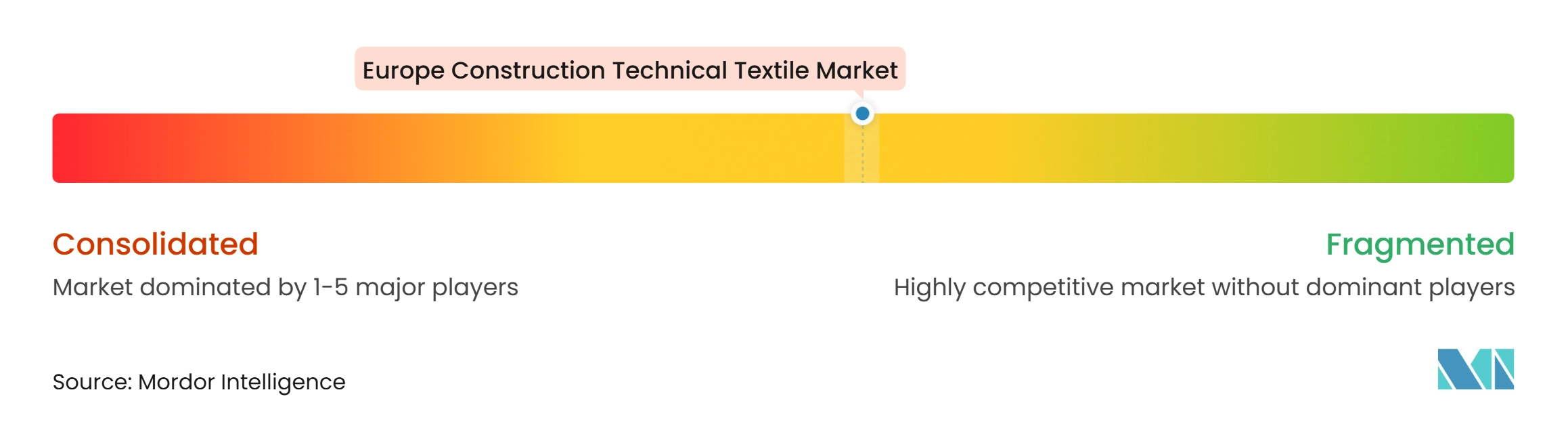
The Europe construction technical textile market exhibits a medium level of market concentration. European specialists include HUESKER Synthetic, NAUE, Sioen Industries, Freudenberg Performance Materials, Concrete Canvas, and Verseidag-Indutex. Solmax launched its Performance Materials platform in June 2025, integrating into the TenCate Geosynthetics and Propex industrial fabrics businesses. Competition centers on CE certification coverage, application engineering, and environmental product declaration credentials.
Solmax completed a comprehensive refinancing in October 2026, strengthening the capital structure of its geosynthetics business in the Europe construction technical textile market. Sioen Industries expanded geotextile production capacity in Italy and invested in a production hall in Ardooie, Belgium, for sun-protection textile products in 2025. Freudenberg Performance Materials launched fine denier spunbond nonwovens for construction applications in April 2025. These moves show how suppliers are improving financial capacity, manufacturing coverage, and product range.
BIM-compatible product libraries, recyclable architectural membranes, and smart geotextiles with fiber-optic sensing are potential areas for development. BAM's research with UCEEB addresses the fire-certification barrier for textile-reinforced concrete. Digital product information can help specification teams compare performance and compliance requirements. Recyclable systems can support circular procurement objectives. The Europe construction technical textile market remains accessible to specialists, but larger projects require strong certification and engineering capability.
Europe Construction Technical Textile Industry Leaders
-
ABG Ltd
-
AFITEXINOV
-
AGRU Kunststofftechnik GmbH
-
BontexGeo NV
-
Concrete Canvas Ltd
- *Disclaimer: Major Players sorted in no particular order
Europe Construction Technical Textile Market Companies Covered in this Report
- ABG Ltd
- AFITEXINOV
- AGRU Kunststofftechnik GmbH
- BontexGeo NV
- Concrete Canvas Ltd
- Fibertex Nonwovens A/S
- Freudenberg Performance Materials
- Geobrugg AG
- HUESKER Synthetic GmbH
- Low and Bonar
- NAUE GmbH and Co. KG
- Officine Maccaferri S.p.A.
- Propex Operating Company, LLC
- Saint-Gobain
- Sika AG
- Sioen Industries NV
- Solmax
- TenCate Geosynthetics
- Tensar International Corporation
- Thrace Group
- Verseidag-Indutex GmbH
Recent Industry Developments in Europe Construction Technical Textile Market
- October 2026: Solmax completed a comprehensive refinancing, strengthening the capital structure of the global geosynthetics platform integrating TenCate Geosynthetics and Propex, and providing a foundation for the next phase of transformation and growth.
- June 2026: Saint-Gobain completed the divestiture of HKO Isolier- und Textiltechnik GmbH, a specialist in high-temperature industrial insulation textiles and fire protection products, to private equity fund LEO III managed by DUBAG Group, as part of its "Lead & Grow" strategic portfolio realignment toward core construction materials.
- April 2025: Freudenberg Performance Materials launched innovative fine denier spunbond nonwovens (17-140 gsm, PET, PE, and PP, 2.5-3 dtex) for construction applications including roofing and façade membranes, vapor barriers, and house wrappings, offering high nail-tear strength and UV resistance.
- March 2025: Sioen Industries announced expansion of geotextile production capacity in Italy for road and infrastructure works, alongside capital investment in a new production hall in Ardooie, Belgium, for sun-protection textile products, reinforcing its vertically integrated European model across civil infrastructure and architectural shading segments.
Europe Construction Technical Textile Market Report Scope
The Europe Construction Technical Textile Market Report is Segmented by Product Type (Roofing and Waterproofing Textiles, Insulation and Acoustic Textiles, and More), by Material Type (Polyester (PET), Polypropylene (PP), and More), by Construction Project Type (Residential Construction, Commercial Construction, and More), and by Geography (Germany, France, and More). The Market Forecasts are Provided in Terms of Value (USD).
Segmentation Overview
| Architectural Membranes and Tensile Fabrics (PVC-Coated Membranes, PTFE-Coated Fiberglass Membranes, etc.) |
| Roofing and Waterproofing Textiles |
| Facade and Building Envelope Textiles (Wraps & weather-Resistive Barriers, Facade Membrane Fabrics, etc.) |
| Construction Reinforcement Textiles (Fiberglass Plaster, Reinforcement Fabric & Meshes, Scrims, etc.) |
| Insulation and Acoustic Textiles |
| Architectural Shading and Canopy Textiles |
| Construction Site Protection Textiles (Debris Nets, Dust and Containment Fabrics, etc.) |
| Other Construction Technical Textiles |
| Polyester (PET) |
| Polypropylene (PP) |
| Polyethylene (PE) |
| Glass Fiber |
| Acrylic and Polyamide Fibers |
| Carbon, Aramid, and Other High-Performance Fibers |
| Natural and Regenerated Fibers |
| Other Specialty Materials |
| Residential Construction |
| Commercial Construction |
| Industrial and Logistics Construction |
| Institutional and Other Building Construction |
| Germany |
| United Kingdom |
| France |
| Italy |
| Spain |
| Netherlands |
| Rest of Europe |
| By Product Type | Architectural Membranes and Tensile Fabrics (PVC-Coated Membranes, PTFE-Coated Fiberglass Membranes, etc.) |
| Roofing and Waterproofing Textiles | |
| Facade and Building Envelope Textiles (Wraps & weather-Resistive Barriers, Facade Membrane Fabrics, etc.) | |
| Construction Reinforcement Textiles (Fiberglass Plaster, Reinforcement Fabric & Meshes, Scrims, etc.) | |
| Insulation and Acoustic Textiles | |
| Architectural Shading and Canopy Textiles | |
| Construction Site Protection Textiles (Debris Nets, Dust and Containment Fabrics, etc.) | |
| Other Construction Technical Textiles | |
| By Material Type | Polyester (PET) |
| Polypropylene (PP) | |
| Polyethylene (PE) | |
| Glass Fiber | |
| Acrylic and Polyamide Fibers | |
| Carbon, Aramid, and Other High-Performance Fibers | |
| Natural and Regenerated Fibers | |
| Other Specialty Materials | |
| By Construction Project Type | Residential Construction |
| Commercial Construction | |
| Industrial and Logistics Construction | |
| Institutional and Other Building Construction | |
| By Geography | Germany |
| United Kingdom | |
| France | |
| Italy | |
| Spain | |
| Netherlands | |
| Rest of Europe |
Key Questions Answered in the Report
What is the forecast growth rate for construction technical textiles in Europe?
The sector is projected to expand to a 4.89% CAGR from 2027-2032, reaching USD 7.16 billion by 2032.
Which product category has the largest share in Europe?
Roofing and waterproofing textiles lead with a 28.5% share in 2026, supported by commercial and industrial flat-roof construction.
Which construction technical textile product is growing fastest?
Architectural membranes and tensile fabrics are forecast to grow at 6.5% CAGR through 2032.
What materials are driving higher-performance construction applications?
Carbon, Aramid, and other high-performance fibers are projected to grow at a 6.8% CAGR through 2032 as textile-reinforced concrete and advanced composites gain use.
Which project type will expand most quickly through 2032?
Industrial and logistics construction is forecast to grow at a 6.2% CAGR, supported by fulfillment centers, data centers, and battery facilities.
Which country is the largest European construction technical textile destination?
Germany holds a 21.7% share in 2026 due to its infrastructure pipeline, industrial construction base, and specialist converting capacity.