
Europe Commercial Water Heater Market Size and Share
Market Overview
| Study Period | 2021 - 2032 |
|---|---|
| Forecast Data Period | 2027 - 2032 |
| Base Year Market Size (2026) | USD 2.01 Billion |
| Market Size (2027) | USD 2.10 Billion |
| Market Size (2032) | USD 2.79 Billion |
| Growth Rate (2027 - 2032) | 5.81 % |
| Market Concentration | Medium |
Major Players *Disclaimer: Major Players sorted in no particular order Image © Mordor Intelligence. Reuse requires attribution under CC BY 4.0. | |
Europe Commercial Water Heater Market Analysis by Mordor Intelligence
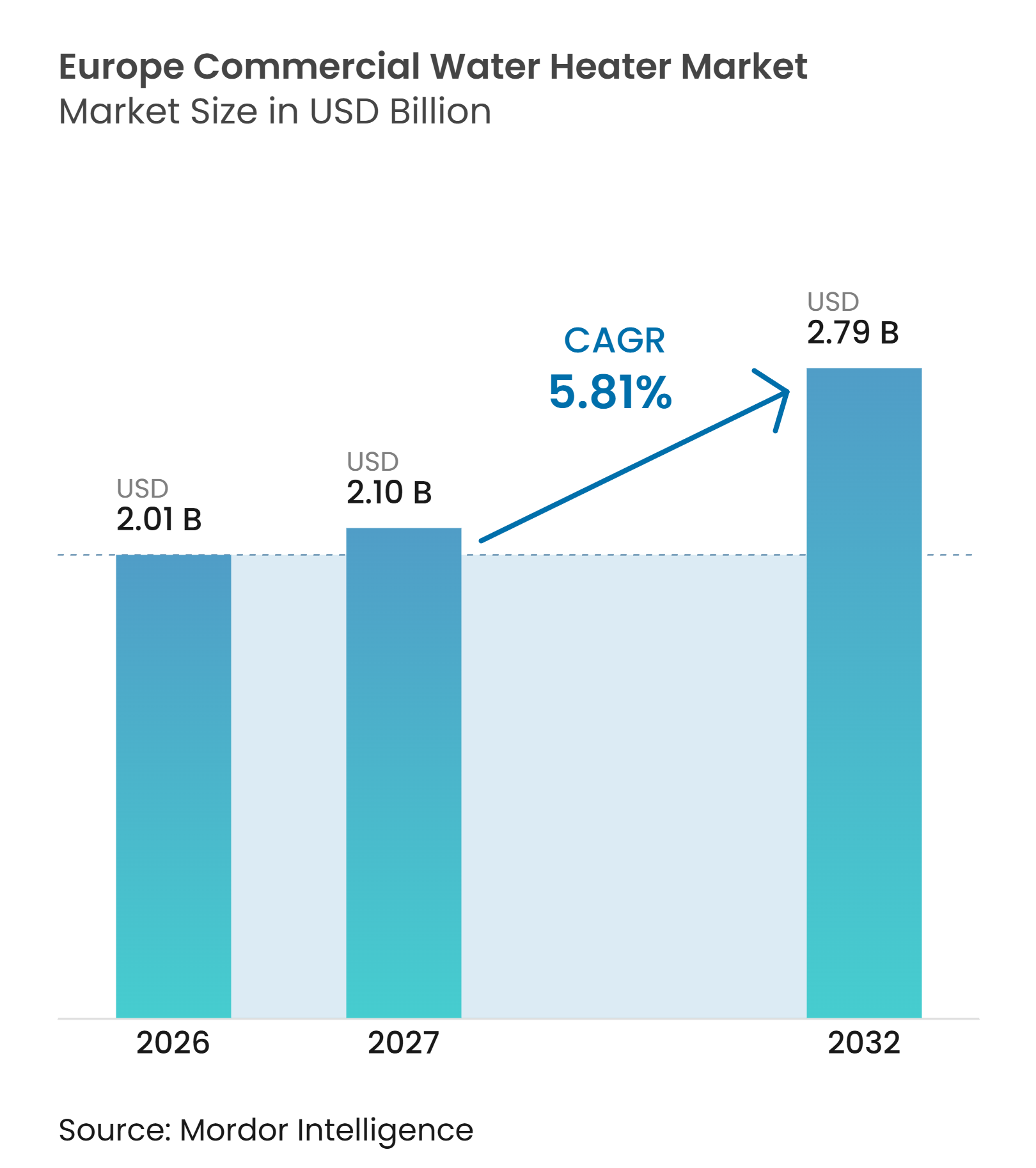
The Europe commercial water heater market size is expected to grow from USD 2.01 billion in 2026 to USD 2.10 billion in 2027 and is forecast to reach USD 2.79 billion by 2032, registering a CAGR of 5.81% during 2027-2032. The market is shaped by regulations that favor efficient heating equipment in commercial buildings and by the replacement needs of an old building stock. The revised Energy Performance of Buildings Directive prevents EU member states from granting public subsidies for stand-alone fossil-fuel boilers from January 2025, which changes equipment selection for renovations. Most EU buildings were built before 2000, and many have weak energy performance, creating a continuing need for water-heating upgrades. Heat pumps, solar-linked systems, and high-efficiency gas equipment are competing for this replacement work, while installers and distributors retain a strong influence over specifications. The European commercial water heater market is therefore less dependent on new construction than on compliance, operating costs, and renovation plans.
Key Report Takeaways
-
By product type, Storage Water Heaters held 42.57% of the Europe commercial water heater market share in 2026, while Heat Pump and Hybrid Water Heaters are forecast to grow at an 8.16% CAGR through 2032.
-
By energy source, Natural Gas and LPG held 37.83% of Europe commercial water heater market share in 2026, while Solar is forecast to grow at a 6.25% CAGR through 2032.
-
By capacity, Below 500 Liters accounted for 38.05% of the Europe commercial water heater market share in 2026, while Above 3,000 Liters is forecast to grow at a 7.17% CAGR through 2032.
-
By end user, Hospitality held 23.76% of the Europe commercial water heater market share in 2026, while Healthcare is forecast to grow at a 7.84% CAGR through 2032.
-
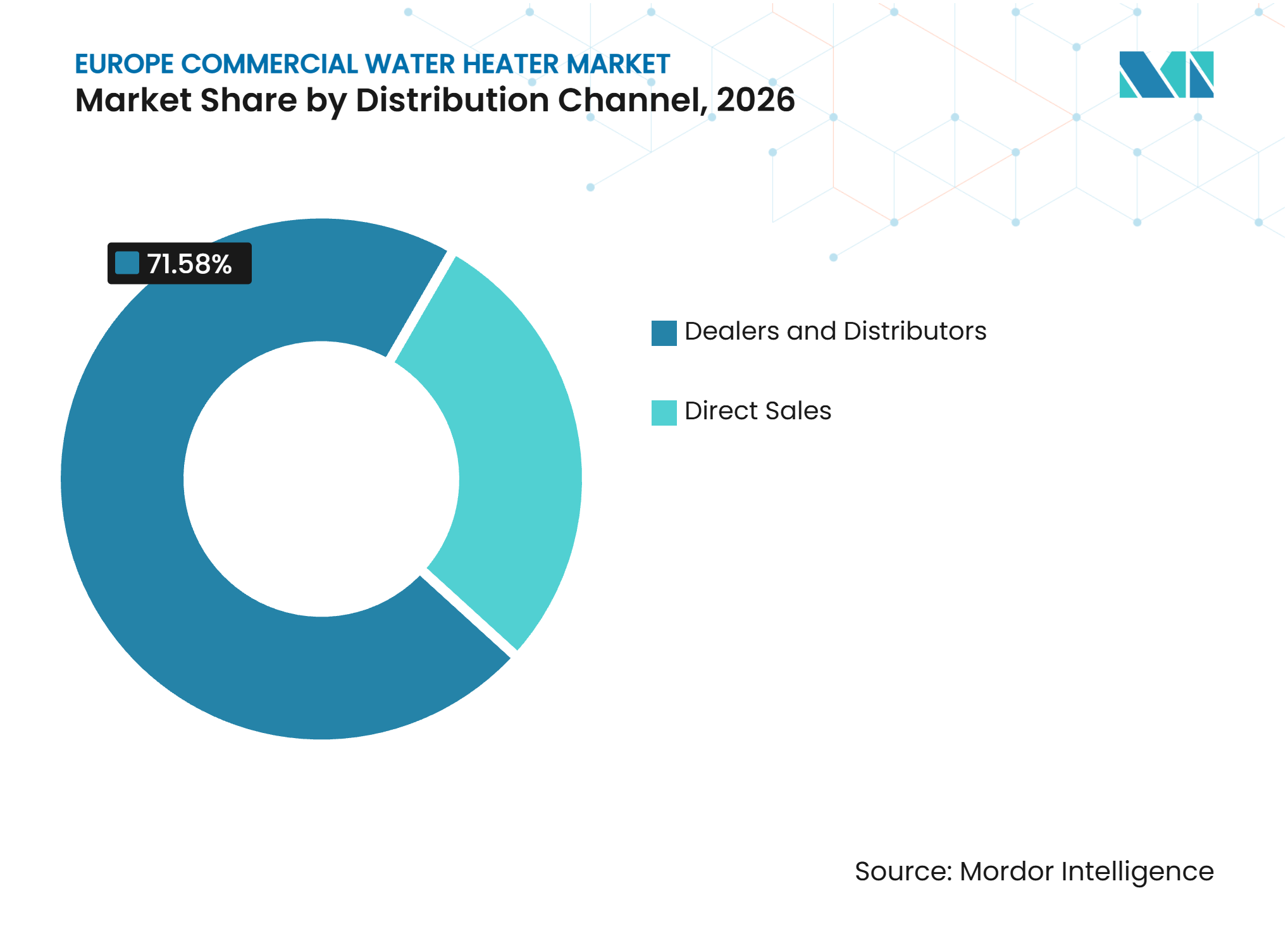
By distribution channel, Dealers and Distributors held 71.58% of revenue in 2026, while Direct Sales is forecast to grow at a 7.41% CAGR through 2032.
-
By geography, Germany held 18.23% of revenue in 2026, while the Nordics are forecast to grow at a 7.55% CAGR through 2032.
Note: Market numbers in this report are based on Mordor Intelligence's proprietary estimation framework, which combines nine months of actuals with Q4 projections for base year 2026.
Market Trends and Insights
Drivers Impact Analysis of Europe Commercial Water Heater Market*
| Driver | (~) % Impact on CAGR Forecast | Geographic Relevance | Impact Timeline |
|---|---|---|---|
| EU Decarbonization Policy and Building Renovation | +1.5% | EU 27 and United Kingdom | Long term (≥ 4 years) |
| Replacement of Aging Heating and Hot-Water Systems | +1.2% | Europe, concentrated in Germany, France, and United Kingdom | Short term (≤ 2 years) |
| Energy-Price Volatility and Operating-Cost Reduction | +0.8% | Europe, most acute in Italy, Germany, and France | Medium term (2-4 years) |
| Heat-Pump Adoption and Renewable-Energy Integration | +1.1% | Nordics, Germany, United Kingdom, and France | Long term (≥ 4 years) |
| Demand Response and Thermal Storage in Commercial Buildings | +0.4% | Germany and Nordics | Medium term (2-4 years) |
| Installer-Led Specification and Energy-Service Contracting | +0.3% | United Kingdom, Germany, and France | Short term (≤ 2 years) |
| Source: Mordor Intelligence | |||
EU Decarbonization Policy and Commercial Building Renovation
The revised Energy Performance of Buildings Directive requires Member States to improve the worst-performing non-residential buildings. It sets a path for renovating the lowest-performing 16% of non-residential buildings by 2030 and 26% by 2033[1]. This creates a defined project pipeline for the Europe commercial water heater market because water heating is part of many building-energy upgrades. The same policy framework stops public support for stand-alone fossil-fuel boilers from January 2025[2]. Facilities that recently installed gas equipment can therefore face shorter useful economic lives when they plan later efficiency work.
Replacement of Aging Commercial Heating and Hot-Water Systems
Replacement demand is increasing because many commercial heating systems installed in the late 1990s and early 2000s are near the end of their design lives. The European Commission reports that 85% of EU buildings were built before 2000, which supports a large renovation requirement[3]. Hotels, hospitals, care facilities, and institutional buildings can replace equipment during planned maintenance rather than wait for new construction. Water hygiene obligations also support recurring work because storage temperatures and system management must control Legionella risks. The EU Renovation Wave seeks to raise annual renovation activity, although current rates remain below the pace required to achieve 2030 goals. This backlog gives the Europe commercial water heater market a source of demand that can remain active when building permits weaken.
Energy-Price Volatility and Commercial Operating-Cost Reduction
Commercial buyers continue to assess water-heating projects through operating-cost savings after the European energy shock. Average EU non-household gas prices fell 6.7% year over year to EUR 0.06 per kWh in the first half of 2026, while non-household electricity prices fell 5.4% to EUR 0.18 per kWh[4]. Prices remain above conditions before the 2021 energy shock, according to the European Central Bank. Commercial operators with high hot-water loads can use these cost differences to justify more efficient systems. Thermal storage and demand-response controls can add value by shifting heat production toward lower-cost or on-site renewable electricity periods.
Heat-Pump Adoption and Renewable-Energy Integration
Heat-pump adoption is a central growth route for the Europe commercial water heater market, even after the wider European market declined in 2024. EHPA reported a 23% drop in 2024. Heat pump sales rose 13% in 2025 to 2.9 million units in 21 European countries. Denmark recorded a 36% increase in heat-pump sales in 2025, sh15- refrigerants, including propane and carbon dioxide, as F-Gas rules tighten. Commercial sites with solar photovoltaic systems can heat pumps when on-site generation is strongest. That combination is particularly relevant for hospitals and hospitality sites with stable daytime electricity demand and large hot-water requirements.
Restraints Impact Analysis of Europe Commercial Water Heater Market*
| Restraint | (~) % Impact on CAGR Forecast | Geographic Relevance | Impact Timeline |
|---|---|---|---|
| High Upfront Cost of Advanced Water-Heating Systems | -1.0% | Europe, most acute in Southern and Eastern Europe | Short term (≤ 2 years) |
| Certified-Installer Shortage and Retrofit Complexity | -0.8% | Europe, most severe in United Kingdom, Germany, and France | Medium term (2-4 years) |
| Fragmented National Rules, Certifications, and Subsidy Schemes | -0.5% | All EU member states | Long term (≥ 4 years) |
| F-Gas Restrictions and Refrigerant-Supply Constraints | -0.3% | EU 27 and United Kingdom | Medium term (2-4 years) |
| Source: Mordor Intelligence | |||
High Upfront Cost of Heat-Pump, Condensing, and Solar Systems
Advanced water-heating systems carry a higher initial cost than conventional gas equipment in many retrofit projects. The cost difference is greater when a site needs new hydraulic connections, electrical upgrades, or multiple heating zones. Independent hotels and foodservice operators can defer projects when payback periods exceed their capital-planning limits. This barrier is more pronounced in Southern and Eastern Europe, where subsidy support can be lower and financing conditions can be less favorable for the Europe commercial water heater market. The cost case improves over a 15- to 20-year operating life when heat-pump systems reduce energy consumption compared with electric resistance equipment. Energy-service contracts can also reduce the initial burden because the provider recovers investment through the energy savings achieved by the installed system.
Certified-Installer Shortage and Retrofit Complexity
The availability of trained installers limits the speed at which advanced systems can be deployed. The European Heat Pump Association states that Europe needs more than 500,000 trained professionals by 2030. The International Institute of Refrigeration reported that the refrigeration sector needs more technicians qualified to work with F-Gases and natural refrigerants. Article 18 of the revised Renewable Energy Directive requires member states to ensure sufficient qualified installers for renewable heating. Shortages can extend lead times and increase execution risk for hospitals, hotels, and public-sector projects. They can also favor suppliers with established contractor training and certification networks in the Europe commercial water heater market.
*Our forecasts treat driver/restraint impacts as directional, not additive. The impact forecasts reflect baseline growth, mix effects, and variable interactions.
Europe Commercial Water Heater Market Segment Analysis
By Product Type:
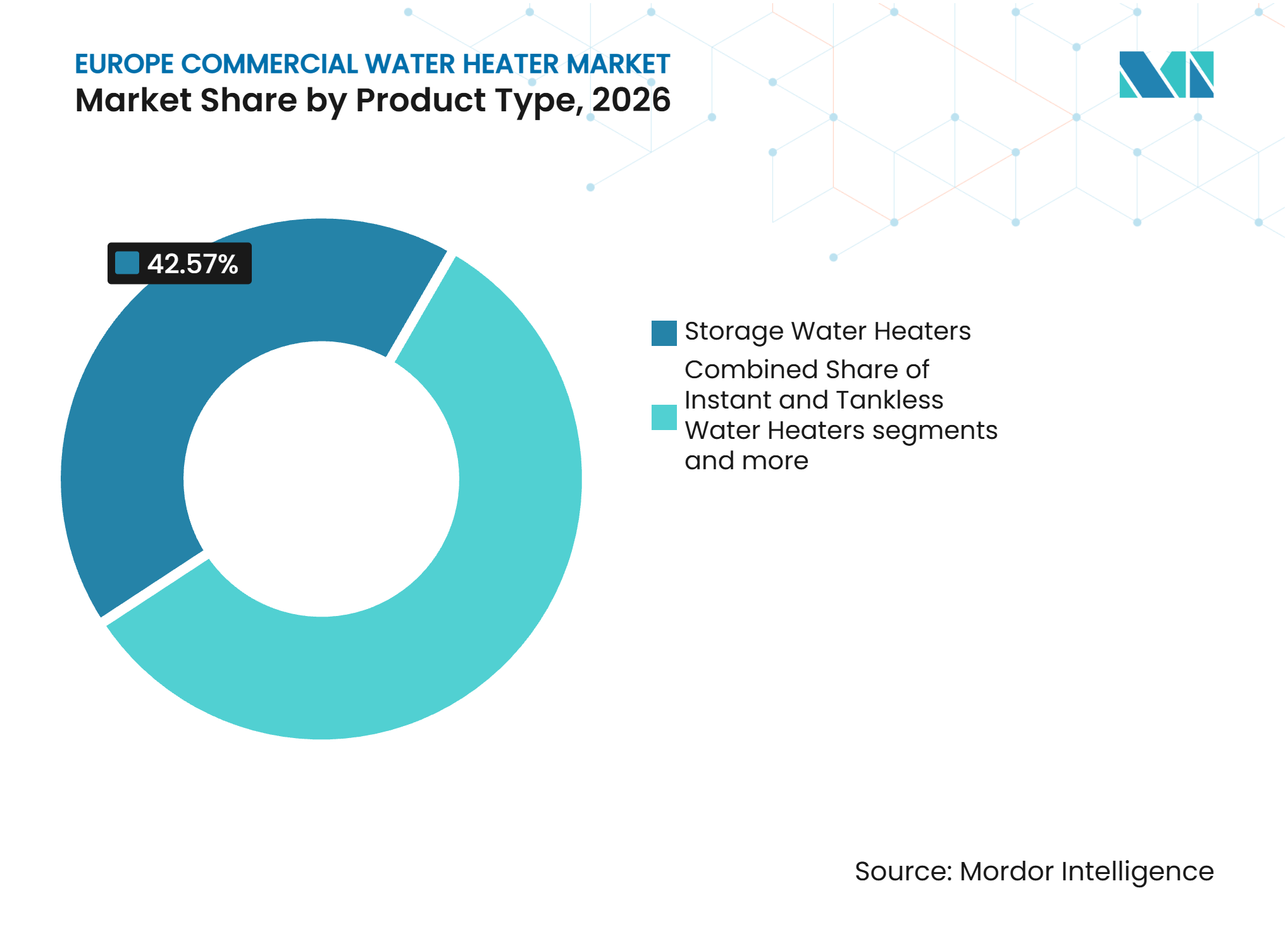
Conventional Units Hold Ground as Heat Pumps ScaleStorage Water Heaters held 42.57% of revenue in 2026. They suit hotels, healthcare facilities, and institutions that have high peak demand and require stored hot water at short notice. A large installed base of centralized storage equipment also makes like-for-like replacement practical during planned renovation work. Commercial kitchens, hotels, and care homes are often designed around existing tank rooms and water-distribution systems. Storage products therefore retain a central role in the Europe commercial water heater industry, especially in sites that prioritize service continuity.
Heat Pump and Hybrid Water Heaters are forecast to grow at an 8.16% CAGR between 2027 and 2032. The segment benefits from stricter energy standards, improving cold-weather performance, and equipment using lower-impact refrigerants. Instant and tankless systems remain relevant where space is limited and intermittent demand makes stored water less useful. Rinnai states that its condensing continuous-flow commercial units can reach tested efficiencies of up to 97%. Cascaded instantaneous units can raise output without a single large vessel, which can suit healthcare and hospitality retrofits with structural limits.



By Energy Source:
Gas Dominates Today as Solar Builds Long-Term MomentumNatural Gas and LPG held 37.83% of revenue in 2026. Condensing gas products remain familiar to facilities managers, specification engineers, and installers in hospitality and foodservice buildings. They provide high output and can require less initial capital than heat-pump systems. Their position is narrowing as public subsidies and building rules move toward efficient electrified equipment. Revised Ecodesign rules approved by the EU Member States in 2026 are expected to apply from autumn 2028.
Solar is forecast to grow at a 6.25% CAGR between 2027 and 2032. Electric systems are gaining relevance as direct electrification becomes an accepted route to meet building performance standards. Solar thermal capacity in Europe reached 43.6 GWth in 2024, up 0.4% from 2023, according to Solar Heat Europe. The Energy Performance of Buildings Directive requires photovoltaic installations on some new non-residential buildings and buildings undergoing major renovation. The combination of solar electricity, heat pumps, thermal storage, and controls can help owners use renewable power without reducing the required water-service level.
By Capacity:
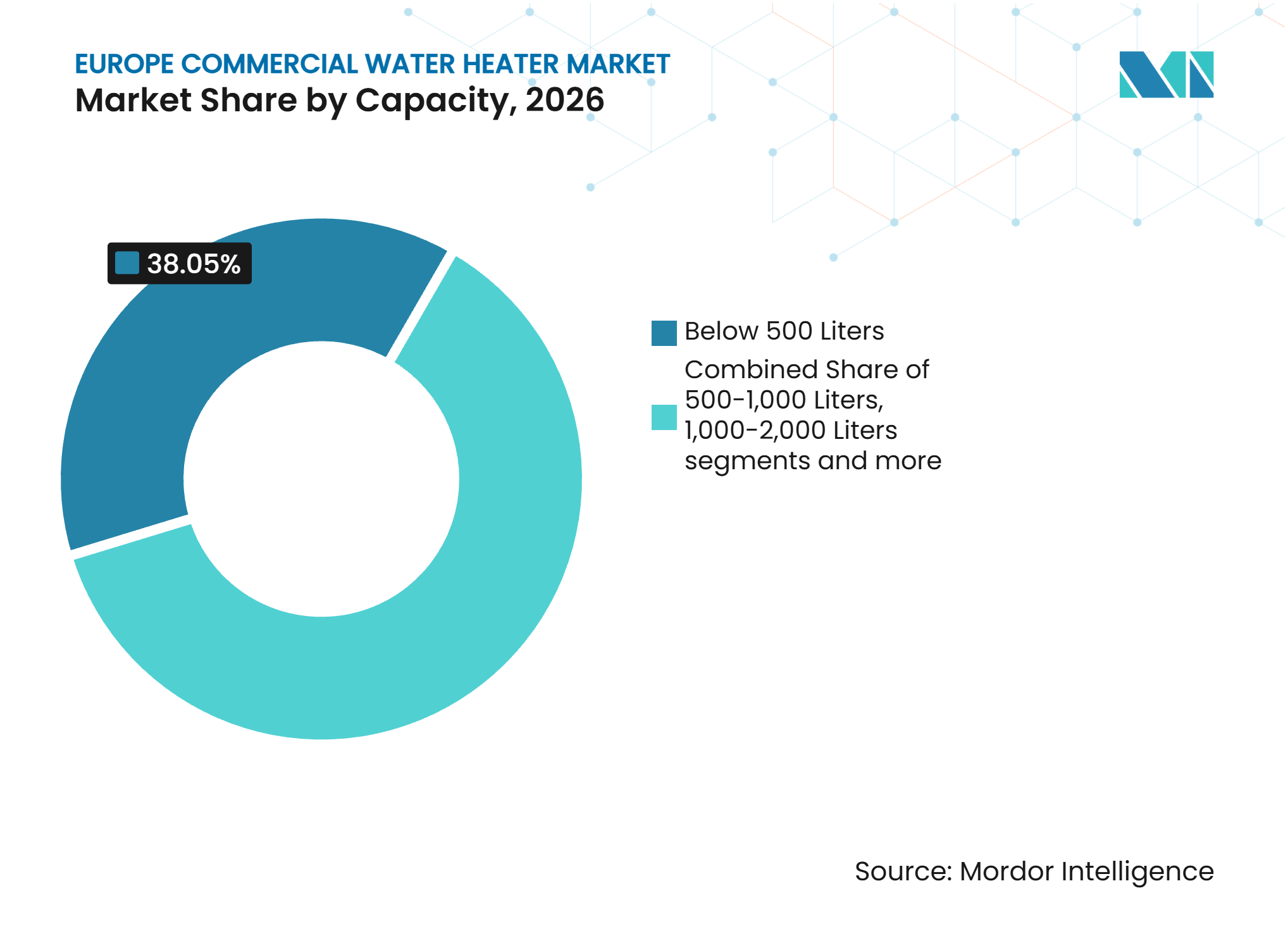
Small Units Lead and Large Systems Gain GroundBelow 500 Liters accounted for 38.05% of market value in 2026. This capacity band serves mid-sized hotels, restaurants, clinics, and institutional kitchens that need multi-point hot-water distribution. It has a wide set of available formats, including storage, instantaneous, and heat-pump equipment. Shorter installation and specification cycles make the segment important for routine replacement work.
Above 3,000 Liters is forecast to grow at a 7.17% CAGR between 2027 and 2032. The 500 to 1,000 Liters range serves larger hotels and healthcare sites, while legacy gas-fired cascades remain common in the 1,000 to 3,000 Liters range. Large hotels, hospitals, university campuses, and district-heated commercial complexes support demand above 3,000 Liters. These projects can suit energy-service contracts and staged heat-pump installations because their scale supports financing and performance guarantees. Cascaded heat-pump modules of 50 to 200 kW can reduce shutdown risk as the facility completes wider renovation work.

By End User:
Hospitality Anchors Demand and Healthcare Grows FastestHospitality held 23.76% of market value in 2026. Hotels, resorts, and accommodation sites have substantial domestic hot-water demand during morning bathing periods and evening kitchen activity. Research in the journal Energies found that tap hot water accounted for 24.8% of hotel electrical energy use. Water hygiene management also supports recurring replacement activity because stored water must be maintained at safe temperatures in the Europe commercial water heater market.
Healthcare is forecast to grow at a 7.84% CAGR between 2027 and 2032. Hospitals, clinics, and care facilities have continuous needs for patient care, laundry, sterilization, and hydrotherapy. A study at Fondazione Policlinico Universitario A. Gemelli IRCCS in Rome found that a hot-water circuit management device reduced daily electrical and thermal energy use by 68.6% and 48.6%, respectively. Institutional, foodservice, multifamily, and industrial buyers require different capacity, control, and service arrangements.
By Distribution Channel:
Dealers Lead and Direct Sales Gain Ground on Large ProjectsDealers and Distributors held 71.58% of revenue in 2026. Many commercial projects are designed by HVAC consultants who rely on distributor relationships, product availability, training, and technical support. The product decision can therefore occur well before the owner issues a purchase order in the Europe commercial water heater market. Manufacturers that invest in installer training and distributor certification can strengthen their position in this channel.
Direct Sales is forecast to grow at a 7.41% CAGR between 2027 and 2032. Hospital trusts, hotel groups, universities, and energy-service companies can use direct framework agreements for large or standardized projects. This route can bypass part of the distributor layer when a project needs engineered equipment, coordinated service, defined commissioning responsibilities, and a single accountable supplier. Direct relationships can also support digital monitoring, maintenance agreements, and energy-performance contracts. The channel is separating into high-volume distribution for standard products and direct sales for larger systems.
Geography Analysis
Germany
Germany held 18.23% of revenue in 2026. Its extensive stock of older commercial heating systems and renovation support framework sustain replacement demand. Eurostat reported a non-household gas price of EUR 7.13 per 100 kWh in Germany during the second half of 2025, which can strengthen the long-term operating case for electrified water heating. The revised Energy Performance of Buildings Directive and national building policies influence specification decisions. Solar integration, water-hygiene obligations, and compliance with the Pressure Equipment Directive are material considerations in large commercial, public, and healthcare projects.
Nordics
The Nordics are forecast to grow at a 7.55% CAGR between 2027 and 2032. Norway and Finland have mature heat-pump installed bases, while Finland recorded the EU’s lowest non-household electricity price at EUR 0.09 per kWh. Denmark’s heat-pump sales rose 36% in 2025, and Norwegian commercial and non-residential sales also increased despite weaker residential demand. District-heating networks, thermal storage, and grid integration make flexible commercial water heating more practical across the region. HOFOR’s planned Copenhagen heat-pump projects show the direction of district-heating investment.
United Kingdom, France, Italy, Spain, BENELUX, and Rest of Europe
The United Kingdom, France, Italy, Spain, BENELUX, and the Rest of Europe have varied purchase conditions. The United Kingdom market is a mature, replacement-driven market undergoing a gradual transition from conventional gas-fired water heating towards electrification, heat pumps and integrated low-carbon domestic hot water (DHW) systems. France is tightening controls on gas equipment in new buildings and supports broader European supply through its manufacturing base. Italy and Spain offer demand from commercial applications, with solar integration relevant to Spanish hotel properties. BENELUX markets follow a transition pattern similar to Germany, while Poland, Romania, and the Czech Republic can benefit from EU renovation funding. National subsidies, certification practices, the Pressure Equipment Directive, and refrigerant compliance shape product selection across these markets.
Competitive Landscape
Market Concentration
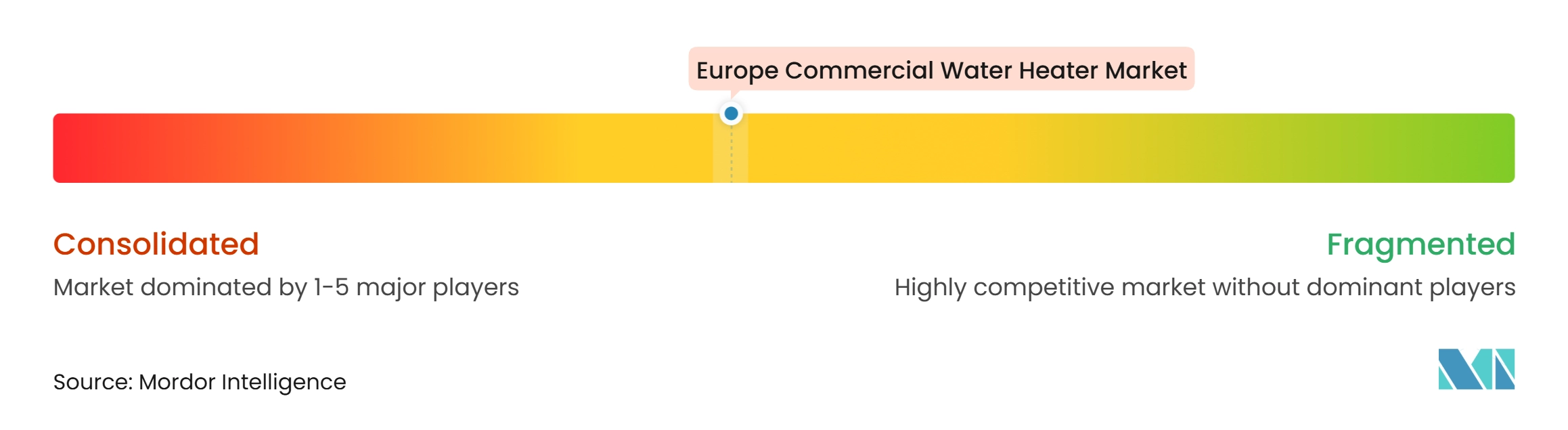
The Europe commercial water heater market is moderately concentrated. Ariston, Vaillant Group, BDR Thermea, Viessmann Climate Solutions, Groupe Atlantic, and STIEBEL ELTRON hold strong positions across European commercial heating categories. Rinnai, NORITZ, and Panasonic also compete in specialized continuous-flow and heat-pump applications. Product development is moving toward R290 propane and carbon dioxide refrigerants as F-Gas restrictions guide future portfolios. Manufacturers are also using controls to connect water heaters with building energy-management systems and on-site generation.
Large commercial systems above 1,000 Liters remain less standardized than smaller products in the Europe commercial water heater market. Many projects in this capacity range still use bespoke engineering, multiple units, and complex hydraulic designs. Rinnai’s Sensei Partner Development Programme supports commercial contractors through training and development. Installer relationships can influence specifications, while compliance with the Pressure Equipment Directive and ISO 9001 practices supports public-sector and healthcare bids.
Cost competitiveness is becoming more important in the Europe commercial water heater market as Chinese suppliers expand standard electric storage distribution. BDR Thermea is consolidating German production within its wider European manufacturing network. European manufacturers are also expanding capacity for heat-pump-compatible equipment. These investments support both volume growth and a transition toward more efficient water-heating systems. Product range, installer support, compliance documents, and manufacturing cost control increasingly shape competitive positions.
Europe Commercial Water Heater Industry Leaders
-
Ariston Holding N.V.
-
Robert Bosch GmbH
-
Vaillant Group
-
Viessmann Climate Solutions SE
-
BDR Thermea Group
- *Disclaimer: Major Players sorted in no particular order
Europe Commercial Water Heater Market Companies Covered in this Report
- Ariston Holding N.V.
- Robert Bosch GmbH
- Vaillant Group
- Viessmann Climate Solutions SE
- BDR Thermea Group
- Groupe Atlantic
- STIEBEL ELTRON GmbH & Co. KG
- NIBE Industrier AB
- A. O. Smith Corporation
- Rheem Manufacturing Company
- Glen Dimplex Group
- Rinnai Corporation
- NORITZ Corporation
- Midea Group Co., Ltd.
- Haier Smart Home Co., Ltd.
- Panasonic Corporation
- Mitsubishi Electric Europe B.V.
- Daikin Europe N.V.
- Ferroli S.p.A.
- CLAGE GmbH
Recent Industry Developments in Europe Commercial Water Heater Market
- November 2026: Aermec launched its HWSG_H and WFGN_H high-temperature water-to-water heat pumps (145–889 kW, up to 80 - 85 °C) for commercial and industrial buildings.
- September 2026: Ideal Commercial Heating entered commercial hot water for the first time with its EQMAX gas condensing water heaters (10 models, 20–120 kW).
- August 2025: NIBE Energy Systems integrated Cetetherm’s Pioneer Heat Interface Unit and substation products into its HVAC Solutions portfolio. The development strengthened its position in district-heating and cooling networks and enabled combined heat-pump-led and large-scale heat-network projects.
Europe Commercial Water Heater Market Report Scope
Segmentation Overview
| Storage Water Heaters |
| Instant and Tankless Water Heaters |
| Heat Pump and Hybrid Water Heaters |
| Electric |
| Natural Gas and LPG |
| Oil-Fired |
| Solar |
| Other Energy Sources |
| Below 500 Liters |
| 500-1,000 Liters |
| 1,000-2,000 Liters |
| 2,000-3,000 Liters |
| Above 3,000 Liters |
| Hospitality — hotels, resorts, accommodation |
| Healthcare — hospitals, clinics, care facilities |
| Institutional — education, public buildings |
| Foodservice — restaurants, commercial kitchens |
| Multifamily / commercial residential buildings |
| Manufacturing, laundries and other facilities |
| Direct Sales |
| Dealers and Distributors |
| United Kingdom |
| Germany |
| France |
| Spain |
| Italy |
| BENELUX (Belgium, Netherlands, Luxembourg) |
| NORDICS (Denmark, Finland, Iceland, Norway, Sweden) |
| Rest of Europe |
| By Product Type | Storage Water Heaters |
| Instant and Tankless Water Heaters | |
| Heat Pump and Hybrid Water Heaters | |
| By Energy Source | Electric |
| Natural Gas and LPG | |
| Oil-Fired | |
| Solar | |
| Other Energy Sources | |
| By Capacity | Below 500 Liters |
| 500-1,000 Liters | |
| 1,000-2,000 Liters | |
| 2,000-3,000 Liters | |
| Above 3,000 Liters | |
| By End User | Hospitality — hotels, resorts, accommodation |
| Healthcare — hospitals, clinics, care facilities | |
| Institutional — education, public buildings | |
| Foodservice — restaurants, commercial kitchens | |
| Multifamily / commercial residential buildings | |
| Manufacturing, laundries and other facilities | |
| By Distribution Channel | Direct Sales |
| Dealers and Distributors | |
| By Geography | United Kingdom |
| Germany | |
| France | |
| Spain | |
| Italy | |
| BENELUX (Belgium, Netherlands, Luxembourg) | |
| NORDICS (Denmark, Finland, Iceland, Norway, Sweden) | |
| Rest of Europe |
Key Questions Answered in the Report
What is driving demand for commercial water heaters in Europe?
The market is projected to grow at a 5.81% CAGR from 2027 to 2032, supported by building renovation, energy-efficiency rules, and replacement demand.
Which product type has the largest share in Europe?
Storage Water Heaters held 42.57% of revenue in 2026 because they remain suitable for high-demand hospitality, healthcare, and institutional applications.
Which water-heating technology is growing the fastest?
Heat Pump and Hybrid Water Heaters are forecast to grow at an 8.16% CAGR through 2032, supported by energy standards and low-global-warming-potential refrigerant products.
Why are commercial heat-pump water heaters gaining adoption?
They can reduce operating energy use, connect with solar photovoltaic generation, and help owners meet tighter building-performance requirements.
Which end user is expected to grow the fastest?
Healthcare is forecast to grow at a 7.84% CAGR through 2032 because hospitals and care facilities have continuous and non-deferrable hot-water needs.