
Europe Commercial Greenhouse Market Size and Share
Market Overview
| Study Period | 2021 - 2031 |
|---|---|
| Forecast Data Period | 2026 - 2031 |
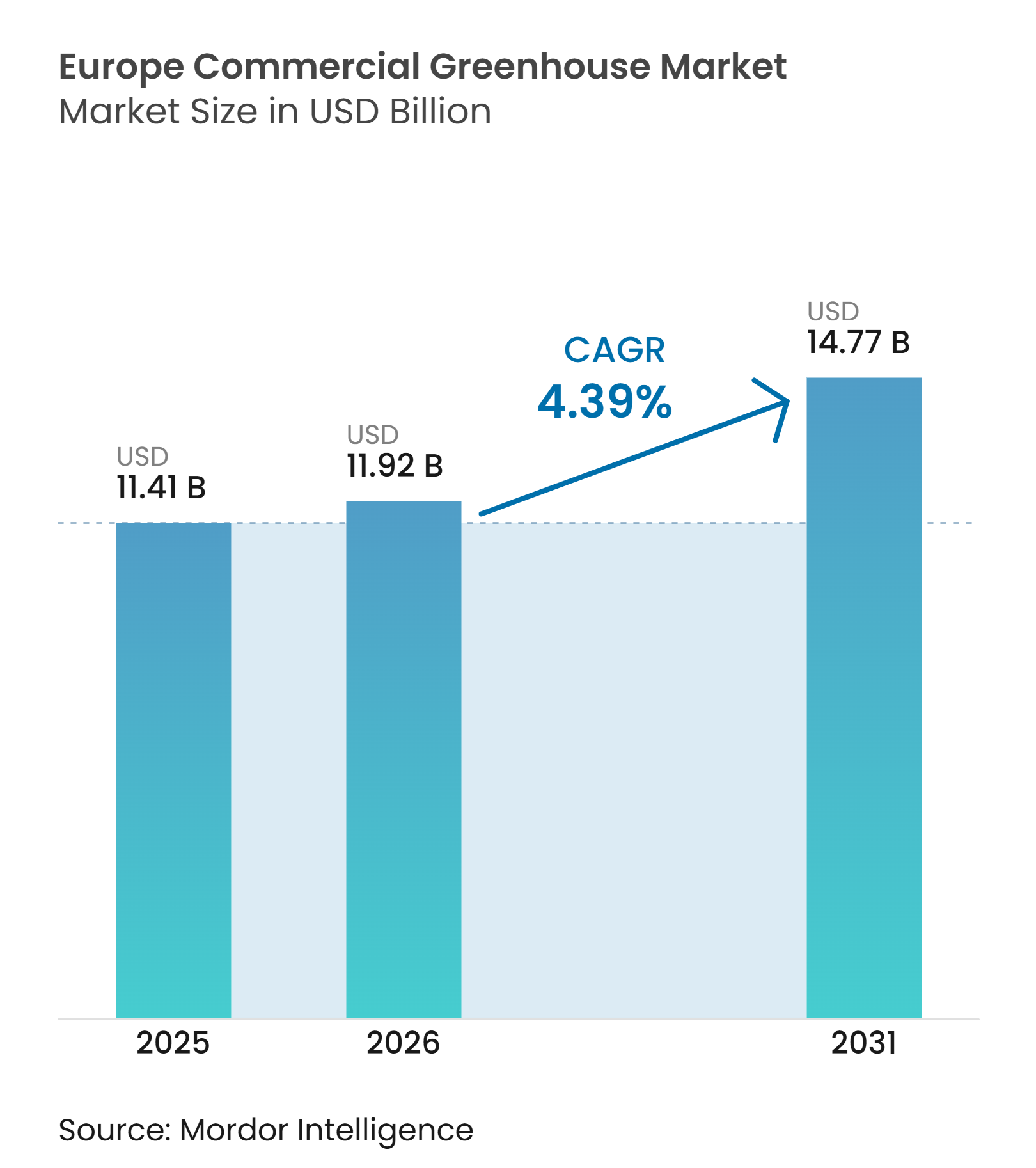
| Base Year Market Size (2025) | USD 11.41 Billion |
| Market Size (2026) | USD 11.92 Billion |
| Market Size (2031) | USD 14.77 Billion |
| Growth Rate (2026 - 2031) | 4.39 % |
| Market Concentration | Medium |
Major Players *Disclaimer: Major Players sorted in no particular order Image © Mordor Intelligence. Reuse requires attribution under CC BY 4.0. | |
Europe Commercial Greenhouse Market Analysis by Mordor Intelligence
The Europe commercial greenhouse market size was valued at USD 11.41 billion in 2025 and is projected to grow from USD 11.92 billion in 2026 to USD 14.77 billion by 2031, registering a CAGR of 4.38% during the forecast period 2026-2031. The market is expanding as European growers and retailers seek reliable year-round production while adapting to European Union (EU) sustainability requirements, rising energy costs, and tighter controls on agricultural inputs. Established greenhouse markets in the Netherlands, Germany, Spain, and Italy are investing in climate-control systems, LED lighting, hydroponics, and automated fertigation to improve productivity and resource efficiency. At the same time, the transition away from fossil-fuel-based greenhouse heating and cogeneration is increasing pressure on energy economics and carbon dioxide availability, particularly in Northern Europe. These challenges are encouraging investment in renewable energy, energy-efficient heating, heat recovery, on-site CO₂ solutions, and automated climate-management systems, supporting continued modernization of the European commercial greenhouse market.
Key Report Takeaways
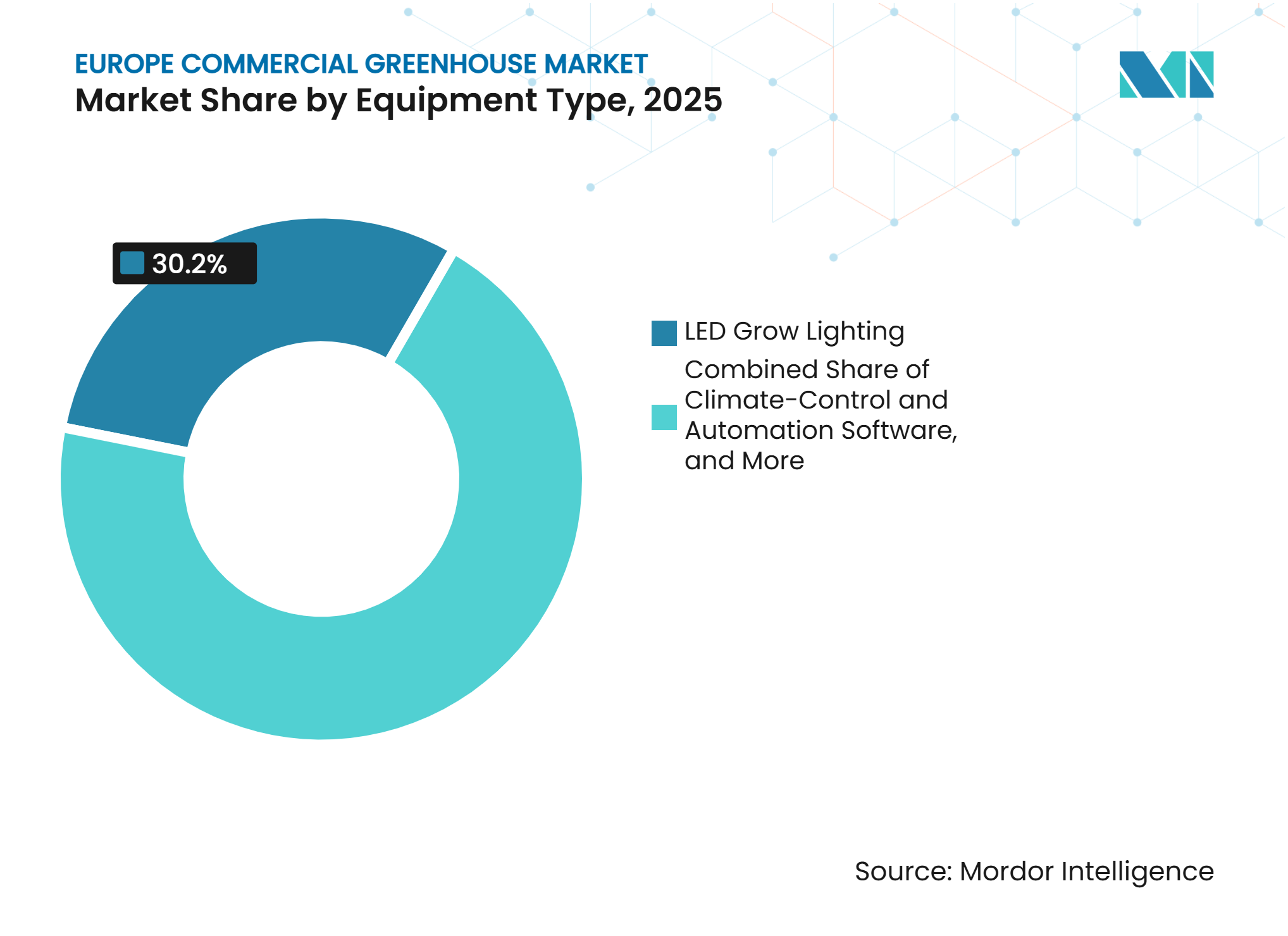
- By equipment type, LED grow lighting segment was the largest segment and held 30.2% of the Europe commercial greenhouse market share in 2025, while climate control and automation software is the fastest growing segment and is forecasted to expand at a 13.2% CAGR between 2026 and 2031.
- By crop type, fruits and vegetables segment was the largest segment and held 55.5% of the Europe commercial greenhouse market size in 2025, while cannabis and specialty crops is the fastest growing segment and is forecasted to expand at a 14.5% CAGR between 2026 and 2031.
- By greenhouse type, plastic-film greenhouses segment was the largest segment and held 61.2% of the market share in 2025, while glass greenhouses is the fastest growing segment and is forecasted to expand at a 12.2% CAGR between 2026 and 2031.
- By cultivation technology, hydroponic was the largest segment and held 54.4% of the market share in 2025, while hybrid and vertical integration is the fastest growing segment and is forecasted to expand at an 11.2% CAGR between 2026 and 2031.
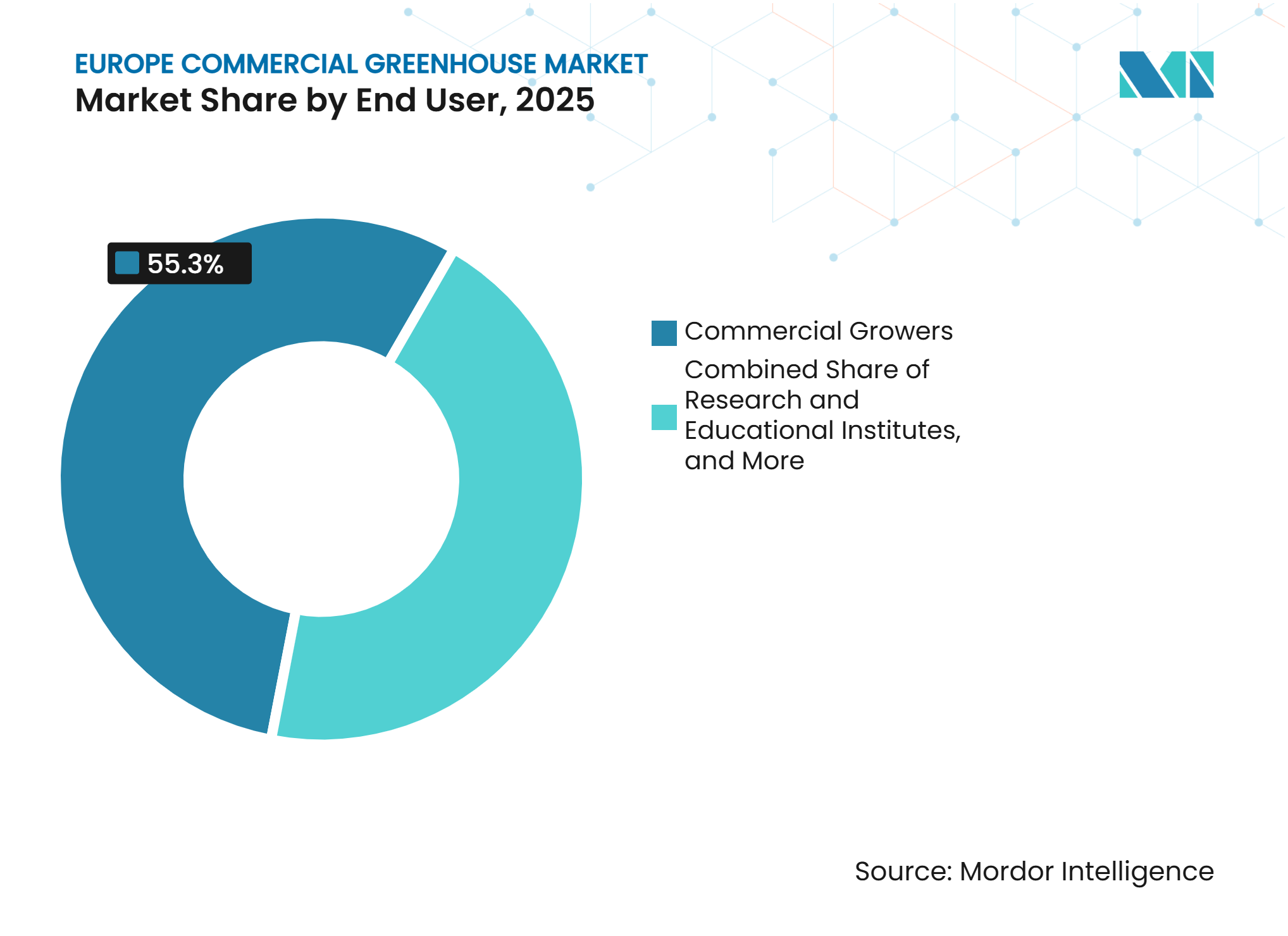
- By end user, commercial growers was the largest segment and held 55.3% of the market share in 2025, while research and educational institutes is the fastest growing segment and is forecasted to expand at a 13.5% CAGR between 2026 and 2031.
Note: Market size and forecast figures in this report are generated using Mordor Intelligence’s proprietary estimation framework, updated with the latest available data and insights as of January 2026.
Market Trends and Insights
Drivers Impact Analysis of Europe Commercial Greenhouse Market*
| Driver | (~) % Impact on CAGR Forecast | Geographic Relevance | Impact Timeline |
|---|---|---|---|
| Year-round fresh produce demand | +1.2% | Global | Short term (≤ 2 years) |
| Climate-resilient production amid weather volatility | +0.8% | European Union-wide, pronounced in Spain, France, and Eastern Europe | Medium term (2-4 years) |
| LED lighting, sensors and climate-control automation | +0.7% | Netherlands, Germany, United Kingdom | Medium term (2-4 years) |
| EU and national support for protected cultivation and food security | +0.5% | Netherlands, France, Ireland | Medium term (2-4 years) |
| Accelerated breeding and propagation cycles in controlled environments | +0.4% | Netherlands, Germany, Czech Republic | Long term (≥ 4 years) |
| Carbon-accounted produce and low-emission retail procurement | +0.3% | Germany, France, Scandinavia | Long term (≥ 4 years) |
| Source: Mordor Intelligence | |||
Year-Round Fresh Produce Demand
Year-round demand for fresh fruits and vegetables is supporting investment in commercial greenhouse production across Europe, as retailers and foodservice operators seek reliable supply beyond traditional outdoor growing seasons. Eurostat reported in August 2025 that the European Union harvested 62.2 million metric tons of fresh vegetables in 2024, 6% more than in 2023, highlighting the scale of the region's fresh-produce market[1]. Commercial greenhouses allow growers to extend production periods and maintain more predictable volumes despite seasonal and weather-related constraints, particularly in Northern and Western Europe. This supports investment in climate-control systems, supplemental LED lighting, automated irrigation, fertigation, and hydroponic technologies that enable more consistent year-round production. In Mediterranean markets, greenhouse cultivation also helps extend harvesting windows and maintain supply for domestic and export markets. As European buyers prioritize reliable volumes, consistent quality, and predictable delivery schedules, year-round production requirements continue to support investment in commercial greenhouse infrastructure.
Climate-Resilient Production Amid Weather Volatility
Increasing weather volatility is strengthening the case for protected cultivation across Europe, as droughts, late frosts, and heat stress can reduce the reliability of open-field vegetable production. The European Commission reported in April 2026 that eco-schemes under the Common Agricultural Policy (CAP) covered 98.3 million hectares, representing more than 60% of European Union agricultural area in 2025, while around 28% of total public funding under CAP Strategic Plans was allocated to eco-schemes and agri-environmental and climate commitments[2]. These policies reinforce the broader shift toward climate-resilient and resource-efficient agricultural systems. Commercial greenhouses can reduce exposure to weather variability by providing greater control over temperature, water, humidity, and crop timing. This is encouraging investment in climate-control systems, efficient irrigation, renewable energy, and protected cultivation infrastructure, particularly where growers need more predictable year-round output. Consequently, increasing climate risk and policy support for adaptation are strengthening the role of commercial greenhouses as a tool for managing production uncertainty across Europe.
LED Lighting, Sensors and Climate-Control Automation
The adoption of LED lighting, sensors, and automated climate-control systems is supporting the modernization of commercial greenhouses across Europe by improving control over light, temperature, humidity, irrigation, and crop conditions. A European Commission-backed greenhouse digitization project reported that integrating advanced sensors with a supervisory control and data acquisition (SCADA) system supported real-time monitoring and improved irrigation, climate, and crop-management decisions. LED technology is also becoming more important as growers seek to manage supplemental lighting more efficiently, particularly in Northern European markets with limited winter daylight. European Union-funded research has demonstrated the potential of dynamic LED systems to adjust light conditions according to crop requirements. The combination of energy-efficient lighting, real-time sensing, and automated climate control allows greenhouse operators to optimize resource use, reduce manual intervention, and maintain more consistent growing conditions. As European growers face pressure to improve productivity while controlling energy and input costs, investment in integrated automation and precision-control technologies is supporting the development of higher-technology commercial greenhouse facilities.
Accelerated Breeding and Propagation Cycles in Controlled Environments
Controlled environments are increasingly being used to accelerate plant breeding, propagation, and the production of healthy planting material by allowing temperature, humidity, light, and nutrient conditions to be precisely managed. The European Commission's HORTI-PREDICT project, launched in July 2025 with a focus on multi-omics approaches for accelerating genetic gain in horticultural crops, reflects growing European investment in technologies that shorten breeding cycles and improve the selection of commercially valuable traits. Controlled-environment facilities can complement these breeding efforts by providing stable conditions for rapid propagation and repeated crop cycles, reducing dependence on seasonal field conditions. This is particularly relevant for high-value horticultural crops, where faster multiplication of improved varieties can shorten the time between breeding, testing, and commercial production. European research initiatives are also prioritizing resilient crop varieties with improved adaptation to climate change, water efficiency, and disease resistance, strengthening the role of controlled environments in modern breeding and propagation programs. As breeders and commercial growers seek faster access to improved planting material, demand for specialized greenhouse infrastructure, propagation systems, environmental controls, and related technologies is anticipated to increase.
Restraints Impact Analysis of Europe Commercial Greenhouse Market*
| Restraint | (~) % Impact on CAGR Forecast | Geographic Relevance | Impact Timeline |
|---|---|---|---|
| High upfront capital and long payback periods | -0.6% | Netherlands, United Kingdom, Germany | Short term (≤ 2 years) |
| Energy-cost volatility and power-intensity exposure | -0.4% | Netherlands, Germany, Austria | Medium term (2-4 years) |
| Grid-connection queues and electrification bottlenecks | -0.5% | European Union-wide, particularly Central and Eastern Europe | Long term (≥ 4 years) |
| Industrial co2 supply retrenchment and purity risk | -0.7% | United Kingdom, Netherlands, Germany | Short term (≤ 2 years) |
| Source: Mordor Intelligence | |||
High Upfront Capital and Long Payback Periods
High upfront investment requirements and long payback periods remain a restraint on the expansion and modernization of commercial greenhouses across Europe. Projects incorporating advanced structures, heating and cooling systems, LED lighting, climate-control equipment, automation, and renewable-energy infrastructure require substantial capital before additional production revenue is realized. An EU CAP Network economic analysis of greenhouse technology projects in Switzerland and Italy found that greenhouse operators generally expect investment payback within 7–10 years, compared with an estimated greenhouse installation lifetime of approximately 15 years[3]. The extended recovery period increases exposure to energy-price volatility, crop prices, interest rates, and changes in environmental regulation, making investment decisions more difficult for smaller and highly leveraged growers. This is particularly relevant in Northern Europe, where greenhouse production can require substantial heating and energy infrastructure. Consequently, growers may delay full-facility upgrades or adopt technologies in stages rather than invest in complete high-technology greenhouse systems, slowing the modernization of parts of the European commercial greenhouse market.
Energy-Cost Volatility and Power-Intensity Exposure
Energy costs remain a significant restraint on commercial greenhouse development in Europe because heating, lighting, ventilation, cooling, and climate-control systems require substantial and continuous energy inputs. Eurostat reported that the average electricity price for non-household consumers in the European Union was EUR 18.37 per 100 kWh (USD 21.1 per 100 kWh) in the second half of 2025, while Germany recorded EUR 22.64 per 100 kWh (USD 26.0 per 100 kWh) for the same consumption category. The variation in electricity costs across European markets creates different operating economics for greenhouse growers, particularly for high-technology facilities that rely heavily on supplemental lighting and automated climate-control systems. Energy-price movements can therefore affect production costs, operating margins, and investment payback periods. This encourages growers to prioritize energy-efficient LED lighting, renewable power, heat recovery, geothermal heating, and automated energy-management systems. However, the capital required for these technologies can further increase initial project costs, creating a trade-off between reducing long-term energy exposure and maintaining acceptable investment returns.
*Our forecasts treat driver/restraint impacts as directional, not additive. The impact forecasts reflect baseline growth, mix effects, and variable interactions.
Europe Commercial Greenhouse Market Segment Analysis
By Equipment Type:
Automation Software Challenges Hardware PrimacyLED grow lighting held a 30.2% share of the Europe commercial greenhouse market by equipment type in 2025, supported by widespread adoption in high-latitude greenhouse facilities where supplemental lighting is required to maintain production during periods of limited natural daylight. Demand is also supported by growers' focus on controlling light intensity and spectrum to optimize crop development and extend production cycles. Heating Systems and Irrigation and Fertigation Systems remain important established equipment categories because they are essential for maintaining temperature, water, and nutrient conditions throughout the production cycle. Screening and Shading and Structural Components, including Glazing Systems and Frames and Trusses, continue to represent significant investment areas, particularly in new greenhouse construction and large-scale facility expansion.
Climate-control and automation software is the fastest-growing equipment segment, registering a CAGR of 13.2% between 2026 and 2031, driven by increasing adoption of artificial intelligence (AI)-enabled fertigation, predictive climate management, automated lighting schedules, and real-time crop monitoring. Wageningen University & Research's AGROS II project, launched in January 2026 at its Bleiswijk research location, is testing autonomous cucumber cultivation using digital twin models, self-learning AI algorithms, and real-time data management. The AUFERTI project, initiated in April 2025 with partners including Certhon Build, Rockwool Grodan, and CE Water Solutions, is developing an autonomous fertigation system that combines moisture, pH, electrical conductivity (EC), and nutrient data with algorithm-based decision support. These developments reflect a shift toward integrated greenhouse systems in which software increasingly coordinates irrigation, fertigation, climate, and lighting functions. Cooling and Ventilation Systems remain important for temperature and humidity management, while improved environmental controls and semi-closed greenhouse designs are encouraging greater integration with automated climate-management platforms.



By Crops:
Specialty Crops and Cannabis Signal Segment EvolutionFruits and vegetables represented 55.5% of the Europe commercial greenhouse market by crop type in 2025, making them the largest crop segment. Demand is anchored by year-round consumption of tomatoes, cucumbers, peppers, and leafy greens across European retail and foodservice channels. These crops benefit from controlled environments that provide greater control over temperature, humidity, irrigation, lighting, and production timing, helping growers maintain consistent supply beyond traditional outdoor growing seasons. Strawberries and berries are also gaining commercial significance as high-value crops that benefit from protected cultivation and extended production periods. Flowers and Ornamentals, including cut flowers and potted and bedding plants, remain an important greenhouse application in the Netherlands and Spain, while herbs and microgreens are gaining traction in proximity-based supply models serving urban foodservice markets.
Cannabis and specialty crops are the fastest-growing crop segment, registering a CAGR of 14.5% between 2026 and 2031, supported by expanding medical-cannabis markets and increasing demand for controlled, pharmaceutical-grade cultivation. Germany's Medical Cannabis Act reform in April 2024 removed tender requirements for domestic cultivators and enabled direct authorization from the Federal Institute for Drugs and Medical Devices (BfArM), broadening opportunities for licensed producers. Czechia's medical cannabis market also recorded strong growth in 2025, supporting the development of domestic production capacity and cross-border supply into European markets. These developments are strengthening investment in specialized greenhouse infrastructure for high-value and specialty crops across Europe.
By Greenhouse Type:
Plastic Film Holds Volume, Glass Captures the Investment PremiumPlastic-film greenhouses held a 61.2% share of the Europe commercial greenhouse market in greenhouse type in 2025, making them the largest segment. Their comparatively lower construction and material costs make them suitable for large-scale protected cultivation, particularly in Mediterranean production regions such as Spain's Almería, where extensive tunnel greenhouse cultivation supports fresh vegetable production. Plastic-film structures also integrate effectively with drip fertigation, shading systems, and other relatively low-cost technologies suited to high-sunlight and water-constrained environments. Glass greenhouses, rigid polycarbonate greenhouses, and hybrid and semi-closed greenhouses serve more technology-intensive applications, with adoption influenced by climate conditions, insulation requirements, energy efficiency, and the anticipated operating life of the structure.
Glass greenhouses are the fastest-growing greenhouse type, registering a CAGR of 12.2% between 2026 and 2031, supported by increasing investment in high-technology protected cultivation in the Netherlands, Germany, and the United Kingdom. Their longer operational lifespans, diffuse-light properties, and compatibility with advanced climate-control, thermal-screen, heating, and semi-closed systems can justify their higher initial capital requirements where production value and operational efficiency support longer-term returns. Recent project activities also reflects this shift toward high-specification glass structures, including new and expanded facilities incorporating automated climate systems, supplemental LED lighting, heating infrastructure, internal transport, and CO₂ integration. Rigid polycarbonate greenhouses remain relevant in colder climates where structural weight and insulation characteristics provide practical advantages, while hybrid and semi-closed greenhouses are gaining attention among growers seeking improved energy efficiency without the full capital requirements of highly specialized greenhouse systems.
By Cultivation Technology:
Hydroponics Leads; Integration Expands the FrontierHydroponic cultivation held a 54.4% share of the Europe commercial greenhouse market by cultivation technology in 2025, making it the largest segment. Its adoption is supported by the ability to provide precise water and nutrient delivery and greater control over root-zone conditions. Nutrient film technique and deep water culture are widely suited to leafy greens and herbs, while drip hydroponics is commonly integrated into high-wire tomato and cucumber production systems. Hydroponic cultivation also supports the integration of automated fertigation and sensor-based monitoring, which is increasingly important as European greenhouse operators seek to improve resource efficiency and production consistency. Non-hydroponic soil and substrate methods, including soil-based cultivation and coco coir and rockwool systems, remain relevant for crops requiring specific root-zone characteristics and for production systems where substrate buffering is advantageous.
Hybrid and vertical integration is the fastest-growing cultivation technology segment, registering a CAGR of 11.2% between 2026 and 2031, as greenhouse operators combine conventional protected cultivation with vertical growing layers, automated handling systems, and multi-tier lighting to increase production efficiency per unit of land. This approach is particularly relevant where land availability and production costs limit conventional greenhouse expansion. The segment is also supported by growing interest in integrating cultivation systems with renewable energy and advanced automation, particularly in colder European markets. Hydroponic and substrate-based systems can be incorporated into these hybrid configurations, allowing growers to combine controlled root-zone management with more intensive use of greenhouse space. This convergence of cultivation technologies is supporting the development of more resource-efficient and higher-density commercial greenhouse production systems across Europe.
By End User:
Commercial Volume Meets Research-Led Technology AccelerationCommercial growers held a 55.3% share of the Europe commercial greenhouse market by end user in 2025, making them the largest segment. Their dominance is supported by large-scale vegetable, ornamental, and propagation operations across major greenhouse markets. Commercial operators have the scale to justify investments in full-turnkey greenhouse systems, precision climate-control platforms, automated logistics, and other advanced production technologies. Continued investment by large growers is also supporting demand for high-specification greenhouse infrastructure as operators expand capacity and modernize existing facilities. Retail garden centers and nurseries represent another important end-user group, particularly for ornamentals, potted plants, and propagation material, with investment levels influenced by consumer demand and retail conditions.
Research and educational institutes are the fastest-growing end-user segment, registering a CAGR of 13.5% between 2026 and 2031, supported by increasing investment in autonomous cultivation, robotics, artificial intelligence (AI), and controlled-environment research. Maastricht University and Brightlands Campus Greenport Venlo received EUR 4.18 million (USD 4.56 million) in June 2026 for an autonomous cultivation greenhouse and advanced robotics laboratory, demonstrating the increasing use of operational greenhouse facilities for testing technologies that can subsequently be adopted by commercial growers. Research institutions are therefore becoming an important pathway for transferring automation, robotics, and precision-cultivation technologies into commercial greenhouse operations. This growing research-to-commercialization pipeline is anticipated to support demand for specialized greenhouse infrastructure and advanced cultivation technologies across Europe.

Geography Analysis
Spain held the largest share of the Europe commercial greenhouse market at 24.8% in 2025, supported by its extensive protected-cultivation base and strong fruit and vegetable production. The Almería region alone has more than 40,000 hectares of greenhouse cultivation, with production largely based on cost-efficient plastic-film structures. Growers increasingly focus on water-use optimization, fertigation, and irrigation efficiency to address the region's water constraints. In contrast, the Netherlands remains a major European technology and innovation hub, with companies such as Dalsem B.V., Priva Holding B.V., KUBO Greenhouse Projects B.V., and Van der Hoeven Horticultural Projects B.V. supplying turnkey greenhouse technologies internationally. Government support for energy-efficiency improvements is also encouraging modernization of Dutch greenhouse facilities. Germany and France are developing additional high-technology greenhouse capacity, including glass greenhouse and controlled-environment projects for vegetables and specialty crops.
Russia is the fastest-growing geography in the Europe commercial greenhouse market, registering a CAGR of 6.4% between 2026 and 2031. Growth is supported by government-backed expansion aimed at increasing domestic greenhouse production and reducing dependence on imported fresh produce. The Ministry of Agriculture has planned new greenhouse projects targeting additional annual production capacity, alongside financial support for greenhouse construction. However, rising energy costs, labor shortages, and dependence on imported technologies remain challenges for operators and can affect project profitability. The United Kingdom is also positioned among the faster-growing major markets, although high industrial electricity costs create pressure on greenhouse operating economics. Germany's controlled-environment segment is diversifying through specialty cultivation and urban-adjacent greenhouse and vertical-farming projects, while France is at an earlier stage of high-technology greenhouse adoption.
The Rest of Europe provides additional growth opportunities through investments in energy-efficient, climate-resilient, and specialized greenhouse production. Austria's Frutura geothermal greenhouse project in eastern Styria is designed to support year-round fruit and vegetable production using geothermal energy, while Poland is expanding tomato cultivation and propagation infrastructure through large-scale investment programs. Sweden is developing illuminated greenhouse capacity through new cultivation projects in Härnösand and Helsingborg, reflecting growing interest in locally produced food in colder climates. Across smaller European markets, the Horizon Europe BIOGREENET program is building knowledge and collaboration around organic greenhouse production. These developments indicate that regional greenhouse investment is increasingly differentiated by climate conditions, energy availability, food-security priorities, and the level of technology adopted.
Competitive Landscape
Market Concentration
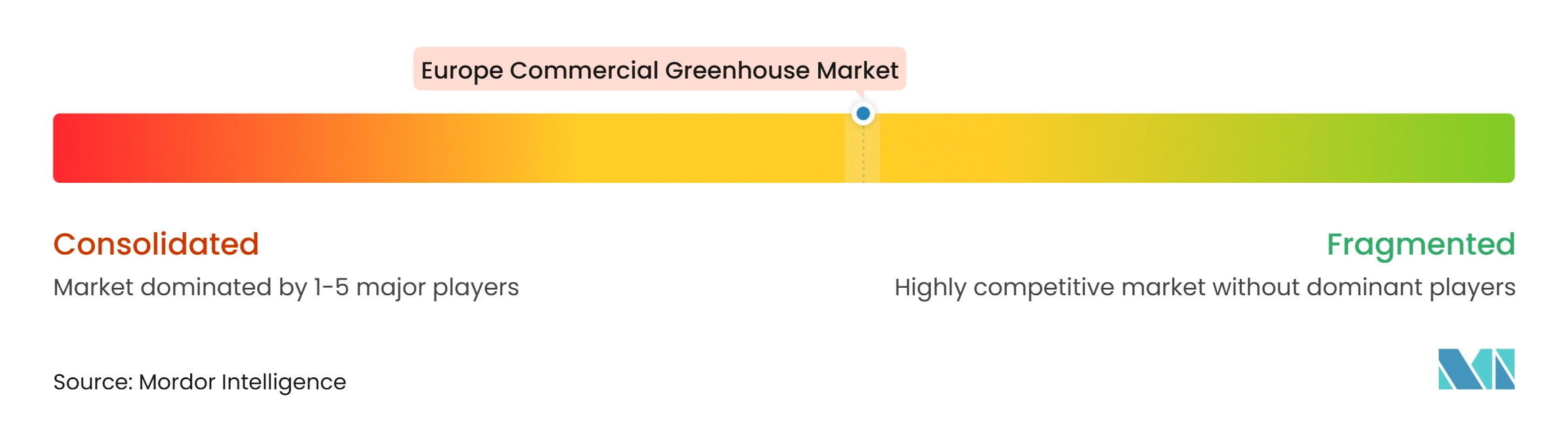
The Europe commercial greenhouse market is moderately concentrated, with the top five companies holding a major share of the market in 2025. Leading participants include Priva Holding B.V., Dalsem B.V., KUBO Greenhouse Projects B.V., Certhon Build B.V., and Signify N.V., with competition centered on turnkey greenhouse engineering, climate-control systems, automation, lighting, and integrated cultivation technologies. Dutch companies maintain a strong competitive position because of the country's established greenhouse technology ecosystem and expertise in designing and delivering advanced commercial greenhouse projects. Other specialized suppliers, including Ridder Holding Harderwijk B.V., Netafim Ltd., Hoogendoorn Growth Management B.V., and Argus Control Systems Ltd., compete through irrigation, fertigation, climate management, lighting, and automation solutions.
Competitive differentiation is increasingly shifting from standalone equipment toward integrated hardware, software, and data-management platforms. Suppliers are connecting lighting, irrigation, fertigation, climate control, and crop-monitoring systems to provide growers with centralized production management and greater automation. The integration of Signify's GrowWise smart-spectrum technology with Ridder's Hortimax Pro through the Horti Lighting Protocol illustrates this transition toward interoperable greenhouse technology. Research initiatives such as AGROS II and AUFERTI are further advancing autonomous cultivation, AI-based climate management, and automated fertigation, creating opportunities for suppliers to commercialize technologies that directly improve production efficiency.
The market is also attracting technology-focused entrants in agri-robotics, AI, energy management, and CO₂ systems, particularly as greenhouse operators seek to address labor and energy costs. Companies developing autonomous harvesting and crop-management technologies are challenging established suppliers by offering solutions linked to measurable productivity improvements. At the same time, opportunities remain for specialized technologies such as on-site CO₂ management, renewable-energy integration, energy storage, and grid-independent power systems. Consequently, competitive advantage is increasingly determined by a company's ability to integrate technologies and demonstrate improvements in yield, labor productivity, resource efficiency, and energy consumption, rather than by the sale of individual greenhouse components alone.
Europe Commercial Greenhouse Industry Leaders
-
Netafim Ltd. (Orbia Advance Corporation, S.A.B. de C.V.)
-
KUBO Greenhouse Projects B.V. (KUBO Group B.V.)
-
Certhon Build B.V. (DENSO Corporation)
-
Priva Holding B.V.
-
Dalsem B.V. (COFRA Holding AG)
- *Disclaimer: Major Players sorted in no particular order
Europe Commercial Greenhouse Market Companies Covered in this Report
- Netafim Ltd. (Orbia Advance Corporation, S.A.B. de C.V.)
- KUBO Greenhouse Projects B.V. (KUBO Group B.V.)
- Certhon Build B.V. (DENSO Corporation)
- Priva Holding B.V.
- Dalsem B.V. (COFRA Holding AG)
- Van der Hoeven Horticultural Projects B.V. (Arvesta NV)
- Ridder Holding Harderwijk B.V.
- Aktiebolaget Ludvig Svensson (Ludvigson Invest AB)
- Signify N.V.
- Hoogendoorn Growth Management B.V. (Batenburg Techniek N.V.)
- Palram Industries Ltd.
- Argus Control Systems Ltd.
- LOGIQS B.V.
- Novedades Agrícolas, S.A.
- Armando Álvarez, S.A.
Recent Industry Developments in Europe Commercial Greenhouse Market
- July 2026: The European Commission authorized an Irish state aid scheme worth EUR 2 million (USD 2.18 million) under the METSAF framework for horticultural businesses facing higher fuel prices, covering additional fuel costs from March through December 2026 for fruit and vegetable producers using heated structures, reflecting the systemic energy-cost exposure affecting greenhouse operators across Europe.
- June 2026: Maastricht University and Brightlands Campus Greenport Venlo received EUR 4.18 million (USD 4.56 million) from the Regio Deal Noord-Limburg II for a combined autonomous cultivation greenhouse and advanced robotics laboratory, advancing AI-driven crop management research toward commercial greenhouse deployment timescales.
- June 2026: Havecon commenced construction of a 15-plus-hectare glass greenhouse project , referred to as Prince Valley, for The Valley in Vierpolders, Netherlands, supporting one of the country's fastest-growing commercial tomato producers in its publicly stated ambition to exceed 100 hectares of total production area.
Europe Commercial Greenhouse Market Report Scope
A commercial greenhouse is a greenhouse that is used for the cultivation of commercial crops that will be sold in the market.
The Europe Commercial Greenhouse Market Report is Segmented by Equipment Type (Heating Systems, and More), by Crop Type (Fruits and Vegetables, and More), by Greenhouse Type (Glass Greenhouse, and More), by Cultivation Technology (Hydroponic, and More), and by End User (Commercial Growers, and More. The Market Forecasts are Provided in Terms of Value (USD).
Segmentation Overview
| Heating Systems | |
| Cooling and Ventilation Systems | |
| LED Grow Lighting | |
| Irrigation and Fertigation Systems | |
| Climate-Control and Automation Software | |
| Screening and Shading | |
| Structural Components | Glazing Systems |
| Frames and Trusses |
| Fruits and Vegetables | Tomatoes |
| Cucumbers | |
| Lettuce and Leafy Greens | |
| Peppers | |
| Strawberries and Berries | |
| Flowers and Ornamentals | Cut Flowers |
| Potted and Bedding Plants | |
| Herbs and Microgreens | |
| Cannabis and Specialty Crops | Medical Cannabis |
| Seedlings and Propagation Crops |
| Glass Greenhouses |
| Plastic-Film Greenhouses |
| Rigid Polycarbonate Greenhouses |
| Hybrid and Semi-Closed Greenhouses |
| Hydroponic | Nutrient Film Technique |
| Deep Water Culture | |
| Drip Hydroponics | |
| Non-Hydroponic Soil and Substrate | Soil-Based |
| Coco Coir and Rockwool Substrate | |
| Hybrid and Vertical Integration |
| Commercial Growers |
| Research and Educational Institutes |
| Retail Garden Centers and Nurseries |
| Europe | Netherlands |
| Spain | |
| Germany | |
| United Kingdom | |
| France | |
| Russia | |
| Rest of Europe |
| By Equipment Type | Heating Systems | |
| Cooling and Ventilation Systems | ||
| LED Grow Lighting | ||
| Irrigation and Fertigation Systems | ||
| Climate-Control and Automation Software | ||
| Screening and Shading | ||
| Structural Components | Glazing Systems | |
| Frames and Trusses | ||
| By Crops | Fruits and Vegetables | Tomatoes |
| Cucumbers | ||
| Lettuce and Leafy Greens | ||
| Peppers | ||
| Strawberries and Berries | ||
| Flowers and Ornamentals | Cut Flowers | |
| Potted and Bedding Plants | ||
| Herbs and Microgreens | ||
| Cannabis and Specialty Crops | Medical Cannabis | |
| Seedlings and Propagation Crops | ||
| By Greenhouse Type | Glass Greenhouses | |
| Plastic-Film Greenhouses | ||
| Rigid Polycarbonate Greenhouses | ||
| Hybrid and Semi-Closed Greenhouses | ||
| By Cultivation Technology | Hydroponic | Nutrient Film Technique |
| Deep Water Culture | ||
| Drip Hydroponics | ||
| Non-Hydroponic Soil and Substrate | Soil-Based | |
| Coco Coir and Rockwool Substrate | ||
| Hybrid and Vertical Integration | ||
| By End User | Commercial Growers | |
| Research and Educational Institutes | ||
| Retail Garden Centers and Nurseries | ||
| By Geography | Europe | Netherlands |
| Spain | ||
| Germany | ||
| United Kingdom | ||
| France | ||
| Russia | ||
| Rest of Europe | ||
Key Questions Answered in the Report
What was the size of the Europe commercial greenhouse market in 2025?
The Europe commercial greenhouse market was valued at USD 11.41 billion in 2025.
Which crop segment dominates the Europe commercial greenhouse market?
Fruits and vegetables segment is the dominant crop segment, representing 55.5% of market value in 2025.
What cultivation technology leads the Europe commercial greenhouse market?
Hydroponic cultivation held 54.40% of the market by cultivation technology in 2025, favored for its water efficiency, phytosanitary advantages, and compatibility with AI-managed precision fertigation systems.
Which country in Europe has the highest greenhouse market growth rate through 2031?
Russia records the highest national growth rate in this analysis at a 6.4% CAGR between 2026 and 2031.