
Market Overview
| Study Period | 2021 - 2032 |
|---|---|
| Forecast Data Period | 2027 - 2032 |
| Base Year Market Size (2026) | USD 1.29 Billion |
| Market Size (2027) | USD 1.30 Billion |
| Market Size (2032) | USD 1.38 Billion |
| Growth Rate (2027 - 2032) | 1.27 % |
| Market Concentration | Medium |
Major Players *Disclaimer: Major Players sorted in no particular order Image © Mordor Intelligence. Reuse requires attribution under CC BY 4.0. | |
Europe Biguanide Market Analysis by Mordor Intelligence
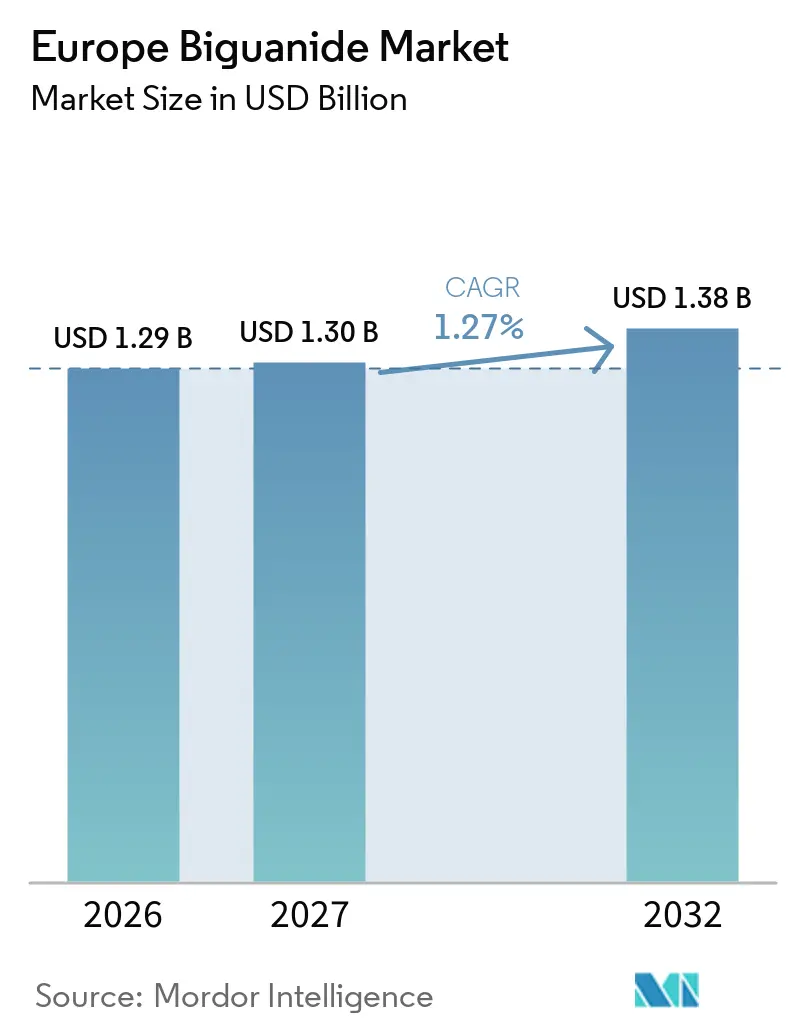
The Europe Biguanide Market size is expected to grow from USD 1.29 billion in 2026 to USD 1.30 billion in 2027 and is forecast to reach USD 1.38 billion by 2032 at 1.27% CAGR over 2027-2032.
Biguanides, particularly metformin, continue to represent a cornerstone of type 2 diabetes management across Europe due to their established efficacy, favorable safety profile, and cost-effectiveness. The widespread availability of generic metformin formulations across major European countries has supported high prescription volumes and broad patient access through national healthcare systems. In addition, European clinical guidelines consistently recommend metformin as the preferred first-line pharmacological therapy for newly diagnosed type 2 diabetes patients, reinforcing its dominant position within the regional biguanide market.
As the incidence of type 2 diabetes continues to increase in Europe, driven by factors like inactive lifestyles and obesity, the need for efficient strategies to manage diabetes will only grow stronger. In this scenario, metformin is anticipated to maintain its significance as a fundamental treatment, supported by advancements in personalized medicine, digital health solutions, and lifestyle interventions that empower patients to attain improved glycemic control and enhance their overall health outcomes.
Although metformin is commonly used and has proven advantages, it does have its drawbacks. Certain individuals may encounter gastrointestinal issues like nausea and diarrhea, impacting their ability to adhere to treatment. Additionally, ongoing studies are investigating metformin's potential in preventing or delaying the development of type 2 diabetes in at-risk populations, along with its effectiveness when paired with newer antidiabetic medications to enhance treatment results.
To summarize, metformin serves as a testament to the remarkable impact of evidence-based medicine in the realm of diabetes treatment. Its lasting influence in Europe not only highlights its effectiveness in therapy, but also its reasonable cost, easy availability, and widespread endorsement from both healthcare providers and patients. As we strive for improved diabetes management, metformin continues to serve as a source of inspiration for countless individuals living with type 2 diabetes in Europe and beyond.
Note: Market numbers in this report are based on Mordor Intelligence's proprietary estimation framework, which combines nine months of actuals with Q4 projections for base year 2026.
Market Trends and Insights
Increasing diabetes prevalence
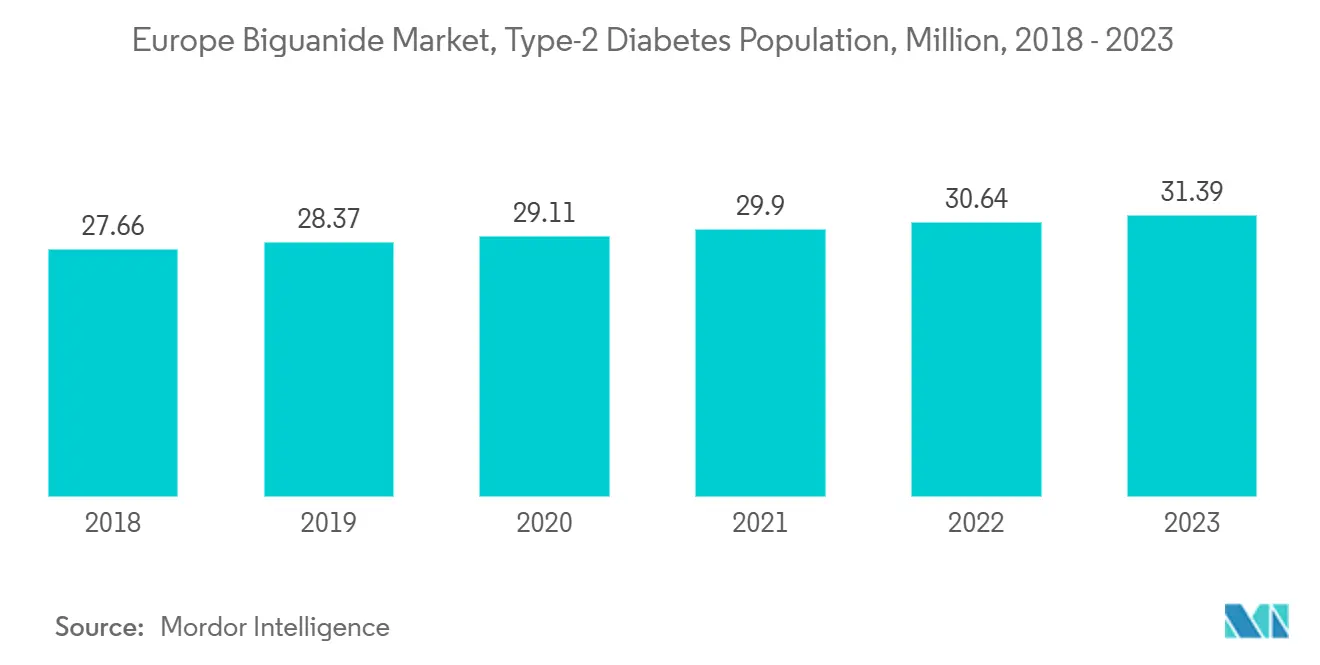
The diabetes population in the European region is expected to rise by more than 5% over the forecast period.
Metformin continues to maintain a dominant position in the treatment algorithm for type 2 diabetes across Europe, supported by recommendations from regional and national clinical guidelines as the preferred first-line pharmacological therapy. For instance, the European Association for the Study of Diabetes (EASD) and the American Diabetes Association (ADA) consensus reports continue to recommend metformin as the foundational therapy for many patients with type 2 diabetes, either as monotherapy or in combination with newer agents. Despite the growing adoption of GLP-1 receptor agonists and SGLT-2 inhibitors, metformin's established efficacy, extensive clinical experience, and low treatment cost continue to support high prescription volumes, reinforcing demand within the European biguanide market.
Oral anti-diabetic drugs have been available internationally and are recommended for use when escalation of treatment for type-2 diabetes is required along with lifestyle management. These are typically the first medications used in the treatment of type-2 diabetes due to their wide range of efficacy, safety, and mechanisms of action. Antidiabetic drugs help diabetes patients keep their condition under control and lower the risk of diabetes complications. People with diabetes may need to take antidiabetic drugs for their whole lives to control their blood glucose levels and avoid hypoglycemia and hyperglycemia. They present the advantages of easier management and lower cost, so they became an attractive alternative to insulin with better acceptance, which enhances adherence to the treatment.
The government, along with the companies, are working towards better diabetes management. For instance, the National Service Framework (NSF) program is improving services by setting national standards to drive up service quality and tackle variations in care. The Association of British HealthTech Industries (ABHI) launched a diabetes section, enabling diabetes technology companies to work together in the first forum of its kind.
Owing to the rising rate of obesity, the growing genetic factors for type-2 diabetes, the increasing prevalence, and the aforementioned factors, it is likely that the market will continue to grow.

Germany holds the highest market share in the Europe Biguanide Market in the current year
Germany has one of Europe's most established Disease Management Programs (DMPs) for diabetes, which promotes structured monitoring and long-term management of patients with type 2 diabetes. The widespread adoption of these programs has increased treatment adherence and early therapeutic intervention, supporting continued utilization of biguanide-based therapies within routine clinical practice.
The Europe biguanide market continues to benefit from the widespread inclusion of biguanide therapies in national reimbursement programs and public healthcare formularies. Across major European countries, healthcare authorities emphasize cost-effective diabetes management strategies to address the growing economic burden of chronic disease. As a result, biguanides remain an important component of glucose-lowering treatment regimens, supporting consistent utilization across the region.
About 8.5 million people in Germany suffer from diabetes, according to the German Diabetes Center (DDZ). The number of people with type-2 diabetes in Germany will continue to increase over the next twenty years. German law requires public plans to cap out-of-pocket health care costs and to cover all medically necessary treatment, including insulin. Germany is one of the most developed countries in terms of healthcare facilities. Moreover, the reimbursement policy and the pricing policy are highly regulated, which drives the market. The roll-out of many new products, increasing international research collaborations in technological advancement, and increasing awareness about diabetes among people are some of the market opportunities for the players in the German diabetes drug market.
Competitive Landscape
Market Concentration
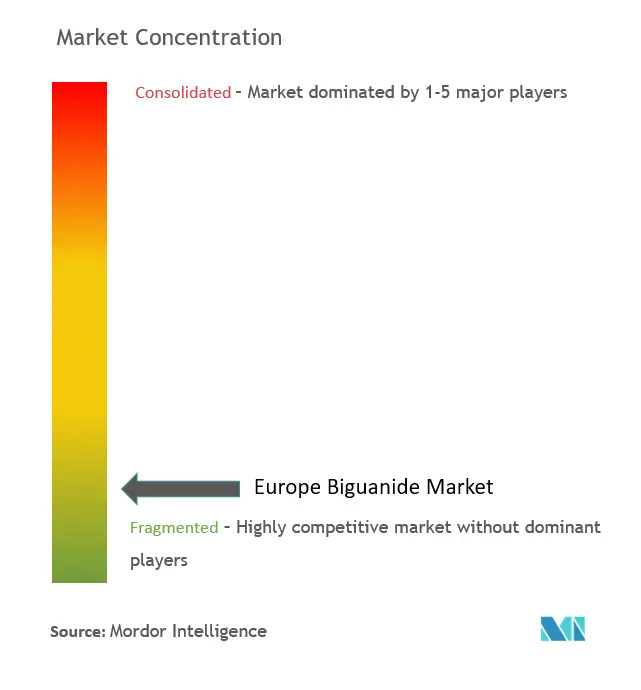
The Europe biguanide market is fragmented consisting of manufacturers like Teva, Takeda, Merck, Sanofi, GlaxoSmithKline, Bristol-Myers Squibb, and Boehringer Ingelheim Pharmaceuticals, etc. having a global market presence and other regional manufacturers.
Europe Biguanide Industry Leaders
-
Teva
-
Bristol-Myers Squibb
-
AstraZeneca
-
Sanofi Aventis
-
Merck and Co.
- *Disclaimer: Major Players sorted in no particular order
Europe Biguanide Market Companies Covered in this Report
- Teva Pharmaceutical Industries
- Merck
- Takeda Pharmaceuticals
- GlaxoSmithKline
- Sanofi
- Boehringer Ingelheim
- Glenmark Pharmaceuticals
- AstraZeneca
- Bristol-Myers Squibb
Recent Industry Developments in Europe Biguanide Market
- April 2023: The European Commission has updated the Classification, Labelling and Packaging Regulation with the following hazard classes which includes, for "Sitagliptin/Metformin Hydrochloride.
- February 2022: Merck announced in a European work sharing procedure (WSP) an extension to the label for metformin products in the EU: Glucophage (metformin hydrochloride immediate release), Glucophage XR (metformin HCL extended release), and Stagid (metformin embonate immediate release) for use throughout pregnancy. The approval was granted based on Merck's own safety cohort study, CLUE, and a large body of published evidence.
Europe Biguanide Market Report Scope
Biguanides are a class of diabetes medications that are used for people with type 2 diabetes. The European biguanide market is segmented into geography (France, Germany, Italy, Russia, Spain, United Kingdom, rest of Europe). The report offers the value (in USD million) and volume (in units million) for the above segments. Further, the report will cover a segment-wise breakdown (value and volume) for all the countries covered under the table of contents.
Segmentation Overview
Geography
| France |
| Germany |
| Italy |
| Russia |
| Spain |
| United Kingdom |
| Rest of Europe |
| Geography | France |
| Germany | |
| Italy | |
| Russia | |
| Spain | |
| United Kingdom | |
| Rest of Europe |
Key Questions Answered in the Report
How big is the Europe Biguanide Market?
The Europe Biguanide Market size is expected to reach USD 1.30 billion in 2027 and grow at a CAGR of 1.27% to reach USD 1.38 billion by 2032.
What is the current Europe Biguanide Market size?
In 2026, the Europe Biguanide Market size is expected to reach USD 1.29 billion.
Who are the key players in Europe Biguanide Market?
Teva, Bristol-Myers Squibb, AstraZeneca, Sanofi Aventis and Merck and Co. are the major companies operating in the Europe Biguanide Market.
What years does this Europe Biguanide Market cover, and what was the market size in 2025?
In 2025, the Europe Biguanide Market size was estimated at USD 1.27 billion. The report covers the Europe Biguanide Market historical market size for years: 2021, 2022, 2023, 2024, 2025, and 2026. The report also forecasts the Europe Biguanide Market size for years: 2027, 2028, 2029, 2030, 2031, and 2032.