
Europe Bathtub Market Size and Share
Market Overview
| Study Period | 2021 - 2032 |
|---|---|
| Forecast Data Period | 2027 - 2032 |
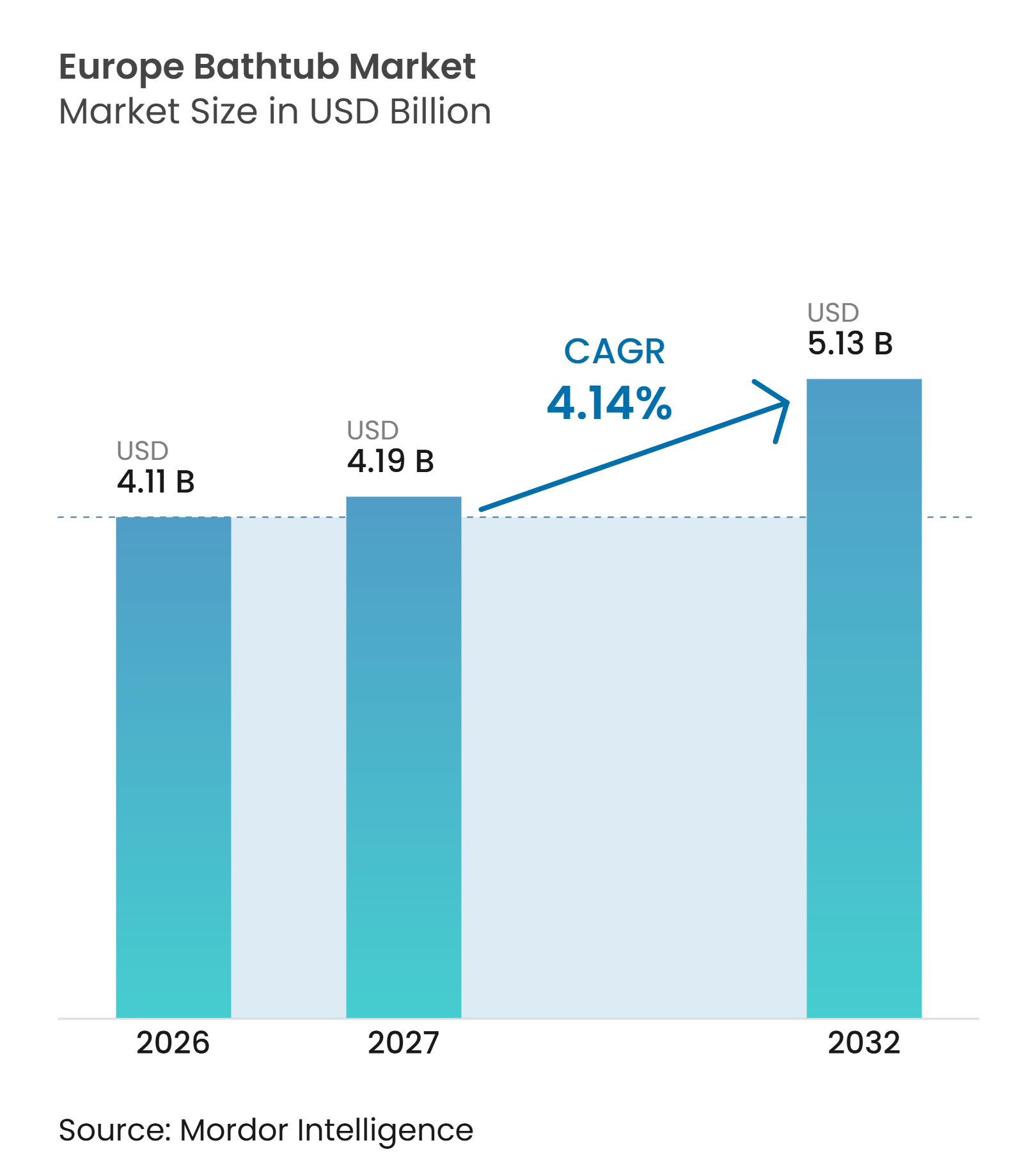
| Base Year Market Size (2026) | USD 4.11 Billion |
| Market Size (2027) | USD 4.19 Billion |
| Market Size (2032) | USD 5.13 Billion |
| Growth Rate (2027 - 2032) | 4.14 % |
| Market Concentration | Medium |
Major Players *Disclaimer: Major Players sorted in no particular order Image © Mordor Intelligence. Reuse requires attribution under CC BY 4.0. | |
Europe Bathtub Market Analysis by Mordor Intelligence
Key Report Takeaways
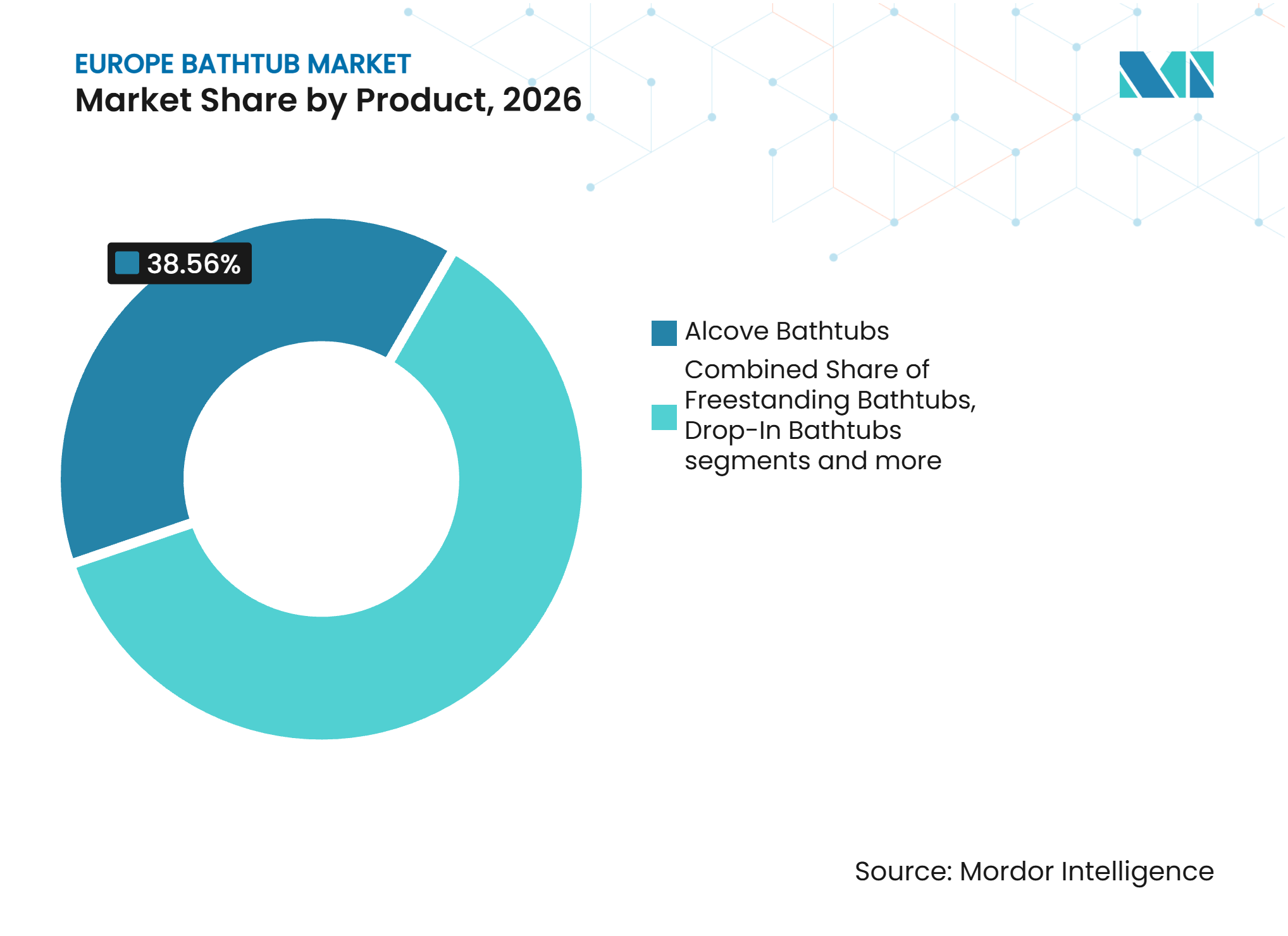
• By product type, alcove bathtubs held a 38.56% share in 2026, while freestanding bathtubs are forecast to grow at a 5.25% CAGR through 2032.
• By material, acrylic held a 44.21% share in 2026, while fiberglass is forecast to grow at a 5.56% CAGR through 2032.
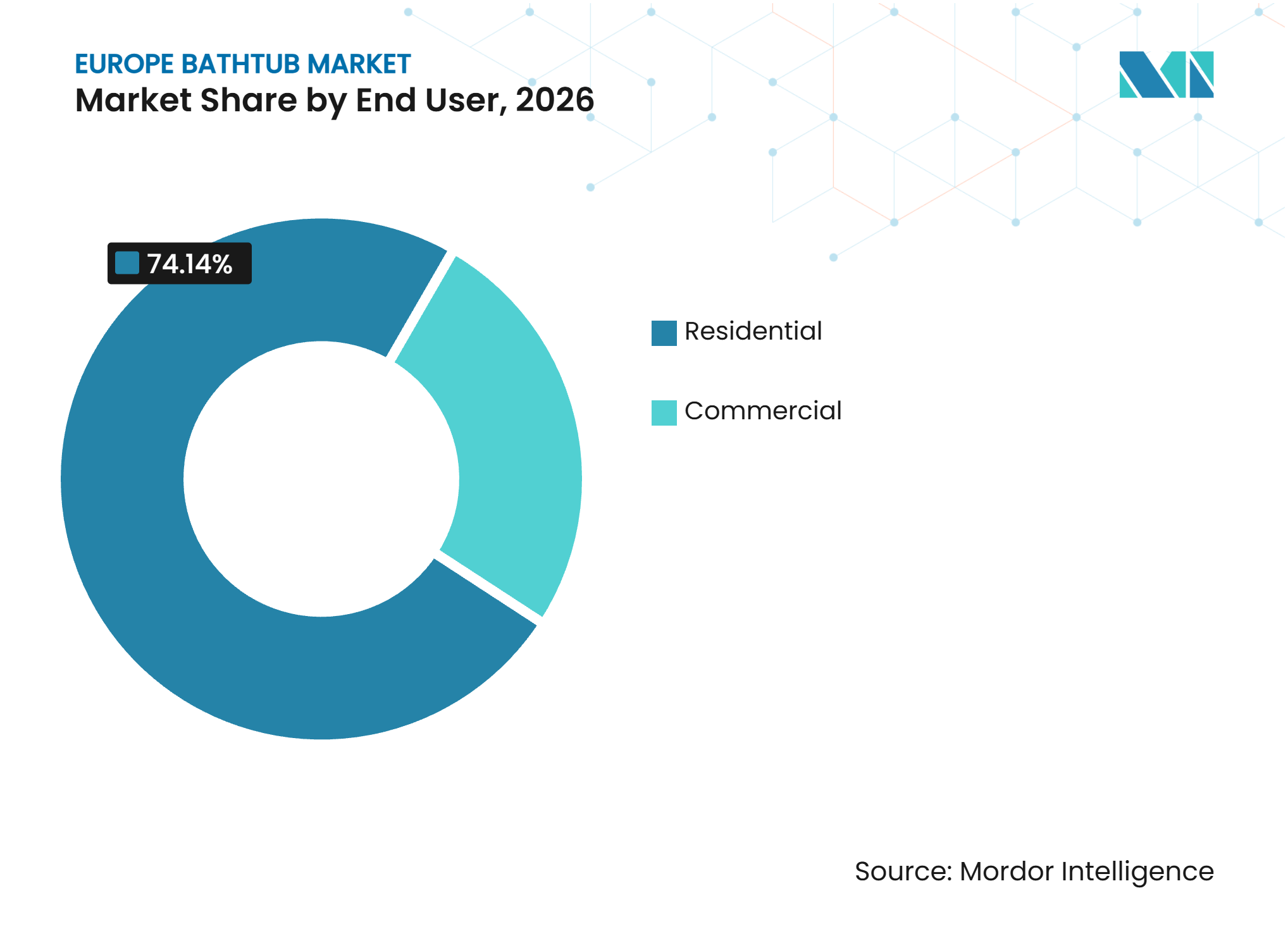
• By end user, residential accounted for 74.14% of the Europe bathtub market size in 2026, while commercial is forecast to grow at a 4.88% CAGR through 2032.
• By distribution channel, B2C/retail held an 80.26% share in 2026 and is forecast to grow at a 5.07% CAGR through 2032.
• By geography, Germany held a 21.56% share in 2026, while Spain is forecast to grow at a 5.73% CAGR through 2032.
Note: Market numbers in this report are based on Mordor Intelligence's proprietary estimation framework, which combines nine months of actuals with Q4 projections for base year 2026.
Market Trends and Insights
Drivers Impact Analysis of Europe Bathtub Market*
| Driver | (~) % Impact on CAGR Forecast | Geographic Relevance | Impact Timeline |
|---|---|---|---|
| Aging Bathroom Stock and Replacement Demand | +1.1% | Pan-European, strongest in Germany, United Kingdom, France, and Nordics | Medium term (2-4 years) |
| Home Wellness and Premium Freestanding Demand | +0.8% | Germany, United Kingdom, France, and Netherlands | Medium term (2-4 years) |
| Hotel Refurbishment and Wellness Tourism | +0.6% | Spain, Italy, France, Nordics, and United Kingdom | Short term (≤ 2 years) |
| Durable and Recyclable Material Demand | +0.4% | Pan-European, particularly Germany, Nordics, and Benelux | Long term (≥ 4 years) |
| Building Renovation Programs and Housing Targets | +0.5% | Europe-wide, particularly countries implementing national renovation plans | Long term (≥ 4 years) |
| E-Commerce and Omnichannel Retail Access | +0.3% | Western, Central, and Eastern Europe | Short term (≤ 2 years) |
| Source: Mordor Intelligence | |||
Aging Bathroom Stock Fueling Renovation and Replacement Demand
Germany provides a clear view of the replacement demand that supports the Europe bathtub market. The German sanitary industry association VDS reported that 18% of private bathrooms, or 7 million units, needed urgent renovation. The same research found that 27% of homeowners expected to renovate soon, rising to 52% among owners of bathrooms not renovated for 35 years or longer[1]. A long gap between refurbishments usually requires plumbing, waterproofing, and fixture replacement at the same time. This favors suppliers that can offer compatible products for constrained layouts and accessible designs. The Energy Performance of Buildings Directive requires Member States to prepare national building renovation plans, which can support integrated home upgrades[2].
Home Wellness and Premium Freestanding Demand
Bathroom renovation is increasingly shaped by comfort, appearance, and daily well-being. A 2025 survey of consumers in Italy, France, and Germany found that 54% viewed the bathroom as a focal point of domestic well-being[3]. This preference supports larger, freestanding, mineral-composite, and premium acrylic bathtubs within renovation specifications. The effect is most visible where buyers are renovating owner-occupied homes rather than fitting basic units into new apartments. Premium tubs can also be installed beside a walk-in shower, allowing a bathtub to remain part of a mixed bathroom design. The Europe bathtub market can therefore preserve value in projects where shower adoption reduces the need for a conventional tub.
Hotel Refurbishments and Wellness Tourism Driving Contract Installations
Hotel upgrades are creating a separate source of bathtub demand from household renovation. Pandox completed an EUR 8 million (USD 9.4 million) conversion of the Leonardo Royal Hotel Baden-Baden into a spa and wellness destination, including renovation of 121 guest rooms and bathrooms[4]. These projects often require durable products, reliable after-sales service, and design consistency across many rooms. KALDEWEI also refurbished and reinstalled used bathroom surfaces at the 25hours Hotel Bikini Berlin in 2025. The company stated that this process produced 65% less CO₂ than manufacturing new products. This makes hospitality a useful route for suppliers that can meet both project delivery and circular procurement requirements.
Growing Preference for Durable, Recyclable Materials
Material selection is becoming more closely tied to lifecycle documentation and procurement requirements. KALDEWEI received Cradle to Cradle Certified Silver status for its steel-enamel bathtubs, shower trays, and washbasins in 2025, confirming that the products are fully recyclable at end of life. Roca fully electrified its Anadia composite and acrylic bathtub plant in Portugal with renewable electricity. The company reported a 10% reduction in electricity consumption per tonne and zero direct production emissions at the facility. Such actions make environmental credentials more visible in public, hospitality, and premium renovation specifications. Fiberglass can retain a price and weight advantage, but its end-of-life position may become more difficult where purchasers require stronger circularity evidence.
Restraints Impact Analysis of Europe Bathtub Market*
| Restraint | (~) % Impact on CAGR Forecast | Geographic Relevance | Impact Timeline |
|---|---|---|---|
| Shift to Floor-Level Walk-In Showers and Wet Rooms | -1.0% | Pan-European, especially United Kingdom, Germany, France, and urban areas | Long term (≥ 4 years) |
| Weak New Residential Construction and Financing Costs | -0.8% | Germany, France, Italy, and Austria | Medium term (2-4 years) |
| Raw Material and Energy Cost Pressure | -0.4% | Pan-European, especially enamel and solid-surface suppliers | Short term (≤ 2 years) |
| Smaller Urban Bathrooms and Water and Energy Concerns | -0.3% | United Kingdom, Germany, France, and other Western European urban areas | Long term (≥ 4 years) |
| Source: Mordor Intelligence | |||
Structural Shift Toward Floor-Level Walk-In Showers and Wet Rooms Replacing Bathtubs
The shift toward level-access showers remains the main structural restraint for the Europe bathtub market. Walk-in showers use space efficiently and can offer easier access for older residents and people with limited mobility. This format is particularly suited to compact urban bathrooms and new-build apartments. The resulting pressure is strongest on standard tubs installed as a default feature rather than a considered design choice. Manufacturers can respond by offering compact freestanding models, walk-in tubs, and products that pair well with shower zones. The remaining opportunity lies in renovations and hospitality projects where a bathtub adds a clear comfort or design function.
Subdued New Residential Construction and High Financing Costs Weighing on New-Build Demand
Weak new residential construction limits a traditional source of demand for basic alcove models. Higher financing costs reduce affordability and delay housing starts, especially in markets where apartment construction had previously supported predictable bathtub volumes. Germany remains important because it combines a large bathtub base with a subdued new-build pipeline. The effect directs suppliers toward renovation, replacement, and contract projects rather than volume-led residential development. It also increases the importance of products with higher value per installation. The Europe bathtub market is therefore likely to depend more on specification quality than on unit growth from new housing.
*Our forecasts treat driver/restraint impacts as directional, not additive. The impact forecasts reflect baseline growth, mix effects, and variable interactions.
Europe Bathtub Market Segment Analysis
By Product Type:
Premium Formats Reshape a Mature CategoryAlcove bathtubs held a 38.56% share in 2026 because they suit existing apartment layouts, standardized bathroom plans, and price-conscious replacement work. Their installed base is strongest in space-constrained homes where replacing a tub without moving plumbing is a practical priority. Drop-In bathtubs remain relevant when an existing deck, surround, or built-in frame is retained during refurbishment. Corner bathtubs serve homes with larger bathroom footprints, particularly in parts of Northern Europe. Walk-In bathtubs are smaller in volume but fit the need for barrier-free home upgrades. Freestanding bathtubs are forecast to grow at a 5.25% CAGR through 2032 as buyers place greater value on the bathroom as a personal space. Their growth is supported by demand for premium renovation, hospitality bathrooms, and combined tub-and-shower layouts. The European bathtub market size for freestanding products benefits when manufacturers offer compact formats for mid-sized rooms.
Whirlpool and hydrotherapy tubs remain concentrated in upscale homes, spas, and hotels where the buyer values wellness features. Their higher maintenance needs limit wider household uptake, which keeps the category more specialized than conventional freestanding products. Product innovation is increasingly focused on ergonomic shapes, reduced water use, smaller footprints, and materials that are easy to maintain. Roca has introduced a freestanding bathtub range from its Cortes plant for premium and contract applications. This approach reflects the need to defend bathtub value where showers are the default choice. Suppliers with both standard replacement products and higher-value design ranges can serve more renovation budgets. The European bathtub market is less dependent on a single format when product portfolios cover accessible, compact, and premium needs.



By Material:
Acrylic Leads While Circularity Changes Product SelectionAcrylic accounted for 44.21% of total value in 2026 because it combines low weight, adaptable shaping, easy maintenance, and broad price coverage. Its nonporous surface and ability to form curved designs support use in both alcove and freestanding products. Fiberglass is forecast to grow at a 5.56% CAGR through 2032, helped by a lighter installation profile and lower cost in renovation projects. Acrylic-reinforced products also suit upper-mid-range designs that need a more refined finish than basic replacement models. Cast iron retains a position in heritage and premium projects where longevity and heat retention are valued. Porcelain-enameled steel provides a practical middle option for suppliers and distributors with established sanitary ware supply chains. Solid surface and stone resin serve buyers willing to pay for a distinct material appearance and premium design. Material choice in the European bathtub market is now shaped by installation effort, lifetime durability, and environmental evidence.
Steel-enamel producers have a clear opportunity to differentiate through verified circularity. KALDEWEI’s 2025 Cradle to Cradle certification demonstrates how certification can support product selection in project work. Roca’s electrified Portuguese facility shows that production emissions can also become part of a supplier’s sales proposition. Fiberglass continues to appeal where weight and purchase price are central, but manufacturers may need stronger evidence on durability and resource use. Stone resin and mineral composites have gained visibility in premium projects because they can support distinctive forms and a solid feel. Cultured marble and ceramic remain niche options for bespoke designs, especially in Southern European markets. This material mix leaves room for suppliers that can match performance, cost, and environmental compliance without making unsupported sustainability claims.
By End User:
Residential Demand Provides Scale While Commercial Demand Gains ValueResidential users accounted for 74.14% of total value in 2026, making household replacement and renovation the primary source of demand. Owner-occupied homes support both basic like-for-like replacements and larger upgrades that include plumbing, waterproofing, and finishes. In Spain, 10% of households carried out a bathroom intervention in 2025, with average spending of EUR 6,700 (USD 7,881.2) per project. Residential buyers divide between price-sensitive households choosing familiar alcove formats and design-led customers selecting freestanding or drop-in models. The growth of older households also supports demand for accessible products. Germany’s KfW Program 159 provides support for barrier-free bathroom conversion, which can improve the case for walk-in bathing solutions. Residential renovation will remain more important to the European bathtub market than new construction over the forecast period.
Commercial demand is forecast to grow at a 4.88% CAGR through 2032, supported by hotels, resorts, spas, senior living, and selected healthcare settings. Hotels and resorts often specify products that can withstand frequent use while fitting a consistent room concept. Spa and wellness centers have a more specialized need for soaking, hydrotherapy, and accessible bathing products. Senior living presents a smaller but durable opportunity as providers adapt buildings for residents with mobility needs. The ZVSHK award for barrier-free bathroom design at ISH 2025 highlighted the continued attention given to accessible solutions in Germany. Contract buyers also increasingly review product lifecycle information and availability of replacement support. Suppliers that combine project service, product durability, and consistent delivery are best positioned for this segment.

By Distribution Channel:
Retail Remains Central While Digital Research ExpandsB2C/Retail held an 80.26% share in 2026 and is forecast to grow at a 5.07% CAGR through 2032. The channel includes specialty retailers, home-improvement stores, showrooms, and online sellers serving household renovation buyers. Specialty retailers remain important for premium tubs because buyers often want design advice, product inspection, and installation guidance. Larger home-improvement stores serve standard replacement demand where price and availability are decisive. Online access improves product discovery and lets buyers compare dimensions, finishes, reviews, and delivery choices before visiting a store. A 2025 survey found that consumers in Germany, France, and Italy frequently used online sources as part of bathroom purchase decisions. The result is an omnichannel buying process rather than a full replacement of physical retail.
B2B/Direct channels are more relevant for hotel groups, developers, and project contractors that need coordinated supply. Direct agreements can include delivery schedules, after-sales support, and specification advice for larger installations. Digital channels put pressure on lower and middle price points because they increase price transparency. This makes showroom service, reliable installation support, and differentiated materials more important for protecting margin. Retailers that combine online product information with local design and installation support can reach both research-driven and service-driven customers. The European bathtub market is therefore likely to reward channel strategies that connect digital discovery with dependable physical fulfillment. For manufacturers, the key is to maintain consistent product information and availability across each route to market.
Geography Analysis
Germany: Renovation Demand Supports a Mature Market
Germany held 21.56% of the European bathtub market size in 2026. Its position rests on a large installed base, a strong domestic sanitary manufacturing base, and persistent renovation need. VDS reported that 7 million private bathrooms required urgent renovation, which gives replacement suppliers a substantial addressable base. KfW support for barrier-free conversion strengthens the case for accessible fixtures and walk-in products. German buyers also use both stores and online sources during bathroom renovation, which requires retailers to provide consistent information across channels. Manufacturers including KALDEWEI, Duravit, Bette, Villeroy & Boch, and Hoesch have production and design capabilities connected to the German market. The main constraint is weak new construction, which places greater weight on higher-value renovation specifications.
Spain: Renovation and Hospitality Support Faster Growth
Spain is forecast to expand at a 5.73% CAGR through 2032, giving it the strongest projected growth among the stated country segments. The bathroom was Spain’s most-renovated room in 2025, and 1.9 million home renovation projects were completed nationally. Renovation spending supports both standard replacement activity and premium upgrades in tourism-oriented areas. The country’s hotel and spa pipeline creates further demand for contract-grade products. Roca’s Cortes plant has introduced freestanding tubs and bespoke shower trays aimed at premium and luxury contract work. Regional housing improvement programs can also support integrated renovation work that includes bathrooms. These conditions give the European bathtub market a growth route that is less reliant on new housing starts.
Other European Markets: Different Routes to Replacement Demand
The United Kingdom faces slower new construction and cautious household spending, but falling bathroom fitting costs in 2025 may allow postponed renovation projects to proceed. France remains a large sanitary market, although the source draft indicates that bathtub sales declined during 2025. Italy has an important manufacturing base and depends on export demand, particularly from Germany and France. The Benelux countries benefit from renovation policy frameworks, but program eligibility is increasingly linked to energy efficiency. Sweden offers a different example, where a temporary enhancement to the ROT renovation subsidy increased invoiced bathroom renovation sales by 20% in 2025. Central and Eastern Europe provide longer-term potential as renovation activity develops and regional production capacity expands. Roca has added bathtub and shower tray lines at its Gryfice plant in Poland, strengthening supply for the region. Across these countries, renovation policy, household affordability, and hospitality investment will determine the pace of demand.
Competitive Landscape
Market Concentration
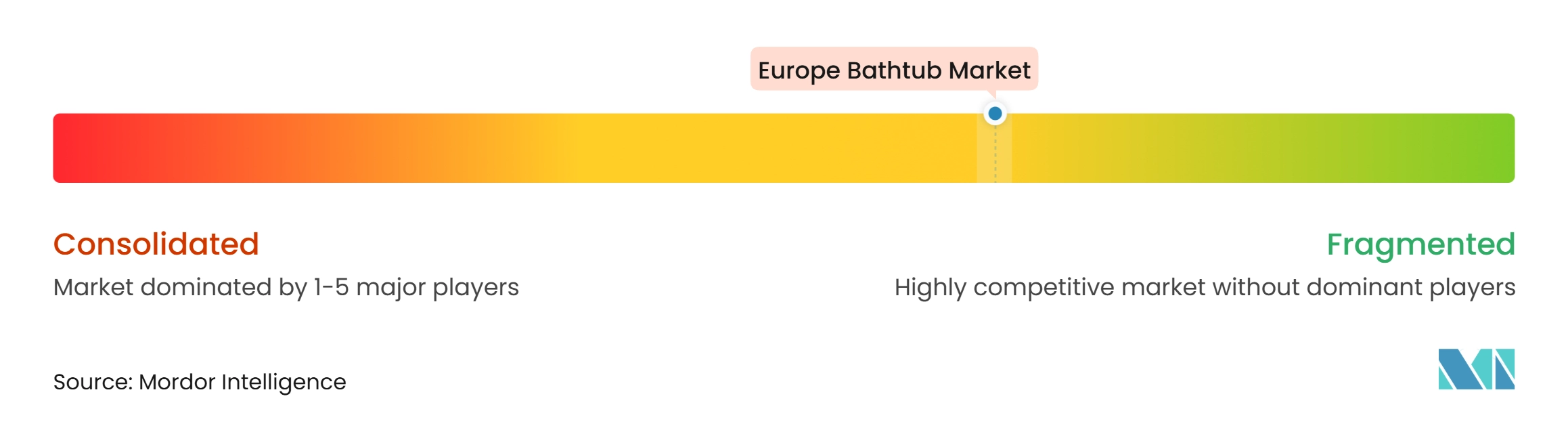
The Europe bathtub market includes large regional manufacturers and many national specialists. Roca, KALDEWEI, Geberit, Villeroy & Boch, Duravit, Bette, Kohler, Jacuzzi, Hoesch, Victoria + Albert, Teuco, Riho, Ravak, Polysan, Cersanit, Porcelanosa, Carron Bathrooms, Bathroom Brands Group, Novellini, and BC Designs are relevant suppliers within the category. These manufacturers collectively hold an estimated 54.5% share, indicating moderate fragmentation, with remaining demand distributed across numerous regional and specialist suppliers.
Their product portfolios span acrylic, steel-enamel, mineral composite, hydrotherapy, freestanding, alcove, and accessible formats. This breadth allows buyers to select products for standard replacement, premium renovation, and contract projects. Large brands benefit from established dealer networks, design resources, manufacturing capacity, and project support. Regional specialists can compete through local distribution, specific materials, compact designs, and lower-cost product lines. The competitive field remains open because bathtub preferences and installation requirements vary widely by country.
Product design and environmental credentials are important competitive tools. KALDEWEI’s Cradle to Cradle Certified Silver status gives its steel-enamel range a verified circularity credential. Its refurbishment work at the 25hours Hotel Bikini Berlin also provides a practical circular model for the hospitality segment. Roca’s electrification of its Anadia facility links acrylic and composite manufacturing to lower direct production emissions. Premium suppliers are also using freestanding forms and mineral materials to address wellness-focused renovation demand. Accessible formats offer another route to differentiation where building owners and households need barrier-free installations. Relevant requirements include EN 14516 for domestic baths and national accessibility rules, including DIN 18040 in Germany.
Channel execution is becoming as important as product choice in the Europe bathtub market. Retailers and manufacturers need clear digital product data because buyers commonly research dimensions, finishes, and installation requirements online. Showrooms remain useful for premium materials and freestanding designs that buyers prefer to inspect in person. Contract suppliers must also manage lead times, replacement parts, and installation coordination for hotel and residential projects. Larger producers can support these services through broad distribution networks, while specialists can build loyalty through focused customer support. The sector’s wide range of suppliers means no single company can rely only on scale. Companies that join accessible design, credible environmental performance, and consistent omnichannel service will be better placed to protect their position.
Europe Bathtub Industry Leaders
-
Kohler Co.
-
TOTO LTD.
-
LIXIL Corporation
-
Roca Sanitario, S.A.
-
Jacuzzi Brands LLC
- *Disclaimer: Major Players sorted in no particular order
Europe Bathtub Market Companies Covered in this Report
- Roca Sanitario S.A. (incl. Laufen)
- Franz Kaldewei GmbH & Co. KG
- Geberit AG (incl. Keramag, Ifö, Koło, Twyford, Sphinx)
- Villeroy & Boch AG (incl. Ideal Standard)
- Duravit AG
- Bette GmbH & Co. KG
- Kohler Co. (incl. Jacob Delafon)
- Jacuzzi Group
- Hoesch Design GmbH
- Victoria + Albert Baths Ltd.
- Teuco S.p.A.
- Riho International B.V.
- Ravak a.s.
- Polysan s.r.o.
- Cersanit S.A. (Rovese Group)
- Grupo Porcelanosa (incl. Systempool, Noken)
- Carron Bathrooms Ltd.
- Bathroom Brands Group Ltd.
- Novellini S.p.A.
- BC Designs Ltd.
Recent Industry Developments in Europe Bathtub Market
- September 2026: Duravit launched the Bento Starck Box bathroom collection with Philippe Starck. It includes the freestanding acrylic Infinity Bathtub, sized for two people, with a beveled water channel around the rim and a rounded headrest shelf.
- August 2026: Roper Rhodes' R2 Bathrooms brand (UK) entered the bathing category with its first bathtub ranges, Sky and Serenity. Both come in single- and double-ended versions for back-to-wall or corner installation.
- July 2026: Noken (Porcelanosa Group, Spain) launched two freestanding bathtubs: Swan, made of transparent resin, and Nova, a one-piece acrylic rectangular tub with flexible tap placement.
- April 2026: Villeroy & Boch launched the Finion All Black collection. It includes the Theano bathtub in Quaryl, offered as an Original Edition and an asymmetric Curved Edition.
Europe Bathtub Market Report Scope
Segmentation Overview
| Freestanding Bathtubs |
| Alcove Bathtubs |
| Drop-In Bathtubs |
| Corner Bathtubs |
| Walk-In Bathtubs |
| Whirlpool Bathtubs |
| Other Product Types |
| Acrylic |
| Fiberglass |
| Cast Iron |
| Porcelain-Enameled Steel |
| Solid Surface and Stone Resin |
| Cultured Marble |
| Ceramic and Other Materials |
| Residential | |
| Commercial | Hotels and Resorts |
| Spas and Wellness Centers | |
| Healthcare and Senior Living | |
| Gyms and Other Commercial Facilities |
| B2C/Retail | Big-Box & Home-Improvement Stores |
| Specialty Retail Stores | |
| Online | |
| Other Distribution Channels | |
| B2B/Direct From Manufacturers |
| United Kingdom |
| Germany |
| France |
| Spain |
| Italy |
| BENELUX (Belgium, Netherlands, Luxembourg) |
| NORDICS (Denmark, Finland, Iceland, Norway, Sweden) |
| Rest of Europe |
| By Product Type | Freestanding Bathtubs | |
| Alcove Bathtubs | ||
| Drop-In Bathtubs | ||
| Corner Bathtubs | ||
| Walk-In Bathtubs | ||
| Whirlpool Bathtubs | ||
| Other Product Types | ||
| By Material | Acrylic | |
| Fiberglass | ||
| Cast Iron | ||
| Porcelain-Enameled Steel | ||
| Solid Surface and Stone Resin | ||
| Cultured Marble | ||
| Ceramic and Other Materials | ||
| By End User | Residential | |
| Commercial | Hotels and Resorts | |
| Spas and Wellness Centers | ||
| Healthcare and Senior Living | ||
| Gyms and Other Commercial Facilities | ||
| By Distribution Channel | B2C/Retail | Big-Box & Home-Improvement Stores |
| Specialty Retail Stores | ||
| Online | ||
| Other Distribution Channels | ||
| B2B/Direct From Manufacturers | ||
| By Geography | United Kingdom | |
| Germany | ||
| France | ||
| Spain | ||
| Italy | ||
| BENELUX (Belgium, Netherlands, Luxembourg) | ||
| NORDICS (Denmark, Finland, Iceland, Norway, Sweden) | ||
| Rest of Europe | ||
Key Questions Answered in the Report
What is the forecast growth rate for the Europe bathtub market?
The Europe bathtub market is forecast to grow at a 4.14% CAGR from 2027 to 2032, reaching USD 5.13 billion by 2032.
Which bathtub type leads sales in Europe?
Alcove Bathtubs lead with a 38.56% share in 2026 because they fit established layouts and replacement projects.
Which bathtub category is growing fastest in Europe?
Freestanding Bathtubs are forecast to grow at a 5.25% CAGR through 2032, supported by premium renovation and wellness-focused design.
What material is most used for bathtubs in Europe?
Acrylic holds a 44.21% share in 2026, supported by its low weight, flexible design options, and suitability across price points.
Why do hotel renovations matter for bathtub suppliers?
Hotel and spa refurbishments require durable products, coordinated delivery, and premium designs, creating contract demand beyond residential renovation.