
Market Overview
| Study Period | 2021 - 2031 |
|---|---|
| Forecast Data Period | 2026 - 2031 |
| Base Year Market Size (2025) | USD 2.45 Billion |
| Market Size (2026) | USD 2.59 Billion |
| Market Size (2031) | USD 3.48 Billion |
| Growth Rate (2026 - 2031) | 6.08 % |
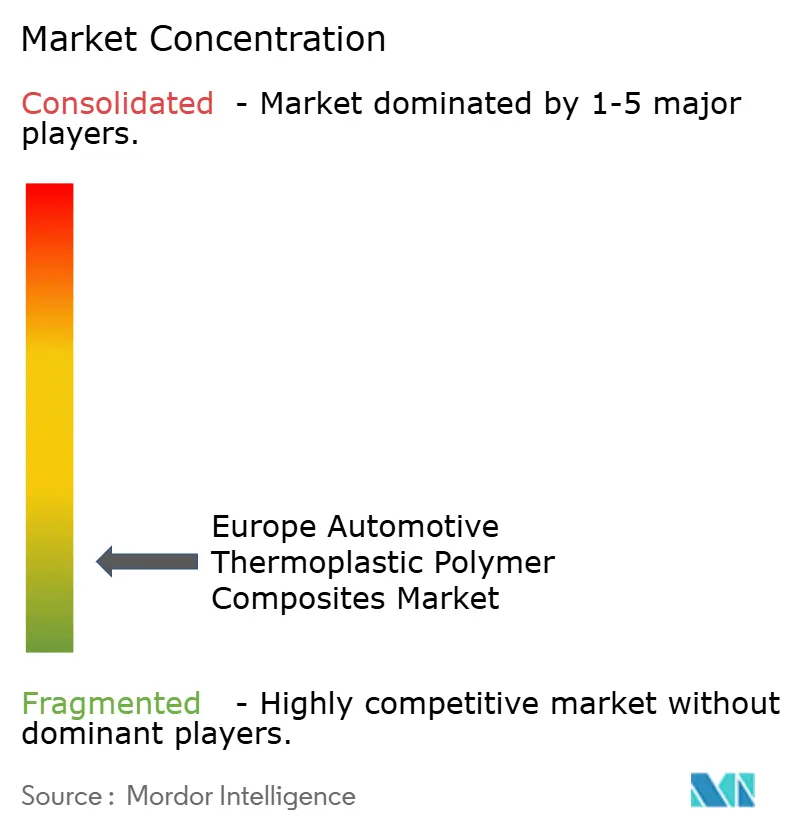
| Market Concentration | Low |
Major Players *Disclaimer: Major Players sorted in no particular order Image © Mordor Intelligence. Reuse requires attribution under CC BY 4.0. | |
Europe Automotive Thermoplastic Polymer Composites Market Analysis by Mordor Intelligence
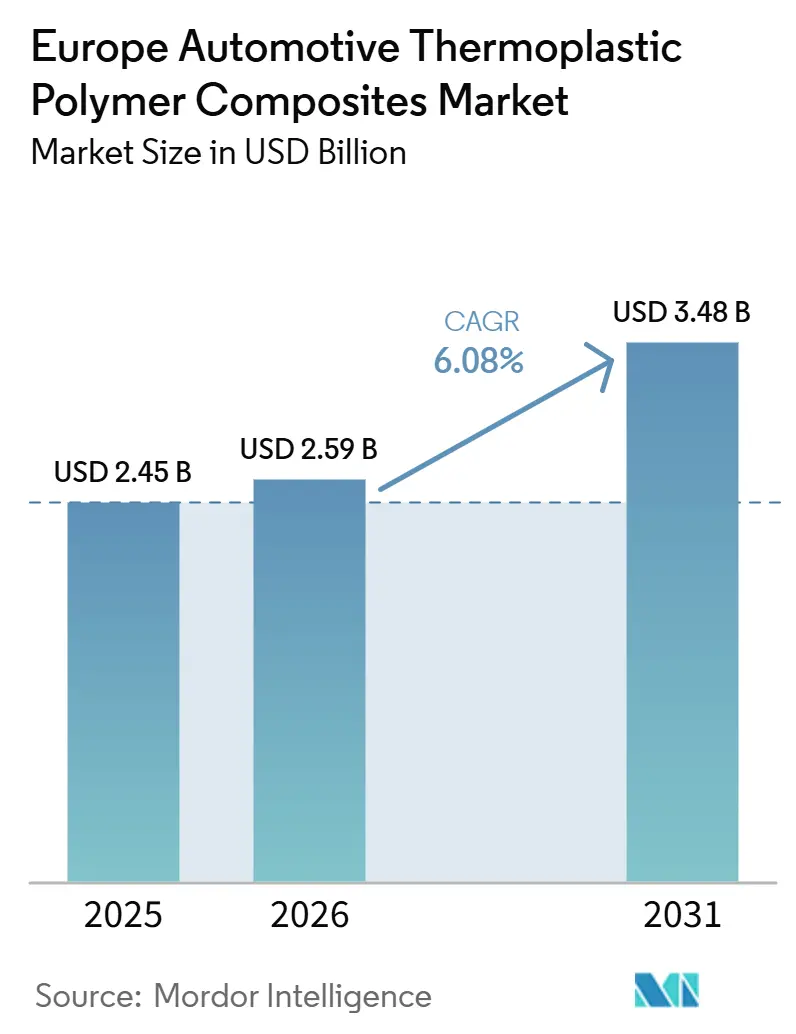
The Europe automotive thermoplastic polymer composites market size is estimated at USD 2.45 billion in 2025 and is estimated to grow from USD 2.59 billion in 2026 to USD 3.48 billion by 2031, at a CAGR of 6.08% during the forecast period (2026-2031). EU fleet-emission regulations and the growth of battery electric vehicles are increasing demand for lightweight components in the Europe automotive thermoplastic polymer composite market. Battery packs add substantial mass, making lighter body, closure, and module designs important for vehicle range and operating performance. Thermoplastic composites also support welding, reprocessing, and component sorting, aligning with European end-of-life vehicle requirements. Suppliers with resin expertise, component design capabilities, and established qualification records are better positioned to participate in long vehicle development cycles. However, production uncertainty remains a constraint, as the Europe automotive thermoplastic polymer composite market depends on vehicle assembly levels and local supply chains.
Key Report Takeaways
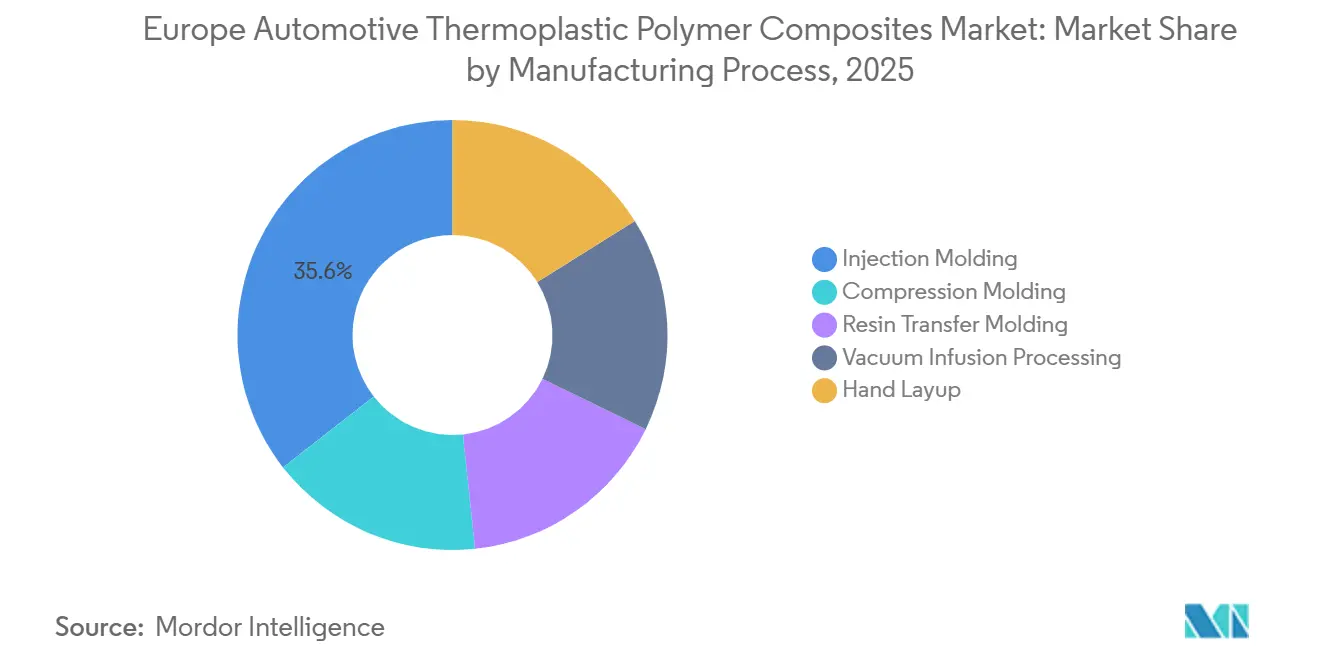
- By manufacturing process, injection molding held 35.56% of the Europe automotive thermoplastic polymer composites market share in 2025, while compression molding is forecast to grow at a 6.86% CAGR through 2031.
- By application, structural components accounted for 33.11% of the Europe automotive thermoplastic polymer composites market size in 2025, while interior components are forecast to expand at a 6.97% CAGR through 2031.
- By product form, short fiber thermoplastics held 40.70% of the Europe automotive thermoplastic polymer composites market share in 2025, while continuous fiber thermoplastics are projected to grow at a 7.45% CAGR through 2031.
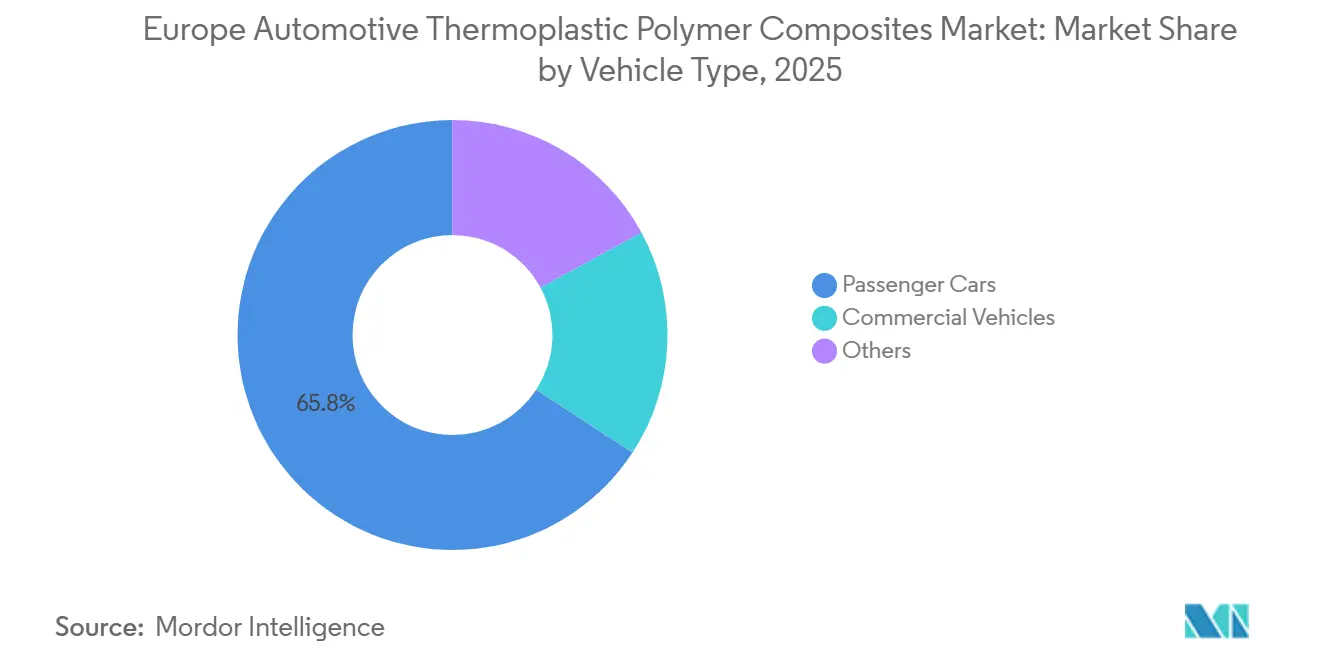
- By vehicle type, passenger cars accounted for 65.79% of demand in 2025, while commercial vehicles are forecast to grow at a 7.32% CAGR through 2031.
- By geography, Germany held 29.82% of regional demand in 2025, while France is forecast to advance at a 7.43% CAGR through 2031.
Note: Market size and forecast figures in this report are generated using Mordor Intelligence’s proprietary estimation framework, updated with the latest available data and insights as of January 2026.
Market Trends and Insights
Drivers Impact Analysis of Europe Automotive Thermoplastic Polymer Composites Market*
| Drivers | (~) % Impact on CAGR Forecast | Geographic Relevance | Impact Timeline |
|---|---|---|---|
| EU Fleet CO2 Compliance and Vehicle Lightweighting | +1.5% | EU-27, with the largest effect in Germany, France, and Italy | Short term (≤ 2 years) |
| Electric Vehicle (EV) Battery Mass Offset Through Composite Components | +1.2% | Global, with the EU as a design-led region, especially Germany, France, and the UK | Short term (≤ 2 years) |
| Recyclable, Weldable, and High-Throughput Thermoplastic Processing | +0.9% | EU-wide, with the strongest adoption pull in Germany | Medium term (2-4 years) |
| OEM Demand for Complex, Integrated Modules | +0.8% | Germany, France, and the UK | Medium term (2-4 years) |
| Battery-Enclosure Qualification Pull from Thermal-Runaway Requirements | +0.7% | Global, with the EU as the principal qualification market | Short term (≤ 2 years) |
| Growth of Natural-Fiber and Recycled-Content Programs | +0.6% | France and Germany, with spillover to the Nordic countries | Long term (≥ 4 years) |
| Source: Mordor Intelligence | |||
EU Fleet CO2 Compliance and Vehicle Lightweighting
The December 2025 Automotive Package retained fleet-emissions requirements, including a 90% CO2 reduction objective from 2021 levels for new passenger cars by 2035. It also retained the 2025 fleet average target of 93.6 g CO2/km for new passenger cars while allowing a limited flexibility corridor for some internal combustion and hybrid vehicles. Manufacturers that exceed fleet targets may face a EUR 95 charge for every g CO2/km above the target for each vehicle sold. A 100 kg weight reduction can lower CO2 emissions from internal combustion engine (ICE) vehicles by 8 to 12 g/km and extend battery-electric driving range by 6 to 10 km. These benefits keep lightweighting relevant across new electric platforms and carryover combustion-engine platforms in the Europe automotive thermoplastic polymer composite market. Material qualification under EU type-approval rules also supports suppliers with established OEM approvals.
EV Battery Mass Offset Through Composite Components
Battery packs add 250 to 600 kg to modern battery-electric vehicles, increasing the need for mass savings in body, closure, and module designs. Thermoplastic battery enclosures and structural covers provide a route for the Europe automotive thermoplastic polymer composite market to address this requirement. The GroKuBat consortium developed a thermoplastic fiber-composite battery housing that reduced weight by 15% compared to an aluminum reference and lowered life-cycle CO2 emissions by 25%[1]. The project also demonstrated production cycle times of less than 2 minutes, supported by pole-impact simulations and physical tests. A separate over-molded battery-cover demonstration combined carbon fiber reinforced thermoplastic (CFRTP) organosheet inserts and long-fiber thermoplastic resin in a component measuring 1.3 m by 1.8 m, with cycle times of less than 90 seconds. Suppliers that complete fire-resistance and structural-integrity qualifications can improve their market position as thermal-runaway containment becomes a material-selection requirement.
Recyclable, Weldable, and High-Throughput Thermoplastic Processing
Thermoplastics can be remelted, while thermoset composites require more complex recovery routes. This makes recyclability a key differentiator for the Europe automotive thermoplastic polymer composite market. Manufacturers can also join thermoplastic subassemblies through vibration, laser, or infrared welding instead of adhesives. These joining methods can reduce assembly time and simplify later disassembly. In-line long fiber thermoplastic direct (LFT-D) processing feeds continuous glass-fiber rovings into a twin-screw extruder before pressing, avoiding a semi-finished-product step and preserving fiber content more effectively than pelleted granulate routes. Materi'act placed IniCycled-P, a compound containing 20% recycled end-of-life vehicle polypropylene, into Renault Master serial production in 2025 and reported a 24% CO2 reduction compared to virgin polypropylene. Established substance dossiers and prior material approvals can further reduce qualification friction for suppliers.
OEM Demand for Complex, Integrated Modules
Vehicle platforms are consolidating multiple parts into single composite structures to reduce assembly stages, tooling requirements, and system mass. This design approach supports suppliers that provide expertise in material selection, simulation, and processing before a platform reaches formal sourcing. Envalior and Röchling Automotive developed a hybrid-molded Tepex thermoplastic fiber-composite roof beam for a German premium convertible, replacing a magnesium casting in a series-production application. The project shows that integrated thermoplastic structures can be used in safety-relevant closure systems. BASF is extending Elastollan TPU into 3D fiber-based armrest structures through the Melooop mono-material process in 2026. Integrated resin-to-part suppliers can shorten qualification work for modules shared across vehicle platforms.
Restraints Impact Analysis of Europe Automotive Thermoplastic Polymer Composites Market*
| Restraints | (~) % Impact on CAGR Forecast | Geographic Relevance | Impact Timeline |
|---|---|---|---|
| Automotive Production Volatility and European Capacity Relocation | -1.4% | Germany, France, Italy, and Spain, with spillover to Eastern Europe | Short term (≤ 2 years) |
| High Energy, Labor, and Compliance Costs for European Converters | -0.9% | Germany, France, and the DACH (Germany, Austria, and Switzerland) region | Medium term (2-4 years) |
| High Cost of Carbon Fiber and High-Performance Resins | -0.8% | EU-wide, especially Germany and Italy | Long term (≥ 4 years) |
| Fragmented End-of-Life Sorting by Resin and Fiber Architecture | -0.5% | EU-wide | Long term (≥ 4 years) |
| Source: Mordor Intelligence | |||
Automotive Production Volatility and European Capacity Relocation
European thermoplastic composite production totaled 1,329 kilotons in 2025, down 2.9% from 1,368 kilotons in 2024[2]. Transportation accounted for more than 60% of this output, linking demand in the Europe automotive thermoplastic polymer composite market to vehicle production. Production shifts can affect purchasing patterns for Tier-1 and Tier-2 composite suppliers, particularly when structural programs require proximity to compression-molding presses. Relocating assembly to lower-cost European locations can increase logistics costs and disrupt just-in-time supply arrangements. Smaller suppliers may need additional capital to establish manufacturing operations near relocated programs. As a result, customer concentration can increase exposure to a single OEM program or local plant decision.
High Cost of Carbon Fiber and High-Performance Resins
Automotive-grade carbon fiber remains higher priced than glass fiber and steel, limiting many continuous-fiber applications to battery structures, crash-critical components, and premium vehicles. Polyphenylene sulfide (PPS) and polyether ether ketone (PEEK) can cost 5 to 10 times more than standard engineering polyamides in under-hood and powertrain-adjacent applications. New resin systems can require 18 to 36 months of automotive qualification work under International Automotive Task Force (IATF) 16949 and material-specific homologation processes. Toray Industries Inc.'s Lacq expansion increased carbon-fiber capacity in France from 5,000 to 6,000 tons per year, but it did not eliminate the cost gap with stamped steel within the forecast period. Life-cycle assessment requirements under ISO 14040 and ISO 14044 also add reporting requirements for high-energy materials, such as polyacrylonitrile (PAN)-based carbon fiber. These factors can affect the adoption pace of high-performance materials in price-sensitive large-scale programs.
*Our forecasts treat driver/restraint impacts as directional, not additive. The impact forecasts reflect baseline growth, mix effects, and variable interactions.
Europe Automotive Thermoplastic Polymer Composites Market Segment Analysis
By Manufacturing Process:
Injection Molding Supports Scale, While Compression Molding Expands in Structural ApplicationsInjection molding held 35.56% of the Europe automotive thermoplastic polymer composite market in 2025. This position reflected decades of OEM tooling investment across European vehicle programs. The process produces complex, multi-gate, wall-integrated components with cycle times of 60 to 90 seconds. These cycle times align with the scale and cost requirements of established passenger-car production. Interior trim, under-hood brackets, and housings remain core applications for the process. Manufacturers use injection molding where parts require detailed geometry and repeatable dimensions. Battery-component overmolding is also becoming increasingly relevant in newer vehicle designs. A one-shot operation can combine a structural insert, housing wall, and connector interface. This integration eliminates assembly joints that can become potential failure points. The mature equipment base gives converters a practical route to introduce fiber-reinforced formulations without redesigning the entire production system. This advantage matters because established European programs require materials that fit existing presses, tooling practices, and quality routines while meeting the unit-cost expectations of large-scale vehicle production. This position does not eliminate the need for engineering work, but it gives converters a clear path to introduce improved fiber reinforcement, recycled content, or redesigned part functions while retaining the process knowledge that OEM teams already understand.
Compression molding is forecast to record the highest process growth, at a 6.86% CAGR from 2026 to 2031. It is gaining ground in Long Fiber Thermoplastic (LFT) and glass-mat thermoplastic floor modules, underbody shields, and battery housings. These applications require larger structural parts than many conventional injection-molded components. The LFT-D route feeds continuous fibers into a twin-screw extruder before the press. This process preserves fiber length and avoids handling a separate semi-finished product. It can therefore support structural performance while reducing process complexity. GroKuBat used compression molding for a battery housing in a layout designed around waste-free rectangular semi-finished products. This example supports the use of compression molding for large-format battery structures in the Europe automotive thermoplastic polymer composite market. Resin transfer molding and vacuum infusion continue to serve lower-output continuous-fiber applications. Hand layup remains limited to specialized uses, while ISO 16750 testing continues to govern component validation across process types. This compliance burden favors established converters that can demonstrate repeatable part performance across environmental exposure, mechanical loading, and long vehicle program timelines. Compression molding, therefore, does more than produce lighter parts. Its role also depends on whether a supplier can consistently manufacture a large structural component within the production window required by an original equipment manufacturer (OEM). This combination of processing speed, fiber retention, and qualification experience explains the process’s position in the growth market.

By Application:
Structural Components Lead the Base, Interior Momentum Builds on Circular MaterialsStructural components accounted for 33.11% of the Europe automotive thermoplastic polymer composite market size in 2025. Demand for fiber-reinforced crash-management rails, crossmembers, and battery-housing structures supported this position. These components must control weight while maintaining their required load-bearing function. They must also meet demanding crash-management requirements. The European New Car Assessment Program (Euro NCAP) performance expectations are particularly relevant to battery structures and reinforcement components. GroKuBat demonstrated that a compression-molded thermoplastic FRP battery housing could meet pole-impact criteria during testing. The project showed that thermoplastic composites can be used in more demanding structural positions. It also created a reference case for battery housing qualification. A single composite structure can combine functions that several metal parts previously handled. This makes early cooperation among resin suppliers, converters, and OEM design teams essential, as component geometry, fiber orientation, joining methods, and battery-system interfaces must be resolved before a program enters series production. The structural opportunity is therefore strongest where a composite solution replaces several metal parts or removes a later assembly stage. It depends less on simple material substitution and more on a coordinated design choice that addresses weight, crash performance, production method, and qualification requirements together.
Interior components are forecast to grow at a 6.97% CAGR from 2026 to 2031. Instrument panels, door liners, and overhead systems are adopting bio-composites and recycled-content formulations. These materials can meet sustainability requirements while retaining compatibility with established injection-molding processes. Materi'act placed IniCycled-P into series production for the Renault Master instrument panel in 2025. The compound contains 20% recycled end-of-life vehicle polypropylene. It also reported 24% lower CO2 emissions than a virgin polypropylene baseline. Powertrain applications use high-temperature engineering polyamides, including BASF Ultramid Advanced N3U42G6 for high-voltage electric-vehicle connectors. Exterior applications use mold-in-color polymethyl methacrylate (PMMA) and glass-fiber thermoplastic fascias. Other applications include underbody shields, battery enclosures, and front-end modules. This range of uses broadens the Europe automotive thermoplastic polymer composite market beyond conventional trim components because the same material family can serve visible interior surfaces, functional exterior parts, high-voltage connector systems, and other modules where durability and manufacturing compatibility are important. This diversity gives converters several routes to apply recycled or bio-based content without relying on a single vehicle part. It also makes existing injection-molding equipment more useful as OEMs bring circular-material requirements into broader interior programs.
By Product Form:
Short Fiber Remains Dominant, While Continuous Fiber Leads GrowthShort-fiber thermoplastics accounted for 40.70% of demand in 2025. They are compatible with standard injection-molding equipment used throughout the European automotive supply base. They also fit established glass-fiber compounding supply chains. Fiber lengths below 1 mm support thin-wall and intricate geometries in interior and exterior trim. This processing flexibility is valuable for parts with detailed visual and functional requirements. Short-fiber materials are practical when cycle time and repeatable geometry take priority over directional structural reinforcement. Their installed equipment base helps converters manage costs across large-scale programs. They provide the demand foundation for the Europe automotive thermoplastic polymer composite market. Other product forms take on more specialized structural roles. Short-fiber grades, therefore, remain relevant even as advanced continuous-fiber systems gain attention, as the material’s practical value rests on its ability to deliver complex features through an established manufacturing route. Converters can use these grades for numerous parts that do not require long or continuous fibers, while reserving more costly reinforcement systems for locations where their mechanical benefits are necessary. This division of roles helps maintain a broad demand base for short-fiber systems across interior and exterior automotive components.
Long fiber thermoplastics occupy a structural position between short-fiber grades and continuous-fiber systems. Fiber lengths of 1 to 10 mm improve impact toughness and fatigue performance for front-end modules, seat frames, and battery-pack brackets. Continuous fiber thermoplastics are forecast to grow at a 7.45% CAGR from 2026 to 2031. Organosheets and unidirectional tapes are being used in battery covers and local reinforcement zones. These applications require controlled fiber orientation for structural performance. GroKuBat combined long-fiber and continuous-fiber materials into a single battery housing design. This approach shows that hybridization can be more useful than one-for-one material substitution. Arkema presented UDX materials combining carbon fibers and bio-based thermoplastic polymers at JEC World 2025. Glass-mat thermoplastics, organosheet panels, and prepregs remain important for motorsport and lower-output performance vehicles. In mainstream production, long fiber thermoplastic (LFT) and continuous fiber thermoplastic (CFT) can improve processing efficiency and mechanical performance. However, the choice between the two forms remains closely tied to a component's location and the direction of the forces it must carry. Manufacturers can specify long and continuous fibers where impact resistance, fatigue life, or local reinforcement is important, rather than throughout an entire vehicle. This mix allows suppliers to combine processing efficiency with targeted structural performance, rather than treating every application as a direct replacement for metal.
By Vehicle Type:
Passenger Cars Dominate, While Commercial Vehicles Accelerate with the Electric Vehicle (EV) PushPassenger cars accounted for 65.79% of the Europe automotive thermoplastic polymer composite market in 2025. The EU produced 11.47 million passenger cars in that year. This output supported the capital-intensive injection and compression tooling used by composite suppliers. Premium and performance vehicles also remained important technology platforms, as they allowed suppliers to qualify advanced composite parts before broader vehicle rollouts. Envalior and Röchling Automotive developed a series-production thermoplastic roof beam for a German premium convertible, demonstrating how a premium program can establish a pathway for future technology adoption. BMW, Audi, and Mercedes-Benz can validate structural applications before subsequent vehicle generations adopt them across more models. Passenger-car demand influences both component scale and qualification opportunities for new materials. This makes close links with premium OEM engineering centers important for the Europe automotive thermoplastic polymer composite market.
Commercial vehicles are forecast to register a CAGR of 7.32% from 2026 to 2031. Electric vans are the primary growth driver, as payload and range requirements make weight reduction commercially viable for fleet operators. The share of EU electrifiable-chargeable vans increased from 6.1% in 2024 to 11.2% in 2025. Thermoplastic underbody shields, battery brackets, and structural floor modules are likely entry points for material adoption. These components can reduce weight without changing the vehicle’s commercial role. LFT compression-molded parts have demonstrated weight reductions of 20% to 30% compared to steel. Motorcycles and specialty vehicles represent a smaller share of demand, but they can test natural-fiber composites and thermoplastic prepregs before larger programs adopt them. This testing creates performance data and design experience for suppliers. It also gives the Europe automotive thermoplastic polymer composite market additional growth routes beyond passenger cars, as commercial platforms can make the operating value of reduced mass more visible through payload and range requirements. Suppliers that establish a component in an electric-van program can apply the same processing knowledge to other fleet vehicles with similar floor, battery, or underbody needs. This creates a complementary demand route alongside passenger vehicles and supports a broader application base for thermoplastic composite converters.
Geography Analysis
Germany Automotive Thermoplastic Polymer Composites Market
Germany held 29.82% of the Europe automotive thermoplastic polymer composite market in 2025. The country produced 4.03 million passenger cars, representing 35.2% of EU output. Its polymer compounders and Tier-1 composite converters work closely with original equipment manufacturer (OEM) engineering centers. Battery-electric programs are increasing composite content per vehicle by offsetting battery mass. Polestar’s use of Bcomp ampliTex in the Polestar 3 sets an electric-vehicle reference for Nordic natural-fiber composite specifications.
France and Southern Europe Automotive Thermoplastic Polymer Composites Market
France is forecast to register a CAGR of 7.43% from 2026 to 2031. Passenger car production increased by 15.5% to 986,275 units in 2025. Toray’s Lacq line adds 1,000 tons of annual carbon-fiber capacity, increasing the site’s total capacity to 6,000 tons. Renault and Materi'act also demonstrated a circular approach by producing a compound in serial from recycled end-of-life vehicle plastic. Italy’s production decline in 2025 and Spain’s 12.9% growth in registrations indicate differing near-term conditions between the two countries.
United Kingdom and Central Europe Automotive Thermoplastic Polymer Composites Market
The United Kingdom is forecast to return to 3.5% production growth in 2026 after an 11.1% contraction in 2025. Poland, Czechia, Slovakia, Hungary, and Romania are emerging as a production-growth corridor for the Europe automotive thermoplastic polymer composite market. Slovakia increased passenger car production by 8.1% to 1.07 million units in 2025, Czechia produced 1.44 million units, and Poland recorded 8.3% registration growth. This expansion can attract Tier-1 converter investment as vehicle assembly shifts toward lower-cost manufacturing locations.
Competitive Landscape
The Europe automotive thermoplastic polymer composite market is fragmented. BASF, Covestro, Solvay, and Arkema compete through resin compounding, qualification networks, and long-cycle development capabilities. Regional vehicle applications use BASF’s Ultramid offerings and Covestro’s polycarbonate blends. Envalior, Teijin Automotive Technologies, and SGL Carbon compete through fiber-matrix engineering and process co-development. Röchling Automotive and Kautex Textron convert material solutions into production-ready assemblies for OEM procurement.
In November 2025, Envalior’s hybrid composite battery cover, developed with SABIC, Siebenwurst, Ensinger, and Forward Engineering, won the Society of Plastics Engineers (SPE) Grand Innovation Award. In 2025, the European Composites Industry Association (EuCIA) launched Carbon Fiber Europe, with Hexcel, Mitsubishi Chemical Europe, Teijin, and Toray as founding members. The group addresses supply chain resilience, recycling, and European content traceability. Suppliers are also investing in organosheet thermoforming, in-mold coating integration, and thermoplastic weld-joint optimization. These actions aim to reduce the production gap with conventional metal stamping.
Bcomp focuses on ampliTex flax-fiber technology. Its materials are used in BMW Group series production for exterior and interior bodywork, including the next-generation BMW M3 roof. Bcomp reported a 40% CO2e reduction compared with carbon fiber for this application. In January 2026, Bcomp won a JEC (Journées Européennes des Composites) Composites Innovation Award with BMW Group. No combined market share is available for the leading companies; therefore, a share-based concentration score cannot be calculated from the supplied evidence.
Europe Automotive Thermoplastic Polymer Composites Industry Leaders
-
BASF
-
Celanese Corporation
-
Avient Corporation
-
Borealis GmbH
-
Envalior
- *Disclaimer: Major Players sorted in no particular order
Europe Automotive Thermoplastic Polymer Composites Market Companies Covered in this Report
- Arkema Group
- Avient Corporation
- BASF
- Bcomp
- Borealis GmbH
- Celanese Corporation
- Covestro AG
- DuPont
- Ensinger
- Envalior
- Hexcel Corporation
- LANXESS
- Mitsubishi Chemical Corporation
- Röchling
- SABIC
- SGL Carbon
- Solvay
- Teijin Limited
- TORAY INDUSTRIES, INC.
Read Analysis of Europe Automotive Thermoplastic Polymer Composites Companies
Recent Industry Developments in Europe Automotive Thermoplastic Polymer Composites Market
- March 2026: Toray Carbon Fibers Europe commenced operations on a new production line at its Lacq facility in southwest France, increasing its annual carbon fiber capacity from 5,000 tons to 6,000 tons. The line produces TORAYCA T300 and high-modulus grades in tow sizes ranging from 3K to 24K. The company expects the line to reach full-rate output by H2 2026, supporting European carbon fiber supply for premium automotive and adjacent industrial sectors.
- January 2026: Bcomp and BMW Group won the JEC Composites Innovation Award 2026 in the Automotive Parts category for BMW M Natural Fiber Composites. This marked the first series-production integration of high-performance flax-fiber composites into the exterior bodywork of production road cars, supporting the adoption of natural fibers in visible automotive exterior applications.
Europe Automotive Thermoplastic Polymer Composites Market Report Scope
Automotive thermoplastic polymer composites combine plastic resins with reinforcing fibers, such as glass or carbon, to manufacture lightweight, recyclable vehicle parts. These materials help lower fuel consumption and carbon emissions and support manufacturing cycles of a few minutes.
The europe automotive thermoplastic polymer composites market is segmented by manufacturing process, application, product form, vehicle type, and country. By manufacturing process, the market is segmented into injection molding, compression molding, resin transfer molding, vacuum infusion processing, and hand layup. By application, the market is segmented into structural components, powertrain components, interior components, exterior components, and others (underbody shields, battery enclosures and covers, front-end modules). By product form, the market is segmented into short fiber thermoplastics, long fiber thermoplastics, continuous fiber thermoplastics, and others (glass mat thermoplastics, organosheets, prepregs and composite plates). By vehicle type, the market is segmented into passenger cars, commercial vehicles, and others. The report also covers the market size and forecasts for europe automotive thermoplastic polymer composites in 6 countries across the Europe region. The market sizes and forecasts are provided in terms of value (USD).
Segmentation Overview
By Manufacturing Process
| Injection Molding |
| Compression Molding |
| Resin Transfer Molding |
| Vacuum Infusion Processing |
| Hand Layup |
By Application
| Structural Components |
| Powertrain Components |
| Interior Components |
| Exterior Components |
| Others (Underbody Shields, Battery Enclosures and Covers, Front-End Modules) |
By Product Form
| Short Fiber Thermoplastics |
| Long Fiber Thermoplastics |
| Continuous Fiber Thermoplastics |
| Others (Glass Mat Thermoplastics, Organosheets, Prepregs and Composite Plates) |
By Vehicle Type
| Passenger Cars |
| Commercial Vehicles |
| Others |
By Country
| Germany |
| United Kingdom |
| France |
| Italy |
| Spain |
| NORDIC Countries |
| Russia |
| Rest of Europe |
| By Manufacturing Process | Injection Molding |
| Compression Molding | |
| Resin Transfer Molding | |
| Vacuum Infusion Processing | |
| Hand Layup | |
| By Application | Structural Components |
| Powertrain Components | |
| Interior Components | |
| Exterior Components | |
| Others (Underbody Shields, Battery Enclosures and Covers, Front-End Modules) | |
| By Product Form | Short Fiber Thermoplastics |
| Long Fiber Thermoplastics | |
| Continuous Fiber Thermoplastics | |
| Others (Glass Mat Thermoplastics, Organosheets, Prepregs and Composite Plates) | |
| By Vehicle Type | Passenger Cars |
| Commercial Vehicles | |
| Others | |
| By Country | Germany |
| United Kingdom | |
| France | |
| Italy | |
| Spain | |
| NORDIC Countries | |
| Russia | |
| Rest of Europe |
Key Questions Answered in the Report
What is current market size of Europe Automotive Thermoplastic Polymer Composites Market?
The Europe automotive thermoplastic polymer composites market size is estimated at USD 2.45 billion in 2025 and is estimated to grow from USD 2.59 billion in 2026 to USD 3.48 billion by 2031, at a CAGR of 6.08% during the forecast period (2026-2031).
Which manufacturing process drives demand for automotive thermoplastic composites in Europe?
Injection molding led with a 35.56% share in 2025 because it supports complex parts and high-volume production.
Which product form is growing fastest in Europe, automotive thermoplastic polymer composites?
Continuous fiber thermoplastics are forecast to grow at a 7.45% CAGR through 2031 as battery structural covers and reinforcement zones adopt organosheets and tapes.
Why are battery-electric vehicles increasing composite demand?
Battery packs add 250 to 600 kg, and removing 100 kg can extend battery-electric driving range by 6 to 10 km.